Effectiveness of B2B Revenue Management in London Hotels
VerifiedAdded on 2023/01/18
|10
|2527
|29
Report
AI Summary
This report investigates the effectiveness of business-to-business (B2B) revenue management in Four Star Hotels located in Central London. It explores the relationship between revenue generation and customer relations, assessing the impact of marketing strategies on market demand, and examining the influence of the digital shift on revenue management operations. The research aims to determine whether revenue management systems lead to increased revenues, considering both short-term and long-term effects, and identifying potential challenges. The report includes a literature review covering front office management, marketing strategies, and the adoption of digital technologies, alongside a data collection guide utilizing qualitative data from hotel managers, revenue managers, support service managers, and customers. The methodology employs interviews and questionnaires to gather insights on the effectiveness of revenue management, the role of customer satisfaction, and the impact of product differentiation and market positioning in the competitive hotel market of Central London. The study concludes by summarizing key findings and implications for improving revenue management practices in the hospitality industry.
Revenue Management in Four Star Hotels in Central London
Name:
Institution:
Course:
Date:
Name:
Institution:
Course:
Date:
Paraphrase This Document
Need a fresh take? Get an instant paraphrase of this document with our AI Paraphraser

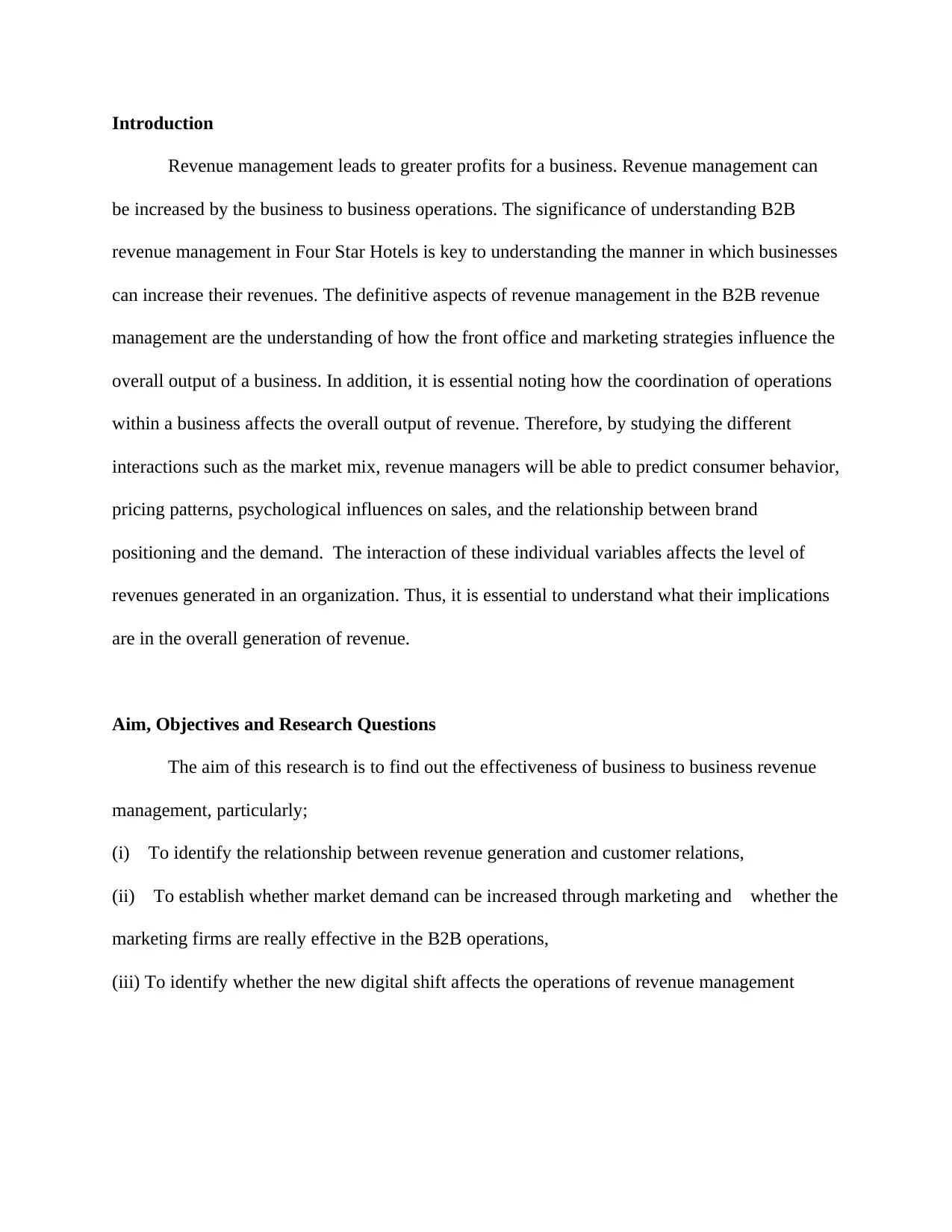
Introduction
Revenue management leads to greater profits for a business. Revenue management can
be increased by the business to business operations. The significance of understanding B2B
revenue management in Four Star Hotels is key to understanding the manner in which businesses
can increase their revenues. The definitive aspects of revenue management in the B2B revenue
management are the understanding of how the front office and marketing strategies influence the
overall output of a business. In addition, it is essential noting how the coordination of operations
within a business affects the overall output of revenue. Therefore, by studying the different
interactions such as the market mix, revenue managers will be able to predict consumer behavior,
pricing patterns, psychological influences on sales, and the relationship between brand
positioning and the demand. The interaction of these individual variables affects the level of
revenues generated in an organization. Thus, it is essential to understand what their implications
are in the overall generation of revenue.
Aim, Objectives and Research Questions
The aim of this research is to find out the effectiveness of business to business revenue
management, particularly;
(i) To identify the relationship between revenue generation and customer relations,
(ii) To establish whether market demand can be increased through marketing and whether the
marketing firms are really effective in the B2B operations,
(iii) To identify whether the new digital shift affects the operations of revenue management
Revenue management leads to greater profits for a business. Revenue management can
be increased by the business to business operations. The significance of understanding B2B
revenue management in Four Star Hotels is key to understanding the manner in which businesses
can increase their revenues. The definitive aspects of revenue management in the B2B revenue
management are the understanding of how the front office and marketing strategies influence the
overall output of a business. In addition, it is essential noting how the coordination of operations
within a business affects the overall output of revenue. Therefore, by studying the different
interactions such as the market mix, revenue managers will be able to predict consumer behavior,
pricing patterns, psychological influences on sales, and the relationship between brand
positioning and the demand. The interaction of these individual variables affects the level of
revenues generated in an organization. Thus, it is essential to understand what their implications
are in the overall generation of revenue.
Aim, Objectives and Research Questions
The aim of this research is to find out the effectiveness of business to business revenue
management, particularly;
(i) To identify the relationship between revenue generation and customer relations,
(ii) To establish whether market demand can be increased through marketing and whether the
marketing firms are really effective in the B2B operations,
(iii) To identify whether the new digital shift affects the operations of revenue management

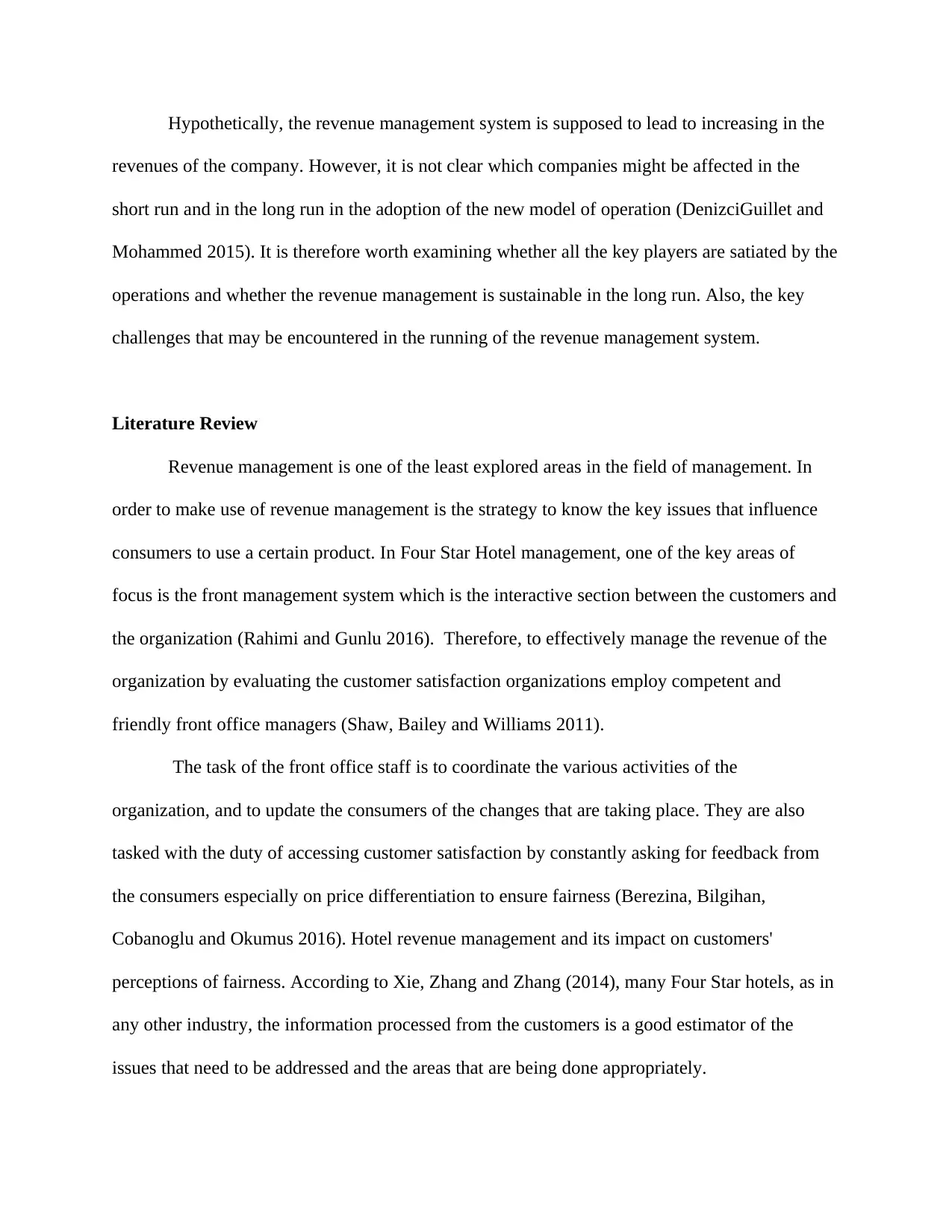
Hypothetically, the revenue management system is supposed to lead to increasing in the
revenues of the company. However, it is not clear which companies might be affected in the
short run and in the long run in the adoption of the new model of operation (DenizciGuillet and
Mohammed 2015). It is therefore worth examining whether all the key players are satiated by the
operations and whether the revenue management is sustainable in the long run. Also, the key
challenges that may be encountered in the running of the revenue management system.
Literature Review
Revenue management is one of the least explored areas in the field of management. In
order to make use of revenue management is the strategy to know the key issues that influence
consumers to use a certain product. In Four Star Hotel management, one of the key areas of
focus is the front management system which is the interactive section between the customers and
the organization (Rahimi and Gunlu 2016). Therefore, to effectively manage the revenue of the
organization by evaluating the customer satisfaction organizations employ competent and
friendly front office managers (Shaw, Bailey and Williams 2011).
The task of the front office staff is to coordinate the various activities of the
organization, and to update the consumers of the changes that are taking place. They are also
tasked with the duty of accessing customer satisfaction by constantly asking for feedback from
the consumers especially on price differentiation to ensure fairness (Berezina, Bilgihan,
Cobanoglu and Okumus 2016). Hotel revenue management and its impact on customers'
perceptions of fairness. According to Xie, Zhang and Zhang (2014), many Four Star hotels, as in
any other industry, the information processed from the customers is a good estimator of the
issues that need to be addressed and the areas that are being done appropriately.
revenues of the company. However, it is not clear which companies might be affected in the
short run and in the long run in the adoption of the new model of operation (DenizciGuillet and
Mohammed 2015). It is therefore worth examining whether all the key players are satiated by the
operations and whether the revenue management is sustainable in the long run. Also, the key
challenges that may be encountered in the running of the revenue management system.
Literature Review
Revenue management is one of the least explored areas in the field of management. In
order to make use of revenue management is the strategy to know the key issues that influence
consumers to use a certain product. In Four Star Hotel management, one of the key areas of
focus is the front management system which is the interactive section between the customers and
the organization (Rahimi and Gunlu 2016). Therefore, to effectively manage the revenue of the
organization by evaluating the customer satisfaction organizations employ competent and
friendly front office managers (Shaw, Bailey and Williams 2011).
The task of the front office staff is to coordinate the various activities of the
organization, and to update the consumers of the changes that are taking place. They are also
tasked with the duty of accessing customer satisfaction by constantly asking for feedback from
the consumers especially on price differentiation to ensure fairness (Berezina, Bilgihan,
Cobanoglu and Okumus 2016). Hotel revenue management and its impact on customers'
perceptions of fairness. According to Xie, Zhang and Zhang (2014), many Four Star hotels, as in
any other industry, the information processed from the customers is a good estimator of the
issues that need to be addressed and the areas that are being done appropriately.
⊘ This is a preview!⊘
Do you want full access?
Subscribe today to unlock all pages.

Trusted by 1+ million students worldwide

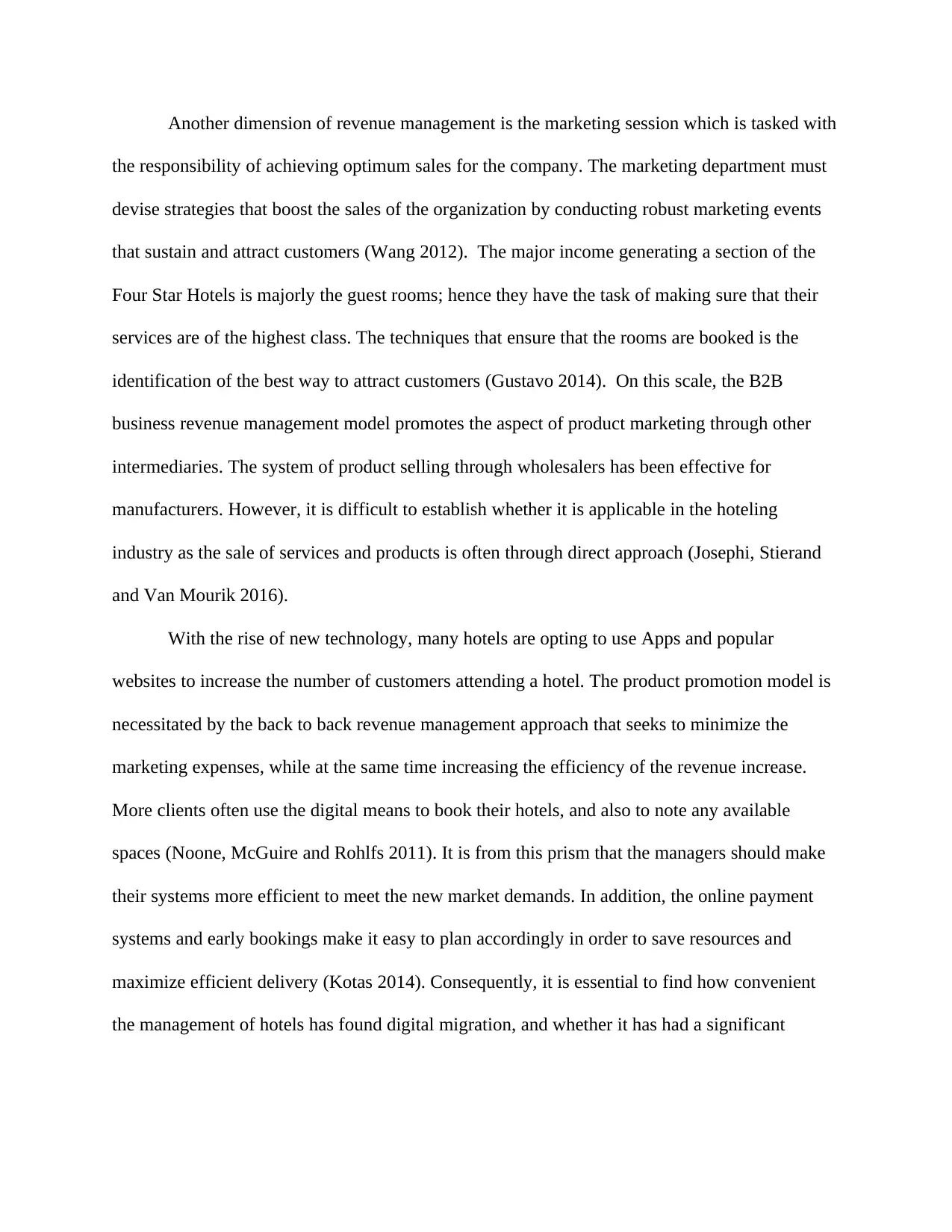
Another dimension of revenue management is the marketing session which is tasked with
the responsibility of achieving optimum sales for the company. The marketing department must
devise strategies that boost the sales of the organization by conducting robust marketing events
that sustain and attract customers (Wang 2012). The major income generating a section of the
Four Star Hotels is majorly the guest rooms; hence they have the task of making sure that their
services are of the highest class. The techniques that ensure that the rooms are booked is the
identification of the best way to attract customers (Gustavo 2014). On this scale, the B2B
business revenue management model promotes the aspect of product marketing through other
intermediaries. The system of product selling through wholesalers has been effective for
manufacturers. However, it is difficult to establish whether it is applicable in the hoteling
industry as the sale of services and products is often through direct approach (Josephi, Stierand
and Van Mourik 2016).
With the rise of new technology, many hotels are opting to use Apps and popular
websites to increase the number of customers attending a hotel. The product promotion model is
necessitated by the back to back revenue management approach that seeks to minimize the
marketing expenses, while at the same time increasing the efficiency of the revenue increase.
More clients often use the digital means to book their hotels, and also to note any available
spaces (Noone, McGuire and Rohlfs 2011). It is from this prism that the managers should make
their systems more efficient to meet the new market demands. In addition, the online payment
systems and early bookings make it easy to plan accordingly in order to save resources and
maximize efficient delivery (Kotas 2014). Consequently, it is essential to find how convenient
the management of hotels has found digital migration, and whether it has had a significant
the responsibility of achieving optimum sales for the company. The marketing department must
devise strategies that boost the sales of the organization by conducting robust marketing events
that sustain and attract customers (Wang 2012). The major income generating a section of the
Four Star Hotels is majorly the guest rooms; hence they have the task of making sure that their
services are of the highest class. The techniques that ensure that the rooms are booked is the
identification of the best way to attract customers (Gustavo 2014). On this scale, the B2B
business revenue management model promotes the aspect of product marketing through other
intermediaries. The system of product selling through wholesalers has been effective for
manufacturers. However, it is difficult to establish whether it is applicable in the hoteling
industry as the sale of services and products is often through direct approach (Josephi, Stierand
and Van Mourik 2016).
With the rise of new technology, many hotels are opting to use Apps and popular
websites to increase the number of customers attending a hotel. The product promotion model is
necessitated by the back to back revenue management approach that seeks to minimize the
marketing expenses, while at the same time increasing the efficiency of the revenue increase.
More clients often use the digital means to book their hotels, and also to note any available
spaces (Noone, McGuire and Rohlfs 2011). It is from this prism that the managers should make
their systems more efficient to meet the new market demands. In addition, the online payment
systems and early bookings make it easy to plan accordingly in order to save resources and
maximize efficient delivery (Kotas 2014). Consequently, it is essential to find how convenient
the management of hotels has found digital migration, and whether it has had a significant
Paraphrase This Document
Need a fresh take? Get an instant paraphrase of this document with our AI Paraphraser

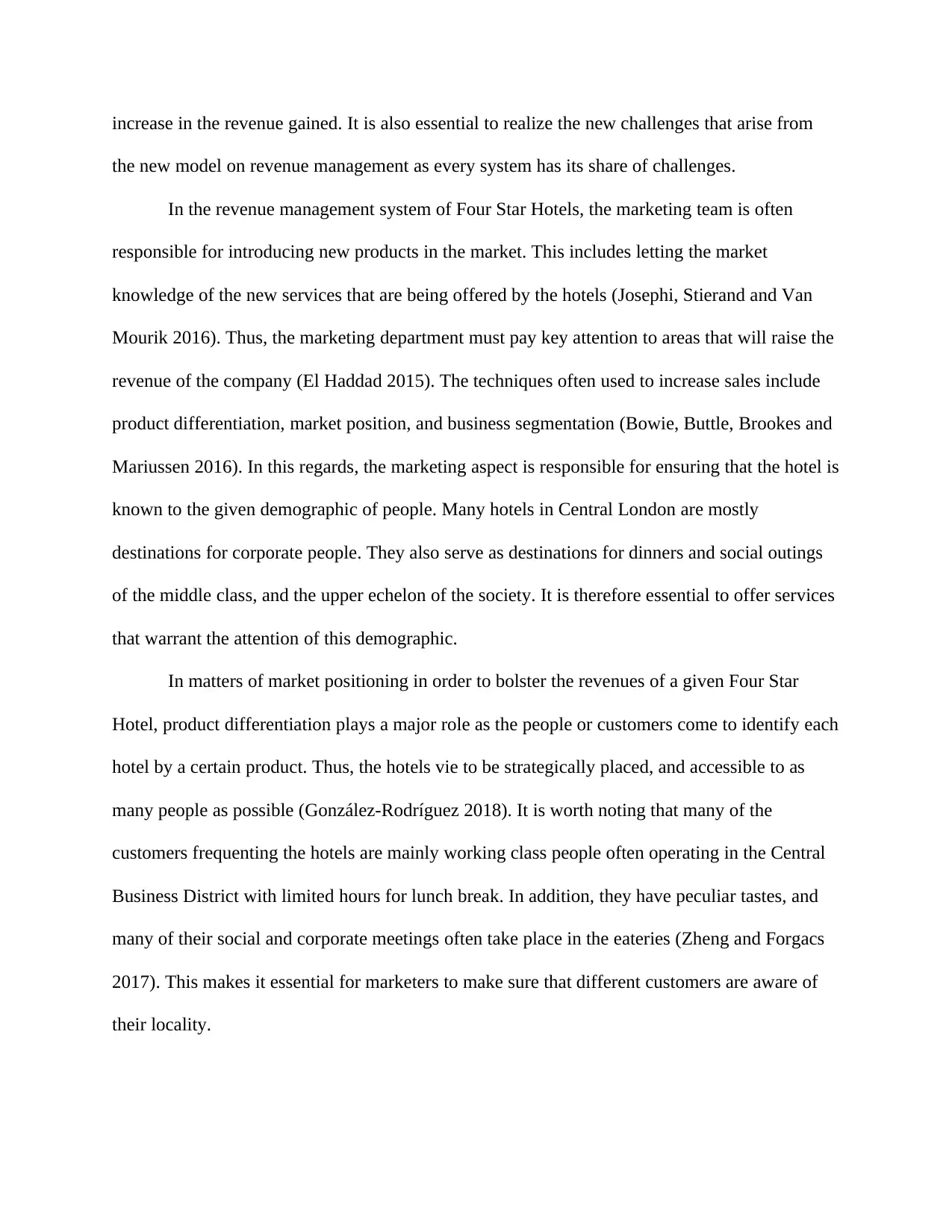
increase in the revenue gained. It is also essential to realize the new challenges that arise from
the new model on revenue management as every system has its share of challenges.
In the revenue management system of Four Star Hotels, the marketing team is often
responsible for introducing new products in the market. This includes letting the market
knowledge of the new services that are being offered by the hotels (Josephi, Stierand and Van
Mourik 2016). Thus, the marketing department must pay key attention to areas that will raise the
revenue of the company (El Haddad 2015). The techniques often used to increase sales include
product differentiation, market position, and business segmentation (Bowie, Buttle, Brookes and
Mariussen 2016). In this regards, the marketing aspect is responsible for ensuring that the hotel is
known to the given demographic of people. Many hotels in Central London are mostly
destinations for corporate people. They also serve as destinations for dinners and social outings
of the middle class, and the upper echelon of the society. It is therefore essential to offer services
that warrant the attention of this demographic.
In matters of market positioning in order to bolster the revenues of a given Four Star
Hotel, product differentiation plays a major role as the people or customers come to identify each
hotel by a certain product. Thus, the hotels vie to be strategically placed, and accessible to as
many people as possible (González-Rodríguez 2018). It is worth noting that many of the
customers frequenting the hotels are mainly working class people often operating in the Central
Business District with limited hours for lunch break. In addition, they have peculiar tastes, and
many of their social and corporate meetings often take place in the eateries (Zheng and Forgacs
2017). This makes it essential for marketers to make sure that different customers are aware of
their locality.
the new model on revenue management as every system has its share of challenges.
In the revenue management system of Four Star Hotels, the marketing team is often
responsible for introducing new products in the market. This includes letting the market
knowledge of the new services that are being offered by the hotels (Josephi, Stierand and Van
Mourik 2016). Thus, the marketing department must pay key attention to areas that will raise the
revenue of the company (El Haddad 2015). The techniques often used to increase sales include
product differentiation, market position, and business segmentation (Bowie, Buttle, Brookes and
Mariussen 2016). In this regards, the marketing aspect is responsible for ensuring that the hotel is
known to the given demographic of people. Many hotels in Central London are mostly
destinations for corporate people. They also serve as destinations for dinners and social outings
of the middle class, and the upper echelon of the society. It is therefore essential to offer services
that warrant the attention of this demographic.
In matters of market positioning in order to bolster the revenues of a given Four Star
Hotel, product differentiation plays a major role as the people or customers come to identify each
hotel by a certain product. Thus, the hotels vie to be strategically placed, and accessible to as
many people as possible (González-Rodríguez 2018). It is worth noting that many of the
customers frequenting the hotels are mainly working class people often operating in the Central
Business District with limited hours for lunch break. In addition, they have peculiar tastes, and
many of their social and corporate meetings often take place in the eateries (Zheng and Forgacs
2017). This makes it essential for marketers to make sure that different customers are aware of
their locality.

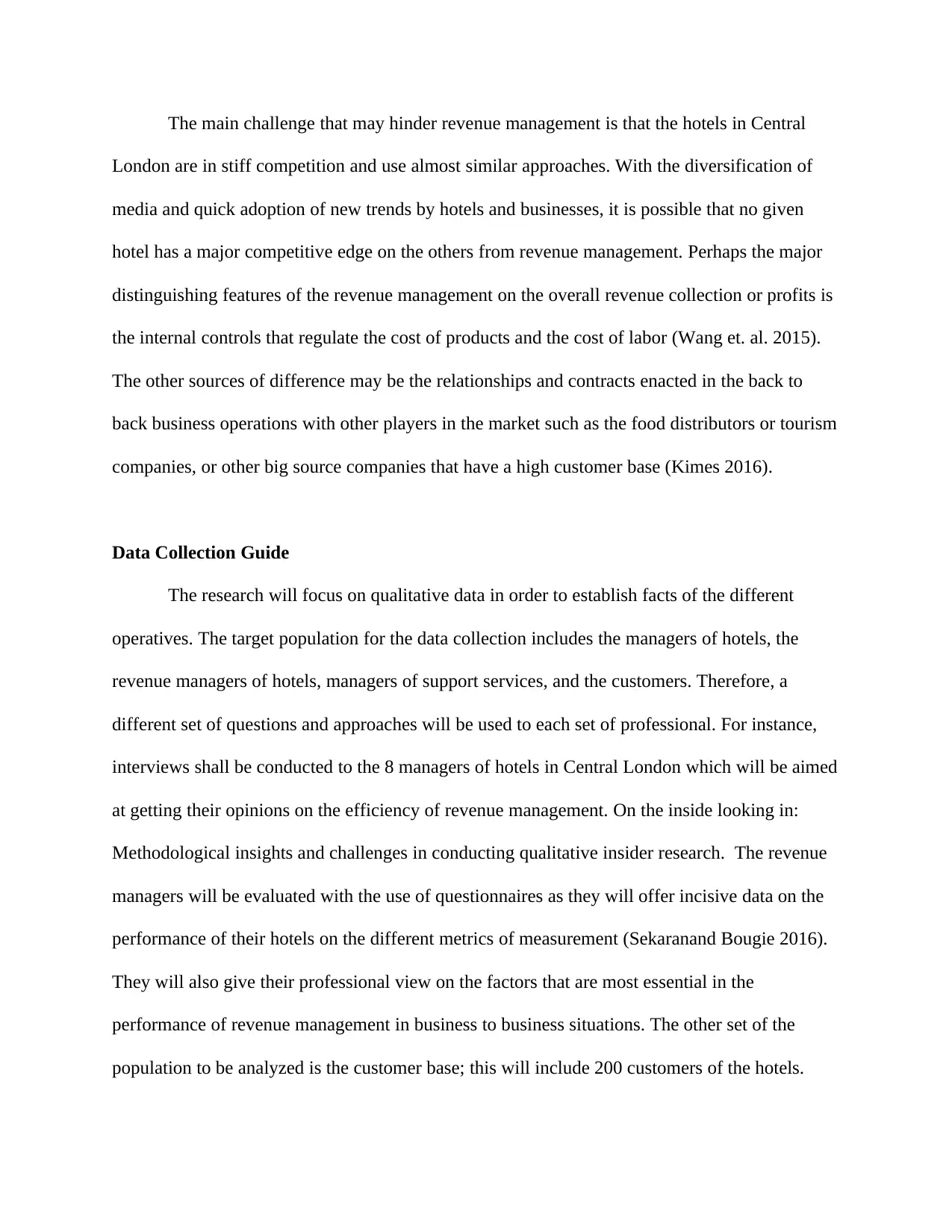
The main challenge that may hinder revenue management is that the hotels in Central
London are in stiff competition and use almost similar approaches. With the diversification of
media and quick adoption of new trends by hotels and businesses, it is possible that no given
hotel has a major competitive edge on the others from revenue management. Perhaps the major
distinguishing features of the revenue management on the overall revenue collection or profits is
the internal controls that regulate the cost of products and the cost of labor (Wang et. al. 2015).
The other sources of difference may be the relationships and contracts enacted in the back to
back business operations with other players in the market such as the food distributors or tourism
companies, or other big source companies that have a high customer base (Kimes 2016).
Data Collection Guide
The research will focus on qualitative data in order to establish facts of the different
operatives. The target population for the data collection includes the managers of hotels, the
revenue managers of hotels, managers of support services, and the customers. Therefore, a
different set of questions and approaches will be used to each set of professional. For instance,
interviews shall be conducted to the 8 managers of hotels in Central London which will be aimed
at getting their opinions on the efficiency of revenue management. On the inside looking in:
Methodological insights and challenges in conducting qualitative insider research. The revenue
managers will be evaluated with the use of questionnaires as they will offer incisive data on the
performance of their hotels on the different metrics of measurement (Sekaranand Bougie 2016).
They will also give their professional view on the factors that are most essential in the
performance of revenue management in business to business situations. The other set of the
population to be analyzed is the customer base; this will include 200 customers of the hotels.
London are in stiff competition and use almost similar approaches. With the diversification of
media and quick adoption of new trends by hotels and businesses, it is possible that no given
hotel has a major competitive edge on the others from revenue management. Perhaps the major
distinguishing features of the revenue management on the overall revenue collection or profits is
the internal controls that regulate the cost of products and the cost of labor (Wang et. al. 2015).
The other sources of difference may be the relationships and contracts enacted in the back to
back business operations with other players in the market such as the food distributors or tourism
companies, or other big source companies that have a high customer base (Kimes 2016).
Data Collection Guide
The research will focus on qualitative data in order to establish facts of the different
operatives. The target population for the data collection includes the managers of hotels, the
revenue managers of hotels, managers of support services, and the customers. Therefore, a
different set of questions and approaches will be used to each set of professional. For instance,
interviews shall be conducted to the 8 managers of hotels in Central London which will be aimed
at getting their opinions on the efficiency of revenue management. On the inside looking in:
Methodological insights and challenges in conducting qualitative insider research. The revenue
managers will be evaluated with the use of questionnaires as they will offer incisive data on the
performance of their hotels on the different metrics of measurement (Sekaranand Bougie 2016).
They will also give their professional view on the factors that are most essential in the
performance of revenue management in business to business situations. The other set of the
population to be analyzed is the customer base; this will include 200 customers of the hotels.
⊘ This is a preview!⊘
Do you want full access?
Subscribe today to unlock all pages.

Trusted by 1+ million students worldwide

When conducting the data collection on customers’ random sampling will be used to ensure that
there is no bias in the data collection (Pannucci and Wilkins 2010). The large set of data
collection on the customers is aimed at increasing the degree of accuracy of the information
offered.
Some of the challenges that may be faced in data collection are that some of the managers
might not be willing to share the sensitive information about their operations. This can be
overcome by assuring the managers that the data will be used for the research purposes and that
anonymity.
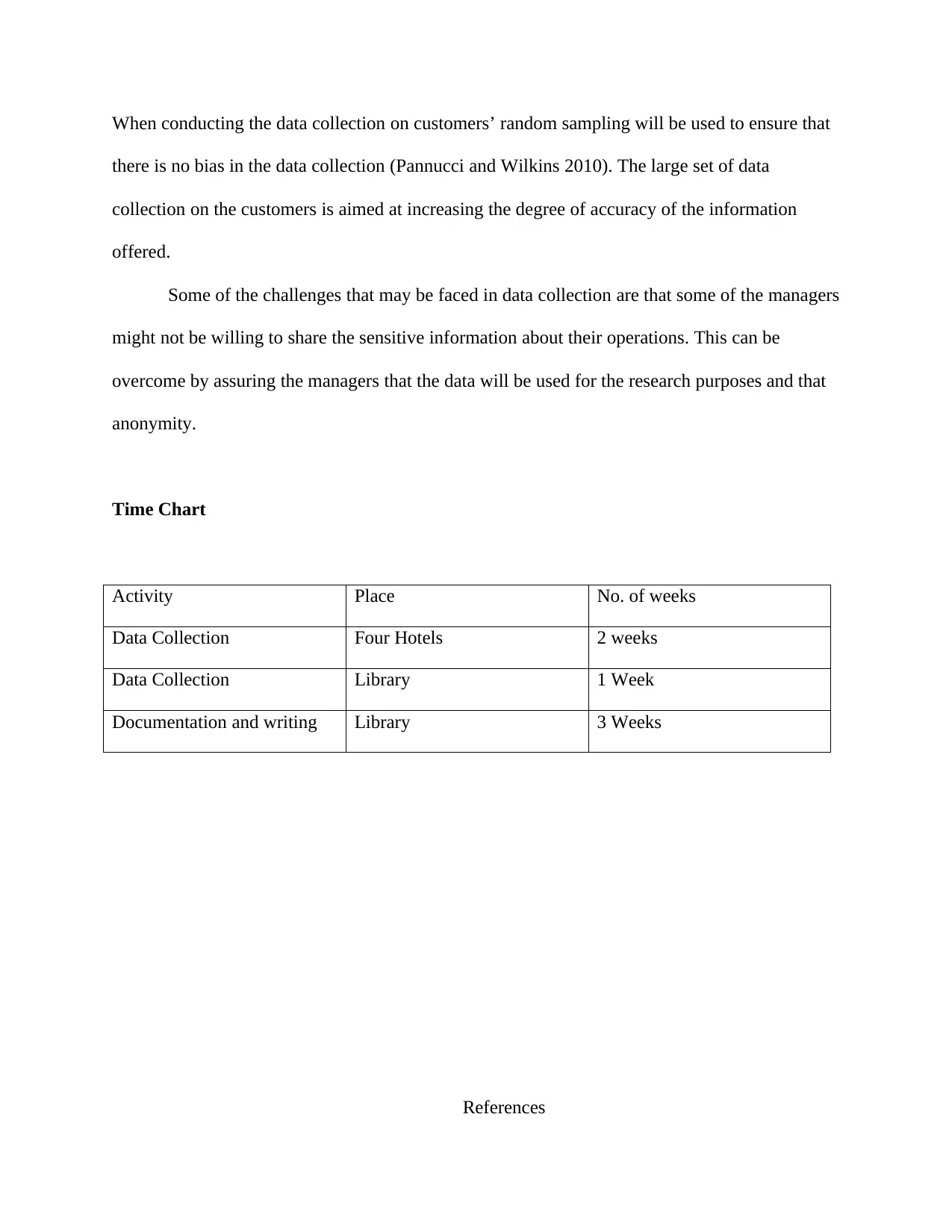
Time Chart
Activity Place No. of weeks
Data Collection Four Hotels 2 weeks
Data Collection Library 1 Week
Documentation and writing Library 3 Weeks
References
there is no bias in the data collection (Pannucci and Wilkins 2010). The large set of data
collection on the customers is aimed at increasing the degree of accuracy of the information
offered.
Some of the challenges that may be faced in data collection are that some of the managers
might not be willing to share the sensitive information about their operations. This can be
overcome by assuring the managers that the data will be used for the research purposes and that
anonymity.
Time Chart
Activity Place No. of weeks
Data Collection Four Hotels 2 weeks
Data Collection Library 1 Week
Documentation and writing Library 3 Weeks
References
Paraphrase This Document
Need a fresh take? Get an instant paraphrase of this document with our AI Paraphraser

Berezina, K., Bilgihan, A., Cobanoglu, C. and Okumus, F., 2016. Understanding satisfied and
dissatisfied hotel customers: text mining of online hotel reviews. Journal of Hospitality
Marketing & Management, 25(1), pp.1-24.
Bowie, D., Buttle, F., Brookes, M. and Mariussen, A., 2016. Hospitality marketing. Routledge.
DenizciGuillet, B., and Mohammed, I., 2015. Revenue management research in hospitality and
tourism: A critical review of current literature and suggestions for future research. International
Journal of Contemporary Hospitality Management, 27(4), 526-560.
El Haddad, R., 2015. Exploration of revenue management practices–case of an upscale budget
hotel chain. International Journal of Contemporary Hospitality Management, 27(8), pp.1791-
1813.
González-Rodríguez, M. R., Jiménez-Caballero, J. L., Martín-Samper, R. C., Köseoglu, M. A.,
and Okumus, F., 2018. Revisiting the link between business strategy and performance: Evidence
from hotels. International Journal of Hospitality Management, 72, 21-31.
Gustavo, N., 2013. Marketing management trends in tourism and hospitality industry: facing the
21st century environment. International Journal of Marketing Studies, 5(3), 13.
Hair Jr, J. F., Wolfinbarger, M., Money, A. H., Samouel, P., and Page, M. J., 2015. Essentials of
business research methods. Routledge.
Jones, P., Hillier, D. and Comfort, D., 2016. Sustainability in the hospitality industry: Some
personal reflections on corporate challenges and research agendas. International Journal of
Contemporary Hospitality Management, 28(1), pp.36-67.
Josephi, S.H., Stierand, M.B. and Van Mourik, A., 2016. Hotel revenue management: Then, now
and tomorrow. Journal of revenue and pricing management, 15(3-4), pp.252-257.
dissatisfied hotel customers: text mining of online hotel reviews. Journal of Hospitality
Marketing & Management, 25(1), pp.1-24.
Bowie, D., Buttle, F., Brookes, M. and Mariussen, A., 2016. Hospitality marketing. Routledge.
DenizciGuillet, B., and Mohammed, I., 2015. Revenue management research in hospitality and
tourism: A critical review of current literature and suggestions for future research. International
Journal of Contemporary Hospitality Management, 27(4), 526-560.
El Haddad, R., 2015. Exploration of revenue management practices–case of an upscale budget
hotel chain. International Journal of Contemporary Hospitality Management, 27(8), pp.1791-
1813.
González-Rodríguez, M. R., Jiménez-Caballero, J. L., Martín-Samper, R. C., Köseoglu, M. A.,
and Okumus, F., 2018. Revisiting the link between business strategy and performance: Evidence
from hotels. International Journal of Hospitality Management, 72, 21-31.
Gustavo, N., 2013. Marketing management trends in tourism and hospitality industry: facing the
21st century environment. International Journal of Marketing Studies, 5(3), 13.
Hair Jr, J. F., Wolfinbarger, M., Money, A. H., Samouel, P., and Page, M. J., 2015. Essentials of
business research methods. Routledge.
Jones, P., Hillier, D. and Comfort, D., 2016. Sustainability in the hospitality industry: Some
personal reflections on corporate challenges and research agendas. International Journal of
Contemporary Hospitality Management, 28(1), pp.36-67.
Josephi, S.H., Stierand, M.B. and Van Mourik, A., 2016. Hotel revenue management: Then, now
and tomorrow. Journal of revenue and pricing management, 15(3-4), pp.252-257.

Kimes, S.E., 2016. The evolution of hotel revenue management. Journal of Revenue and Pricing
Management, 15(3-4), pp.247-251.
Kotas, R., 2014. Management accounting for hotels and restaurants. Routledge.
Noone, B. M., McGuire, K. A., and Rohlfs, K. V., 2011. Social media meets hotel revenue
management: Opportunities, issues and unanswered questions. Journal of Revenue and Pricing
Management, 10(4), 293-305.
Pannucci, C. J., and Wilkins, E. G., 2010. Identifying and avoiding bias in research. Plastic and
reconstructive surgery, 126(2), 619.
Rahimi, R. and Gunlu, E., 2016. Implementing customer relationship management (CRM) in
hotel industry from organizational culture perspective: case of a chain hotel in the
UK. International Journal of Contemporary Hospitality Management, 28(1), pp.89-112.
Sekaran, U. and Bougie, R., 2016. Research methods for business: A skill building approach.
John Wiley & Sons.
Shaw, G., Bailey, A., and Williams, A., 2011. Aspects of service-dominant logic and its
implications for tourism management: Examples from the hotel industry. Tourism
management, 32(2), 207-214.
Wang, X. L., 2012. Relationship or revenue: Potential management conflicts between customer
relationship management and hotel revenue management. International Journal of Hospitality
Management, 31(3), 864-874.
Wang, X.L., Yoonjoung Heo, C., Schwartz, Z., Legohérel, P. and Specklin, F., 2015. Revenue
management: Progress, challenges, and research prospects. Journal of Travel & Tourism
Marketing, 32(7), pp.797-811.
Management, 15(3-4), pp.247-251.
Kotas, R., 2014. Management accounting for hotels and restaurants. Routledge.
Noone, B. M., McGuire, K. A., and Rohlfs, K. V., 2011. Social media meets hotel revenue
management: Opportunities, issues and unanswered questions. Journal of Revenue and Pricing
Management, 10(4), 293-305.
Pannucci, C. J., and Wilkins, E. G., 2010. Identifying and avoiding bias in research. Plastic and
reconstructive surgery, 126(2), 619.
Rahimi, R. and Gunlu, E., 2016. Implementing customer relationship management (CRM) in
hotel industry from organizational culture perspective: case of a chain hotel in the
UK. International Journal of Contemporary Hospitality Management, 28(1), pp.89-112.
Sekaran, U. and Bougie, R., 2016. Research methods for business: A skill building approach.
John Wiley & Sons.
Shaw, G., Bailey, A., and Williams, A., 2011. Aspects of service-dominant logic and its
implications for tourism management: Examples from the hotel industry. Tourism
management, 32(2), 207-214.
Wang, X. L., 2012. Relationship or revenue: Potential management conflicts between customer
relationship management and hotel revenue management. International Journal of Hospitality
Management, 31(3), 864-874.
Wang, X.L., Yoonjoung Heo, C., Schwartz, Z., Legohérel, P. and Specklin, F., 2015. Revenue
management: Progress, challenges, and research prospects. Journal of Travel & Tourism
Marketing, 32(7), pp.797-811.
⊘ This is a preview!⊘
Do you want full access?
Subscribe today to unlock all pages.

Trusted by 1+ million students worldwide

Xie, K. L., Zhang, Z., and Zhang, Z., 2014. The business value of online consumer reviews and
management response to hotel performance. International Journal of Hospitality
Management, 43, 1-12.
Zheng, C. and Forgacs, G., 2017. The emerging trend of hotel total revenue
management. Journal of Revenue and Pricing Management, 16(3), pp.238-245.
management response to hotel performance. International Journal of Hospitality
Management, 43, 1-12.
Zheng, C. and Forgacs, G., 2017. The emerging trend of hotel total revenue
management. Journal of Revenue and Pricing Management, 16(3), pp.238-245.
1 out of 10
Related Documents
Your All-in-One AI-Powered Toolkit for Academic Success.
+13062052269
info@desklib.com
Available 24*7 on WhatsApp / Email
Unlock your academic potential
Copyright © 2020–2026 A2Z Services. All Rights Reserved. Developed and managed by ZUCOL.