MITS5002 - Software Engineering: Risk Assessment using Analysis
VerifiedAdded on 2024/06/21
|12
|2040
|488
Report
AI Summary
This report provides a critical review of a paper focusing on risk assessment in software development using Fishbone analysis. It identifies various risks such as schedule, budget, technical, and policies risks, explaining their impact on software security and development. The report discusses the application of Fishbone analysis for identifying and addressing the root causes of these risks, along with a questionnaire used for risk assessment. Qualitative and quantitative risk assessment methods are also examined, providing a comprehensive overview of the paper's approach to managing risks in the software development lifecycle. The review offers alternative perspectives and suggestions for improvement, highlighting the importance of proactive risk management in ensuring software quality and security. Desklib offers a wealth of similar documents and study resources for students.
MITS5002 SOFTWARE ENGINEERING
METHODOLOGY
ASSIGNMENT 2
Paper: Risk Assessment on Software Development using Fishbone Analysis by
Muhammad Talha Riaz, Muhammad Shah Jahan, Khawaja Sarmad Arif and Wasi
Haider Butt
1
Student Name and ID
METHODOLOGY
ASSIGNMENT 2
Paper: Risk Assessment on Software Development using Fishbone Analysis by
Muhammad Talha Riaz, Muhammad Shah Jahan, Khawaja Sarmad Arif and Wasi
Haider Butt
1
Student Name and ID

Paraphrase This Document
Need a fresh take? Get an instant paraphrase of this document with our AI Paraphraser
Table of Contents
Table of Figures...............................................................................................................................2
Introduction......................................................................................................................................3
Software Development Risk:...........................................................................................................4
Schedule Risk:.............................................................................................................................4
Budget Risk:................................................................................................................................4
Technical Risk:............................................................................................................................4
Policies Risk:...............................................................................................................................4
Fishbone Analysis:...........................................................................................................................5
Questionnaire:..................................................................................................................................6
Risk Identification:..........................................................................................................................8
Risk Assessment:.............................................................................................................................9
Qualitative Risk Assessment:......................................................................................................9
Quantitative Risk Assessment:....................................................................................................9
Conclusion:....................................................................................................................................11
References:....................................................................................................................................12
Table of Figures
Figure 1 Fishbone Diagram.............................................................................................................5
Figure 2 Changes in Schedule.........................................................................................................6
Figure 3 Root cause of Scheduled Risk...........................................................................................7
Figure 4 Changes in Budget............................................................................................................7
Figure 5 Root cause of Budget Risk................................................................................................7
Figure 6 Fishbone Analysis of Risk.................................................................................................8
Figure 7 Qualitative Risk Assessment Table...................................................................................9
Figure 8 Quantitative Risk Assessment Table...............................................................................10
2
Student Name and ID
Table of Figures...............................................................................................................................2
Introduction......................................................................................................................................3
Software Development Risk:...........................................................................................................4
Schedule Risk:.............................................................................................................................4
Budget Risk:................................................................................................................................4
Technical Risk:............................................................................................................................4
Policies Risk:...............................................................................................................................4
Fishbone Analysis:...........................................................................................................................5
Questionnaire:..................................................................................................................................6
Risk Identification:..........................................................................................................................8
Risk Assessment:.............................................................................................................................9
Qualitative Risk Assessment:......................................................................................................9
Quantitative Risk Assessment:....................................................................................................9
Conclusion:....................................................................................................................................11
References:....................................................................................................................................12
Table of Figures
Figure 1 Fishbone Diagram.............................................................................................................5
Figure 2 Changes in Schedule.........................................................................................................6
Figure 3 Root cause of Scheduled Risk...........................................................................................7
Figure 4 Changes in Budget............................................................................................................7
Figure 5 Root cause of Budget Risk................................................................................................7
Figure 6 Fishbone Analysis of Risk.................................................................................................8
Figure 7 Qualitative Risk Assessment Table...................................................................................9
Figure 8 Quantitative Risk Assessment Table...............................................................................10
2
Student Name and ID
Introduction
The report is based on a risk assessment at the time of software development. The time of
software development issues is accrued and produce the complexity of the software and reduce
security. The given paper is based on the development risk of the software which can cause
security issues and thread impact on the software. This report explains the risk caused during the
time of development and their solutions. This report contains information about identifying,
classifying the risk based on the author's review. This report is based on the paper review of the
software development risk assessment. The report contains a critical review of the given paper
about all the views of the author about the given topic. This report contains a different review
about the same paper which shows its property of examination by the reviews of the critic and
analysis of the concept.
3
Student Name and ID
The report is based on a risk assessment at the time of software development. The time of
software development issues is accrued and produce the complexity of the software and reduce
security. The given paper is based on the development risk of the software which can cause
security issues and thread impact on the software. This report explains the risk caused during the
time of development and their solutions. This report contains information about identifying,
classifying the risk based on the author's review. This report is based on the paper review of the
software development risk assessment. The report contains a critical review of the given paper
about all the views of the author about the given topic. This report contains a different review
about the same paper which shows its property of examination by the reviews of the critic and
analysis of the concept.
3
Student Name and ID
⊘ This is a preview!⊘
Do you want full access?
Subscribe today to unlock all pages.

Trusted by 1+ million students worldwide
Software Development Risk:
The software development risk is made at the time of programming the software and improve its
function. The software development life cycle is used for creating the structure of the software
with every phase and step which includes the security of the software and analysis. The paper
contains the following risks:
Schedule Risk:
This risk is accrued because of the time limit which leads the project behind the schedule. There
are many schedule risks such as time estimation, project complexity, and project scope. These
risks are made the scheduling process slow or down.
Budget Risk:
The budget risk is related to the cost estimation of the software which causes many problems like
budget estimation, cost overrun, and project extinction. These risks are cause some issues related
to the cost of the system that increases the utilization of resources.
Technical Risk:
Technical risk occurs during the programming of the software. This risk can affect the
performance of the software and cause a lack of security. Technical risks are made when the
requirements are changed or lack of technology.
Policies Risk:
The policy's risk is based on government policies and changing customer requirements. These
are the policies based on risk and cannot be avoidable.
In my opinion, the given information about the “Software Development Risk ” by the author is
completely correct and useful. All the risks are explained properly and actual. These are some
more risk can be discussed in the paper which shows the deep information about the risk in
software development. The given information about the task is actual and made full science to
analyze the developments properly. The correction needed in the paper is that the policies based
risk can be avoidable if all the requirements should be fulfilled don that particular period.
4
Student Name and ID
The software development risk is made at the time of programming the software and improve its
function. The software development life cycle is used for creating the structure of the software
with every phase and step which includes the security of the software and analysis. The paper
contains the following risks:
Schedule Risk:
This risk is accrued because of the time limit which leads the project behind the schedule. There
are many schedule risks such as time estimation, project complexity, and project scope. These
risks are made the scheduling process slow or down.
Budget Risk:
The budget risk is related to the cost estimation of the software which causes many problems like
budget estimation, cost overrun, and project extinction. These risks are cause some issues related
to the cost of the system that increases the utilization of resources.
Technical Risk:
Technical risk occurs during the programming of the software. This risk can affect the
performance of the software and cause a lack of security. Technical risks are made when the
requirements are changed or lack of technology.
Policies Risk:
The policy's risk is based on government policies and changing customer requirements. These
are the policies based on risk and cannot be avoidable.
In my opinion, the given information about the “Software Development Risk ” by the author is
completely correct and useful. All the risks are explained properly and actual. These are some
more risk can be discussed in the paper which shows the deep information about the risk in
software development. The given information about the task is actual and made full science to
analyze the developments properly. The correction needed in the paper is that the policies based
risk can be avoidable if all the requirements should be fulfilled don that particular period.
4
Student Name and ID
Paraphrase This Document
Need a fresh take? Get an instant paraphrase of this document with our AI Paraphraser
Fishbone Analysis:
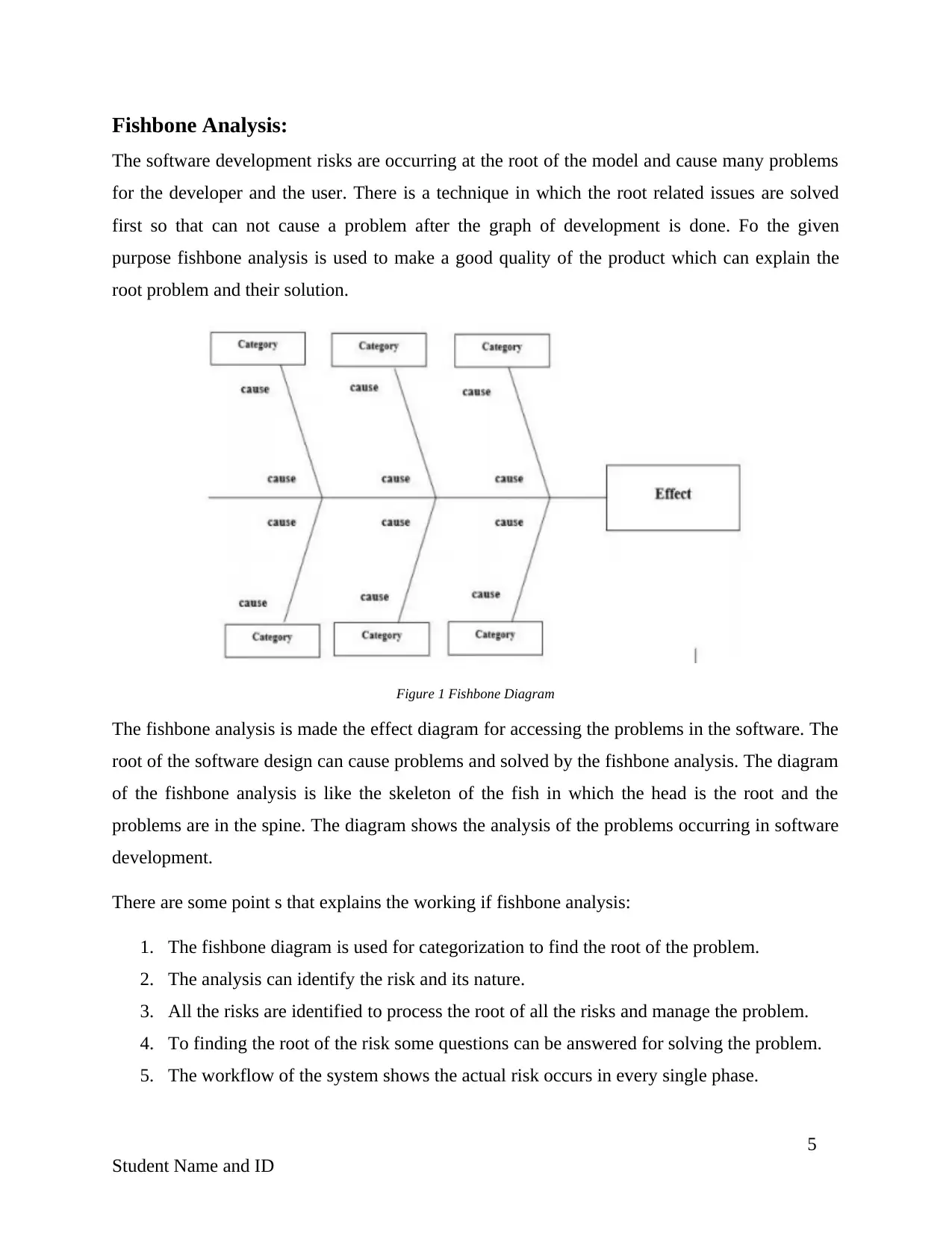
The software development risks are occurring at the root of the model and cause many problems
for the developer and the user. There is a technique in which the root related issues are solved
first so that can not cause a problem after the graph of development is done. Fo the given
purpose fishbone analysis is used to make a good quality of the product which can explain the
root problem and their solution.
Figure 1 Fishbone Diagram
The fishbone analysis is made the effect diagram for accessing the problems in the software. The
root of the software design can cause problems and solved by the fishbone analysis. The diagram
of the fishbone analysis is like the skeleton of the fish in which the head is the root and the
problems are in the spine. The diagram shows the analysis of the problems occurring in software
development.
There are some point s that explains the working if fishbone analysis:
1. The fishbone diagram is used for categorization to find the root of the problem.
2. The analysis can identify the risk and its nature.
3. All the risks are identified to process the root of all the risks and manage the problem.
4. To finding the root of the risk some questions can be answered for solving the problem.
5. The workflow of the system shows the actual risk occurs in every single phase.
5
Student Name and ID
The software development risks are occurring at the root of the model and cause many problems
for the developer and the user. There is a technique in which the root related issues are solved
first so that can not cause a problem after the graph of development is done. Fo the given
purpose fishbone analysis is used to make a good quality of the product which can explain the
root problem and their solution.
Figure 1 Fishbone Diagram
The fishbone analysis is made the effect diagram for accessing the problems in the software. The
root of the software design can cause problems and solved by the fishbone analysis. The diagram
of the fishbone analysis is like the skeleton of the fish in which the head is the root and the
problems are in the spine. The diagram shows the analysis of the problems occurring in software
development.
There are some point s that explains the working if fishbone analysis:
1. The fishbone diagram is used for categorization to find the root of the problem.
2. The analysis can identify the risk and its nature.
3. All the risks are identified to process the root of all the risks and manage the problem.
4. To finding the root of the risk some questions can be answered for solving the problem.
5. The workflow of the system shows the actual risk occurs in every single phase.
5
Student Name and ID
In my opinion, the facts of the fishbone analysis are presented by the author in the given paper.
Basic information is disused in the paper with the imaginary data. So for improving the paper the
analysis should be explained in the paper with each step taken for solving the problems. The
major role of the fishbone analysis should be explained for understanding the concept of it. The
author has done his/ her work properly but still in the given scenario the problem should be
solved step by step using an example.
Questionnaire:
The questionnaire is based on the views taken for the problem solution on software development.
The question is asked for all the basic steps taken to avoid the risk in software development. For
finding the root of the problem the question is used for giving the solution on each risk and how
it affects the property of the software.
The paper contains the survey for analysing the risk in software development. The question is
based on the requirements for all the purpose and data consistency about the major issues in the
software development life cycle.
The basic questions and answers are as follows:
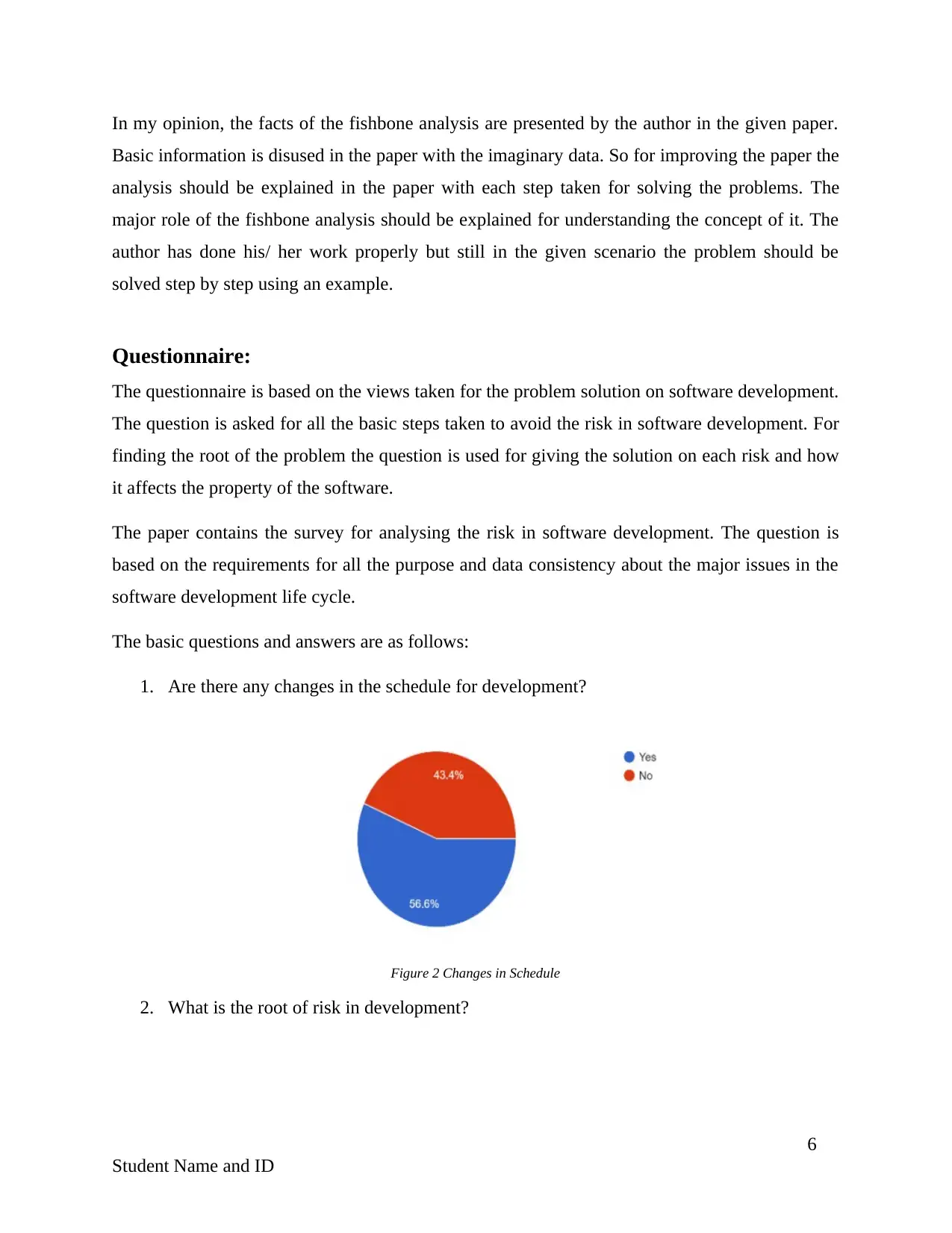
1. Are there any changes in the schedule for development?
Figure 2 Changes in Schedule
2. What is the root of risk in development?
6
Student Name and ID
Basic information is disused in the paper with the imaginary data. So for improving the paper the
analysis should be explained in the paper with each step taken for solving the problems. The
major role of the fishbone analysis should be explained for understanding the concept of it. The
author has done his/ her work properly but still in the given scenario the problem should be
solved step by step using an example.
Questionnaire:
The questionnaire is based on the views taken for the problem solution on software development.
The question is asked for all the basic steps taken to avoid the risk in software development. For
finding the root of the problem the question is used for giving the solution on each risk and how
it affects the property of the software.
The paper contains the survey for analysing the risk in software development. The question is
based on the requirements for all the purpose and data consistency about the major issues in the
software development life cycle.
The basic questions and answers are as follows:
1. Are there any changes in the schedule for development?
Figure 2 Changes in Schedule
2. What is the root of risk in development?
6
Student Name and ID
⊘ This is a preview!⊘
Do you want full access?
Subscribe today to unlock all pages.
Trusted by 1+ million students worldwide
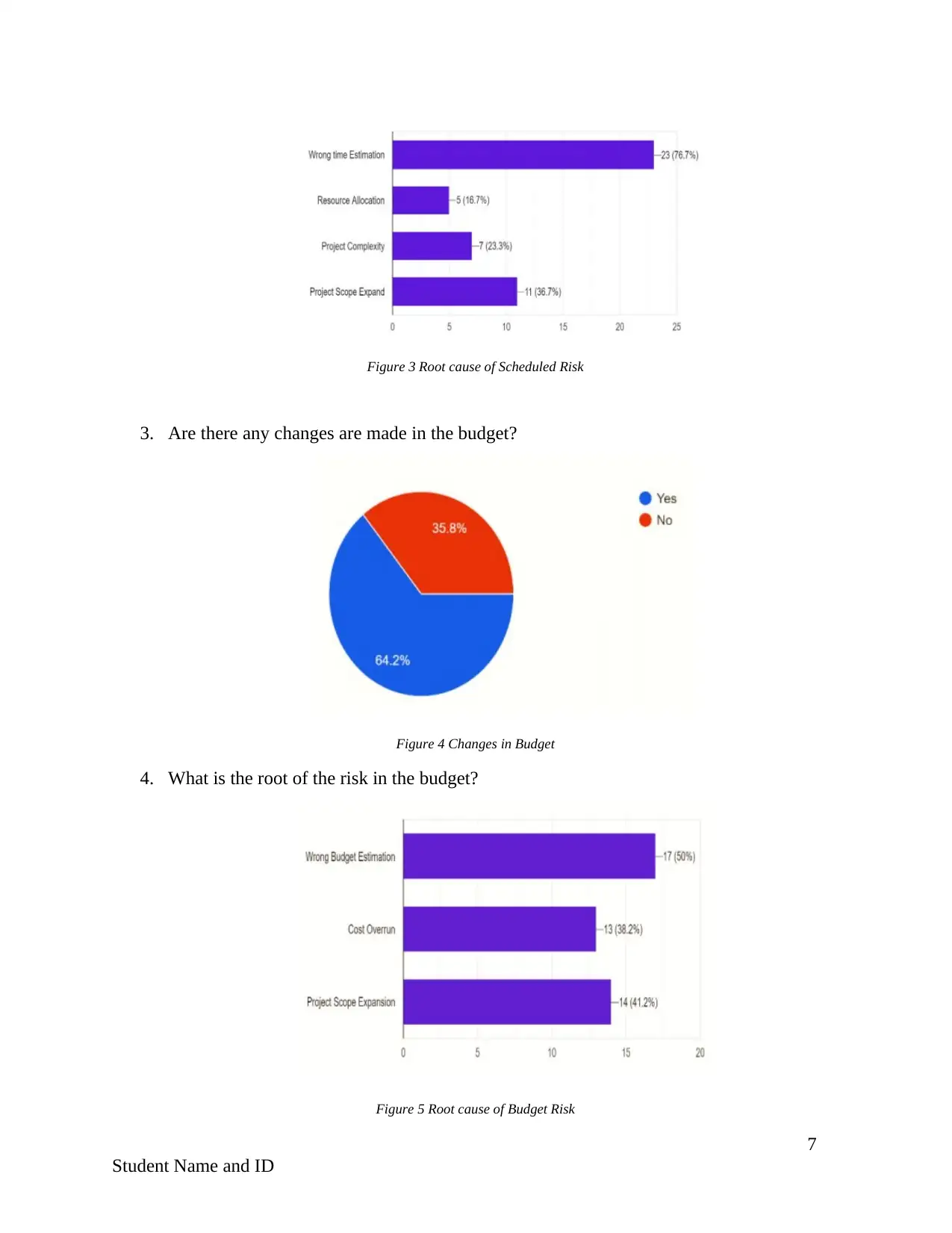
Figure 3 Root cause of Scheduled Risk
3. Are there any changes are made in the budget?
Figure 4 Changes in Budget
4. What is the root of the risk in the budget?
Figure 5 Root cause of Budget Risk
7
Student Name and ID
3. Are there any changes are made in the budget?
Figure 4 Changes in Budget
4. What is the root of the risk in the budget?
Figure 5 Root cause of Budget Risk
7
Student Name and ID
Paraphrase This Document
Need a fresh take? Get an instant paraphrase of this document with our AI Paraphraser
In my opinion, in the given survey the authors did their excellent work. The survey is probably
the best idea to acknowledge the terms of the software development risk and finding the root of
all the problems made in the development by a different organization, there is no need to exceed
this task, the work of the author is done properly in this task.
Risk Identification:
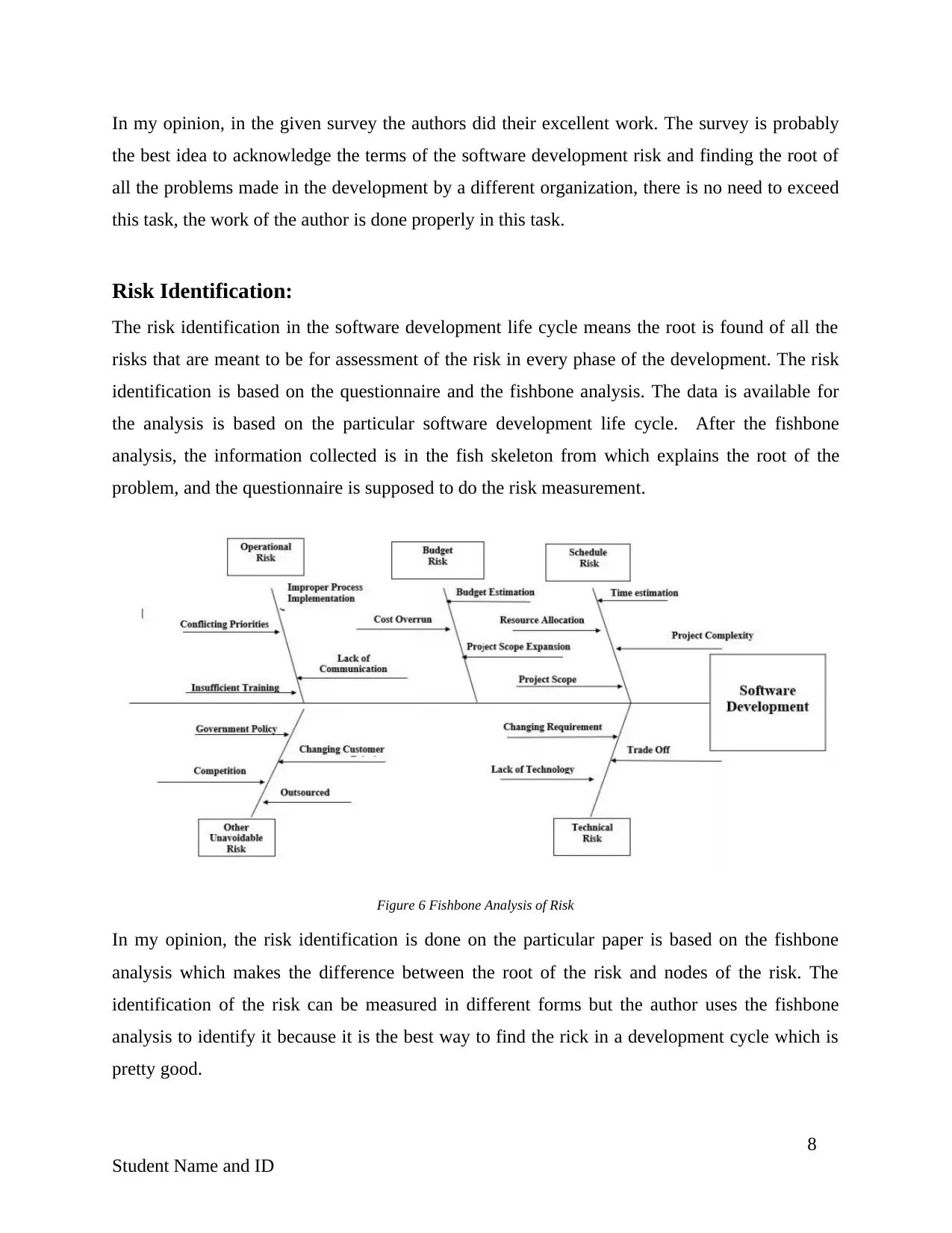
The risk identification in the software development life cycle means the root is found of all the
risks that are meant to be for assessment of the risk in every phase of the development. The risk
identification is based on the questionnaire and the fishbone analysis. The data is available for
the analysis is based on the particular software development life cycle. After the fishbone
analysis, the information collected is in the fish skeleton from which explains the root of the
problem, and the questionnaire is supposed to do the risk measurement.
Figure 6 Fishbone Analysis of Risk
In my opinion, the risk identification is done on the particular paper is based on the fishbone
analysis which makes the difference between the root of the risk and nodes of the risk. The
identification of the risk can be measured in different forms but the author uses the fishbone
analysis to identify it because it is the best way to find the rick in a development cycle which is
pretty good.
8
Student Name and ID
the best idea to acknowledge the terms of the software development risk and finding the root of
all the problems made in the development by a different organization, there is no need to exceed
this task, the work of the author is done properly in this task.
Risk Identification:
The risk identification in the software development life cycle means the root is found of all the
risks that are meant to be for assessment of the risk in every phase of the development. The risk
identification is based on the questionnaire and the fishbone analysis. The data is available for
the analysis is based on the particular software development life cycle. After the fishbone
analysis, the information collected is in the fish skeleton from which explains the root of the
problem, and the questionnaire is supposed to do the risk measurement.
Figure 6 Fishbone Analysis of Risk
In my opinion, the risk identification is done on the particular paper is based on the fishbone
analysis which makes the difference between the root of the risk and nodes of the risk. The
identification of the risk can be measured in different forms but the author uses the fishbone
analysis to identify it because it is the best way to find the rick in a development cycle which is
pretty good.
8
Student Name and ID
Risk Assessment:
The given paper contains quantitative and qualitative risk assessment:
Qualitative Risk Assessment:
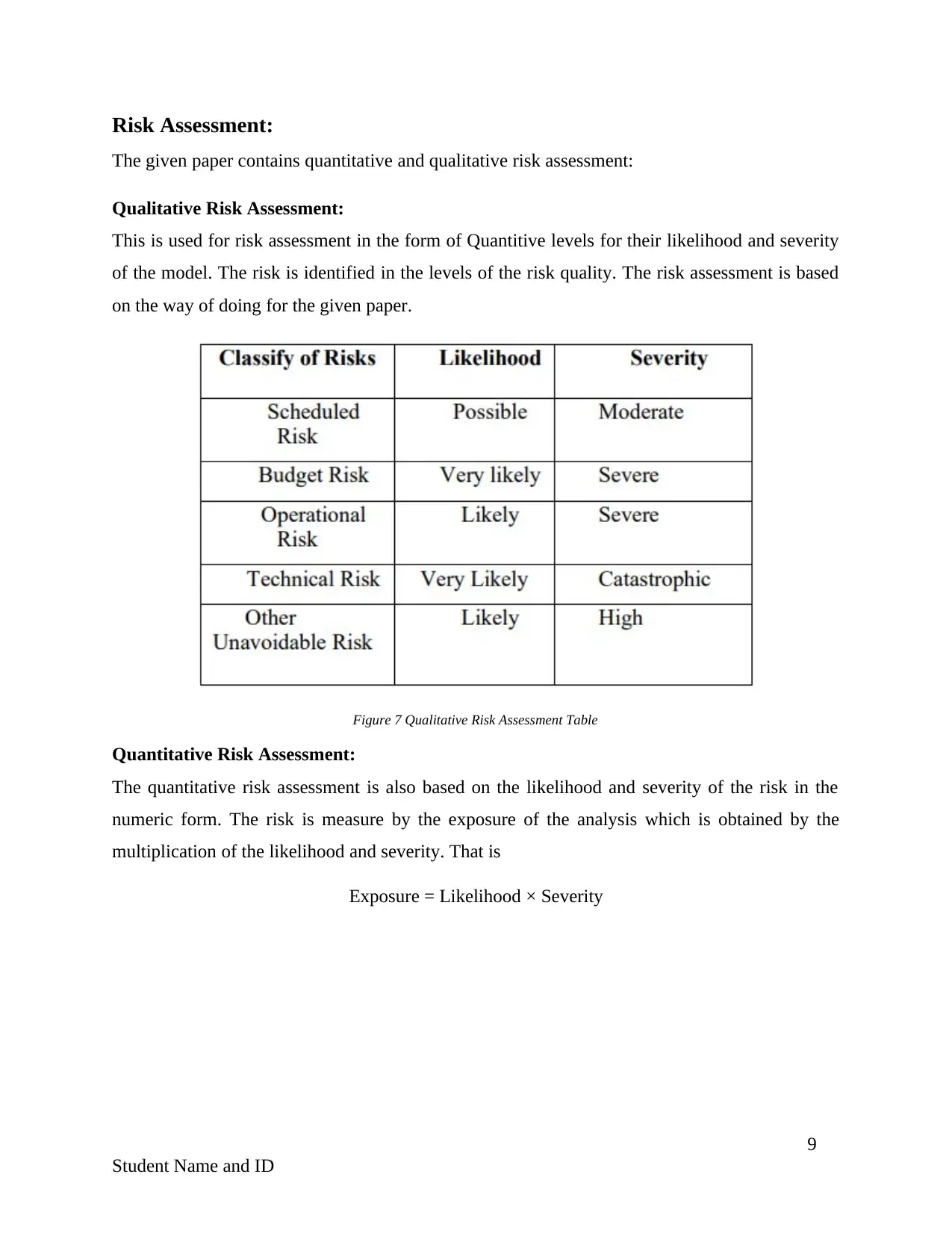
This is used for risk assessment in the form of Quantitive levels for their likelihood and severity
of the model. The risk is identified in the levels of the risk quality. The risk assessment is based
on the way of doing for the given paper.
Figure 7 Qualitative Risk Assessment Table
Quantitative Risk Assessment:
The quantitative risk assessment is also based on the likelihood and severity of the risk in the
numeric form. The risk is measure by the exposure of the analysis which is obtained by the
multiplication of the likelihood and severity. That is
Exposure = Likelihood × Severity
9
Student Name and ID
The given paper contains quantitative and qualitative risk assessment:
Qualitative Risk Assessment:
This is used for risk assessment in the form of Quantitive levels for their likelihood and severity
of the model. The risk is identified in the levels of the risk quality. The risk assessment is based
on the way of doing for the given paper.
Figure 7 Qualitative Risk Assessment Table
Quantitative Risk Assessment:
The quantitative risk assessment is also based on the likelihood and severity of the risk in the
numeric form. The risk is measure by the exposure of the analysis which is obtained by the
multiplication of the likelihood and severity. That is
Exposure = Likelihood × Severity
9
Student Name and ID
⊘ This is a preview!⊘
Do you want full access?
Subscribe today to unlock all pages.
Trusted by 1+ million students worldwide
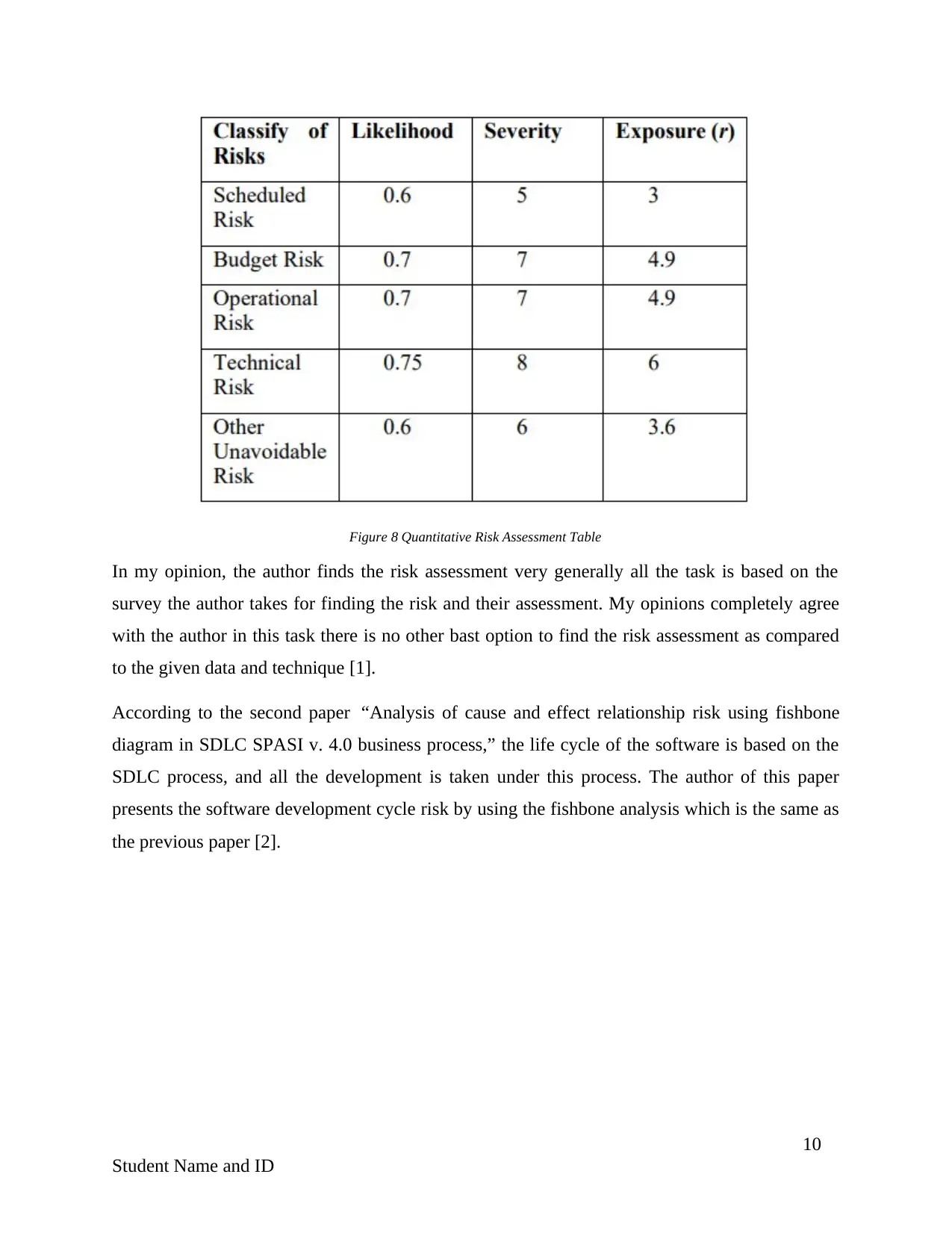
Figure 8 Quantitative Risk Assessment Table
In my opinion, the author finds the risk assessment very generally all the task is based on the
survey the author takes for finding the risk and their assessment. My opinions completely agree
with the author in this task there is no other bast option to find the risk assessment as compared
to the given data and technique [1].
According to the second paper “Analysis of cause and effect relationship risk using fishbone
diagram in SDLC SPASI v. 4.0 business process,” the life cycle of the software is based on the
SDLC process, and all the development is taken under this process. The author of this paper
presents the software development cycle risk by using the fishbone analysis which is the same as
the previous paper [2].
10
Student Name and ID
In my opinion, the author finds the risk assessment very generally all the task is based on the
survey the author takes for finding the risk and their assessment. My opinions completely agree
with the author in this task there is no other bast option to find the risk assessment as compared
to the given data and technique [1].
According to the second paper “Analysis of cause and effect relationship risk using fishbone
diagram in SDLC SPASI v. 4.0 business process,” the life cycle of the software is based on the
SDLC process, and all the development is taken under this process. The author of this paper
presents the software development cycle risk by using the fishbone analysis which is the same as
the previous paper [2].
10
Student Name and ID
Paraphrase This Document
Need a fresh take? Get an instant paraphrase of this document with our AI Paraphraser
Conclusion:
This report contains a review of a paper name “Risk Assessment on Software Development using
Fishbone Analysis”. The report contains the critical analysis of the paper and based on this the
review are made. The report contains all the risk occurs during the software development and the
fishbone analysis for finding the root of the risk. The Questionnaire is taken as a servery for the
risk assessment strategy. The review of the paper shows the difference of opinion on the same
topic.
Based on my opinion both the papers have a similarity about the software development risk and
assessment. The SDLC model of software development is used in the second paper and all the
related data based on that model is used. The difference between these two papers is that the first
paper explains the risk by using the fishbone analysis and the second paper use the SDLC life
cycle.
11
Student Name and ID
This report contains a review of a paper name “Risk Assessment on Software Development using
Fishbone Analysis”. The report contains the critical analysis of the paper and based on this the
review are made. The report contains all the risk occurs during the software development and the
fishbone analysis for finding the root of the risk. The Questionnaire is taken as a servery for the
risk assessment strategy. The review of the paper shows the difference of opinion on the same
topic.
Based on my opinion both the papers have a similarity about the software development risk and
assessment. The SDLC model of software development is used in the second paper and all the
related data based on that model is used. The difference between these two papers is that the first
paper explains the risk by using the fishbone analysis and the second paper use the SDLC life
cycle.
11
Student Name and ID
References:
[1] M. T. Riaz, M. S. Jahan, K. S. Arif, & W. H. Butt,” Risk Assessment on Software
Development using Fishbone Analysis,” 2019 International Conference on Data and Software
Engineering (ICoDSE), pp. 1-6, 2019.
[1] A. R. Kamila & S. Sutikno, “Analysis of cause and effect relationship risk using fishbone
diagram in SDLC SPASI v. 4.0 business process,” 2016 International Conference on
Information Technology Systems and Innovation (ICITSI), pp. 1-5, 2016. DOI:
10.1109/ICITSI.2016.7858186.
12
Student Name and ID
[1] M. T. Riaz, M. S. Jahan, K. S. Arif, & W. H. Butt,” Risk Assessment on Software
Development using Fishbone Analysis,” 2019 International Conference on Data and Software
Engineering (ICoDSE), pp. 1-6, 2019.
[1] A. R. Kamila & S. Sutikno, “Analysis of cause and effect relationship risk using fishbone
diagram in SDLC SPASI v. 4.0 business process,” 2016 International Conference on
Information Technology Systems and Innovation (ICITSI), pp. 1-5, 2016. DOI:
10.1109/ICITSI.2016.7858186.
12
Student Name and ID
⊘ This is a preview!⊘
Do you want full access?
Subscribe today to unlock all pages.
Trusted by 1+ million students worldwide

1 out of 12


Related Documents


Your All-in-One AI-Powered Toolkit for Academic Success.
+13062052269
info@desklib.com
Available 24*7 on WhatsApp / Email
![[object Object]](/_next/static/media/star-bottom.7253800d.svg)
Unlock your academic potential
Copyright © 2020–2025 A2Z Services. All Rights Reserved. Developed and managed by ZUCOL.