Risk Management Plan: Stakeholder Analysis and Importance in Business
VerifiedAdded on 2020/07/23
|7
|1701
|52
Report
AI Summary
This report provides a comprehensive overview of risk management, focusing on the crucial role of stakeholders. It defines risk and identifies internal stakeholders such as employees, managers, and owners, and external stakeholders including suppliers, society, government, creditors, shareholders, customers, competitors, and investors. The report details the significance of each stakeholder group in the risk management plan, emphasizing their contributions to hazard removal, decision-making, and overall business success. An action plan is also included, suggesting communication strategies to keep stakeholders informed of changes. The report concludes by reinforcing the importance of stakeholder involvement in eliminating corporate risks. This assignment is available on Desklib, a platform offering AI-based study tools and past papers for students.
Risk Management
(Part 2)
(Part 2)
Paraphrase This Document
Need a fresh take? Get an instant paraphrase of this document with our AI Paraphraser

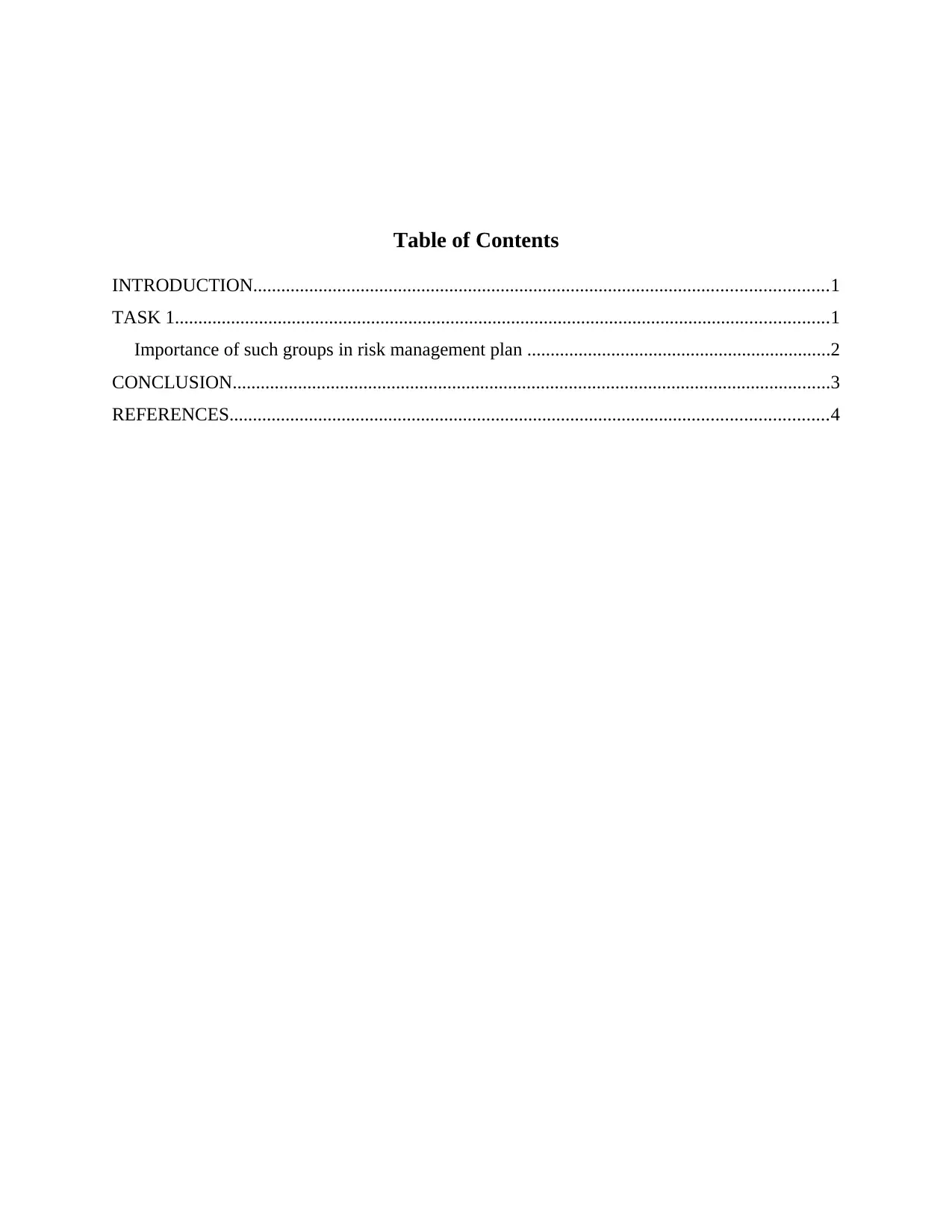
Table of Contents
INTRODUCTION...........................................................................................................................1
TASK 1............................................................................................................................................1
Importance of such groups in risk management plan .................................................................2
CONCLUSION................................................................................................................................3
REFERENCES................................................................................................................................4
INTRODUCTION...........................................................................................................................1
TASK 1............................................................................................................................................1
Importance of such groups in risk management plan .................................................................2
CONCLUSION................................................................................................................................3
REFERENCES................................................................................................................................4

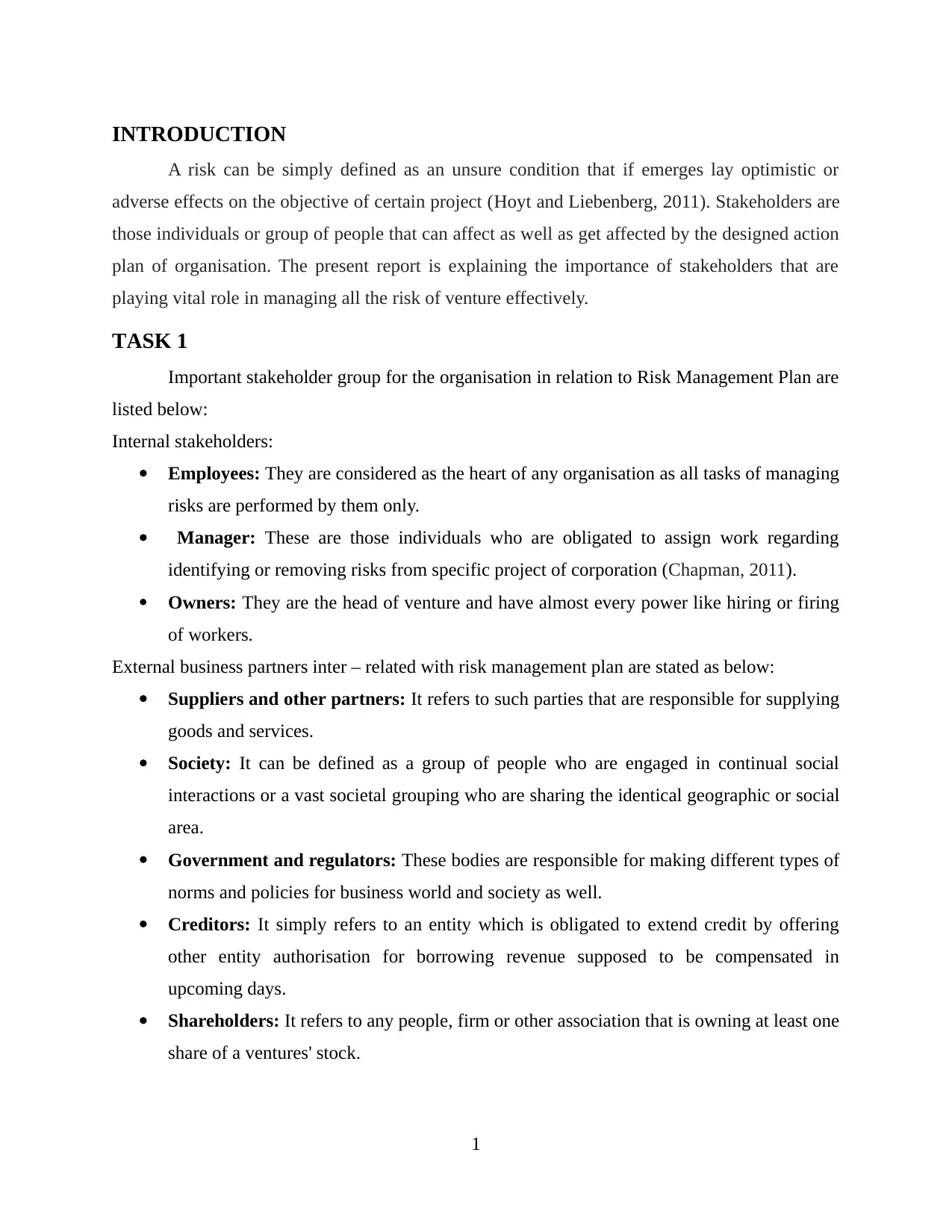
INTRODUCTION
A risk can be simply defined as an unsure condition that if emerges lay optimistic or
adverse effects on the objective of certain project (Hoyt and Liebenberg, 2011). Stakeholders are
those individuals or group of people that can affect as well as get affected by the designed action
plan of organisation. The present report is explaining the importance of stakeholders that are
playing vital role in managing all the risk of venture effectively.
TASK 1
Important stakeholder group for the organisation in relation to Risk Management Plan are
listed below:
Internal stakeholders:
Employees: They are considered as the heart of any organisation as all tasks of managing
risks are performed by them only.
Manager: These are those individuals who are obligated to assign work regarding
identifying or removing risks from specific project of corporation (Chapman, 2011).
Owners: They are the head of venture and have almost every power like hiring or firing
of workers.
External business partners inter – related with risk management plan are stated as below:
Suppliers and other partners: It refers to such parties that are responsible for supplying
goods and services.
Society: It can be defined as a group of people who are engaged in continual social
interactions or a vast societal grouping who are sharing the identical geographic or social
area.
Government and regulators: These bodies are responsible for making different types of
norms and policies for business world and society as well.
Creditors: It simply refers to an entity which is obligated to extend credit by offering
other entity authorisation for borrowing revenue supposed to be compensated in
upcoming days.
Shareholders: It refers to any people, firm or other association that is owning at least one
share of a ventures' stock.
1
A risk can be simply defined as an unsure condition that if emerges lay optimistic or
adverse effects on the objective of certain project (Hoyt and Liebenberg, 2011). Stakeholders are
those individuals or group of people that can affect as well as get affected by the designed action
plan of organisation. The present report is explaining the importance of stakeholders that are
playing vital role in managing all the risk of venture effectively.
TASK 1
Important stakeholder group for the organisation in relation to Risk Management Plan are
listed below:
Internal stakeholders:
Employees: They are considered as the heart of any organisation as all tasks of managing
risks are performed by them only.
Manager: These are those individuals who are obligated to assign work regarding
identifying or removing risks from specific project of corporation (Chapman, 2011).
Owners: They are the head of venture and have almost every power like hiring or firing
of workers.
External business partners inter – related with risk management plan are stated as below:
Suppliers and other partners: It refers to such parties that are responsible for supplying
goods and services.
Society: It can be defined as a group of people who are engaged in continual social
interactions or a vast societal grouping who are sharing the identical geographic or social
area.
Government and regulators: These bodies are responsible for making different types of
norms and policies for business world and society as well.
Creditors: It simply refers to an entity which is obligated to extend credit by offering
other entity authorisation for borrowing revenue supposed to be compensated in
upcoming days.
Shareholders: It refers to any people, firm or other association that is owning at least one
share of a ventures' stock.
1
⊘ This is a preview!⊘
Do you want full access?
Subscribe today to unlock all pages.

Trusted by 1+ million students worldwide

Customers: These are individuals who buy products or services from a business or an
enterprise.
Competitors: Simply referred as such groups or institute that offer same goods or
services in comparison to other companies.
Investors: They are such people who invest some amount of money in the business of
any venture.
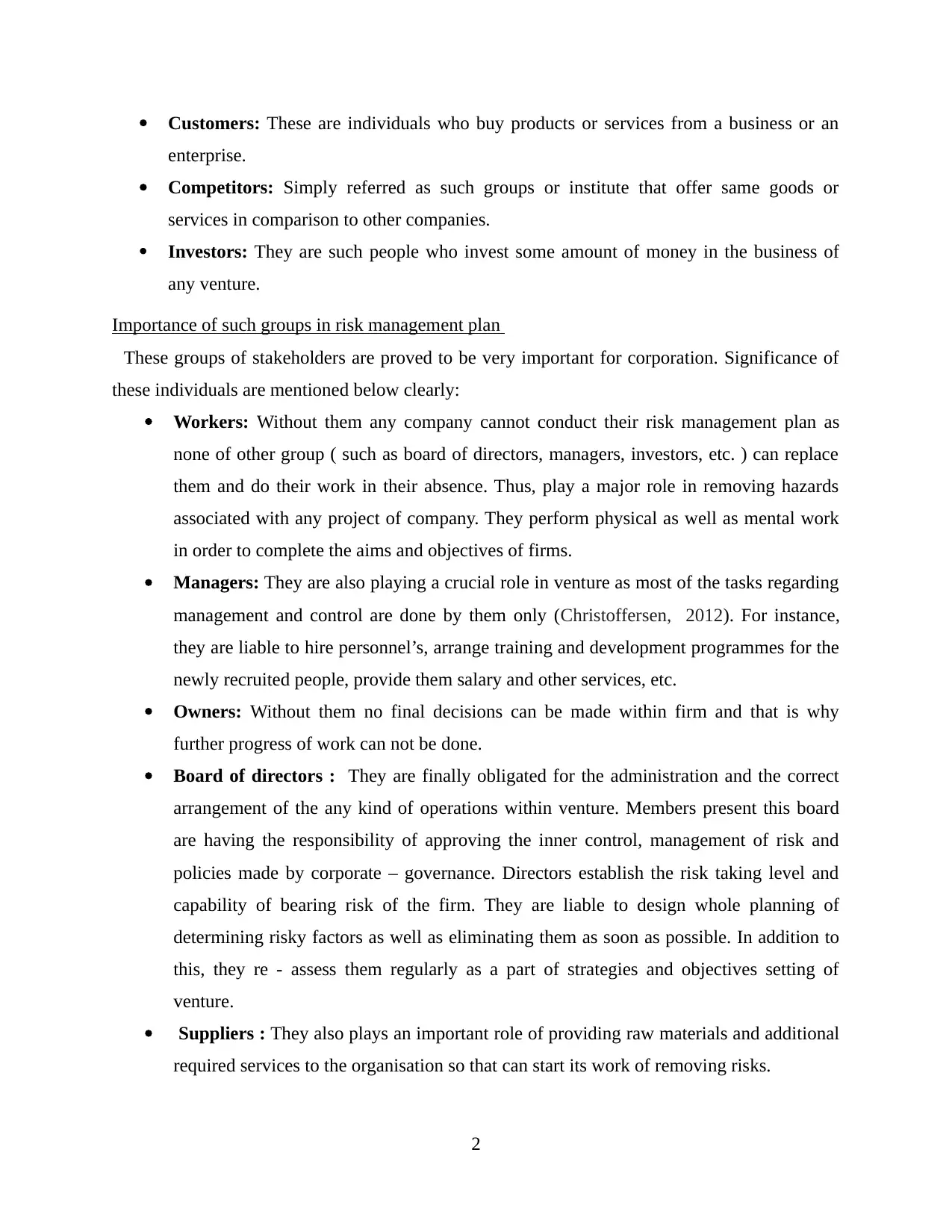
Importance of such groups in risk management plan
These groups of stakeholders are proved to be very important for corporation. Significance of
these individuals are mentioned below clearly:
Workers: Without them any company cannot conduct their risk management plan as
none of other group ( such as board of directors, managers, investors, etc. ) can replace
them and do their work in their absence. Thus, play a major role in removing hazards
associated with any project of company. They perform physical as well as mental work
in order to complete the aims and objectives of firms.
Managers: They are also playing a crucial role in venture as most of the tasks regarding
management and control are done by them only (Christoffersen, 2012). For instance,
they are liable to hire personnel’s, arrange training and development programmes for the
newly recruited people, provide them salary and other services, etc.
Owners: Without them no final decisions can be made within firm and that is why
further progress of work can not be done.
Board of directors : They are finally obligated for the administration and the correct
arrangement of the any kind of operations within venture. Members present this board
are having the responsibility of approving the inner control, management of risk and
policies made by corporate – governance. Directors establish the risk taking level and
capability of bearing risk of the firm. They are liable to design whole planning of
determining risky factors as well as eliminating them as soon as possible. In addition to
this, they re - assess them regularly as a part of strategies and objectives setting of
venture.
Suppliers : They also plays an important role of providing raw materials and additional
required services to the organisation so that can start its work of removing risks.
2
enterprise.
Competitors: Simply referred as such groups or institute that offer same goods or
services in comparison to other companies.
Investors: They are such people who invest some amount of money in the business of
any venture.
Importance of such groups in risk management plan
These groups of stakeholders are proved to be very important for corporation. Significance of
these individuals are mentioned below clearly:
Workers: Without them any company cannot conduct their risk management plan as
none of other group ( such as board of directors, managers, investors, etc. ) can replace
them and do their work in their absence. Thus, play a major role in removing hazards
associated with any project of company. They perform physical as well as mental work
in order to complete the aims and objectives of firms.
Managers: They are also playing a crucial role in venture as most of the tasks regarding
management and control are done by them only (Christoffersen, 2012). For instance,
they are liable to hire personnel’s, arrange training and development programmes for the
newly recruited people, provide them salary and other services, etc.
Owners: Without them no final decisions can be made within firm and that is why
further progress of work can not be done.
Board of directors : They are finally obligated for the administration and the correct
arrangement of the any kind of operations within venture. Members present this board
are having the responsibility of approving the inner control, management of risk and
policies made by corporate – governance. Directors establish the risk taking level and
capability of bearing risk of the firm. They are liable to design whole planning of
determining risky factors as well as eliminating them as soon as possible. In addition to
this, they re - assess them regularly as a part of strategies and objectives setting of
venture.
Suppliers : They also plays an important role of providing raw materials and additional
required services to the organisation so that can start its work of removing risks.
2
Paraphrase This Document
Need a fresh take? Get an instant paraphrase of this document with our AI Paraphraser

Government : These are authorised body that are having important role of making
legislation so that illegal activities can not be done by any of the companies.
Creditors : As ventures need help of revenues in the case of emergency or before
starting a big project of eliminating risks. Here creditors are having the role of providing
credits so that enterprise can take loan easily but they also has to return the same before
the dead line of submission.
Shareholders : They play an eminent role of investing definite sum of revenue in the
business of specific firms. Thus, without them company can not run their any of the plan
in context to management of risk (Glendon, Clarke and McKenna, 2016).
Customers : They are having vital role of offering suggestions and feedbacks to the
enterprise in order to make them aware about the defects or absence of good quality in
their products manufactured by them. Thus, from after receiving recommendations of
civilians, firm get an idea of doing changes and removing risky components from their
products or services.
Competitors : They impacts negatively on the performance of company as due to them
large number of potential consumers get segmented or move towards other firms. It can
be said that they show the cited enterprise an appropriate way of doing business. Thus,
company should do investigation regarding production provided by their challengers in
order to do proper modification and by this way they can remove such risks easily. In
fact , if they found any flaws or risks in the goods or services manufactured by their
competitors
Investors : They are responsible of doing investments in the business of specific
enterprise and participates in their operation. In addition to this, they also claim for their
shares and in turn gain its returns from that as venture earns profitability by purchasing
its goods and services.
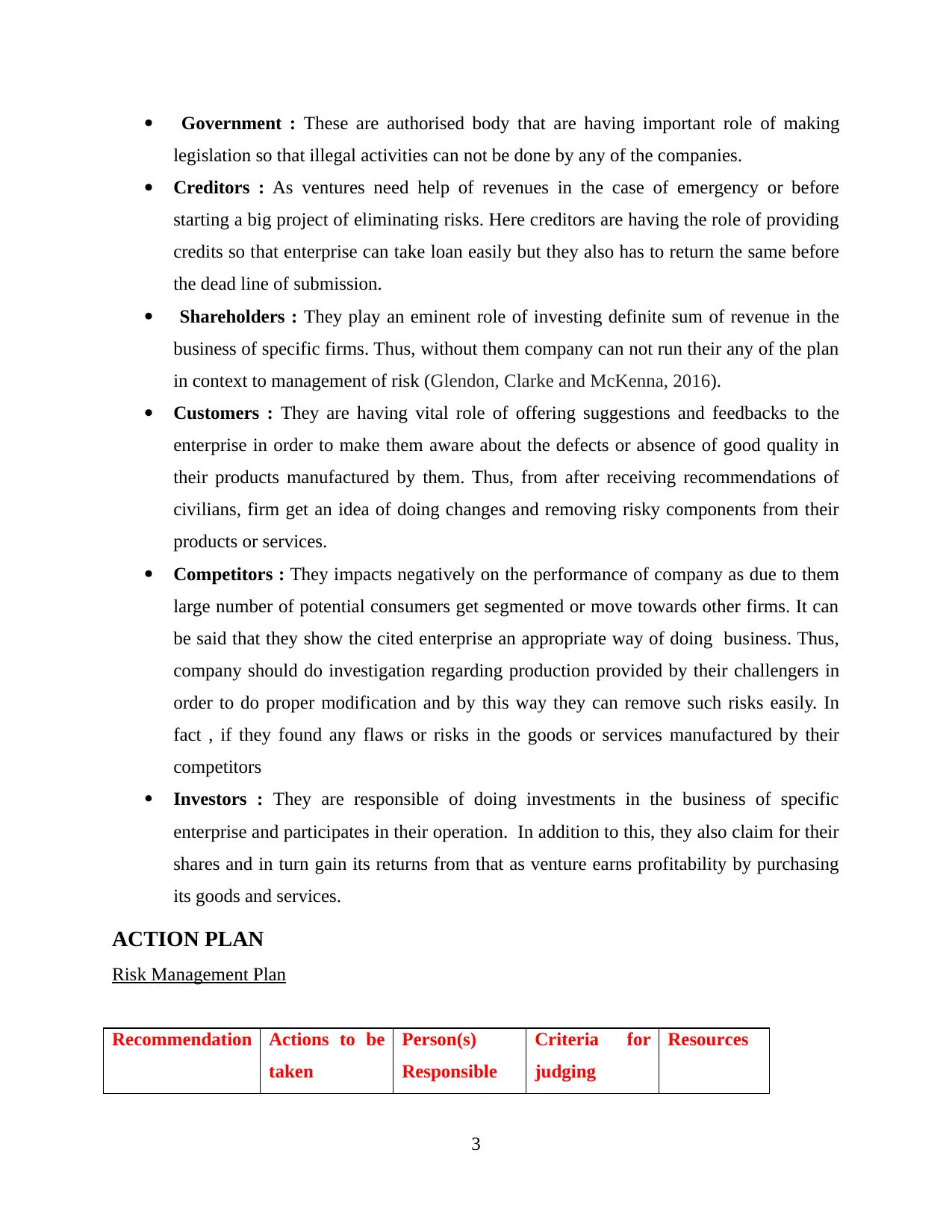
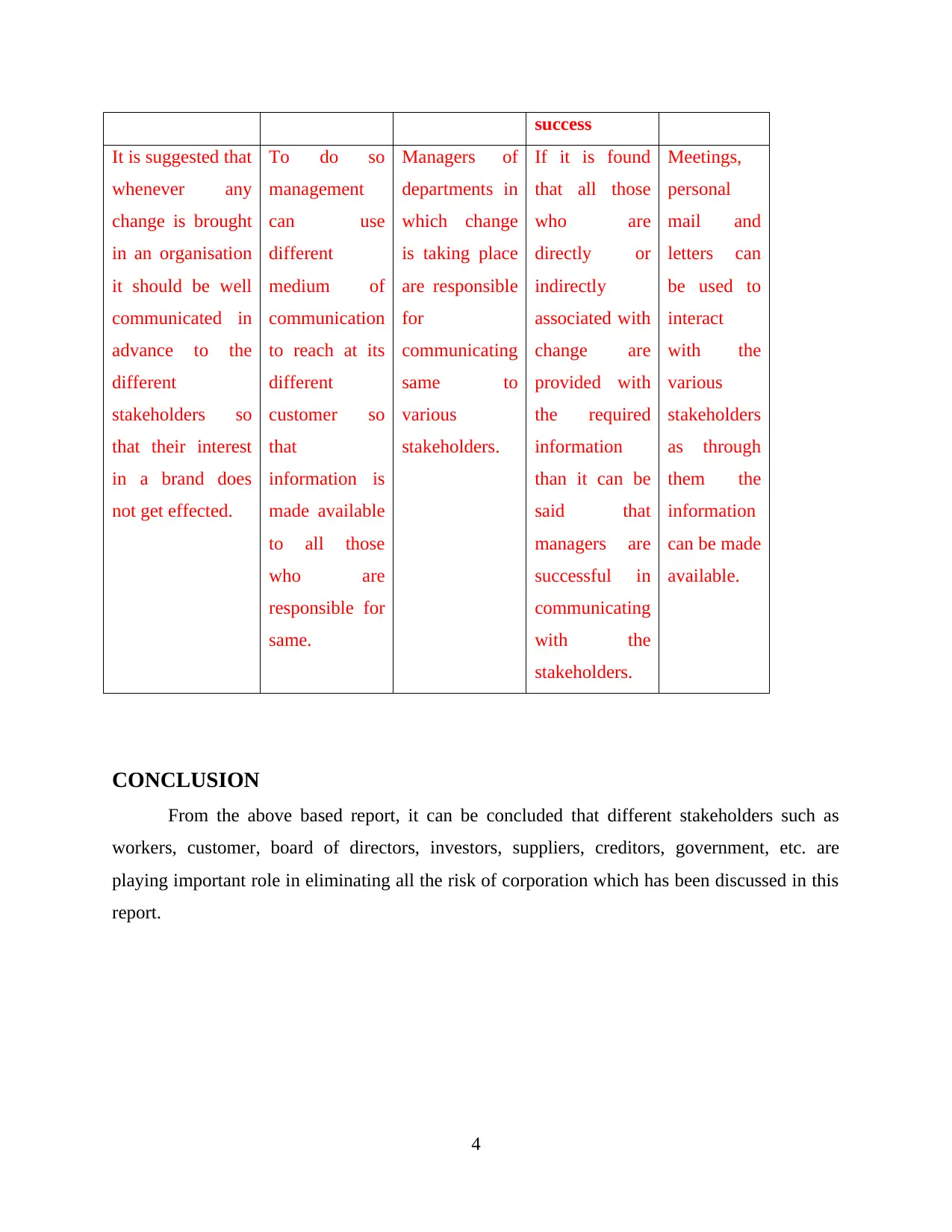
ACTION PLAN
Risk Management Plan
Recommendation Actions to be
taken
Person(s)
Responsible
Criteria for
judging
Resources
3
legislation so that illegal activities can not be done by any of the companies.
Creditors : As ventures need help of revenues in the case of emergency or before
starting a big project of eliminating risks. Here creditors are having the role of providing
credits so that enterprise can take loan easily but they also has to return the same before
the dead line of submission.
Shareholders : They play an eminent role of investing definite sum of revenue in the
business of specific firms. Thus, without them company can not run their any of the plan
in context to management of risk (Glendon, Clarke and McKenna, 2016).
Customers : They are having vital role of offering suggestions and feedbacks to the
enterprise in order to make them aware about the defects or absence of good quality in
their products manufactured by them. Thus, from after receiving recommendations of
civilians, firm get an idea of doing changes and removing risky components from their
products or services.
Competitors : They impacts negatively on the performance of company as due to them
large number of potential consumers get segmented or move towards other firms. It can
be said that they show the cited enterprise an appropriate way of doing business. Thus,
company should do investigation regarding production provided by their challengers in
order to do proper modification and by this way they can remove such risks easily. In
fact , if they found any flaws or risks in the goods or services manufactured by their
competitors
Investors : They are responsible of doing investments in the business of specific
enterprise and participates in their operation. In addition to this, they also claim for their
shares and in turn gain its returns from that as venture earns profitability by purchasing
its goods and services.
ACTION PLAN
Risk Management Plan
Recommendation Actions to be
taken
Person(s)
Responsible
Criteria for
judging
Resources
3

success
It is suggested that
whenever any
change is brought
in an organisation
it should be well
communicated in
advance to the
different
stakeholders so
that their interest
in a brand does
not get effected.
To do so
management
can use
different
medium of
communication
to reach at its
different
customer so
that
information is
made available
to all those
who are
responsible for
same.
Managers of
departments in
which change
is taking place
are responsible
for
communicating
same to
various
stakeholders.
If it is found
that all those
who are
directly or
indirectly
associated with
change are
provided with
the required
information
than it can be
said that
managers are
successful in
communicating
with the
stakeholders.
Meetings,
personal
mail and
letters can
be used to
interact
with the
various
stakeholders
as through
them the
information
can be made
available.
CONCLUSION
From the above based report, it can be concluded that different stakeholders such as
workers, customer, board of directors, investors, suppliers, creditors, government, etc. are
playing important role in eliminating all the risk of corporation which has been discussed in this
report.
4
It is suggested that
whenever any
change is brought
in an organisation
it should be well
communicated in
advance to the
different
stakeholders so
that their interest
in a brand does
not get effected.
To do so
management
can use
different
medium of
communication
to reach at its
different
customer so
that
information is
made available
to all those
who are
responsible for
same.
Managers of
departments in
which change
is taking place
are responsible
for
communicating
same to
various
stakeholders.
If it is found
that all those
who are
directly or
indirectly
associated with
change are
provided with
the required
information
than it can be
said that
managers are
successful in
communicating
with the
stakeholders.
Meetings,
personal
mail and
letters can
be used to
interact
with the
various
stakeholders
as through
them the
information
can be made
available.
CONCLUSION
From the above based report, it can be concluded that different stakeholders such as
workers, customer, board of directors, investors, suppliers, creditors, government, etc. are
playing important role in eliminating all the risk of corporation which has been discussed in this
report.
4
⊘ This is a preview!⊘
Do you want full access?
Subscribe today to unlock all pages.

Trusted by 1+ million students worldwide

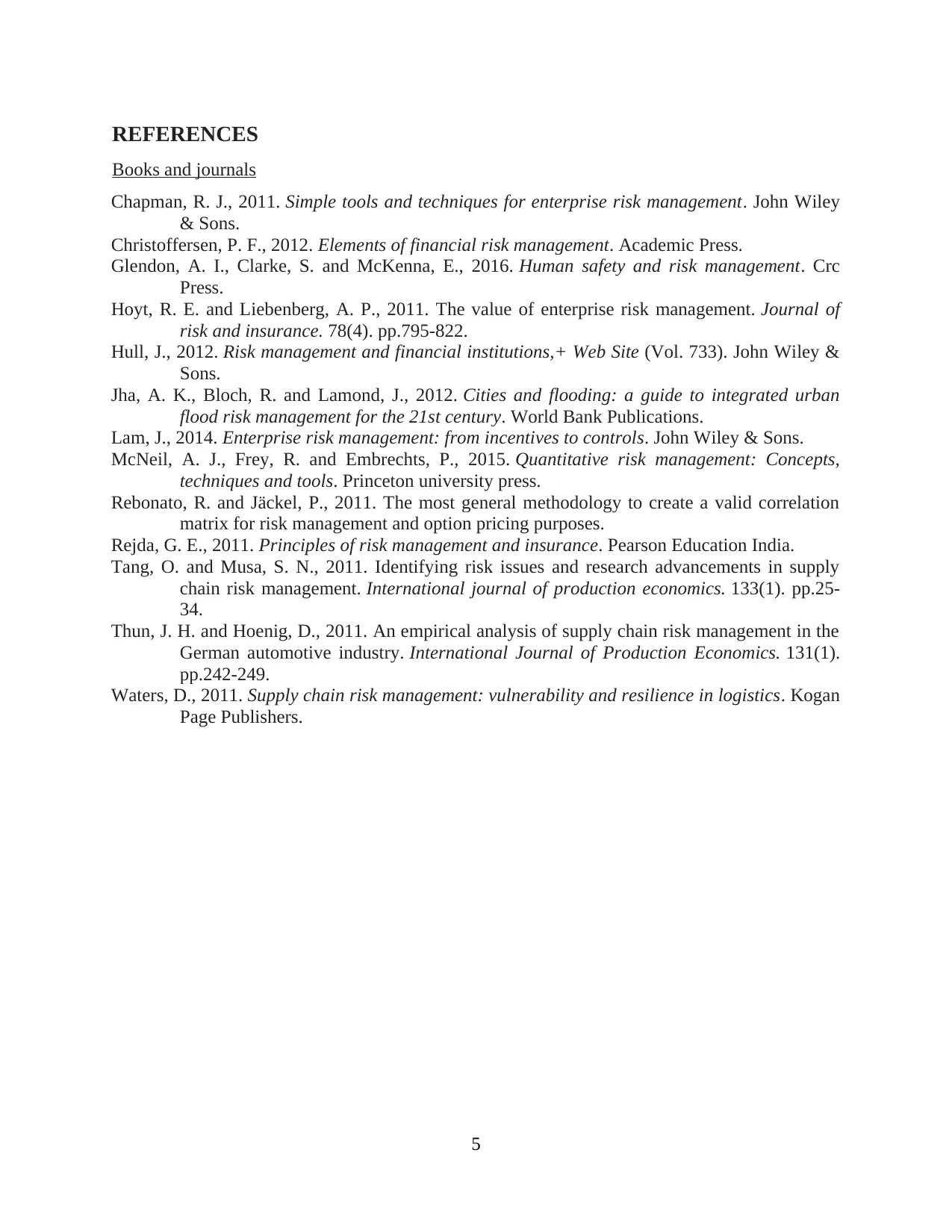
REFERENCES
Books and journals
Chapman, R. J., 2011. Simple tools and techniques for enterprise risk management. John Wiley
& Sons.
Christoffersen, P. F., 2012. Elements of financial risk management. Academic Press.
Glendon, A. I., Clarke, S. and McKenna, E., 2016. Human safety and risk management. Crc
Press.
Hoyt, R. E. and Liebenberg, A. P., 2011. The value of enterprise risk management. Journal of
risk and insurance. 78(4). pp.795-822.
Hull, J., 2012. Risk management and financial institutions,+ Web Site (Vol. 733). John Wiley &
Sons.
Jha, A. K., Bloch, R. and Lamond, J., 2012. Cities and flooding: a guide to integrated urban
flood risk management for the 21st century. World Bank Publications.
Lam, J., 2014. Enterprise risk management: from incentives to controls. John Wiley & Sons.
McNeil, A. J., Frey, R. and Embrechts, P., 2015. Quantitative risk management: Concepts,
techniques and tools. Princeton university press.
Rebonato, R. and Jäckel, P., 2011. The most general methodology to create a valid correlation
matrix for risk management and option pricing purposes.
Rejda, G. E., 2011. Principles of risk management and insurance. Pearson Education India.
Tang, O. and Musa, S. N., 2011. Identifying risk issues and research advancements in supply
chain risk management. International journal of production economics. 133(1). pp.25-
34.
Thun, J. H. and Hoenig, D., 2011. An empirical analysis of supply chain risk management in the
German automotive industry. International Journal of Production Economics. 131(1).
pp.242-249.
Waters, D., 2011. Supply chain risk management: vulnerability and resilience in logistics. Kogan
Page Publishers.
5
Books and journals
Chapman, R. J., 2011. Simple tools and techniques for enterprise risk management. John Wiley
& Sons.
Christoffersen, P. F., 2012. Elements of financial risk management. Academic Press.
Glendon, A. I., Clarke, S. and McKenna, E., 2016. Human safety and risk management. Crc
Press.
Hoyt, R. E. and Liebenberg, A. P., 2011. The value of enterprise risk management. Journal of
risk and insurance. 78(4). pp.795-822.
Hull, J., 2012. Risk management and financial institutions,+ Web Site (Vol. 733). John Wiley &
Sons.
Jha, A. K., Bloch, R. and Lamond, J., 2012. Cities and flooding: a guide to integrated urban
flood risk management for the 21st century. World Bank Publications.
Lam, J., 2014. Enterprise risk management: from incentives to controls. John Wiley & Sons.
McNeil, A. J., Frey, R. and Embrechts, P., 2015. Quantitative risk management: Concepts,
techniques and tools. Princeton university press.
Rebonato, R. and Jäckel, P., 2011. The most general methodology to create a valid correlation
matrix for risk management and option pricing purposes.
Rejda, G. E., 2011. Principles of risk management and insurance. Pearson Education India.
Tang, O. and Musa, S. N., 2011. Identifying risk issues and research advancements in supply
chain risk management. International journal of production economics. 133(1). pp.25-
34.
Thun, J. H. and Hoenig, D., 2011. An empirical analysis of supply chain risk management in the
German automotive industry. International Journal of Production Economics. 131(1).
pp.242-249.
Waters, D., 2011. Supply chain risk management: vulnerability and resilience in logistics. Kogan
Page Publishers.
5
1 out of 7
Related Documents
Your All-in-One AI-Powered Toolkit for Academic Success.
+13062052269
info@desklib.com
Available 24*7 on WhatsApp / Email
Unlock your academic potential
Copyright © 2020–2026 A2Z Services. All Rights Reserved. Developed and managed by ZUCOL.