Legal, Ethical, Sustainability Risk Management in Tourism
VerifiedAdded on 2022/10/01
|10
|2858
|490
Essay
AI Summary
This essay provides a detailed analysis of risk management within the context of the tourism, events, and hospitality industries. It examines the legal, ethical, and sustainability dimensions of risk, highlighting their importance and interconnectedness. The essay explores the legal implications of risk management, emphasizing the need for proactive measures and standardized procedures to mitigate legal risks. It then delves into the ethical dimension, asserting that good risk management necessitates good ethics and vice versa, and underscores the significance of ethical conduct in safeguarding stakeholders. Finally, the essay addresses the sustainability dimension, discussing the integration of profit objectives with environmental policies and the role of sustainability risk management in ensuring business continuity while protecting the environment. The essay concludes by summarizing the key points and emphasizing the significance of risk management in the industry.
Running head: ANALYTICAL ESSAY 1
RISK MANAGEMENT
Student details:
8/18/2019
RISK MANAGEMENT
Student details:
8/18/2019

Paraphrase This Document
Need a fresh take? Get an instant paraphrase of this document with our AI Paraphraser
ANALYTICAL ESSAY 2
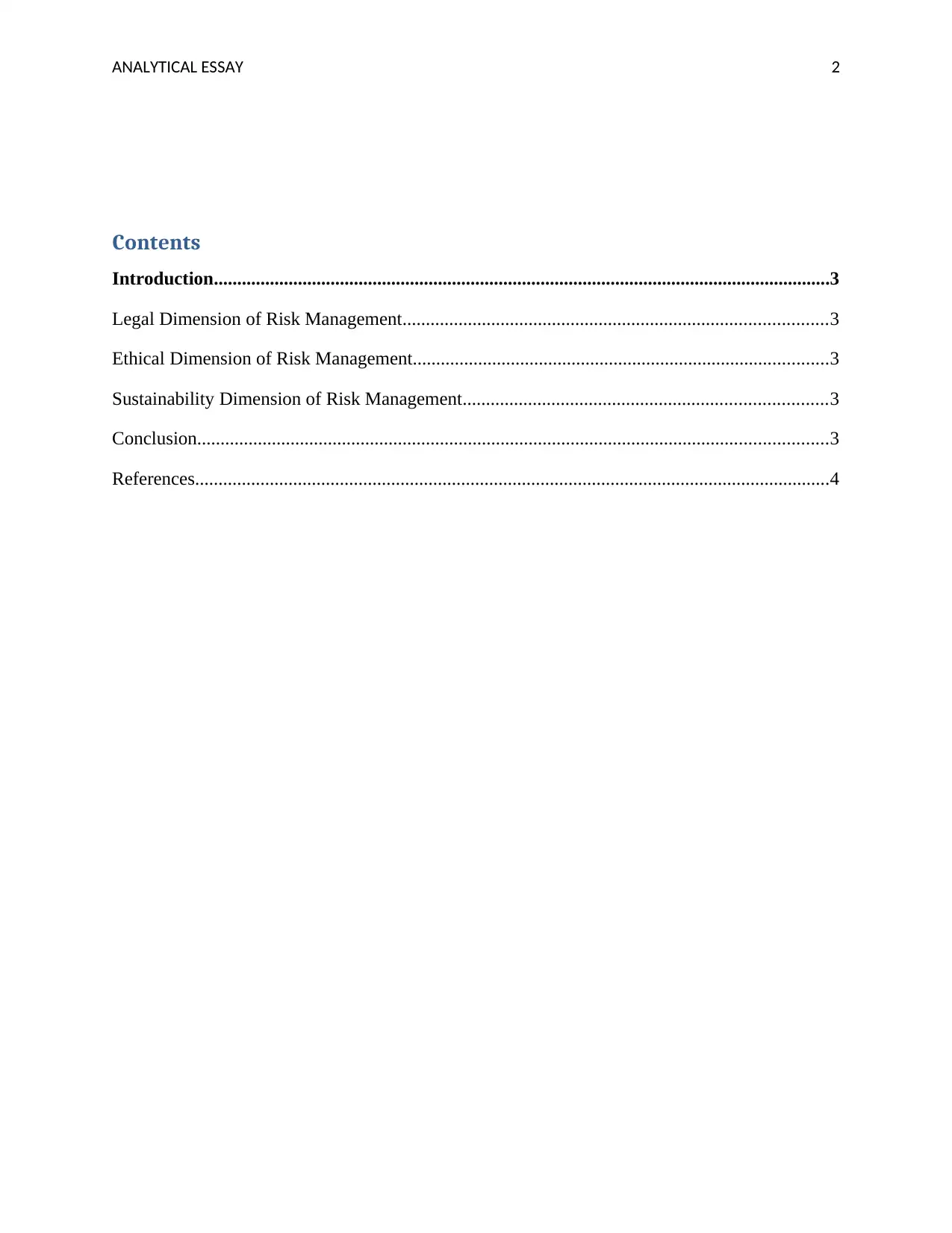
Contents
Introduction....................................................................................................................................3
Legal Dimension of Risk Management...........................................................................................3
Ethical Dimension of Risk Management.........................................................................................3
Sustainability Dimension of Risk Management..............................................................................3
Conclusion.......................................................................................................................................3
References........................................................................................................................................4
Contents
Introduction....................................................................................................................................3
Legal Dimension of Risk Management...........................................................................................3
Ethical Dimension of Risk Management.........................................................................................3
Sustainability Dimension of Risk Management..............................................................................3
Conclusion.......................................................................................................................................3
References........................................................................................................................................4
ANALYTICAL ESSAY 3
Introduction
As the management process, the risk management is useful for the recognition and
avoidance of the possible costs, agenda, as well as performance or technical risk to the system,
take the practical and prearranged approaches to handle the adverse results, respond to them if
they occur, and recognize probable opportunities that can be hidden in situations. The risk
management approach manages these management objectives. The risk management is
considered as recognition, assessment, and prioritization of the risk tracked by synchronized as
well as efficient application of means to reduce, examine, and manage the probabilities or
impacts of adverse events or to increase the comprehension of opportunity. The risk
management is a procedure of recognizing risks, evaluating risks, and initiating actions to
minimize the risks to the acceptable level. The risk management approach decides the
procedures, methods, devices, and team roles or accountabilities for the particular project.
The following parts render the comprehensive evaluation and explanation of the elements
that may affect the level of risk related with service industry like tourism, events or hospitality
industry. The risk management team of the tourism, events or hospitality industries develops the
proper approaches for managing risks to cope with rising risk as well as situation that can cause
the danger to individual and safety of community. The risk management is very significant to
recognize significantly and assess the ethical, legal and sustainability extent of the risk
management. The essay also discusses the treatment to reduce the risk of tourism, events or
hospitality industries (Hopkin, 2018).
Legal Dimension of Risk Management
The risk management is considered as the key to existing with potentially terrible risks;
however the verbal communication of adverse risk management carries with it the implications
that each risk may actually be handled (Elena & Maria, 2015). It signifies that if there are
Introduction
As the management process, the risk management is useful for the recognition and
avoidance of the possible costs, agenda, as well as performance or technical risk to the system,
take the practical and prearranged approaches to handle the adverse results, respond to them if
they occur, and recognize probable opportunities that can be hidden in situations. The risk
management approach manages these management objectives. The risk management is
considered as recognition, assessment, and prioritization of the risk tracked by synchronized as
well as efficient application of means to reduce, examine, and manage the probabilities or
impacts of adverse events or to increase the comprehension of opportunity. The risk
management is a procedure of recognizing risks, evaluating risks, and initiating actions to
minimize the risks to the acceptable level. The risk management approach decides the
procedures, methods, devices, and team roles or accountabilities for the particular project.
The following parts render the comprehensive evaluation and explanation of the elements
that may affect the level of risk related with service industry like tourism, events or hospitality
industry. The risk management team of the tourism, events or hospitality industries develops the
proper approaches for managing risks to cope with rising risk as well as situation that can cause
the danger to individual and safety of community. The risk management is very significant to
recognize significantly and assess the ethical, legal and sustainability extent of the risk
management. The essay also discusses the treatment to reduce the risk of tourism, events or
hospitality industries (Hopkin, 2018).
Legal Dimension of Risk Management
The risk management is considered as the key to existing with potentially terrible risks;
however the verbal communication of adverse risk management carries with it the implications
that each risk may actually be handled (Elena & Maria, 2015). It signifies that if there are
⊘ This is a preview!⊘
Do you want full access?
Subscribe today to unlock all pages.

Trusted by 1+ million students worldwide
ANALYTICAL ESSAY 4
negative outcomes, even accepting the intrinsic outstanding risks, there should be the letdowns
by those accountable. The idea of risk management increases the more risks of being responsible
for not succeeding to meet community prospects and that risk too, requires to be handled. It is
essential to consider the question of risk management from the legal as well as administrative
point of view (Glendon & Clarke, 2015). It is required to consider whether the disaster risk
management is affecting from decreasing the risks to community to decreasing the risks to the
government as well as urgent situation manager. The policy reforms as well as legal reforms that
can be helpful for refocusing on the disaster risk management to those susceptible to risks, rather
than susceptible to blame, would be essentially required to be recognized (Farm & Dennis,
2018).
Further, all the systems during the lifecycle, would make legal implication that require to
be managed. The potential cost of an insufficient management of legal features may even imply
the letdown of a project. As the result, the legal risk management must not only be the main
function of the enlargement lifecycle, however it is required to be performed by experienced
personnel following well-described norms and processes. On the other hand, the existing
software procedure enhancement models do not accurately involve the procedures for legal
audits and more concretely legal risks management for all the phases of software development
lifecycle (Ho, et. al, 2015). In tourism, events and hospitality industry, it is not possible to search
the well-described and standardized projects by managing the legal issues. The absence of
standardized procedure means that legal risk is managed reactively rather than proactively. This
is organized by the series of functions to be executed at all the stages of the software
development lifecycle to end or reduce the risk of project failure for legal reasons (Basari, 2017).
It is required to recognize the legal risks in the tourism, events or hospitality industries by
finding the sources of legal risks, identifying or recognizing the risks in risk register. The issues
related to the risk management can include moreover tax law, in relation to the Co-operative
observance process and its consequences on the inner construction of corporation. After this, the
legal risks should be analyzed by assessing the controls. The risk controls may consider the
various forms depending on risk, the type of industry, as well as the association. For instance, for
managing the contract risk, an organization may utilize the necessities tracking system to make
sure that individual responsibilities are satisfied (Leonard, et. al, 2018).
negative outcomes, even accepting the intrinsic outstanding risks, there should be the letdowns
by those accountable. The idea of risk management increases the more risks of being responsible
for not succeeding to meet community prospects and that risk too, requires to be handled. It is
essential to consider the question of risk management from the legal as well as administrative
point of view (Glendon & Clarke, 2015). It is required to consider whether the disaster risk
management is affecting from decreasing the risks to community to decreasing the risks to the
government as well as urgent situation manager. The policy reforms as well as legal reforms that
can be helpful for refocusing on the disaster risk management to those susceptible to risks, rather
than susceptible to blame, would be essentially required to be recognized (Farm & Dennis,
2018).
Further, all the systems during the lifecycle, would make legal implication that require to
be managed. The potential cost of an insufficient management of legal features may even imply
the letdown of a project. As the result, the legal risk management must not only be the main
function of the enlargement lifecycle, however it is required to be performed by experienced
personnel following well-described norms and processes. On the other hand, the existing
software procedure enhancement models do not accurately involve the procedures for legal
audits and more concretely legal risks management for all the phases of software development
lifecycle (Ho, et. al, 2015). In tourism, events and hospitality industry, it is not possible to search
the well-described and standardized projects by managing the legal issues. The absence of
standardized procedure means that legal risk is managed reactively rather than proactively. This
is organized by the series of functions to be executed at all the stages of the software
development lifecycle to end or reduce the risk of project failure for legal reasons (Basari, 2017).
It is required to recognize the legal risks in the tourism, events or hospitality industries by
finding the sources of legal risks, identifying or recognizing the risks in risk register. The issues
related to the risk management can include moreover tax law, in relation to the Co-operative
observance process and its consequences on the inner construction of corporation. After this, the
legal risks should be analyzed by assessing the controls. The risk controls may consider the
various forms depending on risk, the type of industry, as well as the association. For instance, for
managing the contract risk, an organization may utilize the necessities tracking system to make
sure that individual responsibilities are satisfied (Leonard, et. al, 2018).
Paraphrase This Document
Need a fresh take? Get an instant paraphrase of this document with our AI Paraphraser
ANALYTICAL ESSAY 5
Ethical Dimension of Risk Management
The matter "ethics and risk management" implies that these two commendable disciplines
ethics and risk management are based on each other. The good risk management needs good
ethics. As same as, the good ethics also needs good risk management. Form the positive point of
view; firstly every representative of organization is required to practice the good ethics for
managing the risks related to tourism, events and hospitality industries. Secondly, the person
who represents that entity should manage the risk well for acting in the ethical way. On the other
hand, as per the negative perspective, firstly the entity that allows or motivates immoral actions
by anybody who represents this is not working good risk management. Secondly, the entity that
motivates or allows anyone who represents it to handle the risks badly is performing immorally
(Mathew, et. al, 2017).
Further, to know why the areas of risk management and ethics require each other, it is
required to consider the general ground they share. The ethics provides the directions for the
proper steps between people and group of people in the provided conditions as well as the proper
actions. The reason is that they state the respect for rights along with civil liberties of others,
actions to secure the people from discomfiture or the significant damages, or actions to authorize
the people with sovereignty to act autonomously (Depietri, Dahal & McPhearson, 2018). The
risk management is depended on the respect for right and independence of others. It is also
depended on the rights to get security from the avoidable dangers or harms, freedoms to perform
as they decide without excessive restriction. The risk management as well as ethics promote
respect for different people. The ethical dimension of the risk management is very much
important to provide the rights to be secure, happy, free as well as productive. It ensures the
respect for all such as neighbor, clients, and workers, fellow users of the services and products,
or fellow inhabitant of the world (Depietri & McPhearson, 2018).
Firstly, for the entity to manage the risks well, all the persons should perform ethically.
For an instance, if a person represents the products of company in wrong way, then the company
is susceptible instantly to the products liability claims and in the long run can lose the status as
well as market share. Once more, if any executive of company treats the assistant worker
unprofessionally, then that worker can lose the keenness for the works. The worker can start to
Ethical Dimension of Risk Management
The matter "ethics and risk management" implies that these two commendable disciplines
ethics and risk management are based on each other. The good risk management needs good
ethics. As same as, the good ethics also needs good risk management. Form the positive point of
view; firstly every representative of organization is required to practice the good ethics for
managing the risks related to tourism, events and hospitality industries. Secondly, the person
who represents that entity should manage the risk well for acting in the ethical way. On the other
hand, as per the negative perspective, firstly the entity that allows or motivates immoral actions
by anybody who represents this is not working good risk management. Secondly, the entity that
motivates or allows anyone who represents it to handle the risks badly is performing immorally
(Mathew, et. al, 2017).
Further, to know why the areas of risk management and ethics require each other, it is
required to consider the general ground they share. The ethics provides the directions for the
proper steps between people and group of people in the provided conditions as well as the proper
actions. The reason is that they state the respect for rights along with civil liberties of others,
actions to secure the people from discomfiture or the significant damages, or actions to authorize
the people with sovereignty to act autonomously (Depietri, Dahal & McPhearson, 2018). The
risk management is depended on the respect for right and independence of others. It is also
depended on the rights to get security from the avoidable dangers or harms, freedoms to perform
as they decide without excessive restriction. The risk management as well as ethics promote
respect for different people. The ethical dimension of the risk management is very much
important to provide the rights to be secure, happy, free as well as productive. It ensures the
respect for all such as neighbor, clients, and workers, fellow users of the services and products,
or fellow inhabitant of the world (Depietri & McPhearson, 2018).
Firstly, for the entity to manage the risks well, all the persons should perform ethically.
For an instance, if a person represents the products of company in wrong way, then the company
is susceptible instantly to the products liability claims and in the long run can lose the status as
well as market share. Once more, if any executive of company treats the assistant worker
unprofessionally, then that worker can lose the keenness for the works. The worker can start to
ANALYTICAL ESSAY 6
take advantages of manager in any of hundreds of little manners, or can easily search other work.
Or in a case when one worker discovers that the other worker is misappropriating from the
company, the failure of that worker to report the deceitfulness causes economic losses to not just
the company and to all the managers however, also to the people who depend on the entity for
the living (McCRACKEN & Johnston, 2015).
Secondly, if the entity is to perform in ethical way, the people who work for that entity,
should do work for managing the risks in fine way. The safeguarding staffs, who take out the
daily trash of entity, should set out of it correctly; or else, neighbor upon whom this is dumped
can take legal action against the entity. Further, in turn, it can have penalties as well as orders for
the ecological toxic waste. Furthermore, the risk management team of the entity should be
thoroughly honest in rendering data to the insurers of entity, not just to be ensure that entity has
great image amongst the underwriters, however also to be certain that the entity pays its morally
fair share of failure disclosures that are gathered throughout the insurance (Chamnan &
Aekplakorn, 2017).
Sustainability Dimension of Risk Management
The sustainability risk management is the business approach, which brings into line the
profit objectives with the ecological policy of the organization. The objective of
sustainability risk management is to conduct this arrangement well-organized enough for
sustaining as well as developing the business when protecting the surroundings. One of main
drivers for sustainability risk management acceptance is growing demands for compliance with
domestic as well as international policies or rules. The entity applying sustainability risk
management usually put focus on the ecological effects of all the business
processes independently and then look for manners to reduce them. The information technology
sector helps by managing data as this relates to sustainability objectives of company as well as
rendering mechanical auditing and reporting abilities (David & Gollasch, 2016).
Further, the sustainability is the many-sided idea that covers the environment, the
financial system as well as the societies. In ecological dimension, the sustainability refers to the
securing as well as strengthening construction and renewal capability of ecological system. In
take advantages of manager in any of hundreds of little manners, or can easily search other work.
Or in a case when one worker discovers that the other worker is misappropriating from the
company, the failure of that worker to report the deceitfulness causes economic losses to not just
the company and to all the managers however, also to the people who depend on the entity for
the living (McCRACKEN & Johnston, 2015).
Secondly, if the entity is to perform in ethical way, the people who work for that entity,
should do work for managing the risks in fine way. The safeguarding staffs, who take out the
daily trash of entity, should set out of it correctly; or else, neighbor upon whom this is dumped
can take legal action against the entity. Further, in turn, it can have penalties as well as orders for
the ecological toxic waste. Furthermore, the risk management team of the entity should be
thoroughly honest in rendering data to the insurers of entity, not just to be ensure that entity has
great image amongst the underwriters, however also to be certain that the entity pays its morally
fair share of failure disclosures that are gathered throughout the insurance (Chamnan &
Aekplakorn, 2017).
Sustainability Dimension of Risk Management
The sustainability risk management is the business approach, which brings into line the
profit objectives with the ecological policy of the organization. The objective of
sustainability risk management is to conduct this arrangement well-organized enough for
sustaining as well as developing the business when protecting the surroundings. One of main
drivers for sustainability risk management acceptance is growing demands for compliance with
domestic as well as international policies or rules. The entity applying sustainability risk
management usually put focus on the ecological effects of all the business
processes independently and then look for manners to reduce them. The information technology
sector helps by managing data as this relates to sustainability objectives of company as well as
rendering mechanical auditing and reporting abilities (David & Gollasch, 2016).
Further, the sustainability is the many-sided idea that covers the environment, the
financial system as well as the societies. In ecological dimension, the sustainability refers to the
securing as well as strengthening construction and renewal capability of ecological system. In
⊘ This is a preview!⊘
Do you want full access?
Subscribe today to unlock all pages.
Trusted by 1+ million students worldwide
ANALYTICAL ESSAY 7
economic dimension, the sustainability is increasing the present and upcoming net advantages of
financial growth when making sure the quality of natural means along with related services.
Communally, the sustainability means enhancing the life’s quality and health ( Rutić & Inđić,
2015). The sustainability also ensures the access to the essential means to make the environment
wherever rights to equality of people as well as right to freedom are secured. In addition, the risk
means the possibility of certain adverse event taking place that in a framework of the company
arises from the decisions or commitments, and outcomes in uncertainty. Because of the
multifaceted scope of sustainability, the sustainability risk is a deliberation of risk taking place
from surroundings and financial system. Moreover, the sustainability risk is the recently up-and-
coming risk field and one of the significant risk fields in the twenty first century. The
sustainability is immense at making positive effects, however does not know how to utilize them
for offsetting the fear. The sustainability also is also helpful for the organization to set
accountable goals. The risk management norm has 11 principles, a framework as well as the risk
assessment procedure (Almeida, Hankins & Williams, 2017).
In addition, the biggest issue with the sustainability citizens is that they have a propensity
to run in separation of operation. It is not dependable or constant with principle that all risk
management as well as sustainability should be resolutely entrenched in the structure and the
decision may not be managed unconnectedly from that structure. The tourism, events and
hospitality industry experienced certain strict losses as the outcome of the series of main global
events and the extent of disaster has become the main matter of discussion for the sustainable
tourism particularly in insurance business. The proper sustainability risk management framework
may assist the management to recognize the issues of concern that can influence the supply
chain, operation as well as construction. The examples of rising problems involve the
accessibility of renewable energy resources, the reduction of non renewable means or varying
government policies (Bromiley, et. al, 2015).
Conclusion
As per the above analysis, it can be concluded that the risk assessment is the significant
analytic device used to assess the effect of environmental stressors on ecology as well as health
economic dimension, the sustainability is increasing the present and upcoming net advantages of
financial growth when making sure the quality of natural means along with related services.
Communally, the sustainability means enhancing the life’s quality and health ( Rutić & Inđić,
2015). The sustainability also ensures the access to the essential means to make the environment
wherever rights to equality of people as well as right to freedom are secured. In addition, the risk
means the possibility of certain adverse event taking place that in a framework of the company
arises from the decisions or commitments, and outcomes in uncertainty. Because of the
multifaceted scope of sustainability, the sustainability risk is a deliberation of risk taking place
from surroundings and financial system. Moreover, the sustainability risk is the recently up-and-
coming risk field and one of the significant risk fields in the twenty first century. The
sustainability is immense at making positive effects, however does not know how to utilize them
for offsetting the fear. The sustainability also is also helpful for the organization to set
accountable goals. The risk management norm has 11 principles, a framework as well as the risk
assessment procedure (Almeida, Hankins & Williams, 2017).
In addition, the biggest issue with the sustainability citizens is that they have a propensity
to run in separation of operation. It is not dependable or constant with principle that all risk
management as well as sustainability should be resolutely entrenched in the structure and the
decision may not be managed unconnectedly from that structure. The tourism, events and
hospitality industry experienced certain strict losses as the outcome of the series of main global
events and the extent of disaster has become the main matter of discussion for the sustainable
tourism particularly in insurance business. The proper sustainability risk management framework
may assist the management to recognize the issues of concern that can influence the supply
chain, operation as well as construction. The examples of rising problems involve the
accessibility of renewable energy resources, the reduction of non renewable means or varying
government policies (Bromiley, et. al, 2015).
Conclusion
As per the above analysis, it can be concluded that the risk assessment is the significant
analytic device used to assess the effect of environmental stressors on ecology as well as health
Paraphrase This Document
Need a fresh take? Get an instant paraphrase of this document with our AI Paraphraser
ANALYTICAL ESSAY 8
of the human being. This device has been implemented over the previous twenty five years to
ease management of ecological threat and remnants the key analytic way in support of
sustainability decisions making. In this way, it is clear that the risk management is significant in
the company because without this, the company may not possibly describe the goals for the
upcoming period. The whole objective of risk management is to ensure that organization only
takes the risk that would be helpful in getting the primary objectives when keeping other risk in
control.
of the human being. This device has been implemented over the previous twenty five years to
ease management of ecological threat and remnants the key analytic way in support of
sustainability decisions making. In this way, it is clear that the risk management is significant in
the company because without this, the company may not possibly describe the goals for the
upcoming period. The whole objective of risk management is to ensure that organization only
takes the risk that would be helpful in getting the primary objectives when keeping other risk in
control.
ANALYTICAL ESSAY 9
References
Almeida, H., Hankins, K. W., & Williams, R. (2017). Risk management with supply
contracts. The Review of Financial Studies, 30(12), 4179-4215.
Basari, I. (2017). Estimation Risk of High Risk Building Project on Contractor. IPTEK The
Journal of Engineering, 3(2).
Bromiley, P., McShane, M., Nair, A., & Rustambekov, E. (2015). Enterprise risk management:
Review, critique, and research directions. Long range planning, 48(4), 265-276.
Chamnan, P., & Aekplakorn, W. (2017). Cardiovascular Risk Assessment in Developing
World. Recent Trends in Cardiovascular Risks, 57.
David, M., & Gollasch, S. (2016). Risk assessment decision support system models for ballast
water. New York: Routledge
Depietri, Y., & McPhearson, T. (2018). Changing urban risk: 140 years of climatic hazards in
New York City. Climatic change, 148(1-2), 95-108.
Depietri, Y., Dahal, K., & McPhearson, T. (2018). Multi-hazard risks in New York City. Natural
Hazards and Earth System Sciences, 18(12), 3363-3381.
Elena, V. C., & Maria, V. (2015). AN ANALYSIS ABOUT THE ROLE AND IMPORTANCE
OF FINANCIAL RISK INSURANCE. Annals of'Constantin Brancusi'University of
Targu-Jiu. Economy Series.
FARM, N. S., & Dennis, S. (2018). Construction Noise Management Plan. New York:
Routledge
Glendon, A. I., & Clarke, S. (2015). Human safety and risk management: A psychological
perspective. Crc Press.
References
Almeida, H., Hankins, K. W., & Williams, R. (2017). Risk management with supply
contracts. The Review of Financial Studies, 30(12), 4179-4215.
Basari, I. (2017). Estimation Risk of High Risk Building Project on Contractor. IPTEK The
Journal of Engineering, 3(2).
Bromiley, P., McShane, M., Nair, A., & Rustambekov, E. (2015). Enterprise risk management:
Review, critique, and research directions. Long range planning, 48(4), 265-276.
Chamnan, P., & Aekplakorn, W. (2017). Cardiovascular Risk Assessment in Developing
World. Recent Trends in Cardiovascular Risks, 57.
David, M., & Gollasch, S. (2016). Risk assessment decision support system models for ballast
water. New York: Routledge
Depietri, Y., & McPhearson, T. (2018). Changing urban risk: 140 years of climatic hazards in
New York City. Climatic change, 148(1-2), 95-108.
Depietri, Y., Dahal, K., & McPhearson, T. (2018). Multi-hazard risks in New York City. Natural
Hazards and Earth System Sciences, 18(12), 3363-3381.
Elena, V. C., & Maria, V. (2015). AN ANALYSIS ABOUT THE ROLE AND IMPORTANCE
OF FINANCIAL RISK INSURANCE. Annals of'Constantin Brancusi'University of
Targu-Jiu. Economy Series.
FARM, N. S., & Dennis, S. (2018). Construction Noise Management Plan. New York:
Routledge
Glendon, A. I., & Clarke, S. (2015). Human safety and risk management: A psychological
perspective. Crc Press.
⊘ This is a preview!⊘
Do you want full access?
Subscribe today to unlock all pages.
Trusted by 1+ million students worldwide
ANALYTICAL ESSAY 10
Ho, W., Zheng, T., Yildiz, H., & Talluri, S. (2015). Supply chain risk management: a literature
review. International Journal of Production Research, 53(16), 5031-5069.
Hopkin, P. (2018). Fundamentals of risk management: understanding, evaluating and
implementing effective risk management. Kogan Page Publishers.
Leonard, K., Robertson, C., Hayes, S., & McNamara, K. (2018). P2. 15-15 Differentiating
Characteristics of Patients Seeking a Second Opinion: A Survey on Non-Small Cell Lung
Cancer Patients. Journal of Thoracic Oncology, 13(10), S822-S823.
Mathew, R. P., Thomas, B., Basti, R. S., & Suresh, H. B. (2017). Gossypibomas, a surgeon's
nightmare—patient demographics, risk factors, imaging and how we can prevent it. The
British journal of radiology, 90(1070), 20160761.
McCRACKEN, A. R., & Johnston, C. R. (2015). Potential for wastewater management using
energy crops. Scientific Papers Series Management, Economic Engineering in
Agriculture and Rural Development, 15, 275-284.
Rutić, S. Z., & Inđić, D. R. (2015). Serbian Army and the risk management of accidents
involving dangerous substances. Vojnotehnički glasnik, 63(4), 166-191.
Ho, W., Zheng, T., Yildiz, H., & Talluri, S. (2015). Supply chain risk management: a literature
review. International Journal of Production Research, 53(16), 5031-5069.
Hopkin, P. (2018). Fundamentals of risk management: understanding, evaluating and
implementing effective risk management. Kogan Page Publishers.
Leonard, K., Robertson, C., Hayes, S., & McNamara, K. (2018). P2. 15-15 Differentiating
Characteristics of Patients Seeking a Second Opinion: A Survey on Non-Small Cell Lung
Cancer Patients. Journal of Thoracic Oncology, 13(10), S822-S823.
Mathew, R. P., Thomas, B., Basti, R. S., & Suresh, H. B. (2017). Gossypibomas, a surgeon's
nightmare—patient demographics, risk factors, imaging and how we can prevent it. The
British journal of radiology, 90(1070), 20160761.
McCRACKEN, A. R., & Johnston, C. R. (2015). Potential for wastewater management using
energy crops. Scientific Papers Series Management, Economic Engineering in
Agriculture and Rural Development, 15, 275-284.
Rutić, S. Z., & Inđić, D. R. (2015). Serbian Army and the risk management of accidents
involving dangerous substances. Vojnotehnički glasnik, 63(4), 166-191.

1 out of 10


Related Documents


Your All-in-One AI-Powered Toolkit for Academic Success.
+13062052269
info@desklib.com
Available 24*7 on WhatsApp / Email
![[object Object]](/_next/static/media/star-bottom.7253800d.svg)
Unlock your academic potential
Copyright © 2020–2026 A2Z Services. All Rights Reserved. Developed and managed by ZUCOL.