Climate Risk Assessment and Adaptation Planning for Melbourne Town

Verified

Added on  2020/02/24

|27
|3590
|197
Report
AI Summary
This report provides a comprehensive climate risk assessment and adaptation planning strategy for Melbourne Town, Australia. It outlines the risk management framework, referencing AS/NZS ISO 31000:2009, and presents an evaluation framework based on Melbourne city's risk management structure. The assessment includes setting the context, risk identification, risk analysis, risk evaluation, and risk treatment phases, adhering to the Paris Climate Agreement guidelines. The report details the city's objectives, success criteria, and the use of a flexible risk management standard with modified likelihood and consequence evaluation scales. Key elements like built and natural environments, emergency management, and business operations are considered, along with stakeholder identification and the implementation of a two-stage risk assessment methodology to prioritize important issues. The report also explores the city's decision framework and spatial prioritization of risks, including the use of climate change scenarios to guide the assessment and adaptation planning efforts.
Document Page
Climate Risk and Adaptation Planning
By Student’s Name
Course + Code
Class
Institution
Date
tabler-icon-diamond-filled.svg

Paraphrase This Document

Need a fresh take? Get an instant paraphrase of this document with our AI Paraphraser
Document Page
Climate Risk Assessment and Adaptation Planning
Introduction
This paper entails the strategies employed to accomplish the risk adaptation and risk
assessment organization for the Melbourne Town, Australia. The risk management outline is
provided in accordance with the AS/NZS ISO 31000:2009. Additionally, the study presents an
evaluation framework for risk assessment. The evaluation framework is based on the Risk
management structure of Melbourne city (Office, 2005). The town encourages a risk
management methodology that is flexible. At such, it approves the framework modification to
enable it fit in the context of decision-making. The project consultants in conjunction with the
Climate Change Working Group and Risk Management worked to develop an evaluation
framework to evaluate the risk of climate to the town. Primarily, the resultant context is based
on the current risk organization of Melbourne city, whereas the modification validation, where
constructed, are shown.
Risk Management
Risk management refers to the method of analysing and defining risks to ease resultant
decision to be made pertaining the necessary strategies with an aim of reducing risks (Health
and Safety Executive, 2015). The framework for Risk Assessment used in this plan is the one
endorsed by the Australian Regime. The Department of Climate Change of Australia, formerly
referred to as The Australian Greenhouse Office (AGO)’ s publication, provides methodology
to carry out climate change risk assessment and adaptation planning based on the Paris Climate
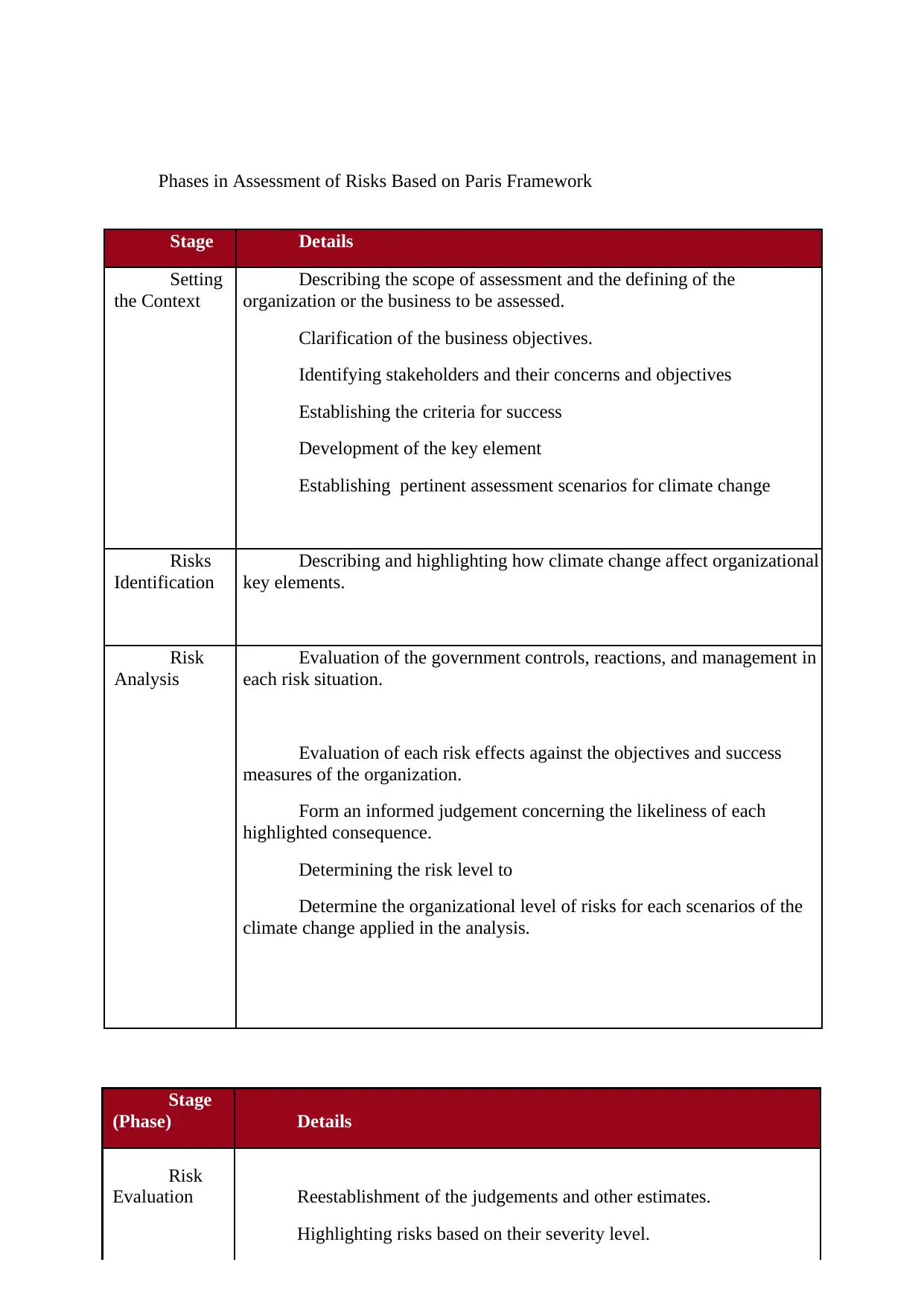
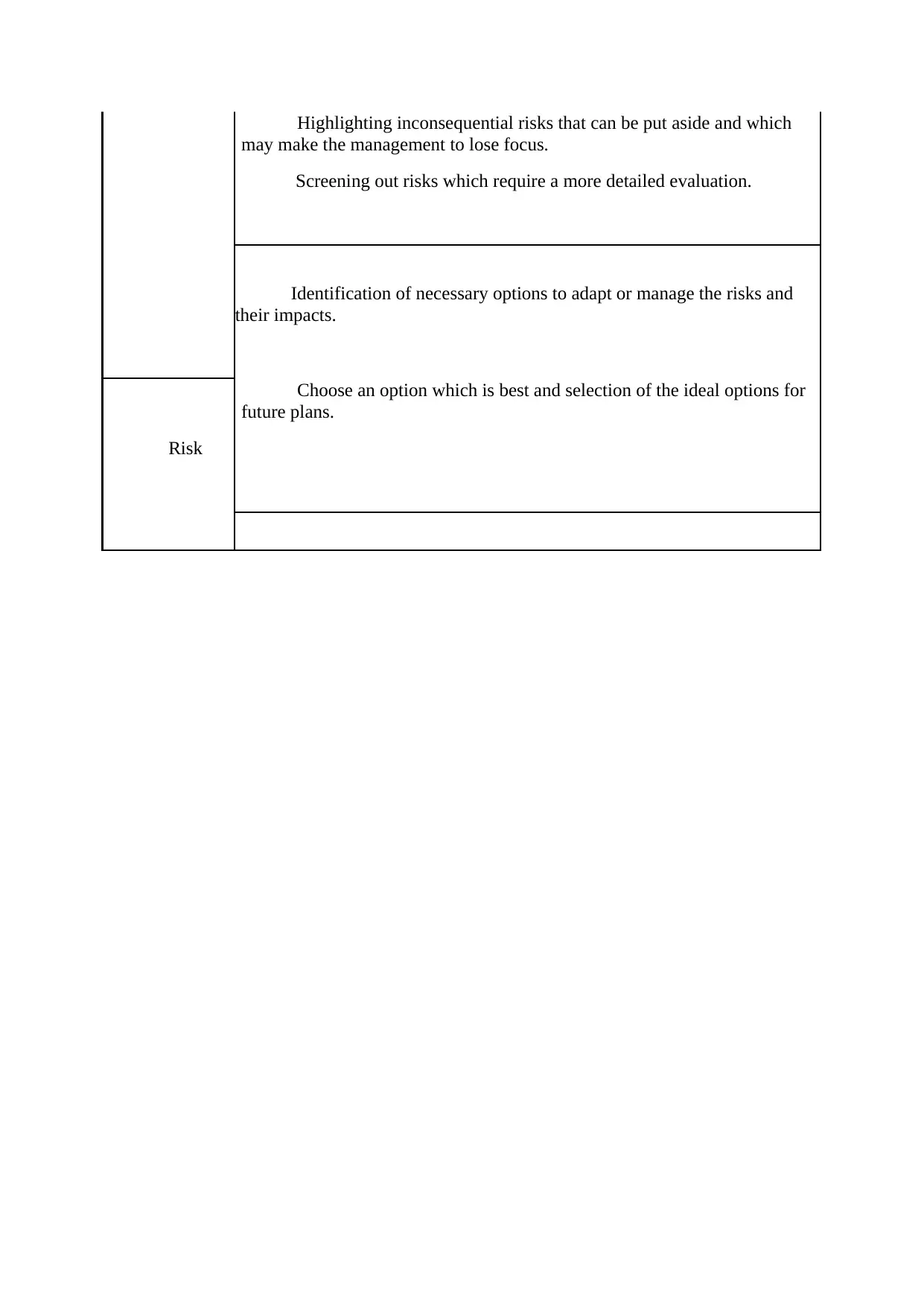
Agreement. On this framework, as shown in the table below, there are five key phases:
Setting the context
Risks identification
Risk analysis
Risk evaluation
Risk treatment
Document Page
Phases in Assessment of Risks Based on Paris Framework
Stage Details
Setting
the Context
Describing the scope of assessment and the defining of the
organization or the business to be assessed.
Clarification of the business objectives.
Identifying stakeholders and their concerns and objectives
Establishing the criteria for success
Development of the key element
Establishing pertinent assessment scenarios for climate change
Risks
Identification
Describing and highlighting how climate change affect organizational
key elements.
Risk
Analysis
Evaluation of the government controls, reactions, and management in
each risk situation.
Evaluation of each risk effects against the objectives and success
measures of the organization.
Form an informed judgement concerning the likeliness of each
highlighted consequence.
Determining the risk level to
Determine the organizational level of risks for each scenarios of the
climate change applied in the analysis.
Stage
(Phase) Details
Risk
Evaluation Reestablishment of the judgements and other estimates.
Highlighting risks based on their severity level.
Document Page
Highlighting inconsequential risks that can be put aside and which
may make the management to lose focus.
Screening out risks which require a more detailed evaluation.
Identification of necessary options to adapt or manage the risks and
their impacts.
Risk
Choose an option which is best and selection of the ideal options for
future plans.
tabler-icon-diamond-filled.svg

Paraphrase This Document

Need a fresh take? Get an instant paraphrase of this document with our AI Paraphraser
Document Page
The predominantly duty of risk assessment framework is to facilitate a
defendable and systematic approach to risk management and adaptation. These
approach is centered on the treatment of organizational risk (Aalst, 2004). The link
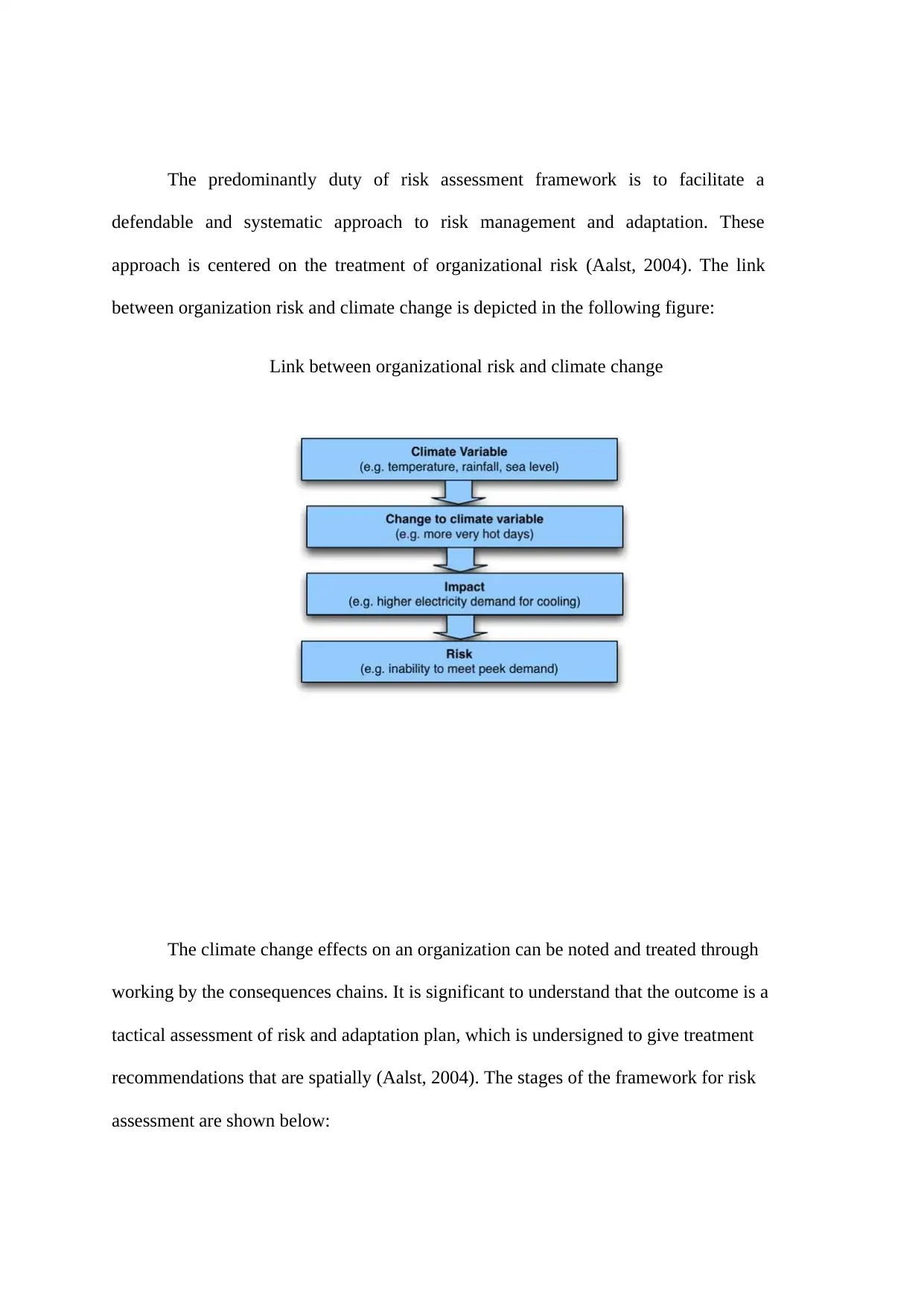
between organization risk and climate change is depicted in the following figure:
Link between organizational risk and climate change
The climate change effects on an organization can be noted and treated through
working by the consequences chains. It is significant to understand that the outcome is a
tactical assessment of risk and adaptation plan, which is undersigned to give treatment
recommendations that are spatially (Aalst, 2004). The stages of the framework for risk
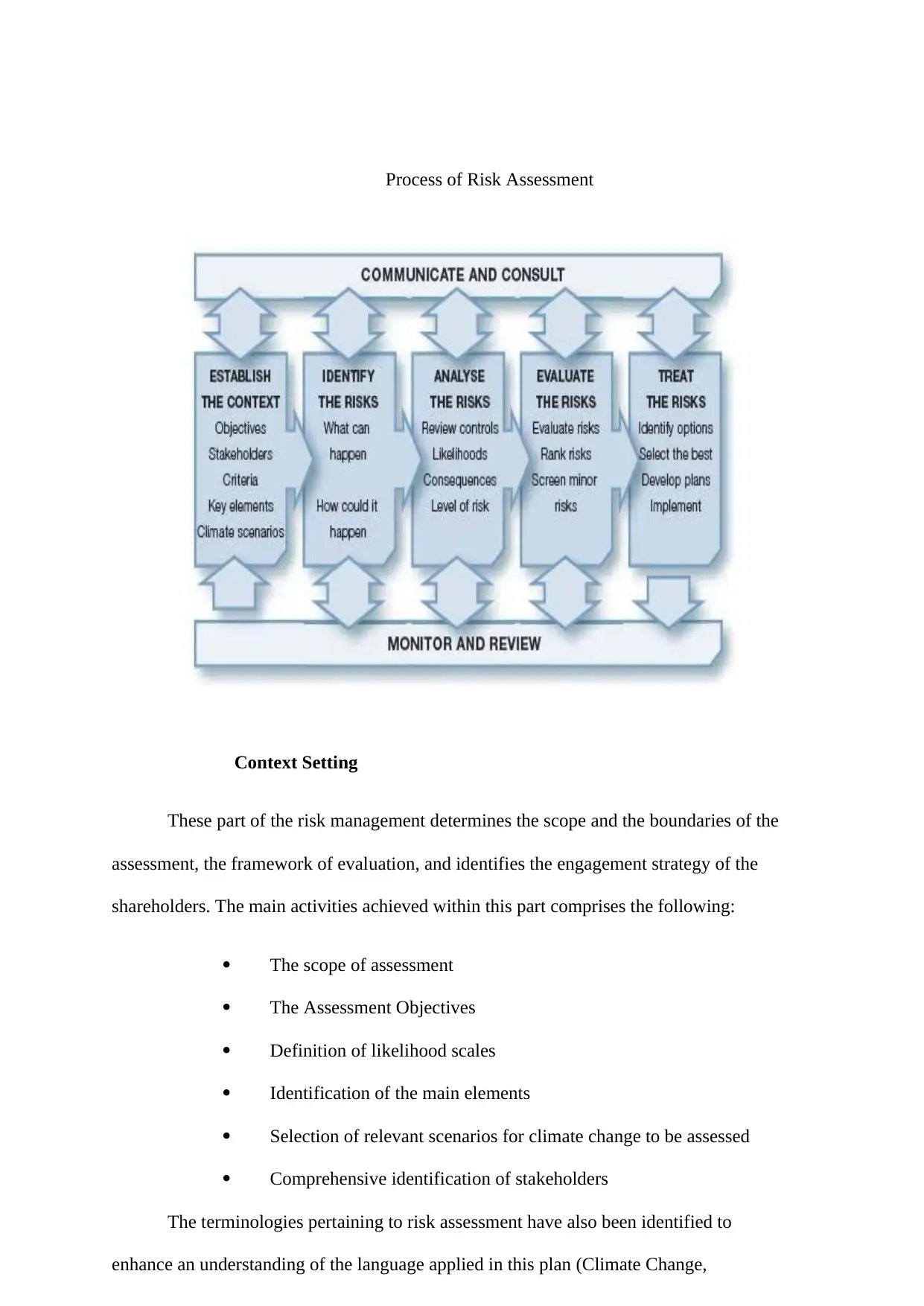
assessment are shown below:
Document Page
Process of Risk Assessment
Context Setting
These part of the risk management determines the scope and the boundaries of the
assessment, the framework of evaluation, and identifies the engagement strategy of the
shareholders. The main activities achieved within this part comprises the following:
The scope of assessment
The Assessment Objectives
Definition of likelihood scales
Identification of the main elements
Selection of relevant scenarios for climate change to be assessed
Comprehensive identification of stakeholders
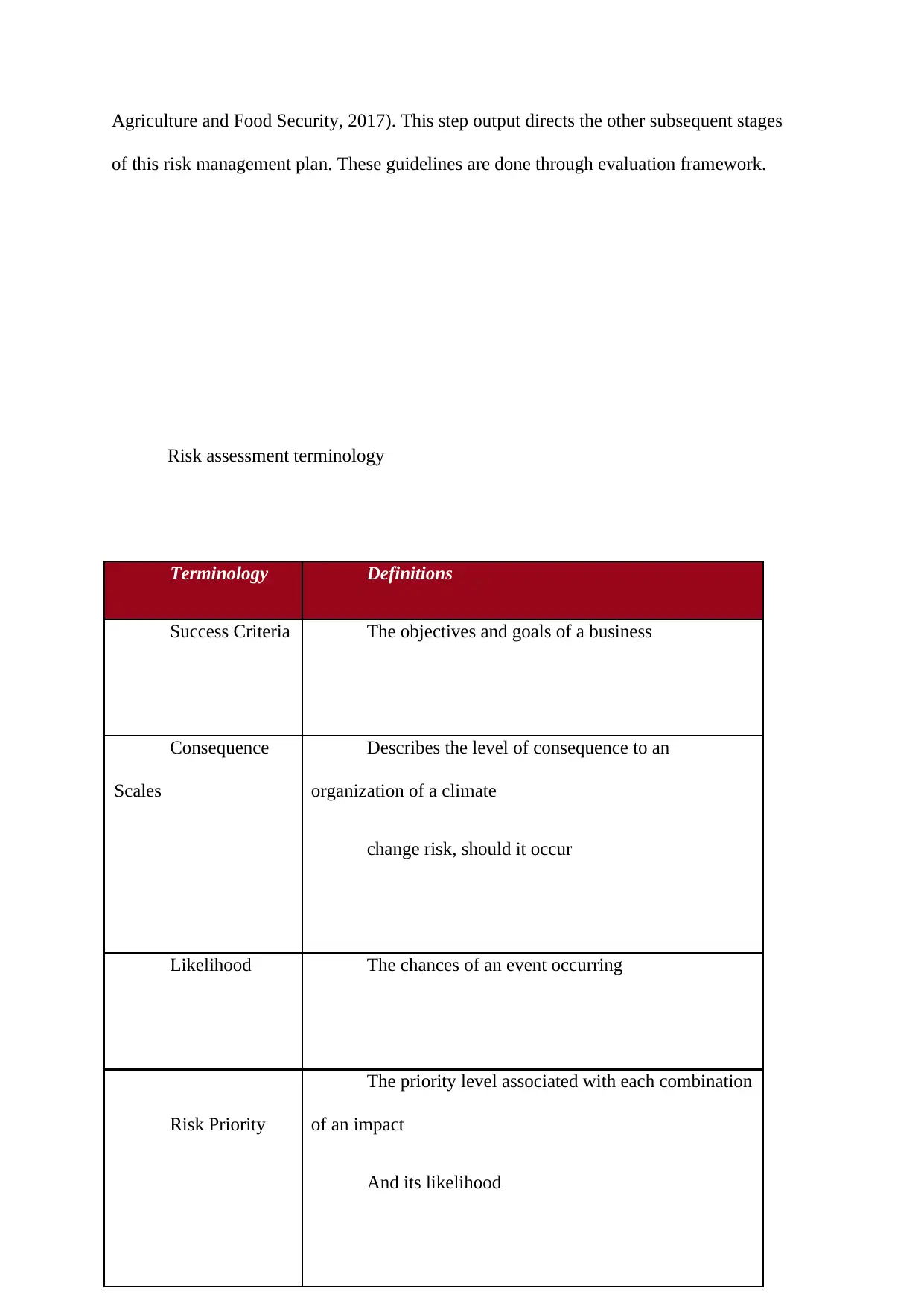
The terminologies pertaining to risk assessment have also been identified to
enhance an understanding of the language applied in this plan (Climate Change,
Document Page
Agriculture and Food Security, 2017). This step output directs the other subsequent stages
of this risk management plan. These guidelines are done through evaluation framework.
Risk assessment terminology
Terminology Definitions
Success Criteria The objectives and goals of a business
Consequence
Scales
Describes the level of consequence to an
organization of a climate
change risk, should it occur
Likelihood The chances of an event occurring
Risk Priority
The priority level associated with each combination
of an impact
And its likelihood
tabler-icon-diamond-filled.svg

Paraphrase This Document

Need a fresh take? Get an instant paraphrase of this document with our AI Paraphraser
Document Page
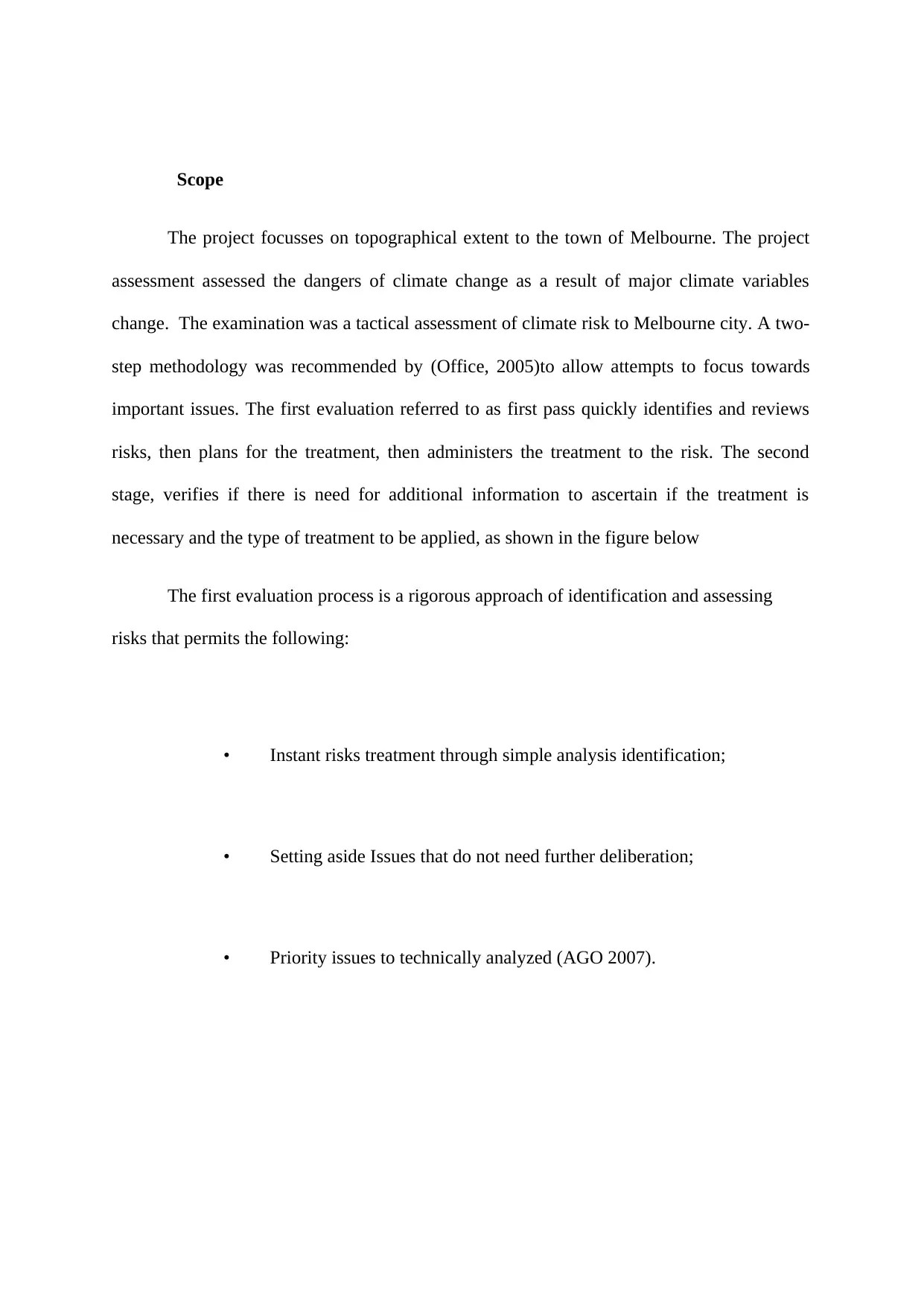
Scope
The project focusses on topographical extent to the town of Melbourne. The project
assessment assessed the dangers of climate change as a result of major climate variables
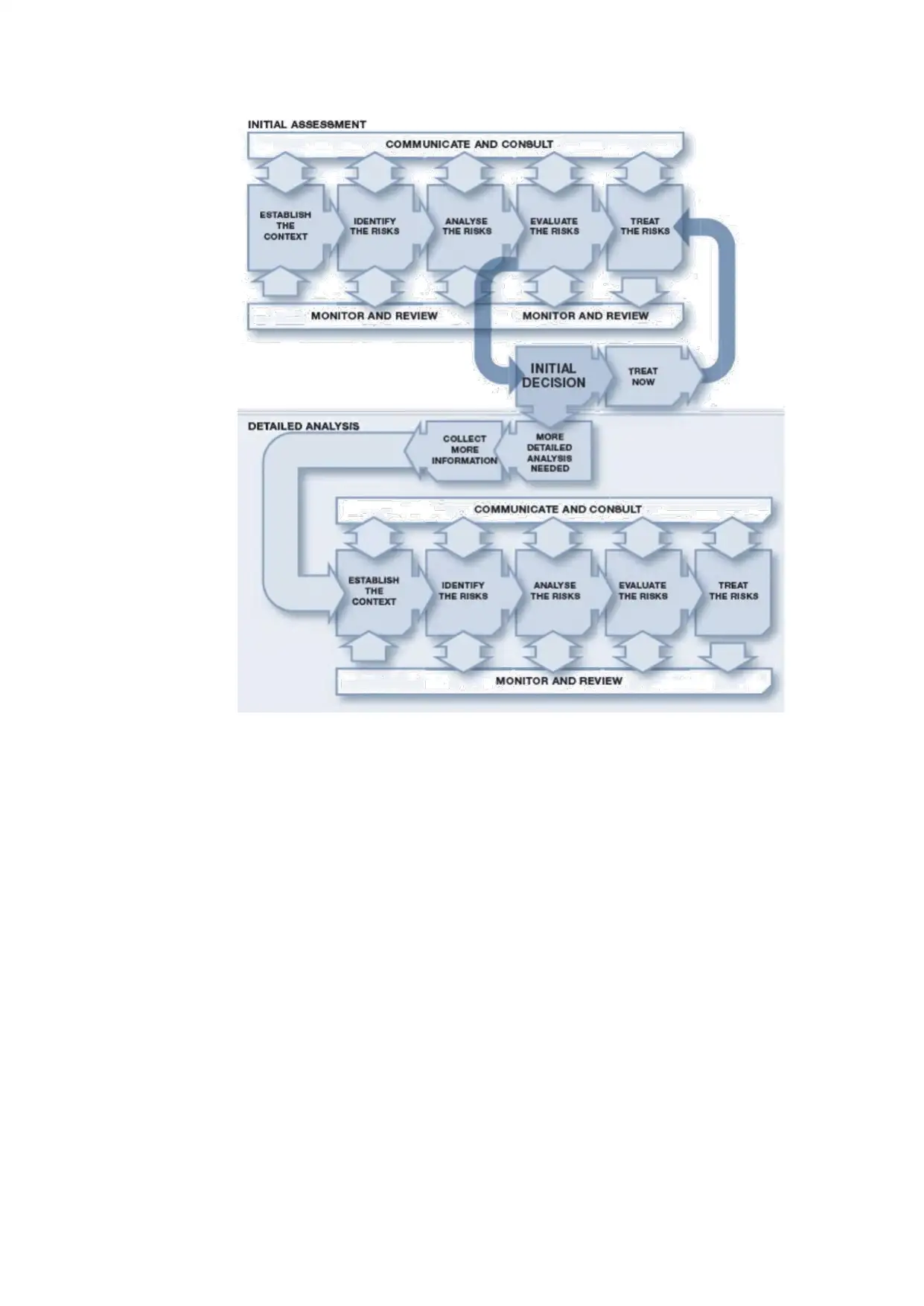
change. The examination was a tactical assessment of climate risk to Melbourne city. A two-
step methodology was recommended by (Office, 2005)to allow attempts to focus towards
important issues. The first evaluation referred to as first pass quickly identifies and reviews
risks, then plans for the treatment, then administers the treatment to the risk. The second
stage, verifies if there is need for additional information to ascertain if the treatment is
necessary and the type of treatment to be applied, as shown in the figure below
The first evaluation process is a rigorous approach of identification and assessing
risks that permits the following:
Instant risks treatment through simple analysis identification;
Setting aside Issues that do not need further deliberation;
Priority issues to technically analyzed (AGO 2007).
Document Page
Document Page
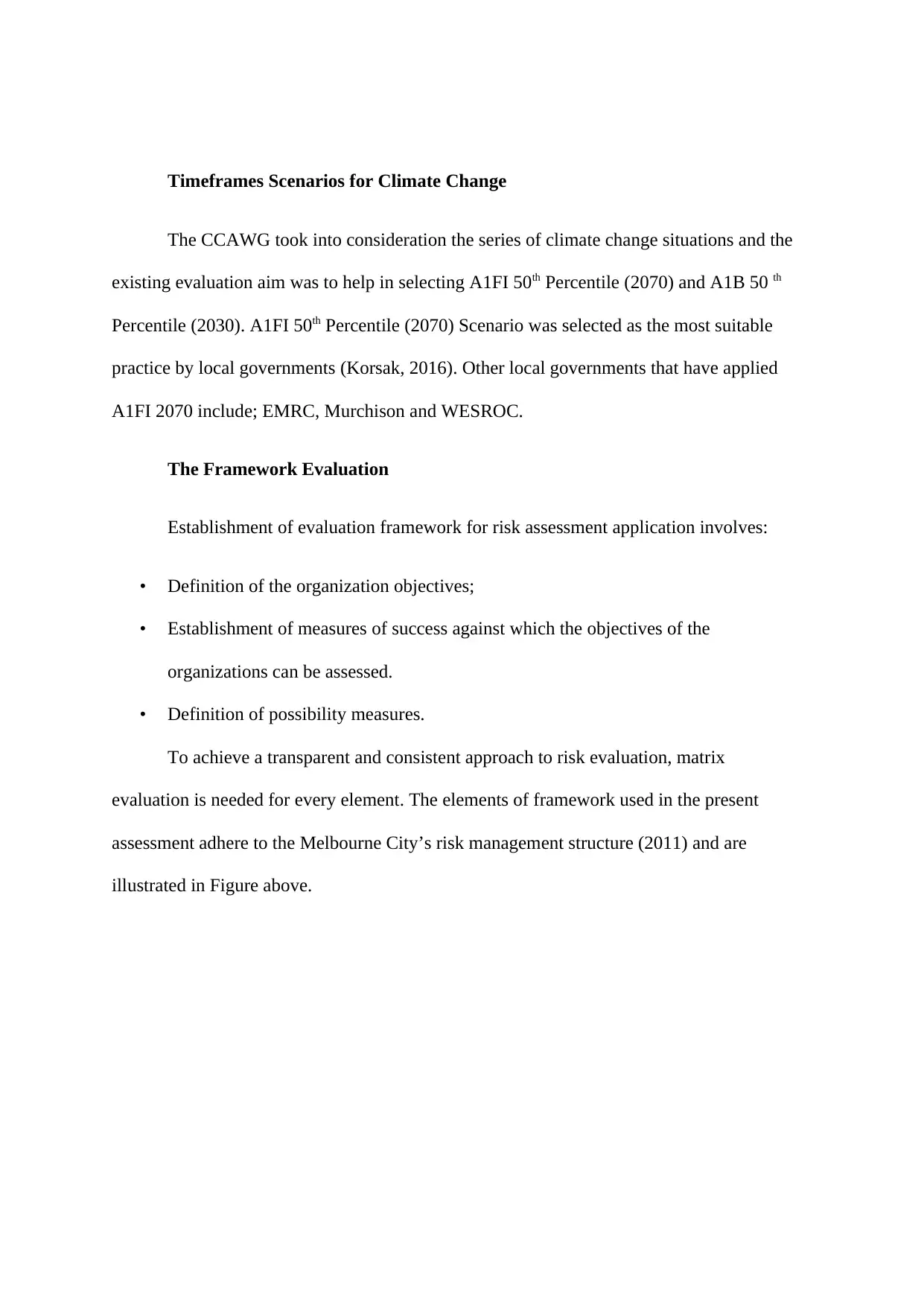
Timeframes Scenarios for Climate Change
The CCAWG took into consideration the series of climate change situations and the
existing evaluation aim was to help in selecting A1FI 50th Percentile (2070) and A1B 50 th
Percentile (2030). A1FI 50th Percentile (2070) Scenario was selected as the most suitable
practice by local governments (Korsak, 2016). Other local governments that have applied
A1FI 2070 include; EMRC, Murchison and WESROC.
The Framework Evaluation
Establishment of evaluation framework for risk assessment application involves:
Definition of the organization objectives;
Establishment of measures of success against which the objectives of the
organizations can be assessed.
Definition of possibility measures.
To achieve a transparent and consistent approach to risk evaluation, matrix
evaluation is needed for every element. The elements of framework used in the present
assessment adhere to the Melbourne City’s risk management structure (2011) and are
illustrated in Figure above.
tabler-icon-diamond-filled.svg

Paraphrase This Document

Need a fresh take? Get an instant paraphrase of this document with our AI Paraphraser
Document Page
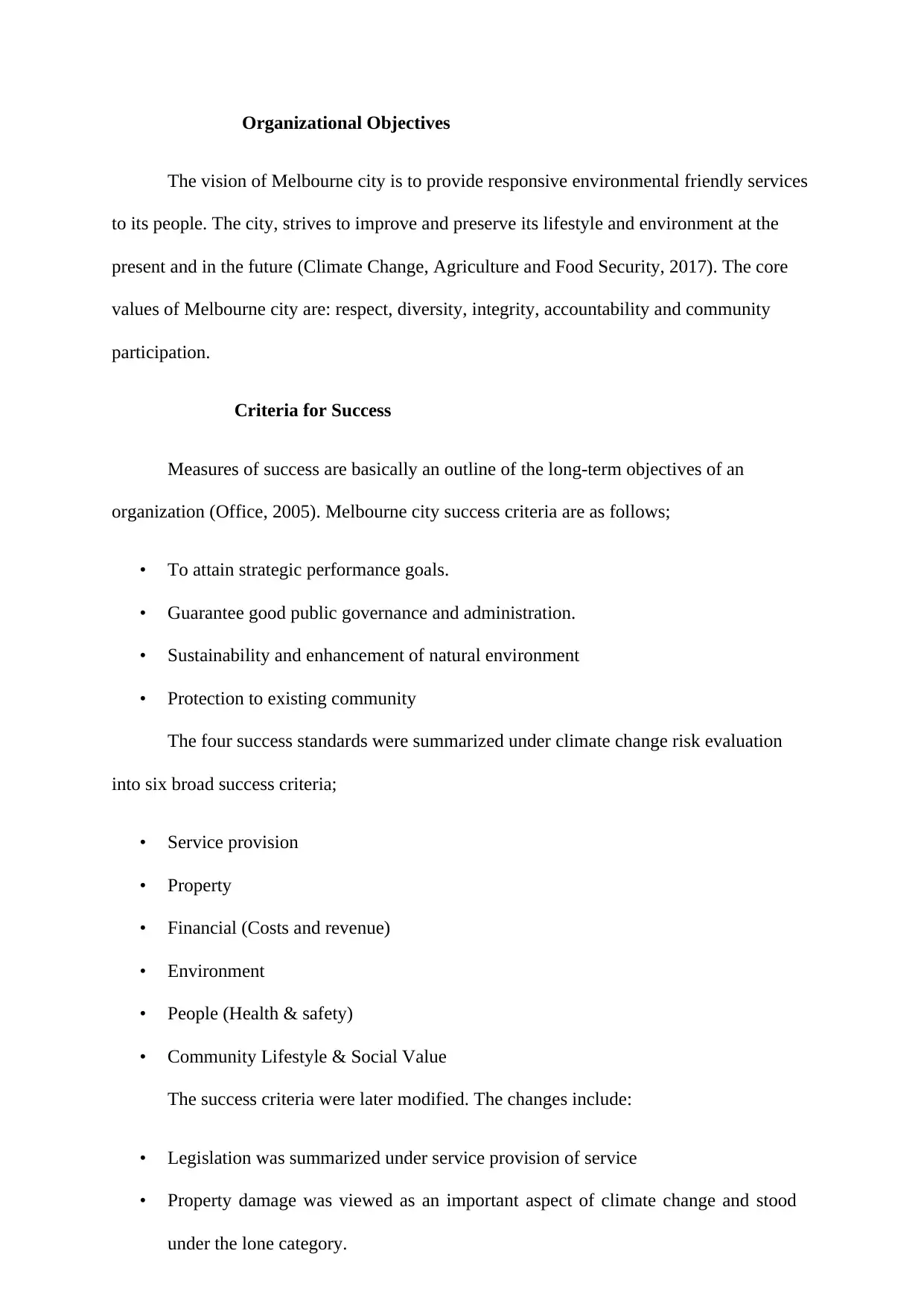
Organizational Objectives
The vision of Melbourne city is to provide responsive environmental friendly services
to its people. The city, strives to improve and preserve its lifestyle and environment at the
present and in the future (Climate Change, Agriculture and Food Security, 2017). The core
values of Melbourne city are: respect, diversity, integrity, accountability and community
participation.
Criteria for Success
Measures of success are basically an outline of the long-term objectives of an
organization (Office, 2005). Melbourne city success criteria are as follows;
To attain strategic performance goals.
Guarantee good public governance and administration.
Sustainability and enhancement of natural environment
Protection to existing community
The four success standards were summarized under climate change risk evaluation
into six broad success criteria;
Service provision
Property
Financial (Costs and revenue)
Environment
People (Health & safety)
Community Lifestyle & Social Value
The success criteria were later modified. The changes include:
Legislation was summarized under service provision of service
Property damage was viewed as an important aspect of climate change and stood
under the lone category.
Document Page
Environment and Financial continued to be consistent across all frameworks.
People capture both broader community and the council staff.
There was an addition of Community lifestyle and Social Value elements that had not
been capture in the initial framework.
Risk Management in Melbourne City follows a flexible standard, where there is
modification of likelihood and consequence evaluation scales (Aalst, 2004). This is
important because it ensures the changes are appropriate in relation to the assessment
framework. This flexible measures makes sure that the parties involved can use suitable
scales. Table 5 illustrates consequence scale adopted.
Scale for the Likelihood of the Risks
Risk is usually demonstrated in terms of:
Occurrence of an event; and
Possibility of the consequence.
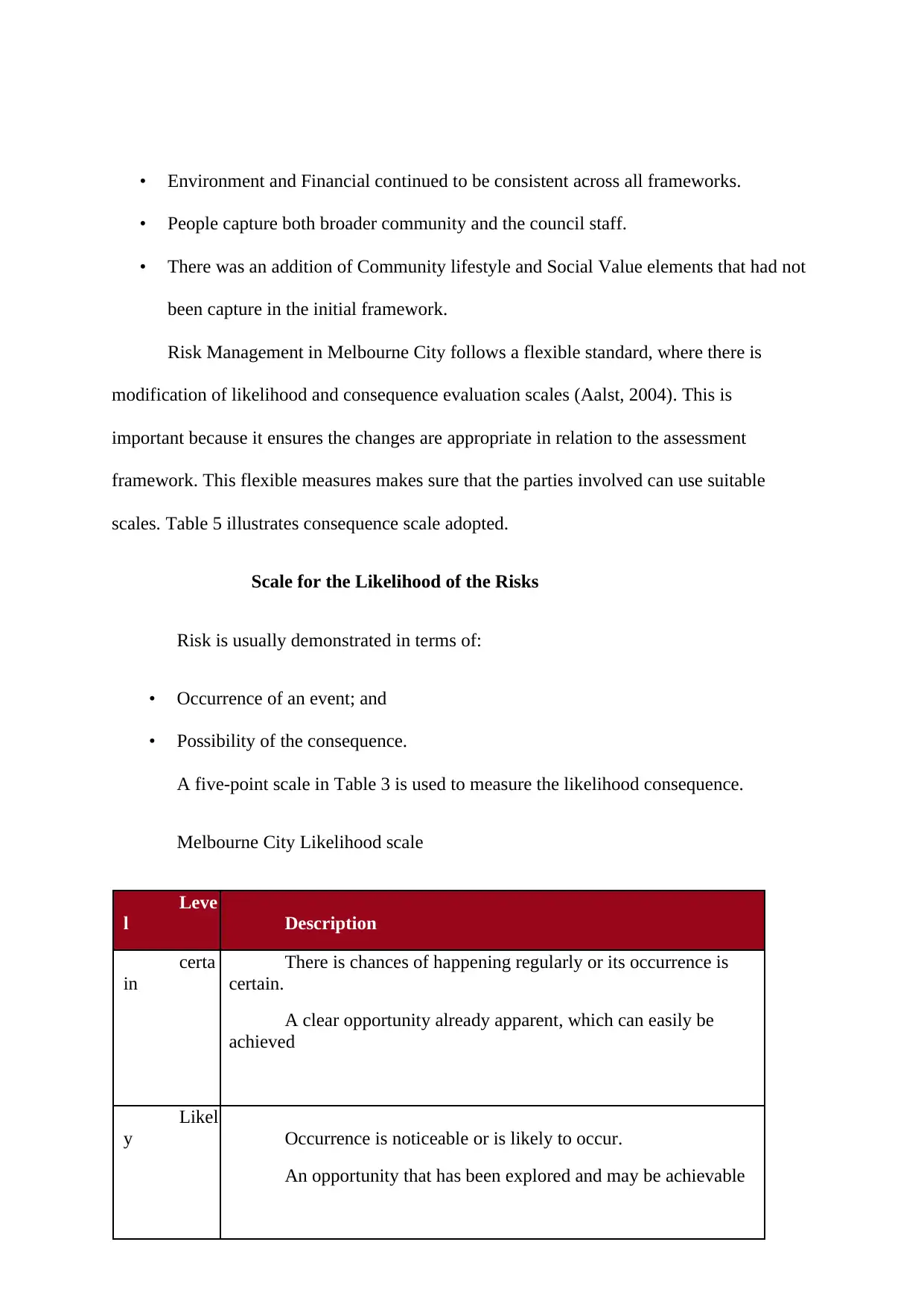
A five-point scale in Table 3 is used to measure the likelihood consequence.
Melbourne City Likelihood scale
Leve
l Description
certa
in
There is chances of happening regularly or its occurrence is
certain.
A clear opportunity already apparent, which can easily be
achieved
Likel
y Occurrence is noticeable or is likely to occur.
An opportunity that has been explored and may be achievable
chevron_up_icon
1 out of 27
circle_padding
hide_on_mobile
zoom_out_icon
[object Object]