Risk Management Assignment Solution for BSBRSK501 Course
VerifiedAdded on 2023/04/25
|13
|3282
|296
Homework Assignment
AI Summary
This document provides a comprehensive solution to a risk management assignment, addressing various aspects of risk management. It begins by defining different types of risks including operational, strategic, and external risks, followed by a discussion of contemporary risk management standards, including the importance of documentation and communication. The assignment explores sources of evidence for risk identification, the components of organizational strategies for risk management, and the PESTEL analysis framework. It also covers stakeholder identification, risk criteria, the importance of communication, and tools for risk identification. Further, the solution details the key functions of risk analysis, the differences between qualitative and quantitative analysis, and the use of likelihood and consequence tables. It also includes the five options for risk treatment, the cost-benefit analysis, and the items to be recognized within a risk organization plan. Finally, it explains the significance of recurrent appraisals of the risk controlling plan and the devices that can be utilized to confirm on-going observing and apprising of the risk organization plan.

Running head: RISK MANAGEMENT
RISK MANAGEMENT
Name of the Student:
Name of the University:
Author Note:
RISK MANAGEMENT
Name of the Student:
Name of the University:
Author Note:

Paraphrase This Document
Need a fresh take? Get an instant paraphrase of this document with our AI Paraphraser
1RISK MANAGEMENT
Questions
1. Enlist two instances of each of the subsequent sorts of threat:
a. Operational hazards
Abrupt communicational burden, let-down of manufacturing sequence,
b. Strategic hazards
Failure in bringing about alteration, failure marketing strategy
c. External hazards
Fiscal dearth, political turmoil
2. Sketch the determination and key essentials of contemporary hazard management standards
The chief determination of the hazard management principles is to assess, analyse and
classify the risks. A precise organization will be counting in an array of documentation practises
and it will consist of expert simplification, effort breakdown enquiry, and brainstorming [1].
Additionally, the hazard handling deeds can be beseeched and prearranged as desirable, across
the lifetime and tenancy of the produce, and the hazard management principles are used to
alleviate some of the opposing effect and influences on accomplishing the objectives. The hazard
management standards are implemented with the aim of successfully extenuating and forestalling
the peril that can have a precarious influence on the growth and advancement of a project.
Documentation of the hazard management, in relation to the risk supervision principles is
differentiated into three dissimilar fragments namely, examining and documentation of perils,
management of the recognised risks, and application of the danger related extenuation strategies,
subject to the needs. The important components of the hazard management procedure comprises
Questions
1. Enlist two instances of each of the subsequent sorts of threat:
a. Operational hazards
Abrupt communicational burden, let-down of manufacturing sequence,
b. Strategic hazards
Failure in bringing about alteration, failure marketing strategy
c. External hazards
Fiscal dearth, political turmoil
2. Sketch the determination and key essentials of contemporary hazard management standards
The chief determination of the hazard management principles is to assess, analyse and
classify the risks. A precise organization will be counting in an array of documentation practises
and it will consist of expert simplification, effort breakdown enquiry, and brainstorming [1].
Additionally, the hazard handling deeds can be beseeched and prearranged as desirable, across
the lifetime and tenancy of the produce, and the hazard management principles are used to
alleviate some of the opposing effect and influences on accomplishing the objectives. The hazard
management standards are implemented with the aim of successfully extenuating and forestalling
the peril that can have a precarious influence on the growth and advancement of a project.
Documentation of the hazard management, in relation to the risk supervision principles is
differentiated into three dissimilar fragments namely, examining and documentation of perils,
management of the recognised risks, and application of the danger related extenuation strategies,
subject to the needs. The important components of the hazard management procedure comprises
2RISK MANAGEMENT
of the complete incorporation of the principles in to the authority arrangement of the institute,
unceasing communication, implementation of hazard management into the decision making
procedure, and unremitting development [2].
3. What are the two mechanisms of hazard management that must happen frequently during the
course of the procedure?
Repeated communications and complete incorporation in the institute's governance assembly
4a. Enlist three sources of evidence that an establishment might use for collecting evidence on
potential risks.
1. Guide 73:2009 Risk management – Vocabulary:
http://infostore.saiglobal.com/store/Details.aspx?ProductID=1378617
2. IEC 31010:2009 Risk management - Risk assessment techniques:
http://infostore.saiglobal.com/store/Details.aspx?ProductID=1382224
3. Risk Management Standard Briefing:
http://www.shortcourses.uts.edu.au/code/coursedetails.php?&sc_code=RISKMGT
b. Sketch the important components and objective of organisational strategies, measures and
procedures for risk management.
The chief goal of hazard management is to classify, examine and assess the risks.
Consequently, the establishments will take into consideration, the practices of brainstorming and
documentation of risks, specialist facilitation, and labour breakdown scrutiny [3]. Although the
foremost components of hazard management consist of complete incorporation of the principles
in to the governance assembly of the association, constant communiqué, implementation of
hazard management into the decision making practice, and incessant enhancement.
of the complete incorporation of the principles in to the authority arrangement of the institute,
unceasing communication, implementation of hazard management into the decision making
procedure, and unremitting development [2].
3. What are the two mechanisms of hazard management that must happen frequently during the
course of the procedure?
Repeated communications and complete incorporation in the institute's governance assembly
4a. Enlist three sources of evidence that an establishment might use for collecting evidence on
potential risks.
1. Guide 73:2009 Risk management – Vocabulary:
http://infostore.saiglobal.com/store/Details.aspx?ProductID=1378617
2. IEC 31010:2009 Risk management - Risk assessment techniques:
http://infostore.saiglobal.com/store/Details.aspx?ProductID=1382224
3. Risk Management Standard Briefing:
http://www.shortcourses.uts.edu.au/code/coursedetails.php?&sc_code=RISKMGT
b. Sketch the important components and objective of organisational strategies, measures and
procedures for risk management.
The chief goal of hazard management is to classify, examine and assess the risks.
Consequently, the establishments will take into consideration, the practices of brainstorming and
documentation of risks, specialist facilitation, and labour breakdown scrutiny [3]. Although the
foremost components of hazard management consist of complete incorporation of the principles
in to the governance assembly of the association, constant communiqué, implementation of
hazard management into the decision making practice, and incessant enhancement.
⊘ This is a preview!⊘
Do you want full access?
Subscribe today to unlock all pages.

Trusted by 1+ million students worldwide

3RISK MANAGEMENT
5. Elucidate and define two objects that are typical constituents for each facet of a PESTEL
examination.
The PESTEL scrutiny refers to (P) political, (E) economic, (S) social, (T) technological,
(E) environmental, and (L) legal. The PESTEL examination therefore involves a scrutiny of
macro-environmental aspects.
Monetary issues are determining factor of a definite economy’s performance. Features
consist of fiscal growth, disposable revenue of consumers, interest rates, inflation rates, exchange
rates, and unemployment rates. These aspects may have a straight or unintended long term
influence on a business, since it disturbs the buying power of customers and could probably alter
the demand/supply facsimiles in the economy. Accordingly, it also creates an impact on the
manner by which different businesses price their merchandises and services. Governmental
aspects are all about by what means and to what degree an administration interferes in the
economy of a definite industry. Essentially all the effects that a administration has on your
commerce could be categorised here. This can comprise of government rule, political constancy
or instability, exploitation, overseas trade policy, tax strategy, labour commandment,
environmental act and trade limitations. [4].
6. Clarify and describe who is a shareholder and what approaches you might use to classify
external and internal stakeholders?
A shareholder can be labelled as a party, having an interest on the business and it can
either get influenced by the industry or affect the trade. The chief stakeholders in a certain
company are the, employees, suppliers, customers and the investors. The contemporary day
philosophy states that the notion of the stakeholders goes beyond the notion of the trade
5. Elucidate and define two objects that are typical constituents for each facet of a PESTEL
examination.
The PESTEL scrutiny refers to (P) political, (E) economic, (S) social, (T) technological,
(E) environmental, and (L) legal. The PESTEL examination therefore involves a scrutiny of
macro-environmental aspects.
Monetary issues are determining factor of a definite economy’s performance. Features
consist of fiscal growth, disposable revenue of consumers, interest rates, inflation rates, exchange
rates, and unemployment rates. These aspects may have a straight or unintended long term
influence on a business, since it disturbs the buying power of customers and could probably alter
the demand/supply facsimiles in the economy. Accordingly, it also creates an impact on the
manner by which different businesses price their merchandises and services. Governmental
aspects are all about by what means and to what degree an administration interferes in the
economy of a definite industry. Essentially all the effects that a administration has on your
commerce could be categorised here. This can comprise of government rule, political constancy
or instability, exploitation, overseas trade policy, tax strategy, labour commandment,
environmental act and trade limitations. [4].
6. Clarify and describe who is a shareholder and what approaches you might use to classify
external and internal stakeholders?
A shareholder can be labelled as a party, having an interest on the business and it can
either get influenced by the industry or affect the trade. The chief stakeholders in a certain
company are the, employees, suppliers, customers and the investors. The contemporary day
philosophy states that the notion of the stakeholders goes beyond the notion of the trade
Paraphrase This Document
Need a fresh take? Get an instant paraphrase of this document with our AI Paraphraser
4RISK MANAGEMENT
associations, government, communities and stakeholder. The stakeholders can be both the
external and internal. The term internal stakeholders refers to individuals whose attentiveness
towards a business comes through the share, possession, employment. On the other hand,
external stakeholders refer to ones that toil with the business but are affected by the activities and
products of the business. The creditors, suppliers, and public groups are measured as the external
shareholders [5].
To recognise a stakeholder, it is vital to realise that internal shareholders are the
individuals who exist within the commerce (manager, investors, and employees). The workers
want to be paid and so they remain engaged in the job, while the proprietors are involved in
earning currency from their asset. In contrast, the external stakeholders encompass individuals
who are not existent within a trade and are influenced by the trade and its performance.
7. Define the connotation of the term ‘risk criteria’ and label its objective?
Hazard Criteria refers to terms of reference (measures, standards, or prospects) used in
construction of a judgement or a conclusion, based on the implication of peril to be evaluated
that could take in the accompanying cost and benefits, lawful and statutory necessities, and the
apprehensions of shareholders. Risk standards are founded on internal and external framework,
and are frequently revised to ensure hazard prevention. Risk standards can also be derived from
ethics, laws and strategies [6].
8. Cite three causes why recurrent communication is imperative to moral risk management.
Decent communication with important shareholders will aid establishment of
expectations, outline the setting of risk management and safeguard their requirements are
considered extremely significant for buying in. During the course of the hazard management
associations, government, communities and stakeholder. The stakeholders can be both the
external and internal. The term internal stakeholders refers to individuals whose attentiveness
towards a business comes through the share, possession, employment. On the other hand,
external stakeholders refer to ones that toil with the business but are affected by the activities and
products of the business. The creditors, suppliers, and public groups are measured as the external
shareholders [5].
To recognise a stakeholder, it is vital to realise that internal shareholders are the
individuals who exist within the commerce (manager, investors, and employees). The workers
want to be paid and so they remain engaged in the job, while the proprietors are involved in
earning currency from their asset. In contrast, the external stakeholders encompass individuals
who are not existent within a trade and are influenced by the trade and its performance.
7. Define the connotation of the term ‘risk criteria’ and label its objective?
Hazard Criteria refers to terms of reference (measures, standards, or prospects) used in
construction of a judgement or a conclusion, based on the implication of peril to be evaluated
that could take in the accompanying cost and benefits, lawful and statutory necessities, and the
apprehensions of shareholders. Risk standards are founded on internal and external framework,
and are frequently revised to ensure hazard prevention. Risk standards can also be derived from
ethics, laws and strategies [6].
8. Cite three causes why recurrent communication is imperative to moral risk management.
Decent communication with important shareholders will aid establishment of
expectations, outline the setting of risk management and safeguard their requirements are
considered extremely significant for buying in. During the course of the hazard management
5RISK MANAGEMENT
procedure, numerous transcribed and verbal infrastructures amid the danger manager, hazard
owner and shareholders will endure to happen [4]. This is in relation to appointing internal and
external shareholders all over the risk management procedure [7].
9. Classify and clarify five apparatuses that you might use in order to classify risks.
The documentation of the risk includes the usage of both the formal and informal
methods. The selections of the risk documentation tool must be capable to regulate the complete
risk of the business.
Tools used in the recognition of risks are paper reviews- the standard exercise of the
hazard identification comprises of going through the plan and the associated documents, such
programs include the administrative process resources, and message learnt; root cause
investigation- from the documentation of the risk, root source is recognized. The root cause also
aids in the documentation of the supplementary risks. Worksheet examination- it is a agenda of
categories and is related with recognition of the projects, and thus aids in hazard identification;
interrogating- consultation is conducted with the contributors, specialists and the shareholders of
the project; brainstorming- it typically conducted among a group of individuals that emphasise
on the documentation of the risk in a scheme.
10. What are the chief works of a risk analysis?
Observing and reviewing, risk analysis, assessment of hazard along with improving
communication, continuous improvement, and planning risk management as well as developing
appropriate guidelines for the mandatory management of hazard risk and managent.
11. State the differences in between qualitative and quantitative hazard analysis?
procedure, numerous transcribed and verbal infrastructures amid the danger manager, hazard
owner and shareholders will endure to happen [4]. This is in relation to appointing internal and
external shareholders all over the risk management procedure [7].
9. Classify and clarify five apparatuses that you might use in order to classify risks.
The documentation of the risk includes the usage of both the formal and informal
methods. The selections of the risk documentation tool must be capable to regulate the complete
risk of the business.
Tools used in the recognition of risks are paper reviews- the standard exercise of the
hazard identification comprises of going through the plan and the associated documents, such
programs include the administrative process resources, and message learnt; root cause
investigation- from the documentation of the risk, root source is recognized. The root cause also
aids in the documentation of the supplementary risks. Worksheet examination- it is a agenda of
categories and is related with recognition of the projects, and thus aids in hazard identification;
interrogating- consultation is conducted with the contributors, specialists and the shareholders of
the project; brainstorming- it typically conducted among a group of individuals that emphasise
on the documentation of the risk in a scheme.
10. What are the chief works of a risk analysis?
Observing and reviewing, risk analysis, assessment of hazard along with improving
communication, continuous improvement, and planning risk management as well as developing
appropriate guidelines for the mandatory management of hazard risk and managent.
11. State the differences in between qualitative and quantitative hazard analysis?
⊘ This is a preview!⊘
Do you want full access?
Subscribe today to unlock all pages.
Trusted by 1+ million students worldwide
6RISK MANAGEMENT
Qualitative risk examination is a procedure that encompasses of cumulative risks which
are identified during risk assessment. The quantitative risk analysis procedure reveals the risks
which are recognised and are sent for future analysis and assessment within the process of
qualitative risk assessment. The qualitative risk analysis procedure on the other hand does not
assess the risks arithmetically and does not consider the distribution of the prospect of the inputs
from the stakeholders. Relatively it is utilized for estimating the effect as well as the probability.
The quantitative risk examination uses the likelihood disseminations that are described as the
impact and possibility. Quantitative risk valuation envisages the consequence of the schemes in
financial terms with respect to time. It also guesses the chances of the cumulative effects of
hazardous risks. Qualitative risk valuation therefore assists in meeting the contingency needs and
setting targets so as to ensure that a desired area of comfort could be achieved [8].
12. Why should you use a likelihood and consequence table?
A probability and significance table is utilised to measure the jeopardy and its events the
level of hazard by classifying the possibility and likelihood of incidence of a hazard as well as
the brutality of the risk. The straightforward tool will upsurge the visibility of the risk and
support the judgement creation of the organisation.
13. What are the five options for hazard treatment?
The five options of risk management critically include the following: Ignoring the risk by
the risk by avoidance, handling of risks, adjusting the possibility, sharing the fundamentals of the
hazards and fluctuating the magnitudes. While the residual portion of the risk valuation would be
a risk craving.
14. What is meant by the cost-benefit analysis?
Qualitative risk examination is a procedure that encompasses of cumulative risks which
are identified during risk assessment. The quantitative risk analysis procedure reveals the risks
which are recognised and are sent for future analysis and assessment within the process of
qualitative risk assessment. The qualitative risk analysis procedure on the other hand does not
assess the risks arithmetically and does not consider the distribution of the prospect of the inputs
from the stakeholders. Relatively it is utilized for estimating the effect as well as the probability.
The quantitative risk examination uses the likelihood disseminations that are described as the
impact and possibility. Quantitative risk valuation envisages the consequence of the schemes in
financial terms with respect to time. It also guesses the chances of the cumulative effects of
hazardous risks. Qualitative risk valuation therefore assists in meeting the contingency needs and
setting targets so as to ensure that a desired area of comfort could be achieved [8].
12. Why should you use a likelihood and consequence table?
A probability and significance table is utilised to measure the jeopardy and its events the
level of hazard by classifying the possibility and likelihood of incidence of a hazard as well as
the brutality of the risk. The straightforward tool will upsurge the visibility of the risk and
support the judgement creation of the organisation.
13. What are the five options for hazard treatment?
The five options of risk management critically include the following: Ignoring the risk by
the risk by avoidance, handling of risks, adjusting the possibility, sharing the fundamentals of the
hazards and fluctuating the magnitudes. While the residual portion of the risk valuation would be
a risk craving.
14. What is meant by the cost-benefit analysis?
Paraphrase This Document
Need a fresh take? Get an instant paraphrase of this document with our AI Paraphraser
7RISK MANAGEMENT
Cost benefit examination can be defined as the corporate procedure which is used in the
investigation of the choices. It is also utilised by a few of the advisors who put a dollar worth in
front of immaterial articles [9].
15. What issues should be measured when piloting a cost–benefit examination?
Direct costs (action, facility, client and invention), unintended costs, perceptible costs
(procuring tools), imperceptible costs (client gratification), and the actual charges (employment
prices) [10].
16. Classify and elucidate five items that must be recognized within a risk organization plan.
The five chief items that necessities to be recognised in a hazard management strategy
are:
Accountabilities and roles- Project administrator will possess the accountability
that can be deputized to different members of a team or to a professional. The
third party hazard administration teams would not be capable to perform the
impartial, self-governing risk analysis which can be backed by a probable team
[11].
Timing- This describes that the preliminary risk organization will be achieved
along with risk administration process and life revolution and it should be
established to move the choices.
Accounting- the risk administration plan must possess a economical plan since the
it is also imperative to guess the risk accomplished and financial plan estimate.
Cost benefit examination can be defined as the corporate procedure which is used in the
investigation of the choices. It is also utilised by a few of the advisors who put a dollar worth in
front of immaterial articles [9].
15. What issues should be measured when piloting a cost–benefit examination?
Direct costs (action, facility, client and invention), unintended costs, perceptible costs
(procuring tools), imperceptible costs (client gratification), and the actual charges (employment
prices) [10].
16. Classify and elucidate five items that must be recognized within a risk organization plan.
The five chief items that necessities to be recognised in a hazard management strategy
are:
Accountabilities and roles- Project administrator will possess the accountability
that can be deputized to different members of a team or to a professional. The
third party hazard administration teams would not be capable to perform the
impartial, self-governing risk analysis which can be backed by a probable team
[11].
Timing- This describes that the preliminary risk organization will be achieved
along with risk administration process and life revolution and it should be
established to move the choices.
Accounting- the risk administration plan must possess a economical plan since the
it is also imperative to guess the risk accomplished and financial plan estimate.
8RISK MANAGEMENT
Clarification and counting- the marks and the explanation are all significant for
the measureable and subjective data of risk management. The counting and
approaches are resolute earlier so that steadiness can be maintained.
Following and appraising- certification of the dissimilar surfaces of the risk events
will be documented so that the requirement of the project in the forthcoming years
and the instructions assimilated from can be defined as well as the risk procedure
can be checked [12].
17. Why is it significant to guarantee recurrent appraisals of the risk controlling plan?
It is significant to inform, control and examine the risk administration strategy in order to
critically view the hazards connected with the actions of the manufacturing, commercial and
situation. While revising the risk organization plan is indispensable to the documentation of the
novel hazards and observing of the efficiency of the approaches of threat management.
18. Describe two devices that can be utilized to confirm on-going observing and apprising of the
risk organization plan.
The two mechanisms that can be used to ensure the updating and monitoring the risk
management plan are as follows:
Discussion and announcement- it comprises fetching the outside and the internal
shareholders through the risk supervision procedure that will benefit the shareholders to
outline their anticipation rendering to the threat organization procedure. It encourages a
advice-giving team technique as well.
Clarification and counting- the marks and the explanation are all significant for
the measureable and subjective data of risk management. The counting and
approaches are resolute earlier so that steadiness can be maintained.
Following and appraising- certification of the dissimilar surfaces of the risk events
will be documented so that the requirement of the project in the forthcoming years
and the instructions assimilated from can be defined as well as the risk procedure
can be checked [12].
17. Why is it significant to guarantee recurrent appraisals of the risk controlling plan?
It is significant to inform, control and examine the risk administration strategy in order to
critically view the hazards connected with the actions of the manufacturing, commercial and
situation. While revising the risk organization plan is indispensable to the documentation of the
novel hazards and observing of the efficiency of the approaches of threat management.
18. Describe two devices that can be utilized to confirm on-going observing and apprising of the
risk organization plan.
The two mechanisms that can be used to ensure the updating and monitoring the risk
management plan are as follows:
Discussion and announcement- it comprises fetching the outside and the internal
shareholders through the risk supervision procedure that will benefit the shareholders to
outline their anticipation rendering to the threat organization procedure. It encourages a
advice-giving team technique as well.
⊘ This is a preview!⊘
Do you want full access?
Subscribe today to unlock all pages.
Trusted by 1+ million students worldwide
9RISK MANAGEMENT
Scheming of a risk running outline- Sympathetic and an actual policy is applied to
describe the risk supervision with the appropriate risk organization outline. Thus, serving
in the scheming an actual outline helps in the organization of the hazards [13].
19. In other words, define the subsequent kinds of the legislature, codes of exercise and
national ideals which transmit to risk supervision in an organisation and deliver instances
in what way they apply:
Legislation Description and Examples
(a) Duty of Care Duty of Care is to show concern for the different employees, or
consumers. For example, nurses showing care to patients.
(b) Company Law Company law is law bestowing to which the firms achieve their
commercial purposes. For example company acts and ethics.
(c) Contract Law Contract laws are the rules on the basis of which the business
parties enter into agreements. For example fair acts policies.
(d) Environmental
Law
Laws that are unambiguously outlined so that the corporations
and business are achieved with destruction to the situation. For
example, acts on pollution, and policies of emission
(d) Privacy Law Privacy laws are set of rules and rules that are monitored to
value the confidentiality of the clienteles and sponsors. For
example, unethical aberration of information.
(e) Freedom of
information
Freedom of information is the elementary set of instructions that
provide accurate information to the general people so that they
Scheming of a risk running outline- Sympathetic and an actual policy is applied to
describe the risk supervision with the appropriate risk organization outline. Thus, serving
in the scheming an actual outline helps in the organization of the hazards [13].
19. In other words, define the subsequent kinds of the legislature, codes of exercise and
national ideals which transmit to risk supervision in an organisation and deliver instances
in what way they apply:
Legislation Description and Examples
(a) Duty of Care Duty of Care is to show concern for the different employees, or
consumers. For example, nurses showing care to patients.
(b) Company Law Company law is law bestowing to which the firms achieve their
commercial purposes. For example company acts and ethics.
(c) Contract Law Contract laws are the rules on the basis of which the business
parties enter into agreements. For example fair acts policies.
(d) Environmental
Law
Laws that are unambiguously outlined so that the corporations
and business are achieved with destruction to the situation. For
example, acts on pollution, and policies of emission
(d) Privacy Law Privacy laws are set of rules and rules that are monitored to
value the confidentiality of the clienteles and sponsors. For
example, unethical aberration of information.
(e) Freedom of
information
Freedom of information is the elementary set of instructions that
provide accurate information to the general people so that they
Paraphrase This Document
Need a fresh take? Get an instant paraphrase of this document with our AI Paraphraser
10RISK MANAGEMENT
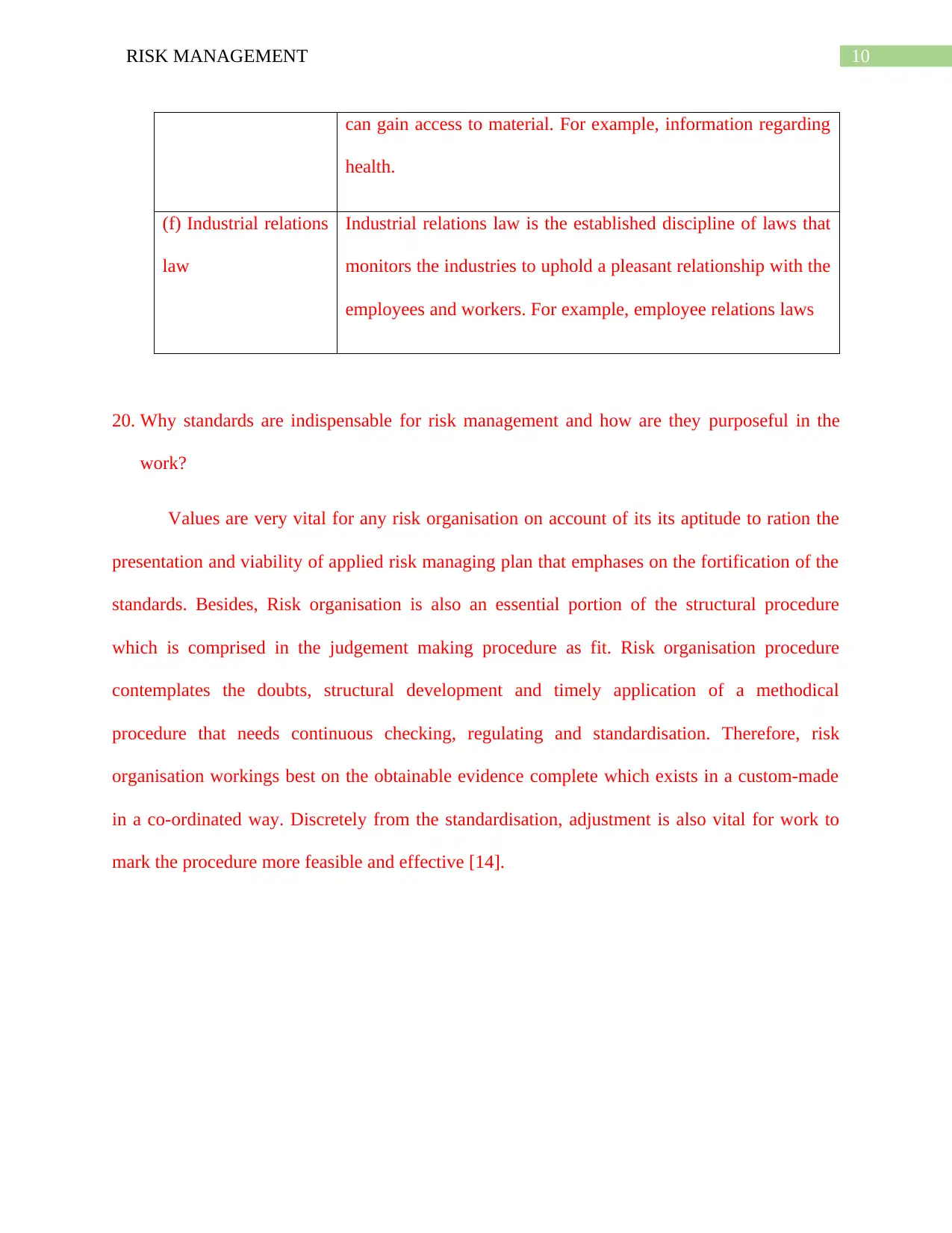
can gain access to material. For example, information regarding
health.
(f) Industrial relations
law
Industrial relations law is the established discipline of laws that
monitors the industries to uphold a pleasant relationship with the
employees and workers. For example, employee relations laws
20. Why standards are indispensable for risk management and how are they purposeful in the
work?
Values are very vital for any risk organisation on account of its its aptitude to ration the
presentation and viability of applied risk managing plan that emphases on the fortification of the
standards. Besides, Risk organisation is also an essential portion of the structural procedure
which is comprised in the judgement making procedure as fit. Risk organisation procedure
contemplates the doubts, structural development and timely application of a methodical
procedure that needs continuous checking, regulating and standardisation. Therefore, risk
organisation workings best on the obtainable evidence complete which exists in a custom-made
in a co-ordinated way. Discretely from the standardisation, adjustment is also vital for work to
mark the procedure more feasible and effective [14].
can gain access to material. For example, information regarding
health.
(f) Industrial relations
law
Industrial relations law is the established discipline of laws that
monitors the industries to uphold a pleasant relationship with the
employees and workers. For example, employee relations laws
20. Why standards are indispensable for risk management and how are they purposeful in the
work?
Values are very vital for any risk organisation on account of its its aptitude to ration the
presentation and viability of applied risk managing plan that emphases on the fortification of the
standards. Besides, Risk organisation is also an essential portion of the structural procedure
which is comprised in the judgement making procedure as fit. Risk organisation procedure
contemplates the doubts, structural development and timely application of a methodical
procedure that needs continuous checking, regulating and standardisation. Therefore, risk
organisation workings best on the obtainable evidence complete which exists in a custom-made
in a co-ordinated way. Discretely from the standardisation, adjustment is also vital for work to
mark the procedure more feasible and effective [14].
11RISK MANAGEMENT
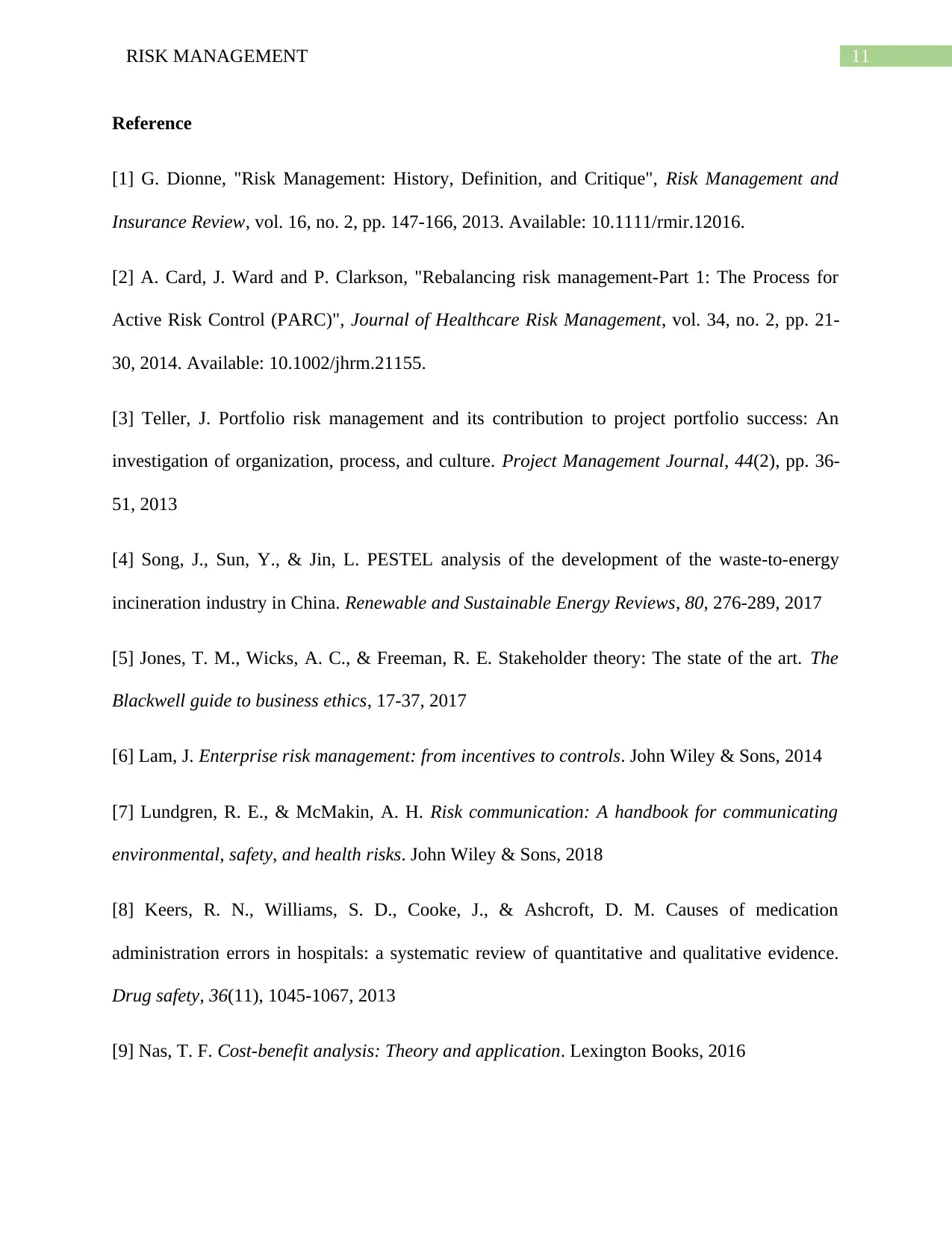
Reference
[1] G. Dionne, "Risk Management: History, Definition, and Critique", Risk Management and
Insurance Review, vol. 16, no. 2, pp. 147-166, 2013. Available: 10.1111/rmir.12016.
[2] A. Card, J. Ward and P. Clarkson, "Rebalancing risk management-Part 1: The Process for
Active Risk Control (PARC)", Journal of Healthcare Risk Management, vol. 34, no. 2, pp. 21-
30, 2014. Available: 10.1002/jhrm.21155.
[3] Teller, J. Portfolio risk management and its contribution to project portfolio success: An
investigation of organization, process, and culture. Project Management Journal, 44(2), pp. 36-
51, 2013
[4] Song, J., Sun, Y., & Jin, L. PESTEL analysis of the development of the waste-to-energy
incineration industry in China. Renewable and Sustainable Energy Reviews, 80, 276-289, 2017
[5] Jones, T. M., Wicks, A. C., & Freeman, R. E. Stakeholder theory: The state of the art. The
Blackwell guide to business ethics, 17-37, 2017
[6] Lam, J. Enterprise risk management: from incentives to controls. John Wiley & Sons, 2014
[7] Lundgren, R. E., & McMakin, A. H. Risk communication: A handbook for communicating
environmental, safety, and health risks. John Wiley & Sons, 2018
[8] Keers, R. N., Williams, S. D., Cooke, J., & Ashcroft, D. M. Causes of medication
administration errors in hospitals: a systematic review of quantitative and qualitative evidence.
Drug safety, 36(11), 1045-1067, 2013
[9] Nas, T. F. Cost-benefit analysis: Theory and application. Lexington Books, 2016
Reference
[1] G. Dionne, "Risk Management: History, Definition, and Critique", Risk Management and
Insurance Review, vol. 16, no. 2, pp. 147-166, 2013. Available: 10.1111/rmir.12016.
[2] A. Card, J. Ward and P. Clarkson, "Rebalancing risk management-Part 1: The Process for
Active Risk Control (PARC)", Journal of Healthcare Risk Management, vol. 34, no. 2, pp. 21-
30, 2014. Available: 10.1002/jhrm.21155.
[3] Teller, J. Portfolio risk management and its contribution to project portfolio success: An
investigation of organization, process, and culture. Project Management Journal, 44(2), pp. 36-
51, 2013
[4] Song, J., Sun, Y., & Jin, L. PESTEL analysis of the development of the waste-to-energy
incineration industry in China. Renewable and Sustainable Energy Reviews, 80, 276-289, 2017
[5] Jones, T. M., Wicks, A. C., & Freeman, R. E. Stakeholder theory: The state of the art. The
Blackwell guide to business ethics, 17-37, 2017
[6] Lam, J. Enterprise risk management: from incentives to controls. John Wiley & Sons, 2014
[7] Lundgren, R. E., & McMakin, A. H. Risk communication: A handbook for communicating
environmental, safety, and health risks. John Wiley & Sons, 2018
[8] Keers, R. N., Williams, S. D., Cooke, J., & Ashcroft, D. M. Causes of medication
administration errors in hospitals: a systematic review of quantitative and qualitative evidence.
Drug safety, 36(11), 1045-1067, 2013
[9] Nas, T. F. Cost-benefit analysis: Theory and application. Lexington Books, 2016
⊘ This is a preview!⊘
Do you want full access?
Subscribe today to unlock all pages.
Trusted by 1+ million students worldwide

1 out of 13


Your All-in-One AI-Powered Toolkit for Academic Success.
+13062052269
info@desklib.com
Available 24*7 on WhatsApp / Email
![[object Object]](/_next/static/media/star-bottom.7253800d.svg)
Unlock your academic potential
Copyright © 2020–2026 A2Z Services. All Rights Reserved. Developed and managed by ZUCOL.