Significance of Risk Management in Project: A Detailed Report
VerifiedAdded on 2023/06/11
|15
|4323
|65
Report
AI Summary
This report provides a comprehensive overview of risk management in project development, emphasizing the significance of identifying, analyzing, and mitigating risks to ensure project success. It discusses the definition of risk, the scope of risk management, and the importance of managing both positive and negative risks. The report covers various risk types, sources, and the perception of risk, highlighting the role of calculated risks and their limitations. It details the project risk management cycle, including risk identification, qualitative and quantitative analysis, response strategies (avoidance, acceptance, transference, mitigation, exploitation, sharing, enhancement), and monitoring and controlling risks. The importance of developing a risk matrix is emphasized, along with a comprehensive review of literature on risk management. Desklib offers this and many other solved assignments to aid students in their studies.
Running head: RISK MANAGEMENT IN THE PROJECT
RISK MANAGEMENT IN THE PROJECT
Name of the Student:
Name of the University:
Author Note:
RISK MANAGEMENT IN THE PROJECT
Name of the Student:
Name of the University:
Author Note:

Paraphrase This Document
Need a fresh take? Get an instant paraphrase of this document with our AI Paraphraser
1RISK MANAGEMENT IN THE PROJECT
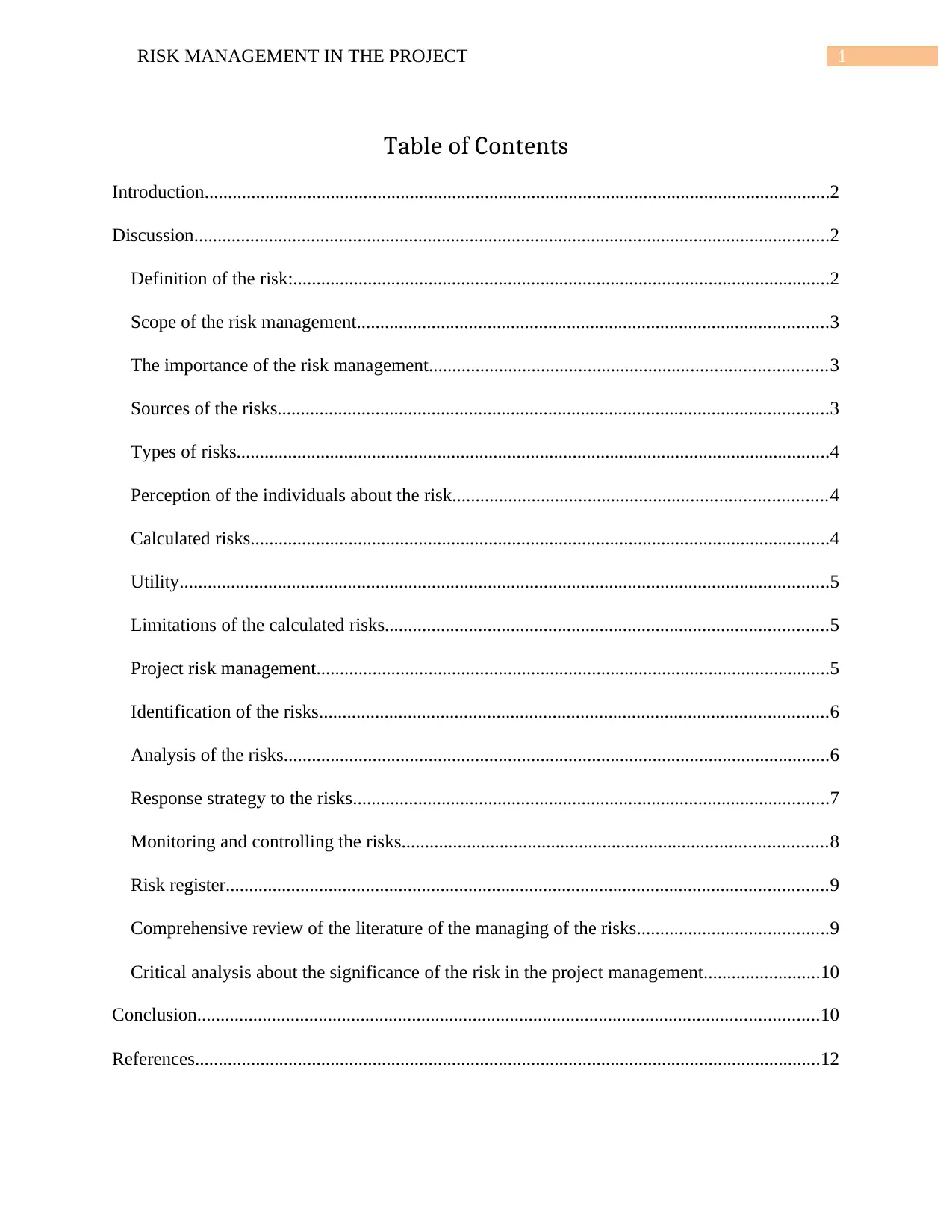
Table of Contents
Introduction......................................................................................................................................2
Discussion........................................................................................................................................2
Definition of the risk:...................................................................................................................2
Scope of the risk management.....................................................................................................3
The importance of the risk management.....................................................................................3
Sources of the risks......................................................................................................................3
Types of risks...............................................................................................................................4
Perception of the individuals about the risk................................................................................4
Calculated risks............................................................................................................................4
Utility...........................................................................................................................................5
Limitations of the calculated risks...............................................................................................5
Project risk management..............................................................................................................5
Identification of the risks.............................................................................................................6
Analysis of the risks.....................................................................................................................6
Response strategy to the risks......................................................................................................7
Monitoring and controlling the risks...........................................................................................8
Risk register.................................................................................................................................9
Comprehensive review of the literature of the managing of the risks.........................................9
Critical analysis about the significance of the risk in the project management.........................10
Conclusion.....................................................................................................................................10
References......................................................................................................................................12
Table of Contents
Introduction......................................................................................................................................2
Discussion........................................................................................................................................2
Definition of the risk:...................................................................................................................2
Scope of the risk management.....................................................................................................3
The importance of the risk management.....................................................................................3
Sources of the risks......................................................................................................................3
Types of risks...............................................................................................................................4
Perception of the individuals about the risk................................................................................4
Calculated risks............................................................................................................................4
Utility...........................................................................................................................................5
Limitations of the calculated risks...............................................................................................5
Project risk management..............................................................................................................5
Identification of the risks.............................................................................................................6
Analysis of the risks.....................................................................................................................6
Response strategy to the risks......................................................................................................7
Monitoring and controlling the risks...........................................................................................8
Risk register.................................................................................................................................9
Comprehensive review of the literature of the managing of the risks.........................................9
Critical analysis about the significance of the risk in the project management.........................10
Conclusion.....................................................................................................................................10
References......................................................................................................................................12
2RISK MANAGEMENT IN THE PROJECT
Introduction
Risk is defined as the sudden unexpected change in the working environment. The risks
can be associated with the processes and the project management. The risk defines the unwanted
event that occurs in the working environment that will create the effect on the project or the
process environment in a positive or the negative way. In most of the cases, the risks associated
with the project management has the negative effect on the projects (Kerzner and Kerzner 2017).
The main objective of this paper is to observe the significance of the risks in the process
management and the effect of the risks present in the project management. In order to discuss the
significance different kinds and the variations of the risks are evaluated. Apart form that the
cycle of the risks in the process has been discussed. This discussion will lead to the importance o
the risks planning and the management of the risks. The risks can be both positive and negative.
The positive risks opens up the new opportunities in the project management process , while the
negative risks create constraint in the project management (Zhao, Hwang and Phng 2014). The
main objective of this paper is to evaluate the risks in project and implement certain techniques
to manage the risks associated with each of the project. There are specific techniques discussed
in order to manage the risks in the project. The importance of developing the risk matrix has
been described along with the way to develop the matrix.
Discussion
Definition of the risk:
The risks can be defined as the unexpected change in the project environment. The
changes can be both positive and the negative. There are different definitions of the risks which
can be presented for the understanding of the risks (Zhao, Hwang and Phng 2014). There are
Introduction
Risk is defined as the sudden unexpected change in the working environment. The risks
can be associated with the processes and the project management. The risk defines the unwanted
event that occurs in the working environment that will create the effect on the project or the
process environment in a positive or the negative way. In most of the cases, the risks associated
with the project management has the negative effect on the projects (Kerzner and Kerzner 2017).
The main objective of this paper is to observe the significance of the risks in the process
management and the effect of the risks present in the project management. In order to discuss the
significance different kinds and the variations of the risks are evaluated. Apart form that the
cycle of the risks in the process has been discussed. This discussion will lead to the importance o
the risks planning and the management of the risks. The risks can be both positive and negative.
The positive risks opens up the new opportunities in the project management process , while the
negative risks create constraint in the project management (Zhao, Hwang and Phng 2014). The
main objective of this paper is to evaluate the risks in project and implement certain techniques
to manage the risks associated with each of the project. There are specific techniques discussed
in order to manage the risks in the project. The importance of developing the risk matrix has
been described along with the way to develop the matrix.
Discussion
Definition of the risk:
The risks can be defined as the unexpected change in the project environment. The
changes can be both positive and the negative. There are different definitions of the risks which
can be presented for the understanding of the risks (Zhao, Hwang and Phng 2014). There are
⊘ This is a preview!⊘
Do you want full access?
Subscribe today to unlock all pages.

Trusted by 1+ million students worldwide
3RISK MANAGEMENT IN THE PROJECT
different types of the risks present in the process. However, the origin of the different types of
the risks are different.
Scope of the risk management: The scope of the risk management includes the
understanding and the managing of the project. The project management risks defines the
managing of the risks in the project. The project risk can be both positive and negative (Zhao,
Hwang and Phng 2014). In case o negative risk management, the main objective is to implement
the strategy that will help to mitigate the bad impacts of the risks in the project process. On the
other hand for the positive risk, the strategy will evaluate the opportunities those can be
implemented in the project development. Both these tasks are carried out by the risk
management.
The importance of the risk management: The main objective of the managing the risks
in the project is to handle the project in a right way so that the processes in the projects can run
smoothly. The initial stage of the risk management is the identification of the risks. The risks
can initially divided into two categories- positive risks and negative risks. The negative risks
present constraint in the project management process (Bromiley et al. 2015). Some of these
constraints are exceed in the budget and time, scope creep in the project. Some of the risks are
also considered in the project management environment as the positive risks. These types of risks
can be the change in the use of technology in the project management process , so that the
project can become more advanced. The positive risks in the project management enhances the
scope and the effectiveness of the project.
Sources of the risks: The identification of the risks are associated with the sources of the
risks. The risks can be both internal and external. The internal risks are also known as
different types of the risks present in the process. However, the origin of the different types of
the risks are different.
Scope of the risk management: The scope of the risk management includes the
understanding and the managing of the project. The project management risks defines the
managing of the risks in the project. The project risk can be both positive and negative (Zhao,
Hwang and Phng 2014). In case o negative risk management, the main objective is to implement
the strategy that will help to mitigate the bad impacts of the risks in the project process. On the
other hand for the positive risk, the strategy will evaluate the opportunities those can be
implemented in the project development. Both these tasks are carried out by the risk
management.
The importance of the risk management: The main objective of the managing the risks
in the project is to handle the project in a right way so that the processes in the projects can run
smoothly. The initial stage of the risk management is the identification of the risks. The risks
can initially divided into two categories- positive risks and negative risks. The negative risks
present constraint in the project management process (Bromiley et al. 2015). Some of these
constraints are exceed in the budget and time, scope creep in the project. Some of the risks are
also considered in the project management environment as the positive risks. These types of risks
can be the change in the use of technology in the project management process , so that the
project can become more advanced. The positive risks in the project management enhances the
scope and the effectiveness of the project.
Sources of the risks: The identification of the risks are associated with the sources of the
risks. The risks can be both internal and external. The internal risks are also known as
Paraphrase This Document
Need a fresh take? Get an instant paraphrase of this document with our AI Paraphraser
4RISK MANAGEMENT IN THE PROJECT
endogenous risks (Lee et al.2017). These types of risks are the internal risks of the organization
and can be controlled through the changing of the parameters. Some of the examples of the
internal risks are timing and the resources for the projects.
The external risks are known as the exogenous risks. These kind of risks are harder to
detect and control. The external risks are from the outside of the organization, effecting the
progress of the organization and the projects.
Types of risks: There are several types of risks such as-
Project risk
Business risks
Operation risks
Technical risks
Political risks
Perception of the individuals about the risk: The definition and identification of the risks
in the process or the project is highly dependent on the perception and the experience of the
project managers. The project managers identifies and give priority to the risks associated with
the project depending on the past experience (Aloini et al.2015) .It can be said that clear and right
identification of the risks are dependent on the accurate interpretation of the past experience of
the project managers. The attitude for handling the risks also differs from managers to
managers.
Calculated risks: The calculated risks are the task of assigning the priority of the risks by the
individuals on the basis of the probability of the happening of the risks and the positive or
negative effects of the risks. The risks are ranked from highest to lowest ranks.
endogenous risks (Lee et al.2017). These types of risks are the internal risks of the organization
and can be controlled through the changing of the parameters. Some of the examples of the
internal risks are timing and the resources for the projects.
The external risks are known as the exogenous risks. These kind of risks are harder to
detect and control. The external risks are from the outside of the organization, effecting the
progress of the organization and the projects.
Types of risks: There are several types of risks such as-
Project risk
Business risks
Operation risks
Technical risks
Political risks
Perception of the individuals about the risk: The definition and identification of the risks
in the process or the project is highly dependent on the perception and the experience of the
project managers. The project managers identifies and give priority to the risks associated with
the project depending on the past experience (Aloini et al.2015) .It can be said that clear and right
identification of the risks are dependent on the accurate interpretation of the past experience of
the project managers. The attitude for handling the risks also differs from managers to
managers.
Calculated risks: The calculated risks are the task of assigning the priority of the risks by the
individuals on the basis of the probability of the happening of the risks and the positive or
negative effects of the risks. The risks are ranked from highest to lowest ranks.
5RISK MANAGEMENT IN THE PROJECT
Utility: Utility is the value for the utilization of something. Here the utility refers to the
handling of the risks and making the opportunities in the project or the process (Hopkin 2017).
Some of the people will not take risks will go for the safe options and some people will take the
calculated risks, which is they will select the risks from the risks matrix in order to gain or
explore opportunities in the course of the process.
The handling of the risks are different for the individuals and the project managers. The
individuals may or may not take the risks in order to compile a task or the process.
However, the project managers can not eliminate the chances of taking risks in the project
management process. In that case, they have to take the calculated risks while developing the
project (Muriana and Vizzini 2017). While taking the calculated risks the project managers are
needed to choose the right option based on the monetary value or the expected value. In this
case, the risks are not evaluated by the highest psychological value or the utility.
Limitations of the calculated risks: There are some limitations of the calculated risks. One
of the main limitation is that sometimes the calculated risks are not easy to determine for the
business or the process (Zhao, Hwang and Phng 2014). The difficulty of the identification may
arise because of the less information about the possible risks and the short time span. In order to
eliminate these limitations the development of the risk structure can be maintained.
Project risk management: The project risks management is the identification of the risks
and the elimination strategy of those risks in the developing phase of the project. It has been seen
the risk management is underrated but significant process in the project management process.
The ignorance of the risk management process may result the failure of the project.
Utility: Utility is the value for the utilization of something. Here the utility refers to the
handling of the risks and making the opportunities in the project or the process (Hopkin 2017).
Some of the people will not take risks will go for the safe options and some people will take the
calculated risks, which is they will select the risks from the risks matrix in order to gain or
explore opportunities in the course of the process.
The handling of the risks are different for the individuals and the project managers. The
individuals may or may not take the risks in order to compile a task or the process.
However, the project managers can not eliminate the chances of taking risks in the project
management process. In that case, they have to take the calculated risks while developing the
project (Muriana and Vizzini 2017). While taking the calculated risks the project managers are
needed to choose the right option based on the monetary value or the expected value. In this
case, the risks are not evaluated by the highest psychological value or the utility.
Limitations of the calculated risks: There are some limitations of the calculated risks. One
of the main limitation is that sometimes the calculated risks are not easy to determine for the
business or the process (Zhao, Hwang and Phng 2014). The difficulty of the identification may
arise because of the less information about the possible risks and the short time span. In order to
eliminate these limitations the development of the risk structure can be maintained.
Project risk management: The project risks management is the identification of the risks
and the elimination strategy of those risks in the developing phase of the project. It has been seen
the risk management is underrated but significant process in the project management process.
The ignorance of the risk management process may result the failure of the project.
⊘ This is a preview!⊘
Do you want full access?
Subscribe today to unlock all pages.
Trusted by 1+ million students worldwide
6RISK MANAGEMENT IN THE PROJECT
The risk management in the project can be done through the risk management planning.
There are several steps in the risk management planning. These steps include:
Identification of the risks.
Risk analysis (The risk analysis can be both qualitative and quantitative in nature)
Response strategy of the risk
Monitoring and controlling of the risks.
Identification of the risks: The identification of the risk is the important and initial thing in
the risk management process and planning (van der Vorm et al. 2015). The identification of the
risks in the project can be done through the evaluation of the past results and the previous
projects. Sometimes the expert opinions from the teams can also be sued in the identification of
the risks. The identification can be done through the application of some techniques such as
‘Delphi’ process.
Analysis of the risks: The analysis of the risks can be done using the two methods- qualitative
and quantitative analysis. The qualitative analysis is based on the expert judgement and the
reviewing the past records . On the other hand the quantitative analysis is based on the statistical
data and analysis such as decision tree and Monte Carlo analysis (Meredith et al. 2016). In case of
qualitative analysis the risk matrix is used (Qazi et al. 2016). The risk matrix examines the risks
from the view point of the probability. The consequence of the happening and the impact of the
consequences of the actions on the development of the project outcome is considered in this case.
The analysis can be done in two ways (Brack et al. 2015). Assigning the categories to the risks
such as high , low and medium, on the other hand allocating the numbers or rating from 1 to 10
to the risks.
The risk management in the project can be done through the risk management planning.
There are several steps in the risk management planning. These steps include:
Identification of the risks.
Risk analysis (The risk analysis can be both qualitative and quantitative in nature)
Response strategy of the risk
Monitoring and controlling of the risks.
Identification of the risks: The identification of the risk is the important and initial thing in
the risk management process and planning (van der Vorm et al. 2015). The identification of the
risks in the project can be done through the evaluation of the past results and the previous
projects. Sometimes the expert opinions from the teams can also be sued in the identification of
the risks. The identification can be done through the application of some techniques such as
‘Delphi’ process.
Analysis of the risks: The analysis of the risks can be done using the two methods- qualitative
and quantitative analysis. The qualitative analysis is based on the expert judgement and the
reviewing the past records . On the other hand the quantitative analysis is based on the statistical
data and analysis such as decision tree and Monte Carlo analysis (Meredith et al. 2016). In case of
qualitative analysis the risk matrix is used (Qazi et al. 2016). The risk matrix examines the risks
from the view point of the probability. The consequence of the happening and the impact of the
consequences of the actions on the development of the project outcome is considered in this case.
The analysis can be done in two ways (Brack et al. 2015). Assigning the categories to the risks
such as high , low and medium, on the other hand allocating the numbers or rating from 1 to 10
to the risks.
Paraphrase This Document
Need a fresh take? Get an instant paraphrase of this document with our AI Paraphraser
7RISK MANAGEMENT IN THE PROJECT
In case of quantitative risk analysis the decision tree is used. The decision tree is the
visual representation of the risks and their consequences. The assumptions regarding the risks are
made while developing the decision tree.
Response strategy to the risks: The identification of the risks needs the strategy for
responding to the risks. The identification of the risks are done through the several process. After
the identification of the risks the ranking of the risks are done (Hwang,Zhao and Toh 2014). The
strategy for handling the risks according to the ranks are then evaluated. The main step followed
by this is the making of the strategy to response to the risks. The risk response planning is
different for the positive risk and the negative risk. As discussed earlier, the positive risks
enhance the opportunities during the development of the project on the other hand the negative
risks create constraints in the project management process. Different planning is needed to be
done for handling the negative risks and explore the positive risks.
In case of the negative risks there are several strategies for responding to the risks. After
identification of the risks one of the following strategies are needed to be taken:
Avoidance of the risks.
Acceptance of the risks
Transference of the risks
Mitigation of the risks
The strategies for exploring the positive risks are:
Exploit the risks
Sharing of the risks
Enhancement of the risks
In case of quantitative risk analysis the decision tree is used. The decision tree is the
visual representation of the risks and their consequences. The assumptions regarding the risks are
made while developing the decision tree.
Response strategy to the risks: The identification of the risks needs the strategy for
responding to the risks. The identification of the risks are done through the several process. After
the identification of the risks the ranking of the risks are done (Hwang,Zhao and Toh 2014). The
strategy for handling the risks according to the ranks are then evaluated. The main step followed
by this is the making of the strategy to response to the risks. The risk response planning is
different for the positive risk and the negative risk. As discussed earlier, the positive risks
enhance the opportunities during the development of the project on the other hand the negative
risks create constraints in the project management process. Different planning is needed to be
done for handling the negative risks and explore the positive risks.
In case of the negative risks there are several strategies for responding to the risks. After
identification of the risks one of the following strategies are needed to be taken:
Avoidance of the risks.
Acceptance of the risks
Transference of the risks
Mitigation of the risks
The strategies for exploring the positive risks are:
Exploit the risks
Sharing of the risks
Enhancement of the risks
8RISK MANAGEMENT IN THE PROJECT
Acceptance of the risks
The strategies for dealing with the risks are depended on the situation and the time of the
risks happening. It also depends on the availability of the resources (Fleming and Koppelman
2016). Certain exam-le can be presented in this case. In some of the construction projects, it the
human resource that is labour is less in the number, the number of labour can be increased using
the higher pay scale and providing them certain benefits.
Monitoring and controlling the risks: Monitoring and the control of the risks happen
throughout the whole process. The main function of the monitoring is the monitoring of the cost,
time and the resources needed for the project development. On the other hand the controlling of
the project includes the control of the flow of the information throughout the project and
collection of the information regrading the risk (Hu et al. 2016). These information can be
beneficial for managing and identification of the risks associated with the project management.
The monitoring and the control phase of the risk planning process is responsible for the review of
the identified risks. The corrective actions can be taken on the basis of the review (Parihar, Bhar
and Kumar 2015). These actions can help to mitigate the negative risks in the process and will
enhance the exploitation of the positive risks.
In this context the risk tracking system or thee techniques can be discussed.
Top 10 risk tracking system can be used to maintain the awareness regarding the risk
throughout the projects. In this process, the top 10 risks in the process are identified (Marcelino-
Sádaba et al. 2014). The review of those 10 risks are down in a periodic fashion. This tracking
system lists the risks mentioning the current and previous status of the risks, the number of times
Acceptance of the risks
The strategies for dealing with the risks are depended on the situation and the time of the
risks happening. It also depends on the availability of the resources (Fleming and Koppelman
2016). Certain exam-le can be presented in this case. In some of the construction projects, it the
human resource that is labour is less in the number, the number of labour can be increased using
the higher pay scale and providing them certain benefits.
Monitoring and controlling the risks: Monitoring and the control of the risks happen
throughout the whole process. The main function of the monitoring is the monitoring of the cost,
time and the resources needed for the project development. On the other hand the controlling of
the project includes the control of the flow of the information throughout the project and
collection of the information regrading the risk (Hu et al. 2016). These information can be
beneficial for managing and identification of the risks associated with the project management.
The monitoring and the control phase of the risk planning process is responsible for the review of
the identified risks. The corrective actions can be taken on the basis of the review (Parihar, Bhar
and Kumar 2015). These actions can help to mitigate the negative risks in the process and will
enhance the exploitation of the positive risks.
In this context the risk tracking system or thee techniques can be discussed.
Top 10 risk tracking system can be used to maintain the awareness regarding the risk
throughout the projects. In this process, the top 10 risks in the process are identified (Marcelino-
Sádaba et al. 2014). The review of those 10 risks are down in a periodic fashion. This tracking
system lists the risks mentioning the current and previous status of the risks, the number of times
⊘ This is a preview!⊘
Do you want full access?
Subscribe today to unlock all pages.
Trusted by 1+ million students worldwide
9RISK MANAGEMENT IN THE PROJECT
they have appeared in the process and the progress to resolve those risks in the process. This list
helps to mitigate the happening of the negative risks in the process.
Risk register: In order to keep the account of the happening of the risks in the process
the risk register is used. The risk register is generally presented in a spreadsheet which shows the
result of the various risk management (Wang 2017). The information it contains includes the
information about the review of the risks , ranking of the risks. The risk register is the list of all
the risks with the detailed information which is used for maintaining and managing the existing
risks in the process of the project management. The risk register can further be used in the future
projects.
Comprehensive review of the literature of the managing of the risks:
There are various article state about the managing of the risks and its significance. The
risk management in the project is an important step (JOSEPH et al.2018). The evaluation of the
risks in the project will help the project managers to eliminate the possible risks from
happening , apart from that it will also help to evaluate certain opportunities in the project
management process (Titman,Keown and Martin 2017). The definition of the risks are evaluated on
the basis of the project management. Certain change in the condition or the situation can cause
the risks in the process of development of the projects.
The project management process will deliver the right outcome if the risks associated
with the projects are reviewed and handled in a proper way (Hornstein 2015). One of the major
risk in the project management is the scope creep. The scope creep of the project management
denotes the sudden changes in the requirement of the process. One of the main technique for
mitigate the chances for the scope creep is to make the clarity in the requirements.
they have appeared in the process and the progress to resolve those risks in the process. This list
helps to mitigate the happening of the negative risks in the process.
Risk register: In order to keep the account of the happening of the risks in the process
the risk register is used. The risk register is generally presented in a spreadsheet which shows the
result of the various risk management (Wang 2017). The information it contains includes the
information about the review of the risks , ranking of the risks. The risk register is the list of all
the risks with the detailed information which is used for maintaining and managing the existing
risks in the process of the project management. The risk register can further be used in the future
projects.
Comprehensive review of the literature of the managing of the risks:
There are various article state about the managing of the risks and its significance. The
risk management in the project is an important step (JOSEPH et al.2018). The evaluation of the
risks in the project will help the project managers to eliminate the possible risks from
happening , apart from that it will also help to evaluate certain opportunities in the project
management process (Titman,Keown and Martin 2017). The definition of the risks are evaluated on
the basis of the project management. Certain change in the condition or the situation can cause
the risks in the process of development of the projects.
The project management process will deliver the right outcome if the risks associated
with the projects are reviewed and handled in a proper way (Hornstein 2015). One of the major
risk in the project management is the scope creep. The scope creep of the project management
denotes the sudden changes in the requirement of the process. One of the main technique for
mitigate the chances for the scope creep is to make the clarity in the requirements.
Paraphrase This Document
Need a fresh take? Get an instant paraphrase of this document with our AI Paraphraser
10RISK MANAGEMENT IN THE PROJECT
Different articles has been discussed about the risks in the project management from the
various perspective (Zhao, Hwang and Phng 2014). However, the handling of the different kinds of
risks in the project management along with the basic definition of the risks was not elaborately
discussed in many of the articles.
Critical analysis about the significance of the risk in the project management:
The risk can be said to the unpredictable condition in the development of the process. The
risk can be included in the process of managing the project. Project managers can not eliminate
the chances of the risks. Therefore, it is important for the developers and the project managers to
evaluate the possible risks associated with the project. The risks can become the new
opportunity for the development of the project. The risks can indicate certain flaws on the
project. Working on that flaw may help the project to get improvised (McNeil,Frey and Embrechts
2015). The risks also indicates the gap between the requirements and the existing processes in the
project. There are two functions of the risk management planning, one is to mitigate the negative
effect of the risks on the project and the process and the other is to exploit the positive risks
(Reed and Angolia 2018). The implementation strategy of the risk handling in right way can be
done through the use of different analysis tools and the techniques like risk register and the risk
matrix. There are certain steps for managing the risks. It can be said that the proper risk
management can bring out the right outcome in the project management.
Conclusion
The assessment of the risks is important for the accurate outcome of the project. The risk
is associated with the every action. The acceptance of the risk is dependent on the individuals. In
the real life situation a person may or may not take the risk. However, in case of the project
Different articles has been discussed about the risks in the project management from the
various perspective (Zhao, Hwang and Phng 2014). However, the handling of the different kinds of
risks in the project management along with the basic definition of the risks was not elaborately
discussed in many of the articles.
Critical analysis about the significance of the risk in the project management:
The risk can be said to the unpredictable condition in the development of the process. The
risk can be included in the process of managing the project. Project managers can not eliminate
the chances of the risks. Therefore, it is important for the developers and the project managers to
evaluate the possible risks associated with the project. The risks can become the new
opportunity for the development of the project. The risks can indicate certain flaws on the
project. Working on that flaw may help the project to get improvised (McNeil,Frey and Embrechts
2015). The risks also indicates the gap between the requirements and the existing processes in the
project. There are two functions of the risk management planning, one is to mitigate the negative
effect of the risks on the project and the process and the other is to exploit the positive risks
(Reed and Angolia 2018). The implementation strategy of the risk handling in right way can be
done through the use of different analysis tools and the techniques like risk register and the risk
matrix. There are certain steps for managing the risks. It can be said that the proper risk
management can bring out the right outcome in the project management.
Conclusion
The assessment of the risks is important for the accurate outcome of the project. The risk
is associated with the every action. The acceptance of the risk is dependent on the individuals. In
the real life situation a person may or may not take the risk. However, in case of the project
11RISK MANAGEMENT IN THE PROJECT
management , the project managers can not eliminate the risks in the project. In that case, the
project managers have to take the calculated risks. While taking the risks the assessment of the
risks are needed to be evaluated on the basis of the systematic analysis of the risks rather than
dependency on the utility or the psychological judgement regarding the risks. The right ranking
of the risks in the risk management will help the project managers to implement the right risk
management strategy. It has been seen that the proper risk assessment in the project helps the
project to deliver the right outcome. As , the effect of the positive and the negative risks are
different the handling strategy for these two types of risks are also different. In case of the
positive risk the main objective of the managing strategy is to exploit the possibility and the
opportunities that can be received from the positive risks. Project may be failed in the absence of
proper risk management. This article has discussed the risk in the project form the basic level.
Apart from that it also discussed about the significance of the risk including the critical analysis
of the presence of the risks on the basis of the various parameters. It can be said from the
discussion from the paper the risk plays an important role in proper compilation of the project.
Hence the management and the planning of the risk is needed to be done in a right way.
management , the project managers can not eliminate the risks in the project. In that case, the
project managers have to take the calculated risks. While taking the risks the assessment of the
risks are needed to be evaluated on the basis of the systematic analysis of the risks rather than
dependency on the utility or the psychological judgement regarding the risks. The right ranking
of the risks in the risk management will help the project managers to implement the right risk
management strategy. It has been seen that the proper risk assessment in the project helps the
project to deliver the right outcome. As , the effect of the positive and the negative risks are
different the handling strategy for these two types of risks are also different. In case of the
positive risk the main objective of the managing strategy is to exploit the possibility and the
opportunities that can be received from the positive risks. Project may be failed in the absence of
proper risk management. This article has discussed the risk in the project form the basic level.
Apart from that it also discussed about the significance of the risk including the critical analysis
of the presence of the risks on the basis of the various parameters. It can be said from the
discussion from the paper the risk plays an important role in proper compilation of the project.
Hence the management and the planning of the risk is needed to be done in a right way.
⊘ This is a preview!⊘
Do you want full access?
Subscribe today to unlock all pages.
Trusted by 1+ million students worldwide

1 out of 15


Related Documents


Your All-in-One AI-Powered Toolkit for Academic Success.
+13062052269
info@desklib.com
Available 24*7 on WhatsApp / Email
![[object Object]](/_next/static/media/star-bottom.7253800d.svg)
Unlock your academic potential
Copyright © 2020–2026 A2Z Services. All Rights Reserved. Developed and managed by ZUCOL.