Risk Management Plan for St. Elizabeth Community Hospital Project

Verified

Added on  2023/06/12

|7
|1452
|420
Project
AI Summary
This project outlines a comprehensive risk management plan for St. Elizabeth Community Hospital, addressing potential risks such as traffic congestion, disease outbreaks, excessive noise levels, and the spread of diseases. The plan includes a detailed risk analysis, assessing the likelihood and consequences of each identified risk. Various risk management treatments and tools are proposed, including risk reduction, risk avoidance, and risk transfer techniques. The project also describes the implementation, monitoring, and evaluation processes for managing risks, emphasizing the importance of identifying risks, estimating their probability and impact, highlighting conditions favoring risk occurrence, evaluating uncertainty caused by treatment, determining residual risk, and regularly monitoring and reviewing risks. The aim is to provide a structured approach to minimize potential disruptions and ensure the safety and well-being of patients and staff within the hospital environment, and to align with the hospital's policies, layout, and stakeholder interests.
Document Page
RISK MANAGEMENT 1
RISK MANAGEMENT
[Name]
Course
Professor’s Name
Institution
Location of institution
Date
tabler-icon-diamond-filled.svg

Paraphrase This Document

Need a fresh take? Get an instant paraphrase of this document with our AI Paraphraser
Document Page
RISK MANAGEMENT 2
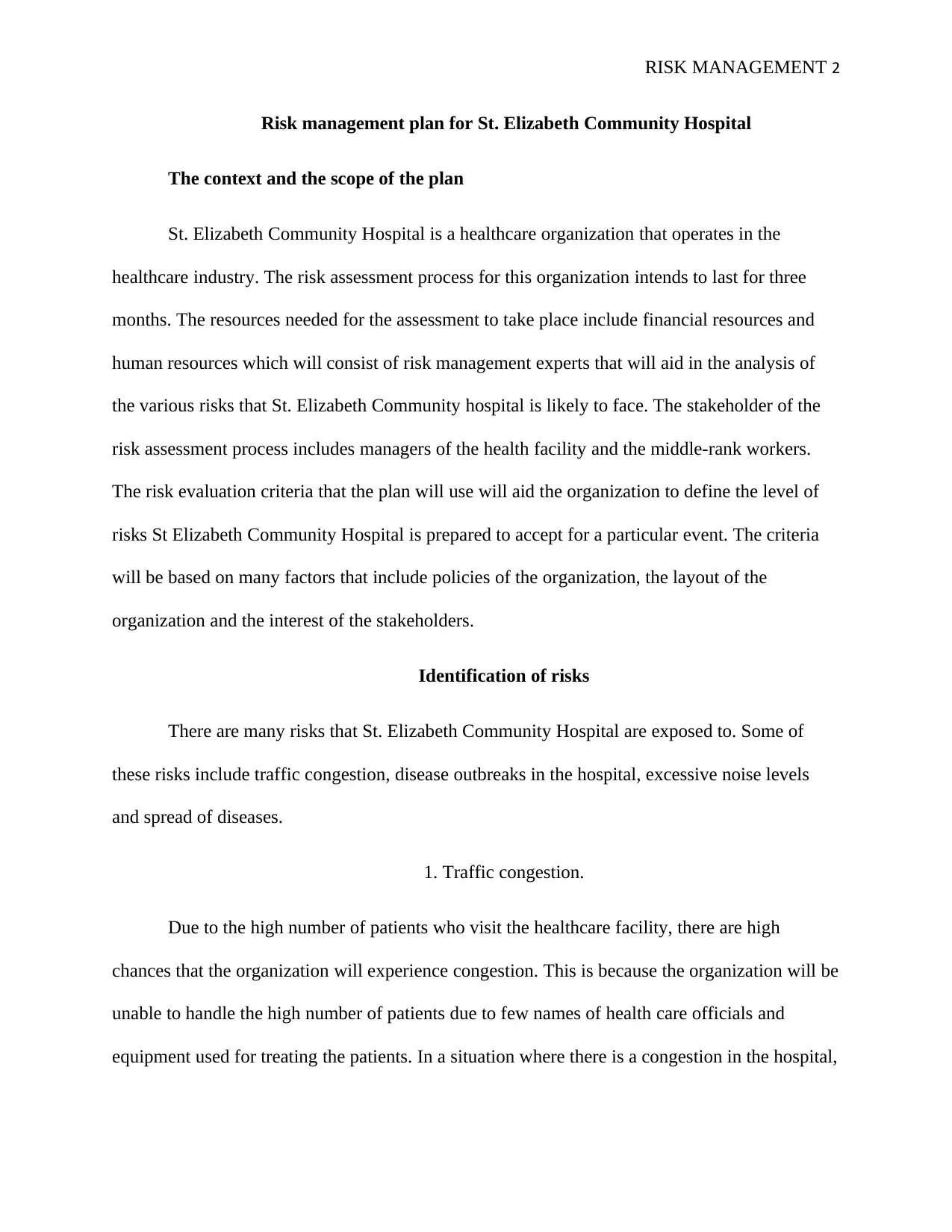
Risk management plan for St. Elizabeth Community Hospital
The context and the scope of the plan
St. Elizabeth Community Hospital is a healthcare organization that operates in the
healthcare industry. The risk assessment process for this organization intends to last for three
months. The resources needed for the assessment to take place include financial resources and
human resources which will consist of risk management experts that will aid in the analysis of
the various risks that St. Elizabeth Community hospital is likely to face. The stakeholder of the
risk assessment process includes managers of the health facility and the middle-rank workers.
The risk evaluation criteria that the plan will use will aid the organization to define the level of
risks St Elizabeth Community Hospital is prepared to accept for a particular event. The criteria
will be based on many factors that include policies of the organization, the layout of the
organization and the interest of the stakeholders.
Identification of risks
There are many risks that St. Elizabeth Community Hospital are exposed to. Some of
these risks include traffic congestion, disease outbreaks in the hospital, excessive noise levels
and spread of diseases.
1. Traffic congestion.
Due to the high number of patients who visit the healthcare facility, there are high
chances that the organization will experience congestion. This is because the organization will be
unable to handle the high number of patients due to few names of health care officials and
equipment used for treating the patients. In a situation where there is a congestion in the hospital,
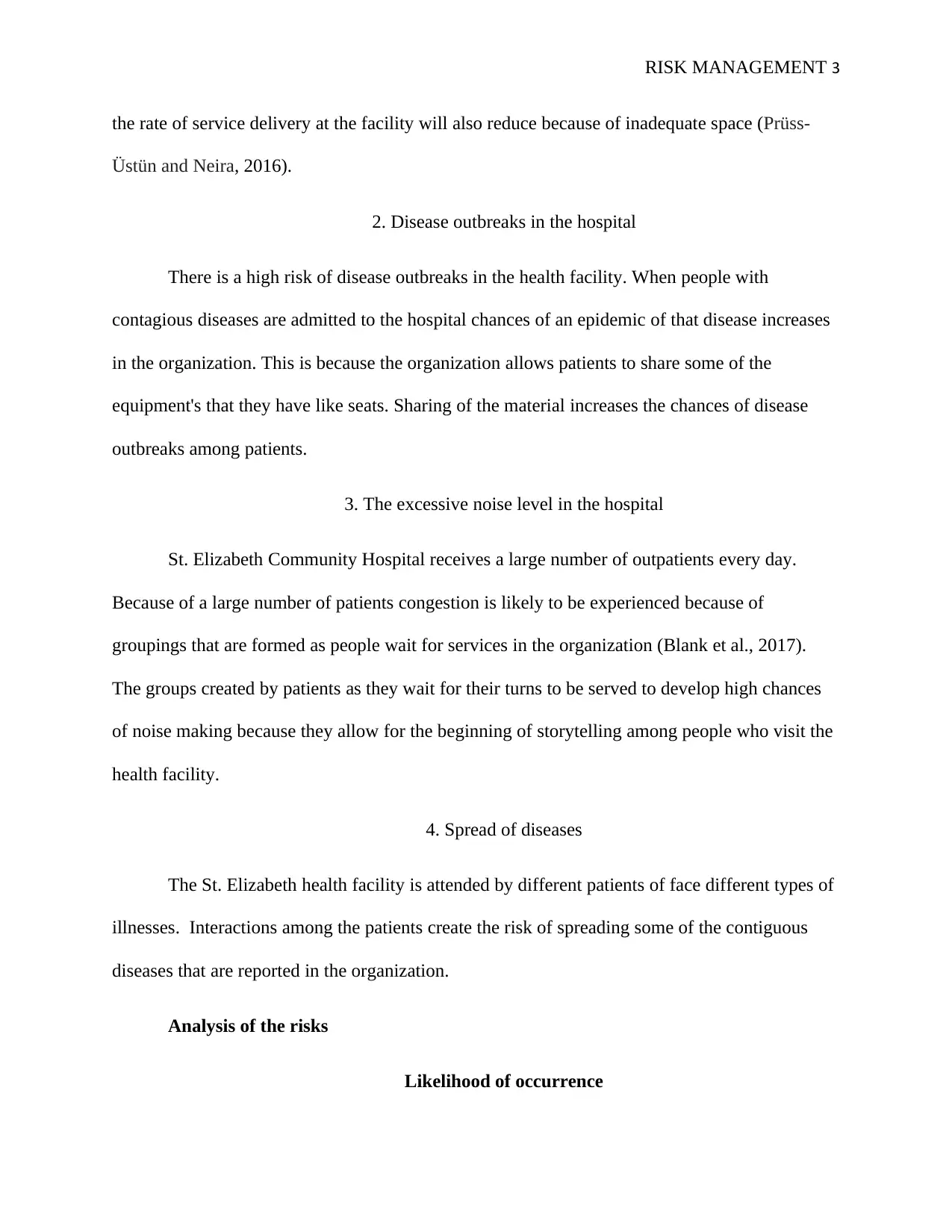
Document Page
RISK MANAGEMENT 3
the rate of service delivery at the facility will also reduce because of inadequate space (Prüss-
Üstün and Neira, 2016).
2. Disease outbreaks in the hospital
There is a high risk of disease outbreaks in the health facility. When people with
contagious diseases are admitted to the hospital chances of an epidemic of that disease increases
in the organization. This is because the organization allows patients to share some of the
equipment's that they have like seats. Sharing of the material increases the chances of disease
outbreaks among patients.
3. The excessive noise level in the hospital
St. Elizabeth Community Hospital receives a large number of outpatients every day.
Because of a large number of patients congestion is likely to be experienced because of
groupings that are formed as people wait for services in the organization (Blank et al., 2017).
The groups created by patients as they wait for their turns to be served to develop high chances
of noise making because they allow for the beginning of storytelling among people who visit the
health facility.
4. Spread of diseases
The St. Elizabeth health facility is attended by different patients of face different types of
illnesses. Interactions among the patients create the risk of spreading some of the contiguous
diseases that are reported in the organization.
Analysis of the risks
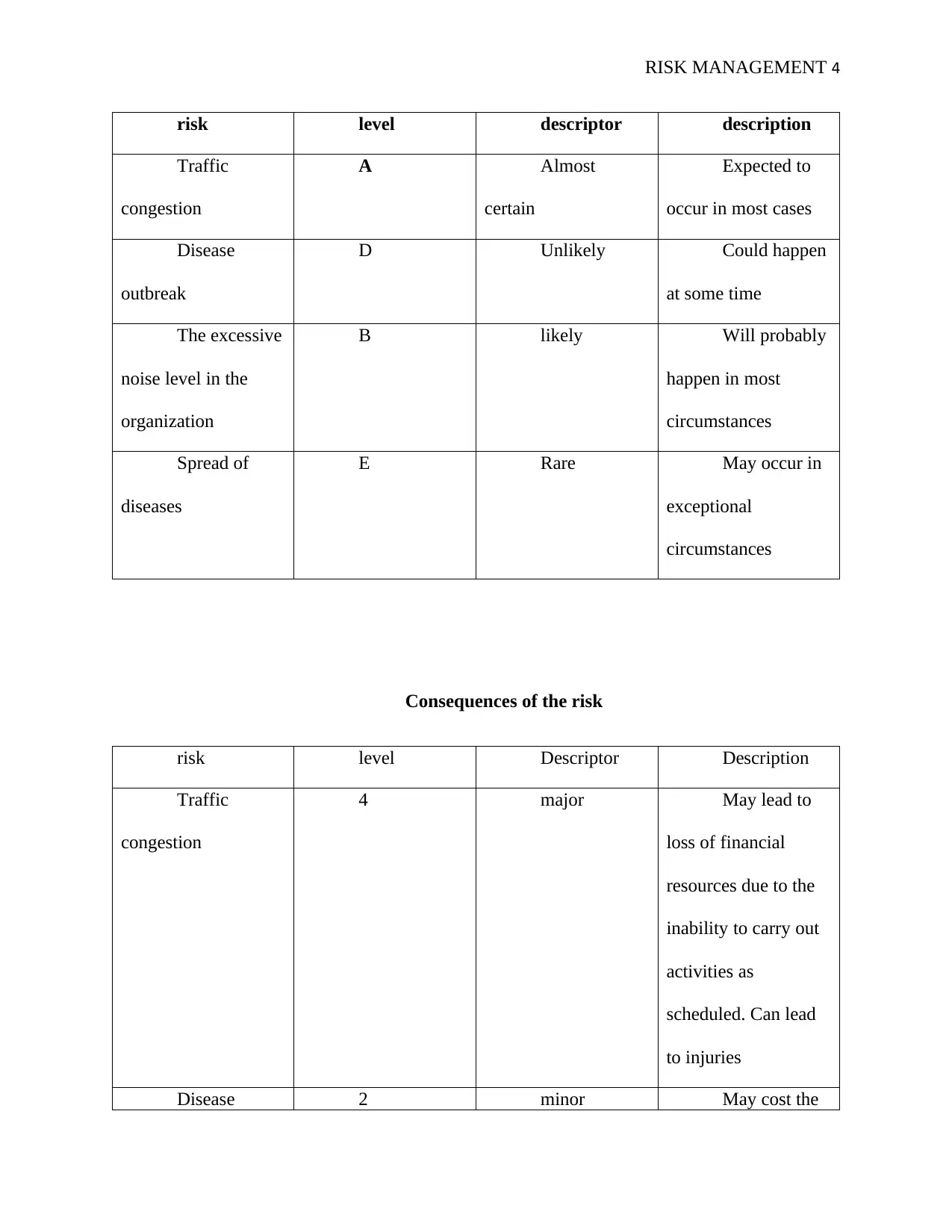
Likelihood of occurrence
Document Page
RISK MANAGEMENT 4
risk level descriptor description
Traffic
congestion
A Almost
certain
Expected to
occur in most cases
Disease
outbreak
D Unlikely Could happen
at some time
The excessive
noise level in the
organization
B likely Will probably
happen in most
circumstances
Spread of
diseases
E Rare May occur in
exceptional
circumstances
Consequences of the risk
risk level Descriptor Description
Traffic
congestion
4 major May lead to
loss of financial
resources due to the
inability to carry out
activities as
scheduled. Can lead
to injuries
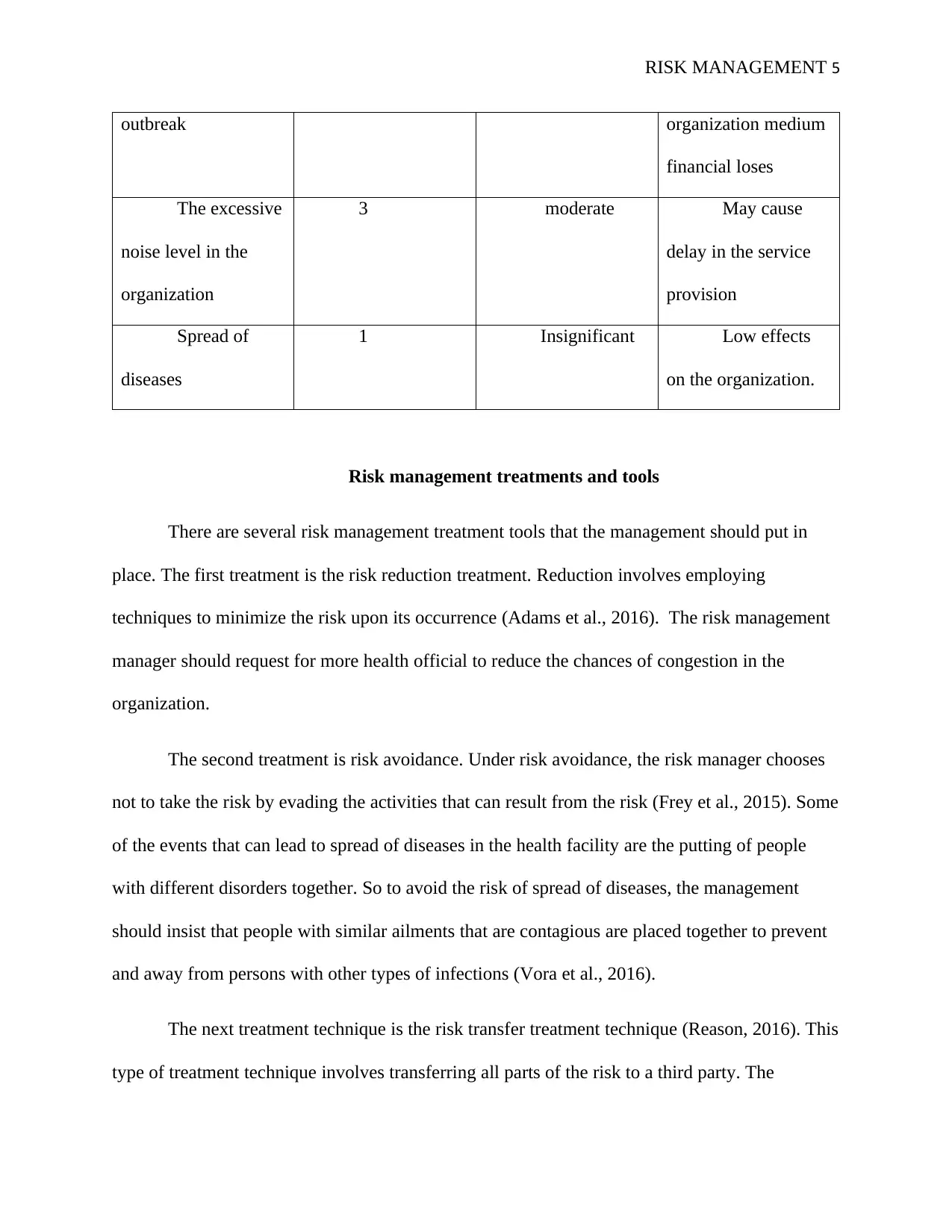
Disease 2 minor May cost the
tabler-icon-diamond-filled.svg

Paraphrase This Document

Need a fresh take? Get an instant paraphrase of this document with our AI Paraphraser
Document Page
RISK MANAGEMENT 5
outbreak organization medium
financial loses
The excessive
noise level in the
organization
3 moderate May cause
delay in the service
provision
Spread of
diseases
1 Insignificant Low effects
on the organization.
Risk management treatments and tools
There are several risk management treatment tools that the management should put in
place. The first treatment is the risk reduction treatment. Reduction involves employing
techniques to minimize the risk upon its occurrence (Adams et al., 2016). The risk management
manager should request for more health official to reduce the chances of congestion in the
organization.
The second treatment is risk avoidance. Under risk avoidance, the risk manager chooses
not to take the risk by evading the activities that can result from the risk (Frey et al., 2015). Some
of the events that can lead to spread of diseases in the health facility are the putting of people
with different disorders together. So to avoid the risk of spread of diseases, the management
should insist that people with similar ailments that are contagious are placed together to prevent
and away from persons with other types of infections (Vora et al., 2016).
The next treatment technique is the risk transfer treatment technique (Reason, 2016). This
type of treatment technique involves transferring all parts of the risk to a third party. The
Document Page
RISK MANAGEMENT 6
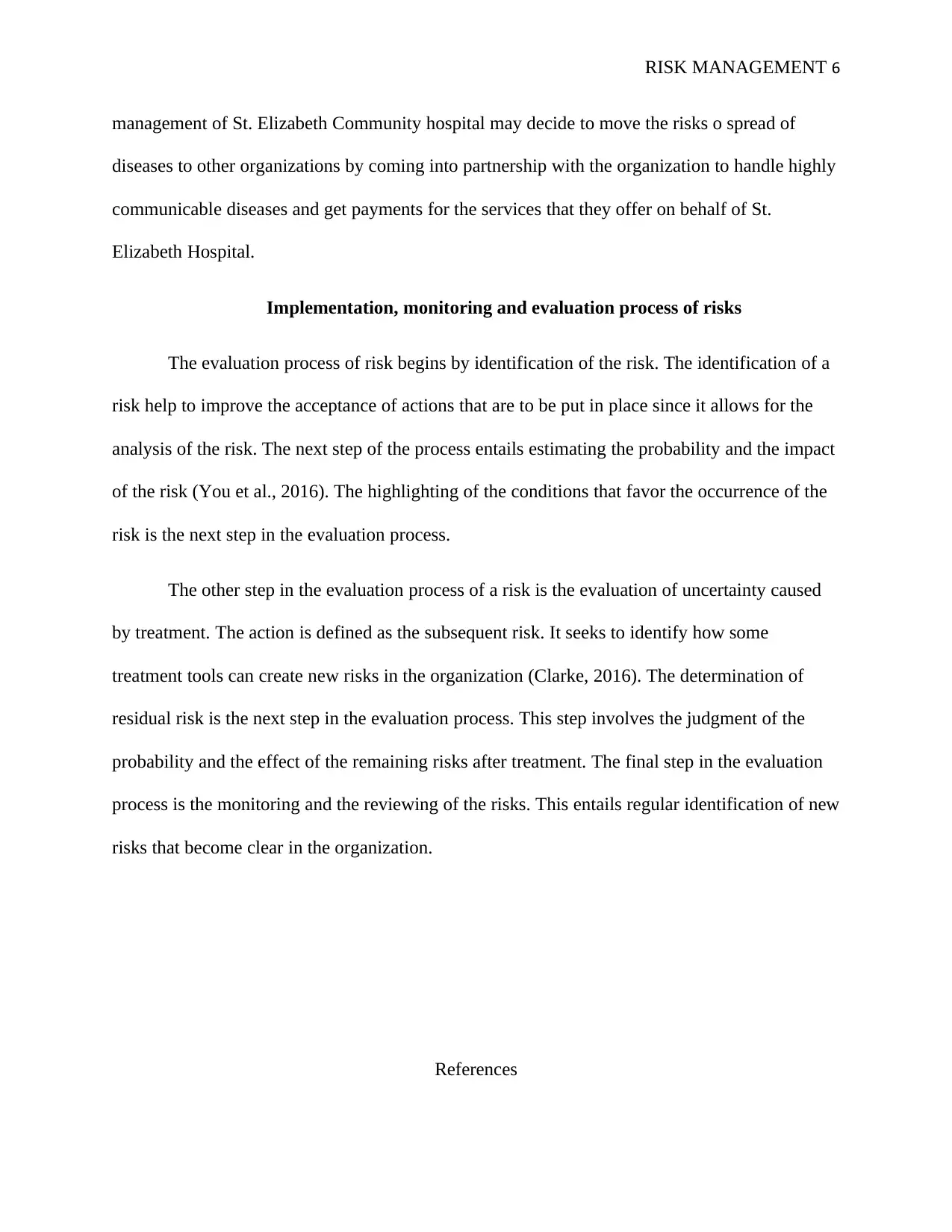
management of St. Elizabeth Community hospital may decide to move the risks o spread of
diseases to other organizations by coming into partnership with the organization to handle highly
communicable diseases and get payments for the services that they offer on behalf of St.
Elizabeth Hospital.
Implementation, monitoring and evaluation process of risks
The evaluation process of risk begins by identification of the risk. The identification of a
risk help to improve the acceptance of actions that are to be put in place since it allows for the
analysis of the risk. The next step of the process entails estimating the probability and the impact
of the risk (You et al., 2016). The highlighting of the conditions that favor the occurrence of the
risk is the next step in the evaluation process.
The other step in the evaluation process of a risk is the evaluation of uncertainty caused
by treatment. The action is defined as the subsequent risk. It seeks to identify how some
treatment tools can create new risks in the organization (Clarke, 2016). The determination of
residual risk is the next step in the evaluation process. This step involves the judgment of the
probability and the effect of the remaining risks after treatment. The final step in the evaluation
process is the monitoring and the reviewing of the risks. This entails regular identification of new
risks that become clear in the organization.
References
Document Page
RISK MANAGEMENT 7
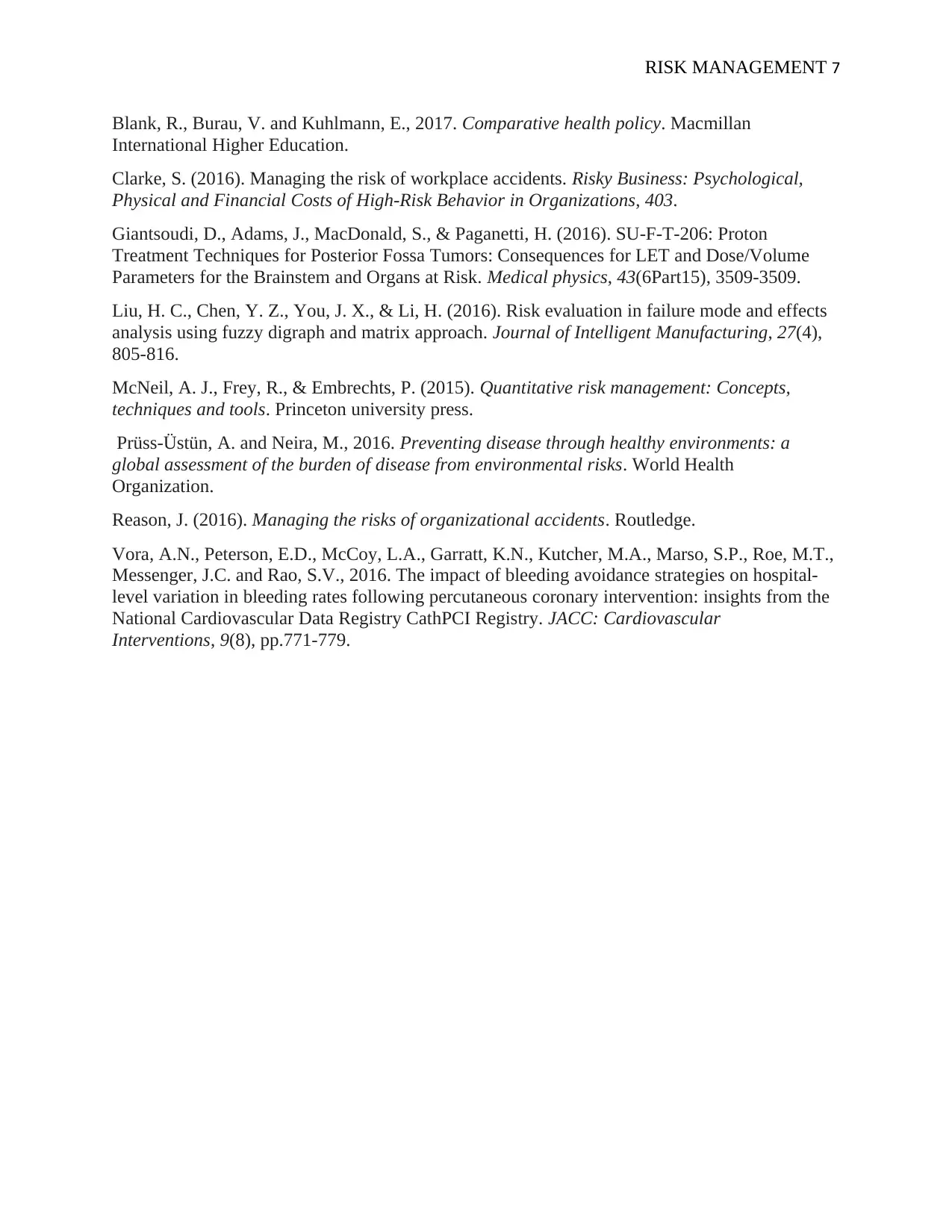
Blank, R., Burau, V. and Kuhlmann, E., 2017. Comparative health policy. Macmillan
International Higher Education.
Clarke, S. (2016). Managing the risk of workplace accidents. Risky Business: Psychological,
Physical and Financial Costs of High-Risk Behavior in Organizations, 403.
Giantsoudi, D., Adams, J., MacDonald, S., & Paganetti, H. (2016). SU‐F‐T‐206: Proton
Treatment Techniques for Posterior Fossa Tumors: Consequences for LET and Dose/Volume
Parameters for the Brainstem and Organs at Risk. Medical physics, 43(6Part15), 3509-3509.
Liu, H. C., Chen, Y. Z., You, J. X., & Li, H. (2016). Risk evaluation in failure mode and effects
analysis using fuzzy digraph and matrix approach. Journal of Intelligent Manufacturing, 27(4),
805-816.
McNeil, A. J., Frey, R., & Embrechts, P. (2015). Quantitative risk management: Concepts,
techniques and tools. Princeton university press.
Prüss-Üstün, A. and Neira, M., 2016. Preventing disease through healthy environments: a
global assessment of the burden of disease from environmental risks. World Health
Organization.
Reason, J. (2016). Managing the risks of organizational accidents. Routledge.
Vora, A.N., Peterson, E.D., McCoy, L.A., Garratt, K.N., Kutcher, M.A., Marso, S.P., Roe, M.T.,
Messenger, J.C. and Rao, S.V., 2016. The impact of bleeding avoidance strategies on hospital-
level variation in bleeding rates following percutaneous coronary intervention: insights from the
National Cardiovascular Data Registry CathPCI Registry. JACC: Cardiovascular
Interventions, 9(8), pp.771-779.
chevron_up_icon
1 out of 7
circle_padding
hide_on_mobile
zoom_out_icon
[object Object]