Robbie's Case: A Psychological Analysis of Brain Injury

Verified

Added on  2023/05/30

|4
|744
|288
Case Study
AI Summary
This case study examines the situation of Robbie, a 19-year-old who suffered brain damage from a car accident exacerbated by frequent drinking. The case highlights several issues affecting his recovery, including decreased support from friends, reduced parental involvement from his father, non-adherence to medication, and a relapse into drinking. Positively, Robbie's mother is dedicated to his care and has sought counseling and professional intervention. The study emphasizes the importance of social support, parental involvement, and treatment adherence for improving Robbie's condition and underscores his acceptance of the need to change his plans. The case illustrates the complex interplay of factors influencing recovery from brain injury, stressing the need for comprehensive support and intervention strategies. Desklib offers similar solved assignments and past papers for students.
Document Page
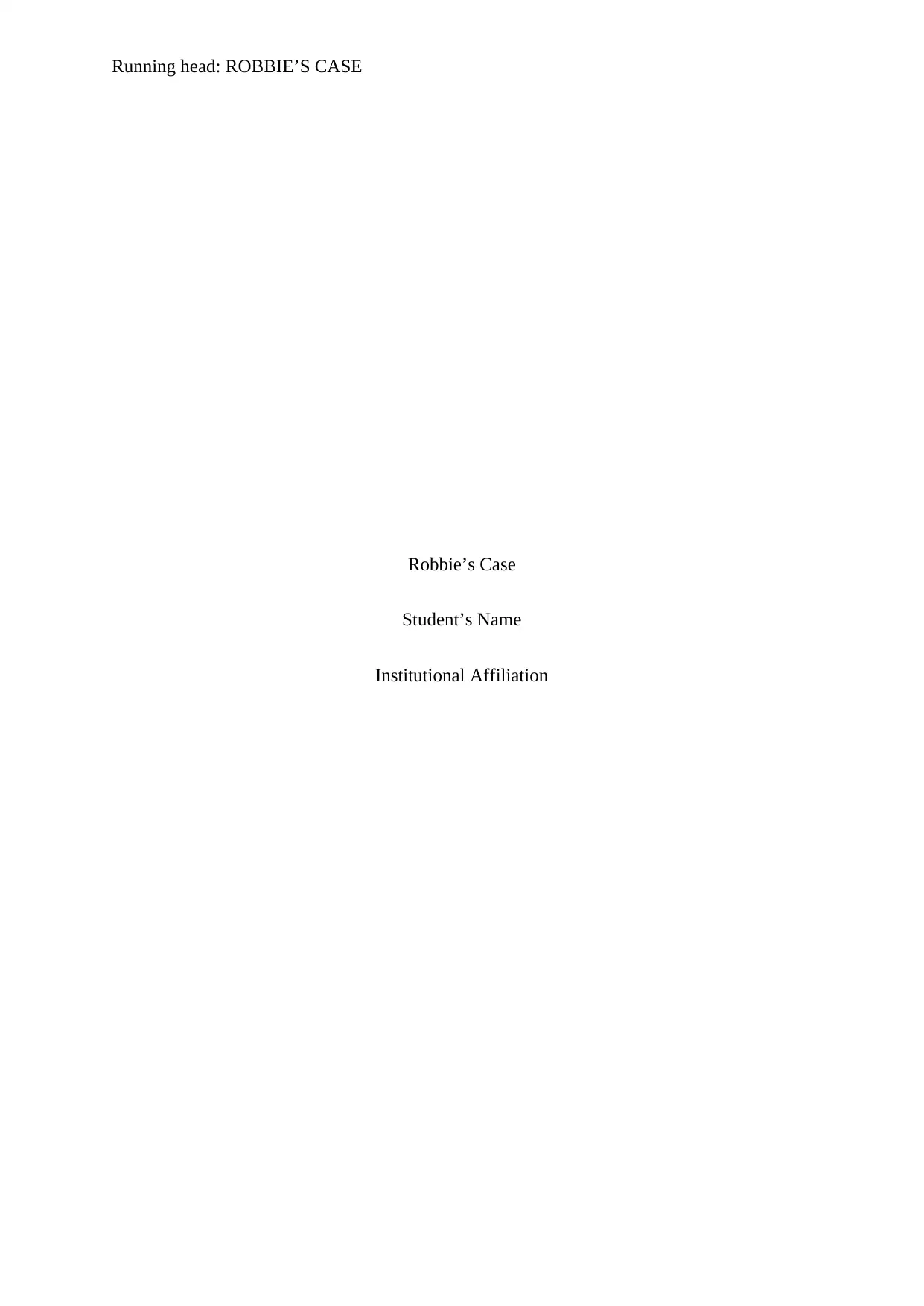
Running head: ROBBIE’S CASE
Robbie’s Case
Student’s Name
Institutional Affiliation
tabler-icon-diamond-filled.svg

Paraphrase This Document

Need a fresh take? Get an instant paraphrase of this document with our AI Paraphraser
Document Page
ROBBIE’S CASE 2
Robbie’s Case
The case study represents a 19-year-old Robbie who has suffered brain damage. The
brain damage was because of a car accident. While his parents knew that he got drunk
occasionally, they did not know that he did it often. They receive the news that their son
drank often with shock and disbelief. On further inquiry from the friends, they find out that it
is true. Prior to the brain damage, Robbie was led a very active lifestyle and was sociable. He
was in college. The damage has greatly affected his life. His memory has been immensely
affected and he finds it hard to remember or even concentrate. The friends were supportive at
first but not anymore. The mother spends most of her time takin care of him and he
complains of the constant interference. The dad does not spend as much time as he used to.
Robbie has not received high quality treatment but has no adhered to the treatment given to
him.
There are several things that have gone wrong in the case study. These things have the
effect of negatively interfering with the effective management of Robbie’s situation. One of
these things is the decreased support of friends. Decrease in support of friends may aggravate
psychological and emotional conditions (Netting, Kettner, McMurtry and Thomas, 2016). It
is worth noting that Robbie was a very sociable person before the accident. Although the
friends supported him at first, they do not do it anymore. This makes him feel lonely and
likely to worsen his condition. The second thing is that the dad has reduced the time that he
used to spend with him. Robbie greatly requires the social support of his parents. He no
longer spends time fishing, hunting and playing golf with his son as he used to. This is likely
to cause emotional stress to Robbie. As Parker (2017) argues, parental support could help
increase the effectiveness of psychological conditions. The other thing that is going wrong is
that Robbie is not adhering to his medication. To improve, it is necessary that he adhere to his
medication. Failure to adhere is to medication is associated with aggravating of the problem
Document Page
ROBBIE’S CASE 3
(Greene, 2017). The last issue is that Robbie has gone back to drinking. This will likely have
negative health consequences such as poor judgements which will further aggravate the
situation.
Although there are some negative aspects of the situation, there are also positive ones.
One of these is that the mother has dedicated her time to caring Robbie. Robbie requires great
care to improve and her mother is offering just that. The other positive aspect is that the
mother has sought a counsellor to help in managing the case. In addition, the parents have
also sought for professional intervention for their son. Extensive evidence suggests that
parental support is vital in such cases(Hepworth, Rooney, Roone and Strom, 2016). There is
also the positive aspect that Robbie knows and accepts that his plans must change. There are
a lot of factors that should play together to improve the situation. These are just some of
them.
Document Page
ROBBIE’S CASE 4
References
Greene, R. R. (2017). Human Behaviour Theory and Professional Social Work Practice. In
Human Behaviour Theory and Social Work Practice (pp. 31-62). Routledge.
Hepworth, D. H., Rooney, R. H., Rooney, G. D., & Strom-Gottfried, K. (2016).
Empowerment series: Direct social work practice: Theory and skills. Nelson
Education.
Netting, F. E., Kettner, P. M., McMurtry, S. L., & Thomas, M. L. (2016). Social work macro
practice. Pearson.
Parker, J. (2017). Social work practice: Assessment, planning, intervention and review.
Learning Matters.
chevron_up_icon
1 out of 4
circle_padding
hide_on_mobile
zoom_out_icon
[object Object]