IT and Society: Analysis of Robotic Nurse Assistant (RoNA) System
VerifiedAdded on 2022/10/17
|10
|1963
|10
Report
AI Summary
This report, titled "IT and Society: Robotic Nurse Assistant (RoNA) System," examines the development and implications of robotic nurse assistants in healthcare. The report begins with an overview of the technology, highlighting the increasing need for nurse robots due to the aging population and the challenges associated with patient transfer. It introduces the Robot for Interactive Body Assistance (RIBA) system, which utilizes human-type arms for lifting and moving patients. The report delves into the design concept of these arms, the stakeholders involved (including healthcare organizations, clinicians, and patients), and the IP protection measures. It then discusses the benefits of RoNA systems, such as improved service care and reduced caregiver burden, as well as the associated risks, including potential unemployment and privacy concerns. The report concludes by summarizing the pros and cons of RIBA and emphasizes the potential of robotic nurse assistants to address nurse scarcity and enhance patient care, while also acknowledging the need for further research and development to overcome existing challenges. References are included for further reading.

IT and Society 1
IT AND SOCIETY
by [Name]
Professor’s Name
Course Code
Course Title
State/City
Date
IT AND SOCIETY
by [Name]
Professor’s Name
Course Code
Course Title
State/City
Date

Paraphrase This Document
Need a fresh take? Get an instant paraphrase of this document with our AI Paraphraser
IT and Society 2
Table of Contents
Technology Overview.................................................................................................................................4
Robotic Nurse Assistant (RoNA) System....................................................................................................4
Design Concept of the Human-type Arms...........................................................................................5
Stakeholders in Robotic Nurse Assistant (RoNA) Technology...............................................................6
IP Protection Measures................................................................................................................................6
Benefits of Robotic Nurse Assistant (RoNA) System..................................................................................7
Risks Related to Robotic Nurse Assistant System.......................................................................................7
Conclusion...................................................................................................................................................8
Pros of RIBA...............................................................................................................................................8
Cons of patient relocation using robotic assistant nurse system..................................................................8
Table of Contents
Technology Overview.................................................................................................................................4
Robotic Nurse Assistant (RoNA) System....................................................................................................4
Design Concept of the Human-type Arms...........................................................................................5
Stakeholders in Robotic Nurse Assistant (RoNA) Technology...............................................................6
IP Protection Measures................................................................................................................................6
Benefits of Robotic Nurse Assistant (RoNA) System..................................................................................7
Risks Related to Robotic Nurse Assistant System.......................................................................................7
Conclusion...................................................................................................................................................8
Pros of RIBA...............................................................................................................................................8
Cons of patient relocation using robotic assistant nurse system..................................................................8
IT and Society 3
Executive Summary
With the rise in the population of aging people in societies, the call for nurse robots to handle the
problem triggered by the elderly populace is high. Patient relocation like moving and lifting
bedridden patients from a bedstead to a wheelchair and back is among the major physical
challenges that is being faced by the nursing care. This is a burden that can be solved by the
advent of robot nurse assistant high-tech. Researchers have advanced a novel prototype known as
RIBA with human-type arms, which has been fashioned to carry out heavy physical
responsibilities that require human interaction and was successful in relocating a human from a
couch to a wheelchair and vice versa. To make use of RIBA it takes the responsibility of the
caregiver to monitor the setting and determine appropriate movements whereas the robot
performs physical hard tasks.
Executive Summary
With the rise in the population of aging people in societies, the call for nurse robots to handle the
problem triggered by the elderly populace is high. Patient relocation like moving and lifting
bedridden patients from a bedstead to a wheelchair and back is among the major physical
challenges that is being faced by the nursing care. This is a burden that can be solved by the
advent of robot nurse assistant high-tech. Researchers have advanced a novel prototype known as
RIBA with human-type arms, which has been fashioned to carry out heavy physical
responsibilities that require human interaction and was successful in relocating a human from a
couch to a wheelchair and vice versa. To make use of RIBA it takes the responsibility of the
caregiver to monitor the setting and determine appropriate movements whereas the robot
performs physical hard tasks.
⊘ This is a preview!⊘
Do you want full access?
Subscribe today to unlock all pages.

Trusted by 1+ million students worldwide
IT and Society 4
Development of a Nursing-Care assistant Robot that can lift a Human in its Arms
Technology Overview
With the increase in the number of aging people, there is a high call for nurse robotics to
confront problems triggered by the elderly populace. The most puzzling task in the attention care
is physical transfer of patients through lifting as well as moving bedridden patients from the bed
to a wheelchair and back. To counter this challenge, the burden has been reduced by the advent
of robotic technologies. Mukai et al. (2010) suggest that human-communicating robots can aid
on-site care providers by taking part in treating humans, especially the swelling aging
population. For that reason, several robots have been suggested such as robots for feeding
individuals who are paralyzed. However, ethical concerns such as loss of human contact, patient
safety and loss of personalized care have been raised (Sharkey, and Sharkey, 2012, p.27). This
paper discusses how robots are useful in patient-transferal task.
Robotic Nurse Assistant (RoNA) System
In order to cope up the challenges of patient transfer Robot for Interactive Body Assistance
(RIBA) has been developed. The robot has adopted a novel tactile guidance, and human-robotic
interface, which is built on perceptible sensors. The robot has sufficient command, safety and
manipulability to care for human (Sharkey, and Sharkey, 2012, p.40). In Japan RIBA has
successfully transferred a human being between a bed and a wheelchair using a human-type arm.
The human-type arm provide RIBA with the capability to adapt its lifting signal to diverse
circumstances that include picking up patients to and from the wheelchair minus a tilt back
function.
Development of a Nursing-Care assistant Robot that can lift a Human in its Arms
Technology Overview
With the increase in the number of aging people, there is a high call for nurse robotics to
confront problems triggered by the elderly populace. The most puzzling task in the attention care
is physical transfer of patients through lifting as well as moving bedridden patients from the bed
to a wheelchair and back. To counter this challenge, the burden has been reduced by the advent
of robotic technologies. Mukai et al. (2010) suggest that human-communicating robots can aid
on-site care providers by taking part in treating humans, especially the swelling aging
population. For that reason, several robots have been suggested such as robots for feeding
individuals who are paralyzed. However, ethical concerns such as loss of human contact, patient
safety and loss of personalized care have been raised (Sharkey, and Sharkey, 2012, p.27). This
paper discusses how robots are useful in patient-transferal task.
Robotic Nurse Assistant (RoNA) System
In order to cope up the challenges of patient transfer Robot for Interactive Body Assistance
(RIBA) has been developed. The robot has adopted a novel tactile guidance, and human-robotic
interface, which is built on perceptible sensors. The robot has sufficient command, safety and
manipulability to care for human (Sharkey, and Sharkey, 2012, p.40). In Japan RIBA has
successfully transferred a human being between a bed and a wheelchair using a human-type arm.
The human-type arm provide RIBA with the capability to adapt its lifting signal to diverse
circumstances that include picking up patients to and from the wheelchair minus a tilt back
function.
Paraphrase This Document
Need a fresh take? Get an instant paraphrase of this document with our AI Paraphraser
IT and Society 5
Design Concept of the Human-type Arms
To transfer an individual using the human-type arms it uses hand-type arms that have
boundless conveyer straps to allow for frictionless attachment under a confined to bed
patient before relocating them.
Some parts of the of the patient’s couch has to be disconnected and connected to the
robot arms to allow for the patient to be pick up with the disconnected part.
The robot uses am artless and small bed static arms to transfer the patient from the bed,
but before that the patient has to be moved from the ordinary bed to a small divan.
Some parts of the bed is supposed to be transformed into a smart wheelchair.
RIBA has the ability to recognize speech, which allows it to understand voice commands. In
addition to that, RIBA has face recognition as well as all-encompassing source localization
functionalities to recognize operating care provider.
The human-type arm robot operates using several sensing points in its upper arms and the
forearm. The shoulders and hands of the human-type arm consists of pressure-sensitive foam
rubber containing perceptible sensors. The tactile sensors are used for communication, tactile
response, and motion adjustment and guaranteeing safety (Mukai et al., 2010, p.6001). RIBA has
the ability to function as a stand-alone mechanical device using batteries and processors located
inside. RIBA operates using processors and local processing boards. These processors and local
processing boards are connected in a network which reduces the computational load of the main
processor. In the process, it declines the cables numbers within RIBA and minimizes the noise
sensor by restricting the analog broadcast length.
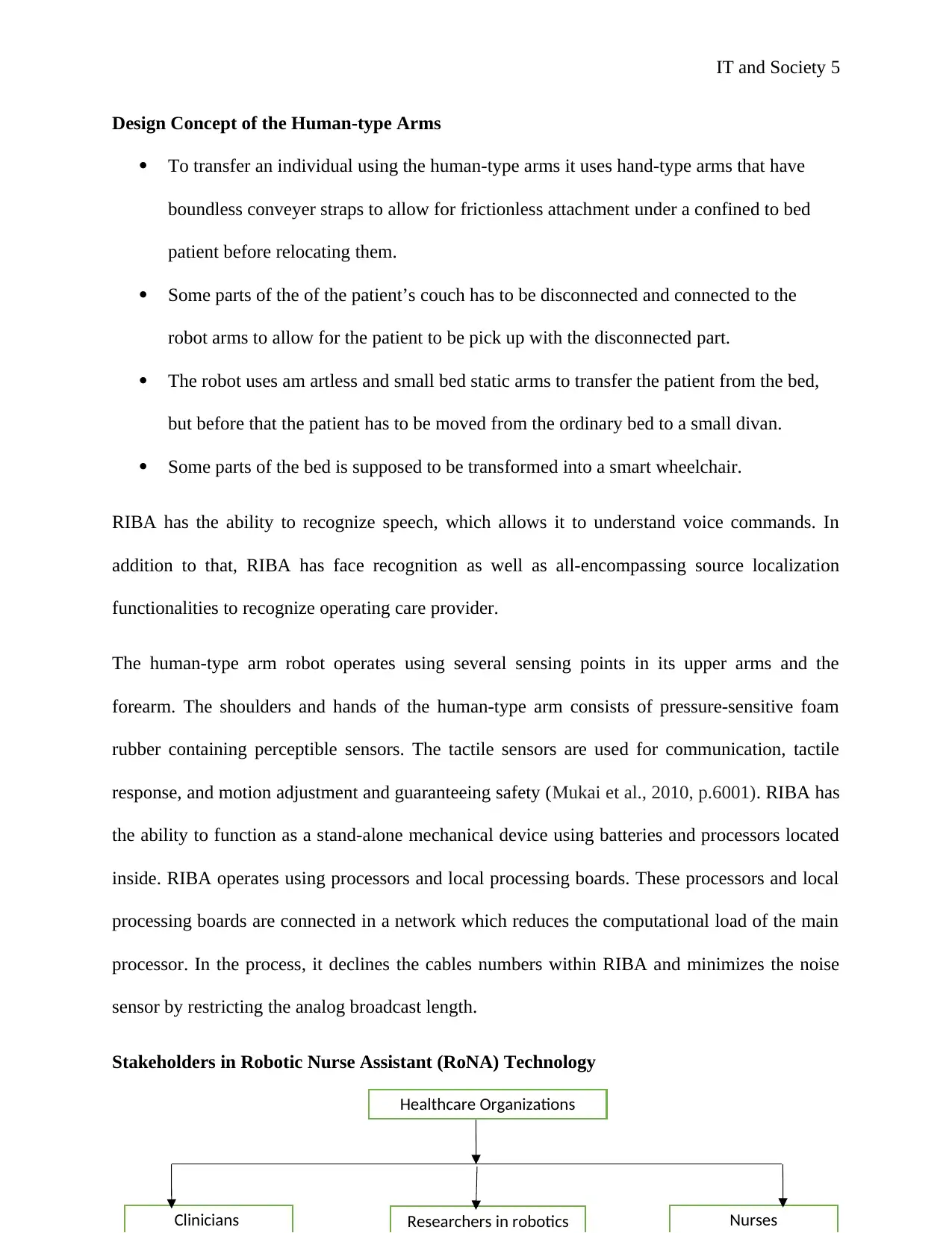
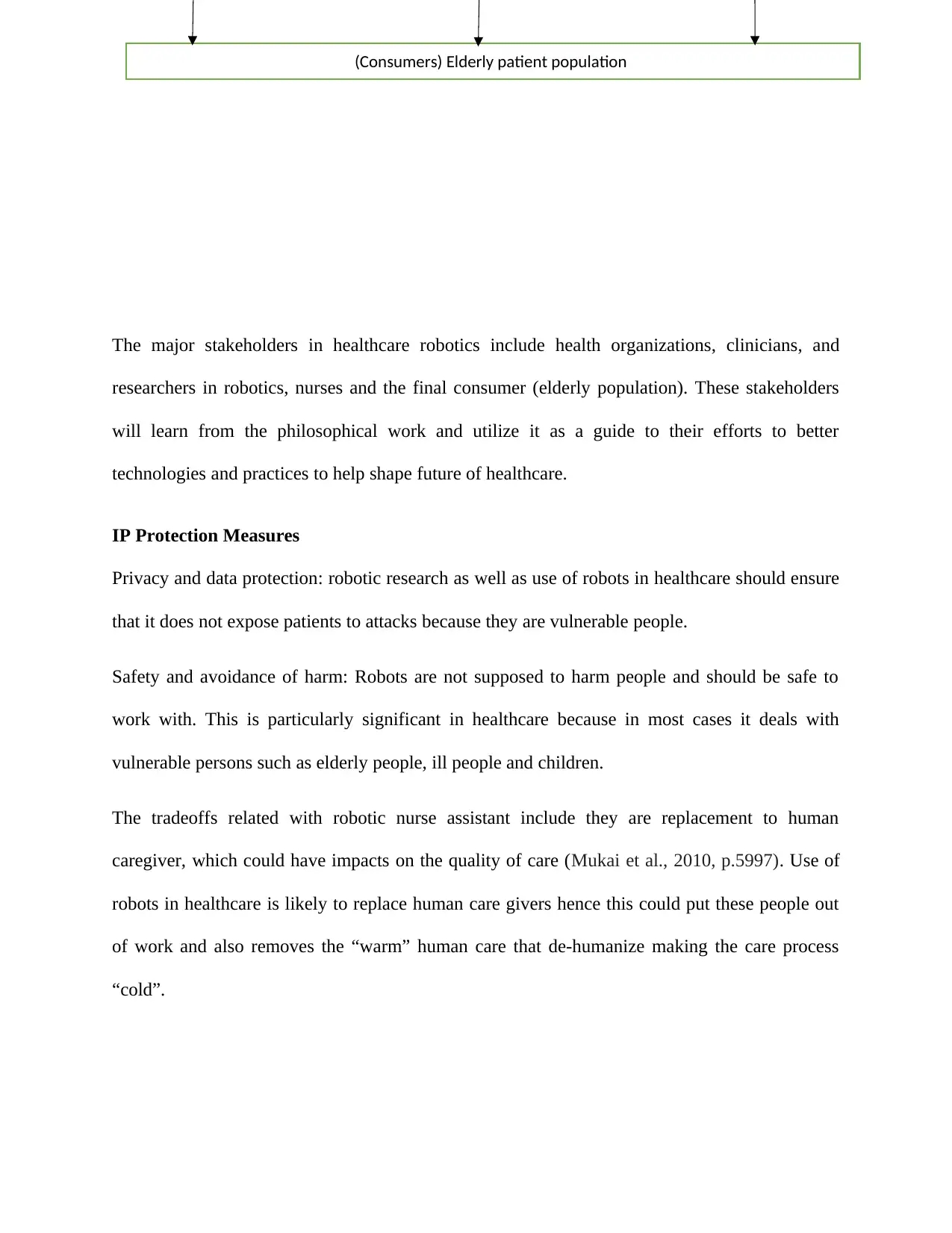
Stakeholders in Robotic Nurse Assistant (RoNA) Technology
Healthcare Organizations
Clinicians Researchers in robotics Nurses
Design Concept of the Human-type Arms
To transfer an individual using the human-type arms it uses hand-type arms that have
boundless conveyer straps to allow for frictionless attachment under a confined to bed
patient before relocating them.
Some parts of the of the patient’s couch has to be disconnected and connected to the
robot arms to allow for the patient to be pick up with the disconnected part.
The robot uses am artless and small bed static arms to transfer the patient from the bed,
but before that the patient has to be moved from the ordinary bed to a small divan.
Some parts of the bed is supposed to be transformed into a smart wheelchair.
RIBA has the ability to recognize speech, which allows it to understand voice commands. In
addition to that, RIBA has face recognition as well as all-encompassing source localization
functionalities to recognize operating care provider.
The human-type arm robot operates using several sensing points in its upper arms and the
forearm. The shoulders and hands of the human-type arm consists of pressure-sensitive foam
rubber containing perceptible sensors. The tactile sensors are used for communication, tactile
response, and motion adjustment and guaranteeing safety (Mukai et al., 2010, p.6001). RIBA has
the ability to function as a stand-alone mechanical device using batteries and processors located
inside. RIBA operates using processors and local processing boards. These processors and local
processing boards are connected in a network which reduces the computational load of the main
processor. In the process, it declines the cables numbers within RIBA and minimizes the noise
sensor by restricting the analog broadcast length.
Stakeholders in Robotic Nurse Assistant (RoNA) Technology
Healthcare Organizations
Clinicians Researchers in robotics Nurses
IT and Society 6
The major stakeholders in healthcare robotics include health organizations, clinicians, and
researchers in robotics, nurses and the final consumer (elderly population). These stakeholders
will learn from the philosophical work and utilize it as a guide to their efforts to better
technologies and practices to help shape future of healthcare.
IP Protection Measures
Privacy and data protection: robotic research as well as use of robots in healthcare should ensure
that it does not expose patients to attacks because they are vulnerable people.
Safety and avoidance of harm: Robots are not supposed to harm people and should be safe to
work with. This is particularly significant in healthcare because in most cases it deals with
vulnerable persons such as elderly people, ill people and children.
The tradeoffs related with robotic nurse assistant include they are replacement to human
caregiver, which could have impacts on the quality of care (Mukai et al., 2010, p.5997). Use of
robots in healthcare is likely to replace human care givers hence this could put these people out
of work and also removes the “warm” human care that de-humanize making the care process
“cold”.
(Consumers) Elderly patient population
The major stakeholders in healthcare robotics include health organizations, clinicians, and
researchers in robotics, nurses and the final consumer (elderly population). These stakeholders
will learn from the philosophical work and utilize it as a guide to their efforts to better
technologies and practices to help shape future of healthcare.
IP Protection Measures
Privacy and data protection: robotic research as well as use of robots in healthcare should ensure
that it does not expose patients to attacks because they are vulnerable people.
Safety and avoidance of harm: Robots are not supposed to harm people and should be safe to
work with. This is particularly significant in healthcare because in most cases it deals with
vulnerable persons such as elderly people, ill people and children.
The tradeoffs related with robotic nurse assistant include they are replacement to human
caregiver, which could have impacts on the quality of care (Mukai et al., 2010, p.5997). Use of
robots in healthcare is likely to replace human care givers hence this could put these people out
of work and also removes the “warm” human care that de-humanize making the care process
“cold”.
(Consumers) Elderly patient population
⊘ This is a preview!⊘
Do you want full access?
Subscribe today to unlock all pages.
Trusted by 1+ million students worldwide
IT and Society 7
Benefits of Robotic Nurse Assistant (RoNA) System
With the rise in the number of aging population in most societies across the world the Robotic
Nurse Assistant System will help medical amenities and facilities by boosting the service care
offered to victims with less involvement of the care givers. Consequently, healthcare
organization stakeholders such as clinicians and nurses will get enough time to provide care
services to many clients with aging complications (Mukai et al., 2010, p.5996). On the same
note, RoNA system will help healthcare facilities to overcome the challenge of nurse scarcity to
take care of the rising population of elderly people.
Through the use of Robotic Nurse Assistant System the challenge of lifting patients weighing a
lot of weight of over 300 kilos would be resolved. The RoNA has been designed in a manner that
it acts as a lifting system as a self-directed robotic nurse. The RoNA has been design in such a
way that it can help healthcare providers to operate and lift patients that weigh many kilos. In
this sense, RoNA will help to reduce work-related injuries that results from manually lifting and
repositioning patients around the bed and shifting them from one bed to another. Indeed, RoNA
has the ability to move in all directions since it is a mobile system that contain mecanum wheels
that can maneuver in any path and work in confined areas where portable lifting systems cannot
operate (Mukai et al., 2010, p.5997). Therefore, healthcare staff can supervise the RoNA system
from a remote location. Therefore, the remotely located medical expert will be in a position to
pay visit to the patient, monitor physiological data in real-time and make commendation about
the local team regarding their ability to diagnose and treat patients.
Risks Related to Robotic Nurse Assistant System
Employment: Even through robotic nurse assistant systems are of great significance to healthcare
facilities by boosting care provision to patients, it is feared that they will result in unemployment
Benefits of Robotic Nurse Assistant (RoNA) System
With the rise in the number of aging population in most societies across the world the Robotic
Nurse Assistant System will help medical amenities and facilities by boosting the service care
offered to victims with less involvement of the care givers. Consequently, healthcare
organization stakeholders such as clinicians and nurses will get enough time to provide care
services to many clients with aging complications (Mukai et al., 2010, p.5996). On the same
note, RoNA system will help healthcare facilities to overcome the challenge of nurse scarcity to
take care of the rising population of elderly people.
Through the use of Robotic Nurse Assistant System the challenge of lifting patients weighing a
lot of weight of over 300 kilos would be resolved. The RoNA has been designed in a manner that
it acts as a lifting system as a self-directed robotic nurse. The RoNA has been design in such a
way that it can help healthcare providers to operate and lift patients that weigh many kilos. In
this sense, RoNA will help to reduce work-related injuries that results from manually lifting and
repositioning patients around the bed and shifting them from one bed to another. Indeed, RoNA
has the ability to move in all directions since it is a mobile system that contain mecanum wheels
that can maneuver in any path and work in confined areas where portable lifting systems cannot
operate (Mukai et al., 2010, p.5997). Therefore, healthcare staff can supervise the RoNA system
from a remote location. Therefore, the remotely located medical expert will be in a position to
pay visit to the patient, monitor physiological data in real-time and make commendation about
the local team regarding their ability to diagnose and treat patients.
Risks Related to Robotic Nurse Assistant System
Employment: Even through robotic nurse assistant systems are of great significance to healthcare
facilities by boosting care provision to patients, it is feared that they will result in unemployment
Paraphrase This Document
Need a fresh take? Get an instant paraphrase of this document with our AI Paraphraser
IT and Society 8
(Sharkey, and Sharkey, 2012, p.27). The duties that are supposed to be performed by nurses, and
clinicians are being programmed and being performed by robots, which means that RoNA are
taking over the work that would have been carried out by human beings.
Privacy: healthcare organizations deal with patient’s private information which is supposed to be
kept confidential. However, with the introduction of robotic nurse assistant systems personal data
and information of patents is at high risk of being accessed by intruders (Sharkey, and Sharkey,
2012, p.38). Robotic nurse assistant systems are developed using programs which can be hacked
hence healthcare organization management should put in place stringent security measures such
as using firewalls within their facilities to minimize possibility of exposing patient’s data and
information to malicious people.
Conclusion
Pros of RIBA
Human-type arms can be used in different types of lifting like helping with rehabilitation
training. For example, in Japan RIBA has successful succeeded to transfer a patient
between a divan and an ordinary wheelchair minus tilt back function, something that has
never been realized by other methods.
RIBA is a robot that can be shared by several patients because it has the ability to lift the
patient and place them at the required position within a short period.
The human-type arm can be put into small spaces beneath a patient resting on a couch,
which makes the insertion to take less time as compared to use of endless belts.
Cons of patient relocation using robotic assistant nurse system
The price of human-type arms is highly expensive
(Sharkey, and Sharkey, 2012, p.27). The duties that are supposed to be performed by nurses, and
clinicians are being programmed and being performed by robots, which means that RoNA are
taking over the work that would have been carried out by human beings.
Privacy: healthcare organizations deal with patient’s private information which is supposed to be
kept confidential. However, with the introduction of robotic nurse assistant systems personal data
and information of patents is at high risk of being accessed by intruders (Sharkey, and Sharkey,
2012, p.38). Robotic nurse assistant systems are developed using programs which can be hacked
hence healthcare organization management should put in place stringent security measures such
as using firewalls within their facilities to minimize possibility of exposing patient’s data and
information to malicious people.
Conclusion
Pros of RIBA
Human-type arms can be used in different types of lifting like helping with rehabilitation
training. For example, in Japan RIBA has successful succeeded to transfer a patient
between a divan and an ordinary wheelchair minus tilt back function, something that has
never been realized by other methods.
RIBA is a robot that can be shared by several patients because it has the ability to lift the
patient and place them at the required position within a short period.
The human-type arm can be put into small spaces beneath a patient resting on a couch,
which makes the insertion to take less time as compared to use of endless belts.
Cons of patient relocation using robotic assistant nurse system
The price of human-type arms is highly expensive
IT and Society 9
The chance of malfunctioning due to the intricacy of the arm structure.
There is danger of the arm dropping the lifted patient which is still need further research
to overcome.
RoNA prototype has been developed to assist medical givers with patient transfer especially
those who have much weight and provide care to the increasing aging population. The
introducing of robotic nurse assistant will aid to satisfy the nurse scarcity that is experienced in
many parts of the world. On the other hand, due to fear of nurse assistant robots taking over
nurses’ work, human nurses are likely to become more productive, providing extra fineness to
the patient experience and at the same time reducing cost.
Reference List
The chance of malfunctioning due to the intricacy of the arm structure.
There is danger of the arm dropping the lifted patient which is still need further research
to overcome.
RoNA prototype has been developed to assist medical givers with patient transfer especially
those who have much weight and provide care to the increasing aging population. The
introducing of robotic nurse assistant will aid to satisfy the nurse scarcity that is experienced in
many parts of the world. On the other hand, due to fear of nurse assistant robots taking over
nurses’ work, human nurses are likely to become more productive, providing extra fineness to
the patient experience and at the same time reducing cost.
Reference List
⊘ This is a preview!⊘
Do you want full access?
Subscribe today to unlock all pages.
Trusted by 1+ million students worldwide
IT and Society 10
Mukai, T., Hirano, S., Nakashima, H., Kato, Y., Sakaida, Y., Guo, S. and Hosoe, S., 2010,
October. Development of a nursing-care assistant robot RIBA that can lift a human in its arms.
In 2010 IEEE/RSJ International Conference on Intelligent Robots and Systems (pp. 5996-6001).
IEEE.
Sharkey, A. and Sharkey, N., 2012. Granny and the robots: ethical issues in robot care for the
elderly. Ethics and information technology, 14(1), pp.27-40.
https://link.springer.com/article/10.1007/s10676-010-9234-6
Mukai, T., Hirano, S., Nakashima, H., Kato, Y., Sakaida, Y., Guo, S. and Hosoe, S., 2010,
October. Development of a nursing-care assistant robot RIBA that can lift a human in its arms.
In 2010 IEEE/RSJ International Conference on Intelligent Robots and Systems (pp. 5996-6001).
IEEE.
Sharkey, A. and Sharkey, N., 2012. Granny and the robots: ethical issues in robot care for the
elderly. Ethics and information technology, 14(1), pp.27-40.
https://link.springer.com/article/10.1007/s10676-010-9234-6

1 out of 10


Your All-in-One AI-Powered Toolkit for Academic Success.
+13062052269
info@desklib.com
Available 24*7 on WhatsApp / Email
![[object Object]](/_next/static/media/star-bottom.7253800d.svg)
Unlock your academic potential
Copyright © 2020–2026 A2Z Services. All Rights Reserved. Developed and managed by ZUCOL.