Detailed Report on Roles, Responsibilities, and the UK Court Process

Verified

Added on  2024/05/17

|6
|1126
|404
Report
AI Summary
This report provides an overview of the UK court system, detailing the roles and responsibilities of various courts, including Magistrate, County, High Court, and Supreme Court, along with the European Court. It outlines the UK court process, from pre-action protocols to post-climax enforcement methods, and differentiates between civil and criminal cases. The report also clarifies the roles of solicitors, lawyers, barristers, and judges, emphasizing their distinct functions in legal proceedings. The conclusion highlights the importance of each individual within the court system for maintaining a proper process structure. Desklib offers a wide range of similar documents for students.

Document Page
Assessment task: report
1
tabler-icon-diamond-filled.svg

Paraphrase This Document

Need a fresh take? Get an instant paraphrase of this document with our AI Paraphraser
Document Page
Contents
Introduction......................................................................................................................................3
Content.............................................................................................................................................3
Conclusion.......................................................................................................................................5
References........................................................................................................................................6
2
Document Page
Introduction:
The report deals with the roles and responsibilities defined by the Magistrate, Country, High
Court and Supreme Court. It also identifies and describes the Court process followed by the UK
court. Types of cases which are been heard have also been explained in the detail form with
defining the roles of the Lawyers, Barristers, and the Judges.
Content
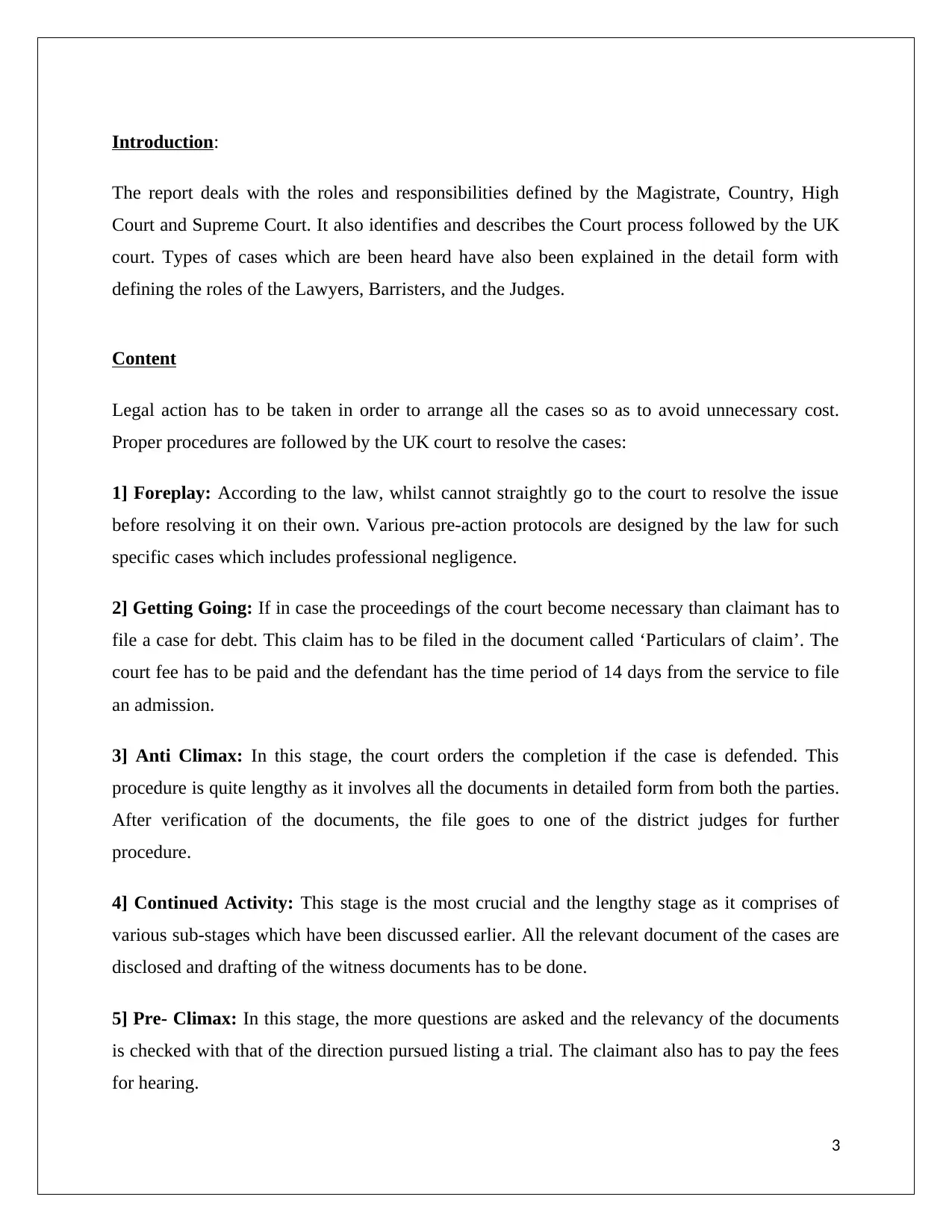
Legal action has to be taken in order to arrange all the cases so as to avoid unnecessary cost.
Proper procedures are followed by the UK court to resolve the cases:
1] Foreplay: According to the law, whilst cannot straightly go to the court to resolve the issue
before resolving it on their own. Various pre-action protocols are designed by the law for such
specific cases which includes professional negligence.
2] Getting Going: If in case the proceedings of the court become necessary than claimant has to
file a case for debt. This claim has to be filed in the document called ‘Particulars of claim’. The
court fee has to be paid and the defendant has the time period of 14 days from the service to file
an admission.
3] Anti Climax: In this stage, the court orders the completion if the case is defended. This
procedure is quite lengthy as it involves all the documents in detailed form from both the parties.
After verification of the documents, the file goes to one of the district judges for further
procedure.
4] Continued Activity: This stage is the most crucial and the lengthy stage as it comprises of
various sub-stages which have been discussed earlier. All the relevant document of the cases are
disclosed and drafting of the witness documents has to be done.
5] Pre- Climax: In this stage, the more questions are asked and the relevancy of the documents
is checked with that of the direction pursued listing a trial. The claimant also has to pay the fees
for hearing.
3
Document Page
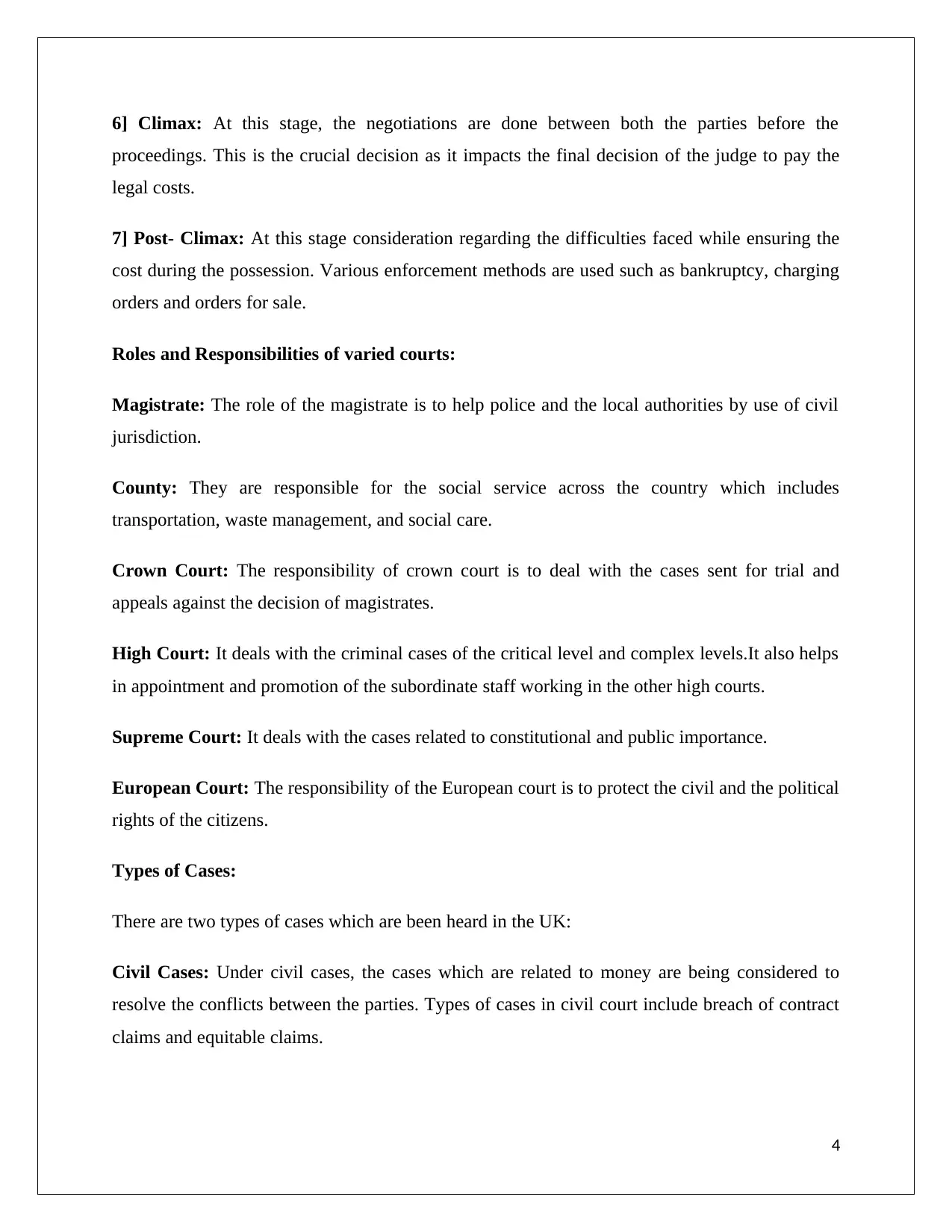
6] Climax: At this stage, the negotiations are done between both the parties before the
proceedings. This is the crucial decision as it impacts the final decision of the judge to pay the
legal costs.
7] Post- Climax: At this stage consideration regarding the difficulties faced while ensuring the
cost during the possession. Various enforcement methods are used such as bankruptcy, charging
orders and orders for sale.
Roles and Responsibilities of varied courts:
Magistrate: The role of the magistrate is to help police and the local authorities by use of civil
jurisdiction.
County: They are responsible for the social service across the country which includes
transportation, waste management, and social care.
Crown Court: The responsibility of crown court is to deal with the cases sent for trial and
appeals against the decision of magistrates.
High Court: It deals with the criminal cases of the critical level and complex levels.It also helps
in appointment and promotion of the subordinate staff working in the other high courts.
Supreme Court: It deals with the cases related to constitutional and public importance.
European Court: The responsibility of the European court is to protect the civil and the political
rights of the citizens.
Types of Cases:
There are two types of cases which are been heard in the UK:
Civil Cases: Under civil cases, the cases which are related to money are being considered to
resolve the conflicts between the parties. Types of cases in civil court include breach of contract
claims and equitable claims.
4
tabler-icon-diamond-filled.svg

Paraphrase This Document

Need a fresh take? Get an instant paraphrase of this document with our AI Paraphraser
Document Page
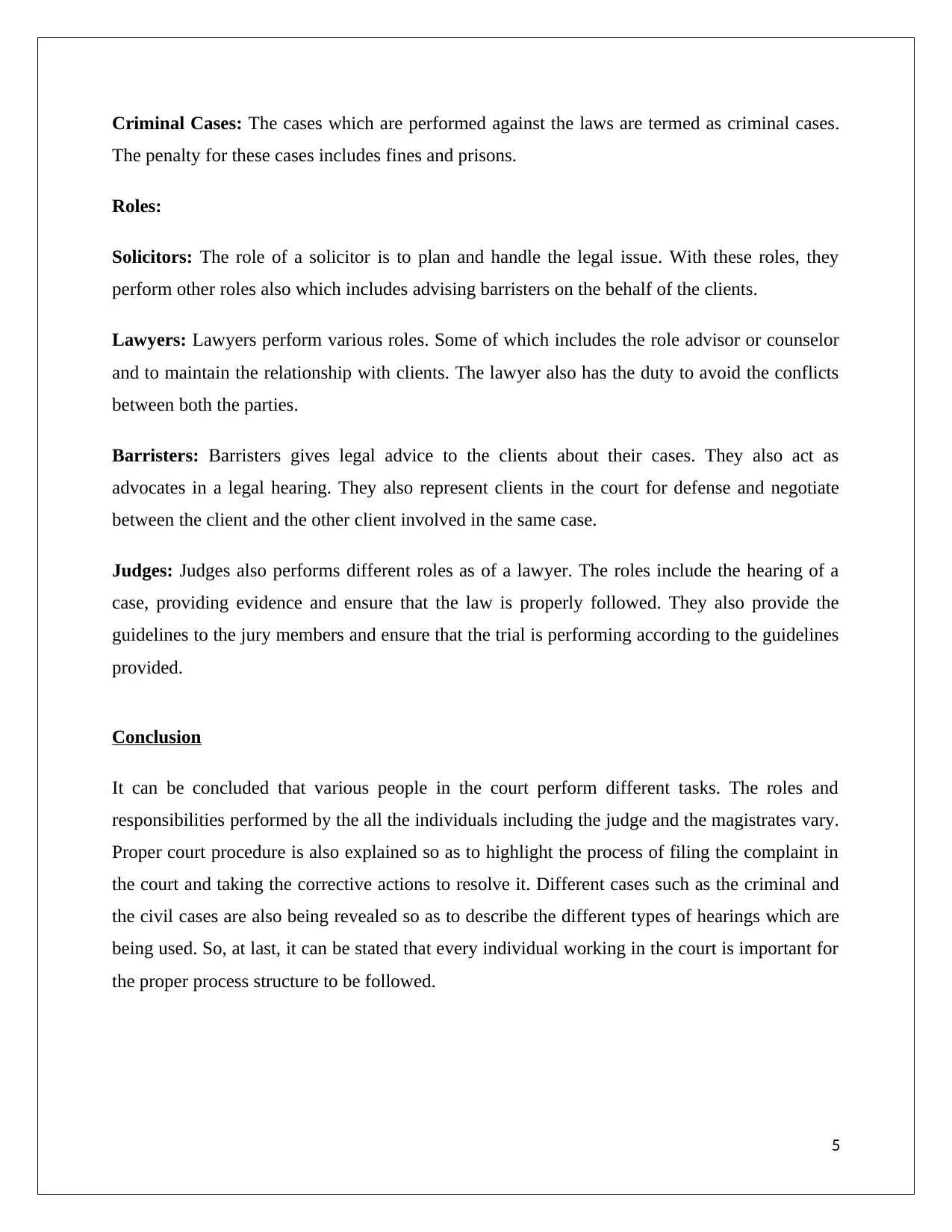
Criminal Cases: The cases which are performed against the laws are termed as criminal cases.
The penalty for these cases includes fines and prisons.
Roles:
Solicitors: The role of a solicitor is to plan and handle the legal issue. With these roles, they
perform other roles also which includes advising barristers on the behalf of the clients.
Lawyers: Lawyers perform various roles. Some of which includes the role advisor or counselor
and to maintain the relationship with clients. The lawyer also has the duty to avoid the conflicts
between both the parties.
Barristers: Barristers gives legal advice to the clients about their cases. They also act as
advocates in a legal hearing. They also represent clients in the court for defense and negotiate
between the client and the other client involved in the same case.
Judges: Judges also performs different roles as of a lawyer. The roles include the hearing of a
case, providing evidence and ensure that the law is properly followed. They also provide the
guidelines to the jury members and ensure that the trial is performing according to the guidelines
provided.
Conclusion
It can be concluded that various people in the court perform different tasks. The roles and
responsibilities performed by the all the individuals including the judge and the magistrates vary.
Proper court procedure is also explained so as to highlight the process of filing the complaint in
the court and taking the corrective actions to resolve it. Different cases such as the criminal and
the civil cases are also being revealed so as to describe the different types of hearings which are
being used. So, at last, it can be stated that every individual working in the court is important for
the proper process structure to be followed.
5
Document Page
References:
1. Courts and Tribunals Judiciary, 2018. [Online] You and the Judiciary.
https://www.judiciary.gov.uk/you-and-the-judiciary/going-to-court/crown-court/.
[Accessed On: 9 March 2018]
2. Supreme Court, 2018. [Online] The Supreme Court.
https://www.supremecourt.uk/about/role-of-the-supreme-court.html. [Accessed On: 9
March 2018]
3. Arnold, W., 2014. The Supreme Court of the United Kingdom (UKSC), an Exploration
of the Roles of Judicial Officers and Court Administrators and how the Relationship
between them may be improved and enhanced: a Case Study. International Journal for
Court Administration.Vol. 6 No. 2. ,.
4. Contact Law, 2016. [Online] Areas of Law.
https://www.contactlaw.co.uk/68-nolink-uk/areas-of-law/general-legal-information/
information-on-lawyers/1048-what-is-your-lawyer-role.html. [Accessed On: 9 March
2018]
6
chevron_up_icon
1 out of 6
circle_padding
hide_on_mobile
zoom_out_icon
[object Object]