Evaluating the Roles of PMO for Organizational Goal Achievement
VerifiedAdded on 2020/05/08
|20
|5429
|71
Report
AI Summary
This report investigates the multifaceted roles of Project Management Offices (PMOs) within organizations, focusing on their capacity to act as knowledge brokers between project teams and top management. It addresses the problem of inadequate knowledge sharing in project-based organizations due to time constraints and the temporary nature of projects, which often leads to loss of valuable lessons learned. The research questions explore the knowledge-sharing criteria of PMOs with top management and other departments, as well as their contribution to achieving organizational goals. The study aims to understand how PMO changes, driven by factors such as organizational context and change management, impact coordination systems and service orientation. It highlights the significance of PMOs in enhancing project and business execution, while also acknowledging limitations related to time, budget, and data availability. The literature review emphasizes the importance of effective knowledge sharing within project-based organizations to avoid repeating mistakes and ensure continuous improvement. The methodology section details the research approach, philosophy, and strategy, including data collection and analysis techniques. Ultimately, the report seeks to provide empirical evidence concerning hierarchical change management and offer practical steps for aligning PMO capabilities with the needs of project managers, thereby improving knowledge sharing and overall organizational performance. Desklib provides a platform for students to access past papers and solved assignments.
Running head: ROLES OF PMO IN AN ORGANIZATION
Roles of PMO in an organization
Name of the Student:
Name of the University:
Author note:
Roles of PMO in an organization
Name of the Student:
Name of the University:
Author note:

Paraphrase This Document
Need a fresh take? Get an instant paraphrase of this document with our AI Paraphraser
1ROLES OF PMO IN AN ORGANIZATION
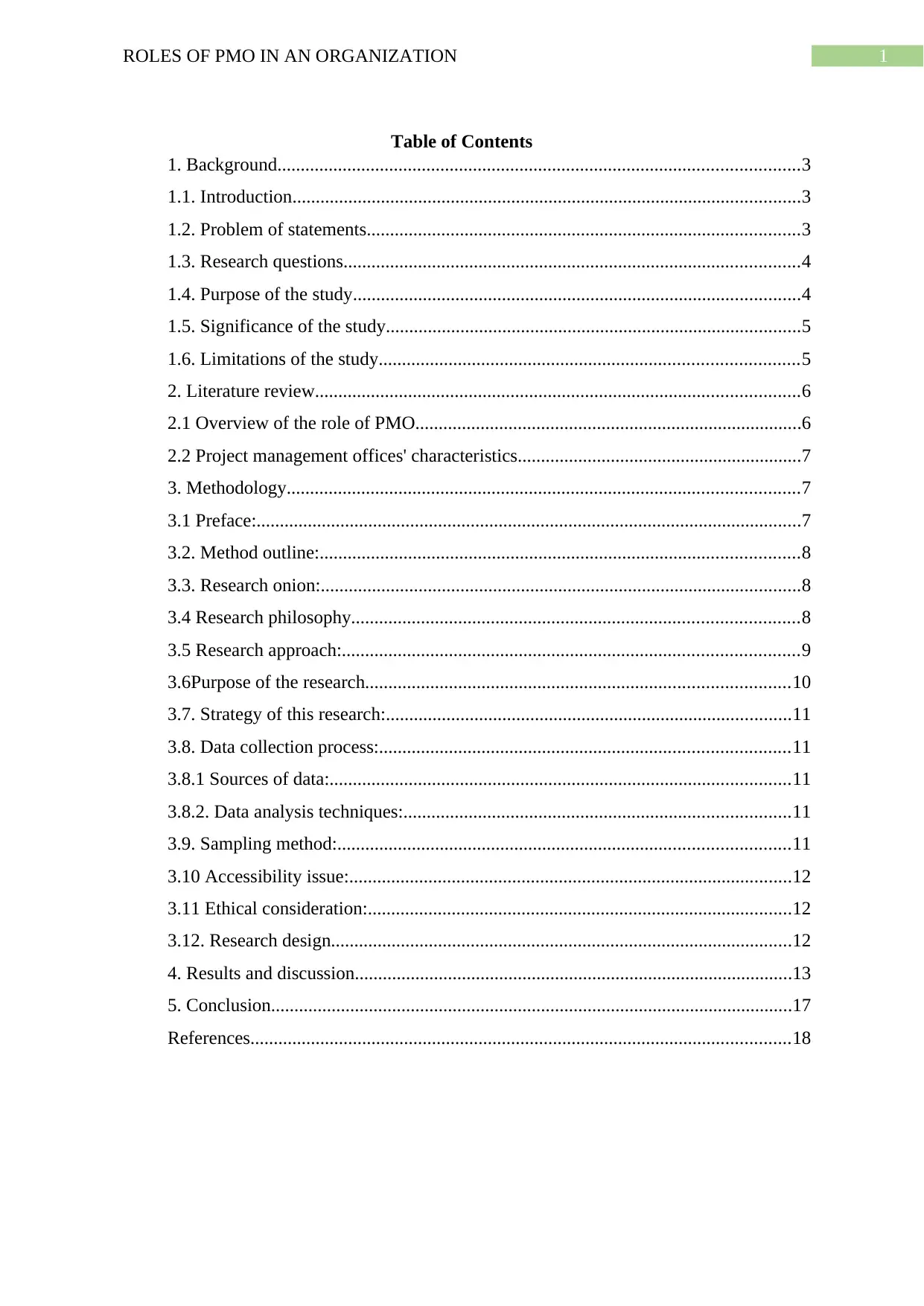
Table of Contents
1. Background................................................................................................................3
1.1. Introduction.............................................................................................................3
1.2. Problem of statements.............................................................................................3
1.3. Research questions..................................................................................................4
1.4. Purpose of the study................................................................................................4
1.5. Significance of the study.........................................................................................5
1.6. Limitations of the study..........................................................................................5
2. Literature review........................................................................................................6
2.1 Overview of the role of PMO...................................................................................6
2.2 Project management offices' characteristics.............................................................7
3. Methodology..............................................................................................................7
3.1 Preface:.....................................................................................................................7
3.2. Method outline:.......................................................................................................8
3.3. Research onion:.......................................................................................................8
3.4 Research philosophy................................................................................................8
3.5 Research approach:..................................................................................................9
3.6Purpose of the research...........................................................................................10
3.7. Strategy of this research:.......................................................................................11
3.8. Data collection process:........................................................................................11
3.8.1 Sources of data:...................................................................................................11
3.8.2. Data analysis techniques:...................................................................................11
3.9. Sampling method:.................................................................................................11
3.10 Accessibility issue:...............................................................................................12
3.11 Ethical consideration:...........................................................................................12
3.12. Research design...................................................................................................12
4. Results and discussion..............................................................................................13
5. Conclusion................................................................................................................17
References....................................................................................................................18
Table of Contents
1. Background................................................................................................................3
1.1. Introduction.............................................................................................................3
1.2. Problem of statements.............................................................................................3
1.3. Research questions..................................................................................................4
1.4. Purpose of the study................................................................................................4
1.5. Significance of the study.........................................................................................5
1.6. Limitations of the study..........................................................................................5
2. Literature review........................................................................................................6
2.1 Overview of the role of PMO...................................................................................6
2.2 Project management offices' characteristics.............................................................7
3. Methodology..............................................................................................................7
3.1 Preface:.....................................................................................................................7
3.2. Method outline:.......................................................................................................8
3.3. Research onion:.......................................................................................................8
3.4 Research philosophy................................................................................................8
3.5 Research approach:..................................................................................................9
3.6Purpose of the research...........................................................................................10
3.7. Strategy of this research:.......................................................................................11
3.8. Data collection process:........................................................................................11
3.8.1 Sources of data:...................................................................................................11
3.8.2. Data analysis techniques:...................................................................................11
3.9. Sampling method:.................................................................................................11
3.10 Accessibility issue:...............................................................................................12
3.11 Ethical consideration:...........................................................................................12
3.12. Research design...................................................................................................12
4. Results and discussion..............................................................................................13
5. Conclusion................................................................................................................17
References....................................................................................................................18
2ROLES OF PMO IN AN ORGANIZATION
1. Background
1.1. Introduction
Present research into evaluating the role of project management offices has stressed
potential of the PMOs’ in order to act as the knowledge brokers between project and top
management. In any case, the study does not give adequate proof of facilitating part of PMOs
(Schwalbe, 2015). In this perspective, the research has revealed plans to look at the capacities
of PMO from knowledge sharing point of view as well as investigate regardless of if these
capacities mirror the information sharing requires of undertaking administrators (PMs). The
issues are evaluated through a cross-case study of organizations. The major commitment is
comprehending how PMO can share information along with consciousness of the
requirement to the structure that PMOs are to line up with tendency, needs and desires so as
to enhance earning partaking in PBOs (Too & Weaver, 2014). At long last, some viable
strides for assisting PMOs for better adjustment of their capacities to necessities of PMs and
their learning as well as information sharing style are proposed.
1.2. Problem of statements
The PBO for the most part learns from the projects through an aggregation of
encounters among the undertaking members and task individuals. However, the project
nature tends to hamper information sharing as PMs' essential concentrate is on time and item,
or administration, conveyance, instead of on learning sharing exercises. Time weight and
transitory nature of the undertaking imply that the finish of the project is frequently the finish
of aggregate learning. Besides, it is a typical practice that task lessons are assessed toward the
finish of the project and respected unnecessary (Lappe & Spang, 2014). This outcome in low
nature of best practices and lessons got the hang of, causing an absence of cross task learning
and correspondence with the end goal that project encounters are caught and shared rarely.
1. Background
1.1. Introduction
Present research into evaluating the role of project management offices has stressed
potential of the PMOs’ in order to act as the knowledge brokers between project and top
management. In any case, the study does not give adequate proof of facilitating part of PMOs
(Schwalbe, 2015). In this perspective, the research has revealed plans to look at the capacities
of PMO from knowledge sharing point of view as well as investigate regardless of if these
capacities mirror the information sharing requires of undertaking administrators (PMs). The
issues are evaluated through a cross-case study of organizations. The major commitment is
comprehending how PMO can share information along with consciousness of the
requirement to the structure that PMOs are to line up with tendency, needs and desires so as
to enhance earning partaking in PBOs (Too & Weaver, 2014). At long last, some viable
strides for assisting PMOs for better adjustment of their capacities to necessities of PMs and
their learning as well as information sharing style are proposed.
1.2. Problem of statements
The PBO for the most part learns from the projects through an aggregation of
encounters among the undertaking members and task individuals. However, the project
nature tends to hamper information sharing as PMs' essential concentrate is on time and item,
or administration, conveyance, instead of on learning sharing exercises. Time weight and
transitory nature of the undertaking imply that the finish of the project is frequently the finish
of aggregate learning. Besides, it is a typical practice that task lessons are assessed toward the
finish of the project and respected unnecessary (Lappe & Spang, 2014). This outcome in low
nature of best practices and lessons got the hang of, causing an absence of cross task learning
and correspondence with the end goal that project encounters are caught and shared rarely.
⊘ This is a preview!⊘
Do you want full access?
Subscribe today to unlock all pages.

Trusted by 1+ million students worldwide
3ROLES OF PMO IN AN ORGANIZATION
Essentially, issues of cross-project learning have more extensive ramifications for procedures
of hierarchical learning and the advancement of authoritative and undertaking administration
capacities.
Knowledge Sharing (KS) on the task level occurs as social communication between
the partners of project and through several unequivocal data channels. For instances, project
archives. Aggregated learning all through the task, if not viably imparted to different projects
and the parent association, can be hopelessly lost. In this way, the danger of an information
misfortune at the undertaking's end is a difficult issue for PBOs (Hill, 2013). It is in this
manner evident that the exchange of information and learning created inside projects, either
to different undertakings or to the parent association, does not occur without trouble. Thus, it
is important to research on knowledge sharing process of PMO with the top management
along with different departments and analyse its advantages that is achieved in the research.
1.3. Research questions
What are knowledge sharing criteria of PMO with the top management as well
as other departments within an organization?
How is it helpful in achieving an organizational goal?
1.4. Purpose of the study
This study purposes for understanding hierarchical change through the investigation
of project management office (PMO) changes. This article recommends that execution
coming about because of a PMO change is directed by the authoritative setting, change
administration, and by changes in coordination systems control or service orientation. This
exploratory investigation embraced a qualitative technique including PMO changes. It
affirms the multifaceted idea of the setting engaged with a PMO change. Outside occasions
assume a key part in activating change and enhancing execution. Key findings propose that
Essentially, issues of cross-project learning have more extensive ramifications for procedures
of hierarchical learning and the advancement of authoritative and undertaking administration
capacities.
Knowledge Sharing (KS) on the task level occurs as social communication between
the partners of project and through several unequivocal data channels. For instances, project
archives. Aggregated learning all through the task, if not viably imparted to different projects
and the parent association, can be hopelessly lost. In this way, the danger of an information
misfortune at the undertaking's end is a difficult issue for PBOs (Hill, 2013). It is in this
manner evident that the exchange of information and learning created inside projects, either
to different undertakings or to the parent association, does not occur without trouble. Thus, it
is important to research on knowledge sharing process of PMO with the top management
along with different departments and analyse its advantages that is achieved in the research.
1.3. Research questions
What are knowledge sharing criteria of PMO with the top management as well
as other departments within an organization?
How is it helpful in achieving an organizational goal?
1.4. Purpose of the study
This study purposes for understanding hierarchical change through the investigation
of project management office (PMO) changes. This article recommends that execution
coming about because of a PMO change is directed by the authoritative setting, change
administration, and by changes in coordination systems control or service orientation. This
exploratory investigation embraced a qualitative technique including PMO changes. It
affirms the multifaceted idea of the setting engaged with a PMO change. Outside occasions
assume a key part in activating change and enhancing execution. Key findings propose that
Paraphrase This Document
Need a fresh take? Get an instant paraphrase of this document with our AI Paraphraser
4ROLES OF PMO IN AN ORGANIZATION
expanding the PMO's strong part enhances project execution, business execution, and
undertaking administration development (Serra & Kunc, 2015). Then again, expanding the
PMO's control part does not enhance execution. This present research's significant
commitment is to give some experimental confirmation concerning hierarchical change
administration.
1.5. Significance of the study
An important finding of past research is to have portrayed the procedure by which the
PMO advances from one phase to the next. The transitory idea of PMOs was then clarified by
this procedure demonstrate based on contextual investigations and approved through
responses to a poll. Here, the brief idea of the PMO alludes to the span of a particular
condition of the element as it happens in all actuality and not as predefined. While this
definition apropos applies to projects and projects, it doesn't represent the profoundly
temporary segments of the association's life. The target of this article is to make the
investigation a stride facilitates by more particularly investigating the effect of the progress
(Pemsel & Wiewiora, 2013). The change delivers the normal outcomes. At the end of the
day, it will the progressions enhance execution. Expanding on the progress procedure show,
this research expects to investigate the connection between the conditions that prompt a PMO
change specifically the issues and the results of these progressions, at the end of the day, the
subsequent execution. This article depends on the suspicion that progressions are attempted
to enhance execution somehow.
1.6. Limitations of the study
For this research, researcher needs to confront restrictions for time and spending plan.
The researcher needs to finish the whole research inside a half month. The researcher needs
to accomplish more viable research in such event, which he/she gets more two weeks for
expanding the PMO's strong part enhances project execution, business execution, and
undertaking administration development (Serra & Kunc, 2015). Then again, expanding the
PMO's control part does not enhance execution. This present research's significant
commitment is to give some experimental confirmation concerning hierarchical change
administration.
1.5. Significance of the study
An important finding of past research is to have portrayed the procedure by which the
PMO advances from one phase to the next. The transitory idea of PMOs was then clarified by
this procedure demonstrate based on contextual investigations and approved through
responses to a poll. Here, the brief idea of the PMO alludes to the span of a particular
condition of the element as it happens in all actuality and not as predefined. While this
definition apropos applies to projects and projects, it doesn't represent the profoundly
temporary segments of the association's life. The target of this article is to make the
investigation a stride facilitates by more particularly investigating the effect of the progress
(Pemsel & Wiewiora, 2013). The change delivers the normal outcomes. At the end of the
day, it will the progressions enhance execution. Expanding on the progress procedure show,
this research expects to investigate the connection between the conditions that prompt a PMO
change specifically the issues and the results of these progressions, at the end of the day, the
subsequent execution. This article depends on the suspicion that progressions are attempted
to enhance execution somehow.
1.6. Limitations of the study
For this research, researcher needs to confront restrictions for time and spending plan.
The researcher needs to finish the whole research inside a half month. The researcher needs
to accomplish more viable research in such event, which he/she gets more two weeks for
5ROLES OF PMO IN AN ORGANIZATION
finishing this specific research contemplate. In addition, some of data related to PMO are not
available that cause limitation in the findings.
2. Literature review
2.1 Overview of the role of PMO
Projects are transitory associations, with a deliberate passing, intentionally intended to
give advantages to a lasting association or certain partners through complex critical thinking
forms. Projects are frequently viewed as a proficient means for consolidating information and
subsequently enhancing an incentive from speculations. In spite of the fact that tasks are
viewed as brief associations, they exist inside the limit of an undertaking based association
(PBO). PBOs have no standard frame and past researchers have examined project based
firms, other undertaking based associations or task based organizations (Turner, 2016). PBOs
are here characterized as associations in which the lion's share of items or administrations is
created through tasks for either inside or outer clients. The PBO might be an independent
association or an auxiliary of a bigger association, yet typically for the two sorts, it's an
association that is fit for taking care of many projects.
The normal advantages of building up a PBO are that the transitory project
association and the PBO should work together. Additionally, new thoughts, difficulties and
learning picked up in undertakings ought to be exchanged to the PBO. In this way, PBO
needs to guarantee compelling learning sharing (KS) and joining inside and between projects
to evade the danger of rehashing the haggle rehashing similar missteps. By and by, despite
the fact that PBOs have information move forms set up, these are regularly incapable
(Albrecht & Spang, 2014). This is for the most part on the grounds that PBOs are divided and
have a high level of self-rule between PBO's sub-units.
finishing this specific research contemplate. In addition, some of data related to PMO are not
available that cause limitation in the findings.
2. Literature review
2.1 Overview of the role of PMO
Projects are transitory associations, with a deliberate passing, intentionally intended to
give advantages to a lasting association or certain partners through complex critical thinking
forms. Projects are frequently viewed as a proficient means for consolidating information and
subsequently enhancing an incentive from speculations. In spite of the fact that tasks are
viewed as brief associations, they exist inside the limit of an undertaking based association
(PBO). PBOs have no standard frame and past researchers have examined project based
firms, other undertaking based associations or task based organizations (Turner, 2016). PBOs
are here characterized as associations in which the lion's share of items or administrations is
created through tasks for either inside or outer clients. The PBO might be an independent
association or an auxiliary of a bigger association, yet typically for the two sorts, it's an
association that is fit for taking care of many projects.
The normal advantages of building up a PBO are that the transitory project
association and the PBO should work together. Additionally, new thoughts, difficulties and
learning picked up in undertakings ought to be exchanged to the PBO. In this way, PBO
needs to guarantee compelling learning sharing (KS) and joining inside and between projects
to evade the danger of rehashing the haggle rehashing similar missteps. By and by, despite
the fact that PBOs have information move forms set up, these are regularly incapable
(Albrecht & Spang, 2014). This is for the most part on the grounds that PBOs are divided and
have a high level of self-rule between PBO's sub-units.
⊘ This is a preview!⊘
Do you want full access?
Subscribe today to unlock all pages.
Trusted by 1+ million students worldwide
6ROLES OF PMO IN AN ORGANIZATION
2.2 Project management offices' characteristics
PMOs are thought about in view of different qualities in various references. This
research characterizes the general attributes of PMOs in useful and basic gatherings. Practical
qualities are those capacities and obligations that PMO is conceivably anticipated that would
do in an association. Secondary qualities are characterized as the period of PMO, staff
creation and its power in the association. This article looks at and characterizes PMOs'
attributes from different references. Hierarchical setting factors which should have effect on
PMOs' attributes. These factors can be sought in two inward and outer conditions of an
association as delineated. Since these factors are not grouped and specified in related writing
unmistakably, researcher of this article needed to finish and adjust them to the attributes of
the Iran's development industry by the utilization of related inquiries about and furthermore a
poll which was replied by researchers in development industry wherein its outcome (Taylor,
2016). Development industry in this research is characterized as a progression of researchers,
including associations, people and elements inside the structure of ordinary specialized
framework, building, and official which cooperate to make a simulated development or
offices that planned to work.
3. Methodology
3.1 Preface:
The section of the research discusses the technique for conducting the research in
effective way. Research methodology is also considered as systematic process, which helps to
complete the research in scientific way (Taylor, 2016). Research methodology portrays
distinctive sorts of ideas as well as thoughts, which are fitting with the research. In this
section, selection of research approach, philosophy and strategy are discussed. Moreover,
2.2 Project management offices' characteristics
PMOs are thought about in view of different qualities in various references. This
research characterizes the general attributes of PMOs in useful and basic gatherings. Practical
qualities are those capacities and obligations that PMO is conceivably anticipated that would
do in an association. Secondary qualities are characterized as the period of PMO, staff
creation and its power in the association. This article looks at and characterizes PMOs'
attributes from different references. Hierarchical setting factors which should have effect on
PMOs' attributes. These factors can be sought in two inward and outer conditions of an
association as delineated. Since these factors are not grouped and specified in related writing
unmistakably, researcher of this article needed to finish and adjust them to the attributes of
the Iran's development industry by the utilization of related inquiries about and furthermore a
poll which was replied by researchers in development industry wherein its outcome (Taylor,
2016). Development industry in this research is characterized as a progression of researchers,
including associations, people and elements inside the structure of ordinary specialized
framework, building, and official which cooperate to make a simulated development or
offices that planned to work.
3. Methodology
3.1 Preface:
The section of the research discusses the technique for conducting the research in
effective way. Research methodology is also considered as systematic process, which helps to
complete the research in scientific way (Taylor, 2016). Research methodology portrays
distinctive sorts of ideas as well as thoughts, which are fitting with the research. In this
section, selection of research approach, philosophy and strategy are discussed. Moreover,
Paraphrase This Document
Need a fresh take? Get an instant paraphrase of this document with our AI Paraphraser
7ROLES OF PMO IN AN ORGANIZATION
limitation of the research, ethical issues and accessibility issues are presented in this chapter
of research report.
3.2. Method outline:
Research outline is considered as the technique that helps to get an overview of the
research tools selected for the research (Brinkmann, 2014). In the present research, deductive
approach, positivism philosophy and descriptive research design has been selected. In
addition, ethical issues are considered for the research. Secondary data related to the topic are
taken for the research from reliable sources such as peer reviewed journals, books and
websites. Mackey and Gass (2015) stated that the sum of total viewpoints for research
methodology are presented through method outline of research.
3.3. Research onion:
Research onion is considered as a structure that characterizes appropriate system of
the research in an auxiliary procedure. There are six layers in research onion and each layer
of this onion characterizes the way of the procedure of research (Vaioleti, 2016). In order to
begin with the layer of research onion provides look into methods of the research. Second
layer of research onion gives inquire about approach.
3.4 Research philosophy
Research philosophy provides measurement as well as learning of the particular
research. It provides the way that discusses learning process and ideas in order to direct the
research in proper way. Bryman and Bell (2011) stated that research philosophy can be
divided into two types such as ontology and epistemology. It helps to get information
regarding the topic. On the other hand, other philosophical types of research is axiology as
well as phenomenology.
limitation of the research, ethical issues and accessibility issues are presented in this chapter
of research report.
3.2. Method outline:
Research outline is considered as the technique that helps to get an overview of the
research tools selected for the research (Brinkmann, 2014). In the present research, deductive
approach, positivism philosophy and descriptive research design has been selected. In
addition, ethical issues are considered for the research. Secondary data related to the topic are
taken for the research from reliable sources such as peer reviewed journals, books and
websites. Mackey and Gass (2015) stated that the sum of total viewpoints for research
methodology are presented through method outline of research.
3.3. Research onion:
Research onion is considered as a structure that characterizes appropriate system of
the research in an auxiliary procedure. There are six layers in research onion and each layer
of this onion characterizes the way of the procedure of research (Vaioleti, 2016). In order to
begin with the layer of research onion provides look into methods of the research. Second
layer of research onion gives inquire about approach.
3.4 Research philosophy
Research philosophy provides measurement as well as learning of the particular
research. It provides the way that discusses learning process and ideas in order to direct the
research in proper way. Bryman and Bell (2011) stated that research philosophy can be
divided into two types such as ontology and epistemology. It helps to get information
regarding the topic. On the other hand, other philosophical types of research is axiology as
well as phenomenology.
8ROLES OF PMO IN AN ORGANIZATION
There are specific philosophy for evaluating the research philosophy like positivism,
post positivism and authenticity. The philosophy of the research deals with authenticity,
positivism as well as post positivism.
Specific philosophy for examine starts with the epistemology approach. Theory of the
research deals with authenticity, positivism as well as post positivism of the philosophy of the
research. In this perspective, positivism philosophy of the research evaluates distinctive
philosophical parts of the research with proper utilization of reality and related philosophy.
Moreover, post positivism philosophy of the research evaluates information of the
research. Post positivism is helpful to assess the past research study and provides learning of
finding of information beforehand investigated. On the other hand, authenticity is helpful to
manage target reality of the specific research contemplate.
Justification of the selected philosophy:
In the research, post-positivism philosophy has been selected that helps to complete
the research with legitimate evaluation as well as data (Smith, 2015). The research theme
depends on hypothetical as well as the common point of the research. Post-positivism
philosophy helps the researcher to manage propelled thinking regarding the research. The
researcher has possessed the capacity for finishing the research with the help of effective
information.
3.5 Research approach:
The research approach is two sorts; those are Inductive as well as Deductive research
approach. Deductive approach of a research is used to test the past hypotheses or models of
the research. In addition, inductive research approach is used to produce new speculations
according to the accumulated data.
There are specific philosophy for evaluating the research philosophy like positivism,
post positivism and authenticity. The philosophy of the research deals with authenticity,
positivism as well as post positivism.
Specific philosophy for examine starts with the epistemology approach. Theory of the
research deals with authenticity, positivism as well as post positivism of the philosophy of the
research. In this perspective, positivism philosophy of the research evaluates distinctive
philosophical parts of the research with proper utilization of reality and related philosophy.
Moreover, post positivism philosophy of the research evaluates information of the
research. Post positivism is helpful to assess the past research study and provides learning of
finding of information beforehand investigated. On the other hand, authenticity is helpful to
manage target reality of the specific research contemplate.
Justification of the selected philosophy:
In the research, post-positivism philosophy has been selected that helps to complete
the research with legitimate evaluation as well as data (Smith, 2015). The research theme
depends on hypothetical as well as the common point of the research. Post-positivism
philosophy helps the researcher to manage propelled thinking regarding the research. The
researcher has possessed the capacity for finishing the research with the help of effective
information.
3.5 Research approach:
The research approach is two sorts; those are Inductive as well as Deductive research
approach. Deductive approach of a research is used to test the past hypotheses or models of
the research. In addition, inductive research approach is used to produce new speculations
according to the accumulated data.
⊘ This is a preview!⊘
Do you want full access?
Subscribe today to unlock all pages.
Trusted by 1+ million students worldwide
9ROLES OF PMO IN AN ORGANIZATION
Justification of the selected approach
The researcher has selected deductive approach in order to lead this specific research
study. This research considers has been legitimately tackled with past speculations and
models of this specific field. On the other hand, deductive approach of the research has been
helped the researcher in order to direct the research study with appropriate use of past models
and hypotheses.
3.6Purpose of the research
Research purpose has three sorts such as exploratory, explanatory research purpose
and descriptive research purpose (Gast & Ledford, 2015). Research purpose provides an
exact approach that gives an effective and clear reason for the particular research. Different
types of designs for a research help to control a researcher keeping in mind the end goal to
the research project with the targets.
In addition, exploratory research purpose has been used as design or purpose of a
research (Neuman & Robson, 2014). This design has a connection with the inductive
approach of research. Logical research associates few thoughts for comprehension of the
circumstances along with end results of the research contemplate.
Descriptive research purpose helps the research with more evaluation and clarification
through putting detailed data of the associated subject of research. A researcher clarifies and
portray the research with additional data of the theme of research.
Justification of the selected research purpose
The researcher has taken descriptive purpose keeping in mind the end goal to make
clarification as well as investigate the specific research point with additional data. Clear
Justification of the selected approach
The researcher has selected deductive approach in order to lead this specific research
study. This research considers has been legitimately tackled with past speculations and
models of this specific field. On the other hand, deductive approach of the research has been
helped the researcher in order to direct the research study with appropriate use of past models
and hypotheses.
3.6Purpose of the research
Research purpose has three sorts such as exploratory, explanatory research purpose
and descriptive research purpose (Gast & Ledford, 2015). Research purpose provides an
exact approach that gives an effective and clear reason for the particular research. Different
types of designs for a research help to control a researcher keeping in mind the end goal to
the research project with the targets.
In addition, exploratory research purpose has been used as design or purpose of a
research (Neuman & Robson, 2014). This design has a connection with the inductive
approach of research. Logical research associates few thoughts for comprehension of the
circumstances along with end results of the research contemplate.
Descriptive research purpose helps the research with more evaluation and clarification
through putting detailed data of the associated subject of research. A researcher clarifies and
portray the research with additional data of the theme of research.
Justification of the selected research purpose
The researcher has taken descriptive purpose keeping in mind the end goal to make
clarification as well as investigate the specific research point with additional data. Clear
Paraphrase This Document
Need a fresh take? Get an instant paraphrase of this document with our AI Paraphraser
10ROLES OF PMO IN AN ORGANIZATION
research reason has provided the full and appropriate idea of the research contemplate by
joining consisted data.
3.7. Strategy of this research:
This research has been led through the study process. The research has used the
process so as to collect the secondary information while breaking down the accumulated data
for evaluating the entire research study.
3.8. Data collection process:
In order to conduct the entire research procedure, it is required to procure different
sorts of information. Data is helpful and considered as the most critical elements while
leading a research on specific research theme.
3.8.1 Sources of data:
Sources are divided two sorts; primary and secondary sources, which are utilized by
the researcher (Bauer, 2014). Secondary information has been gathered in the present study
from several sources like books, journals and articles.
3.8.2. Data analysis techniques:
Data analysis techniques are two sorts; those are quantitative as well as qualitative
data analysis techniques. For this research, the researcher has selected qualitative data
analysis method for breaking down information gathered from the secondary sources.
3.9. Sampling method:
Sampling method can be of two sorts; probability as well as non-probability sampling
technique are by and large utilized by a researcher. For the present research contemplate, the
researcher will take the help of probability sampling technique to choose the secondary
sources.
research reason has provided the full and appropriate idea of the research contemplate by
joining consisted data.
3.7. Strategy of this research:
This research has been led through the study process. The research has used the
process so as to collect the secondary information while breaking down the accumulated data
for evaluating the entire research study.
3.8. Data collection process:
In order to conduct the entire research procedure, it is required to procure different
sorts of information. Data is helpful and considered as the most critical elements while
leading a research on specific research theme.
3.8.1 Sources of data:
Sources are divided two sorts; primary and secondary sources, which are utilized by
the researcher (Bauer, 2014). Secondary information has been gathered in the present study
from several sources like books, journals and articles.
3.8.2. Data analysis techniques:
Data analysis techniques are two sorts; those are quantitative as well as qualitative
data analysis techniques. For this research, the researcher has selected qualitative data
analysis method for breaking down information gathered from the secondary sources.
3.9. Sampling method:
Sampling method can be of two sorts; probability as well as non-probability sampling
technique are by and large utilized by a researcher. For the present research contemplate, the
researcher will take the help of probability sampling technique to choose the secondary
sources.
11ROLES OF PMO IN AN ORGANIZATION
3.10 Accessibility issue:
For the present research, the researcher needs to evaluate a few issues while making
an attempt to get to important data for leading the entire research contemplates. The
researcher has confronted some issued while gathering information from the secondary
sources because some of the articles are under copyright act. Some data has additionally not
been accumulated for the electronic clamour and language issues
3.11 Ethical consideration:
The researcher has kept up the morals while gathering data for the research.
According to the Data Protection Act of 1998, the researcher has kept up security of the
accumulated information. In addition, the researcher has not released the particular gathered
information under copyright act.
3.12. Research design
The searching strategy was driven through a customized look in the going with web
look instruments: Science Direct, Scopus and Wiley Online Library. It has been looked for
papers in Wiley engine to incorporate papers dispersed before 2010. A quick chase was also
done in Google Scholar, yet huge papers found had quite recently been procured by past
engines. This method yielded 513 papers, which moulded the purpose behind the
accompanying stage. After the papers had been recognized we shed duplicated titles that were
gotten in more than one web crawler, which achieved 472 papers. In order to do all things
considered, it was used the item Mendeley. All titles and digests were scrutinized with a
particular true objective to empty the papers not related to the degree of this examination,
which realized 70 picked papers. Considering the picked papers, 36% of articles insinuated
learning organization in Project based.
3.10 Accessibility issue:
For the present research, the researcher needs to evaluate a few issues while making
an attempt to get to important data for leading the entire research contemplates. The
researcher has confronted some issued while gathering information from the secondary
sources because some of the articles are under copyright act. Some data has additionally not
been accumulated for the electronic clamour and language issues
3.11 Ethical consideration:
The researcher has kept up the morals while gathering data for the research.
According to the Data Protection Act of 1998, the researcher has kept up security of the
accumulated information. In addition, the researcher has not released the particular gathered
information under copyright act.
3.12. Research design
The searching strategy was driven through a customized look in the going with web
look instruments: Science Direct, Scopus and Wiley Online Library. It has been looked for
papers in Wiley engine to incorporate papers dispersed before 2010. A quick chase was also
done in Google Scholar, yet huge papers found had quite recently been procured by past
engines. This method yielded 513 papers, which moulded the purpose behind the
accompanying stage. After the papers had been recognized we shed duplicated titles that were
gotten in more than one web crawler, which achieved 472 papers. In order to do all things
considered, it was used the item Mendeley. All titles and digests were scrutinized with a
particular true objective to empty the papers not related to the degree of this examination,
which realized 70 picked papers. Considering the picked papers, 36% of articles insinuated
learning organization in Project based.
⊘ This is a preview!⊘
Do you want full access?
Subscribe today to unlock all pages.
Trusted by 1+ million students worldwide

1 out of 20


Related Documents


Your All-in-One AI-Powered Toolkit for Academic Success.
+13062052269
info@desklib.com
Available 24*7 on WhatsApp / Email
![[object Object]](/_next/static/media/star-bottom.7253800d.svg)
Unlock your academic potential
Copyright © 2020–2026 A2Z Services. All Rights Reserved. Developed and managed by ZUCOL.