International Taxation Report: BEPS, EU, and Sophie's Dream Group
VerifiedAdded on 2023/01/18
|15
|2309
|77
Report
AI Summary
This report analyzes the international tax challenges faced by Sophie's Dream Group, an international company operating across Europe. It examines the company's organizational and supply chain structures, highlighting how these are designed to minimize tax liabilities through the use of subsidiaries, branches, and tax treaties. The report delves into key aspects of base erosion and profit shifting (BEPS), focusing on actions 8, 9, and 13, which address transfer pricing, risk and capital allocation, and documentation requirements, respectively. It discusses the implications of these actions on the company's profit attribution to permanent establishments, financing arrangements, and favorable tax rate arrangements with the Austrian government. The report also reviews the intellectual property structure of the company and its tax implications in Spain and Luxembourg. The report provides recommendations for the company to address tax-related issues and ensure compliance with international tax regulations and guidelines.
Running head: RULE OF INTERNATIONAL TAXATION
Rule of International Taxation
Name of the Student
Name of the University
Author’s note
Rule of International Taxation
Name of the Student
Name of the University
Author’s note

Paraphrase This Document
Need a fresh take? Get an instant paraphrase of this document with our AI Paraphraser
1RULE OF INTERNATIONAL TAXATION
Executive summary
The aim of the report is to give a description of the various tax rules in relation with
the OECD BEPS actions and the EU developments. The report further contains the details of
the methods that the directors of Sophie’s dream group should follow in order to challenge
the problems that are related with the tax system of the country in which it operates. The
report also highlights the consideration for the profit attribution to PE, the financing
arrangements and the favourable tax rate arrangements with the Austrian government.
Executive summary
The aim of the report is to give a description of the various tax rules in relation with
the OECD BEPS actions and the EU developments. The report further contains the details of
the methods that the directors of Sophie’s dream group should follow in order to challenge
the problems that are related with the tax system of the country in which it operates. The
report also highlights the consideration for the profit attribution to PE, the financing
arrangements and the favourable tax rate arrangements with the Austrian government.
2RULE OF INTERNATIONAL TAXATION
Table of Contents
Introduction................................................................................................................................3
Discussion..................................................................................................................................3
The organisational structure of the company is shown below...................................................3
The Supply chain management structure of the company is shown below...............................4
The key factors of the base erosion and profit shifting are the followings................................6
Conclusion................................................................................................................................12
Table of Contents
Introduction................................................................................................................................3
Discussion..................................................................................................................................3
The organisational structure of the company is shown below...................................................3
The Supply chain management structure of the company is shown below...............................4
The key factors of the base erosion and profit shifting are the followings................................6
Conclusion................................................................................................................................12
⊘ This is a preview!⊘
Do you want full access?
Subscribe today to unlock all pages.

Trusted by 1+ million students worldwide
3RULE OF INTERNATIONAL TAXATION
Introduction
The Sophie dreams group is an international company that operates in different
countries all over the Europe the organisational structure is made in such a way so that it can
reduce the excess burden of tax liability. The company take advantage of the tax treaties
between various countries. The organisational structure of the company includes many
subsidiaries and branches in different locations and this lead to the complication in assessing
the tax liability of the company.
Discussion
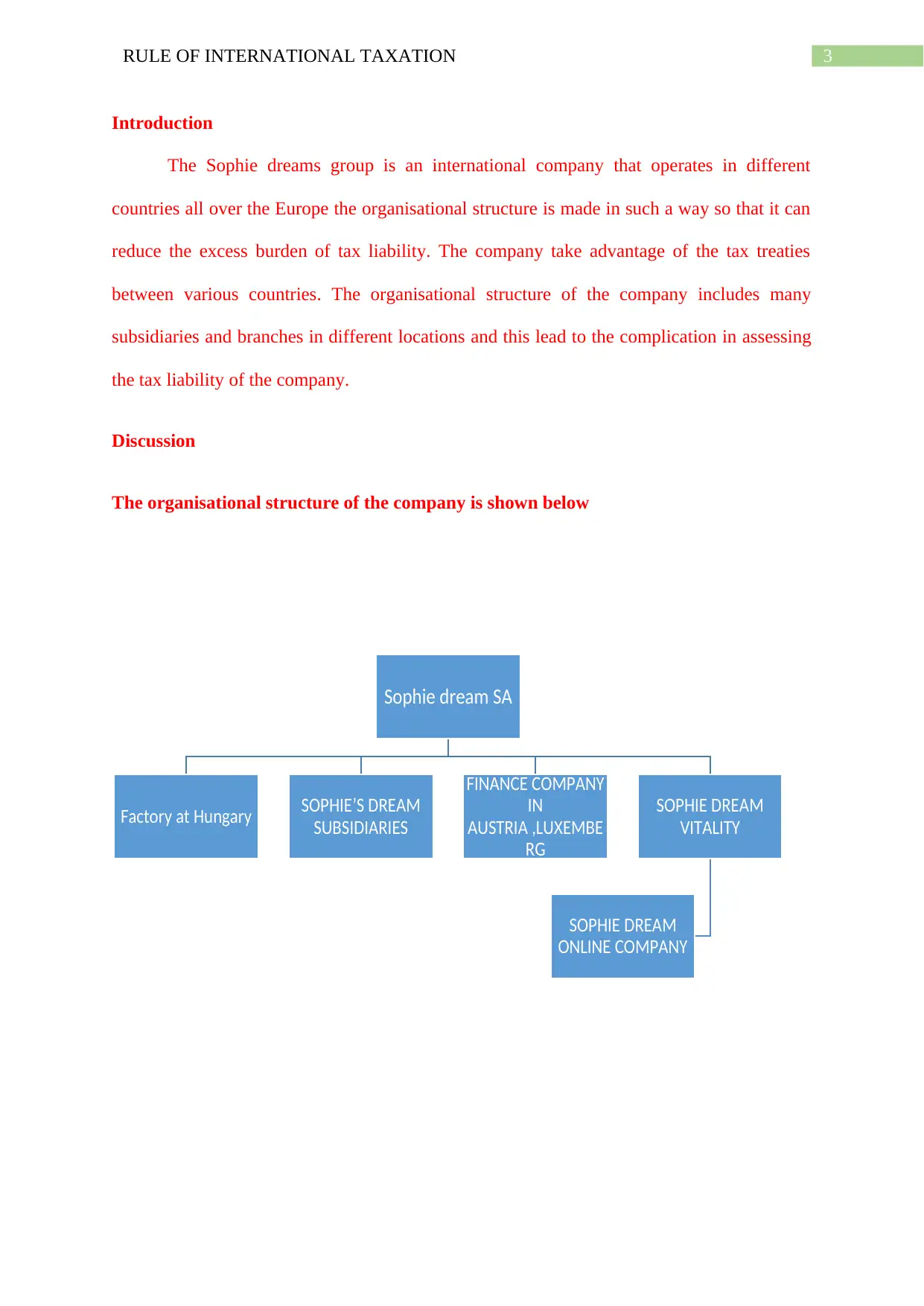
The organisational structure of the company is shown below
Sophie dream SA
Factory at Hungary SOPHIE’S DREAM
SUBSIDIARIES
FINANCE COMPANY
IN
AUSTRIA ,LUXEMBE
RG
SOPHIE DREAM
VITALITY
SOPHIE DREAM
ONLINE COMPANY
Introduction
The Sophie dreams group is an international company that operates in different
countries all over the Europe the organisational structure is made in such a way so that it can
reduce the excess burden of tax liability. The company take advantage of the tax treaties
between various countries. The organisational structure of the company includes many
subsidiaries and branches in different locations and this lead to the complication in assessing
the tax liability of the company.
Discussion
The organisational structure of the company is shown below
Sophie dream SA
Factory at Hungary SOPHIE’S DREAM
SUBSIDIARIES
FINANCE COMPANY
IN
AUSTRIA ,LUXEMBE
RG
SOPHIE DREAM
VITALITY
SOPHIE DREAM
ONLINE COMPANY
Paraphrase This Document
Need a fresh take? Get an instant paraphrase of this document with our AI Paraphraser
4RULE OF INTERNATIONAL TAXATION
The main parent company is the Sophie dream SA which deals eco fashion customs
line of sustainable and organic clothing. The lines are currently available online and through
department stores in various companies.
The group has developed a process in which their clothing is manufactured through 3-
D printing the main ingredients to build such 3-D printings includes tomato vines , tulips and
deconstructed cotton clothing’s that the organisation brings from Portugal Greece and
Netherlands. These products are then processed in the workshops of these countries.
The company then transport these pastes in the factory in Hungary where these are
refined and blended with the cotton to use in the 3-D printing. The refined ingredients are
then transported to the retail centres on the demand of the customers.
It is observed that the company make transactions with different countries all over the
Europe. The company then produce a unique item, which it distributes through its various
retail chain in all over Europe.
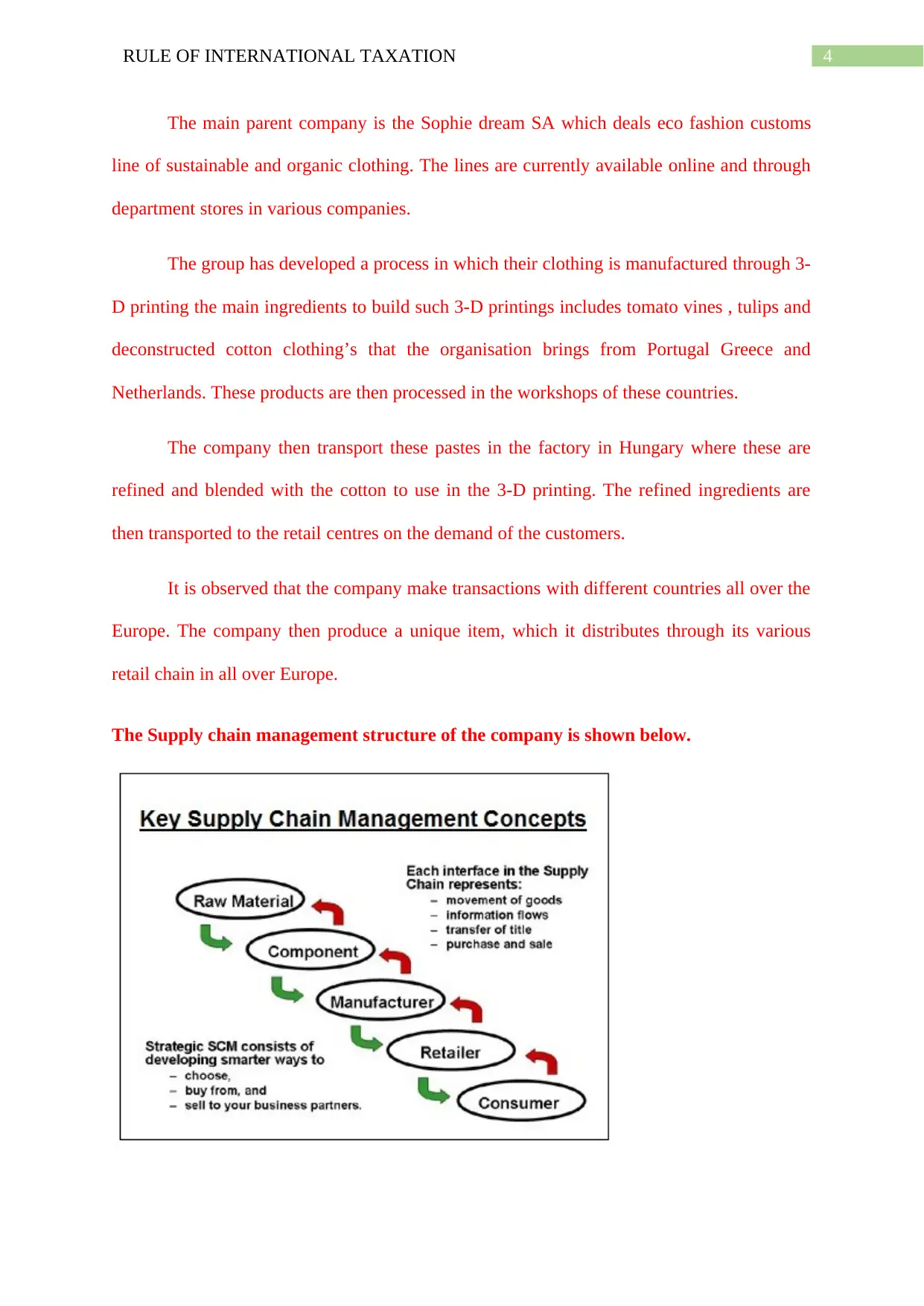
The Supply chain management structure of the company is shown below.
The main parent company is the Sophie dream SA which deals eco fashion customs
line of sustainable and organic clothing. The lines are currently available online and through
department stores in various companies.
The group has developed a process in which their clothing is manufactured through 3-
D printing the main ingredients to build such 3-D printings includes tomato vines , tulips and
deconstructed cotton clothing’s that the organisation brings from Portugal Greece and
Netherlands. These products are then processed in the workshops of these countries.
The company then transport these pastes in the factory in Hungary where these are
refined and blended with the cotton to use in the 3-D printing. The refined ingredients are
then transported to the retail centres on the demand of the customers.
It is observed that the company make transactions with different countries all over the
Europe. The company then produce a unique item, which it distributes through its various
retail chain in all over Europe.
The Supply chain management structure of the company is shown below.
5RULE OF INTERNATIONAL TAXATION
The company purchased various raw material from the countries like Greece Portugal
and Netherlands then make a paste from these ingredients in workshops that are situated in
these countries. Then the company transfer the component in its factory, which is situated in
Hungary. From the factory the final product is generated which is then transferred to various
retail stores which are opened as the subsidiaries of Sophie’s dream group of companies. The
company also made an lease agreement with an Romanian company which will deliver the
products of the company directly to its customers.
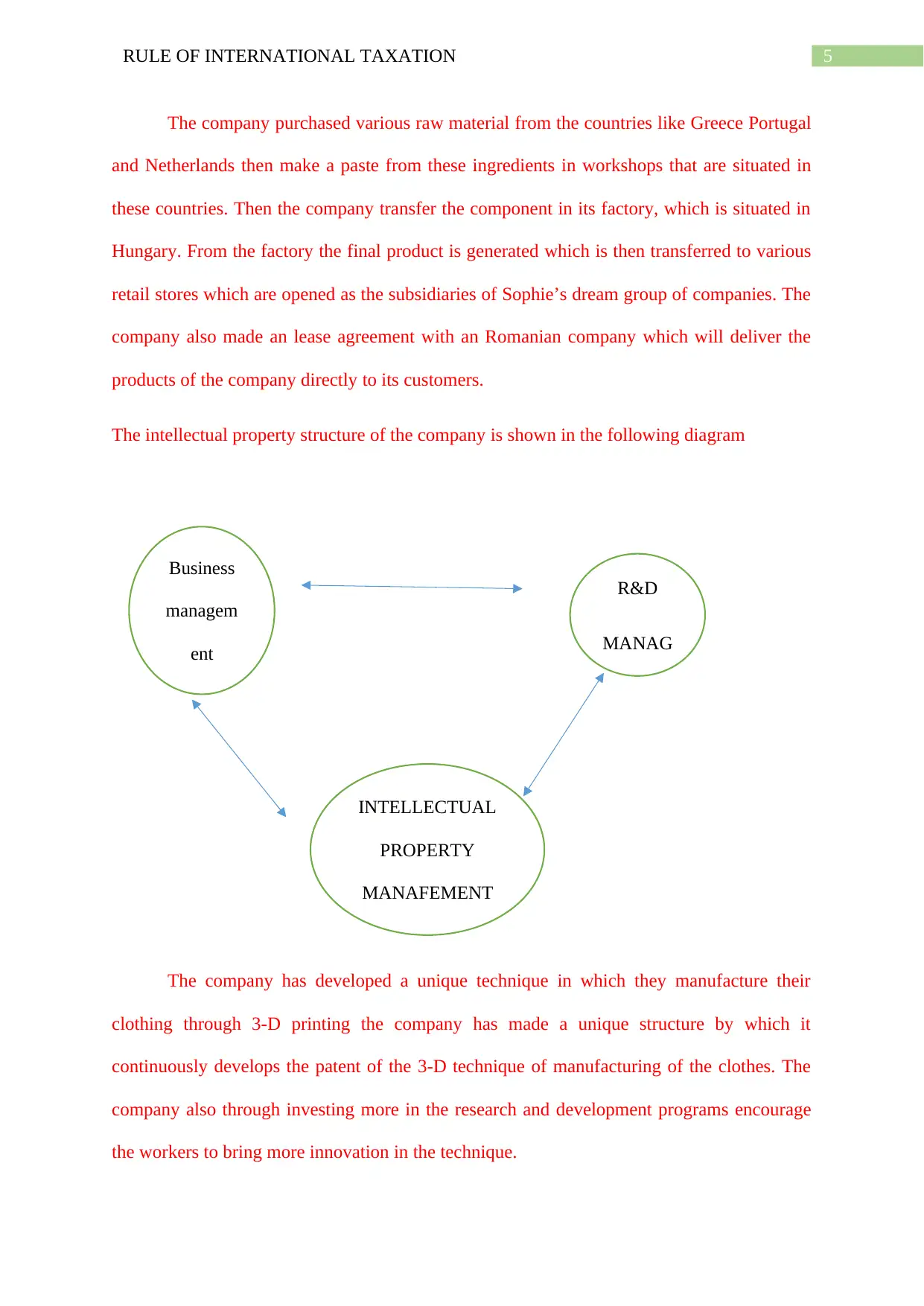
The intellectual property structure of the company is shown in the following diagram
The company has developed a unique technique in which they manufacture their
clothing through 3-D printing the company has made a unique structure by which it
continuously develops the patent of the 3-D technique of manufacturing of the clothes. The
company also through investing more in the research and development programs encourage
the workers to bring more innovation in the technique.
Business
managem
ent
INTELLECTUAL
PROPERTY
MANAFEMENT
R&D
MANAG
The company purchased various raw material from the countries like Greece Portugal
and Netherlands then make a paste from these ingredients in workshops that are situated in
these countries. Then the company transfer the component in its factory, which is situated in
Hungary. From the factory the final product is generated which is then transferred to various
retail stores which are opened as the subsidiaries of Sophie’s dream group of companies. The
company also made an lease agreement with an Romanian company which will deliver the
products of the company directly to its customers.
The intellectual property structure of the company is shown in the following diagram
The company has developed a unique technique in which they manufacture their
clothing through 3-D printing the company has made a unique structure by which it
continuously develops the patent of the 3-D technique of manufacturing of the clothes. The
company also through investing more in the research and development programs encourage
the workers to bring more innovation in the technique.
Business
managem
ent
INTELLECTUAL
PROPERTY
MANAFEMENT
R&D
MANAG
⊘ This is a preview!⊘
Do you want full access?
Subscribe today to unlock all pages.
Trusted by 1+ million students worldwide
6RULE OF INTERNATIONAL TAXATION
Intellectual property act in Spain
Intellectual property is the sequences of privileges that inventers and new owners
have over the work and profits that stalk from their conception. It contains literary, scientific
and artistic formation. However, regardless of not being essential to hold this correct in Spain
it is likely to record a formation at the intellectual property office.
In Spain and in other European countries software cannot be patented as the patent act
explicitly disregards them from the list of creations suitable for a patent. Some software along
with the papers attached, is sheltered by copyright as intellectual property. Although
additional actions of guard are suggested, such as keeping them in the supervision of a notary
public.
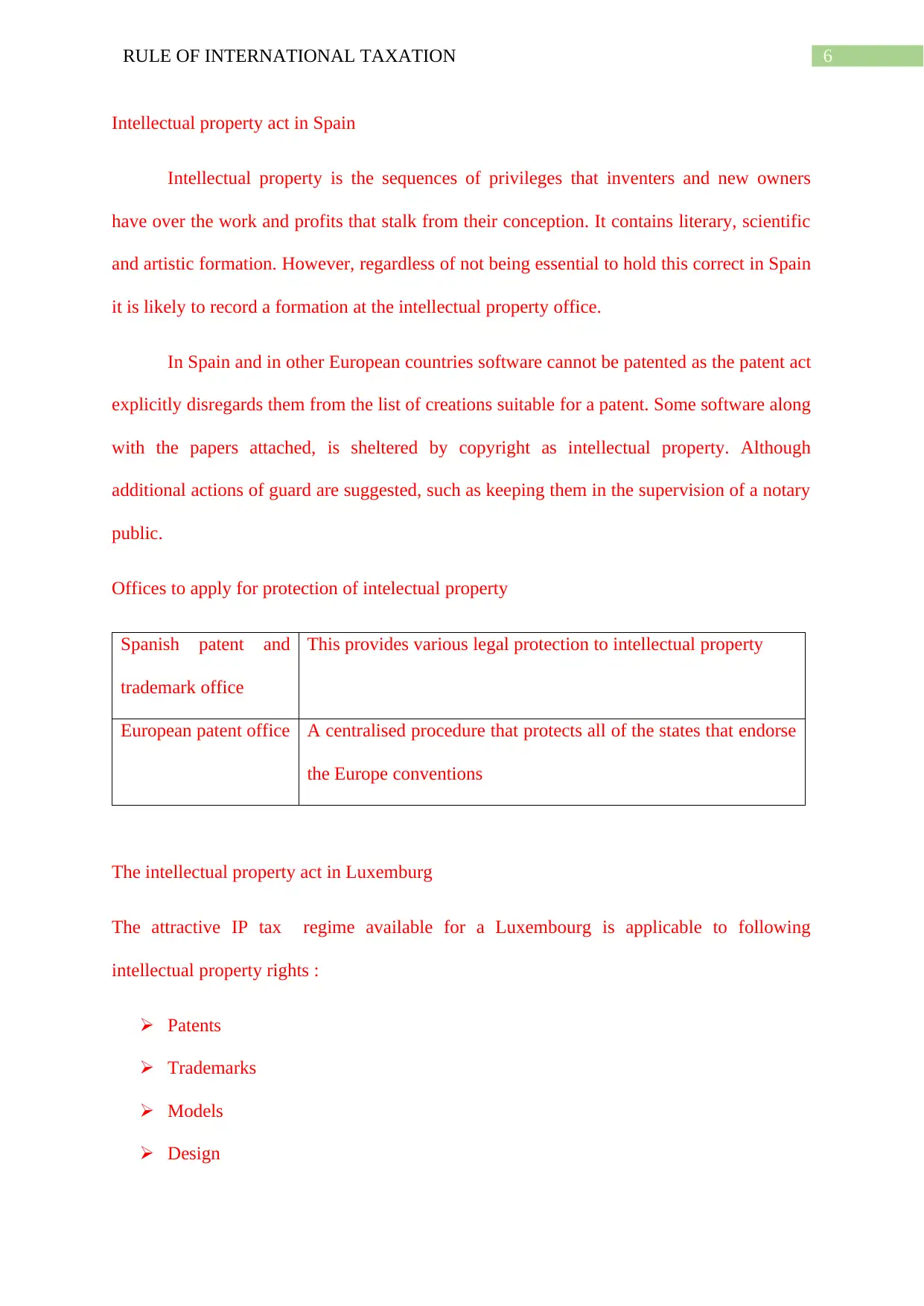
Offices to apply for protection of intelectual property
Spanish patent and
trademark office
This provides various legal protection to intellectual property
European patent office A centralised procedure that protects all of the states that endorse
the Europe conventions
The intellectual property act in Luxemburg
The attractive IP tax regime available for a Luxembourg is applicable to following
intellectual property rights :
Patents
Trademarks
Models
Design
Intellectual property act in Spain
Intellectual property is the sequences of privileges that inventers and new owners
have over the work and profits that stalk from their conception. It contains literary, scientific
and artistic formation. However, regardless of not being essential to hold this correct in Spain
it is likely to record a formation at the intellectual property office.
In Spain and in other European countries software cannot be patented as the patent act
explicitly disregards them from the list of creations suitable for a patent. Some software along
with the papers attached, is sheltered by copyright as intellectual property. Although
additional actions of guard are suggested, such as keeping them in the supervision of a notary
public.
Offices to apply for protection of intelectual property
Spanish patent and
trademark office
This provides various legal protection to intellectual property
European patent office A centralised procedure that protects all of the states that endorse
the Europe conventions
The intellectual property act in Luxemburg
The attractive IP tax regime available for a Luxembourg is applicable to following
intellectual property rights :
Patents
Trademarks
Models
Design
Paraphrase This Document
Need a fresh take? Get an instant paraphrase of this document with our AI Paraphraser
7RULE OF INTERNATIONAL TAXATION
Authors copyright relates to software
The intellectual property right tax regime (article 50bis and 50ter Luxemburg tax code)
Exclusion of 80% of the net earnings resulting from the royalties acknowledged from
company based in Luxembourg on its IP rights.
Exclusion of 80% of the net capital gains comprehended upon removal of the IP rights
100% exclusion from the wealth tax on the IP rights worth detained by the company
The artefact 50ter permits a taxpayer to advantage from an IP rule (exception at 80pc of
revenue resulting from IP) to the amount that the taxpayer himself acquired succeeding
investigation and expansion disbursements that give intensification to the IP income.
This is in line through the OECD’s article released on 2015.
The key factors of the base erosion and profit shifting are the followings
BEPS action 8
The necessity of describing the real dealings between related enterprises by analysing
the promised associations with indication of the actual behaviour of the parties.In case of
Sophie’s dream group the company is making transactions with different countries in Europe
like Greece Netherlands and Portugal and the company has its subsidiary in Hungary. This
transactions of Sophie’s dream group attracts the provisions of the double taxation treaties
with UK and other European countries.
The purpose of the article 8 of the BEPS is to guide the companies regarding the
transfer pricing guidelines or distinctive procedures to transfer pricing on intangibles the
basic objective of which is to prevent base erosion and profit shifting by affecting intangibles
among the group members.
Authors copyright relates to software
The intellectual property right tax regime (article 50bis and 50ter Luxemburg tax code)
Exclusion of 80% of the net earnings resulting from the royalties acknowledged from
company based in Luxembourg on its IP rights.
Exclusion of 80% of the net capital gains comprehended upon removal of the IP rights
100% exclusion from the wealth tax on the IP rights worth detained by the company
The artefact 50ter permits a taxpayer to advantage from an IP rule (exception at 80pc of
revenue resulting from IP) to the amount that the taxpayer himself acquired succeeding
investigation and expansion disbursements that give intensification to the IP income.
This is in line through the OECD’s article released on 2015.
The key factors of the base erosion and profit shifting are the followings
BEPS action 8
The necessity of describing the real dealings between related enterprises by analysing
the promised associations with indication of the actual behaviour of the parties.In case of
Sophie’s dream group the company is making transactions with different countries in Europe
like Greece Netherlands and Portugal and the company has its subsidiary in Hungary. This
transactions of Sophie’s dream group attracts the provisions of the double taxation treaties
with UK and other European countries.
The purpose of the article 8 of the BEPS is to guide the companies regarding the
transfer pricing guidelines or distinctive procedures to transfer pricing on intangibles the
basic objective of which is to prevent base erosion and profit shifting by affecting intangibles
among the group members.
8RULE OF INTERNATIONAL TAXATION
The BEPS transfer pricing report also give guidelines regarding the development of
the tax administration regarding the application of the transfer pricing intangibles approach.
Under this provision, the committee on the fiscal affairs make a public discussions draft in
which it invites the interested parties to submit their view on the proposed guidance on tax
administration.
Where the real income or cash inflows are significantly higher or lower than the
estimated income or cash inflows on which pricing was based. The anticipated evidence that
the estimated income or cash inflow used in the original valuation should have been higher or
lower and that the budgeted weighting of such outcomes comes under the scrutiny of the of
the tax administrator.
The assessment of the ex ante valuing procedure based on the ex post results will
necessarily conceder the guidance contained in the provisions of the action 8 of the BEPS.
In execution such assessment tax administrations not only considers the ex post
outcomes taken as the probable results. Also any other pertinent evidence related to the
transfer pricing on intangibles transactions that become accessible to the tax administrators
and that could practically has been known by the related enterprises at the phase the dealings
has been originated in.
The tax commissioners used to apply audit performs to confirm that transfer pricing
on intangibles contacts are recognised and represented upon as early as possible . Conversely
it should be kept in attention that in some cases it may be problematic for the tax
commissioners to do the risk assessment at the time of the contacts or even just thereafter to
assess the dependability of the evidence on which the pricing has been founded or to consider
whether the allocation has been valued at arm’s length . Such investigation has been made
only after some years of the contacts. In case transfer pricing on intangibles were detected
The BEPS transfer pricing report also give guidelines regarding the development of
the tax administration regarding the application of the transfer pricing intangibles approach.
Under this provision, the committee on the fiscal affairs make a public discussions draft in
which it invites the interested parties to submit their view on the proposed guidance on tax
administration.
Where the real income or cash inflows are significantly higher or lower than the
estimated income or cash inflows on which pricing was based. The anticipated evidence that
the estimated income or cash inflow used in the original valuation should have been higher or
lower and that the budgeted weighting of such outcomes comes under the scrutiny of the of
the tax administrator.
The assessment of the ex ante valuing procedure based on the ex post results will
necessarily conceder the guidance contained in the provisions of the action 8 of the BEPS.
In execution such assessment tax administrations not only considers the ex post
outcomes taken as the probable results. Also any other pertinent evidence related to the
transfer pricing on intangibles transactions that become accessible to the tax administrators
and that could practically has been known by the related enterprises at the phase the dealings
has been originated in.
The tax commissioners used to apply audit performs to confirm that transfer pricing
on intangibles contacts are recognised and represented upon as early as possible . Conversely
it should be kept in attention that in some cases it may be problematic for the tax
commissioners to do the risk assessment at the time of the contacts or even just thereafter to
assess the dependability of the evidence on which the pricing has been founded or to consider
whether the allocation has been valued at arm’s length . Such investigation has been made
only after some years of the contacts. In case transfer pricing on intangibles were detected
⊘ This is a preview!⊘
Do you want full access?
Subscribe today to unlock all pages.
Trusted by 1+ million students worldwide
9RULE OF INTERNATIONAL TAXATION
the tax commissioner may in some belongings use the ex post consequences to consider the
rationality of the forecasts and the chance of weightings taken into interpretation in the
valuation at the time of the deal.
However, some countries may found it problematic in applying the transfer pricing
on intangibles due to short audit sequences or short statute of restrictions. That direction does
not need countries to accept regulations intended at incapacitating such difficulties, but it
does not stop the countries in seeing target variations to events or legislations.
The ex post results notify the purpose of the assessment that would have been
completed at the time of the contract , though it would be improper to base the estimate on
the real revenue or cash streams deprived of taking into contemplation. Whether the
associated enterprise should sensibly have known and measured at the time of the
transmission of the transfer pricing on intangibles, the evidence related to the likelihood of
attaining such revenue or cash influxes.
Where a reviewed assessment displays that the intangible was moved at an underrate
or overestimate related to the arm’s length price , the swotted price of the transported
intangible may be measured to tax taking into interpretation price alteration clause or reliant
payments regardless of the imbursement summaries declared by the taxpayer.
Tax management should put on audit practices to safeguard that the probable
suggestion created on the ex post results is recognised and represented upon as early as
conceivable.
From the following provisions of the BEPS 8 actions on intangibles, the board of
directors should always keep it in mind that the company should follow all the guidelines of
the transfer pricing on the intangibles, in order to get tax benefits from the double taxation
treaties made between the different countries in Europe.
the tax commissioner may in some belongings use the ex post consequences to consider the
rationality of the forecasts and the chance of weightings taken into interpretation in the
valuation at the time of the deal.
However, some countries may found it problematic in applying the transfer pricing
on intangibles due to short audit sequences or short statute of restrictions. That direction does
not need countries to accept regulations intended at incapacitating such difficulties, but it
does not stop the countries in seeing target variations to events or legislations.
The ex post results notify the purpose of the assessment that would have been
completed at the time of the contract , though it would be improper to base the estimate on
the real revenue or cash streams deprived of taking into contemplation. Whether the
associated enterprise should sensibly have known and measured at the time of the
transmission of the transfer pricing on intangibles, the evidence related to the likelihood of
attaining such revenue or cash influxes.
Where a reviewed assessment displays that the intangible was moved at an underrate
or overestimate related to the arm’s length price , the swotted price of the transported
intangible may be measured to tax taking into interpretation price alteration clause or reliant
payments regardless of the imbursement summaries declared by the taxpayer.
Tax management should put on audit practices to safeguard that the probable
suggestion created on the ex post results is recognised and represented upon as early as
conceivable.
From the following provisions of the BEPS 8 actions on intangibles, the board of
directors should always keep it in mind that the company should follow all the guidelines of
the transfer pricing on the intangibles, in order to get tax benefits from the double taxation
treaties made between the different countries in Europe.
Paraphrase This Document
Need a fresh take? Get an instant paraphrase of this document with our AI Paraphraser
10RULE OF INTERNATIONAL TAXATION
BEPS action 9
The BEPS action 9 is associated with the risks and capital. If any organisation wants
to take risk on an authentic basis then it should have to take control of the risk and should
have financials capacity to take risk. The action 9 develop rules to stop BEPS by moving
risks amongst or assigning extreme capital to group associates. This will include accepting
transfer pricing rules or distinctive actions to guarantee that unsuitable returns will not
accumulate to an entity exclusively because it has contractually presumed risks or has
delivered capital. The guidelines to be established will also necessitate arrangement of returns
with worth formation. This work will be synchronised with the effort on interest expenditure
deduction and other financial expenses.
BEPS action 13
Develop guidelines concerning transfer pricing documentation to improve clearness
for tax administration, compelling into deliberation the acquiescence overheads for business.
The guidelines to be established will embrace a obligation that MNE’s deliver all applicable
governments with needed evidence on their worldwide distribution of the earnings, economic
action and taxes paid between countries conferring to a collective pattern.
The activities to counter BEPS must be supplemented with activities that ensure
inevitability and obviousness for business. Work to progress the efficiency of the mutual
agreement procedure (MAP) will be a significant accompaniment to the work on BEPS
matters. The explanation and submission of original guidelines consequential from the work
designated above could present essentials of indecision that should be diminished as far as
conceivable. Work will consequently be assumed in order to inspect and discourse hindrances
that prevent countries from resolving treaty connected arguments under the MAP.
BEPS action 9
The BEPS action 9 is associated with the risks and capital. If any organisation wants
to take risk on an authentic basis then it should have to take control of the risk and should
have financials capacity to take risk. The action 9 develop rules to stop BEPS by moving
risks amongst or assigning extreme capital to group associates. This will include accepting
transfer pricing rules or distinctive actions to guarantee that unsuitable returns will not
accumulate to an entity exclusively because it has contractually presumed risks or has
delivered capital. The guidelines to be established will also necessitate arrangement of returns
with worth formation. This work will be synchronised with the effort on interest expenditure
deduction and other financial expenses.
BEPS action 13
Develop guidelines concerning transfer pricing documentation to improve clearness
for tax administration, compelling into deliberation the acquiescence overheads for business.
The guidelines to be established will embrace a obligation that MNE’s deliver all applicable
governments with needed evidence on their worldwide distribution of the earnings, economic
action and taxes paid between countries conferring to a collective pattern.
The activities to counter BEPS must be supplemented with activities that ensure
inevitability and obviousness for business. Work to progress the efficiency of the mutual
agreement procedure (MAP) will be a significant accompaniment to the work on BEPS
matters. The explanation and submission of original guidelines consequential from the work
designated above could present essentials of indecision that should be diminished as far as
conceivable. Work will consequently be assumed in order to inspect and discourse hindrances
that prevent countries from resolving treaty connected arguments under the MAP.
11RULE OF INTERNATIONAL TAXATION
Deliberation will also be agreed to complementing the present MAP facility in tax treaties
with a compulsory and obligatory arbitration endowment.
The company make transactions with the countries like Spain Portugal Netherlands
Greece and Hungary, so in order to avoid the risk of double taxation Sophie dream group
should abide the rules of the BEPS actions.
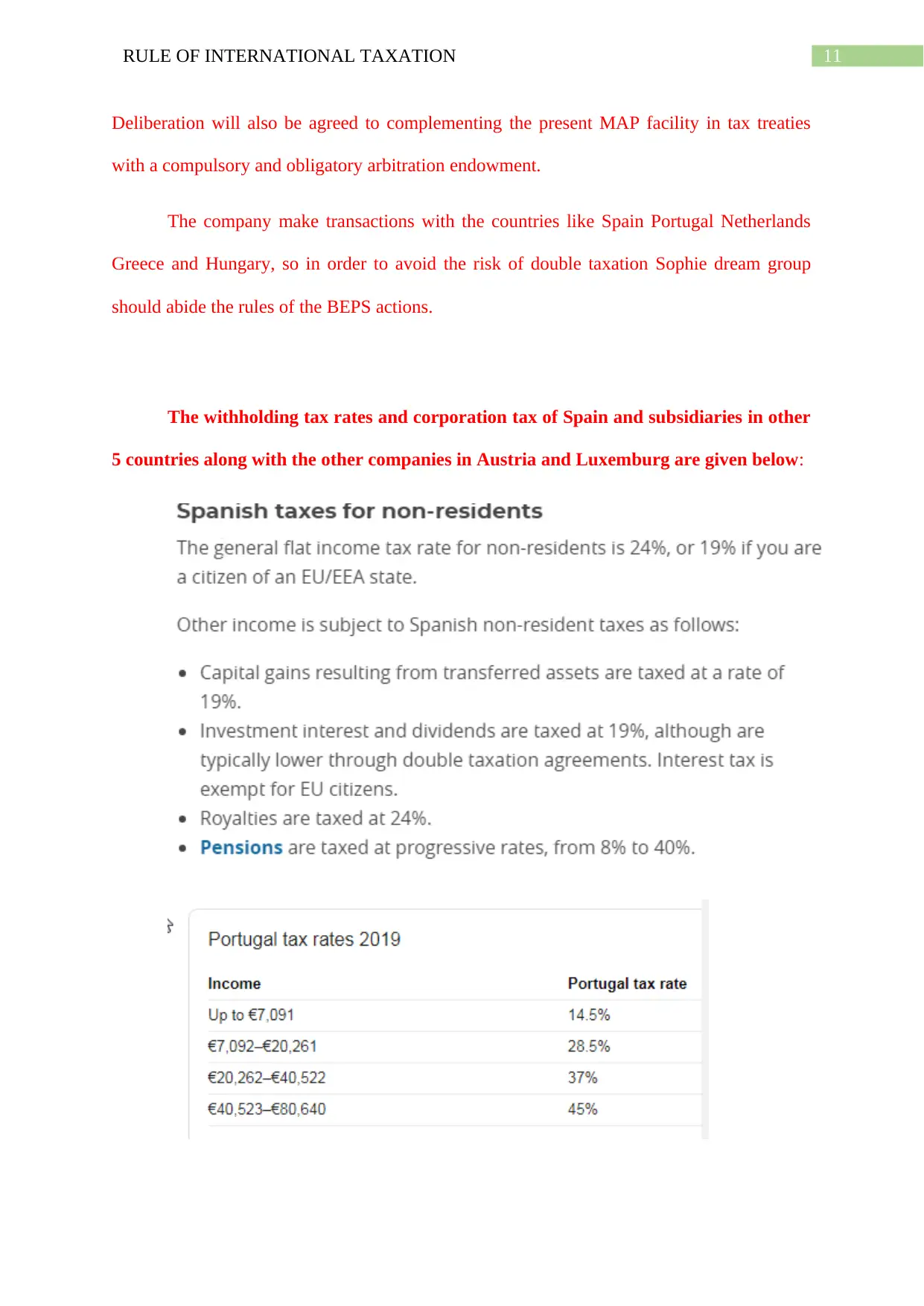
The withholding tax rates and corporation tax of Spain and subsidiaries in other
5 countries along with the other companies in Austria and Luxemburg are given below:
Deliberation will also be agreed to complementing the present MAP facility in tax treaties
with a compulsory and obligatory arbitration endowment.
The company make transactions with the countries like Spain Portugal Netherlands
Greece and Hungary, so in order to avoid the risk of double taxation Sophie dream group
should abide the rules of the BEPS actions.
The withholding tax rates and corporation tax of Spain and subsidiaries in other
5 countries along with the other companies in Austria and Luxemburg are given below:
⊘ This is a preview!⊘
Do you want full access?
Subscribe today to unlock all pages.
Trusted by 1+ million students worldwide

1 out of 15


Your All-in-One AI-Powered Toolkit for Academic Success.
+13062052269
info@desklib.com
Available 24*7 on WhatsApp / Email
![[object Object]](/_next/static/media/star-bottom.7253800d.svg)
Unlock your academic potential
Copyright © 2020–2026 A2Z Services. All Rights Reserved. Developed and managed by ZUCOL.