Sales Planning Report: Technology, Data Management, and Strategy
VerifiedAdded on 2019/12/18
|9
|2084
|140
Report
AI Summary
This report provides a comprehensive analysis of sales planning strategies in the context of technological advancements. It begins by identifying the goals and objectives of retailers for both online and store-based sales, emphasizing the importance of adapting to new technological ideas to create better products and services. The report then delves into the tools organizations use to analyze the competitive environment, such as Porter's Five Forces, and discusses the strategic alignment between goals, objectives, and technology implementation. It highlights the benefits of data management, the importance of web2 and web3 technologies, and the threats organizations face due to complex technological environments. The report concludes with recommendations for better technology implementation, emphasizing the need for security measures, staff training, and development to ensure operational efficiency and cost savings. The example of Apple is used throughout the report to illustrate the impact of technology on business operations and sales processes.

Sales Planning
1
1

Paraphrase This Document
Need a fresh take? Get an instant paraphrase of this document with our AI Paraphraser
Executive Summary
Technological advancements in recent years have seen business
Houses adopt strategies that can govern the business prospects in making new and advanced
products with the capability to appease audience's tastes. The current report looks to establish
the reasons behind the failure of some business houses to still adopt strategies and policies
that implement the newest technology. The various tools used by organisations for assessing
the market environment along with an understanding of the importance of data management
and technologies such as web2 and web3 in the business. The threats of implementing
complex technology in business are explained along with recommendations for the better
implementation process.
2
Technological advancements in recent years have seen business
Houses adopt strategies that can govern the business prospects in making new and advanced
products with the capability to appease audience's tastes. The current report looks to establish
the reasons behind the failure of some business houses to still adopt strategies and policies
that implement the newest technology. The various tools used by organisations for assessing
the market environment along with an understanding of the importance of data management
and technologies such as web2 and web3 in the business. The threats of implementing
complex technology in business are explained along with recommendations for the better
implementation process.
2
Table of Contents
Introduction................................................................................................................................4
1. Identifying the goals and objectives of retailer for both online and store-based sales..........4
2. Identifying the tools used by organisations for analysing competitive environment of the
target market...............................................................................................................................4
3. Analysing role of strategic alignment between goals and objectives and impact of
technology to achieve these objectives......................................................................................6
4. Analysing the benefits of data management..........................................................................6
5. Importance of using web2 and web3 technology...................................................................7
6. Discussing threats that organisations face due to complex technological environment........7
Conclusion and Recommendations............................................................................................8
Reference List............................................................................................................................9
3
Introduction................................................................................................................................4
1. Identifying the goals and objectives of retailer for both online and store-based sales..........4
2. Identifying the tools used by organisations for analysing competitive environment of the
target market...............................................................................................................................4
3. Analysing role of strategic alignment between goals and objectives and impact of
technology to achieve these objectives......................................................................................6
4. Analysing the benefits of data management..........................................................................6
5. Importance of using web2 and web3 technology...................................................................7
6. Discussing threats that organisations face due to complex technological environment........7
Conclusion and Recommendations............................................................................................8
Reference List............................................................................................................................9
3
⊘ This is a preview!⊘
Do you want full access?
Subscribe today to unlock all pages.

Trusted by 1+ million students worldwide
Introduction
The implementation of technology has several benefits to industry as it allows them to clearly
use their new found technological ideas that can be used to create better products and
services. The report carefully examines the impact that use of technology can have for
business along with the threats and complexities involved in implementing the technology.
The example of Apple can be used to examine the impact of technology on their business.
1. Identifying the goals and objectives of retailer for both online and store-based sales
According to Hackathorn (2014), both physical and online stores do have their methods and
techniques to operate sales processes in the business environment with the ulterior motive of
gaining profitable market share. The business of Apple is widespread to various continents,
and they boast of a large business structure that handles demands of millions of people. Being
an innovation and technology-based company, it becomes vital that the organisation is
capable of handling operations by using the best technology that is present in the market. This
helps Apple to not only design and produce products with the latest technology, but it also
helps them innovate as a brand as well.
Apple has a wide reach in both the retail and online markets. The sales and services are
conducted by them efficiently using these mediums. The basic objective that arises from both
kind of sales options is the generation of profits. The two mediums of the sale of products,
either by online or store-based sales provides the company options regarding their reach
towards customers. The ultimate objective is to initiate sales through these mediums and
Apple does that considerably well.
2. Identifying the tools used by organisations for analysing competitive environment of
the target market
It becomes increasingly important for Apple to conduct an analysis of the competitive market
environment to commence its sales process in the Australian market. This allows them to
establish an idea about the business perspectives and objectives that can be allocated. Using
Porter's Five Forces tool, the competitive environment can be assessed carefully.
4
The implementation of technology has several benefits to industry as it allows them to clearly
use their new found technological ideas that can be used to create better products and
services. The report carefully examines the impact that use of technology can have for
business along with the threats and complexities involved in implementing the technology.
The example of Apple can be used to examine the impact of technology on their business.
1. Identifying the goals and objectives of retailer for both online and store-based sales
According to Hackathorn (2014), both physical and online stores do have their methods and
techniques to operate sales processes in the business environment with the ulterior motive of
gaining profitable market share. The business of Apple is widespread to various continents,
and they boast of a large business structure that handles demands of millions of people. Being
an innovation and technology-based company, it becomes vital that the organisation is
capable of handling operations by using the best technology that is present in the market. This
helps Apple to not only design and produce products with the latest technology, but it also
helps them innovate as a brand as well.
Apple has a wide reach in both the retail and online markets. The sales and services are
conducted by them efficiently using these mediums. The basic objective that arises from both
kind of sales options is the generation of profits. The two mediums of the sale of products,
either by online or store-based sales provides the company options regarding their reach
towards customers. The ultimate objective is to initiate sales through these mediums and
Apple does that considerably well.
2. Identifying the tools used by organisations for analysing competitive environment of
the target market
It becomes increasingly important for Apple to conduct an analysis of the competitive market
environment to commence its sales process in the Australian market. This allows them to
establish an idea about the business perspectives and objectives that can be allocated. Using
Porter's Five Forces tool, the competitive environment can be assessed carefully.
4
Paraphrase This Document
Need a fresh take? Get an instant paraphrase of this document with our AI Paraphraser
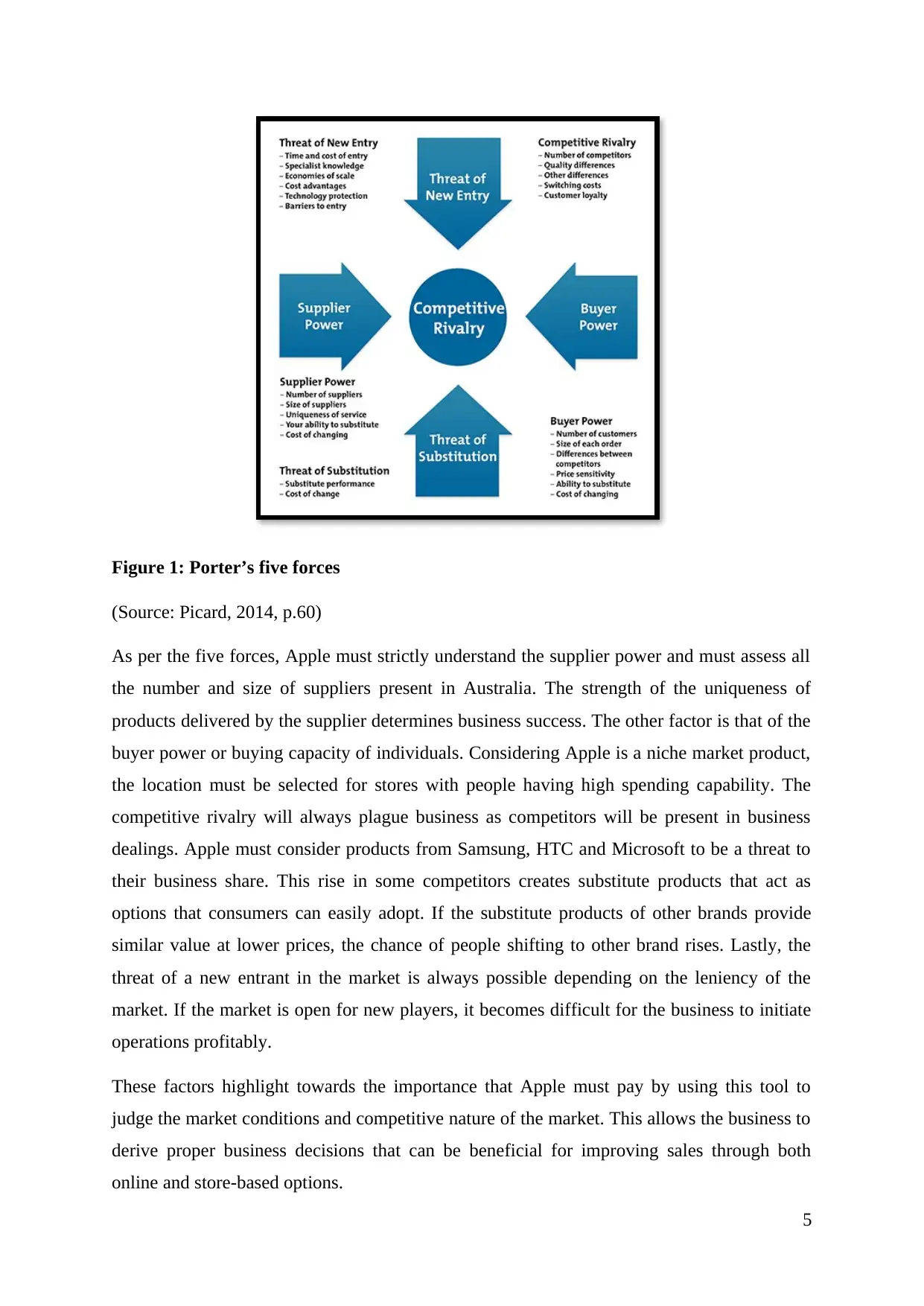
Figure 1: Porter’s five forces
(Source: Picard, 2014, p.60)
As per the five forces, Apple must strictly understand the supplier power and must assess all
the number and size of suppliers present in Australia. The strength of the uniqueness of
products delivered by the supplier determines business success. The other factor is that of the
buyer power or buying capacity of individuals. Considering Apple is a niche market product,
the location must be selected for stores with people having high spending capability. The
competitive rivalry will always plague business as competitors will be present in business
dealings. Apple must consider products from Samsung, HTC and Microsoft to be a threat to
their business share. This rise in some competitors creates substitute products that act as
options that consumers can easily adopt. If the substitute products of other brands provide
similar value at lower prices, the chance of people shifting to other brand rises. Lastly, the
threat of a new entrant in the market is always possible depending on the leniency of the
market. If the market is open for new players, it becomes difficult for the business to initiate
operations profitably.
These factors highlight towards the importance that Apple must pay by using this tool to
judge the market conditions and competitive nature of the market. This allows the business to
derive proper business decisions that can be beneficial for improving sales through both
online and store-based options.
5
(Source: Picard, 2014, p.60)
As per the five forces, Apple must strictly understand the supplier power and must assess all
the number and size of suppliers present in Australia. The strength of the uniqueness of
products delivered by the supplier determines business success. The other factor is that of the
buyer power or buying capacity of individuals. Considering Apple is a niche market product,
the location must be selected for stores with people having high spending capability. The
competitive rivalry will always plague business as competitors will be present in business
dealings. Apple must consider products from Samsung, HTC and Microsoft to be a threat to
their business share. This rise in some competitors creates substitute products that act as
options that consumers can easily adopt. If the substitute products of other brands provide
similar value at lower prices, the chance of people shifting to other brand rises. Lastly, the
threat of a new entrant in the market is always possible depending on the leniency of the
market. If the market is open for new players, it becomes difficult for the business to initiate
operations profitably.
These factors highlight towards the importance that Apple must pay by using this tool to
judge the market conditions and competitive nature of the market. This allows the business to
derive proper business decisions that can be beneficial for improving sales through both
online and store-based options.
5
3. Analysing role of strategic alignment between goals and objectives and impact of
technology to achieve these objectives
According to Reichheld et al. (2013), the impact of technology has revolutionised the manner
in which business undertakings are handled, and strategy plans are devised. The use of
technology in business has been going on with each passing year, and yet there are some
organisations that have still not used the opportunity to implement the latest technology to
achieve their objectives. Keeping the current business scenario in mind, it can be safely
assumed that using technological tools to achieve the business interests is a factor that must
be adopted by all business houses. If the stores of Apple are to be evaluated, the online sales
through websites are done impeccably as it uses cloud computing to measure demands and
record sales automatically.
The use of technologically superior computers can help the business to enhance operational
activities and make the sales procedure easier to fulfil. Quick production procedures can be
initiated, and data management through the use of big data can allow a smooth transition of
information to each department. Various logs about the future sale trends and customer
feedback information can also be identified to make the business success.
4. Analysing the benefits of data management
Business transactions through either online or store-based option do require essential data and
data management processes to ensure market understanding and the demands of the
consumers of a certain target location. A large company such as Apple considerably manages
data through measures of big data and other cloud computing measures. This helps their
business tremendously to run the business smoothly.
According to Shin and Kim (2016), data management is extremely crucial for the minimising
of possible errors as those errors slowly go on to cause damaging consequences. The
management of data allows consolidation of information and works as a reference that can be
used for business decision-making purposes. Data management avoids the risk of any leakage
of information as it may cause disastrous consequences for the business. Managing data well
can create a collaborative atmosphere for work due to transmission of vital information.
Having a database of existing information can help the organisation save time in finding new
data as already existing literature can be avoided and newer ideas can be searched. This
provides the company with enough data to effectively contribute towards making new
research possible that can help the company be successful in business dealings.
6
technology to achieve these objectives
According to Reichheld et al. (2013), the impact of technology has revolutionised the manner
in which business undertakings are handled, and strategy plans are devised. The use of
technology in business has been going on with each passing year, and yet there are some
organisations that have still not used the opportunity to implement the latest technology to
achieve their objectives. Keeping the current business scenario in mind, it can be safely
assumed that using technological tools to achieve the business interests is a factor that must
be adopted by all business houses. If the stores of Apple are to be evaluated, the online sales
through websites are done impeccably as it uses cloud computing to measure demands and
record sales automatically.
The use of technologically superior computers can help the business to enhance operational
activities and make the sales procedure easier to fulfil. Quick production procedures can be
initiated, and data management through the use of big data can allow a smooth transition of
information to each department. Various logs about the future sale trends and customer
feedback information can also be identified to make the business success.
4. Analysing the benefits of data management
Business transactions through either online or store-based option do require essential data and
data management processes to ensure market understanding and the demands of the
consumers of a certain target location. A large company such as Apple considerably manages
data through measures of big data and other cloud computing measures. This helps their
business tremendously to run the business smoothly.
According to Shin and Kim (2016), data management is extremely crucial for the minimising
of possible errors as those errors slowly go on to cause damaging consequences. The
management of data allows consolidation of information and works as a reference that can be
used for business decision-making purposes. Data management avoids the risk of any leakage
of information as it may cause disastrous consequences for the business. Managing data well
can create a collaborative atmosphere for work due to transmission of vital information.
Having a database of existing information can help the organisation save time in finding new
data as already existing literature can be avoided and newer ideas can be searched. This
provides the company with enough data to effectively contribute towards making new
research possible that can help the company be successful in business dealings.
6
⊘ This is a preview!⊘
Do you want full access?
Subscribe today to unlock all pages.
Trusted by 1+ million students worldwide
5. Importance of using web2 and web3 technology
As per Srinivasan et al. (2013), using technology in a business can be a major hassle as it
involves the implementation of machinery and tools that may be cumbersome for employees.
However, the web2 and web3 technologies are very efficient in helping companies make
important business decisions for the benefit of the corporation. The use of web2 and web3
design do bring forward new and effective methods that can push business opportunities
ahead. The benefit that web2 provides is the fact that it makes interaction among employees
easy and at a lower cost. It also promotes participation and helps in sharing of ideas, thus
allowing the company to gain and develop knowledge. Another importance of implementing
web2 technologies is the development of bonding with existing customers and assisting in the
better communication process with various suppliers.
On the other hand, web3 is the latest technology that uses machine intelligence to help assist
business decisions. The use of machines to assist production process, decision-making
process and improving internet aspects makes it quite beneficial in the current business trend.
Web3 also provides companies with a wider capacity for processing and allows the products
to be of highest value so that customers can be appeased.
6. Discussing threats that organisations face due to complex technological environment
According to Tallon et al. (2014), technology implementation is not as easy as it sounds since
complexities may arise due to reasons such as personnel incapability and other factors such as
poor implementation. The major threat that organisations face while implementing new
technology is that of the personal skills of employees in dealing with new technological tools.
The risks of getting infected by viruses or hacking make the companies worry about the clear
implementation of high technology implementation seem risky in the organisation. In an
organisation as big as Apple, the use of technology is mandatory and the security measures
being top notch allows them to function well.
The other threats that arise are the problem of costs. Introducing new technology in a
company requires ample funding for the resources, and it may get difficult for the
organisation to bear the expenses. Moreover, the maintenance costs and up gradation costs
may incur additional expenses to the company. Keeping in mind economies of scale, it can be
suggested that implementing latest technological aspects even though are of tremendous help
to the organisation; it can still be complex for ready installation.
7
As per Srinivasan et al. (2013), using technology in a business can be a major hassle as it
involves the implementation of machinery and tools that may be cumbersome for employees.
However, the web2 and web3 technologies are very efficient in helping companies make
important business decisions for the benefit of the corporation. The use of web2 and web3
design do bring forward new and effective methods that can push business opportunities
ahead. The benefit that web2 provides is the fact that it makes interaction among employees
easy and at a lower cost. It also promotes participation and helps in sharing of ideas, thus
allowing the company to gain and develop knowledge. Another importance of implementing
web2 technologies is the development of bonding with existing customers and assisting in the
better communication process with various suppliers.
On the other hand, web3 is the latest technology that uses machine intelligence to help assist
business decisions. The use of machines to assist production process, decision-making
process and improving internet aspects makes it quite beneficial in the current business trend.
Web3 also provides companies with a wider capacity for processing and allows the products
to be of highest value so that customers can be appeased.
6. Discussing threats that organisations face due to complex technological environment
According to Tallon et al. (2014), technology implementation is not as easy as it sounds since
complexities may arise due to reasons such as personnel incapability and other factors such as
poor implementation. The major threat that organisations face while implementing new
technology is that of the personal skills of employees in dealing with new technological tools.
The risks of getting infected by viruses or hacking make the companies worry about the clear
implementation of high technology implementation seem risky in the organisation. In an
organisation as big as Apple, the use of technology is mandatory and the security measures
being top notch allows them to function well.
The other threats that arise are the problem of costs. Introducing new technology in a
company requires ample funding for the resources, and it may get difficult for the
organisation to bear the expenses. Moreover, the maintenance costs and up gradation costs
may incur additional expenses to the company. Keeping in mind economies of scale, it can be
suggested that implementing latest technological aspects even though are of tremendous help
to the organisation; it can still be complex for ready installation.
7
Paraphrase This Document
Need a fresh take? Get an instant paraphrase of this document with our AI Paraphraser
Conclusion and recommendations
The overall reports suggest that technology is a massive boost for organisations to implement
and utilise it for attaining business objectives while spending little effort and expertise. The
importance of utilising data management is critical as it allows safeguarding of information
and assists the use of information to make business decision making much more streamlined
and capable. It is however recommended that security measures to avoid any hacking or virus
infection must be made so that no loss of vital information has to be borne. The training and
development of staff are necessary before the implementation of new technology so that
operational activities can be initiated immediately and cost can be saved on separate training
modules for employees.
8
The overall reports suggest that technology is a massive boost for organisations to implement
and utilise it for attaining business objectives while spending little effort and expertise. The
importance of utilising data management is critical as it allows safeguarding of information
and assists the use of information to make business decision making much more streamlined
and capable. It is however recommended that security measures to avoid any hacking or virus
infection must be made so that no loss of vital information has to be borne. The training and
development of staff are necessary before the implementation of new technology so that
operational activities can be initiated immediately and cost can be saved on separate training
modules for employees.
8
Reference List
Hackathorn, R.D., (2014). Web farming for the data warehouse. Morgan Kaufmann
Publishers Inc.
Picard, R.G., (2014). Changing business models of online content services: Their
implications for multimedia and other content producers. International Journal on Media
Management, 2(2), pp.60-68.
Reichheld, F.F., Markey Jr, R.G. and Hopton, C., (2013). E-customer loyalty-applying the
traditional rules of business for online success. European Business Journal, 12(4), p.173-175.
Shin, D.H. and Kim, W.Y., (2016). Applying the technology acceptance model and flow
theory to cyworld user behaviour: implication of the web2.0 user
acceptance. CyberPsychology & Behaviour, 11(3), pp.378-382.
Srinivasan, R., Lilien, G.L. and Rangaswamy, A., (2013). Technological opportunism and
radical technology adoption: An application to e-business. Journal of Marketing, 66(3),
pp.47-60.
Tallon, P.P., Kraemer, K.L. and Gurbaxani, V., (2014). Executives’ perceptions of the
business value of information technology: a process-oriented approach. Journal of
Management Information Systems, 16(4), pp.145-173.
9
Hackathorn, R.D., (2014). Web farming for the data warehouse. Morgan Kaufmann
Publishers Inc.
Picard, R.G., (2014). Changing business models of online content services: Their
implications for multimedia and other content producers. International Journal on Media
Management, 2(2), pp.60-68.
Reichheld, F.F., Markey Jr, R.G. and Hopton, C., (2013). E-customer loyalty-applying the
traditional rules of business for online success. European Business Journal, 12(4), p.173-175.
Shin, D.H. and Kim, W.Y., (2016). Applying the technology acceptance model and flow
theory to cyworld user behaviour: implication of the web2.0 user
acceptance. CyberPsychology & Behaviour, 11(3), pp.378-382.
Srinivasan, R., Lilien, G.L. and Rangaswamy, A., (2013). Technological opportunism and
radical technology adoption: An application to e-business. Journal of Marketing, 66(3),
pp.47-60.
Tallon, P.P., Kraemer, K.L. and Gurbaxani, V., (2014). Executives’ perceptions of the
business value of information technology: a process-oriented approach. Journal of
Management Information Systems, 16(4), pp.145-173.
9
⊘ This is a preview!⊘
Do you want full access?
Subscribe today to unlock all pages.
Trusted by 1+ million students worldwide

1 out of 9


Related Documents


Your All-in-One AI-Powered Toolkit for Academic Success.
+13062052269
info@desklib.com
Available 24*7 on WhatsApp / Email
![[object Object]](/_next/static/media/star-bottom.7253800d.svg)
Unlock your academic potential
Copyright © 2020–2026 A2Z Services. All Rights Reserved. Developed and managed by ZUCOL.