Equity Valuation of Shares: Methods, Analysis, and Buffett's Insights
VerifiedAdded on 2021/05/30
|13
|3684
|64
Report
AI Summary
This report delves into the intricacies of equity valuation, exploring various methods such as the constant growth model, P/E ratio analysis, and balance sheet methods like book value and liquidation value. It provides calculations for the value of ordinary shares using these methods, ranks investments based on desirability, and justifies the selection of a preferred investment option. The report also examines Warren Buffett's perspectives on intrinsic value, including his 'Two-Column Valuation Method' and its application. Furthermore, it compares Buffett's approach to share valuation with other methodologies, recommending a preferred approach and providing a rationale. The analysis covers key financial metrics, including price-to-earnings ratios and price-to-book value ratios, for several companies across various sectors. The report also includes interesting facts about Warren Buffett and how his investment philosophies relate to the selected companies from the Financial Review. The report concludes with a comprehensive overview of equity valuation and a comparative analysis of different valuation techniques, ultimately offering valuable insights into the field of finance.

Page1
Assignment-Finance
Assignment-Finance

Paraphrase This Document
Need a fresh take? Get an instant paraphrase of this document with our AI Paraphraser
Page2
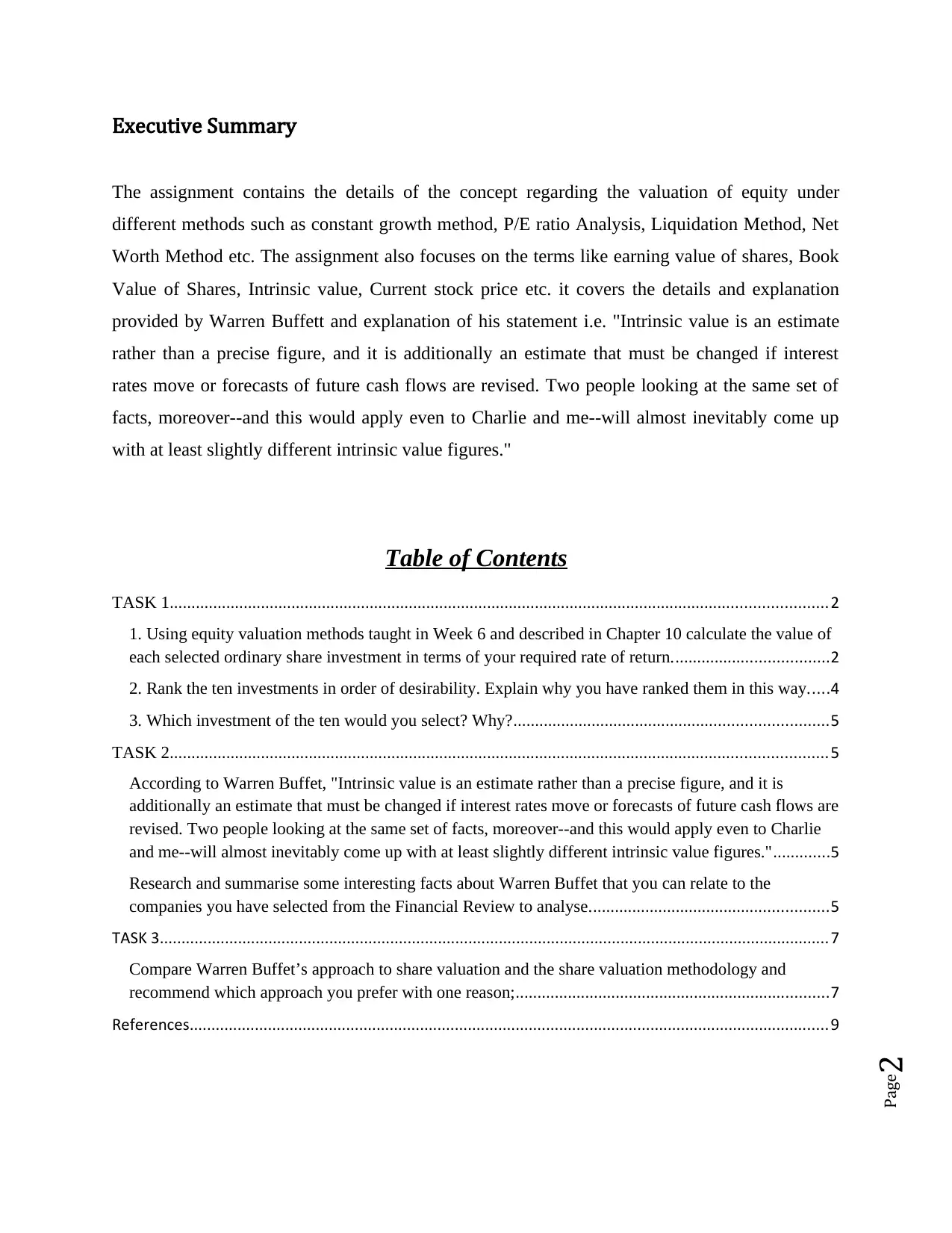
Executive Summary
The assignment contains the details of the concept regarding the valuation of equity under
different methods such as constant growth method, P/E ratio Analysis, Liquidation Method, Net
Worth Method etc. The assignment also focuses on the terms like earning value of shares, Book
Value of Shares, Intrinsic value, Current stock price etc. it covers the details and explanation
provided by Warren Buffett and explanation of his statement i.e. "Intrinsic value is an estimate
rather than a precise figure, and it is additionally an estimate that must be changed if interest
rates move or forecasts of future cash flows are revised. Two people looking at the same set of
facts, moreover--and this would apply even to Charlie and me--will almost inevitably come up
with at least slightly different intrinsic value figures."
Table of Contents
TASK 1.......................................................................................................................................................2
1. Using equity valuation methods taught in Week 6 and described in Chapter 10 calculate the value of
each selected ordinary share investment in terms of your required rate of return....................................2
2. Rank the ten investments in order of desirability. Explain why you have ranked them in this way.....4
3. Which investment of the ten would you select? Why?........................................................................5
TASK 2.......................................................................................................................................................5
According to Warren Buffet, "Intrinsic value is an estimate rather than a precise figure, and it is
additionally an estimate that must be changed if interest rates move or forecasts of future cash flows are
revised. Two people looking at the same set of facts, moreover--and this would apply even to Charlie
and me--will almost inevitably come up with at least slightly different intrinsic value figures.".............5
Research and summarise some interesting facts about Warren Buffet that you can relate to the
companies you have selected from the Financial Review to analyse.......................................................5
TASK 3..........................................................................................................................................................7
Compare Warren Buffet’s approach to share valuation and the share valuation methodology and
recommend which approach you prefer with one reason;........................................................................7
References...................................................................................................................................................9
Executive Summary
The assignment contains the details of the concept regarding the valuation of equity under
different methods such as constant growth method, P/E ratio Analysis, Liquidation Method, Net
Worth Method etc. The assignment also focuses on the terms like earning value of shares, Book
Value of Shares, Intrinsic value, Current stock price etc. it covers the details and explanation
provided by Warren Buffett and explanation of his statement i.e. "Intrinsic value is an estimate
rather than a precise figure, and it is additionally an estimate that must be changed if interest
rates move or forecasts of future cash flows are revised. Two people looking at the same set of
facts, moreover--and this would apply even to Charlie and me--will almost inevitably come up
with at least slightly different intrinsic value figures."
Table of Contents
TASK 1.......................................................................................................................................................2
1. Using equity valuation methods taught in Week 6 and described in Chapter 10 calculate the value of
each selected ordinary share investment in terms of your required rate of return....................................2
2. Rank the ten investments in order of desirability. Explain why you have ranked them in this way.....4
3. Which investment of the ten would you select? Why?........................................................................5
TASK 2.......................................................................................................................................................5
According to Warren Buffet, "Intrinsic value is an estimate rather than a precise figure, and it is
additionally an estimate that must be changed if interest rates move or forecasts of future cash flows are
revised. Two people looking at the same set of facts, moreover--and this would apply even to Charlie
and me--will almost inevitably come up with at least slightly different intrinsic value figures.".............5
Research and summarise some interesting facts about Warren Buffet that you can relate to the
companies you have selected from the Financial Review to analyse.......................................................5
TASK 3..........................................................................................................................................................7
Compare Warren Buffet’s approach to share valuation and the share valuation methodology and
recommend which approach you prefer with one reason;........................................................................7
References...................................................................................................................................................9
Page3
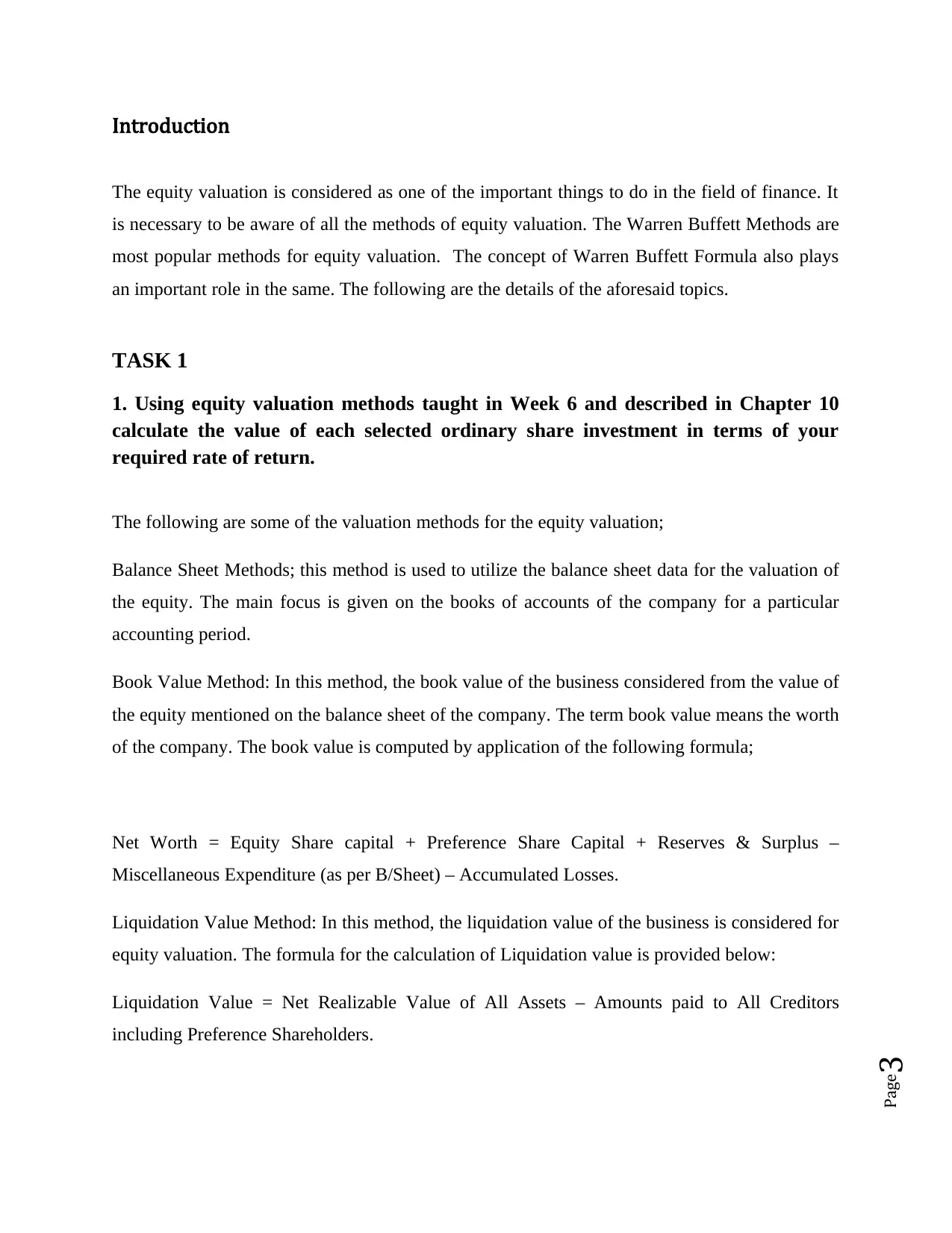
Introduction
The equity valuation is considered as one of the important things to do in the field of finance. It
is necessary to be aware of all the methods of equity valuation. The Warren Buffett Methods are
most popular methods for equity valuation. The concept of Warren Buffett Formula also plays
an important role in the same. The following are the details of the aforesaid topics.
TASK 1
1. Using equity valuation methods taught in Week 6 and described in Chapter 10
calculate the value of each selected ordinary share investment in terms of your
required rate of return.
The following are some of the valuation methods for the equity valuation;
Balance Sheet Methods; this method is used to utilize the balance sheet data for the valuation of
the equity. The main focus is given on the books of accounts of the company for a particular
accounting period.
Book Value Method: In this method, the book value of the business considered from the value of
the equity mentioned on the balance sheet of the company. The term book value means the worth
of the company. The book value is computed by application of the following formula;
Net Worth = Equity Share capital + Preference Share Capital + Reserves & Surplus –
Miscellaneous Expenditure (as per B/Sheet) – Accumulated Losses.
Liquidation Value Method: In this method, the liquidation value of the business is considered for
equity valuation. The formula for the calculation of Liquidation value is provided below:
Liquidation Value = Net Realizable Value of All Assets – Amounts paid to All Creditors
including Preference Shareholders.
Introduction
The equity valuation is considered as one of the important things to do in the field of finance. It
is necessary to be aware of all the methods of equity valuation. The Warren Buffett Methods are
most popular methods for equity valuation. The concept of Warren Buffett Formula also plays
an important role in the same. The following are the details of the aforesaid topics.
TASK 1
1. Using equity valuation methods taught in Week 6 and described in Chapter 10
calculate the value of each selected ordinary share investment in terms of your
required rate of return.
The following are some of the valuation methods for the equity valuation;
Balance Sheet Methods; this method is used to utilize the balance sheet data for the valuation of
the equity. The main focus is given on the books of accounts of the company for a particular
accounting period.
Book Value Method: In this method, the book value of the business considered from the value of
the equity mentioned on the balance sheet of the company. The term book value means the worth
of the company. The book value is computed by application of the following formula;
Net Worth = Equity Share capital + Preference Share Capital + Reserves & Surplus –
Miscellaneous Expenditure (as per B/Sheet) – Accumulated Losses.
Liquidation Value Method: In this method, the liquidation value of the business is considered for
equity valuation. The formula for the calculation of Liquidation value is provided below:
Liquidation Value = Net Realizable Value of All Assets – Amounts paid to All Creditors
including Preference Shareholders.
⊘ This is a preview!⊘
Do you want full access?
Subscribe today to unlock all pages.

Trusted by 1+ million students worldwide
Page4
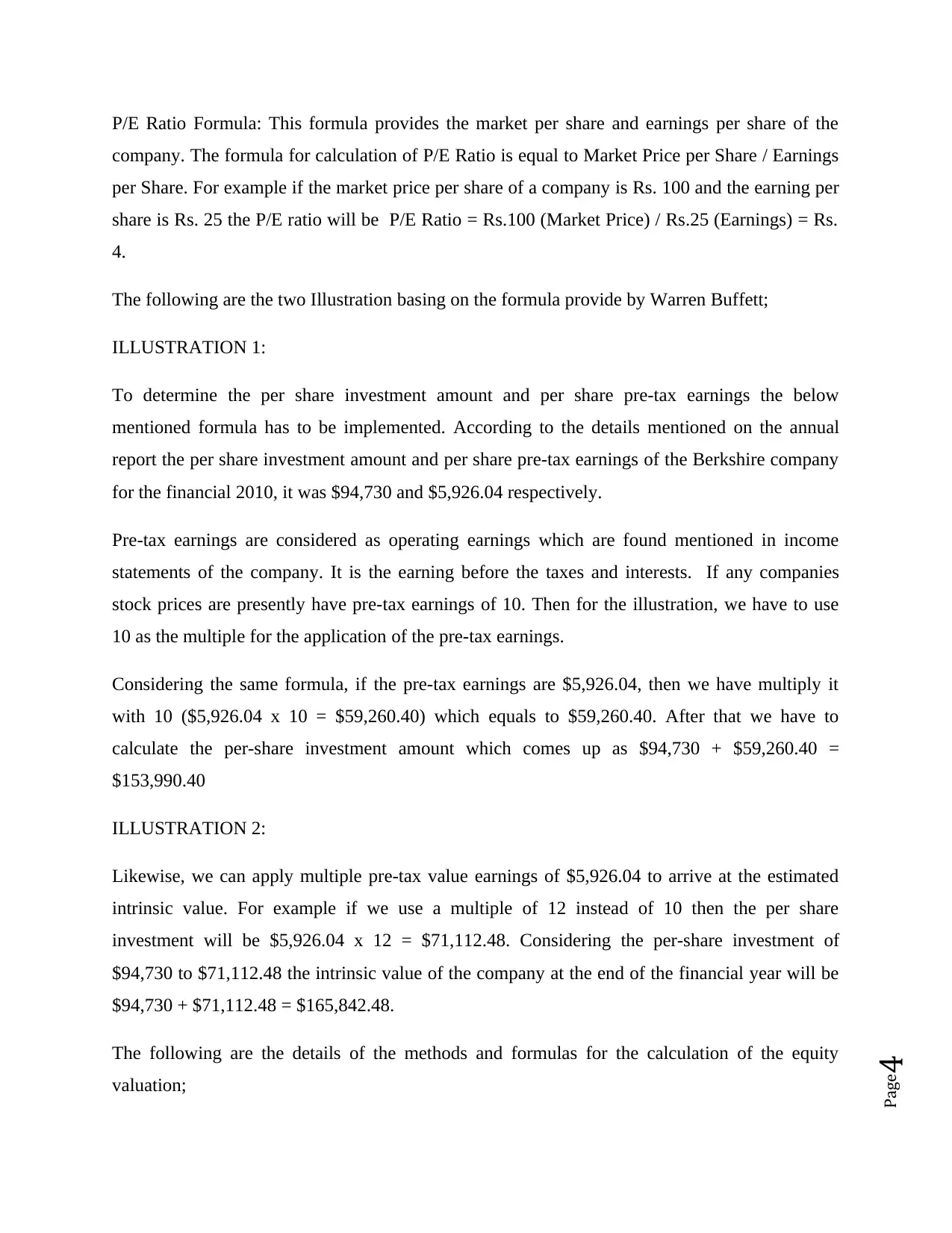
P/E Ratio Formula: This formula provides the market per share and earnings per share of the
company. The formula for calculation of P/E Ratio is equal to Market Price per Share / Earnings
per Share. For example if the market price per share of a company is Rs. 100 and the earning per
share is Rs. 25 the P/E ratio will be P/E Ratio = Rs.100 (Market Price) / Rs.25 (Earnings) = Rs.
4.
The following are the two Illustration basing on the formula provide by Warren Buffett;
ILLUSTRATION 1:
To determine the per share investment amount and per share pre-tax earnings the below
mentioned formula has to be implemented. According to the details mentioned on the annual
report the per share investment amount and per share pre-tax earnings of the Berkshire company
for the financial 2010, it was $94,730 and $5,926.04 respectively.
Pre-tax earnings are considered as operating earnings which are found mentioned in income
statements of the company. It is the earning before the taxes and interests. If any companies
stock prices are presently have pre-tax earnings of 10. Then for the illustration, we have to use
10 as the multiple for the application of the pre-tax earnings.
Considering the same formula, if the pre-tax earnings are $5,926.04, then we have multiply it
with 10 ($5,926.04 x 10 = $59,260.40) which equals to $59,260.40. After that we have to
calculate the per-share investment amount which comes up as $94,730 + $59,260.40 =
$153,990.40
ILLUSTRATION 2:
Likewise, we can apply multiple pre-tax value earnings of $5,926.04 to arrive at the estimated
intrinsic value. For example if we use a multiple of 12 instead of 10 then the per share
investment will be $5,926.04 x 12 = $71,112.48. Considering the per-share investment of
$94,730 to $71,112.48 the intrinsic value of the company at the end of the financial year will be
$94,730 + $71,112.48 = $165,842.48.
The following are the details of the methods and formulas for the calculation of the equity
valuation;
P/E Ratio Formula: This formula provides the market per share and earnings per share of the
company. The formula for calculation of P/E Ratio is equal to Market Price per Share / Earnings
per Share. For example if the market price per share of a company is Rs. 100 and the earning per
share is Rs. 25 the P/E ratio will be P/E Ratio = Rs.100 (Market Price) / Rs.25 (Earnings) = Rs.
4.
The following are the two Illustration basing on the formula provide by Warren Buffett;
ILLUSTRATION 1:
To determine the per share investment amount and per share pre-tax earnings the below
mentioned formula has to be implemented. According to the details mentioned on the annual
report the per share investment amount and per share pre-tax earnings of the Berkshire company
for the financial 2010, it was $94,730 and $5,926.04 respectively.
Pre-tax earnings are considered as operating earnings which are found mentioned in income
statements of the company. It is the earning before the taxes and interests. If any companies
stock prices are presently have pre-tax earnings of 10. Then for the illustration, we have to use
10 as the multiple for the application of the pre-tax earnings.
Considering the same formula, if the pre-tax earnings are $5,926.04, then we have multiply it
with 10 ($5,926.04 x 10 = $59,260.40) which equals to $59,260.40. After that we have to
calculate the per-share investment amount which comes up as $94,730 + $59,260.40 =
$153,990.40
ILLUSTRATION 2:
Likewise, we can apply multiple pre-tax value earnings of $5,926.04 to arrive at the estimated
intrinsic value. For example if we use a multiple of 12 instead of 10 then the per share
investment will be $5,926.04 x 12 = $71,112.48. Considering the per-share investment of
$94,730 to $71,112.48 the intrinsic value of the company at the end of the financial year will be
$94,730 + $71,112.48 = $165,842.48.
The following are the details of the methods and formulas for the calculation of the equity
valuation;
Paraphrase This Document
Need a fresh take? Get an instant paraphrase of this document with our AI Paraphraser
Page5
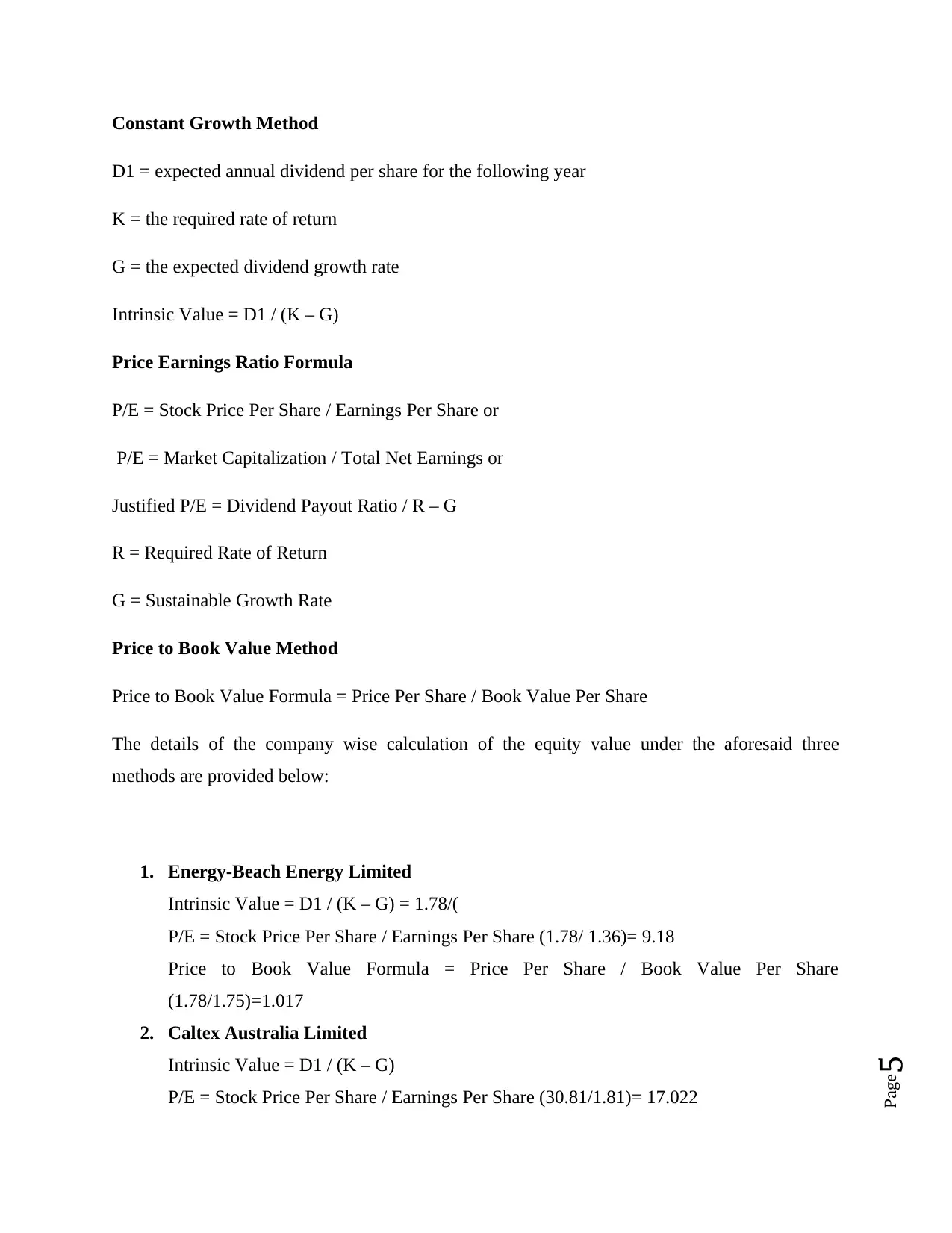
Constant Growth Method
D1 = expected annual dividend per share for the following year
K = the required rate of return
G = the expected dividend growth rate
Intrinsic Value = D1 / (K – G)
Price Earnings Ratio Formula
P/E = Stock Price Per Share / Earnings Per Share or
P/E = Market Capitalization / Total Net Earnings or
Justified P/E = Dividend Payout Ratio / R – G
R = Required Rate of Return
G = Sustainable Growth Rate
Price to Book Value Method
Price to Book Value Formula = Price Per Share / Book Value Per Share
The details of the company wise calculation of the equity value under the aforesaid three
methods are provided below:
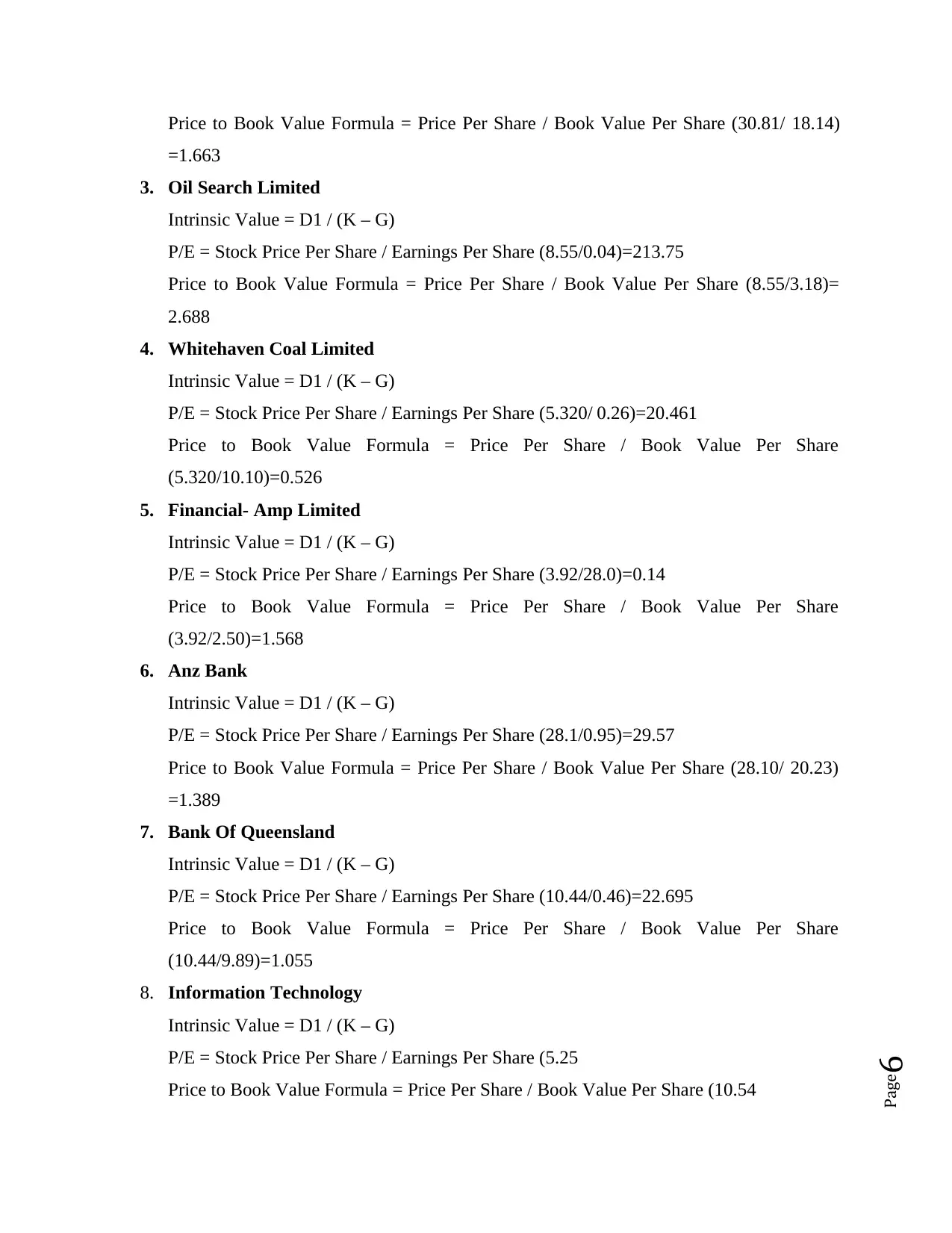
1. Energy-Beach Energy Limited
Intrinsic Value = D1 / (K – G) = 1.78/(
P/E = Stock Price Per Share / Earnings Per Share (1.78/ 1.36)= 9.18
Price to Book Value Formula = Price Per Share / Book Value Per Share
(1.78/1.75)=1.017
2. Caltex Australia Limited
Intrinsic Value = D1 / (K – G)
P/E = Stock Price Per Share / Earnings Per Share (30.81/1.81)= 17.022
Constant Growth Method
D1 = expected annual dividend per share for the following year
K = the required rate of return
G = the expected dividend growth rate
Intrinsic Value = D1 / (K – G)
Price Earnings Ratio Formula
P/E = Stock Price Per Share / Earnings Per Share or
P/E = Market Capitalization / Total Net Earnings or
Justified P/E = Dividend Payout Ratio / R – G
R = Required Rate of Return
G = Sustainable Growth Rate
Price to Book Value Method
Price to Book Value Formula = Price Per Share / Book Value Per Share
The details of the company wise calculation of the equity value under the aforesaid three
methods are provided below:
1. Energy-Beach Energy Limited
Intrinsic Value = D1 / (K – G) = 1.78/(
P/E = Stock Price Per Share / Earnings Per Share (1.78/ 1.36)= 9.18
Price to Book Value Formula = Price Per Share / Book Value Per Share
(1.78/1.75)=1.017
2. Caltex Australia Limited
Intrinsic Value = D1 / (K – G)
P/E = Stock Price Per Share / Earnings Per Share (30.81/1.81)= 17.022
Page6
Price to Book Value Formula = Price Per Share / Book Value Per Share (30.81/ 18.14)
=1.663
3. Oil Search Limited
Intrinsic Value = D1 / (K – G)
P/E = Stock Price Per Share / Earnings Per Share (8.55/0.04)=213.75
Price to Book Value Formula = Price Per Share / Book Value Per Share (8.55/3.18)=
2.688
4. Whitehaven Coal Limited
Intrinsic Value = D1 / (K – G)
P/E = Stock Price Per Share / Earnings Per Share (5.320/ 0.26)=20.461
Price to Book Value Formula = Price Per Share / Book Value Per Share
(5.320/10.10)=0.526
5. Financial- Amp Limited
Intrinsic Value = D1 / (K – G)
P/E = Stock Price Per Share / Earnings Per Share (3.92/28.0)=0.14
Price to Book Value Formula = Price Per Share / Book Value Per Share
(3.92/2.50)=1.568
6. Anz Bank
Intrinsic Value = D1 / (K – G)
P/E = Stock Price Per Share / Earnings Per Share (28.1/0.95)=29.57
Price to Book Value Formula = Price Per Share / Book Value Per Share (28.10/ 20.23)
=1.389
7. Bank Of Queensland
Intrinsic Value = D1 / (K – G)
P/E = Stock Price Per Share / Earnings Per Share (10.44/0.46)=22.695
Price to Book Value Formula = Price Per Share / Book Value Per Share
(10.44/9.89)=1.055
8. Information Technology
Intrinsic Value = D1 / (K – G)
P/E = Stock Price Per Share / Earnings Per Share (5.25
Price to Book Value Formula = Price Per Share / Book Value Per Share (10.54
Price to Book Value Formula = Price Per Share / Book Value Per Share (30.81/ 18.14)
=1.663
3. Oil Search Limited
Intrinsic Value = D1 / (K – G)
P/E = Stock Price Per Share / Earnings Per Share (8.55/0.04)=213.75
Price to Book Value Formula = Price Per Share / Book Value Per Share (8.55/3.18)=
2.688
4. Whitehaven Coal Limited
Intrinsic Value = D1 / (K – G)
P/E = Stock Price Per Share / Earnings Per Share (5.320/ 0.26)=20.461
Price to Book Value Formula = Price Per Share / Book Value Per Share
(5.320/10.10)=0.526
5. Financial- Amp Limited
Intrinsic Value = D1 / (K – G)
P/E = Stock Price Per Share / Earnings Per Share (3.92/28.0)=0.14
Price to Book Value Formula = Price Per Share / Book Value Per Share
(3.92/2.50)=1.568
6. Anz Bank
Intrinsic Value = D1 / (K – G)
P/E = Stock Price Per Share / Earnings Per Share (28.1/0.95)=29.57
Price to Book Value Formula = Price Per Share / Book Value Per Share (28.10/ 20.23)
=1.389
7. Bank Of Queensland
Intrinsic Value = D1 / (K – G)
P/E = Stock Price Per Share / Earnings Per Share (10.44/0.46)=22.695
Price to Book Value Formula = Price Per Share / Book Value Per Share
(10.44/9.89)=1.055
8. Information Technology
Intrinsic Value = D1 / (K – G)
P/E = Stock Price Per Share / Earnings Per Share (5.25
Price to Book Value Formula = Price Per Share / Book Value Per Share (10.54
⊘ This is a preview!⊘
Do you want full access?
Subscribe today to unlock all pages.
Trusted by 1+ million students worldwide
Page7
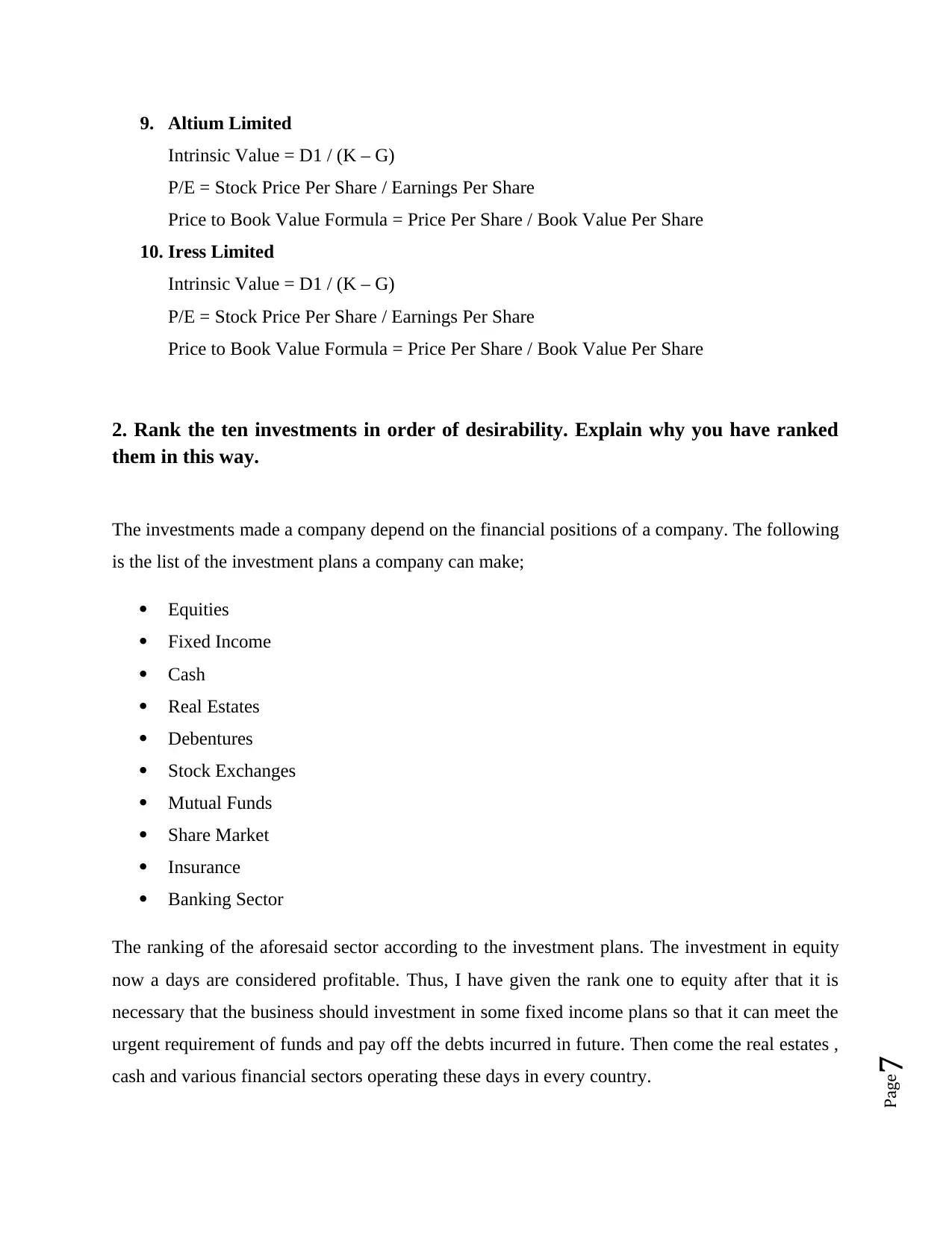
9. Altium Limited
Intrinsic Value = D1 / (K – G)
P/E = Stock Price Per Share / Earnings Per Share
Price to Book Value Formula = Price Per Share / Book Value Per Share
10. Iress Limited
Intrinsic Value = D1 / (K – G)
P/E = Stock Price Per Share / Earnings Per Share
Price to Book Value Formula = Price Per Share / Book Value Per Share
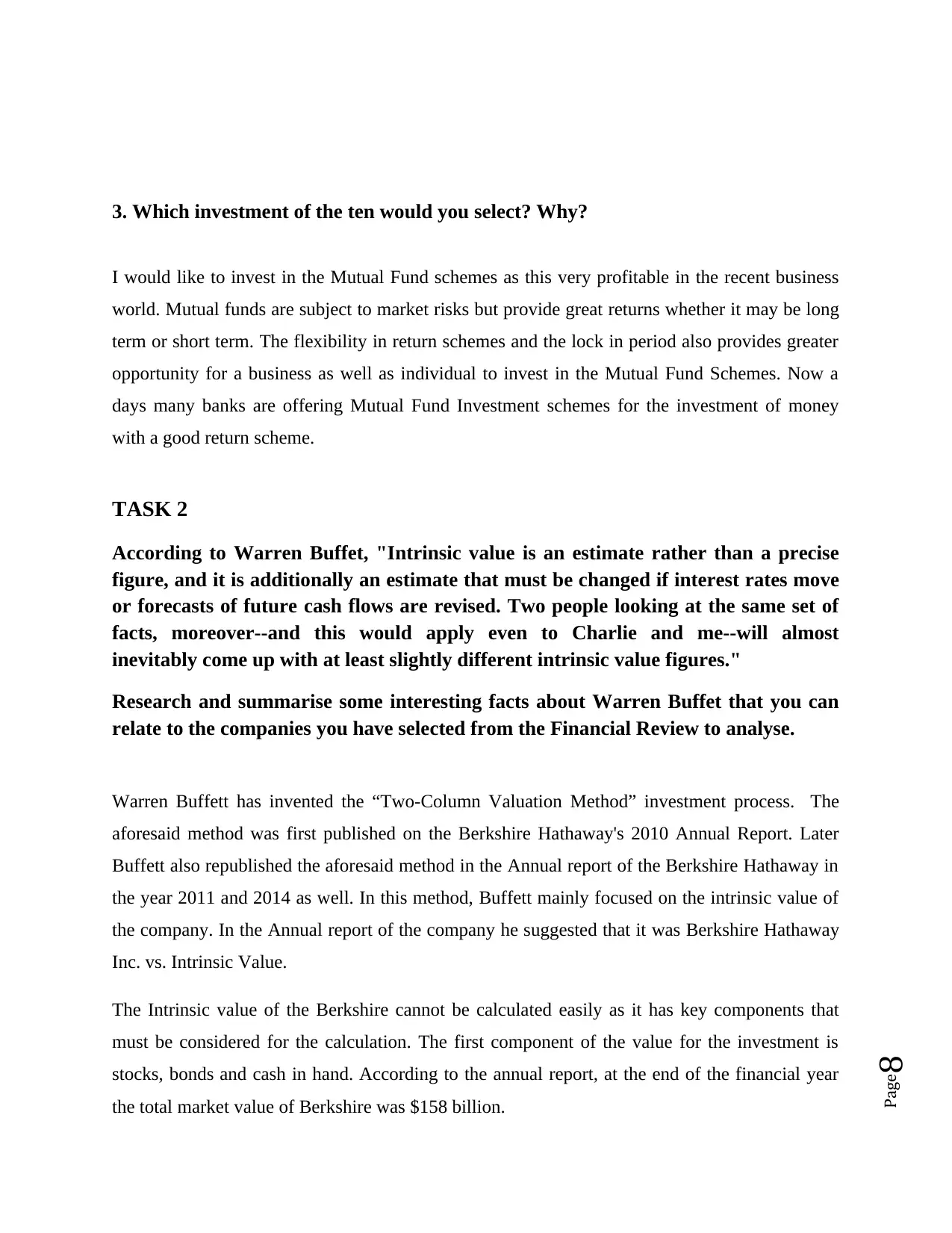
2. Rank the ten investments in order of desirability. Explain why you have ranked
them in this way.
The investments made a company depend on the financial positions of a company. The following
is the list of the investment plans a company can make;
Equities
Fixed Income
Cash
Real Estates
Debentures
Stock Exchanges
Mutual Funds
Share Market
Insurance
Banking Sector
The ranking of the aforesaid sector according to the investment plans. The investment in equity
now a days are considered profitable. Thus, I have given the rank one to equity after that it is
necessary that the business should investment in some fixed income plans so that it can meet the
urgent requirement of funds and pay off the debts incurred in future. Then come the real estates ,
cash and various financial sectors operating these days in every country.
9. Altium Limited
Intrinsic Value = D1 / (K – G)
P/E = Stock Price Per Share / Earnings Per Share
Price to Book Value Formula = Price Per Share / Book Value Per Share
10. Iress Limited
Intrinsic Value = D1 / (K – G)
P/E = Stock Price Per Share / Earnings Per Share
Price to Book Value Formula = Price Per Share / Book Value Per Share
2. Rank the ten investments in order of desirability. Explain why you have ranked
them in this way.
The investments made a company depend on the financial positions of a company. The following
is the list of the investment plans a company can make;
Equities
Fixed Income
Cash
Real Estates
Debentures
Stock Exchanges
Mutual Funds
Share Market
Insurance
Banking Sector
The ranking of the aforesaid sector according to the investment plans. The investment in equity
now a days are considered profitable. Thus, I have given the rank one to equity after that it is
necessary that the business should investment in some fixed income plans so that it can meet the
urgent requirement of funds and pay off the debts incurred in future. Then come the real estates ,
cash and various financial sectors operating these days in every country.
Paraphrase This Document
Need a fresh take? Get an instant paraphrase of this document with our AI Paraphraser
Page8
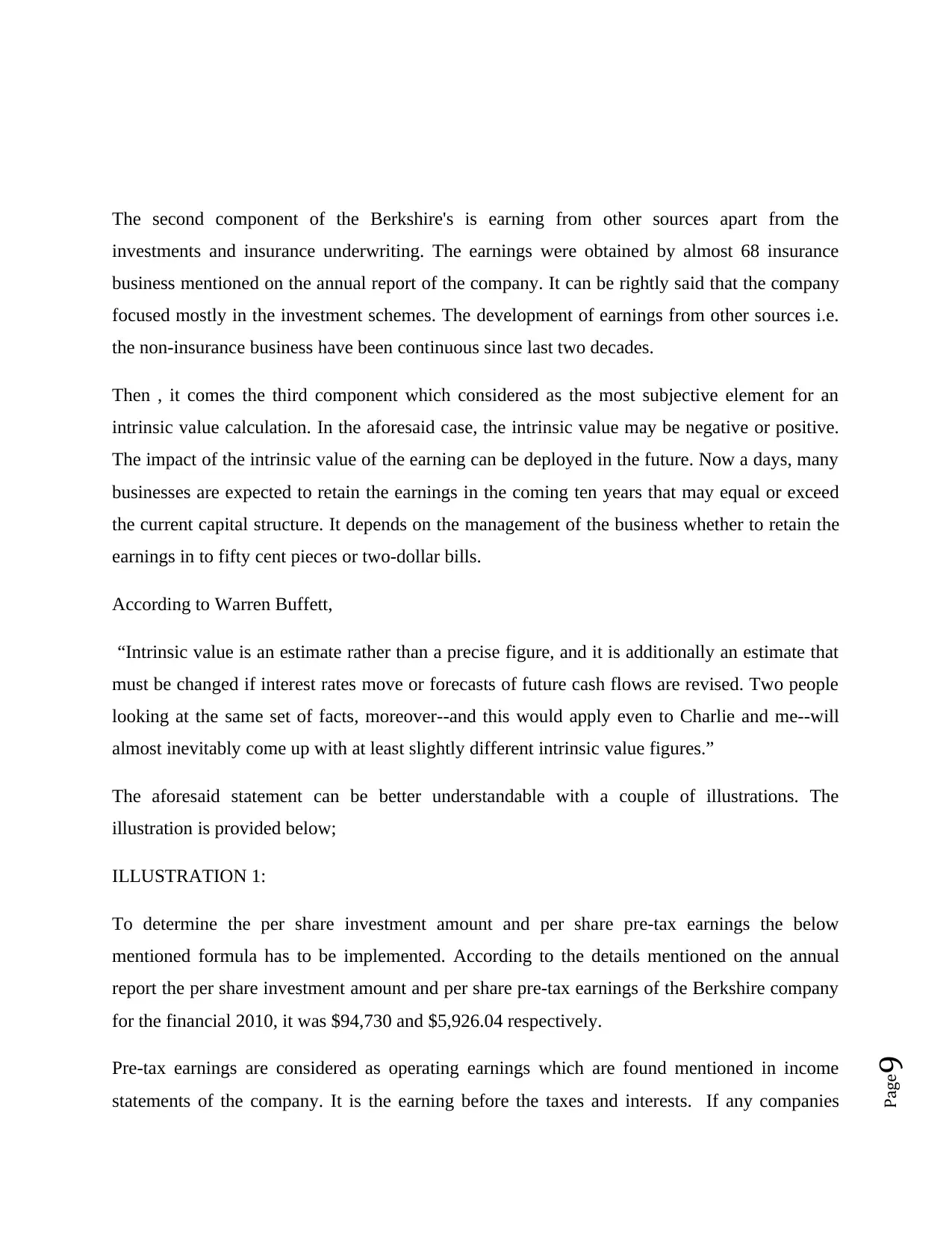
3. Which investment of the ten would you select? Why?
I would like to invest in the Mutual Fund schemes as this very profitable in the recent business
world. Mutual funds are subject to market risks but provide great returns whether it may be long
term or short term. The flexibility in return schemes and the lock in period also provides greater
opportunity for a business as well as individual to invest in the Mutual Fund Schemes. Now a
days many banks are offering Mutual Fund Investment schemes for the investment of money
with a good return scheme.
TASK 2
According to Warren Buffet, "Intrinsic value is an estimate rather than a precise
figure, and it is additionally an estimate that must be changed if interest rates move
or forecasts of future cash flows are revised. Two people looking at the same set of
facts, moreover--and this would apply even to Charlie and me--will almost
inevitably come up with at least slightly different intrinsic value figures."
Research and summarise some interesting facts about Warren Buffet that you can
relate to the companies you have selected from the Financial Review to analyse.
Warren Buffett has invented the “Two-Column Valuation Method” investment process. The
aforesaid method was first published on the Berkshire Hathaway's 2010 Annual Report. Later
Buffett also republished the aforesaid method in the Annual report of the Berkshire Hathaway in
the year 2011 and 2014 as well. In this method, Buffett mainly focused on the intrinsic value of
the company. In the Annual report of the company he suggested that it was Berkshire Hathaway
Inc. vs. Intrinsic Value.
The Intrinsic value of the Berkshire cannot be calculated easily as it has key components that
must be considered for the calculation. The first component of the value for the investment is
stocks, bonds and cash in hand. According to the annual report, at the end of the financial year
the total market value of Berkshire was $158 billion.
3. Which investment of the ten would you select? Why?
I would like to invest in the Mutual Fund schemes as this very profitable in the recent business
world. Mutual funds are subject to market risks but provide great returns whether it may be long
term or short term. The flexibility in return schemes and the lock in period also provides greater
opportunity for a business as well as individual to invest in the Mutual Fund Schemes. Now a
days many banks are offering Mutual Fund Investment schemes for the investment of money
with a good return scheme.
TASK 2
According to Warren Buffet, "Intrinsic value is an estimate rather than a precise
figure, and it is additionally an estimate that must be changed if interest rates move
or forecasts of future cash flows are revised. Two people looking at the same set of
facts, moreover--and this would apply even to Charlie and me--will almost
inevitably come up with at least slightly different intrinsic value figures."
Research and summarise some interesting facts about Warren Buffet that you can
relate to the companies you have selected from the Financial Review to analyse.
Warren Buffett has invented the “Two-Column Valuation Method” investment process. The
aforesaid method was first published on the Berkshire Hathaway's 2010 Annual Report. Later
Buffett also republished the aforesaid method in the Annual report of the Berkshire Hathaway in
the year 2011 and 2014 as well. In this method, Buffett mainly focused on the intrinsic value of
the company. In the Annual report of the company he suggested that it was Berkshire Hathaway
Inc. vs. Intrinsic Value.
The Intrinsic value of the Berkshire cannot be calculated easily as it has key components that
must be considered for the calculation. The first component of the value for the investment is
stocks, bonds and cash in hand. According to the annual report, at the end of the financial year
the total market value of Berkshire was $158 billion.
Page9
The second component of the Berkshire's is earning from other sources apart from the
investments and insurance underwriting. The earnings were obtained by almost 68 insurance
business mentioned on the annual report of the company. It can be rightly said that the company
focused mostly in the investment schemes. The development of earnings from other sources i.e.
the non-insurance business have been continuous since last two decades.
Then , it comes the third component which considered as the most subjective element for an
intrinsic value calculation. In the aforesaid case, the intrinsic value may be negative or positive.
The impact of the intrinsic value of the earning can be deployed in the future. Now a days, many
businesses are expected to retain the earnings in the coming ten years that may equal or exceed
the current capital structure. It depends on the management of the business whether to retain the
earnings in to fifty cent pieces or two-dollar bills.
According to Warren Buffett,
“Intrinsic value is an estimate rather than a precise figure, and it is additionally an estimate that
must be changed if interest rates move or forecasts of future cash flows are revised. Two people
looking at the same set of facts, moreover--and this would apply even to Charlie and me--will
almost inevitably come up with at least slightly different intrinsic value figures.”
The aforesaid statement can be better understandable with a couple of illustrations. The
illustration is provided below;
ILLUSTRATION 1:
To determine the per share investment amount and per share pre-tax earnings the below
mentioned formula has to be implemented. According to the details mentioned on the annual
report the per share investment amount and per share pre-tax earnings of the Berkshire company
for the financial 2010, it was $94,730 and $5,926.04 respectively.
Pre-tax earnings are considered as operating earnings which are found mentioned in income
statements of the company. It is the earning before the taxes and interests. If any companies
The second component of the Berkshire's is earning from other sources apart from the
investments and insurance underwriting. The earnings were obtained by almost 68 insurance
business mentioned on the annual report of the company. It can be rightly said that the company
focused mostly in the investment schemes. The development of earnings from other sources i.e.
the non-insurance business have been continuous since last two decades.
Then , it comes the third component which considered as the most subjective element for an
intrinsic value calculation. In the aforesaid case, the intrinsic value may be negative or positive.
The impact of the intrinsic value of the earning can be deployed in the future. Now a days, many
businesses are expected to retain the earnings in the coming ten years that may equal or exceed
the current capital structure. It depends on the management of the business whether to retain the
earnings in to fifty cent pieces or two-dollar bills.
According to Warren Buffett,
“Intrinsic value is an estimate rather than a precise figure, and it is additionally an estimate that
must be changed if interest rates move or forecasts of future cash flows are revised. Two people
looking at the same set of facts, moreover--and this would apply even to Charlie and me--will
almost inevitably come up with at least slightly different intrinsic value figures.”
The aforesaid statement can be better understandable with a couple of illustrations. The
illustration is provided below;
ILLUSTRATION 1:
To determine the per share investment amount and per share pre-tax earnings the below
mentioned formula has to be implemented. According to the details mentioned on the annual
report the per share investment amount and per share pre-tax earnings of the Berkshire company
for the financial 2010, it was $94,730 and $5,926.04 respectively.
Pre-tax earnings are considered as operating earnings which are found mentioned in income
statements of the company. It is the earning before the taxes and interests. If any companies
⊘ This is a preview!⊘
Do you want full access?
Subscribe today to unlock all pages.
Trusted by 1+ million students worldwide
Page10
stock prices are presently have pre-tax earnings of 10. Then for the illustration, we have to use
10 as the multiple for the application of the pre-tax earnings.
Considering the same formula, if the pre-tax earnings are $5,926.04, then we have multiply it
with 10 ($5,926.04 x 10 = $59,260.40) which equals to $59,260.40. After that we have to
calculate the per-share investment amount which comes up as $94,730 + $59,260.40 =
$153,990.40
ILLUSTRATION 2:
Likewise, we can apply multiple pre-tax value earnings of $5,926.04 to arrive at the estimated
intrinsic value. For example if we use a multiple of 12 instead of 10 then the per share
investment will be $5,926.04 x 12 = $71,112.48. Considering the per-share investment of
$94,730 to $71,112.48 the intrinsic value of the company at the end of the financial year will be
$94,730 + $71,112.48 = $165,842.48.
From the above two illustrations it can be concluded that the Two-Column Valuation Method,”
invented by Warren Buffett’s is purely based on the intrinsic value. The intrinsic value of the
Berkshire at the end of the financial year is estimated to be between $153,990.40 and
$165,842.48. On analyzing the same Warren Buffett gave the following to statements;
“Market price and intrinsic value often follow very different paths – sometimes for extended
periods – but eventually they meet.”
“It’s better to be approximately right, than precisely wrong."
TASK 3
Compare Warren Buffet’s approach to share valuation and the share valuation
methodology and recommend which approach you prefer with one reason;
Warren Buffets has invented the “Two-Column Valuation Method” for the calculation of the per-
share investments and pre-tax earnings which are a part of share valuation. The combined study
of the two amounts will provide the intrinsic value of the share.
stock prices are presently have pre-tax earnings of 10. Then for the illustration, we have to use
10 as the multiple for the application of the pre-tax earnings.
Considering the same formula, if the pre-tax earnings are $5,926.04, then we have multiply it
with 10 ($5,926.04 x 10 = $59,260.40) which equals to $59,260.40. After that we have to
calculate the per-share investment amount which comes up as $94,730 + $59,260.40 =
$153,990.40
ILLUSTRATION 2:
Likewise, we can apply multiple pre-tax value earnings of $5,926.04 to arrive at the estimated
intrinsic value. For example if we use a multiple of 12 instead of 10 then the per share
investment will be $5,926.04 x 12 = $71,112.48. Considering the per-share investment of
$94,730 to $71,112.48 the intrinsic value of the company at the end of the financial year will be
$94,730 + $71,112.48 = $165,842.48.
From the above two illustrations it can be concluded that the Two-Column Valuation Method,”
invented by Warren Buffett’s is purely based on the intrinsic value. The intrinsic value of the
Berkshire at the end of the financial year is estimated to be between $153,990.40 and
$165,842.48. On analyzing the same Warren Buffett gave the following to statements;
“Market price and intrinsic value often follow very different paths – sometimes for extended
periods – but eventually they meet.”
“It’s better to be approximately right, than precisely wrong."
TASK 3
Compare Warren Buffet’s approach to share valuation and the share valuation
methodology and recommend which approach you prefer with one reason;
Warren Buffets has invented the “Two-Column Valuation Method” for the calculation of the per-
share investments and pre-tax earnings which are a part of share valuation. The combined study
of the two amounts will provide the intrinsic value of the share.
Paraphrase This Document
Need a fresh take? Get an instant paraphrase of this document with our AI Paraphraser
Page11
Warren Buffett also introduced the concept if Discounted Cash Flow and Free Cash Flow to
calculate the intrinsic value of the business. Some of the past valuation methods of Warren
Buffett foe the valuation of the shares are;
Net-Net Working Capital Method
DCF Method,
Four Filters Investment Process,
Two-Column Valuation Method
Buffett's Methodology for Valuation
While considering the valuation method, the following are the few things that Buffett keeps in
his mind to evaluate the stock's level for valuation;
If the company has performed well in the last financial year, this question reveals that the of the
shareholders are earning incomes on the shares. For the analysis of this factor Buffett apply the
Return of Equity method to check if the company has performed well. The formula for the
calculation of Return of Equity is Net Income / Shareholder's Equity.
The second point which he considers is if the company has avoided the debts. To find out the
answer of this question Buffett focus on the earnings growth of the business which is generated
from the shareholders equity. The debt equity ratio is calculated as Total Liabilities /
Shareholders' Equity
The third factor which is considered by Buffett is the profit margins of them business is
increasing. To find out Buffett calculate the profit margins of the business by dividing the net
incomes with net sales. If the profit margins are high it suggests that the business is successful
and efficient in managing its expenses.
The fourth factors to be considered are how long the company has been in public. To analyze the
same Buffett focuses on the Initial Public Offerings of the company for last decade. It the IPO
analysis is necessary to know how long the company has offering its shares to public for
Warren Buffett also introduced the concept if Discounted Cash Flow and Free Cash Flow to
calculate the intrinsic value of the business. Some of the past valuation methods of Warren
Buffett foe the valuation of the shares are;
Net-Net Working Capital Method
DCF Method,
Four Filters Investment Process,
Two-Column Valuation Method
Buffett's Methodology for Valuation
While considering the valuation method, the following are the few things that Buffett keeps in
his mind to evaluate the stock's level for valuation;
If the company has performed well in the last financial year, this question reveals that the of the
shareholders are earning incomes on the shares. For the analysis of this factor Buffett apply the
Return of Equity method to check if the company has performed well. The formula for the
calculation of Return of Equity is Net Income / Shareholder's Equity.
The second point which he considers is if the company has avoided the debts. To find out the
answer of this question Buffett focus on the earnings growth of the business which is generated
from the shareholders equity. The debt equity ratio is calculated as Total Liabilities /
Shareholders' Equity
The third factor which is considered by Buffett is the profit margins of them business is
increasing. To find out Buffett calculate the profit margins of the business by dividing the net
incomes with net sales. If the profit margins are high it suggests that the business is successful
and efficient in managing its expenses.
The fourth factors to be considered are how long the company has been in public. To analyze the
same Buffett focuses on the Initial Public Offerings of the company for last decade. It the IPO
analysis is necessary to know how long the company has offering its shares to public for
Page12
subscription. By knowing the offering schemes of the business one can analyze the other factors
effecting the valuation of shares. The past performance of the company plays an important role
in the valuation of the shares of the company.
The fifth factor which needs to be focused is if the company's product or service depends on a
community. To analyze the same Buffett gave emphasis on the products of the competitors
which are similar as that of the own company's products. It is important to notice that if the
company has anything else to offer rather than the things which are available in the market and
offered by the competitors. This concept is called competitive advantage by Buffett. It is also
known as economic moat.
The sixth factor which needs to be considered is the stock selling of company, if it is being sold
on its real value of or at a discounted rate. For this, Buffett mainly focus on to determine the
intrinsic value of the business by analyzing the factors such as revenue, assets, earnings etc. if a
company has high intrinsic value the company has higher liquidation value.
On analyzing both the methods and methodology of Warren Buffett I will prefer for the
methodology he has been following for the valuation of shares as it provides the fundamental
and basic details of a company's financial structure as compared to the methods provided by him.
The methods he provides only focuses on the calculation of the intrinsic value while the
methodology provides the details of all the factors concerned.
References
(2013, May 19). Warren Buffett’s “Two-Column Valuation Method .
Ferraro, S. R. (2009). Focusing on return on capital may be the key to investment success. The
Buffett Approach to Valuing Stocks , 2 (3).
Staff, I. (2018, April 28). Warren Buffett: How He Does It .
Today, B. (2014, August ). Buying At A Discount. Retrieved from https://www.businesstoday.in/:
https://www.businesstoday.in/moneytoday/cover-story/investment-lessons-from-warren-buffett-
others-and-top-stocks/story/208504.html
subscription. By knowing the offering schemes of the business one can analyze the other factors
effecting the valuation of shares. The past performance of the company plays an important role
in the valuation of the shares of the company.
The fifth factor which needs to be focused is if the company's product or service depends on a
community. To analyze the same Buffett gave emphasis on the products of the competitors
which are similar as that of the own company's products. It is important to notice that if the
company has anything else to offer rather than the things which are available in the market and
offered by the competitors. This concept is called competitive advantage by Buffett. It is also
known as economic moat.
The sixth factor which needs to be considered is the stock selling of company, if it is being sold
on its real value of or at a discounted rate. For this, Buffett mainly focus on to determine the
intrinsic value of the business by analyzing the factors such as revenue, assets, earnings etc. if a
company has high intrinsic value the company has higher liquidation value.
On analyzing both the methods and methodology of Warren Buffett I will prefer for the
methodology he has been following for the valuation of shares as it provides the fundamental
and basic details of a company's financial structure as compared to the methods provided by him.
The methods he provides only focuses on the calculation of the intrinsic value while the
methodology provides the details of all the factors concerned.
References
(2013, May 19). Warren Buffett’s “Two-Column Valuation Method .
Ferraro, S. R. (2009). Focusing on return on capital may be the key to investment success. The
Buffett Approach to Valuing Stocks , 2 (3).
Staff, I. (2018, April 28). Warren Buffett: How He Does It .
Today, B. (2014, August ). Buying At A Discount. Retrieved from https://www.businesstoday.in/:
https://www.businesstoday.in/moneytoday/cover-story/investment-lessons-from-warren-buffett-
others-and-top-stocks/story/208504.html
⊘ This is a preview!⊘
Do you want full access?
Subscribe today to unlock all pages.
Trusted by 1+ million students worldwide

1 out of 13


Related Documents


Your All-in-One AI-Powered Toolkit for Academic Success.
+13062052269
info@desklib.com
Available 24*7 on WhatsApp / Email
![[object Object]](/_next/static/media/star-bottom.7253800d.svg)
Unlock your academic potential
Copyright © 2020–2026 A2Z Services. All Rights Reserved. Developed and managed by ZUCOL.