SBS Swiss Business School Principles of Finance Assignment
VerifiedAdded on 2021/06/22
|25
|4440
|50
Homework Assignment
AI Summary
This finance assignment from SBS Swiss Business School covers key concepts in financial management. It begins by defining working capital and the operating cycle, followed by an explanation of the determinants of working capital, including internal and external factors such as the nature of the business, production policy, and business fluctuations. The assignment then includes a calculation of the operating cycle in days based on provided financial data. Next, the assignment explains derivatives, their types (futures, options, forwards, and swaps), and their role in financial markets. It also elaborates on risk management, including its process and various approaches to deal with risk. The solution provides detailed explanations and calculations to illustrate the concepts. The assignment aims to enhance understanding of financial principles and their practical applications.
SBS Swiss Business School
Final Assignment
Course Code Course Name Principles Of Finance
Date 24.07.2020 Time Duration
Maximum Marks 60 Weight
Learning Outcomes
Student Name Ahmed Rayyan
Student ID SBS-180-70166
For Examiner’s Use Only
Total Points: _______/ 60 points= _________% Grade:
Tasks A
Marks Allocated 60
Marks Obtained
Final Assignment
Course Code Course Name Principles Of Finance
Date 24.07.2020 Time Duration
Maximum Marks 60 Weight
Learning Outcomes
Student Name Ahmed Rayyan
Student ID SBS-180-70166
For Examiner’s Use Only
Total Points: _______/ 60 points= _________% Grade:
Tasks A
Marks Allocated 60
Marks Obtained

Paraphrase This Document
Need a fresh take? Get an instant paraphrase of this document with our AI Paraphraser
Principles of Finance -II
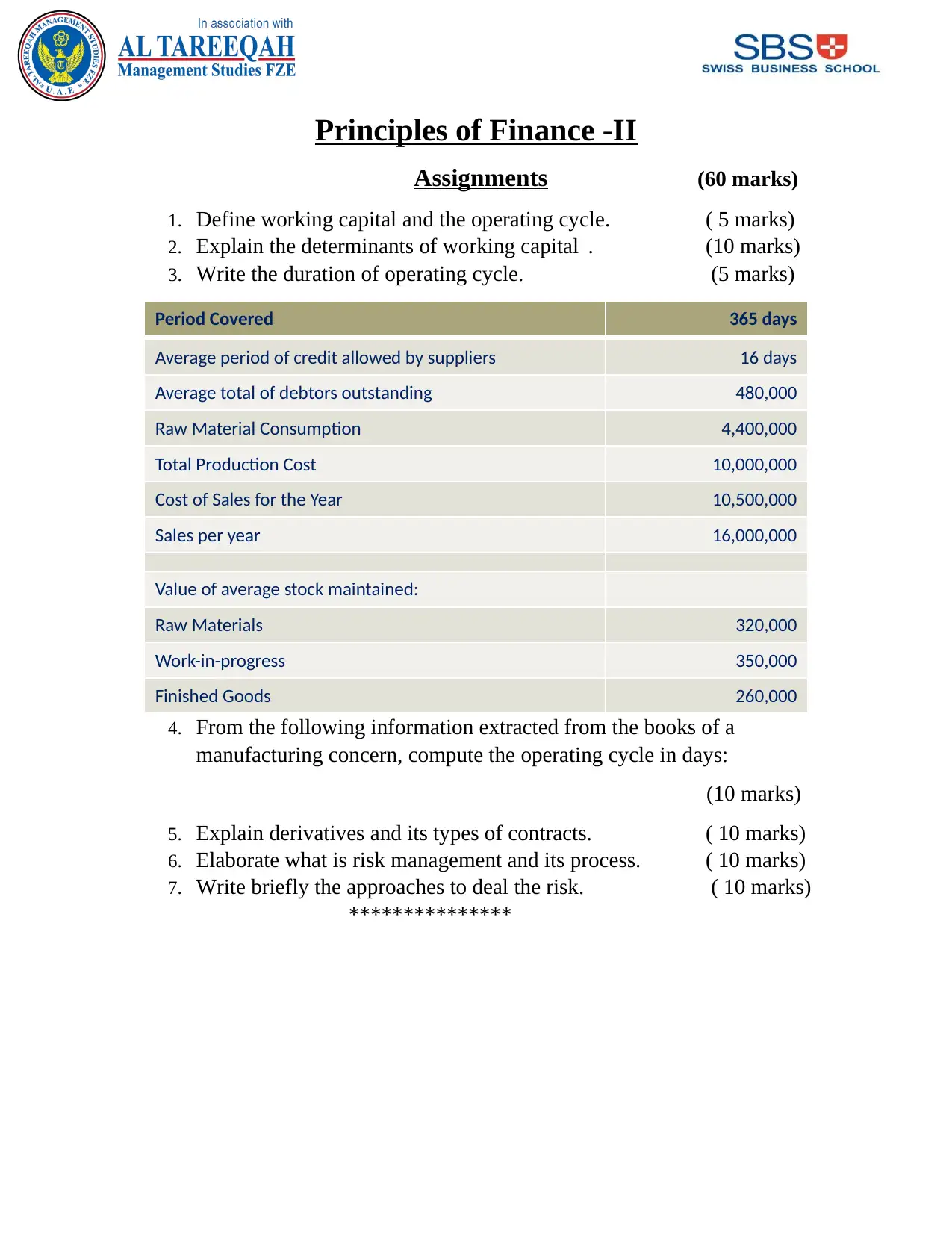
Assignments (60 marks)
1. Define working capital and the operating cycle. ( 5 marks)
2. Explain the determinants of working capital . (10 marks)
3. Write the duration of operating cycle. (5 marks)
Period Covered 365 days
Average period of credit allowed by suppliers 16 days
Average total of debtors outstanding 480,000
Raw Material Consumption 4,400,000
Total Production Cost 10,000,000
Cost of Sales for the Year 10,500,000
Sales per year 16,000,000
Value of average stock maintained:
Raw Materials 320,000
Work-in-progress 350,000
Finished Goods 260,000
4. From the following information extracted from the books of a
manufacturing concern, compute the operating cycle in days:
(10 marks)
5. Explain derivatives and its types of contracts. ( 10 marks)
6. Elaborate what is risk management and its process. ( 10 marks)
7. Write briefly the approaches to deal the risk. ( 10 marks)
***************
Assignments (60 marks)
1. Define working capital and the operating cycle. ( 5 marks)
2. Explain the determinants of working capital . (10 marks)
3. Write the duration of operating cycle. (5 marks)
Period Covered 365 days
Average period of credit allowed by suppliers 16 days
Average total of debtors outstanding 480,000
Raw Material Consumption 4,400,000
Total Production Cost 10,000,000
Cost of Sales for the Year 10,500,000
Sales per year 16,000,000
Value of average stock maintained:
Raw Materials 320,000
Work-in-progress 350,000
Finished Goods 260,000
4. From the following information extracted from the books of a
manufacturing concern, compute the operating cycle in days:
(10 marks)
5. Explain derivatives and its types of contracts. ( 10 marks)
6. Elaborate what is risk management and its process. ( 10 marks)
7. Write briefly the approaches to deal the risk. ( 10 marks)
***************
Principles Of Finance
Assignment
Ahmed Rayyan
SBS-180-70166
24 July 2020
Assignment
Ahmed Rayyan
SBS-180-70166
24 July 2020
⊘ This is a preview!⊘
Do you want full access?
Subscribe today to unlock all pages.

Trusted by 1+ million students worldwide
1. Define working capital and the operating cycle. ( 5 marks)
Ans.) Working capital is cash that’s to be had to a business enterprise
for its daily operations. Simply put, running capital shows a business
enterprise's working liquidity and efficiency. A business enterprise's running
capital displays a bunch of business enterprise activities, such as cash, stock,
debts receivable, debts payable, and the part of debt due inside one year (in
addition to some other short-time period debts). This can enlarge to stock
management, debt management, sales collection, and bills to suppliers.
According to Weston & Brigham - “Working capital refers to a firm’s
investment in short term assets, such as cash amounts receivables,
inventories etc.
The operating cycle is the common time period required for an
enterprise to make a preliminary outlay of coins to supply goods, promote
the goods, and obtain coins from clients in trade for the goods. If an agency
is a retailer, then the working cycle does now no longer encompass any time
for production: it's far in reality the date from the preliminary coins outlay to
the date of coins receipt from the customer. The operating cycle is beneficial
for estimating the quantity of operating capital that an agency will want to be
able to preserve or develop its enterprise. An agency with a very quick
Ans.) Working capital is cash that’s to be had to a business enterprise
for its daily operations. Simply put, running capital shows a business
enterprise's working liquidity and efficiency. A business enterprise's running
capital displays a bunch of business enterprise activities, such as cash, stock,
debts receivable, debts payable, and the part of debt due inside one year (in
addition to some other short-time period debts). This can enlarge to stock
management, debt management, sales collection, and bills to suppliers.
According to Weston & Brigham - “Working capital refers to a firm’s
investment in short term assets, such as cash amounts receivables,
inventories etc.
The operating cycle is the common time period required for an
enterprise to make a preliminary outlay of coins to supply goods, promote
the goods, and obtain coins from clients in trade for the goods. If an agency
is a retailer, then the working cycle does now no longer encompass any time
for production: it's far in reality the date from the preliminary coins outlay to
the date of coins receipt from the customer. The operating cycle is beneficial
for estimating the quantity of operating capital that an agency will want to be
able to preserve or develop its enterprise. An agency with a very quick
Paraphrase This Document
Need a fresh take? Get an instant paraphrase of this document with our AI Paraphraser
working cycle calls for much less coins to preserve its operations, and so can
nonetheless develop even as promoting at pretty small earnings margins.
2. Explain the determinants of working capital. (10 marks)
Ans.) The Determinants of working capital include Internal Factors
and External Factors. Please see the below explanation:
1. Internal Factors
1. Nature and size of the business
The working capital necessities of an organization are essentially
inspired through the character and length of the commercial enterprise. An
organization with large scale of operations will want extra running capital
than a small organization. Similarly, the character of the commercial
enterprise - impact the working capital decisions. Trading and monetary
companies have much less funding in constant assets. But require a big
amount of cash to be invested in running capital. Retail stores, commercial
enterprise gadgets require large quantity of working capital, in which as,
public utilities want much less running capital and extra finances to spend
money on constant assets.
nonetheless develop even as promoting at pretty small earnings margins.
2. Explain the determinants of working capital. (10 marks)
Ans.) The Determinants of working capital include Internal Factors
and External Factors. Please see the below explanation:
1. Internal Factors
1. Nature and size of the business
The working capital necessities of an organization are essentially
inspired through the character and length of the commercial enterprise. An
organization with large scale of operations will want extra running capital
than a small organization. Similarly, the character of the commercial
enterprise - impact the working capital decisions. Trading and monetary
companies have much less funding in constant assets. But require a big
amount of cash to be invested in running capital. Retail stores, commercial
enterprise gadgets require large quantity of working capital, in which as,
public utilities want much less running capital and extra finances to spend
money on constant assets.
2. Firm’s production policy
The firm’s manufacturing coverage (production cycle) is a crucial
component to determine the running capital requirement of a firm. The
manufacturing cycle begins off evolved with the acquisition and use of
uncooked fabric and completes with the manufacturing of completed goods.
On the opposite hand manufacturing coverage is uniform manufacturing
coverage or seasonal manufacturing coverage etc., additionally impacts the
running capital decisions.
3. Firm’s credit policy
The credit score coverage of a company affects credit score coverage
of operating capital. A company following liberal credit score coverage to
all clients calls for funds. On the alternative hand, the company adopting
strict credit score coverage and supply credit score centers to few ability
clients would require much less quantity of operating capital.
4. Availability of credit
The working capital necessities of an organization also are tormented
by credit score phrases granted via way of means of its suppliers – i.e.
Creditors. An organization will want much less running capital if liberal
credit score phrases are to be had to it. Similarly, the provision of credit
The firm’s manufacturing coverage (production cycle) is a crucial
component to determine the running capital requirement of a firm. The
manufacturing cycle begins off evolved with the acquisition and use of
uncooked fabric and completes with the manufacturing of completed goods.
On the opposite hand manufacturing coverage is uniform manufacturing
coverage or seasonal manufacturing coverage etc., additionally impacts the
running capital decisions.
3. Firm’s credit policy
The credit score coverage of a company affects credit score coverage
of operating capital. A company following liberal credit score coverage to
all clients calls for funds. On the alternative hand, the company adopting
strict credit score coverage and supply credit score centers to few ability
clients would require much less quantity of operating capital.
4. Availability of credit
The working capital necessities of an organization also are tormented
by credit score phrases granted via way of means of its suppliers – i.e.
Creditors. An organization will want much less running capital if liberal
credit score phrases are to be had to it. Similarly, the provision of credit
⊘ This is a preview!⊘
Do you want full access?
Subscribe today to unlock all pages.
Trusted by 1+ million students worldwide
score from banks additionally affects the working capital wishes of the
organization. An organization, that could get financial institution credit score
effortlessly on favorable conditions, may be operated with much less
running capital than an organization without the sort of facility.
5. Growth and expansion of business
Working capital requirement of an enterprise company have a
tendency to growth in correspondence with boom in income extent and
glued property. A developing company may also want budget to put money
into constant property with the intention to maintain its developing
manufacturing and income. This will, in turn, growth funding in cutting-
edge property to aid elevated scale of operations. Thus, a developing
company desires extra budget continuously.
6. Profit margin and dividend policy
The importance of running capital in an organization relies upon its
income margin and dividend coverage. An excessive internet income margin
contributes toward the running capital pool. To the quantity the internet
income has been earned in coins, it will become a supply of running capital.
This relies upon the dividend coverage of the organization. Distribution of
excessive percentage of income in the shape of coins dividends effects in a
organization. An organization, that could get financial institution credit score
effortlessly on favorable conditions, may be operated with much less
running capital than an organization without the sort of facility.
5. Growth and expansion of business
Working capital requirement of an enterprise company have a
tendency to growth in correspondence with boom in income extent and
glued property. A developing company may also want budget to put money
into constant property with the intention to maintain its developing
manufacturing and income. This will, in turn, growth funding in cutting-
edge property to aid elevated scale of operations. Thus, a developing
company desires extra budget continuously.
6. Profit margin and dividend policy
The importance of running capital in an organization relies upon its
income margin and dividend coverage. An excessive internet income margin
contributes toward the running capital pool. To the quantity the internet
income has been earned in coins, it will become a supply of running capital.
This relies upon the dividend coverage of the organization. Distribution of
excessive percentage of income in the shape of coins dividends effects in a
Paraphrase This Document
Need a fresh take? Get an instant paraphrase of this document with our AI Paraphraser
drain on coins assets and for this reason reduces company’s running capital
to that quantity. The running capital function of the organization is
reinforced if the control follows conservative dividend coverage and vice
versa.
7. Operating efficiency of the firm
Operating performance manner the most suitable utilization of a
company’s sources at minimal cost. If a company efficaciously controls
working cost, it is going to be capable of enhance internet income margin
which, will, in turn, launch extra price range for operating capital purposes.
8. Coordinating activities in firm
The operating capital necessities of an organization are rely upon the
co-ordination among manufacturing and distribution activities. The extra and
powerful the co-ordinations, the stress at the operating capital could be
minimized. In the absence of co-ordination, call for operating capital is
reduced.
to that quantity. The running capital function of the organization is
reinforced if the control follows conservative dividend coverage and vice
versa.
7. Operating efficiency of the firm
Operating performance manner the most suitable utilization of a
company’s sources at minimal cost. If a company efficaciously controls
working cost, it is going to be capable of enhance internet income margin
which, will, in turn, launch extra price range for operating capital purposes.
8. Coordinating activities in firm
The operating capital necessities of an organization are rely upon the
co-ordination among manufacturing and distribution activities. The extra and
powerful the co-ordinations, the stress at the operating capital could be
minimized. In the absence of co-ordination, call for operating capital is
reduced.
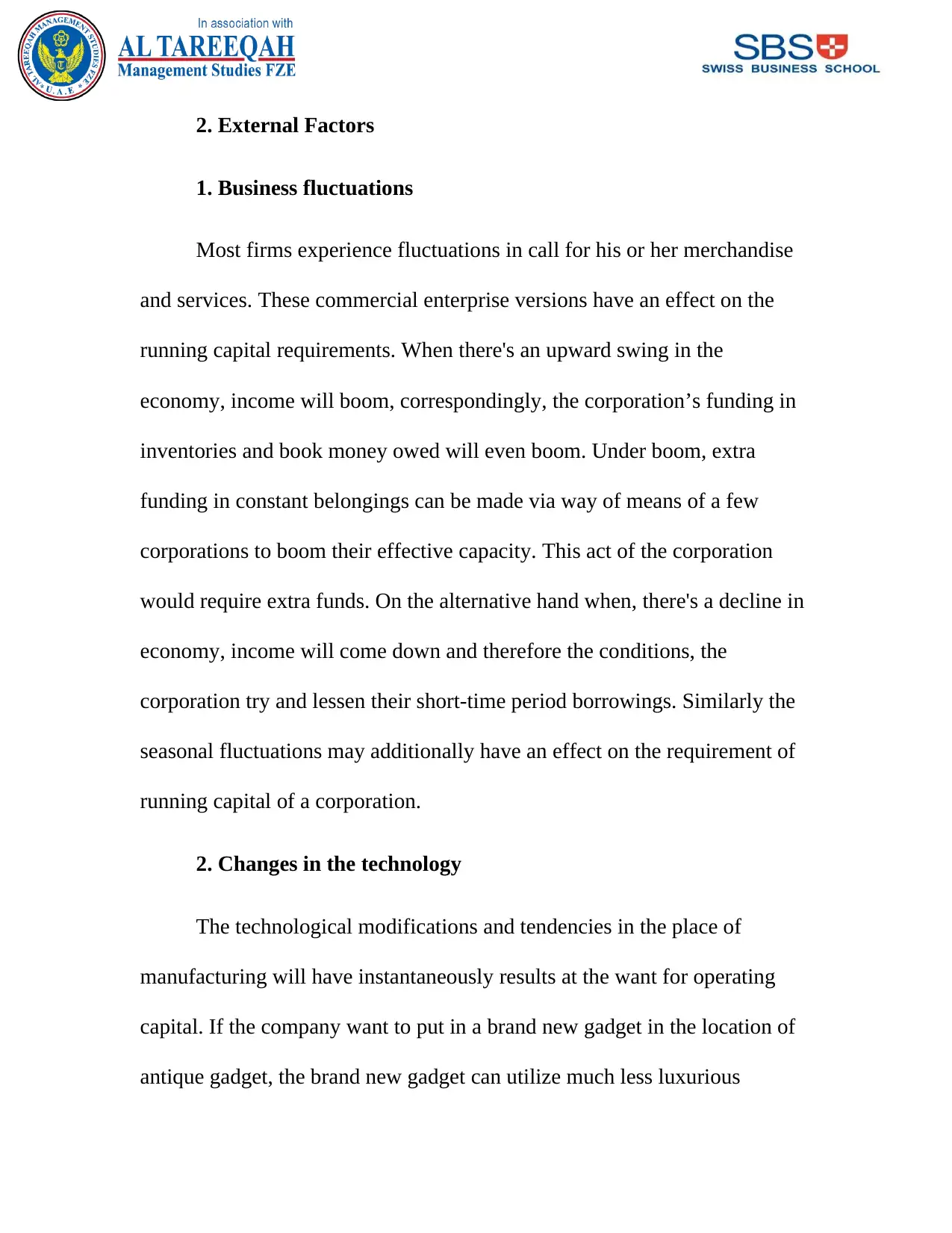
2. External Factors
1. Business fluctuations
Most firms experience fluctuations in call for his or her merchandise
and services. These commercial enterprise versions have an effect on the
running capital requirements. When there's an upward swing in the
economy, income will boom, correspondingly, the corporation’s funding in
inventories and book money owed will even boom. Under boom, extra
funding in constant belongings can be made via way of means of a few
corporations to boom their effective capacity. This act of the corporation
would require extra funds. On the alternative hand when, there's a decline in
economy, income will come down and therefore the conditions, the
corporation try and lessen their short-time period borrowings. Similarly the
seasonal fluctuations may additionally have an effect on the requirement of
running capital of a corporation.
2. Changes in the technology
The technological modifications and tendencies in the place of
manufacturing will have instantaneously results at the want for operating
capital. If the company want to put in a brand new gadget in the location of
antique gadget, the brand new gadget can utilize much less luxurious
1. Business fluctuations
Most firms experience fluctuations in call for his or her merchandise
and services. These commercial enterprise versions have an effect on the
running capital requirements. When there's an upward swing in the
economy, income will boom, correspondingly, the corporation’s funding in
inventories and book money owed will even boom. Under boom, extra
funding in constant belongings can be made via way of means of a few
corporations to boom their effective capacity. This act of the corporation
would require extra funds. On the alternative hand when, there's a decline in
economy, income will come down and therefore the conditions, the
corporation try and lessen their short-time period borrowings. Similarly the
seasonal fluctuations may additionally have an effect on the requirement of
running capital of a corporation.
2. Changes in the technology
The technological modifications and tendencies in the place of
manufacturing will have instantaneously results at the want for operating
capital. If the company want to put in a brand new gadget in the location of
antique gadget, the brand new gadget can utilize much less luxurious
⊘ This is a preview!⊘
Do you want full access?
Subscribe today to unlock all pages.
Trusted by 1+ million students worldwide
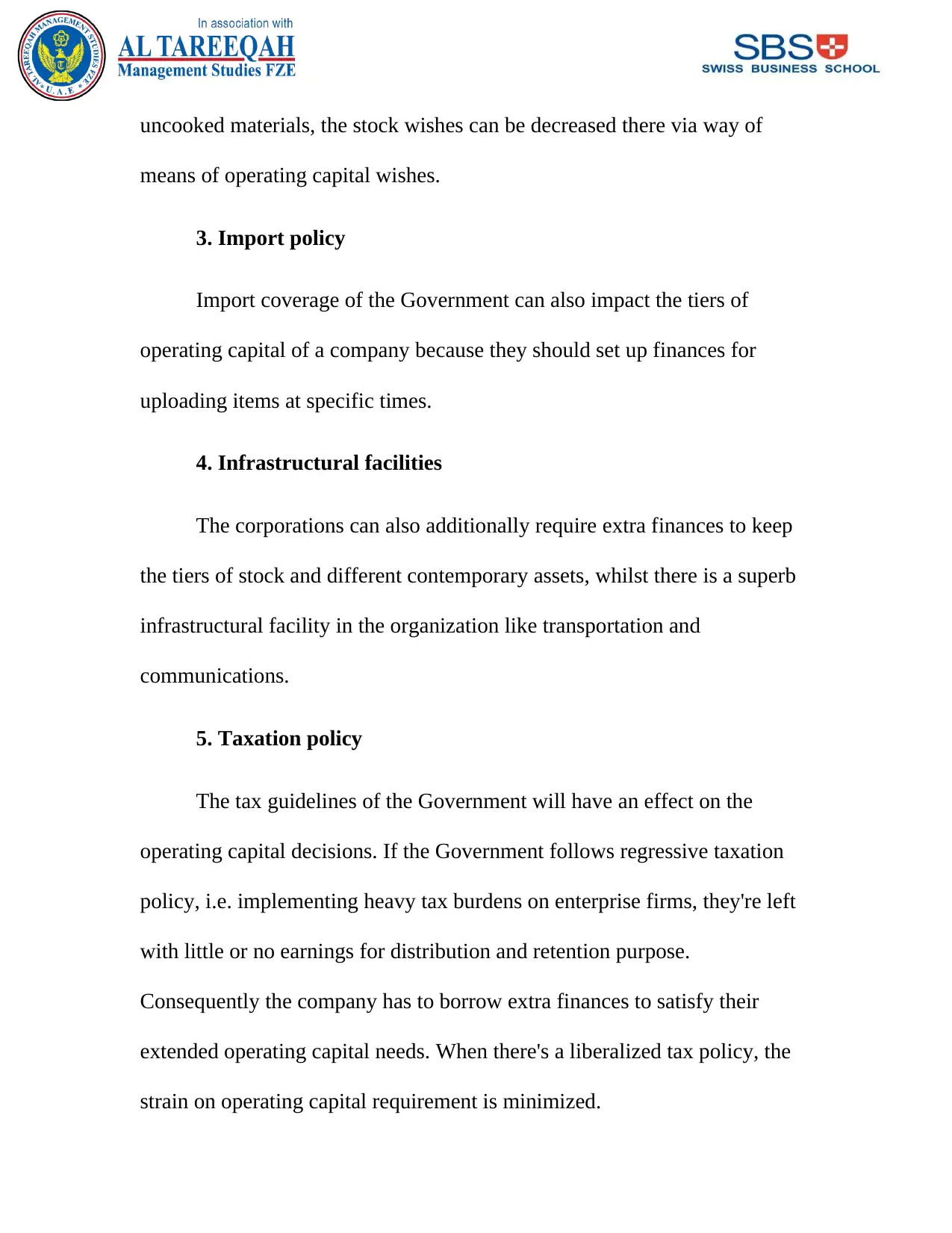
uncooked materials, the stock wishes can be decreased there via way of
means of operating capital wishes.
3. Import policy
Import coverage of the Government can also impact the tiers of
operating capital of a company because they should set up finances for
uploading items at specific times.
4. Infrastructural facilities
The corporations can also additionally require extra finances to keep
the tiers of stock and different contemporary assets, whilst there is a superb
infrastructural facility in the organization like transportation and
communications.
5. Taxation policy
The tax guidelines of the Government will have an effect on the
operating capital decisions. If the Government follows regressive taxation
policy, i.e. implementing heavy tax burdens on enterprise firms, they're left
with little or no earnings for distribution and retention purpose.
Consequently the company has to borrow extra finances to satisfy their
extended operating capital needs. When there's a liberalized tax policy, the
strain on operating capital requirement is minimized.
means of operating capital wishes.
3. Import policy
Import coverage of the Government can also impact the tiers of
operating capital of a company because they should set up finances for
uploading items at specific times.
4. Infrastructural facilities
The corporations can also additionally require extra finances to keep
the tiers of stock and different contemporary assets, whilst there is a superb
infrastructural facility in the organization like transportation and
communications.
5. Taxation policy
The tax guidelines of the Government will have an effect on the
operating capital decisions. If the Government follows regressive taxation
policy, i.e. implementing heavy tax burdens on enterprise firms, they're left
with little or no earnings for distribution and retention purpose.
Consequently the company has to borrow extra finances to satisfy their
extended operating capital needs. When there's a liberalized tax policy, the
strain on operating capital requirement is minimized.
Paraphrase This Document
Need a fresh take? Get an instant paraphrase of this document with our AI Paraphraser
Thus the operating capital necessities of a company are encouraged
via way of means of the inner and outside factors.
3. Write the duration of operating cycle. (5 marks)
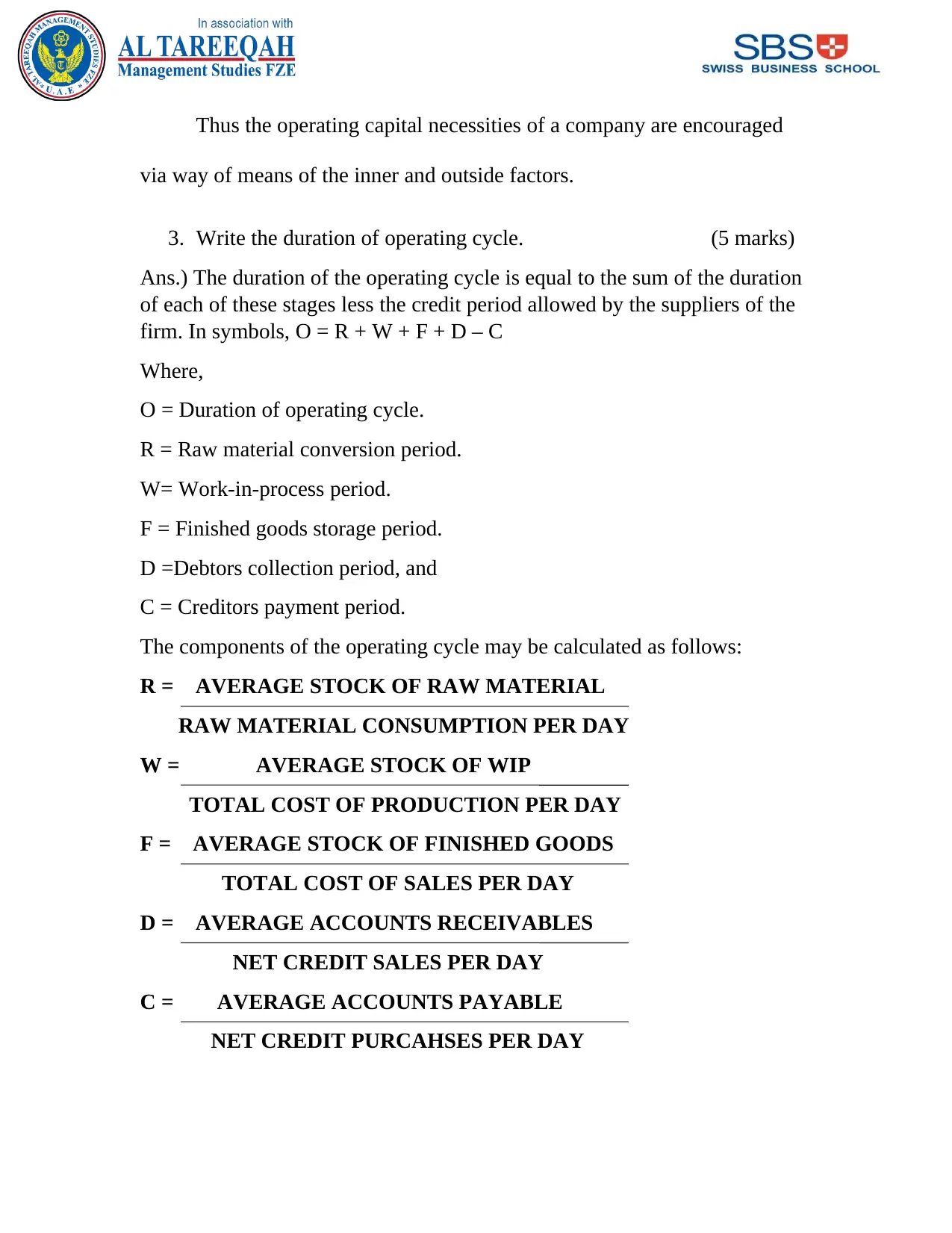
Ans.) The duration of the operating cycle is equal to the sum of the duration
of each of these stages less the credit period allowed by the suppliers of the
firm. In symbols, O = R + W + F + D – C
Where,
O = Duration of operating cycle.
R = Raw material conversion period.
W= Work-in-process period.
F = Finished goods storage period.
D =Debtors collection period, and
C = Creditors payment period.
The components of the operating cycle may be calculated as follows:
R = AVERAGE STOCK OF RAW MATERIAL
RAW MATERIAL CONSUMPTION PER DAY
W = AVERAGE STOCK OF WIP
TOTAL COST OF PRODUCTION PER DAY
F = AVERAGE STOCK OF FINISHED GOODS
TOTAL COST OF SALES PER DAY
D = AVERAGE ACCOUNTS RECEIVABLES
NET CREDIT SALES PER DAY
C = AVERAGE ACCOUNTS PAYABLE
NET CREDIT PURCAHSES PER DAY
via way of means of the inner and outside factors.
3. Write the duration of operating cycle. (5 marks)
Ans.) The duration of the operating cycle is equal to the sum of the duration
of each of these stages less the credit period allowed by the suppliers of the
firm. In symbols, O = R + W + F + D – C
Where,
O = Duration of operating cycle.
R = Raw material conversion period.
W= Work-in-process period.
F = Finished goods storage period.
D =Debtors collection period, and
C = Creditors payment period.
The components of the operating cycle may be calculated as follows:
R = AVERAGE STOCK OF RAW MATERIAL
RAW MATERIAL CONSUMPTION PER DAY
W = AVERAGE STOCK OF WIP
TOTAL COST OF PRODUCTION PER DAY
F = AVERAGE STOCK OF FINISHED GOODS
TOTAL COST OF SALES PER DAY
D = AVERAGE ACCOUNTS RECEIVABLES
NET CREDIT SALES PER DAY
C = AVERAGE ACCOUNTS PAYABLE
NET CREDIT PURCAHSES PER DAY
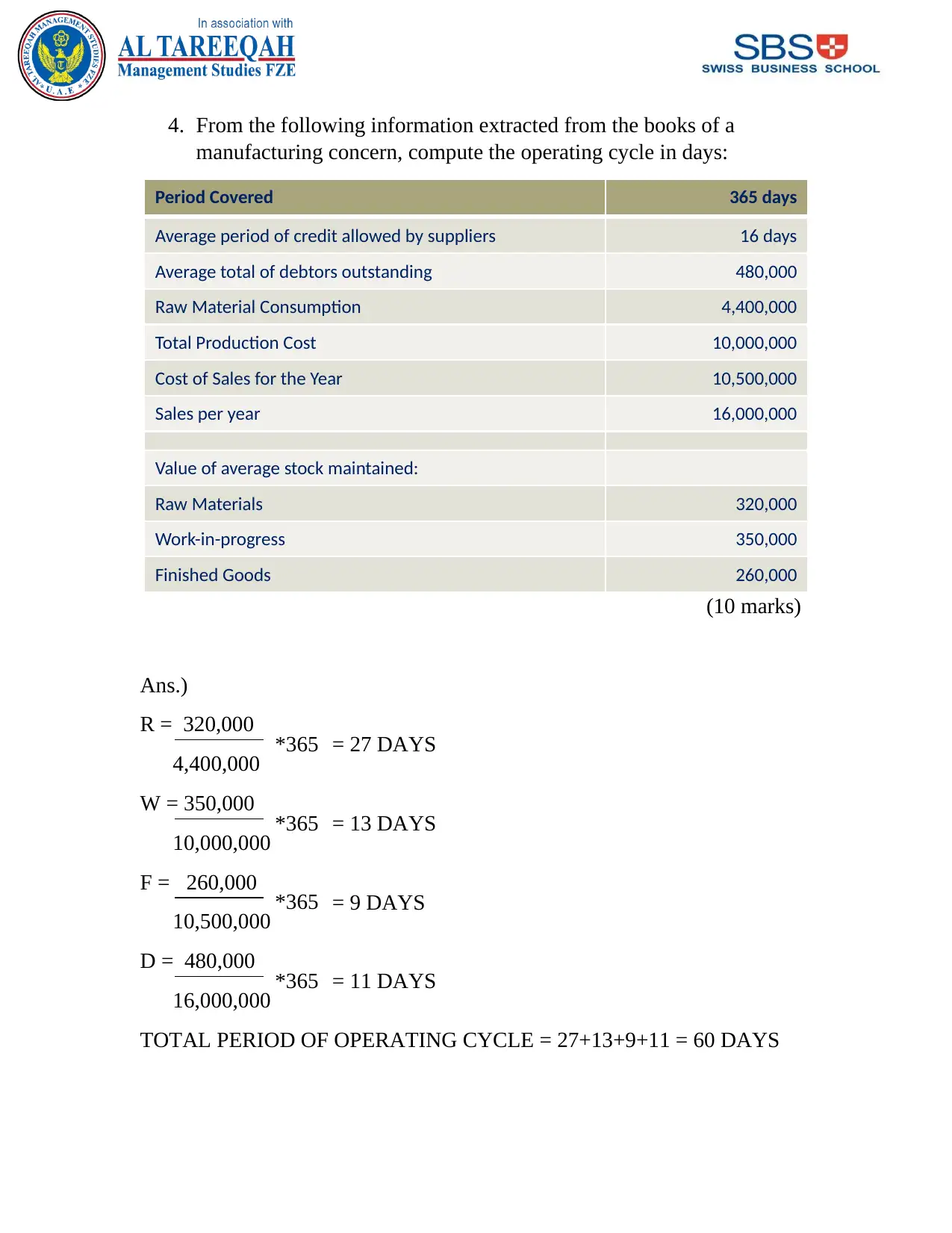
4. From the following information extracted from the books of a
manufacturing concern, compute the operating cycle in days:
Period Covered 365 days
Average period of credit allowed by suppliers 16 days
Average total of debtors outstanding 480,000
Raw Material Consumption 4,400,000
Total Production Cost 10,000,000
Cost of Sales for the Year 10,500,000
Sales per year 16,000,000
Value of average stock maintained:
Raw Materials 320,000
Work-in-progress 350,000
Finished Goods 260,000
(10 marks)
Ans.)
R = 320,000
4,400,000
W = 350,000
10,000,000
F = 260,000
10,500,000
D = 480,000
16,000,000
TOTAL PERIOD OF OPERATING CYCLE = 27+13+9+11 = 60 DAYS
*365 = 27 DAYS
*365 = 13 DAYS
*365 = 9 DAYS
*365 = 11 DAYS
manufacturing concern, compute the operating cycle in days:
Period Covered 365 days
Average period of credit allowed by suppliers 16 days
Average total of debtors outstanding 480,000
Raw Material Consumption 4,400,000
Total Production Cost 10,000,000
Cost of Sales for the Year 10,500,000
Sales per year 16,000,000
Value of average stock maintained:
Raw Materials 320,000
Work-in-progress 350,000
Finished Goods 260,000
(10 marks)
Ans.)
R = 320,000
4,400,000
W = 350,000
10,000,000
F = 260,000
10,500,000
D = 480,000
16,000,000
TOTAL PERIOD OF OPERATING CYCLE = 27+13+9+11 = 60 DAYS
*365 = 27 DAYS
*365 = 13 DAYS
*365 = 9 DAYS
*365 = 11 DAYS
⊘ This is a preview!⊘
Do you want full access?
Subscribe today to unlock all pages.
Trusted by 1+ million students worldwide

1 out of 25


Related Documents


Your All-in-One AI-Powered Toolkit for Academic Success.
+13062052269
info@desklib.com
Available 24*7 on WhatsApp / Email
![[object Object]](/_next/static/media/star-bottom.7253800d.svg)
Unlock your academic potential
Copyright © 2020–2026 A2Z Services. All Rights Reserved. Developed and managed by ZUCOL.