Research Report: Scheme-Driven Errors in Everyday Memory and Recall
VerifiedAdded on 2023/06/15
|12
|2027
|276
Report
AI Summary
This report investigates memory distortion through a study on scheme-driven errors, focusing on the representation of Roman numerals on a clock face. The study, involving 72 participants, examines whether individuals are more likely to misrepresent the number 4 as 'IV' due to their schematic knowledge of the Roman numeral system. The methodology employs a quantitative approach using SPSS to analyze data from three conditions: copy, forewarned, and surprise. Results indicate that the null hypothesis, suggesting no significant relationship between memory condition and the frequency of responses, is accepted. The discussion highlights that participants' awareness and schematic knowledge influence their representation of Roman numerals, with no significant difference observed between memory conditions and the usual figure drawn. The research concludes that while misrepresentations occur, they are not significantly affected by the manipulated memory conditions, emphasizing the role of general knowledge and schematic understanding in memory recall. Desklib provides access to this and similar solved assignments to aid students in their studies.
Introduction to Research Methods

Paraphrase This Document
Need a fresh take? Get an instant paraphrase of this document with our AI Paraphraser
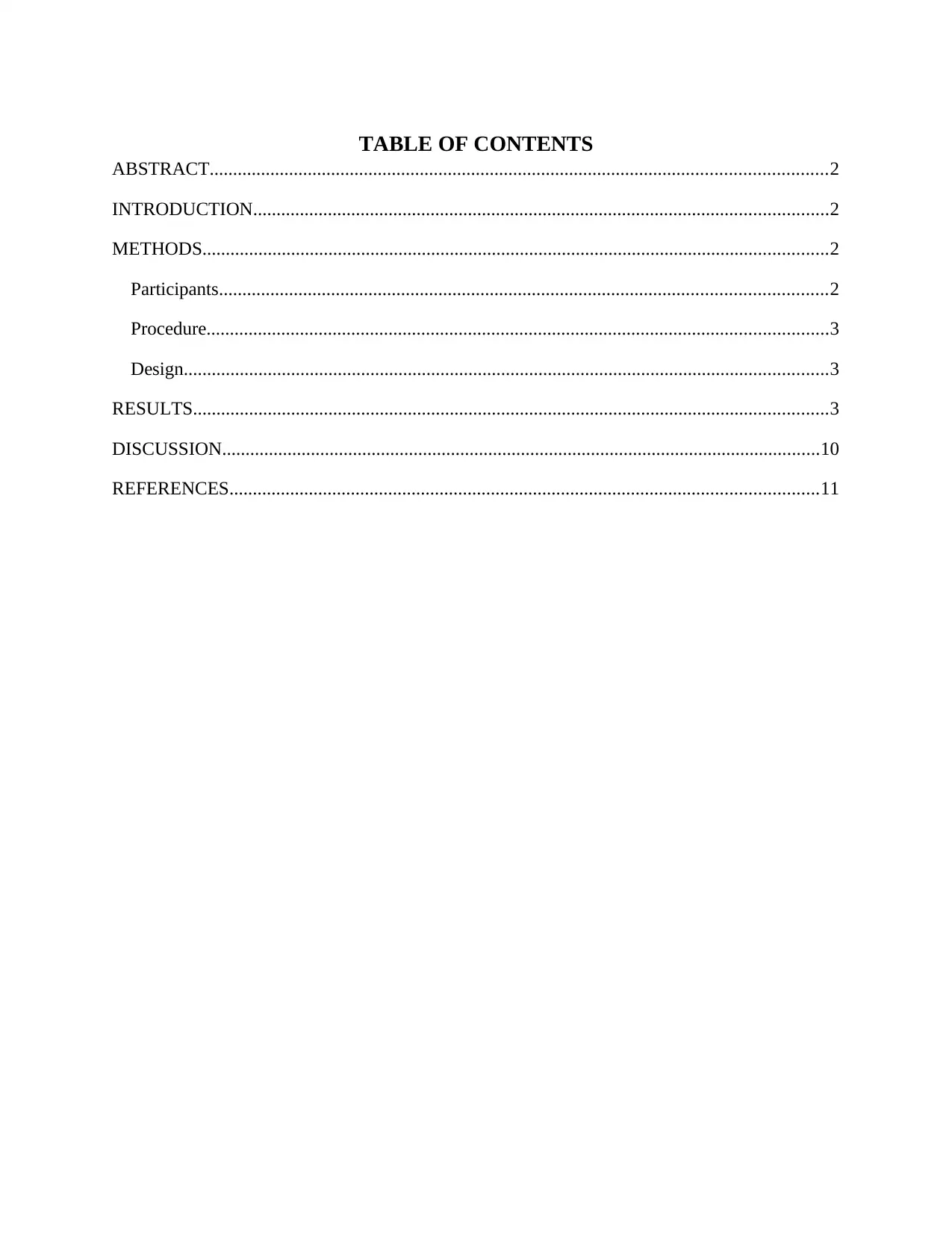
TABLE OF CONTENTS
ABSTRACT....................................................................................................................................2
INTRODUCTION...........................................................................................................................2
METHODS......................................................................................................................................2
Participants..................................................................................................................................2
Procedure.....................................................................................................................................3
Design..........................................................................................................................................3
RESULTS........................................................................................................................................3
DISCUSSION................................................................................................................................10
REFERENCES..............................................................................................................................11
ABSTRACT....................................................................................................................................2
INTRODUCTION...........................................................................................................................2
METHODS......................................................................................................................................2
Participants..................................................................................................................................2
Procedure.....................................................................................................................................3
Design..........................................................................................................................................3
RESULTS........................................................................................................................................3
DISCUSSION................................................................................................................................10
REFERENCES..............................................................................................................................11
Title: Clock this! An everyday example of a scheme-driven error in memory
ABSTRACT
The entire study is based upon an example of a distortion of memory is reported. The
reason behind choosing this topic is such that previous research already conducted and that is
why, it provides in-depth detail that help to determine position of a Roman Numerals. Also, the
hypothesis derived which can be proved by using SPSS software. Also, 72 participants are
chosen from Uni Open day and with the help of Chi-square test, it has been identified that null
hypothesis accepted over other. The limitation of the study is to increase the sample size and also
add different factors that help to derive the results in more effective manner.
INTRODUCTION
From last 20 years, it has been analysed that memory is differed from most of previous
80 in a study that is being recognized as a great importance. The study is evolved through
Schema Theory that explain many phenomena of everyday memory. It also investigated that role
of prior knowledge and past experience is influenced by individual’s views. Thus, the theory
stated that knowledge which a person stored in memory is organized as a set of schemas and
knowledge structure (French and Richards, 1993). The inspiration for the study is derived from
observation by daughter where her attention was caught by Roman numerals upon clock in a
room.
The study is based upon a hypothesis in which the author predicted that participants in a
memory condition will be more likely than those in copy condition, this is further relying on
their schematic knowledge of roman numeral system and misrepresent number 4 as ‘IV’. Apart
from this, the study also examined whether participants in ‘forewarned’ as a memory condition
make this mistakes less often than participants in ‘not forewarned or surprise’ memory condition.
METHODS
Participants
For the study, 71 participants are participated in the study with an age range from 17 to
61. They ae recruited from a University where University invites prospective students onto their
campus where respondents are participating to derive better result by considering the hypothesis.
ABSTRACT
The entire study is based upon an example of a distortion of memory is reported. The
reason behind choosing this topic is such that previous research already conducted and that is
why, it provides in-depth detail that help to determine position of a Roman Numerals. Also, the
hypothesis derived which can be proved by using SPSS software. Also, 72 participants are
chosen from Uni Open day and with the help of Chi-square test, it has been identified that null
hypothesis accepted over other. The limitation of the study is to increase the sample size and also
add different factors that help to derive the results in more effective manner.
INTRODUCTION
From last 20 years, it has been analysed that memory is differed from most of previous
80 in a study that is being recognized as a great importance. The study is evolved through
Schema Theory that explain many phenomena of everyday memory. It also investigated that role
of prior knowledge and past experience is influenced by individual’s views. Thus, the theory
stated that knowledge which a person stored in memory is organized as a set of schemas and
knowledge structure (French and Richards, 1993). The inspiration for the study is derived from
observation by daughter where her attention was caught by Roman numerals upon clock in a
room.
The study is based upon a hypothesis in which the author predicted that participants in a
memory condition will be more likely than those in copy condition, this is further relying on
their schematic knowledge of roman numeral system and misrepresent number 4 as ‘IV’. Apart
from this, the study also examined whether participants in ‘forewarned’ as a memory condition
make this mistakes less often than participants in ‘not forewarned or surprise’ memory condition.
METHODS
Participants
For the study, 71 participants are participated in the study with an age range from 17 to
61. They ae recruited from a University where University invites prospective students onto their
campus where respondents are participating to derive better result by considering the hypothesis.
⊘ This is a preview!⊘
Do you want full access?
Subscribe today to unlock all pages.

Trusted by 1+ million students worldwide
This in turn derive the better results and also examine whether there is a difference between the
variables or not (Hameiri, Jones and Heathershaw, 2020).
Procedure
For the present study, independent variable is Memory condition where three different
situations are used which include copy, forewarned and surprise (Palmieri, 2020). On the other
side, dependent variable for the present study include representation of roman numerals for on a
clock face which include IIII as a correct and IV as incorrect.
Design
The study is based upon quantitative study in which SPSS used that assists to generate
effective results so that effective results are derived (Zhu and et.al., 2021). Along with this, by
using the relevant test, scholar uses designed between each participant complete only one of the
condition and this help to derive better outcomes too.
RESULTS
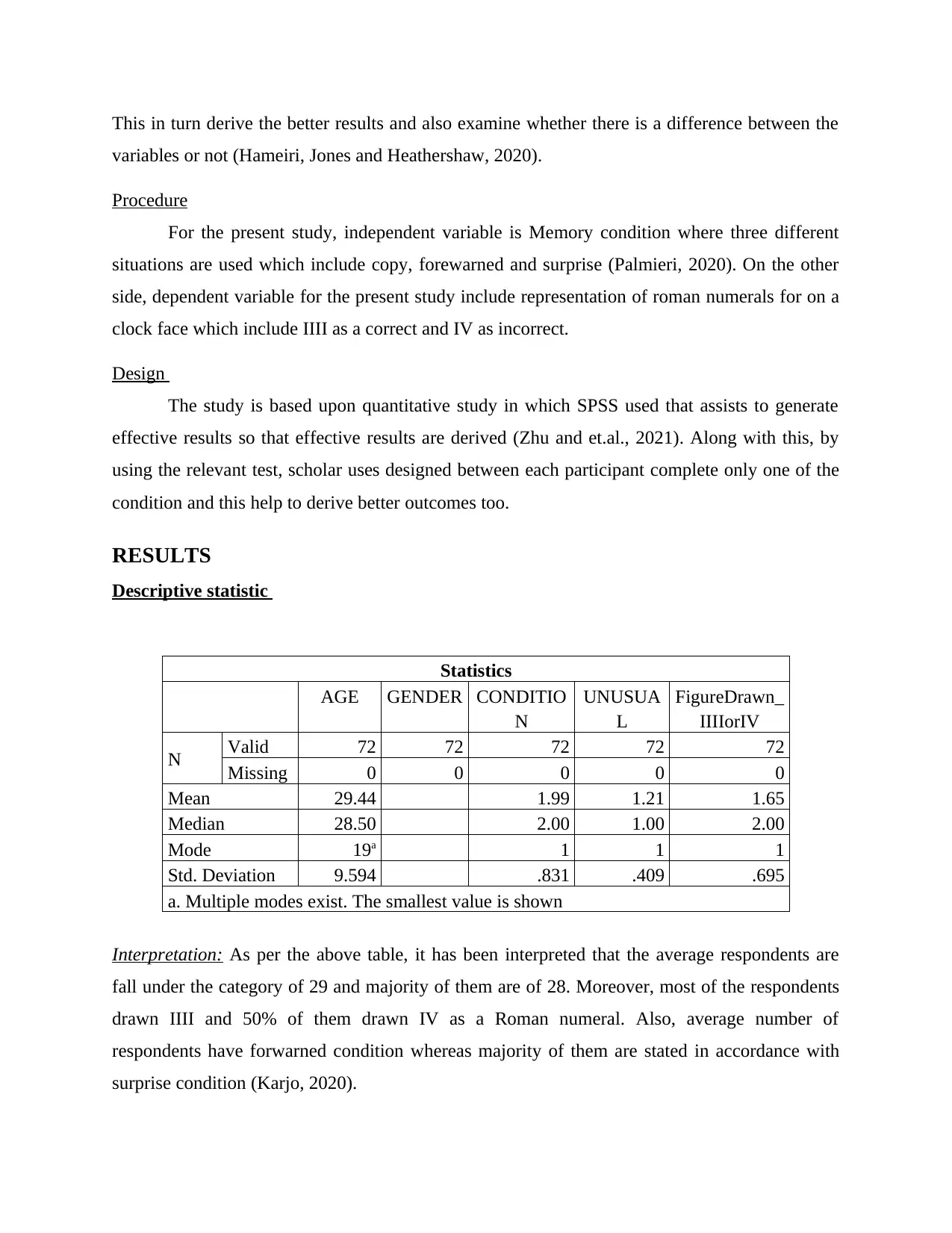
Descriptive statistic
Statistics
AGE GENDER CONDITIO
N
UNUSUA
L
FigureDrawn_
IIIIorIV
N Valid 72 72 72 72 72
Missing 0 0 0 0 0
Mean 29.44 1.99 1.21 1.65
Median 28.50 2.00 1.00 2.00
Mode 19a 1 1 1
Std. Deviation 9.594 .831 .409 .695
a. Multiple modes exist. The smallest value is shown
Interpretation: As per the above table, it has been interpreted that the average respondents are
fall under the category of 29 and majority of them are of 28. Moreover, most of the respondents
drawn IIII and 50% of them drawn IV as a Roman numeral. Also, average number of
respondents have forwarned condition whereas majority of them are stated in accordance with
surprise condition (Karjo, 2020).
variables or not (Hameiri, Jones and Heathershaw, 2020).
Procedure
For the present study, independent variable is Memory condition where three different
situations are used which include copy, forewarned and surprise (Palmieri, 2020). On the other
side, dependent variable for the present study include representation of roman numerals for on a
clock face which include IIII as a correct and IV as incorrect.
Design
The study is based upon quantitative study in which SPSS used that assists to generate
effective results so that effective results are derived (Zhu and et.al., 2021). Along with this, by
using the relevant test, scholar uses designed between each participant complete only one of the
condition and this help to derive better outcomes too.
RESULTS
Descriptive statistic
Statistics
AGE GENDER CONDITIO
N
UNUSUA
L
FigureDrawn_
IIIIorIV
N Valid 72 72 72 72 72
Missing 0 0 0 0 0
Mean 29.44 1.99 1.21 1.65
Median 28.50 2.00 1.00 2.00
Mode 19a 1 1 1
Std. Deviation 9.594 .831 .409 .695
a. Multiple modes exist. The smallest value is shown
Interpretation: As per the above table, it has been interpreted that the average respondents are
fall under the category of 29 and majority of them are of 28. Moreover, most of the respondents
drawn IIII and 50% of them drawn IV as a Roman numeral. Also, average number of
respondents have forwarned condition whereas majority of them are stated in accordance with
surprise condition (Karjo, 2020).
Paraphrase This Document
Need a fresh take? Get an instant paraphrase of this document with our AI Paraphraser
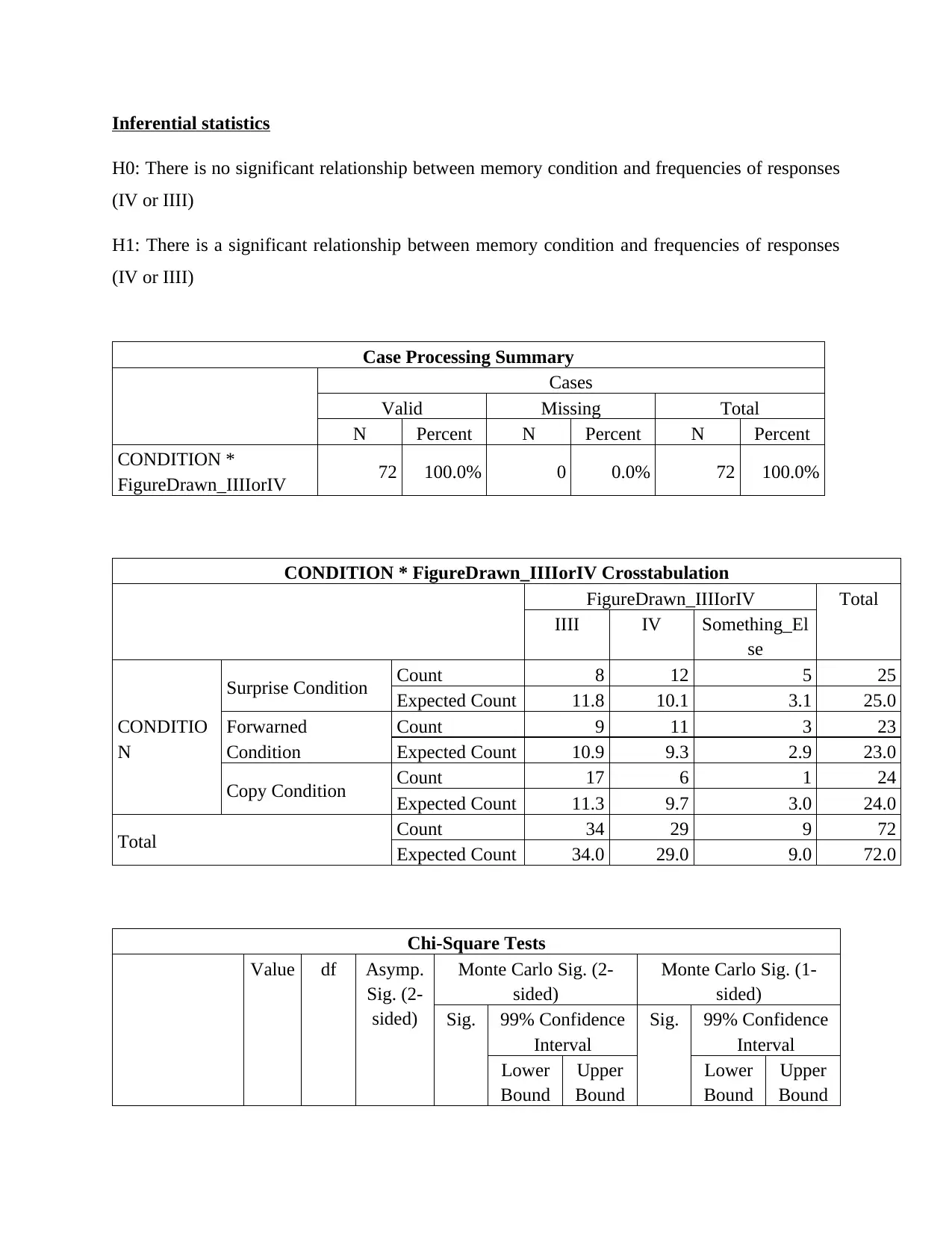
Inferential statistics
H0: There is no significant relationship between memory condition and frequencies of responses
(IV or IIII)
H1: There is a significant relationship between memory condition and frequencies of responses
(IV or IIII)
Case Processing Summary
Cases
Valid Missing Total
N Percent N Percent N Percent
CONDITION *
FigureDrawn_IIIIorIV 72 100.0% 0 0.0% 72 100.0%
CONDITION * FigureDrawn_IIIIorIV Crosstabulation
FigureDrawn_IIIIorIV Total
IIII IV Something_El
se
CONDITIO
N
Surprise Condition Count 8 12 5 25
Expected Count 11.8 10.1 3.1 25.0
Forwarned
Condition
Count 9 11 3 23
Expected Count 10.9 9.3 2.9 23.0
Copy Condition Count 17 6 1 24
Expected Count 11.3 9.7 3.0 24.0
Total Count 34 29 9 72
Expected Count 34.0 29.0 9.0 72.0
Chi-Square Tests
Value df Asymp.
Sig. (2-
sided)
Monte Carlo Sig. (2-
sided)
Monte Carlo Sig. (1-
sided)
Sig. 99% Confidence
Interval
Sig. 99% Confidence
Interval
Lower
Bound
Upper
Bound
Lower
Bound
Upper
Bound
H0: There is no significant relationship between memory condition and frequencies of responses
(IV or IIII)
H1: There is a significant relationship between memory condition and frequencies of responses
(IV or IIII)
Case Processing Summary
Cases
Valid Missing Total
N Percent N Percent N Percent
CONDITION *
FigureDrawn_IIIIorIV 72 100.0% 0 0.0% 72 100.0%
CONDITION * FigureDrawn_IIIIorIV Crosstabulation
FigureDrawn_IIIIorIV Total
IIII IV Something_El
se
CONDITIO
N
Surprise Condition Count 8 12 5 25
Expected Count 11.8 10.1 3.1 25.0
Forwarned
Condition
Count 9 11 3 23
Expected Count 10.9 9.3 2.9 23.0
Copy Condition Count 17 6 1 24
Expected Count 11.3 9.7 3.0 24.0
Total Count 34 29 9 72
Expected Count 34.0 29.0 9.0 72.0
Chi-Square Tests
Value df Asymp.
Sig. (2-
sided)
Monte Carlo Sig. (2-
sided)
Monte Carlo Sig. (1-
sided)
Sig. 99% Confidence
Interval
Sig. 99% Confidence
Interval
Lower
Bound
Upper
Bound
Lower
Bound
Upper
Bound
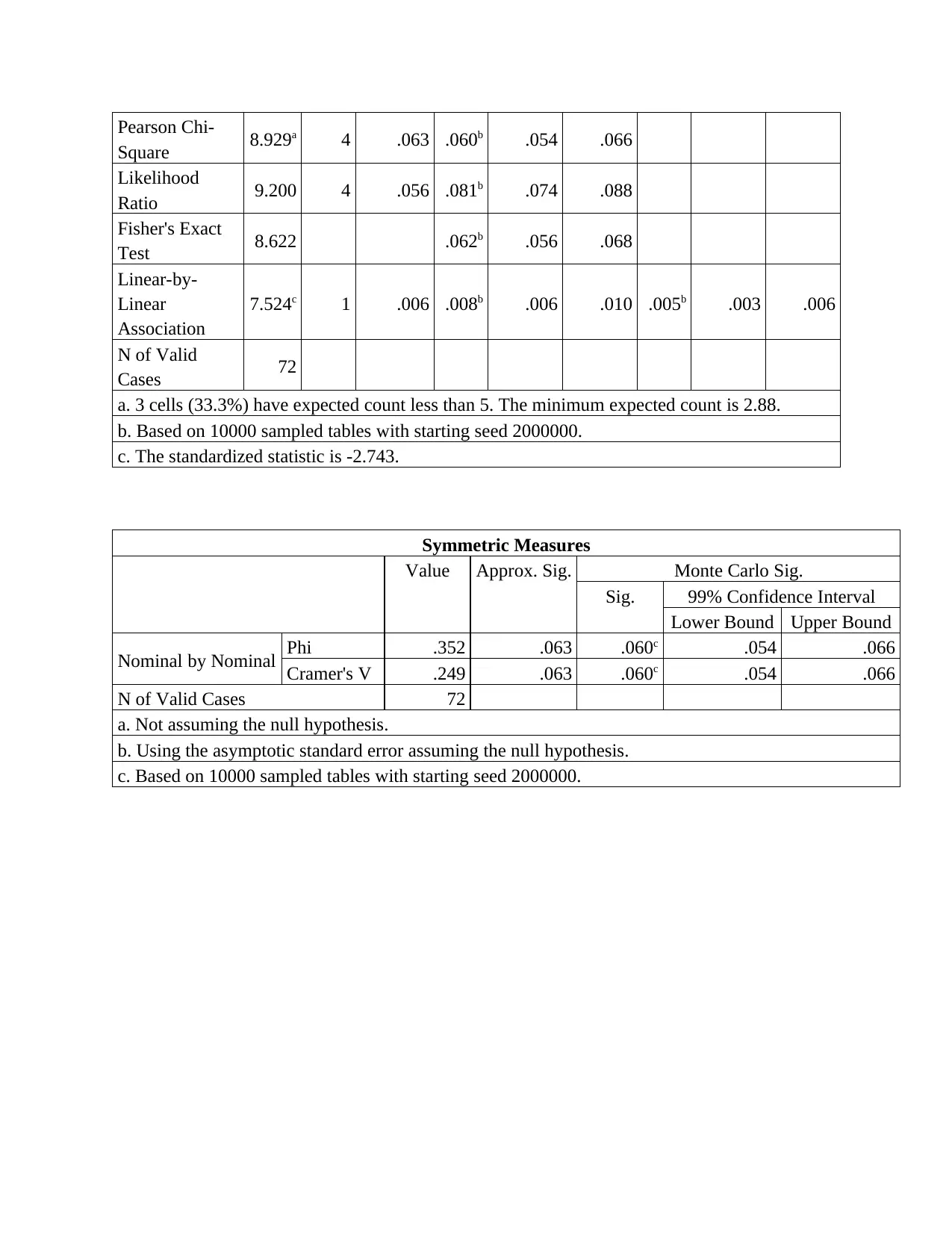
Pearson Chi-
Square 8.929a 4 .063 .060b .054 .066
Likelihood
Ratio 9.200 4 .056 .081b .074 .088
Fisher's Exact
Test 8.622 .062b .056 .068
Linear-by-
Linear
Association
7.524c 1 .006 .008b .006 .010 .005b .003 .006
N of Valid
Cases 72
a. 3 cells (33.3%) have expected count less than 5. The minimum expected count is 2.88.
b. Based on 10000 sampled tables with starting seed 2000000.
c. The standardized statistic is -2.743.
Symmetric Measures
Value Approx. Sig. Monte Carlo Sig.
Sig. 99% Confidence Interval
Lower Bound Upper Bound
Nominal by Nominal Phi .352 .063 .060c .054 .066
Cramer's V .249 .063 .060c .054 .066
N of Valid Cases 72
a. Not assuming the null hypothesis.
b. Using the asymptotic standard error assuming the null hypothesis.
c. Based on 10000 sampled tables with starting seed 2000000.
Square 8.929a 4 .063 .060b .054 .066
Likelihood
Ratio 9.200 4 .056 .081b .074 .088
Fisher's Exact
Test 8.622 .062b .056 .068
Linear-by-
Linear
Association
7.524c 1 .006 .008b .006 .010 .005b .003 .006
N of Valid
Cases 72
a. 3 cells (33.3%) have expected count less than 5. The minimum expected count is 2.88.
b. Based on 10000 sampled tables with starting seed 2000000.
c. The standardized statistic is -2.743.
Symmetric Measures
Value Approx. Sig. Monte Carlo Sig.
Sig. 99% Confidence Interval
Lower Bound Upper Bound
Nominal by Nominal Phi .352 .063 .060c .054 .066
Cramer's V .249 .063 .060c .054 .066
N of Valid Cases 72
a. Not assuming the null hypothesis.
b. Using the asymptotic standard error assuming the null hypothesis.
c. Based on 10000 sampled tables with starting seed 2000000.
⊘ This is a preview!⊘
Do you want full access?
Subscribe today to unlock all pages.
Trusted by 1+ million students worldwide
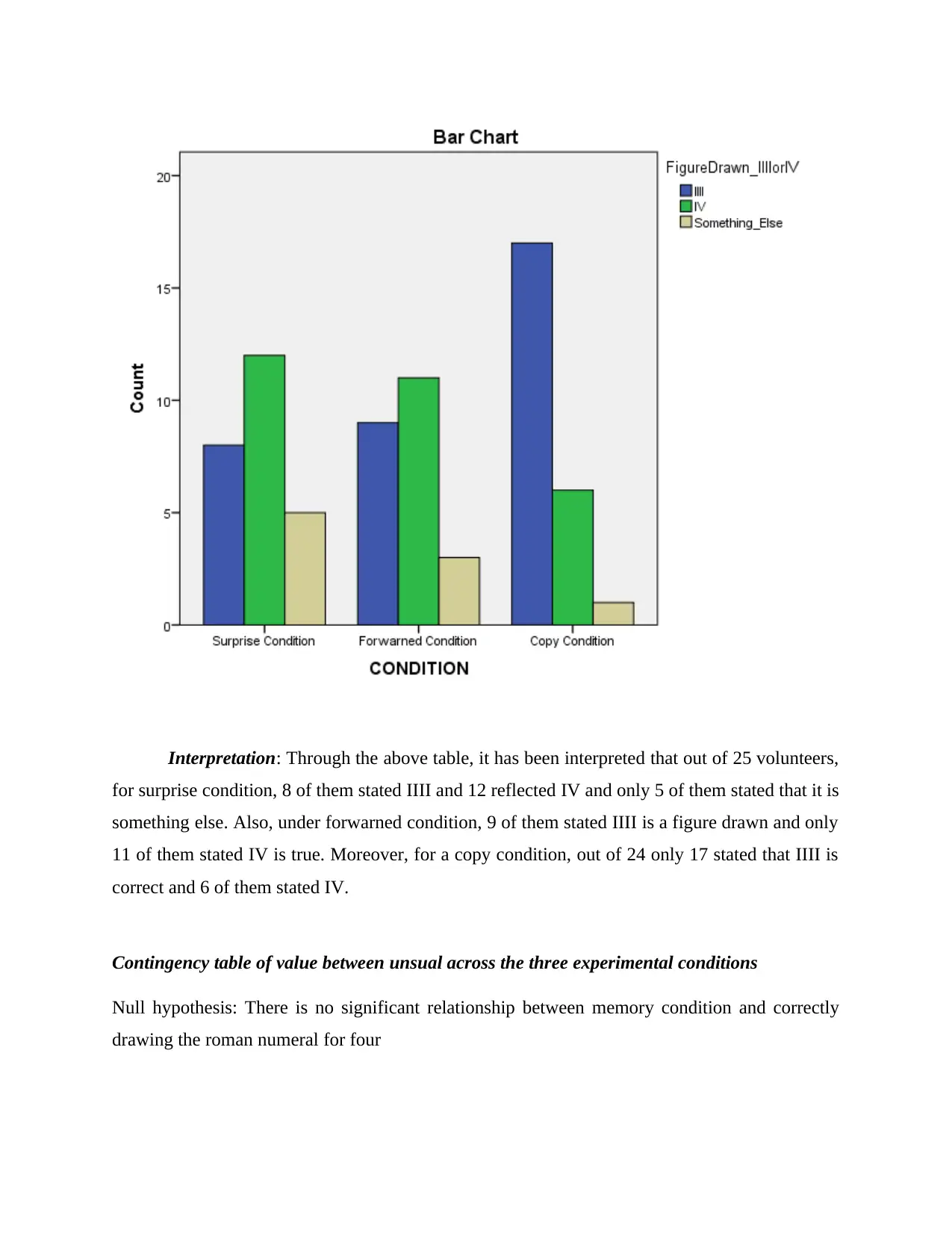
Interpretation: Through the above table, it has been interpreted that out of 25 volunteers,
for surprise condition, 8 of them stated IIII and 12 reflected IV and only 5 of them stated that it is
something else. Also, under forwarned condition, 9 of them stated IIII is a figure drawn and only
11 of them stated IV is true. Moreover, for a copy condition, out of 24 only 17 stated that IIII is
correct and 6 of them stated IV.
Contingency table of value between unsual across the three experimental conditions
Null hypothesis: There is no significant relationship between memory condition and correctly
drawing the roman numeral for four
for surprise condition, 8 of them stated IIII and 12 reflected IV and only 5 of them stated that it is
something else. Also, under forwarned condition, 9 of them stated IIII is a figure drawn and only
11 of them stated IV is true. Moreover, for a copy condition, out of 24 only 17 stated that IIII is
correct and 6 of them stated IV.
Contingency table of value between unsual across the three experimental conditions
Null hypothesis: There is no significant relationship between memory condition and correctly
drawing the roman numeral for four
Paraphrase This Document
Need a fresh take? Get an instant paraphrase of this document with our AI Paraphraser
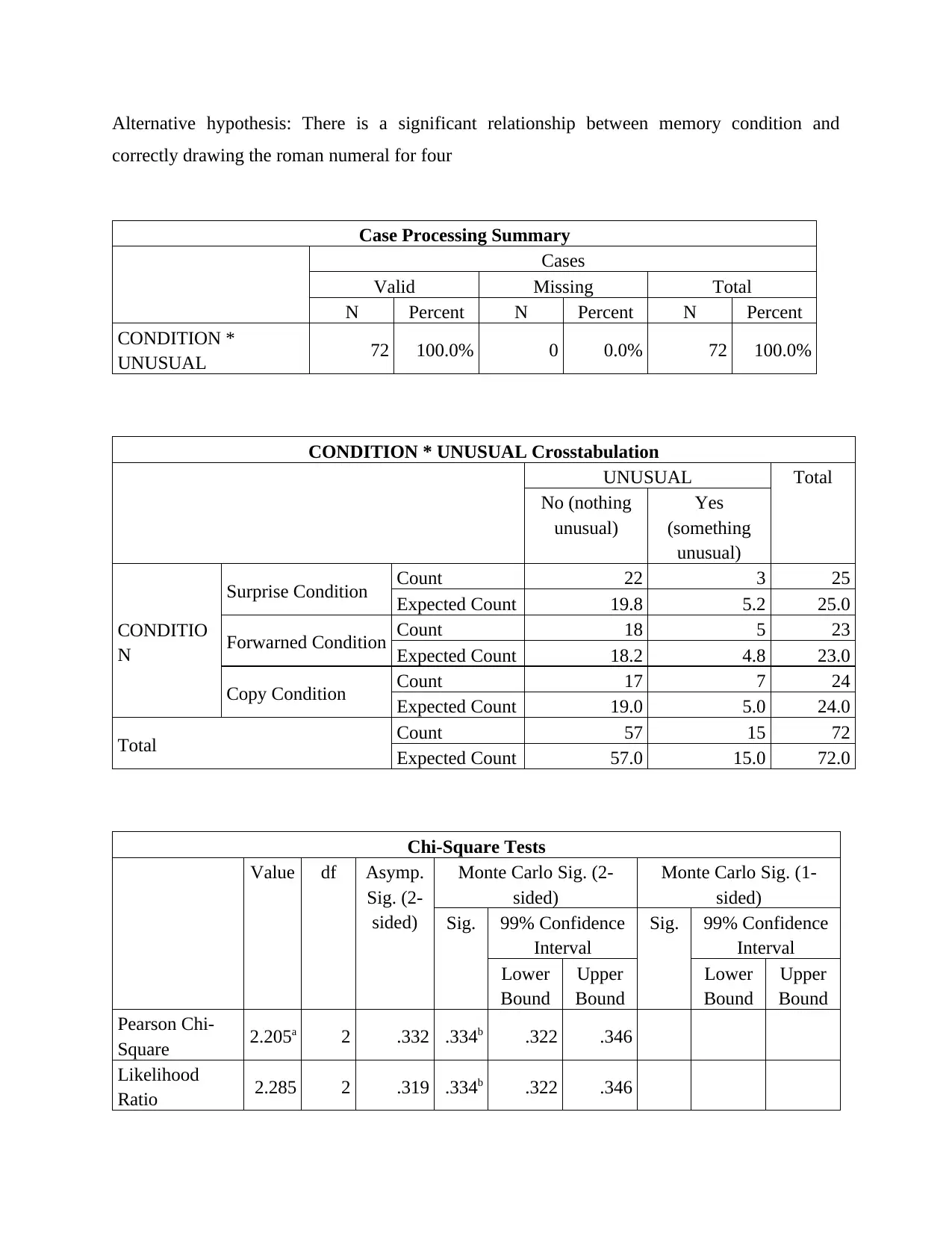
Alternative hypothesis: There is a significant relationship between memory condition and
correctly drawing the roman numeral for four
Case Processing Summary
Cases
Valid Missing Total
N Percent N Percent N Percent
CONDITION *
UNUSUAL 72 100.0% 0 0.0% 72 100.0%
CONDITION * UNUSUAL Crosstabulation
UNUSUAL Total
No (nothing
unusual)
Yes
(something
unusual)
CONDITIO
N
Surprise Condition Count 22 3 25
Expected Count 19.8 5.2 25.0
Forwarned Condition Count 18 5 23
Expected Count 18.2 4.8 23.0
Copy Condition Count 17 7 24
Expected Count 19.0 5.0 24.0
Total Count 57 15 72
Expected Count 57.0 15.0 72.0
Chi-Square Tests
Value df Asymp.
Sig. (2-
sided)
Monte Carlo Sig. (2-
sided)
Monte Carlo Sig. (1-
sided)
Sig. 99% Confidence
Interval
Sig. 99% Confidence
Interval
Lower
Bound
Upper
Bound
Lower
Bound
Upper
Bound
Pearson Chi-
Square 2.205a 2 .332 .334b .322 .346
Likelihood
Ratio 2.285 2 .319 .334b .322 .346
correctly drawing the roman numeral for four
Case Processing Summary
Cases
Valid Missing Total
N Percent N Percent N Percent
CONDITION *
UNUSUAL 72 100.0% 0 0.0% 72 100.0%
CONDITION * UNUSUAL Crosstabulation
UNUSUAL Total
No (nothing
unusual)
Yes
(something
unusual)
CONDITIO
N
Surprise Condition Count 22 3 25
Expected Count 19.8 5.2 25.0
Forwarned Condition Count 18 5 23
Expected Count 18.2 4.8 23.0
Copy Condition Count 17 7 24
Expected Count 19.0 5.0 24.0
Total Count 57 15 72
Expected Count 57.0 15.0 72.0
Chi-Square Tests
Value df Asymp.
Sig. (2-
sided)
Monte Carlo Sig. (2-
sided)
Monte Carlo Sig. (1-
sided)
Sig. 99% Confidence
Interval
Sig. 99% Confidence
Interval
Lower
Bound
Upper
Bound
Lower
Bound
Upper
Bound
Pearson Chi-
Square 2.205a 2 .332 .334b .322 .346
Likelihood
Ratio 2.285 2 .319 .334b .322 .346
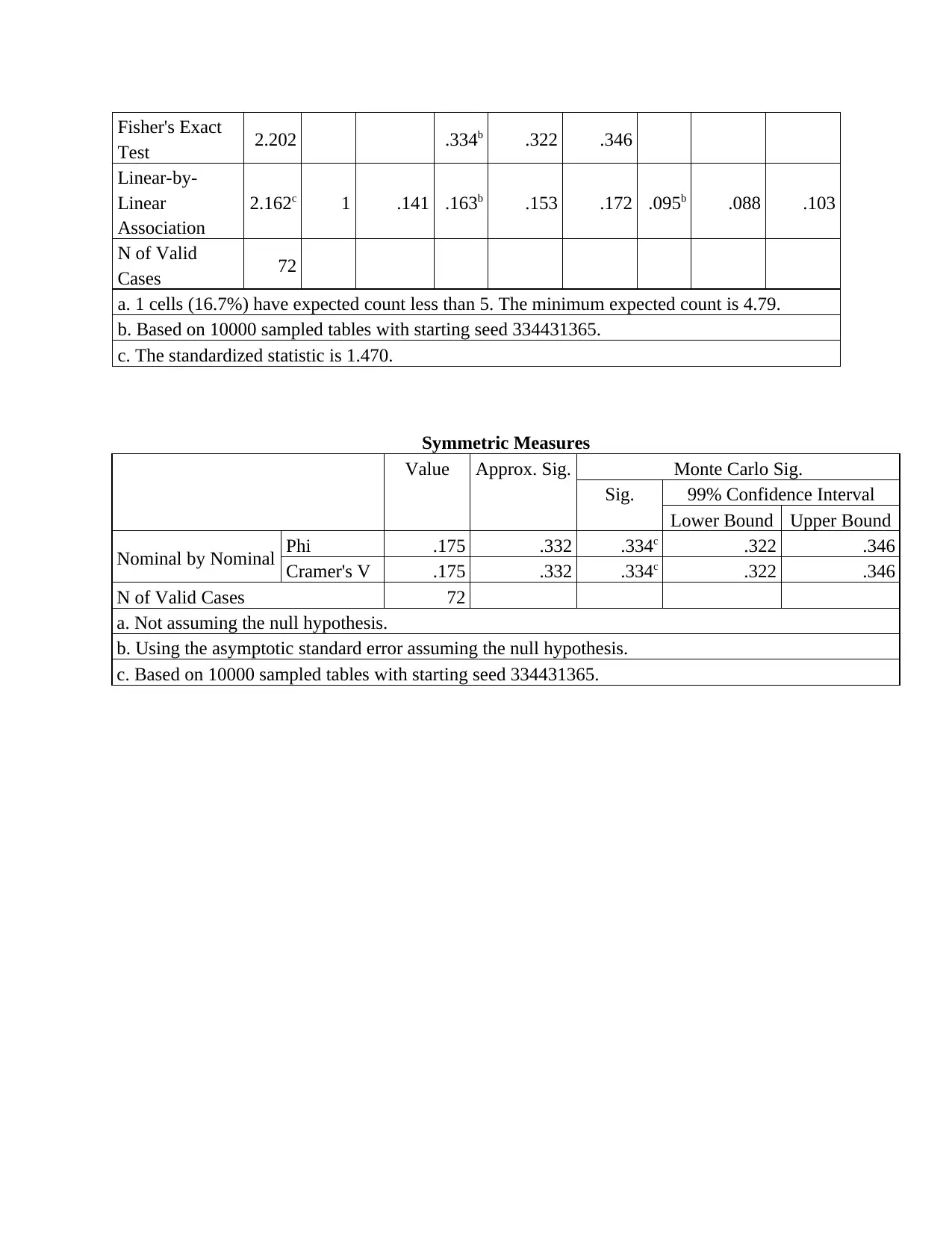
Fisher's Exact
Test 2.202 .334b .322 .346
Linear-by-
Linear
Association
2.162c 1 .141 .163b .153 .172 .095b .088 .103
N of Valid
Cases 72
a. 1 cells (16.7%) have expected count less than 5. The minimum expected count is 4.79.
b. Based on 10000 sampled tables with starting seed 334431365.
c. The standardized statistic is 1.470.
Symmetric Measures
Value Approx. Sig. Monte Carlo Sig.
Sig. 99% Confidence Interval
Lower Bound Upper Bound
Nominal by Nominal Phi .175 .332 .334c .322 .346
Cramer's V .175 .332 .334c .322 .346
N of Valid Cases 72
a. Not assuming the null hypothesis.
b. Using the asymptotic standard error assuming the null hypothesis.
c. Based on 10000 sampled tables with starting seed 334431365.
Test 2.202 .334b .322 .346
Linear-by-
Linear
Association
2.162c 1 .141 .163b .153 .172 .095b .088 .103
N of Valid
Cases 72
a. 1 cells (16.7%) have expected count less than 5. The minimum expected count is 4.79.
b. Based on 10000 sampled tables with starting seed 334431365.
c. The standardized statistic is 1.470.
Symmetric Measures
Value Approx. Sig. Monte Carlo Sig.
Sig. 99% Confidence Interval
Lower Bound Upper Bound
Nominal by Nominal Phi .175 .332 .334c .322 .346
Cramer's V .175 .332 .334c .322 .346
N of Valid Cases 72
a. Not assuming the null hypothesis.
b. Using the asymptotic standard error assuming the null hypothesis.
c. Based on 10000 sampled tables with starting seed 334431365.
⊘ This is a preview!⊘
Do you want full access?
Subscribe today to unlock all pages.
Trusted by 1+ million students worldwide
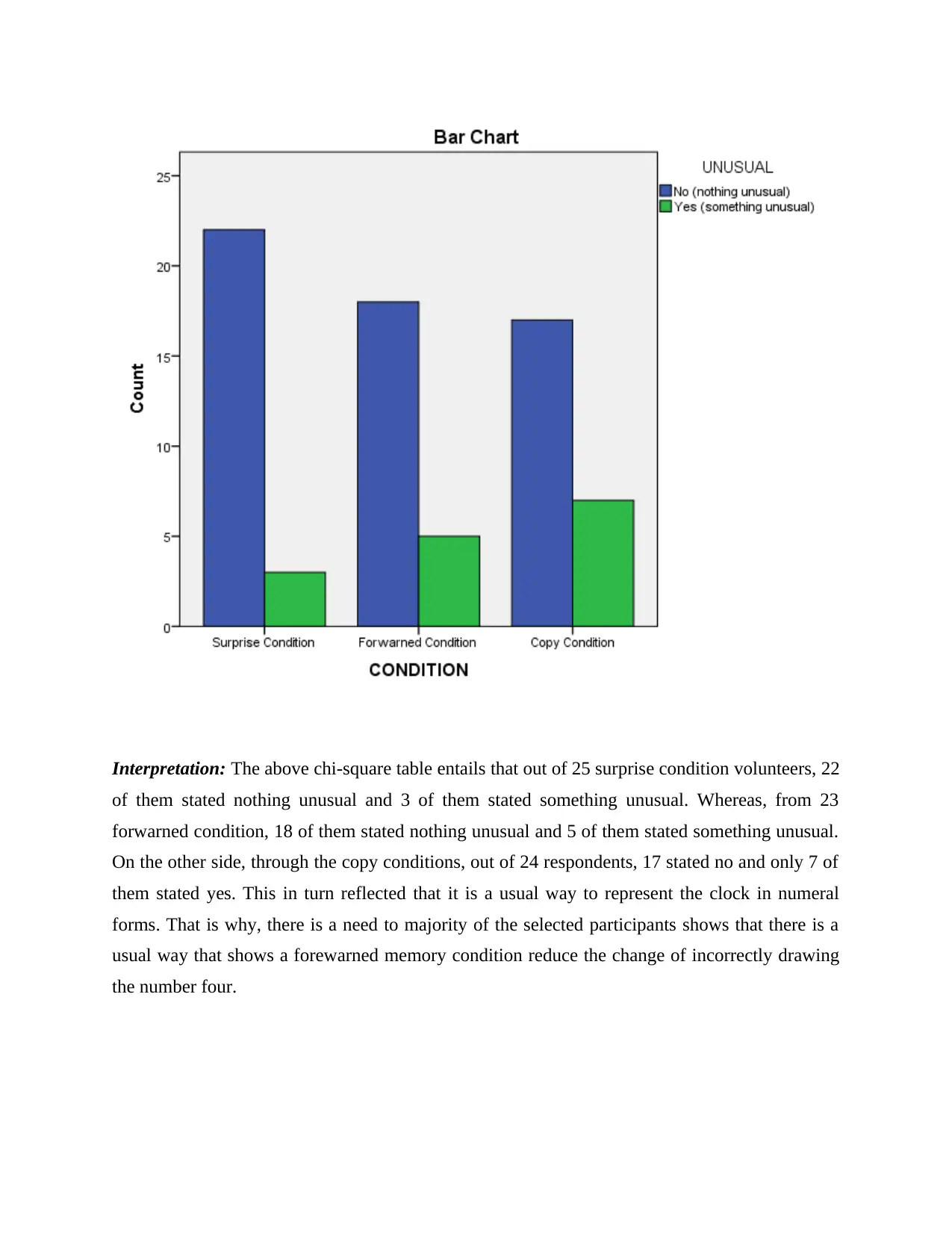
Interpretation: The above chi-square table entails that out of 25 surprise condition volunteers, 22
of them stated nothing unusual and 3 of them stated something unusual. Whereas, from 23
forwarned condition, 18 of them stated nothing unusual and 5 of them stated something unusual.
On the other side, through the copy conditions, out of 24 respondents, 17 stated no and only 7 of
them stated yes. This in turn reflected that it is a usual way to represent the clock in numeral
forms. That is why, there is a need to majority of the selected participants shows that there is a
usual way that shows a forewarned memory condition reduce the change of incorrectly drawing
the number four.
of them stated nothing unusual and 3 of them stated something unusual. Whereas, from 23
forwarned condition, 18 of them stated nothing unusual and 5 of them stated something unusual.
On the other side, through the copy conditions, out of 24 respondents, 17 stated no and only 7 of
them stated yes. This in turn reflected that it is a usual way to represent the clock in numeral
forms. That is why, there is a need to majority of the selected participants shows that there is a
usual way that shows a forewarned memory condition reduce the change of incorrectly drawing
the number four.
Paraphrase This Document
Need a fresh take? Get an instant paraphrase of this document with our AI Paraphraser
DISCUSSION
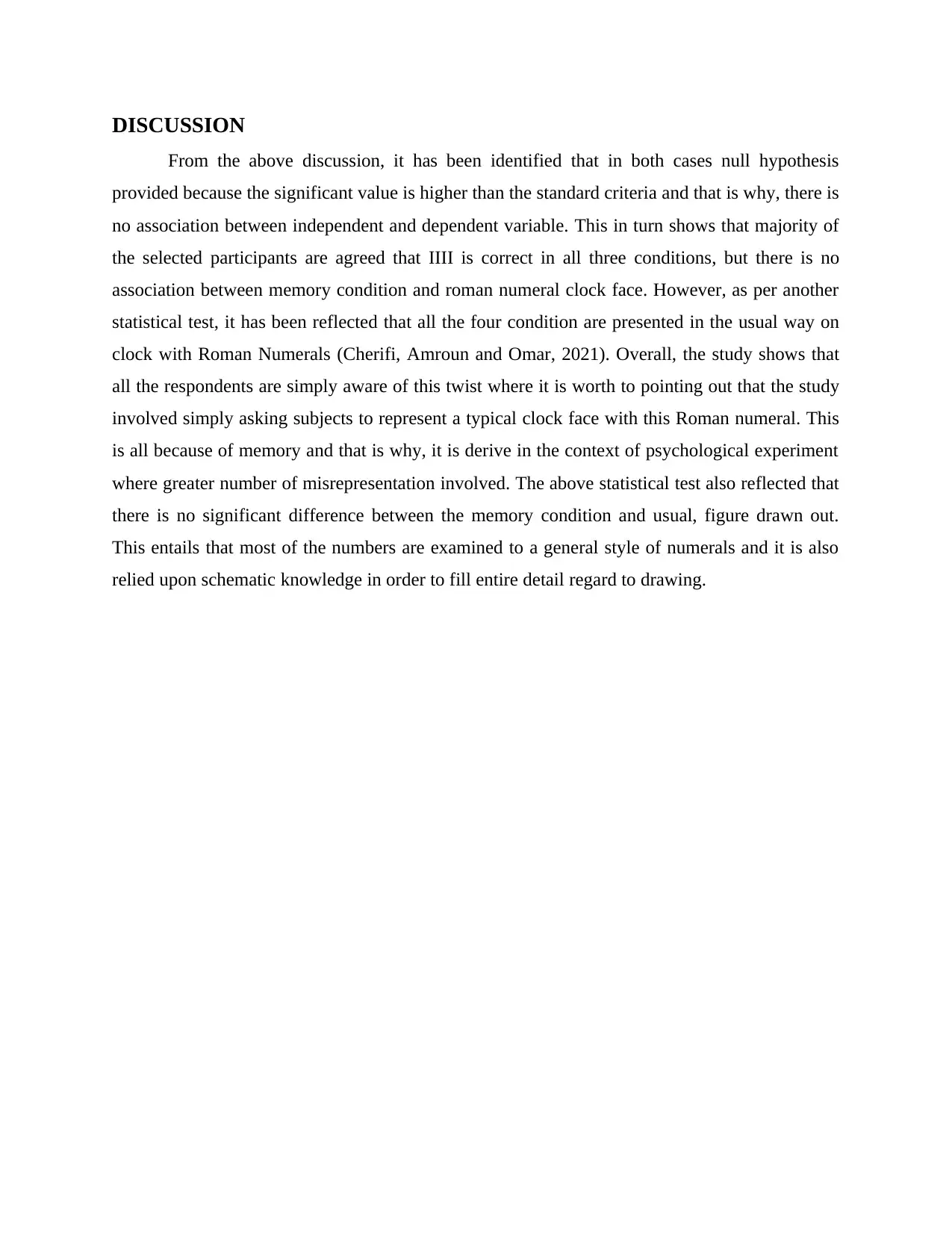
From the above discussion, it has been identified that in both cases null hypothesis
provided because the significant value is higher than the standard criteria and that is why, there is
no association between independent and dependent variable. This in turn shows that majority of
the selected participants are agreed that IIII is correct in all three conditions, but there is no
association between memory condition and roman numeral clock face. However, as per another
statistical test, it has been reflected that all the four condition are presented in the usual way on
clock with Roman Numerals (Cherifi, Amroun and Omar, 2021). Overall, the study shows that
all the respondents are simply aware of this twist where it is worth to pointing out that the study
involved simply asking subjects to represent a typical clock face with this Roman numeral. This
is all because of memory and that is why, it is derive in the context of psychological experiment
where greater number of misrepresentation involved. The above statistical test also reflected that
there is no significant difference between the memory condition and usual, figure drawn out.
This entails that most of the numbers are examined to a general style of numerals and it is also
relied upon schematic knowledge in order to fill entire detail regard to drawing.
From the above discussion, it has been identified that in both cases null hypothesis
provided because the significant value is higher than the standard criteria and that is why, there is
no association between independent and dependent variable. This in turn shows that majority of
the selected participants are agreed that IIII is correct in all three conditions, but there is no
association between memory condition and roman numeral clock face. However, as per another
statistical test, it has been reflected that all the four condition are presented in the usual way on
clock with Roman Numerals (Cherifi, Amroun and Omar, 2021). Overall, the study shows that
all the respondents are simply aware of this twist where it is worth to pointing out that the study
involved simply asking subjects to represent a typical clock face with this Roman numeral. This
is all because of memory and that is why, it is derive in the context of psychological experiment
where greater number of misrepresentation involved. The above statistical test also reflected that
there is no significant difference between the memory condition and usual, figure drawn out.
This entails that most of the numbers are examined to a general style of numerals and it is also
relied upon schematic knowledge in order to fill entire detail regard to drawing.
REFERENCES
Books and Journals
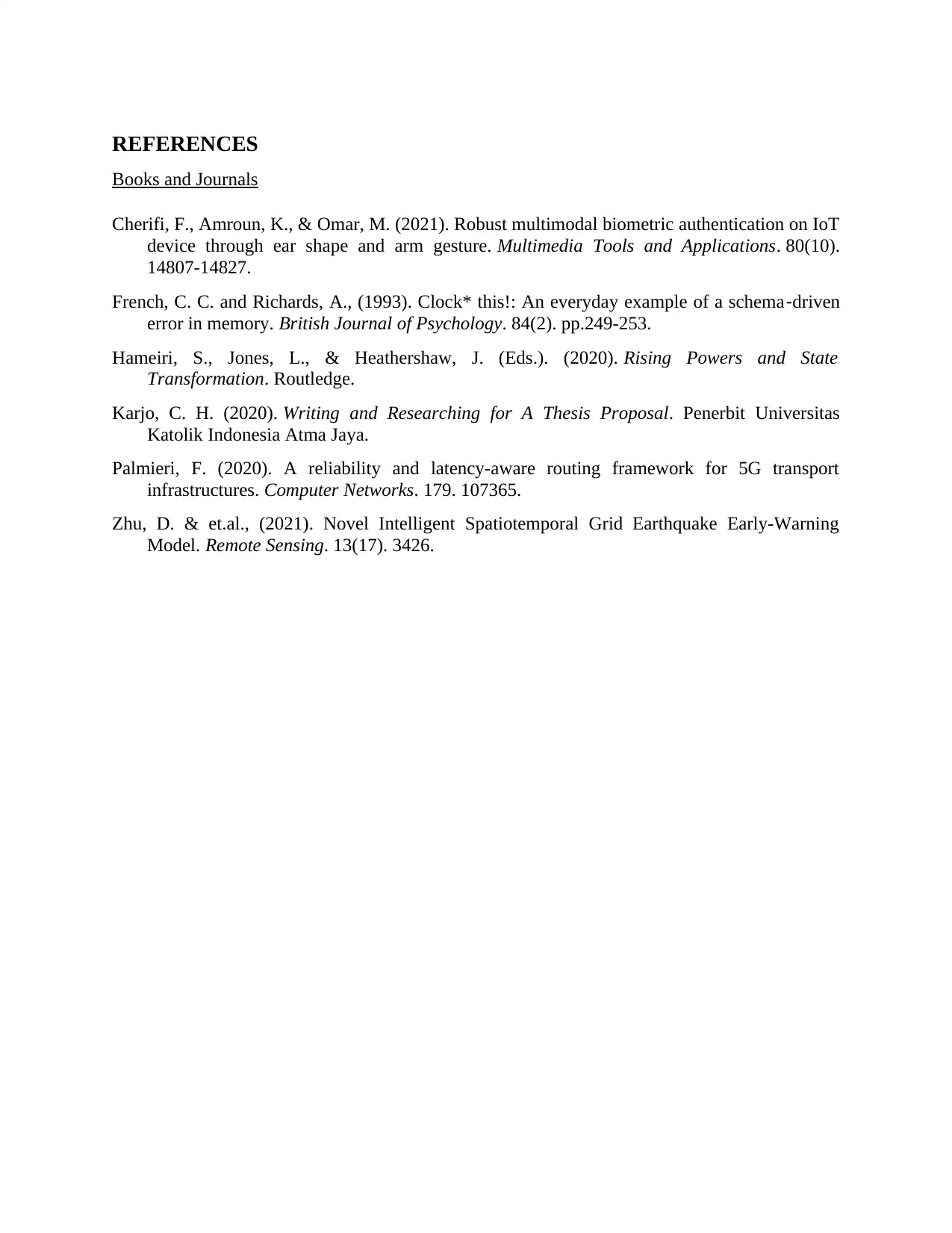
Cherifi, F., Amroun, K., & Omar, M. (2021). Robust multimodal biometric authentication on IoT
device through ear shape and arm gesture. Multimedia Tools and Applications. 80(10).
14807-14827.
French, C. C. and Richards, A., (1993). Clock* this!: An everyday example of a schema‐driven
error in memory. British Journal of Psychology. 84(2). pp.249-253.
Hameiri, S., Jones, L., & Heathershaw, J. (Eds.). (2020). Rising Powers and State
Transformation. Routledge.
Karjo, C. H. (2020). Writing and Researching for A Thesis Proposal. Penerbit Universitas
Katolik Indonesia Atma Jaya.
Palmieri, F. (2020). A reliability and latency-aware routing framework for 5G transport
infrastructures. Computer Networks. 179. 107365.
Zhu, D. & et.al., (2021). Novel Intelligent Spatiotemporal Grid Earthquake Early-Warning
Model. Remote Sensing. 13(17). 3426.
Books and Journals
Cherifi, F., Amroun, K., & Omar, M. (2021). Robust multimodal biometric authentication on IoT
device through ear shape and arm gesture. Multimedia Tools and Applications. 80(10).
14807-14827.
French, C. C. and Richards, A., (1993). Clock* this!: An everyday example of a schema‐driven
error in memory. British Journal of Psychology. 84(2). pp.249-253.
Hameiri, S., Jones, L., & Heathershaw, J. (Eds.). (2020). Rising Powers and State
Transformation. Routledge.
Karjo, C. H. (2020). Writing and Researching for A Thesis Proposal. Penerbit Universitas
Katolik Indonesia Atma Jaya.
Palmieri, F. (2020). A reliability and latency-aware routing framework for 5G transport
infrastructures. Computer Networks. 179. 107365.
Zhu, D. & et.al., (2021). Novel Intelligent Spatiotemporal Grid Earthquake Early-Warning
Model. Remote Sensing. 13(17). 3426.
⊘ This is a preview!⊘
Do you want full access?
Subscribe today to unlock all pages.
Trusted by 1+ million students worldwide

1 out of 12


Your All-in-One AI-Powered Toolkit for Academic Success.
+13062052269
info@desklib.com
Available 24*7 on WhatsApp / Email
![[object Object]](/_next/static/media/star-bottom.7253800d.svg)
Unlock your academic potential
Copyright © 2020–2026 A2Z Services. All Rights Reserved. Developed and managed by ZUCOL.