Improving Innovation Capacity in Banks in Vietnam: NEU Project
VerifiedAdded on 2022/03/10
|29
|13344
|13
Project
AI Summary
This project examines the critical need for enhancing innovation capacity within Vietnamese banks, particularly in light of increasing competition and the opportunities presented by the industrial revolution 4.0. It begins by establishing a theoretical foundation, defining innovation and innovation capacity, and exploring the factors that influence it within the banking sector. The project then assesses the current state of innovation at major Vietnamese banks such as Vietcombank, BIDV, and Vietinbank, highlighting both achievements and limitations in their innovation efforts from 2018 to 2021. Finally, it proposes specific strategies for improving innovation capacity in the period of 2021-2024, including investments in human and financial resources, fostering a culture of innovation within banks, and advocating for supportive government policies. The project concludes by emphasizing the importance of continuous innovation for the long-term success and competitiveness of Vietnamese banks.
NATIONAL ECONOMICS UNIVERSITY
--------□□--------
SCHEME
MANAGEMENT OF QUALITY AND
INNOVATION
IMPROVING INNOVATION CAPACITY
Students: Đỗ Ngọc Khánh - 11192558
Major: Business Administration
Intake: 61
Class: Management of quality and innovation
Supervisor: Bùi Thu Vân
Ha Noi, 11/2021
--------□□--------
SCHEME
MANAGEMENT OF QUALITY AND
INNOVATION
IMPROVING INNOVATION CAPACITY
Students: Đỗ Ngọc Khánh - 11192558
Major: Business Administration
Intake: 61
Class: Management of quality and innovation
Supervisor: Bùi Thu Vân
Ha Noi, 11/2021

Paraphrase This Document
Need a fresh take? Get an instant paraphrase of this document with our AI Paraphraser

PREFACE:
After a period of studying and researching seriously, I have completed the project with
the topic "Improving innovation capacity in banks in Vietnam ". This project is not
only my own effort but also the contribution of teachers and friends.
Therefore, first, I would like to sincerely thank Ms. Bui Thu Van for her enthusiastic
guidance throughout the process of implementing the project.
I would like to express my sincere thanks to all the teachers of the Faculty of Business
Administration and the National Economics University for imparting theoretical
lessons as well as useful practical experiences, along with scientific research methods.
study and that is the basic knowledge that helps me to successfully complete the
project.
In the process of completing the project, due to the limited theoretical level as well as
practical experience, the project cannot avoid shortcomings, I look forward to
receiving your comments so that I can learn more. gained a lot of experience and will
do better in the upcoming graduation report.
Thank you sincerely!
Hanoi December 24, 2021
Students perform
Do Ngoc Khanh
After a period of studying and researching seriously, I have completed the project with
the topic "Improving innovation capacity in banks in Vietnam ". This project is not
only my own effort but also the contribution of teachers and friends.
Therefore, first, I would like to sincerely thank Ms. Bui Thu Van for her enthusiastic
guidance throughout the process of implementing the project.
I would like to express my sincere thanks to all the teachers of the Faculty of Business
Administration and the National Economics University for imparting theoretical
lessons as well as useful practical experiences, along with scientific research methods.
study and that is the basic knowledge that helps me to successfully complete the
project.
In the process of completing the project, due to the limited theoretical level as well as
practical experience, the project cannot avoid shortcomings, I look forward to
receiving your comments so that I can learn more. gained a lot of experience and will
do better in the upcoming graduation report.
Thank you sincerely!
Hanoi December 24, 2021
Students perform
Do Ngoc Khanh
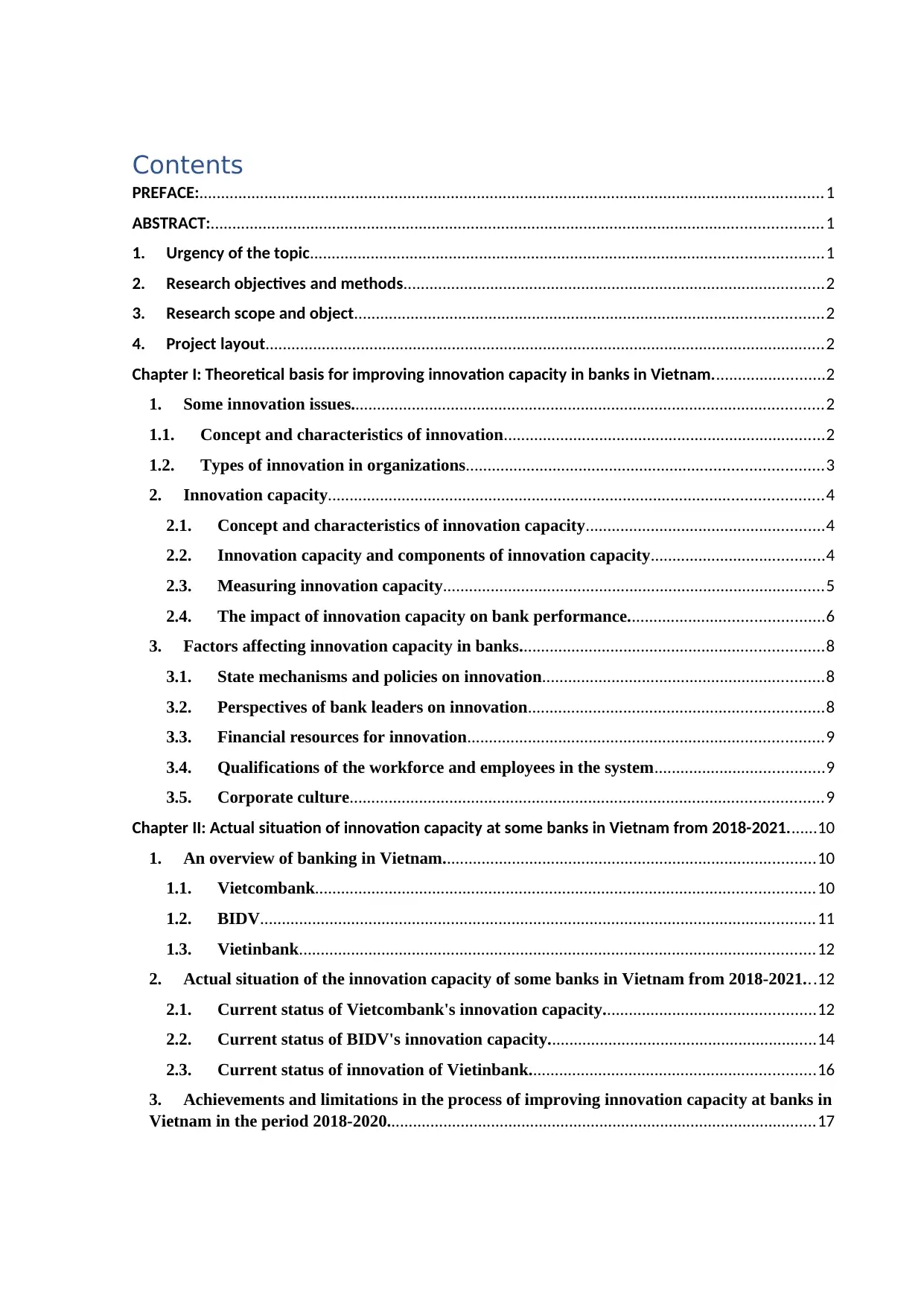
Contents
PREFACE:................................................................................................................................................1
ABSTRACT:.............................................................................................................................................1
1. Urgency of the topic......................................................................................................................1
2. Research objectives and methods.................................................................................................2
3. Research scope and object............................................................................................................2
4. Project layout.................................................................................................................................2
Chapter I: Theoretical basis for improving innovation capacity in banks in Vietnam..........................2
1. Some innovation issues.............................................................................................................2
1.1. Concept and characteristics of innovation..........................................................................2
1.2. Types of innovation in organizations..................................................................................3
2. Innovation capacity..................................................................................................................4
2.1. Concept and characteristics of innovation capacity.......................................................4
2.2. Innovation capacity and components of innovation capacity........................................4
2.3. Measuring innovation capacity........................................................................................5
2.4. The impact of innovation capacity on bank performance.............................................6
3. Factors affecting innovation capacity in banks......................................................................8
3.1. State mechanisms and policies on innovation.................................................................8
3.2. Perspectives of bank leaders on innovation....................................................................8
3.3. Financial resources for innovation..................................................................................9
3.4. Qualifications of the workforce and employees in the system.......................................9
3.5. Corporate culture.............................................................................................................9
Chapter II: Actual situation of innovation capacity at some banks in Vietnam from 2018-2021.......10
1. An overview of banking in Vietnam......................................................................................10
1.1. Vietcombank...................................................................................................................10
1.2. BIDV................................................................................................................................11
1.3. Vietinbank.......................................................................................................................12
2. Actual situation of the innovation capacity of some banks in Vietnam from 2018-2021...12
2.1. Current status of Vietcombank's innovation capacity.................................................12
2.2. Current status of BIDV's innovation capacity..............................................................14
2.3. Current status of innovation of Vietinbank..................................................................16
3. Achievements and limitations in the process of improving innovation capacity at banks in
Vietnam in the period 2018-2020...................................................................................................17
PREFACE:................................................................................................................................................1
ABSTRACT:.............................................................................................................................................1
1. Urgency of the topic......................................................................................................................1
2. Research objectives and methods.................................................................................................2
3. Research scope and object............................................................................................................2
4. Project layout.................................................................................................................................2
Chapter I: Theoretical basis for improving innovation capacity in banks in Vietnam..........................2
1. Some innovation issues.............................................................................................................2
1.1. Concept and characteristics of innovation..........................................................................2
1.2. Types of innovation in organizations..................................................................................3
2. Innovation capacity..................................................................................................................4
2.1. Concept and characteristics of innovation capacity.......................................................4
2.2. Innovation capacity and components of innovation capacity........................................4
2.3. Measuring innovation capacity........................................................................................5
2.4. The impact of innovation capacity on bank performance.............................................6
3. Factors affecting innovation capacity in banks......................................................................8
3.1. State mechanisms and policies on innovation.................................................................8
3.2. Perspectives of bank leaders on innovation....................................................................8
3.3. Financial resources for innovation..................................................................................9
3.4. Qualifications of the workforce and employees in the system.......................................9
3.5. Corporate culture.............................................................................................................9
Chapter II: Actual situation of innovation capacity at some banks in Vietnam from 2018-2021.......10
1. An overview of banking in Vietnam......................................................................................10
1.1. Vietcombank...................................................................................................................10
1.2. BIDV................................................................................................................................11
1.3. Vietinbank.......................................................................................................................12
2. Actual situation of the innovation capacity of some banks in Vietnam from 2018-2021...12
2.1. Current status of Vietcombank's innovation capacity.................................................12
2.2. Current status of BIDV's innovation capacity..............................................................14
2.3. Current status of innovation of Vietinbank..................................................................16
3. Achievements and limitations in the process of improving innovation capacity at banks in
Vietnam in the period 2018-2020...................................................................................................17
⊘ This is a preview!⊘
Do you want full access?
Subscribe today to unlock all pages.

Trusted by 1+ million students worldwide
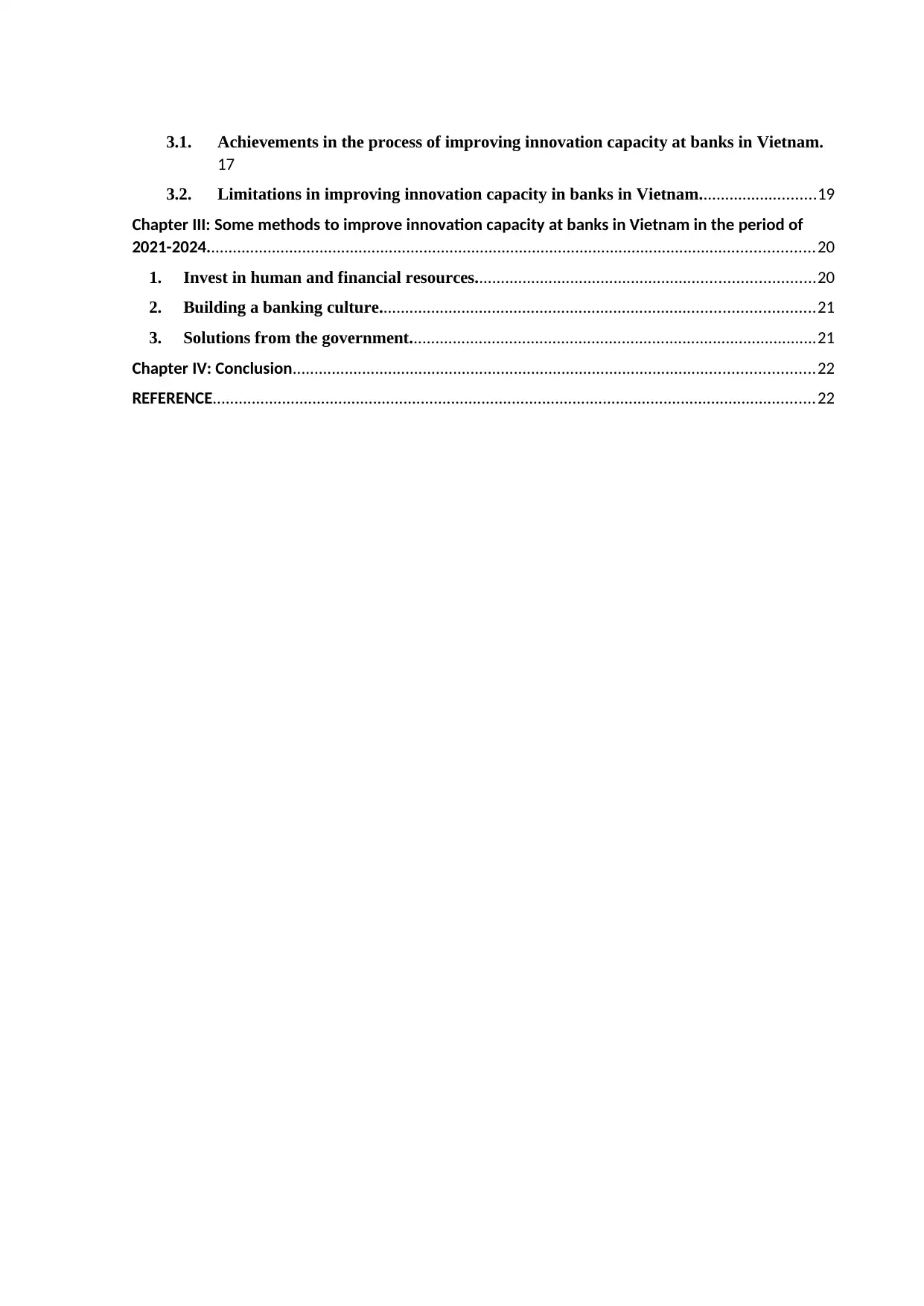
3.1. Achievements in the process of improving innovation capacity at banks in Vietnam.
17
3.2. Limitations in improving innovation capacity in banks in Vietnam...........................19
Chapter III: Some methods to improve innovation capacity at banks in Vietnam in the period of
2021-2024............................................................................................................................................20
1. Invest in human and financial resources..............................................................................20
2. Building a banking culture....................................................................................................21
3. Solutions from the government..............................................................................................21
Chapter IV: Conclusion........................................................................................................................22
REFERENCE...........................................................................................................................................22
17
3.2. Limitations in improving innovation capacity in banks in Vietnam...........................19
Chapter III: Some methods to improve innovation capacity at banks in Vietnam in the period of
2021-2024............................................................................................................................................20
1. Invest in human and financial resources..............................................................................20
2. Building a banking culture....................................................................................................21
3. Solutions from the government..............................................................................................21
Chapter IV: Conclusion........................................................................................................................22
REFERENCE...........................................................................................................................................22
Paraphrase This Document
Need a fresh take? Get an instant paraphrase of this document with our AI Paraphraser
ABSTRACT:INSTRUCTION
Innovation is the process by which an enterprise develops new products, services,
processes, or management systems to meet the changing requirements of the business
and technological environment. According to Schumpeter, innovation is reflected in
new outcomes: a new good or a new quality of the good; a new mode of production; a
new market; a new supply; or a new organizational structure, which can be summed up
as innovation as making a difference. The results of the implementation of innovation
are shown through the improvement of the capacity of enterprises. Innovation is
considered the key to the success of businesses in the context of increasingly fierce
competition and the development of the current knowledge economy. This has been
confirmed by many researchers as well as economic organizations around the world.
Research by Woodward (2009)has shown that in order to achieve higher business
results, companies are interested in innovation. The success of companies thanks to
innovation is confirmed according to the research of Bessant and Tidd (2013).
In Vietnam, commercial banks are currently facing many integration challenges and
increasingly fierce competition, in addition to opportunities and challenges from the
industrial revolution 4.0. Innovation and creativity are recognized as critical factors in
improving operational efficiency and the competitive advantages of banks. Awareness
of the need for innovation in Vietnamese commercial banks is very clear through
specific actions. In fact, banks have actively researched and invested in several
successful technologies of the industrial revolution 4.0 in their products, services,
operations, and governance, implementing model changes. Executive management,
business model, product and service structure adapt to customer trends to exploit
market opportunities. Big banks like Vietcombank have built an innovative mindset
that spreads widely throughout the system and has become the culture of Vietcombank
"Ready to innovate to become a modern bank with a high position in the banking
system". in global value chains". Vietcombank also held the contest "Innovation -
creativity for development and integration" in 2018 affirming that the initiative does
not stop at ideas but will be applied in practice to bring practical effects, in order to
contribute to the development and integration, firmly moving forward in the journey of
reaching out to the immense sea of the Bank.
1. Urgency of the topic
In recent years, the issue of innovation in Vietnamese enterprises and banks has
attracted the attention of many researchers. Many scientific works have been
published; many seminars related to the above issues have been held. Many documents
of the Party and State related to the above topics have been promulgated and come to
life.
Science, technology, and innovation capacity are still weak, and the national
innovation system is still young and fragmented. Research and development (R&D)
are still only a supplementary activity in enterprises and government agencies.
The increasing level of competition in the world necessitates early investments in the
development of advanced technological capabilities, including R&D. Improving
1
Innovation is the process by which an enterprise develops new products, services,
processes, or management systems to meet the changing requirements of the business
and technological environment. According to Schumpeter, innovation is reflected in
new outcomes: a new good or a new quality of the good; a new mode of production; a
new market; a new supply; or a new organizational structure, which can be summed up
as innovation as making a difference. The results of the implementation of innovation
are shown through the improvement of the capacity of enterprises. Innovation is
considered the key to the success of businesses in the context of increasingly fierce
competition and the development of the current knowledge economy. This has been
confirmed by many researchers as well as economic organizations around the world.
Research by Woodward (2009)has shown that in order to achieve higher business
results, companies are interested in innovation. The success of companies thanks to
innovation is confirmed according to the research of Bessant and Tidd (2013).
In Vietnam, commercial banks are currently facing many integration challenges and
increasingly fierce competition, in addition to opportunities and challenges from the
industrial revolution 4.0. Innovation and creativity are recognized as critical factors in
improving operational efficiency and the competitive advantages of banks. Awareness
of the need for innovation in Vietnamese commercial banks is very clear through
specific actions. In fact, banks have actively researched and invested in several
successful technologies of the industrial revolution 4.0 in their products, services,
operations, and governance, implementing model changes. Executive management,
business model, product and service structure adapt to customer trends to exploit
market opportunities. Big banks like Vietcombank have built an innovative mindset
that spreads widely throughout the system and has become the culture of Vietcombank
"Ready to innovate to become a modern bank with a high position in the banking
system". in global value chains". Vietcombank also held the contest "Innovation -
creativity for development and integration" in 2018 affirming that the initiative does
not stop at ideas but will be applied in practice to bring practical effects, in order to
contribute to the development and integration, firmly moving forward in the journey of
reaching out to the immense sea of the Bank.
1. Urgency of the topic
In recent years, the issue of innovation in Vietnamese enterprises and banks has
attracted the attention of many researchers. Many scientific works have been
published; many seminars related to the above issues have been held. Many documents
of the Party and State related to the above topics have been promulgated and come to
life.
Science, technology, and innovation capacity are still weak, and the national
innovation system is still young and fragmented. Research and development (R&D)
are still only a supplementary activity in enterprises and government agencies.
The increasing level of competition in the world necessitates early investments in the
development of advanced technological capabilities, including R&D. Improving
1
innovation capacity becomes imperative for businesses to improve their position in the
global value chain.
To meet the future demand, it is necessary to step up investment in science,
technology, and innovation to strengthen, rationalize and adjust the innovation system
towards a more focus on enterprises.
Facing that reality, it is very urgent to study the current state of innovation in
Vietnamese banks and find solutions to improve innovation capacity in banks.
Realizing the urgency in improving innovation at banks, I chose the topic "Improving
innovation capacity in banks in Vietnam" as the topic for this project.
2. Research objectives and methods
The project's research objective is to clarify the current state of innovation of banks in
Vietnam and provide solutions to improve innovation capacity in the future.
The project uses the practical basis, the current situation of banks in Vietnam, and
research-based on specialized knowledge learned.
3. Research scope and object
The project focuses on the current state of innovation of banks in Vietnam.
Specifically, BIDV, Vietcombank and Vietinbank.
4. Project layout
Project layout three main chapters:
Chapter I: Theoretical basis for improving innovation capacity in banks in Vietnam.
Chapter II: Actual situation of innovation capacity at some banks in Vietnam from
2018-2021.
Chapter III: Some methods to improve innovation capacity at banks in Vietnam in the
period of 2021-2024.
Chapter I: Theoretical basis for improving innovation capacity in banks in
Vietnam.
1. Some innovation issues.
1.1. Concept and characteristics of innovation
There are different definitions of innovation. For example, Schumpeter (1995) argues
that innovation includes the whole process of starting from an idea and continuing
through all the steps to create a unique product that can be sold in the market.
Furthermore, Katz (2007) defines innovation as "the creation, development, and
successful implementation of new and original ideas including the introduction of
innovative products, processes, and strategies." new developments for the company
that leads to business success and market leadership, creating value for stakeholders,
driving economic growth and rising living standards."
global value chain.
To meet the future demand, it is necessary to step up investment in science,
technology, and innovation to strengthen, rationalize and adjust the innovation system
towards a more focus on enterprises.
Facing that reality, it is very urgent to study the current state of innovation in
Vietnamese banks and find solutions to improve innovation capacity in banks.
Realizing the urgency in improving innovation at banks, I chose the topic "Improving
innovation capacity in banks in Vietnam" as the topic for this project.
2. Research objectives and methods
The project's research objective is to clarify the current state of innovation of banks in
Vietnam and provide solutions to improve innovation capacity in the future.
The project uses the practical basis, the current situation of banks in Vietnam, and
research-based on specialized knowledge learned.
3. Research scope and object
The project focuses on the current state of innovation of banks in Vietnam.
Specifically, BIDV, Vietcombank and Vietinbank.
4. Project layout
Project layout three main chapters:
Chapter I: Theoretical basis for improving innovation capacity in banks in Vietnam.
Chapter II: Actual situation of innovation capacity at some banks in Vietnam from
2018-2021.
Chapter III: Some methods to improve innovation capacity at banks in Vietnam in the
period of 2021-2024.
Chapter I: Theoretical basis for improving innovation capacity in banks in
Vietnam.
1. Some innovation issues.
1.1. Concept and characteristics of innovation
There are different definitions of innovation. For example, Schumpeter (1995) argues
that innovation includes the whole process of starting from an idea and continuing
through all the steps to create a unique product that can be sold in the market.
Furthermore, Katz (2007) defines innovation as "the creation, development, and
successful implementation of new and original ideas including the introduction of
innovative products, processes, and strategies." new developments for the company
that leads to business success and market leadership, creating value for stakeholders,
driving economic growth and rising living standards."
⊘ This is a preview!⊘
Do you want full access?
Subscribe today to unlock all pages.
Trusted by 1+ million students worldwide
According to the Organization for Economic Co-operation and Development (OECD),
innovation is defined as: "the implementation of a new or significantly improved
product (goods/service) or process, a method new marketing, or a new organizational
measure in operational practice, in the organization of work or external relations."
Thus, according to the definition given by the OECD, innovation takes place partially
or completely in the operation of an organization, changing both internal and external
relationships in a new direction. up."
In Vietnam, the Law on Science and Technology (2013) defines innovation as creating
and applying achievements, technical solutions, technologies, and management
solutions to improve development efficiency. Socio-economic development improves
productivity, quality, and added value of products and goods. Innovation focuses on
improving operational efficiency, including the synthesis of all comprehensive and
synchronous activities within the organization. Thus, innovation activities include the
creation and application of advanced scientific and technical achievements. This
application is implemented flexibly based on the actual capacity of each organization
to achieve the highest operational efficiency, focusing on adding value to goods and
services and labor productivity.
Thus, it can be understood Innovation is about creating a new idea to solve a problem
or improve an existing product.
Dodgson et al. (2008) argue that innovation is essential for a company to stay in
business in the market. In today's ever-changing business environment, innovation is
an important catalyst for growth and development as it provides unique products and
services to consumers.
1.2. Types of innovation in organizations
According to the OECD (2005), there are four basic types of innovation: product
innovation, process innovation, marketing innovation, and organizational innovation.
First, product innovation: To offer a new or improved product and service in terms of
specifications, components, and materials, software used in products and services,
user-friendliness, the user, or other functional characteristics. Product innovation can
take advantage of new knowledge and technologies. Product innovation is a very
complex process, which can change customer needs, product life cycle and help
businesses increase competitiveness in the market.
Second, process innovation: A method of production or distribution is new or
improved from the past. This includes technical, equipment, and software changes.
Process innovation can reduce product production and distribution costs and increase
product quality. Fagerberg (2004)emphasize that while the introduction of new
products often has a clear and positive effect on growth in incomes and employment,
process innovation can have a negative impact lighter on these issues.
Third, marketing innovation: A new method of marketing that involves changes in
product design or packaging, product distribution, promotion, and product pricing.
innovation is defined as: "the implementation of a new or significantly improved
product (goods/service) or process, a method new marketing, or a new organizational
measure in operational practice, in the organization of work or external relations."
Thus, according to the definition given by the OECD, innovation takes place partially
or completely in the operation of an organization, changing both internal and external
relationships in a new direction. up."
In Vietnam, the Law on Science and Technology (2013) defines innovation as creating
and applying achievements, technical solutions, technologies, and management
solutions to improve development efficiency. Socio-economic development improves
productivity, quality, and added value of products and goods. Innovation focuses on
improving operational efficiency, including the synthesis of all comprehensive and
synchronous activities within the organization. Thus, innovation activities include the
creation and application of advanced scientific and technical achievements. This
application is implemented flexibly based on the actual capacity of each organization
to achieve the highest operational efficiency, focusing on adding value to goods and
services and labor productivity.
Thus, it can be understood Innovation is about creating a new idea to solve a problem
or improve an existing product.
Dodgson et al. (2008) argue that innovation is essential for a company to stay in
business in the market. In today's ever-changing business environment, innovation is
an important catalyst for growth and development as it provides unique products and
services to consumers.
1.2. Types of innovation in organizations
According to the OECD (2005), there are four basic types of innovation: product
innovation, process innovation, marketing innovation, and organizational innovation.
First, product innovation: To offer a new or improved product and service in terms of
specifications, components, and materials, software used in products and services,
user-friendliness, the user, or other functional characteristics. Product innovation can
take advantage of new knowledge and technologies. Product innovation is a very
complex process, which can change customer needs, product life cycle and help
businesses increase competitiveness in the market.
Second, process innovation: A method of production or distribution is new or
improved from the past. This includes technical, equipment, and software changes.
Process innovation can reduce product production and distribution costs and increase
product quality. Fagerberg (2004)emphasize that while the introduction of new
products often has a clear and positive effect on growth in incomes and employment,
process innovation can have a negative impact lighter on these issues.
Third, marketing innovation: A new method of marketing that involves changes in
product design or packaging, product distribution, promotion, and product pricing.
Paraphrase This Document
Need a fresh take? Get an instant paraphrase of this document with our AI Paraphraser
This innovation aims to better satisfy customer needs, develop new consumption
markets, and position the company's products in the market.
Fourth, organizational innovation: A new organizational method is introduced into
business practice. This innovation must increase the efficiency of the organization by
reducing administrative costs, improving the satisfaction of employees in the
workplace as well as the working environment in the organization.
2. Innovation capacity
2.1. Concept and characteristics of innovation capacity
Capacity is understood as the strategic management ability of the company related to
adapting, integrating, and restructuring organizational skills, resources, and functions
to suit the changing needs of customers' business environment. Innovation Capacity is
a prerequisite for innovation (Laforet, 2011). Lawson and Samson (2001) define
innovation capacity as “the ability to continuously transform knowledge and ideas into
new products, processes, and systems for the benefit of the company and its
customers.” Stakeholders"; while Chen (2009) defines innovation as “a firm's ability,
based on processes, systems, and organizational structures, applicable to activities
product or process innovation.” Innovation can also be understood as “the continued
ability of the lead companies to utilize the collective expertise, knowledge, skills, and
resources of key supply chain members in innovation activities related to new
processes, products, services, administrative, or organizational systems to create and
capture value for the entire supply chain” (Iddris, 2016). All the above concepts
suggest that the ability to innovate is a complex phenomenon that requires the
exchange of resources and expertise through relationships with key actors since a
company is almost always does not possess all the additional resources and expertise
required to create value for customers through innovative activities.
2.2. Innovation capacity and components of innovation capacity
Agyei-Mensah (2016) argues that innovation capacity is composed of five main
components: (i) Product innovation capacity; (ii) Process innovation capacity; (iii)
Organizational innovation capacity; (iv) Innovation capacity in marketing and (v)
Innovation capacity in cooperation.
Product innovation capabilities, including significant changes in product
characteristics, maybe new product services, or improved services or products. The
organization will then introduce and bring a new product to market or improve an
existing product in terms of functionality, quality, or appearance (Liao et al., 2007;
OECD, 2005). Bloch and Bugge (2013)define product innovation capacity as the
provision of goods or services that are new or significantly improved compared to
those currently offered by the organization, which may include changing the
characteristics of goods or services or changing the way that customers can access to
use goods or products.
markets, and position the company's products in the market.
Fourth, organizational innovation: A new organizational method is introduced into
business practice. This innovation must increase the efficiency of the organization by
reducing administrative costs, improving the satisfaction of employees in the
workplace as well as the working environment in the organization.
2. Innovation capacity
2.1. Concept and characteristics of innovation capacity
Capacity is understood as the strategic management ability of the company related to
adapting, integrating, and restructuring organizational skills, resources, and functions
to suit the changing needs of customers' business environment. Innovation Capacity is
a prerequisite for innovation (Laforet, 2011). Lawson and Samson (2001) define
innovation capacity as “the ability to continuously transform knowledge and ideas into
new products, processes, and systems for the benefit of the company and its
customers.” Stakeholders"; while Chen (2009) defines innovation as “a firm's ability,
based on processes, systems, and organizational structures, applicable to activities
product or process innovation.” Innovation can also be understood as “the continued
ability of the lead companies to utilize the collective expertise, knowledge, skills, and
resources of key supply chain members in innovation activities related to new
processes, products, services, administrative, or organizational systems to create and
capture value for the entire supply chain” (Iddris, 2016). All the above concepts
suggest that the ability to innovate is a complex phenomenon that requires the
exchange of resources and expertise through relationships with key actors since a
company is almost always does not possess all the additional resources and expertise
required to create value for customers through innovative activities.
2.2. Innovation capacity and components of innovation capacity
Agyei-Mensah (2016) argues that innovation capacity is composed of five main
components: (i) Product innovation capacity; (ii) Process innovation capacity; (iii)
Organizational innovation capacity; (iv) Innovation capacity in marketing and (v)
Innovation capacity in cooperation.
Product innovation capabilities, including significant changes in product
characteristics, maybe new product services, or improved services or products. The
organization will then introduce and bring a new product to market or improve an
existing product in terms of functionality, quality, or appearance (Liao et al., 2007;
OECD, 2005). Bloch and Bugge (2013)define product innovation capacity as the
provision of goods or services that are new or significantly improved compared to
those currently offered by the organization, which may include changing the
characteristics of goods or services or changing the way that customers can access to
use goods or products.
Process innovation capabilities, including creating and improving production and
transportation; or applying new inputs (such as inputs, tasks, information flows,
equipment) into the organization's production processes (Damanpour, 1996). The
OECD (2005)adds that significant variation in factors such as technology, equipment,
or software is also a component of process innovation capacity. In addition, Bloch and
Bugge (2013) expand the view of process innovation capacity as the implementation
of a new or significantly improved method of producing and providing goods and
services, or significantly improved compared to the process. The organization's current
processes, which may include improvements related to equipment, skills, support such
as IT, accounting, or purchasing.
Organizational innovation capacity: The implementation of new or changed
organizational methods in the organization's operation, which can be expressed in the
form of hiring more personnel, allocating resources, structuring redeployment of
duties, responsibilities, and authorities across departments (Damanpour, 1992;
Gopalakrishnan and Damanpour, 1997). Bloch and Bugge (2013) argue that
organizational innovation capacity is the implementation of a new approach to
management and organization that is different from the current way of operating the
organization, which may include innovation activities or significantly improve the
management system or workplace organization.
Marketing innovation: Involves the implementation of new marketing activities,
including the design, packaging, and distribution, as well as the way in which goods
and services are priced (Vorhies and Harker, 2000; Weerawardena, 2003). Besides, the
capacity of marketing innovation can also be the implementation of a new promotion
method for the organization's goods and services or a new method to influence buyer
behavior (Bloch and Bugge, 2013).
Collaborative innovation capacity: change in relationships with external partners, or
increase customer satisfaction through after-sales services, warranty policies,
procedure maintenance process, and order fulfillment system (Gopalakrishnan and
Damanpour, 1997).
2.3. Measuring innovation capacity
Some scholars have researched measuring innovation capacity; Wang and Ahmed
(2004)provided one of the pioneering works in measuring innovation capacity. In their
research, they developed and empirically tested innovation capacity dimensions,
including product innovation, market innovation, and process innovation. Saunila and
Ukko (2012) also proposed a conceptual framework to measure innovation capacity.
The authors identified creativity, leadership motivation, communication channels, idea
generation, new products, and new processes as key innovation competencies. Vicente
et al. (2015)contributed to the export market literature by developing innovative
capacity scales to help export firms. They have identified technological capabilities,
innovation capabilities, product development capabilities, and strategic capabilities as
key aspects of innovation capabilities to improve the performance of a company's
annual export business the company. In the service sector, Hogan et al. (2011) and
transportation; or applying new inputs (such as inputs, tasks, information flows,
equipment) into the organization's production processes (Damanpour, 1996). The
OECD (2005)adds that significant variation in factors such as technology, equipment,
or software is also a component of process innovation capacity. In addition, Bloch and
Bugge (2013) expand the view of process innovation capacity as the implementation
of a new or significantly improved method of producing and providing goods and
services, or significantly improved compared to the process. The organization's current
processes, which may include improvements related to equipment, skills, support such
as IT, accounting, or purchasing.
Organizational innovation capacity: The implementation of new or changed
organizational methods in the organization's operation, which can be expressed in the
form of hiring more personnel, allocating resources, structuring redeployment of
duties, responsibilities, and authorities across departments (Damanpour, 1992;
Gopalakrishnan and Damanpour, 1997). Bloch and Bugge (2013) argue that
organizational innovation capacity is the implementation of a new approach to
management and organization that is different from the current way of operating the
organization, which may include innovation activities or significantly improve the
management system or workplace organization.
Marketing innovation: Involves the implementation of new marketing activities,
including the design, packaging, and distribution, as well as the way in which goods
and services are priced (Vorhies and Harker, 2000; Weerawardena, 2003). Besides, the
capacity of marketing innovation can also be the implementation of a new promotion
method for the organization's goods and services or a new method to influence buyer
behavior (Bloch and Bugge, 2013).
Collaborative innovation capacity: change in relationships with external partners, or
increase customer satisfaction through after-sales services, warranty policies,
procedure maintenance process, and order fulfillment system (Gopalakrishnan and
Damanpour, 1997).
2.3. Measuring innovation capacity
Some scholars have researched measuring innovation capacity; Wang and Ahmed
(2004)provided one of the pioneering works in measuring innovation capacity. In their
research, they developed and empirically tested innovation capacity dimensions,
including product innovation, market innovation, and process innovation. Saunila and
Ukko (2012) also proposed a conceptual framework to measure innovation capacity.
The authors identified creativity, leadership motivation, communication channels, idea
generation, new products, and new processes as key innovation competencies. Vicente
et al. (2015)contributed to the export market literature by developing innovative
capacity scales to help export firms. They have identified technological capabilities,
innovation capabilities, product development capabilities, and strategic capabilities as
key aspects of innovation capabilities to improve the performance of a company's
annual export business the company. In the service sector, Hogan et al. (2011) and
⊘ This is a preview!⊘
Do you want full access?
Subscribe today to unlock all pages.
Trusted by 1+ million students worldwide
Grawe et al. (2009) provided another perspective by developing an innovation capacity
scale for Professional Services Firms.Hogan et al. (2011) focus on measuring
innovation in knowledge-based services for lawyers, accountants, consulting
engineers, and management consultants.
According to research by (Vương Đức Hoàng Quân, 2018), the innovation capacity
framework is measured by internal factors of enterprises and the support of State
management agencies. These factors include seven factors: (1) Innovation attitude of
business leaders, (2) Existing capacity of the organization, (3) Characteristics of the
enterprise, (4) Effective management practices, (5) Relationship with partners, (6)
Access to external resources, (7) Regulations and support from state management
agencies Vuong Duc Hoang Quan(2018). According to this study, the "innovative
attitude of business leaders" plays a decisive role in the elements of the innovation
capacity framework of enterprises.
2.4. The impact of innovation capacity on bank performance.
The operational efficiency of an organization is understood as the ability to provide
products and services in a cost-effective manner without sacrificing product or service
quality (Nematollahi et al., 1996). Kumbhakar and Lovell (2000)argue that operational
efficiency is understood as the maximization of output factors, minimizing costs, or
maximizing profits. In addition, Lotto (2018) argues that organizational performance is
the combination and allocation of inputs and outputs at a reasonable price, that is,
combining people, processes, and technology along with reducing operating costs to a
predetermined level, to increase the productivity and operational value of any
business. The operational efficiency of commercial banks has received more attention
since the early 90s of the last century. The bank performance perspective is like the
organizational performance perspective. According to Berger et al. (1993), commercial
banks are considered efficient when commercial banks can increase profitability and
provide customers with products and services with better prices and quality, and at the
same time have abundant capital more abundant.
The impact of innovation capacity on different types of organizational performance
can be expressed in terms of market efficiency, financial efficiency, and innovation
efficiency (Hagedoorn and Cloodt, 2003). However, the research model on the impact
of innovation capacity on different types of bank performance is shown in three
aspects: financial efficiency, market efficiency, and financial efficiency creative
innovation. As follows:
Financial performance: The impact of innovation capacity on financial performance is
reflected in most of the studies that have shown a significant impact on profitability,
market share, and ratio return on investment as well as the rate of return (Karabulut,
2015). Research by Reichheld et al. (2000)shows that innovation helps increase
customer satisfaction and loyalty, thereby helping businesses increase profitability and
revenue.
Research by Akhisar et al. (2015) on the impact of innovation on bank performance
and a separate study on e-banking services. The study uses dynamic panel data on e-
scale for Professional Services Firms.Hogan et al. (2011) focus on measuring
innovation in knowledge-based services for lawyers, accountants, consulting
engineers, and management consultants.
According to research by (Vương Đức Hoàng Quân, 2018), the innovation capacity
framework is measured by internal factors of enterprises and the support of State
management agencies. These factors include seven factors: (1) Innovation attitude of
business leaders, (2) Existing capacity of the organization, (3) Characteristics of the
enterprise, (4) Effective management practices, (5) Relationship with partners, (6)
Access to external resources, (7) Regulations and support from state management
agencies Vuong Duc Hoang Quan(2018). According to this study, the "innovative
attitude of business leaders" plays a decisive role in the elements of the innovation
capacity framework of enterprises.
2.4. The impact of innovation capacity on bank performance.
The operational efficiency of an organization is understood as the ability to provide
products and services in a cost-effective manner without sacrificing product or service
quality (Nematollahi et al., 1996). Kumbhakar and Lovell (2000)argue that operational
efficiency is understood as the maximization of output factors, minimizing costs, or
maximizing profits. In addition, Lotto (2018) argues that organizational performance is
the combination and allocation of inputs and outputs at a reasonable price, that is,
combining people, processes, and technology along with reducing operating costs to a
predetermined level, to increase the productivity and operational value of any
business. The operational efficiency of commercial banks has received more attention
since the early 90s of the last century. The bank performance perspective is like the
organizational performance perspective. According to Berger et al. (1993), commercial
banks are considered efficient when commercial banks can increase profitability and
provide customers with products and services with better prices and quality, and at the
same time have abundant capital more abundant.
The impact of innovation capacity on different types of organizational performance
can be expressed in terms of market efficiency, financial efficiency, and innovation
efficiency (Hagedoorn and Cloodt, 2003). However, the research model on the impact
of innovation capacity on different types of bank performance is shown in three
aspects: financial efficiency, market efficiency, and financial efficiency creative
innovation. As follows:
Financial performance: The impact of innovation capacity on financial performance is
reflected in most of the studies that have shown a significant impact on profitability,
market share, and ratio return on investment as well as the rate of return (Karabulut,
2015). Research by Reichheld et al. (2000)shows that innovation helps increase
customer satisfaction and loyalty, thereby helping businesses increase profitability and
revenue.
Research by Akhisar et al. (2015) on the impact of innovation on bank performance
and a separate study on e-banking services. The study uses dynamic panel data on e-
Paraphrase This Document
Need a fresh take? Get an instant paraphrase of this document with our AI Paraphraser
banking services of 23 developed and developing countries in the period 2005-2013.
In which, innovation in banking is understood as technology-based products such as e-
banking. The research results show that the bank's profitability ratio expressed in ROE
and ROA ratios in countries is statistically significantly affected by the number of
branches and the number of ATMs. Or as our studies show that product innovation has
an impact on advertising costs, operational efficiency as well as the risk of a bank's
loan portfolio. Similarly, research by Scott et al. (2017) using data of 6848 banks in 29
countries in Europe and America, the results show that the use of the innovative
product SWIFT has an impact on the long-term profitability of the research banks.
Market efficiency: Innovation capacity also affects non-financial aspects of the
business, such as customer satisfaction (Gunday et al., 2011). Market efficiency is
demonstrated by the company's ability to attract new customers, increase customer
satisfaction and loyalty, and its market share relative to other competitors (Oh et al.,
2014). The ability to innovate helps to improve the quality of products and services,
adding value to customers, thereby helping to attract new customers and satisfy
existing customers, thereby increasing the position and market share of business,
Hogan and Coote (2014)
Geroski and Machin (1992) have demonstrated that innovative firms have the ability to
capture a larger market share and have a higher profit growth rate. In which, technical
factors (measured through invention, research, and development) and economic factors
(labor productivity, stock price) have proven that efficiency in terms of the technology
of the enterprise has a positive relationship with the market value of the enterprise.
Ndunga et al. (2016) used a data set through a questionnaire survey of bankers and
customers at 20 banks in Meru city, Kenya, and the research results showed that the
financial performance of the bank is subject to statistically significant impact by
innovative technology products such as mobile banking, internet banking, ATM. From
there, the study makes recommendations for banks to better manage costs and invest
more in technology products and services.
Innovation efficiency: The impact of innovation capacity on innovation efficiency is
demonstrated in the research of Chiang and Hung (2010); Reed et al. (2012), research
shows that organizational innovation helps businesses better understand their
capabilities and strengths, thereby helping to increase their competitive advantage
compared to their competitors with opponents.
Agyei-Mensah (2016) research on the impact of innovation capacity on UT bank
operations in Ghana in 2014 used a questionnaire for 201039 subjects, including bank
employees and clients.
In which innovation capacity of the bank is measured through products, marketing,
organization, combining functions and processes. Research results show that product,
marketing, and process innovation has a significant impact on bank performance,
while organizational and functional innovation is not proven to have a significant
impact on UT Bank's operations in Ghana.
In which, innovation in banking is understood as technology-based products such as e-
banking. The research results show that the bank's profitability ratio expressed in ROE
and ROA ratios in countries is statistically significantly affected by the number of
branches and the number of ATMs. Or as our studies show that product innovation has
an impact on advertising costs, operational efficiency as well as the risk of a bank's
loan portfolio. Similarly, research by Scott et al. (2017) using data of 6848 banks in 29
countries in Europe and America, the results show that the use of the innovative
product SWIFT has an impact on the long-term profitability of the research banks.
Market efficiency: Innovation capacity also affects non-financial aspects of the
business, such as customer satisfaction (Gunday et al., 2011). Market efficiency is
demonstrated by the company's ability to attract new customers, increase customer
satisfaction and loyalty, and its market share relative to other competitors (Oh et al.,
2014). The ability to innovate helps to improve the quality of products and services,
adding value to customers, thereby helping to attract new customers and satisfy
existing customers, thereby increasing the position and market share of business,
Hogan and Coote (2014)
Geroski and Machin (1992) have demonstrated that innovative firms have the ability to
capture a larger market share and have a higher profit growth rate. In which, technical
factors (measured through invention, research, and development) and economic factors
(labor productivity, stock price) have proven that efficiency in terms of the technology
of the enterprise has a positive relationship with the market value of the enterprise.
Ndunga et al. (2016) used a data set through a questionnaire survey of bankers and
customers at 20 banks in Meru city, Kenya, and the research results showed that the
financial performance of the bank is subject to statistically significant impact by
innovative technology products such as mobile banking, internet banking, ATM. From
there, the study makes recommendations for banks to better manage costs and invest
more in technology products and services.
Innovation efficiency: The impact of innovation capacity on innovation efficiency is
demonstrated in the research of Chiang and Hung (2010); Reed et al. (2012), research
shows that organizational innovation helps businesses better understand their
capabilities and strengths, thereby helping to increase their competitive advantage
compared to their competitors with opponents.
Agyei-Mensah (2016) research on the impact of innovation capacity on UT bank
operations in Ghana in 2014 used a questionnaire for 201039 subjects, including bank
employees and clients.
In which innovation capacity of the bank is measured through products, marketing,
organization, combining functions and processes. Research results show that product,
marketing, and process innovation has a significant impact on bank performance,
while organizational and functional innovation is not proven to have a significant
impact on UT Bank's operations in Ghana.
3. Factors affecting innovation capacity in banks.
3.1. State mechanisms and policies on innovation
It can be seen that the mechanisms and policies of the state play an important role in
business activities in general and innovation in particular of credit institutions and the
commercial banking system. The changing policies of the state in recent years have
had a very positive influence on innovation activities in the financial-banking sector.
The Vietnamese Government is paying more and more attention to the science and
technology market, developing policies to support innovation for businesses. Since
2016, the Government has shown the highest determination on the development
orientation to promote innovative start-ups through the Project "Supporting the
national innovative start-up ecosystem until 2025" by the Ministry of Science and
Technology. and
The proposed technology was approved by the Prime Minister in Decision No.
844/QDTTg dated May 18, 2016. That is why the start-up and innovation movements
in Vietnam have been aroused as vigorously as they are now with the participation of
most industries and sectors in the economy.
However, according to some experts in the banking and finance sector, a number of
new ideas and initiatives currently do not have a clear legal framework or have existed
but have not yet been approved by the state. Commercial banks do not dare to apply
and deploy. For example, the previous electronic payment application. Many of the
bank's initiatives are relatively slow to develop due to the lack of specific guidance
from the Vietnamese state-owned bank, as these are technology-based services that are
relatively new in Vietnam. In addition, because we do not have a clear policy roadmap
on the use of services based on new technology platforms such as cloud computing,
big data, blockchain technology, electronic customer identification, etc. This is exactly
what is tying innovation at some commercial banks.
In summary, the mechanisms and policies of the state can both positively and
negatively affect the innovation activities of the commercial banking system.
3.2. Perspectives of bank leaders on innovation
Many experts and researchers point to the important role of leaders in innovation
through strategic directions, appropriate policies and environment, and decisions to
encourage innovation. Innovation and initiatives in organizations in general and
commercial banks in particular (Aragon-Correa et al., 2007; Ryan and Tipu, 2013). It
is the timely orientation and encouragement of senior leaders in the bank that will
motivate the staff and all employees to promote their personal qualities and creativity
created in solving problems, especially breakthrough solutions. With the
characteristics of the banking industry to provide financial services to individuals and
organizations in the economy, with the increasingly fierce competition today,
especially with banks. This requires the acumen and decisiveness of the senior leaders
of commercial banks in accessing new and advanced technologies of the world.
Leaders need to create a positive learning and knowledge-sharing environment in these
banks. This is an ideal environment for creativity and innovation activities.
3.1. State mechanisms and policies on innovation
It can be seen that the mechanisms and policies of the state play an important role in
business activities in general and innovation in particular of credit institutions and the
commercial banking system. The changing policies of the state in recent years have
had a very positive influence on innovation activities in the financial-banking sector.
The Vietnamese Government is paying more and more attention to the science and
technology market, developing policies to support innovation for businesses. Since
2016, the Government has shown the highest determination on the development
orientation to promote innovative start-ups through the Project "Supporting the
national innovative start-up ecosystem until 2025" by the Ministry of Science and
Technology. and
The proposed technology was approved by the Prime Minister in Decision No.
844/QDTTg dated May 18, 2016. That is why the start-up and innovation movements
in Vietnam have been aroused as vigorously as they are now with the participation of
most industries and sectors in the economy.
However, according to some experts in the banking and finance sector, a number of
new ideas and initiatives currently do not have a clear legal framework or have existed
but have not yet been approved by the state. Commercial banks do not dare to apply
and deploy. For example, the previous electronic payment application. Many of the
bank's initiatives are relatively slow to develop due to the lack of specific guidance
from the Vietnamese state-owned bank, as these are technology-based services that are
relatively new in Vietnam. In addition, because we do not have a clear policy roadmap
on the use of services based on new technology platforms such as cloud computing,
big data, blockchain technology, electronic customer identification, etc. This is exactly
what is tying innovation at some commercial banks.
In summary, the mechanisms and policies of the state can both positively and
negatively affect the innovation activities of the commercial banking system.
3.2. Perspectives of bank leaders on innovation
Many experts and researchers point to the important role of leaders in innovation
through strategic directions, appropriate policies and environment, and decisions to
encourage innovation. Innovation and initiatives in organizations in general and
commercial banks in particular (Aragon-Correa et al., 2007; Ryan and Tipu, 2013). It
is the timely orientation and encouragement of senior leaders in the bank that will
motivate the staff and all employees to promote their personal qualities and creativity
created in solving problems, especially breakthrough solutions. With the
characteristics of the banking industry to provide financial services to individuals and
organizations in the economy, with the increasingly fierce competition today,
especially with banks. This requires the acumen and decisiveness of the senior leaders
of commercial banks in accessing new and advanced technologies of the world.
Leaders need to create a positive learning and knowledge-sharing environment in these
banks. This is an ideal environment for creativity and innovation activities.
⊘ This is a preview!⊘
Do you want full access?
Subscribe today to unlock all pages.
Trusted by 1+ million students worldwide

1 out of 29


Related Documents


Your All-in-One AI-Powered Toolkit for Academic Success.
+13062052269
info@desklib.com
Available 24*7 on WhatsApp / Email
![[object Object]](/_next/static/media/star-bottom.7253800d.svg)
Unlock your academic potential
Copyright © 2020–2026 A2Z Services. All Rights Reserved. Developed and managed by ZUCOL.