Scheme of Work Report: Higher Education - Planning and Delivery
VerifiedAdded on 2020/02/05
|7
|1607
|86
Report
AI Summary
This report provides a comprehensive overview of a scheme of work, focusing on its application within a higher education context. It begins with an introduction that defines a scheme of work as a plan of action guiding course syllabi and monitoring progress. The report then delves into the selection and sequencing of topics, emphasizing the importance of differentiating and comparing various schemes. It outlines the essential elements of a scheme of work, including the institution, subject, topic order, and learning goals. The report also explores the selection of resources to promote inclusive learning, highlighting the significance of diverse perspectives and specialized schemes for disabled learners. Differentiation strategies are discussed as a crucial aspect of the scheme, alongside the choice of assessment methods, including summative, formative, and continuous assessments. The recording of results is also emphasized. Furthermore, the report addresses the development of wider professional skills, including literacy, numeracy, and ICT proficiency. The conclusion reiterates the importance of proper planning, resource selection, and assessment techniques for effective teaching. References to relevant literature are also provided.
Scheme of Work 1
Scheme of Work
Student Name:
Student ID:
University:
Scheme of Work
Student Name:
Student ID:
University:
Paraphrase This Document
Need a fresh take? Get an instant paraphrase of this document with our AI Paraphraser

Scheme of Work 2
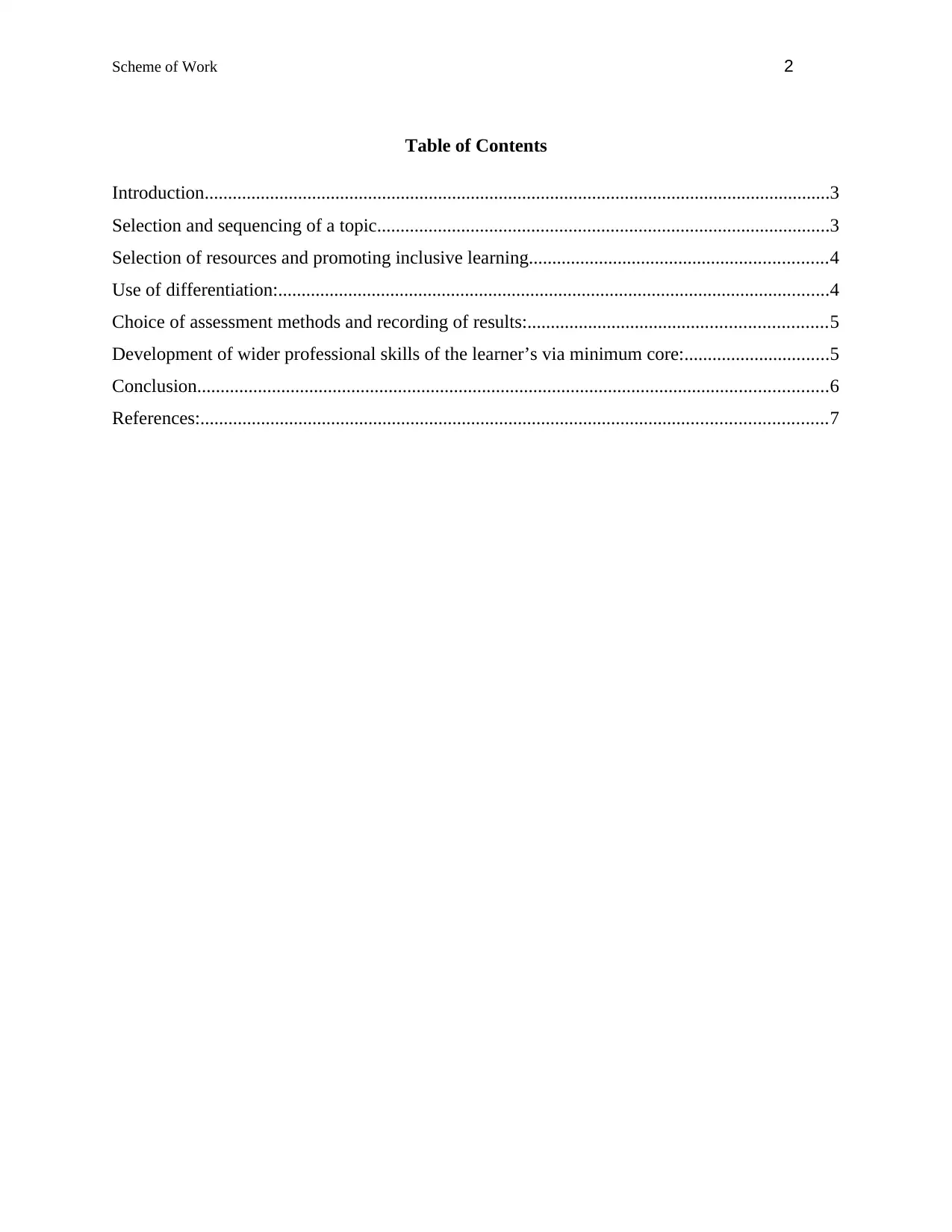
Table of Contents
Introduction......................................................................................................................................3
Selection and sequencing of a topic.................................................................................................3
Selection of resources and promoting inclusive learning................................................................4
Use of differentiation:......................................................................................................................4
Choice of assessment methods and recording of results:................................................................5
Development of wider professional skills of the learner’s via minimum core:...............................5
Conclusion.......................................................................................................................................6
References:......................................................................................................................................7
Table of Contents
Introduction......................................................................................................................................3
Selection and sequencing of a topic.................................................................................................3
Selection of resources and promoting inclusive learning................................................................4
Use of differentiation:......................................................................................................................4
Choice of assessment methods and recording of results:................................................................5
Development of wider professional skills of the learner’s via minimum core:...............................5
Conclusion.......................................................................................................................................6
References:......................................................................................................................................7

Scheme of Work 3
Introduction
According to O’Leary (2013), scheme of work can be termed as the plan of action,
which provides the guidelines for conducting any course syllabus and monitoring the growth in
comparison to what is actually being into practice.
The most effective schemes of work comprise of providing a pathway on approaches, engrossing
activities and resources, which ensure to cater people's search. They are treated as practical
documents, topics concerning frequent discussion. These are provided with a reconsideration of
the judgment, which helped staff to develop their skills.
Selection and sequencing of a topic
Essential steps that are followed for creating a scheme of work:
In order to find out whether the place of work has a doctrine or a norm, it is important to
differentiate and compare other schemes of work. While creating a scheme of work from grass
root level a spreadsheet should be prepared. Planning regarding divisions of modules of the
syllabus and distribution of each module according to the course session also needs to be
considered (O’Leary, 2013). Further segregation of topics to be covered from each module are
also decided.
Elements comprising a scheme of work:
The institution one refers to for attaining course of their choice. The subject concerning
the course along with the span for completion of the scheme of work are some of the critical
elements. Formation of the order in which the different topics of the syllabus are to be taught.
The aim or goal, which depicts the desired pattern of learning by the learners is essential part of
the plan. Implementation is the next step followed which deals with putting the aims into
practice.
Selection of resources and promoting inclusive learning
It is important for the educators to select the right mix of resources while planning a
lesson or designing a syllabus for a particular topic in a subject. The prior planning of resources
will also help the educators in arranging the materials like visual aids, teaching aids, ICT based
resources and many other requirements based upon the topic. The selection of resources must be
done so as to inculcate practical application of the concepts and knowledge among the learners.
Introduction
According to O’Leary (2013), scheme of work can be termed as the plan of action,
which provides the guidelines for conducting any course syllabus and monitoring the growth in
comparison to what is actually being into practice.
The most effective schemes of work comprise of providing a pathway on approaches, engrossing
activities and resources, which ensure to cater people's search. They are treated as practical
documents, topics concerning frequent discussion. These are provided with a reconsideration of
the judgment, which helped staff to develop their skills.
Selection and sequencing of a topic
Essential steps that are followed for creating a scheme of work:
In order to find out whether the place of work has a doctrine or a norm, it is important to
differentiate and compare other schemes of work. While creating a scheme of work from grass
root level a spreadsheet should be prepared. Planning regarding divisions of modules of the
syllabus and distribution of each module according to the course session also needs to be
considered (O’Leary, 2013). Further segregation of topics to be covered from each module are
also decided.
Elements comprising a scheme of work:
The institution one refers to for attaining course of their choice. The subject concerning
the course along with the span for completion of the scheme of work are some of the critical
elements. Formation of the order in which the different topics of the syllabus are to be taught.
The aim or goal, which depicts the desired pattern of learning by the learners is essential part of
the plan. Implementation is the next step followed which deals with putting the aims into
practice.
Selection of resources and promoting inclusive learning
It is important for the educators to select the right mix of resources while planning a
lesson or designing a syllabus for a particular topic in a subject. The prior planning of resources
will also help the educators in arranging the materials like visual aids, teaching aids, ICT based
resources and many other requirements based upon the topic. The selection of resources must be
done so as to inculcate practical application of the concepts and knowledge among the learners.
⊘ This is a preview!⊘
Do you want full access?
Subscribe today to unlock all pages.

Trusted by 1+ million students worldwide

Scheme of Work 4
Inclusive learning appreciates and brings in diverse perspectives under consideration
such as social, cultural and educational spheres (Nottingham, 2013). Such learning practices not
only enhance the knowledge of the learners but also act extremely beneficial on the part of the
faculty. Inclusive learning is governed by socio-political and ethnic boundaries. It speaks in
support of the institution's diverse visions. Specialised schemes are structured keeping in view to
addressing the disabled learners as well. Inclusive learning is one of the major stepping-stone
towards the attainment of awards, rewards and research scholarships by its learners in their
concerning courses (Nottingham, 2013). Similarly, faculty appraisals and gradual increment in
remunerations gives a boost to the organisation structure.
Use of differentiation:
Differentiation is a way of teaching and a process of identifying each learner understand
well and show their attention on a particular subjects or courses (Gueudet, Pepin, & Trouche,
2013). Differences also depend on learning style, age, motivations, experience and learning
difficulties. So the use of differentiation is very important part of the scheme of work.
Education act as a ladder and every learner want to climb as fast and as high as their
ability. With differentiation, learner can identify their field, choose the courses of interest and
this also make easy to find their ability on a particular subjects or courses. It can be divided into
two parts: short-term plan and long-term plan. Short-term-plan consists of self-assessment,
conferencing, teacher’s observations and the long-term plan is totally dependent on the syllabus
of courses and subjects.
Choice of assessment methods and recording of results:
Assessment means judgment which classifies of something or someone with respect to
its worth. It determines student approaches of learning, making assessment more effective,
efficient and interesting for the learner, planning and designing assessment and reflecting upon
assessment, which enhances learner for learning through assessment (Stephenson, & Yorke,
2013). Planning and designing assessment focused on when to do it and how to implement it.
This includes the Aim of a learner, learning outcomes, method of learning and assessment
method and tasks.
There are three types of assessment: Summative assessment, Formative assessment,
and Continuous assessment. Summative assessment is used to intend competence and contribute
Inclusive learning appreciates and brings in diverse perspectives under consideration
such as social, cultural and educational spheres (Nottingham, 2013). Such learning practices not
only enhance the knowledge of the learners but also act extremely beneficial on the part of the
faculty. Inclusive learning is governed by socio-political and ethnic boundaries. It speaks in
support of the institution's diverse visions. Specialised schemes are structured keeping in view to
addressing the disabled learners as well. Inclusive learning is one of the major stepping-stone
towards the attainment of awards, rewards and research scholarships by its learners in their
concerning courses (Nottingham, 2013). Similarly, faculty appraisals and gradual increment in
remunerations gives a boost to the organisation structure.
Use of differentiation:
Differentiation is a way of teaching and a process of identifying each learner understand
well and show their attention on a particular subjects or courses (Gueudet, Pepin, & Trouche,
2013). Differences also depend on learning style, age, motivations, experience and learning
difficulties. So the use of differentiation is very important part of the scheme of work.
Education act as a ladder and every learner want to climb as fast and as high as their
ability. With differentiation, learner can identify their field, choose the courses of interest and
this also make easy to find their ability on a particular subjects or courses. It can be divided into
two parts: short-term plan and long-term plan. Short-term-plan consists of self-assessment,
conferencing, teacher’s observations and the long-term plan is totally dependent on the syllabus
of courses and subjects.
Choice of assessment methods and recording of results:
Assessment means judgment which classifies of something or someone with respect to
its worth. It determines student approaches of learning, making assessment more effective,
efficient and interesting for the learner, planning and designing assessment and reflecting upon
assessment, which enhances learner for learning through assessment (Stephenson, & Yorke,
2013). Planning and designing assessment focused on when to do it and how to implement it.
This includes the Aim of a learner, learning outcomes, method of learning and assessment
method and tasks.
There are three types of assessment: Summative assessment, Formative assessment,
and Continuous assessment. Summative assessment is used to intend competence and contribute
Paraphrase This Document
Need a fresh take? Get an instant paraphrase of this document with our AI Paraphraser

Scheme of Work 5
to a student’s grade in a course, module, level or degree (Gueudet, Pepin, & Trouche, 2013).
Formative assessment is strictly used to provide feedback to the student on their learning but it
provides the student with advice on how to maintain and improve progress. Continuous
assessment involves a series of tasks that are individually assessed. It is mostly used in several
distinct module-learning outcomes, which define the stages during the module.
Recording of result plays a very important role in the scheme of work. The student
should have their academic result in a database form, which is convenient for the student to store
their results.
Development of wider professional skills of the learner’s via minimum core:
Professional skills consists the knowledge of student’s core subject including with their
literacy and numeracy skills. When students want to prepare for any competitive exam they must
have to learn firstly on literacy and numeracy skill then after they have to prepare on their core
subjects.
Literacy: Literacy professional skills based on a range of practical skills deemed important for a
professional practice. It is divided into four sections: Spelling, Punctuation, Grammar, and
Comprehension.
Spelling sections enhance the skills of a learner to find out the mistakes in a spell of any
words. Punctuation section contains some punctuation errors and omissions (Stephenson, &
Yorke, 2013). Through the grammar, section learners enhance the knowledge of the syntax of
sentences. It requires constructing a short, continuous prose passage.
Comprehension section enhances the reading skills of the learner and to identify the
main point in a text, distinguish between facts and opinions, retrieve facts and key points, make
inferences and deductions and evaluate meaning and status.
Numeracy:
Numeracy skills are mainly based on the mathematical skills and are divided into two
areas: Mental arithmetic section and written section. Through Numeracy skills learner improves
their calculations power, which is very important or needs for the Day-to-day life not only for the
learner also for general person.
ICT:
to a student’s grade in a course, module, level or degree (Gueudet, Pepin, & Trouche, 2013).
Formative assessment is strictly used to provide feedback to the student on their learning but it
provides the student with advice on how to maintain and improve progress. Continuous
assessment involves a series of tasks that are individually assessed. It is mostly used in several
distinct module-learning outcomes, which define the stages during the module.
Recording of result plays a very important role in the scheme of work. The student
should have their academic result in a database form, which is convenient for the student to store
their results.
Development of wider professional skills of the learner’s via minimum core:
Professional skills consists the knowledge of student’s core subject including with their
literacy and numeracy skills. When students want to prepare for any competitive exam they must
have to learn firstly on literacy and numeracy skill then after they have to prepare on their core
subjects.
Literacy: Literacy professional skills based on a range of practical skills deemed important for a
professional practice. It is divided into four sections: Spelling, Punctuation, Grammar, and
Comprehension.
Spelling sections enhance the skills of a learner to find out the mistakes in a spell of any
words. Punctuation section contains some punctuation errors and omissions (Stephenson, &
Yorke, 2013). Through the grammar, section learners enhance the knowledge of the syntax of
sentences. It requires constructing a short, continuous prose passage.
Comprehension section enhances the reading skills of the learner and to identify the
main point in a text, distinguish between facts and opinions, retrieve facts and key points, make
inferences and deductions and evaluate meaning and status.
Numeracy:
Numeracy skills are mainly based on the mathematical skills and are divided into two
areas: Mental arithmetic section and written section. Through Numeracy skills learner improves
their calculations power, which is very important or needs for the Day-to-day life not only for the
learner also for general person.
ICT:

Scheme of Work 6
Information and communications technology (ICT) professionals guide on research,
plan, design, write, test, provide advice and enhance information technology systems, hardware,
software and related concepts for specific applications (Stephenson, & Yorke, 2013). Five key
skills required for ICT professionals are Advanced ICT skills, Problem solving, Moderate ICT
skills, learning and job-specific skills. Through ICT techniques learner can learn not only a
theoretical concept but also a practical knowledge of any particular subjects, which is very useful
for any learner because the theoretical concept may vanish as the time gone but the theoretical
concept, remembered.
Conclusion
It can be inferred from the above discussion that proper planning and selection of appropriate
resources and assessment techniques are some of the essential prerequisites in the scheme of
work. Moreover, an assessor also needs to decide on the number of teaching periods and also
consider the managing the coursework in the case of any predictable breaks such as holidays or
extra-curricular events and unpredictable breaks. An educator needs to consider all these
parameters while making a proper estimation time for effective teaching.
Information and communications technology (ICT) professionals guide on research,
plan, design, write, test, provide advice and enhance information technology systems, hardware,
software and related concepts for specific applications (Stephenson, & Yorke, 2013). Five key
skills required for ICT professionals are Advanced ICT skills, Problem solving, Moderate ICT
skills, learning and job-specific skills. Through ICT techniques learner can learn not only a
theoretical concept but also a practical knowledge of any particular subjects, which is very useful
for any learner because the theoretical concept may vanish as the time gone but the theoretical
concept, remembered.
Conclusion
It can be inferred from the above discussion that proper planning and selection of appropriate
resources and assessment techniques are some of the essential prerequisites in the scheme of
work. Moreover, an assessor also needs to decide on the number of teaching periods and also
consider the managing the coursework in the case of any predictable breaks such as holidays or
extra-curricular events and unpredictable breaks. An educator needs to consider all these
parameters while making a proper estimation time for effective teaching.
⊘ This is a preview!⊘
Do you want full access?
Subscribe today to unlock all pages.

Trusted by 1+ million students worldwide

Scheme of Work 7
References:
Gueudet, G., Pepin, B., & Trouche, L. (2013). Collective work with resources: an essential
dimension for teacher documentation. ZDM, 45(7), 1003-1016.
Nottingham, J. (2015). Challenging Learning: Theory, Effective Practice and Lesson Ideas to Create
Optimal Learning in the Classroom. London: Routledge.
O’Leary, M. (2013). Surveillance, performativity and normalised practice: the use and impact of
graded lesson observations in Further Education colleges. Journal of further and higher
education, 37(5), 694-714.
Stephenson, J., & Yorke, M. (2013). Capability and quality in higher education. London: Routledge.
References:
Gueudet, G., Pepin, B., & Trouche, L. (2013). Collective work with resources: an essential
dimension for teacher documentation. ZDM, 45(7), 1003-1016.
Nottingham, J. (2015). Challenging Learning: Theory, Effective Practice and Lesson Ideas to Create
Optimal Learning in the Classroom. London: Routledge.
O’Leary, M. (2013). Surveillance, performativity and normalised practice: the use and impact of
graded lesson observations in Further Education colleges. Journal of further and higher
education, 37(5), 694-714.
Stephenson, J., & Yorke, M. (2013). Capability and quality in higher education. London: Routledge.
1 out of 7
Related Documents
Your All-in-One AI-Powered Toolkit for Academic Success.
+13062052269
info@desklib.com
Available 24*7 on WhatsApp / Email
Unlock your academic potential
Copyright © 2020–2026 A2Z Services. All Rights Reserved. Developed and managed by ZUCOL.