Massey University HRM: Performance Review Manipulation Analysis
VerifiedAdded on 2021/06/14
|10
|2994
|199
Report
AI Summary
This report, submitted by a student at Massey University, analyzes the manipulation of performance review systems within Human Resource Management (HRM). It explores how employees, particularly sales representatives, exploit the appraisal process by timing reviews to coincide with peak performance periods, thereby influencing managerial perceptions and potentially leading to biased evaluations. The report highlights the negative consequences of such manipulation, including inaccurate assessments of employee potential, skewed compensation and promotion decisions, and ineffective training and development programs. It emphasizes the importance of standardized, objective, and continuous performance evaluations to mitigate bias and ensure fair and accurate appraisals. The report also discusses the characteristics of effective performance appraisal systems, including job-related criteria, standardization, due process, clear communication, and trained appraisers, while also addressing common errors such as the halo and horn effects. The conclusion underscores the critical role of well-designed and properly implemented performance review systems in fostering employee development and achieving organizational objectives.
MASSEY UNIVERSITY
S c h o o l o f M a n a g e m e n t ( A l b a n y )
L e c t u r e r ’ s N a m e
D ar r y l F o r s y t h
P a p e r N a m e
H um a n R e s ou r c e
Ma n a g em e n t &
W or k p l a c e R e l a t i on s
P a p er N u m be r :
11 4 7 0 2
Honesty Declaration
I/we declare that this is an original assignment and is entirely my/our own work.
Where I/we have made use of the ideas of other writers, I/we have acknowledged (referenced) the source in
every instance.
Where I/we have used any diagrams or visuals produced by others, I/we have acknowledged (referenced) the
source in every instance.
This assignment has been prepared exclusively by me/us for this paper and has not been and will
not be submitted as assessed work in any other academic paper.
I /we have read the Code of Student Conduct on the Massey University web site
http://calendar.massey.ac.nz/2007/statutes/dr.htm, clause (f), wherein it states [Students shall] “act with
honesty and integrity in submitting material or imparting information to the university”. Assessment &
Examination Regulations clause (7) clarifies further that “dishonesty” is a breach of the Code of Student
Conduct and will be dealt with accordingly.
Family Name Given Name(s) ID number Student Signature Date
TANNA VATSAL 17065572 06th May 2018
Group Name or number
For Office Only
Marker’s Name: Grade/Mark:…………………………….
Marker’s Signature: Date:……………………………..
Date Assignment due: 6th May
2018
S c h o o l o f M a n a g e m e n t ( A l b a n y )
L e c t u r e r ’ s N a m e
D ar r y l F o r s y t h
P a p e r N a m e
H um a n R e s ou r c e
Ma n a g em e n t &
W or k p l a c e R e l a t i on s
P a p er N u m be r :
11 4 7 0 2
Honesty Declaration
I/we declare that this is an original assignment and is entirely my/our own work.
Where I/we have made use of the ideas of other writers, I/we have acknowledged (referenced) the source in
every instance.
Where I/we have used any diagrams or visuals produced by others, I/we have acknowledged (referenced) the
source in every instance.
This assignment has been prepared exclusively by me/us for this paper and has not been and will
not be submitted as assessed work in any other academic paper.
I /we have read the Code of Student Conduct on the Massey University web site
http://calendar.massey.ac.nz/2007/statutes/dr.htm, clause (f), wherein it states [Students shall] “act with
honesty and integrity in submitting material or imparting information to the university”. Assessment &
Examination Regulations clause (7) clarifies further that “dishonesty” is a breach of the Code of Student
Conduct and will be dealt with accordingly.
Family Name Given Name(s) ID number Student Signature Date
TANNA VATSAL 17065572 06th May 2018
Group Name or number
For Office Only
Marker’s Name: Grade/Mark:…………………………….
Marker’s Signature: Date:……………………………..
Date Assignment due: 6th May
2018

Paraphrase This Document
Need a fresh take? Get an instant paraphrase of this document with our AI Paraphraser
TANNA, Vatsal 17065572 Assignment Two.
Introduction:
Performance review refers to the evaluation of individual work performance to obtain
objective personnel decisions. It can also be described as the process of analyzing, obtaining and
recording information on the value of work done by an employee (DeNisi & Murphy, 2017). The
appraisal system is the platform for supervisors and employees to interact and evaluate the
strengths and weaknesses of the employee and plan of the way to improve the future
performance. Organizations use performance appraisal to manage the employee’s performances
(Armstrong and Baron, 2010).
Organizations use different types of appraisal based on their requirements to benefit from
the appraisal system (Appelbaum and Nur, 2011). The performance appraisal is advantageous to
both the employer and employee of an organization. The employees benefit by learning and
understanding their key strengths and weaknesses, while the employers get to understand the
ways to better the performance of the employees. A performance appraisal main goal is to
manage the Performance of the organization.
The evaluation helps determine how well the employees have performed and determines
reasons for poor performance and determine areas of development needed by the employees to
achieve their career goals. After the process completion of the process, the goals for the next
performance appraisals are set, and the cycle continues.The sales representative manipulates the
appraisal system and only schedule for the review during their biggest wins and the managers are
in happy mood hence generalising their performance and attaining high marks during review.
The sales team always time focus on timing the reviews. It has an impact on the management
gauging the performance of the employee over a period of time as the evaluation will only be
2
Introduction:
Performance review refers to the evaluation of individual work performance to obtain
objective personnel decisions. It can also be described as the process of analyzing, obtaining and
recording information on the value of work done by an employee (DeNisi & Murphy, 2017). The
appraisal system is the platform for supervisors and employees to interact and evaluate the
strengths and weaknesses of the employee and plan of the way to improve the future
performance. Organizations use performance appraisal to manage the employee’s performances
(Armstrong and Baron, 2010).
Organizations use different types of appraisal based on their requirements to benefit from
the appraisal system (Appelbaum and Nur, 2011). The performance appraisal is advantageous to
both the employer and employee of an organization. The employees benefit by learning and
understanding their key strengths and weaknesses, while the employers get to understand the
ways to better the performance of the employees. A performance appraisal main goal is to
manage the Performance of the organization.
The evaluation helps determine how well the employees have performed and determines
reasons for poor performance and determine areas of development needed by the employees to
achieve their career goals. After the process completion of the process, the goals for the next
performance appraisals are set, and the cycle continues.The sales representative manipulates the
appraisal system and only schedule for the review during their biggest wins and the managers are
in happy mood hence generalising their performance and attaining high marks during review.
The sales team always time focus on timing the reviews. It has an impact on the management
gauging the performance of the employee over a period of time as the evaluation will only be
2
TANNA, Vatsal 17065572 Assignment Two.
based on the current performance. The review will not cover the previous performances of the
employee as the current performance will overshadow the poor performance in the previous
months.
Organisations use the performance appraisal system to identify the needs of their
employees and use the information to plan the training needed. It identifies the specific areas
where the employees need training and development(Ivancevich, 2009).. The appraisal identifies
the deficiencies affecting performance, and the organization finds ways to address the problem
by organizing training programs. The main aim of training and development is to develop the
individual strengths and weaknesses of the organization (DeVries, Morrison and Gerlach, 2011).
In the case where the employees manipulates by ensuring the review is done of the time when
they have performed well or have initiated new projects, the appraisal will not be effective and
the organization will fail to determine areas of correction needed.
The use of limited time schedule is also used by the sales executives to manipulate the
appraisal system. Time is critical and most managers prefer emphasising on the positive aspects
of the performance. It is advantageous to the employees as they find a way out and shortening
the review period where the managers do not have a lot of time to exhaust all the performance
against the job description. The limited time also make employees appear dedicated to their work
and is seen as a positive attribute to their work. This aspect has an impact on the performance
appraisal system as data collected is used to assist employees to develop their career plans. The
employee set their goals and identifies ways of achieving them. The organization develops the
employees and ensures the qualification and right experiences required are available(Armstrong
and Baron, 2010). The organization determines this through performance appraisal. A well-
designed appraisal system can capture all the aspects of career planning and development. When
3
based on the current performance. The review will not cover the previous performances of the
employee as the current performance will overshadow the poor performance in the previous
months.
Organisations use the performance appraisal system to identify the needs of their
employees and use the information to plan the training needed. It identifies the specific areas
where the employees need training and development(Ivancevich, 2009).. The appraisal identifies
the deficiencies affecting performance, and the organization finds ways to address the problem
by organizing training programs. The main aim of training and development is to develop the
individual strengths and weaknesses of the organization (DeVries, Morrison and Gerlach, 2011).
In the case where the employees manipulates by ensuring the review is done of the time when
they have performed well or have initiated new projects, the appraisal will not be effective and
the organization will fail to determine areas of correction needed.
The use of limited time schedule is also used by the sales executives to manipulate the
appraisal system. Time is critical and most managers prefer emphasising on the positive aspects
of the performance. It is advantageous to the employees as they find a way out and shortening
the review period where the managers do not have a lot of time to exhaust all the performance
against the job description. The limited time also make employees appear dedicated to their work
and is seen as a positive attribute to their work. This aspect has an impact on the performance
appraisal system as data collected is used to assist employees to develop their career plans. The
employee set their goals and identifies ways of achieving them. The organization develops the
employees and ensures the qualification and right experiences required are available(Armstrong
and Baron, 2010). The organization determines this through performance appraisal. A well-
designed appraisal system can capture all the aspects of career planning and development. When
3
⊘ This is a preview!⊘
Do you want full access?
Subscribe today to unlock all pages.

Trusted by 1+ million students worldwide
TANNA, Vatsal 17065572 Assignment Two.
all the data is not captured during appraisal due to lack of time, the it has an impact on the
overall organization performance and some skills required might not be available leading to
failure in performing specific tasks.
Manipulation of the appraisal may not help determine the potential of the employees
(Kim & Rubianty, 2011). The management assesses the employee potentiality through reviews
over a period of time. The review should be based on previous performance. It is noted that the
past behavior may predict the future behaviors in some jobs and sometimes past performance
does not reflect on the future performance (Heslin & VandeWalle, 2011). For example, a good
salesperson might not make a good sales manager. All qualities of an employee should be
assessed during the appraisal and ignoring other aspects may lead to the promotion of a not
worthy employee. A well-established appraisal system captures all these aspect.
Managers do not like to be seen as failures and the performance of their team members
affects their performance. Focusing on the positive aspects of the performance only is also
advantageous to them as they would find reasons to their shortcomings during their own
appraisals. Managers like to be positively praised and indicating that they do have good
managerial skills is a bonus to the employee. The manager would most likely do a positive
feedback and avoid the negative areas of performance and these results in high ratings during
reviews (Farndale & Kelliher, 2013). The organisation uses the ratings as a way to reward
employees and the manipulation of the process leads to wrong employees getting promotions and
increase in compensation. Performance review is used for compensation programs within the
organization. It provides a basis for adjustment of the pay (Gupta & Kumar 2013). Those who
perform well are rewarded with an increase in pay as a way of motivation and accomplishing the
objectives of the organization. When the review is only based on the positive aspects of the
4
all the data is not captured during appraisal due to lack of time, the it has an impact on the
overall organization performance and some skills required might not be available leading to
failure in performing specific tasks.
Manipulation of the appraisal may not help determine the potential of the employees
(Kim & Rubianty, 2011). The management assesses the employee potentiality through reviews
over a period of time. The review should be based on previous performance. It is noted that the
past behavior may predict the future behaviors in some jobs and sometimes past performance
does not reflect on the future performance (Heslin & VandeWalle, 2011). For example, a good
salesperson might not make a good sales manager. All qualities of an employee should be
assessed during the appraisal and ignoring other aspects may lead to the promotion of a not
worthy employee. A well-established appraisal system captures all these aspect.
Managers do not like to be seen as failures and the performance of their team members
affects their performance. Focusing on the positive aspects of the performance only is also
advantageous to them as they would find reasons to their shortcomings during their own
appraisals. Managers like to be positively praised and indicating that they do have good
managerial skills is a bonus to the employee. The manager would most likely do a positive
feedback and avoid the negative areas of performance and these results in high ratings during
reviews (Farndale & Kelliher, 2013). The organisation uses the ratings as a way to reward
employees and the manipulation of the process leads to wrong employees getting promotions and
increase in compensation. Performance review is used for compensation programs within the
organization. It provides a basis for adjustment of the pay (Gupta & Kumar 2013). Those who
perform well are rewarded with an increase in pay as a way of motivation and accomplishing the
objectives of the organization. When the review is only based on the positive aspects of the
4
Paraphrase This Document
Need a fresh take? Get an instant paraphrase of this document with our AI Paraphraser
TANNA, Vatsal 17065572 Assignment Two.
performance, the organization rewards the employees who do not deserve it. A firm designs its
organization performance appraisal system and rewards the most productive worker and teams.
A well-designed appraisal system is based on a long period and not only the positive aspects of
performance ( Kondrasuk, 2012). The most productive workers over the set period and have
achieved their targets get a reward or compensation for the work well done.
Appraisal is termed by the employees as a feel good moments and the employees strive to
avoid conflict of any manner with the manager to ensure the mood is happy during the review.
The managers avoid negative feedback and only provide positive information to the
organization. The data collected during the appraisal is used to identify who can be promoted to
management level and if there is sufficient workforce in the organization (Kim, 2016). The
human resource plans on how to fill the gaps identified during the appraisal. Evaluation of
performance is used to rate and predict the performance of the job applicants. A successful
employee can be identified through the performance appraisal system. If the data collected is
standard, it helps recruit the right candidate for an open position (DeVries, Morrison and
Gerlach, 2011).
The performance appraisal data is also used for the improvement of the internal employee
relations. It includes the promotions, termination of contracts, transfers, demotion, and layoffs of
employees. The data is used to determine if the performance level is unacceptable and
termination or layoff may be done at that point. Also, the data can be used to determine the skills
and behaviours of the employee and if they can handle a much higher position (Bowman, 2010).
Collection of incorrect data during the reviews may create chaos in the organization as the right
behaviours and skills are not available. The employees might lack skills on how to relate with
other members of the organization and cause disputes leading to poor work performances.
5
performance, the organization rewards the employees who do not deserve it. A firm designs its
organization performance appraisal system and rewards the most productive worker and teams.
A well-designed appraisal system is based on a long period and not only the positive aspects of
performance ( Kondrasuk, 2012). The most productive workers over the set period and have
achieved their targets get a reward or compensation for the work well done.
Appraisal is termed by the employees as a feel good moments and the employees strive to
avoid conflict of any manner with the manager to ensure the mood is happy during the review.
The managers avoid negative feedback and only provide positive information to the
organization. The data collected during the appraisal is used to identify who can be promoted to
management level and if there is sufficient workforce in the organization (Kim, 2016). The
human resource plans on how to fill the gaps identified during the appraisal. Evaluation of
performance is used to rate and predict the performance of the job applicants. A successful
employee can be identified through the performance appraisal system. If the data collected is
standard, it helps recruit the right candidate for an open position (DeVries, Morrison and
Gerlach, 2011).
The performance appraisal data is also used for the improvement of the internal employee
relations. It includes the promotions, termination of contracts, transfers, demotion, and layoffs of
employees. The data is used to determine if the performance level is unacceptable and
termination or layoff may be done at that point. Also, the data can be used to determine the skills
and behaviours of the employee and if they can handle a much higher position (Bowman, 2010).
Collection of incorrect data during the reviews may create chaos in the organization as the right
behaviours and skills are not available. The employees might lack skills on how to relate with
other members of the organization and cause disputes leading to poor work performances.
5
TANNA, Vatsal 17065572 Assignment Two.
Improving the individual, teams and the organization's performance is the main objective of
the performance appraisal. It also assists in the administrative decision making processes such as
pay increases, promotions, layoffs, transfers and terminations when necessary Kim & Rubianty,
2011). Appraisal systems possess certain characteristics as there is no perfect system. These
characteristics seek to achieve an accurate assessment of performance and not biased. The plan
should provide feedback to the employees on how they perform and what the organization think
of them.
Job related criteriais the essential criterion needed during the employee appraisal. The
guidelines during selection are clear, and evaluation determined through the job analysis. Other
subjective factors such loyalty, avoidance of conflict with the managers and appraisers,
cooperation and initiatives should not be used during the appraisal system if not clear in the job
description. It enables the appraisal process to be effective.
Standardisation is where the same evaluation instrument should be used for all the
employees of the organization in the same level. The appraisals should cover similar periods of
time and feedbacks should be provided to all the employees. All the feedbacks should be
documented, and employees should sign. It helps against biases and evaluation is based on the
overall performance of a given time and not just the period when the appraisals are taking place.
Due process in appraisal system is important as it allows employees and the organization
to achieve accurate results. An employee can appeal appraisal results that he or she feels is
unfair. The organization should have procedures in where the employees can pursue their
grievances and having them addressed accordingly.
The performance expectations should be communicated to the employees before the
appraisal period. The employees have to know what they are measured against. It enables the
6
Improving the individual, teams and the organization's performance is the main objective of
the performance appraisal. It also assists in the administrative decision making processes such as
pay increases, promotions, layoffs, transfers and terminations when necessary Kim & Rubianty,
2011). Appraisal systems possess certain characteristics as there is no perfect system. These
characteristics seek to achieve an accurate assessment of performance and not biased. The plan
should provide feedback to the employees on how they perform and what the organization think
of them.
Job related criteriais the essential criterion needed during the employee appraisal. The
guidelines during selection are clear, and evaluation determined through the job analysis. Other
subjective factors such loyalty, avoidance of conflict with the managers and appraisers,
cooperation and initiatives should not be used during the appraisal system if not clear in the job
description. It enables the appraisal process to be effective.
Standardisation is where the same evaluation instrument should be used for all the
employees of the organization in the same level. The appraisals should cover similar periods of
time and feedbacks should be provided to all the employees. All the feedbacks should be
documented, and employees should sign. It helps against biases and evaluation is based on the
overall performance of a given time and not just the period when the appraisals are taking place.
Due process in appraisal system is important as it allows employees and the organization
to achieve accurate results. An employee can appeal appraisal results that he or she feels is
unfair. The organization should have procedures in where the employees can pursue their
grievances and having them addressed accordingly.
The performance expectations should be communicated to the employees before the
appraisal period. The employees have to know what they are measured against. It enables the
6
⊘ This is a preview!⊘
Do you want full access?
Subscribe today to unlock all pages.
Trusted by 1+ million students worldwide
TANNA, Vatsal 17065572 Assignment Two.
employees to evaluate themselves and improve where necessary as they perform their duties
before the appraisals. The appraisals have to be based on the set performance expectations.
A good appraisal system provides continuous open communication to the employees. The
supervisors should provide desired feedback to employees on a continuous basis. The feedback
helps coach and direct employees to grow and improve their performances. The managers should
perform a continuous review to ensure that there is consistency in performance and development
and training conducted where needed. The continuous feedback provides useful and effective
appraisals.
The people who conduct appraisals should be trained on how to conduct effective
evaluation process and avoid biases and conflicts. The appraisal should be consistent, accurate
and objectives stated clearly.
Halo error refers to when performance appraiser generalizes one positive occurrence to
all aspects of performance which results in a higher valuation. The horn error occurs when the
appraiser generalizes a negative incident to the performance of the employee affecting all aspects
of their work. Trained appraisers can be used to avoid this biases and the happy mood effect
employees use during review (Sillup and Klimberf 2010).
Conclusion:
In conclusion, performance review systems are not perfect, but when well planned and
the process followed correctly, they evaluate the employee performance as required.
Performance review aims to develop and improve the general performance of employees and the
organization to achieve its objectives. A clear process of performance appraisal should be
established by the organization to avoid biases and manipulation of the appraisal process. For
7
employees to evaluate themselves and improve where necessary as they perform their duties
before the appraisals. The appraisals have to be based on the set performance expectations.
A good appraisal system provides continuous open communication to the employees. The
supervisors should provide desired feedback to employees on a continuous basis. The feedback
helps coach and direct employees to grow and improve their performances. The managers should
perform a continuous review to ensure that there is consistency in performance and development
and training conducted where needed. The continuous feedback provides useful and effective
appraisals.
The people who conduct appraisals should be trained on how to conduct effective
evaluation process and avoid biases and conflicts. The appraisal should be consistent, accurate
and objectives stated clearly.
Halo error refers to when performance appraiser generalizes one positive occurrence to
all aspects of performance which results in a higher valuation. The horn error occurs when the
appraiser generalizes a negative incident to the performance of the employee affecting all aspects
of their work. Trained appraisers can be used to avoid this biases and the happy mood effect
employees use during review (Sillup and Klimberf 2010).
Conclusion:
In conclusion, performance review systems are not perfect, but when well planned and
the process followed correctly, they evaluate the employee performance as required.
Performance review aims to develop and improve the general performance of employees and the
organization to achieve its objectives. A clear process of performance appraisal should be
established by the organization to avoid biases and manipulation of the appraisal process. For
7
Paraphrase This Document
Need a fresh take? Get an instant paraphrase of this document with our AI Paraphraser
TANNA, Vatsal 17065572 Assignment Two.
managers conducting the appraisals, time should be allocated specifically for the process to avoid
rushing and missing the important aspects of the process.
The process should be continuous and not only done when the employees have performed
well. The process needs to capture a specific period and evaluation done on all aspects of work.
It enables the company to determine the weaknesses of the employee and identify the training
needed for the development of the employees and the organization’s growth. The organization is
also able to determine gaps present in the overall performance of the employees and improve on
them.
Training or outsourcing the appraisers can be done to prevent employee manipulation of
the appraisers. Some employees understand the personalities of their managers and know what
can be done for the appraiser only to evaluate the positive aspects of the employee. The external
or trained appraisers are in a position to determine what is right or wrong. It leads to an effective
performance evaluation which is not only beneficial to the employee but the organization too.
Continuous support should be provided to the employees throughout their work period to achieve
their career goals and the company’s’ objectives. It ensures that employees can perform different
task as required and excuses not given during the appraisal.
8
managers conducting the appraisals, time should be allocated specifically for the process to avoid
rushing and missing the important aspects of the process.
The process should be continuous and not only done when the employees have performed
well. The process needs to capture a specific period and evaluation done on all aspects of work.
It enables the company to determine the weaknesses of the employee and identify the training
needed for the development of the employees and the organization’s growth. The organization is
also able to determine gaps present in the overall performance of the employees and improve on
them.
Training or outsourcing the appraisers can be done to prevent employee manipulation of
the appraisers. Some employees understand the personalities of their managers and know what
can be done for the appraiser only to evaluate the positive aspects of the employee. The external
or trained appraisers are in a position to determine what is right or wrong. It leads to an effective
performance evaluation which is not only beneficial to the employee but the organization too.
Continuous support should be provided to the employees throughout their work period to achieve
their career goals and the company’s’ objectives. It ensures that employees can perform different
task as required and excuses not given during the appraisal.
8
TANNA, Vatsal 17065572 Assignment Two.
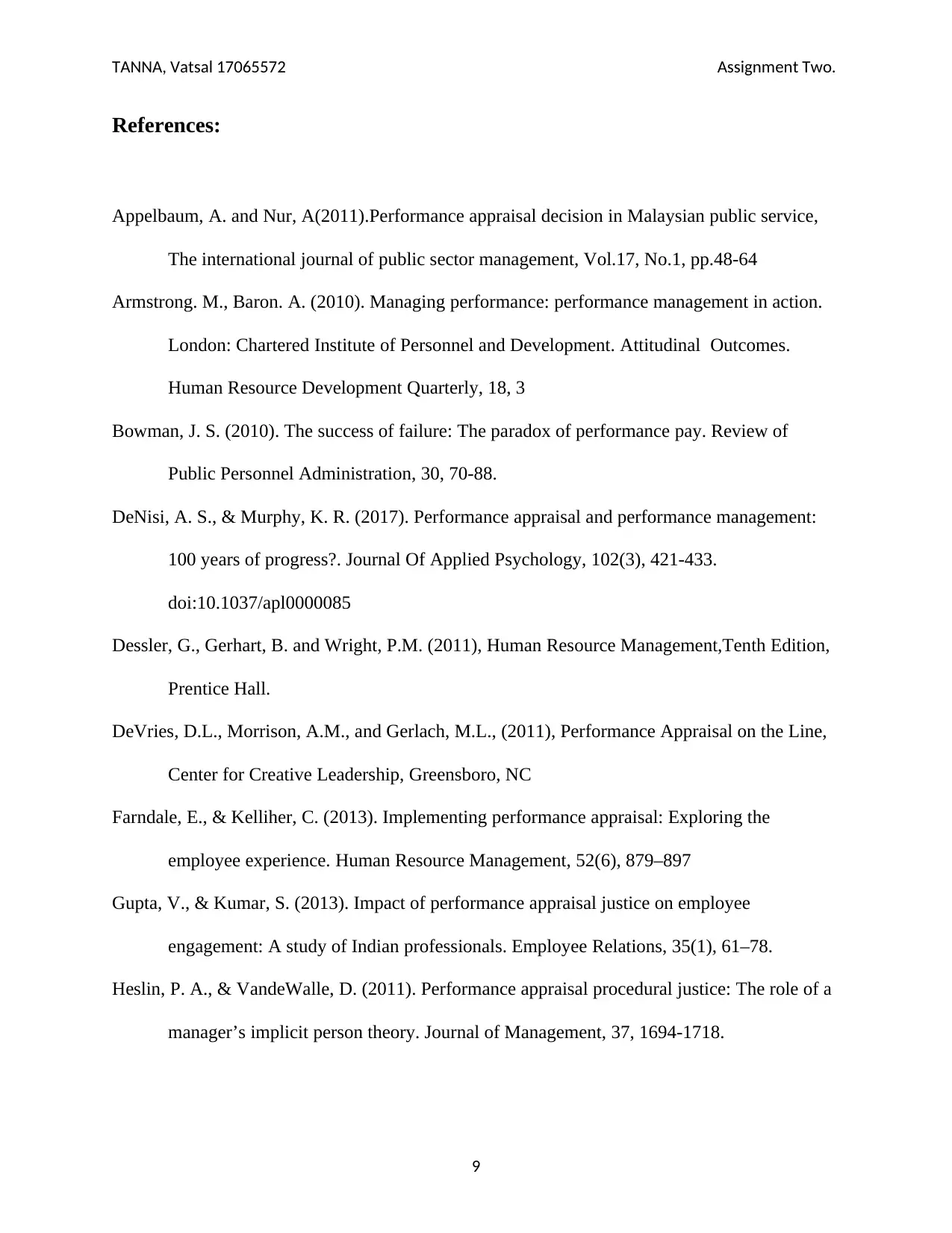
References:
Appelbaum, A. and Nur, A(2011).Performance appraisal decision in Malaysian public service,
The international journal of public sector management, Vol.17, No.1, pp.48-64
Armstrong. M., Baron. A. (2010). Managing performance: performance management in action.
London: Chartered Institute of Personnel and Development. Attitudinal Outcomes.
Human Resource Development Quarterly, 18, 3
Bowman, J. S. (2010). The success of failure: The paradox of performance pay. Review of
Public Personnel Administration, 30, 70-88.
DeNisi, A. S., & Murphy, K. R. (2017). Performance appraisal and performance management:
100 years of progress?. Journal Of Applied Psychology, 102(3), 421-433.
doi:10.1037/apl0000085
Dessler, G., Gerhart, B. and Wright, P.M. (2011), Human Resource Management,Tenth Edition,
Prentice Hall.
DeVries, D.L., Morrison, A.M., and Gerlach, M.L., (2011), Performance Appraisal on the Line,
Center for Creative Leadership, Greensboro, NC
Farndale, E., & Kelliher, C. (2013). Implementing performance appraisal: Exploring the
employee experience. Human Resource Management, 52(6), 879–897
Gupta, V., & Kumar, S. (2013). Impact of performance appraisal justice on employee
engagement: A study of Indian professionals. Employee Relations, 35(1), 61–78.
Heslin, P. A., & VandeWalle, D. (2011). Performance appraisal procedural justice: The role of a
manager’s implicit person theory. Journal of Management, 37, 1694-1718.
9
References:
Appelbaum, A. and Nur, A(2011).Performance appraisal decision in Malaysian public service,
The international journal of public sector management, Vol.17, No.1, pp.48-64
Armstrong. M., Baron. A. (2010). Managing performance: performance management in action.
London: Chartered Institute of Personnel and Development. Attitudinal Outcomes.
Human Resource Development Quarterly, 18, 3
Bowman, J. S. (2010). The success of failure: The paradox of performance pay. Review of
Public Personnel Administration, 30, 70-88.
DeNisi, A. S., & Murphy, K. R. (2017). Performance appraisal and performance management:
100 years of progress?. Journal Of Applied Psychology, 102(3), 421-433.
doi:10.1037/apl0000085
Dessler, G., Gerhart, B. and Wright, P.M. (2011), Human Resource Management,Tenth Edition,
Prentice Hall.
DeVries, D.L., Morrison, A.M., and Gerlach, M.L., (2011), Performance Appraisal on the Line,
Center for Creative Leadership, Greensboro, NC
Farndale, E., & Kelliher, C. (2013). Implementing performance appraisal: Exploring the
employee experience. Human Resource Management, 52(6), 879–897
Gupta, V., & Kumar, S. (2013). Impact of performance appraisal justice on employee
engagement: A study of Indian professionals. Employee Relations, 35(1), 61–78.
Heslin, P. A., & VandeWalle, D. (2011). Performance appraisal procedural justice: The role of a
manager’s implicit person theory. Journal of Management, 37, 1694-1718.
9
⊘ This is a preview!⊘
Do you want full access?
Subscribe today to unlock all pages.
Trusted by 1+ million students worldwide
TANNA, Vatsal 17065572 Assignment Two.
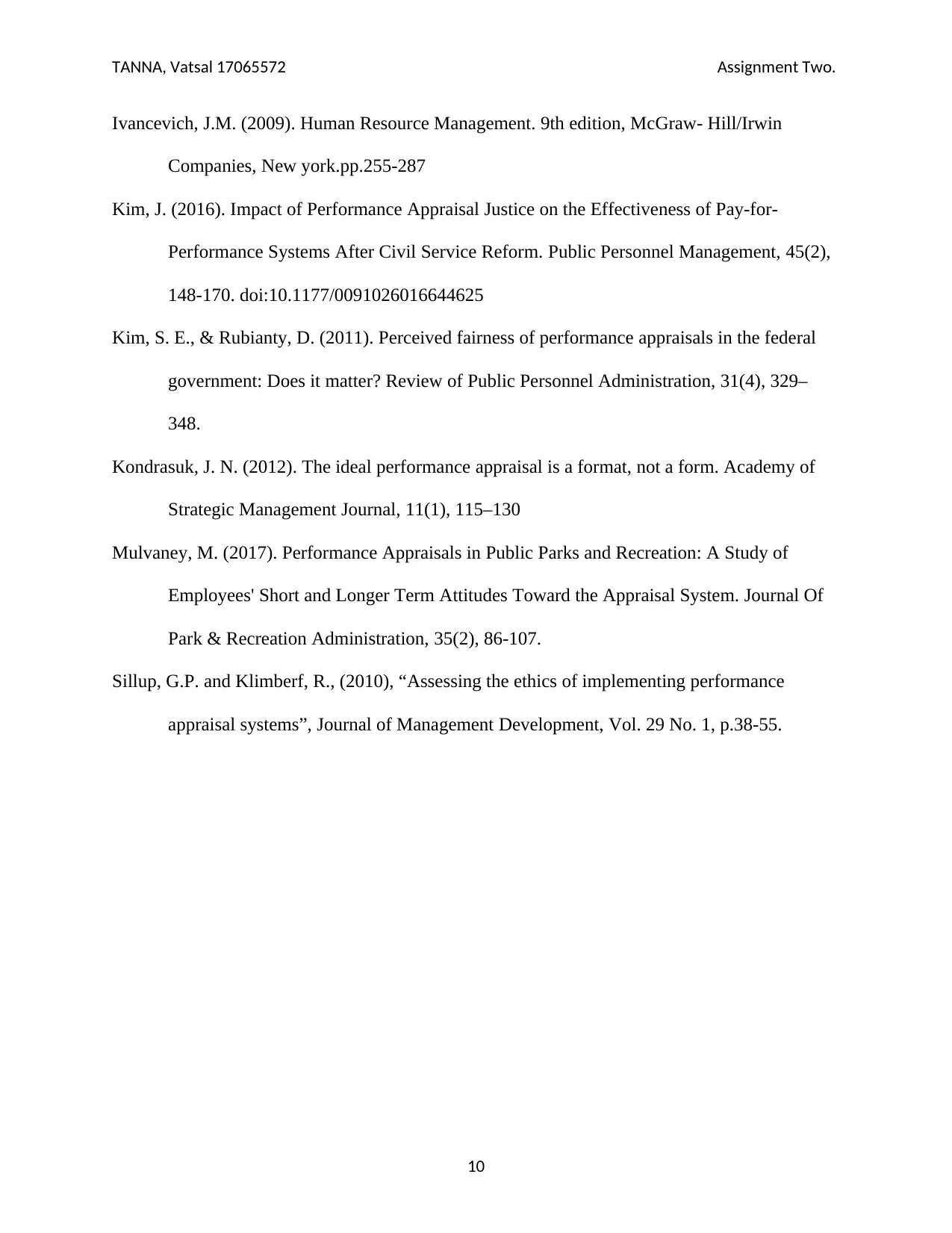
Ivancevich, J.M. (2009). Human Resource Management. 9th edition, McGraw- Hill/Irwin
Companies, New york.pp.255-287
Kim, J. (2016). Impact of Performance Appraisal Justice on the Effectiveness of Pay-for-
Performance Systems After Civil Service Reform. Public Personnel Management, 45(2),
148-170. doi:10.1177/0091026016644625
Kim, S. E., & Rubianty, D. (2011). Perceived fairness of performance appraisals in the federal
government: Does it matter? Review of Public Personnel Administration, 31(4), 329–
348.
Kondrasuk, J. N. (2012). The ideal performance appraisal is a format, not a form. Academy of
Strategic Management Journal, 11(1), 115–130
Mulvaney, M. (2017). Performance Appraisals in Public Parks and Recreation: A Study of
Employees' Short and Longer Term Attitudes Toward the Appraisal System. Journal Of
Park & Recreation Administration, 35(2), 86-107.
Sillup, G.P. and Klimberf, R., (2010), “Assessing the ethics of implementing performance
appraisal systems”, Journal of Management Development, Vol. 29 No. 1, p.38-55.
10
Ivancevich, J.M. (2009). Human Resource Management. 9th edition, McGraw- Hill/Irwin
Companies, New york.pp.255-287
Kim, J. (2016). Impact of Performance Appraisal Justice on the Effectiveness of Pay-for-
Performance Systems After Civil Service Reform. Public Personnel Management, 45(2),
148-170. doi:10.1177/0091026016644625
Kim, S. E., & Rubianty, D. (2011). Perceived fairness of performance appraisals in the federal
government: Does it matter? Review of Public Personnel Administration, 31(4), 329–
348.
Kondrasuk, J. N. (2012). The ideal performance appraisal is a format, not a form. Academy of
Strategic Management Journal, 11(1), 115–130
Mulvaney, M. (2017). Performance Appraisals in Public Parks and Recreation: A Study of
Employees' Short and Longer Term Attitudes Toward the Appraisal System. Journal Of
Park & Recreation Administration, 35(2), 86-107.
Sillup, G.P. and Klimberf, R., (2010), “Assessing the ethics of implementing performance
appraisal systems”, Journal of Management Development, Vol. 29 No. 1, p.38-55.
10

1 out of 10


Related Documents


Your All-in-One AI-Powered Toolkit for Academic Success.
+13062052269
info@desklib.com
Available 24*7 on WhatsApp / Email
![[object Object]](/_next/static/media/star-bottom.7253800d.svg)
Unlock your academic potential
Copyright © 2020–2026 A2Z Services. All Rights Reserved. Developed and managed by ZUCOL.