Contemporary Issues in Health: Screening Advantages and Disadvantages

Verified

Added on  2022/09/08

|22
|1249
|16
Presentation
AI Summary
This presentation provides an analysis of the advantages and disadvantages of disease screening, with a focus on breast cancer screening within the UK's National Health Service (NHS). It begins by defining screening and exploring sociological perspectives, notably Armstrong's theory of surveillance medicine, which examines how societal factors influence health and illness. The presentation then delves into the NHS Breast Screening Program, presenting statistical data on breast cancer incidence, mortality rates, and screening participation. It highlights trends in breast cancer detection and mortality, and discusses the challenges faced by the NHS in its screening programs. The advantages of screening, such as early disease detection, are weighed against the disadvantages, including the potential for misdiagnosis and the psychological impact on patients. The conclusion emphasizes the importance of adopting appropriate strategies to ensure safe public health, acknowledging the complex balance between the benefits and drawbacks of screening programs. References include academic sources and NHS publications.
Document Page
Screening:
Advantages and
disadvantages
tabler-icon-diamond-filled.svg

Paraphrase This Document

Need a fresh take? Get an instant paraphrase of this document with our AI Paraphraser
Document Page
In this presentation, an analysis will be done
over the advantages and disadvantages of
screening for achieving a sound health.
The pros and cons of screening will be
judged on the bases of different theories of
health and medicines including Surveillance
theory of medicines by Armstrong and
Eborall.
Introduction
Document Page
The trend in UK related to impact of
screening will also be analysed.
Focus will be given on achieving a sound
public health for the country with the help
of NHS programs.
Document Page
Screening refers to a method to identify the
symptoms of breast cancer with the help of
mammography.
Definition of screening
tabler-icon-diamond-filled.svg

Paraphrase This Document

Need a fresh take? Get an instant paraphrase of this document with our AI Paraphraser
Document Page
This theory remapped the fundamental space
of illness. This focuses on the psychological
and social factors related to the person which
leads towards the construction of illness
(Armstrong, 1995).
It was said by Armstrong that in 21st century,
positive social environment is the key factor of
sound health because he felt that most of the
diseases are constructed due to the pressure of
society (Armstrong, 1995).
Theory of surveillance medicine
by Armstrong
Document Page
Armstrong believes that many social factors
like low economic condition, looks, obesity,
complexion, neglecting by parents and
family members, lack of emotional support
and workplace pressure leads towards the
mental problems in a person and finally
results in harmful diseases (Armstrong,
1995).
Theory of surveillance medicine
by Armstrong
Document Page
This theory stated that screening is a best
method to avoid treatments of crucial diseases.
Screening is the best strategy to achieve sound
public health.
Authors believe that because of many risk
factors related to social life of public, screening
and other preventive methods should be
beneficial in achieving a satisfactory public
health (Eborall, 2012).
Theory of Surveillance by
Armstrong and Eborall
tabler-icon-diamond-filled.svg

Paraphrase This Document

Need a fresh take? Get an instant paraphrase of this document with our AI Paraphraser
Document Page
This theory focus on the physical and
emotional changes of public after screening
test.
The author stated that the health of a person
is not only related to the absence of a
disease. It is related to the regular routine
work and a power to resist the disease
(Gillespie, 2015).
Theory of surveillance medicine
by Chris Gillespie
Document Page
NHS is offering Breast Screening Program to
the females of UK above the age of 50 years
to save them from the risk of breast cancer
(NHS, 2019).
Breast screening Program
offered by NHS
Document Page
According to the statistics of organisation of
cancer research UK, around 55,213 new
cases of breast cancer detected in 2014-
2016. Among them 11,399 women died.
Only 23% of cases were preventable.
Trend of breast cancer in
UK
tabler-icon-diamond-filled.svg

Paraphrase This Document

Need a fresh take? Get an instant paraphrase of this document with our AI Paraphraser
Document Page
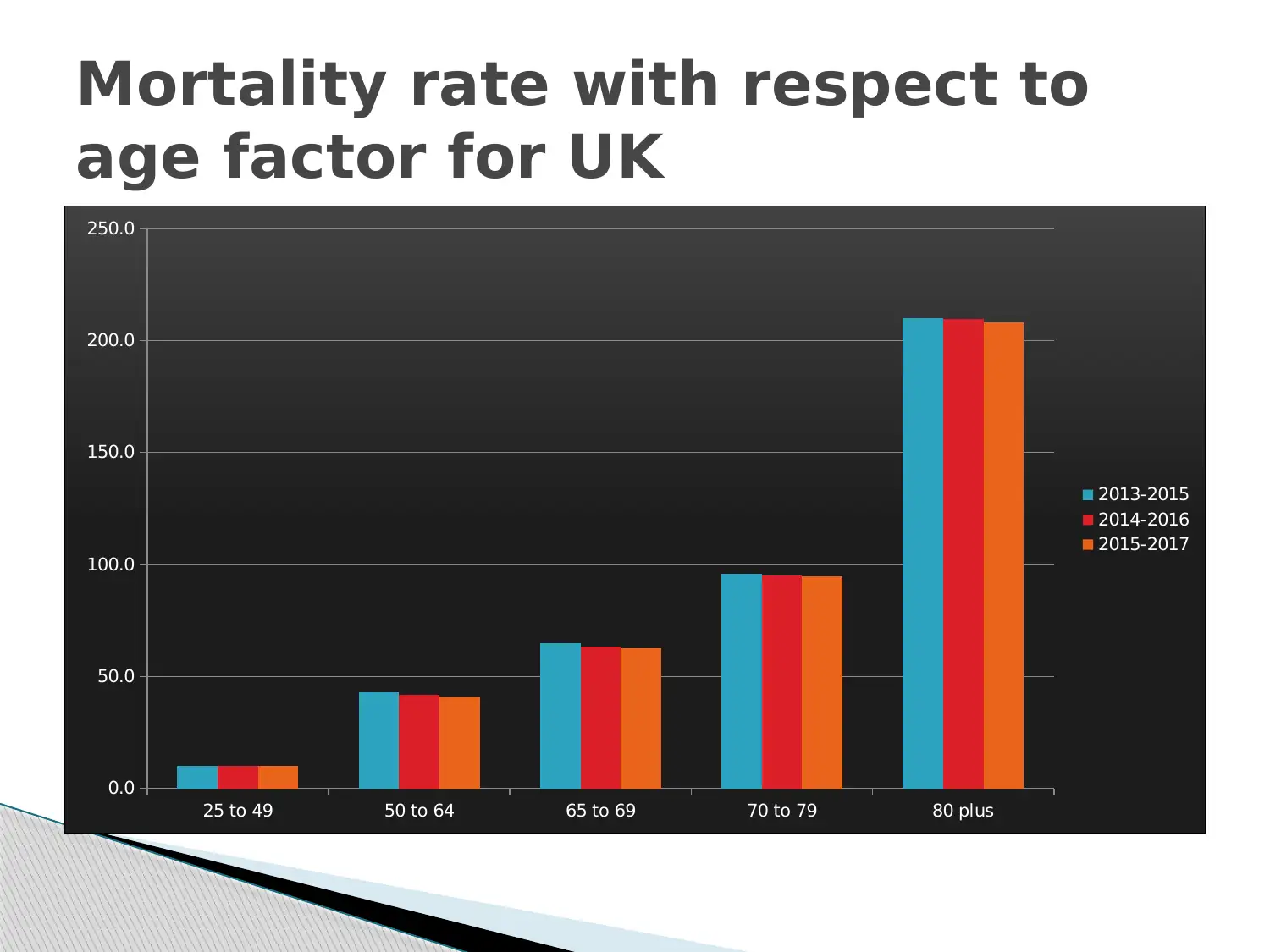
25 to 49 50 to 64 65 to 69 70 to 79 80 plus
0.0
50.0
100.0
150.0
200.0
250.0
2013-2015
2014-2016
2015-2017
Mortality rate with respect to
age factor for UK
Document Page
In 2016-2017, 2.20 million women, who are aged
45 years or above screened within the program
of NHS. In which 18,402 detected the breast
cancer(8.4 cases per 1000 women) (NHS, 2018).
Whereas in 2015-2016, 2.16 million women
screened within the program with same age
group (NHS, 2018)..
An increase of 1.8% reported in screening by
NHS program in last one year.
Data analysis of NHS program of
screening 2016-2017:
chevron_up_icon
1 out of 22
circle_padding
hide_on_mobile
zoom_out_icon
[object Object]