Automation in Hospitality and Tourism: History, Impact, and Future
VerifiedAdded on 2023/04/24
|9
|2489
|170
Essay
AI Summary
This essay provides a comprehensive analysis of automation's role in the hospitality and tourism industries. It begins with an overview of factors driving global trends, such as safety and security, global competition, and price value, and then explores the historical development of robotics, including key figures and milestones. The essay then examines the current applications of automation within the hospitality and tourism sectors, providing context-specific examples. It assesses the present impact of automation, predicting its future effects, such as increased job opportunities and data collection capabilities. Furthermore, the essay addresses criticisms and concerns regarding automation, including job displacement, the potential dangers of AI, and the loss of human interaction, offering assessments of their validity. The essay concludes by summarizing the significant changes automation is bringing to the hospitality and tourism industries, emphasizing the importance of its future development and the need to consider its impacts on the workforce and customer experience.
Running head: AUTOMATION 1
Automation
Name
Institution
Automation
Name
Institution

Paraphrase This Document
Need a fresh take? Get an instant paraphrase of this document with our AI Paraphraser
AUTOMATION 2
AUTOMATION
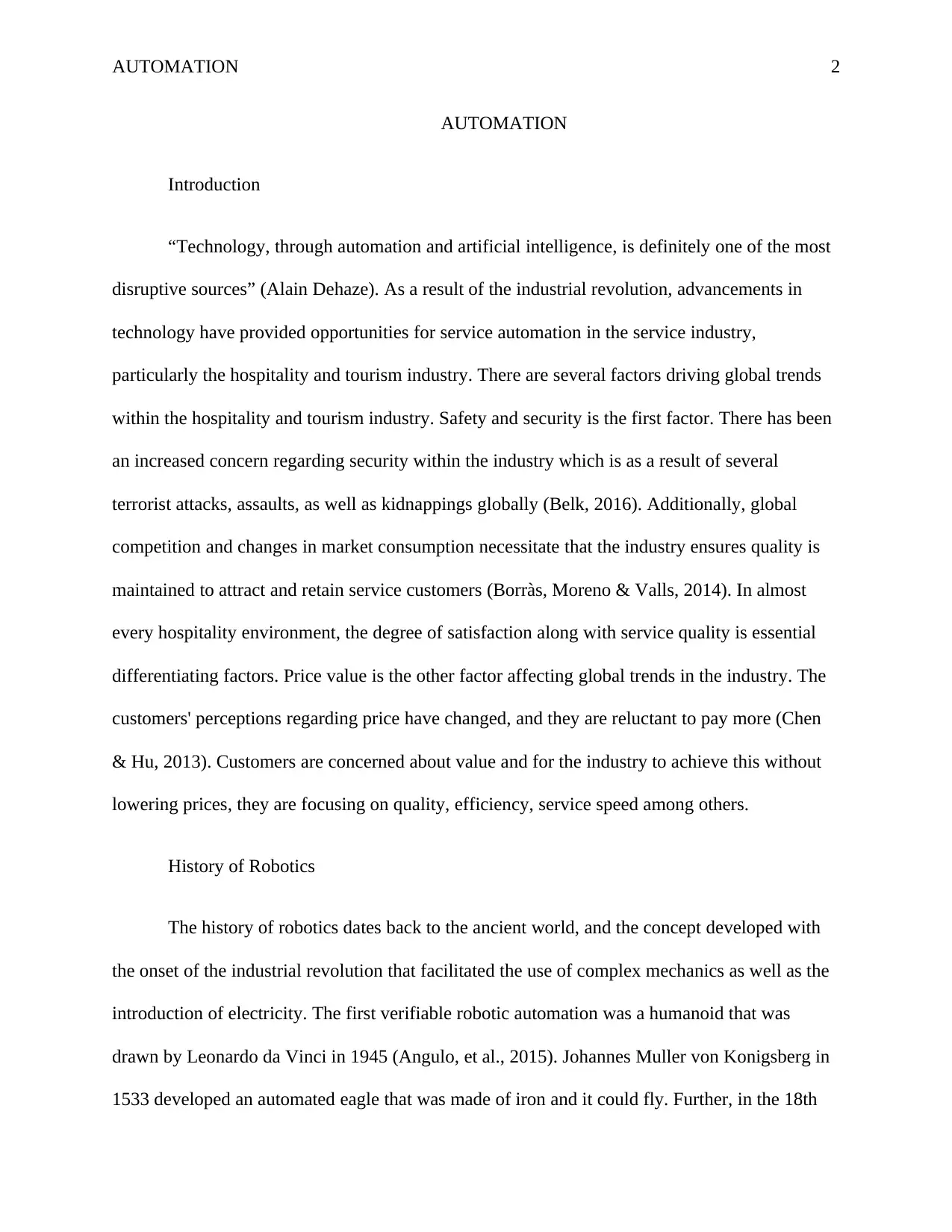
Introduction
“Technology, through automation and artificial intelligence, is definitely one of the most
disruptive sources” (Alain Dehaze). As a result of the industrial revolution, advancements in
technology have provided opportunities for service automation in the service industry,
particularly the hospitality and tourism industry. There are several factors driving global trends
within the hospitality and tourism industry. Safety and security is the first factor. There has been
an increased concern regarding security within the industry which is as a result of several
terrorist attacks, assaults, as well as kidnappings globally (Belk, 2016). Additionally, global
competition and changes in market consumption necessitate that the industry ensures quality is
maintained to attract and retain service customers (Borràs, Moreno & Valls, 2014). In almost
every hospitality environment, the degree of satisfaction along with service quality is essential
differentiating factors. Price value is the other factor affecting global trends in the industry. The
customers' perceptions regarding price have changed, and they are reluctant to pay more (Chen
& Hu, 2013). Customers are concerned about value and for the industry to achieve this without
lowering prices, they are focusing on quality, efficiency, service speed among others.
History of Robotics
The history of robotics dates back to the ancient world, and the concept developed with
the onset of the industrial revolution that facilitated the use of complex mechanics as well as the
introduction of electricity. The first verifiable robotic automation was a humanoid that was
drawn by Leonardo da Vinci in 1945 (Angulo, et al., 2015). Johannes Muller von Konigsberg in
1533 developed an automated eagle that was made of iron and it could fly. Further, in the 18th
AUTOMATION
Introduction
“Technology, through automation and artificial intelligence, is definitely one of the most
disruptive sources” (Alain Dehaze). As a result of the industrial revolution, advancements in
technology have provided opportunities for service automation in the service industry,
particularly the hospitality and tourism industry. There are several factors driving global trends
within the hospitality and tourism industry. Safety and security is the first factor. There has been
an increased concern regarding security within the industry which is as a result of several
terrorist attacks, assaults, as well as kidnappings globally (Belk, 2016). Additionally, global
competition and changes in market consumption necessitate that the industry ensures quality is
maintained to attract and retain service customers (Borràs, Moreno & Valls, 2014). In almost
every hospitality environment, the degree of satisfaction along with service quality is essential
differentiating factors. Price value is the other factor affecting global trends in the industry. The
customers' perceptions regarding price have changed, and they are reluctant to pay more (Chen
& Hu, 2013). Customers are concerned about value and for the industry to achieve this without
lowering prices, they are focusing on quality, efficiency, service speed among others.
History of Robotics
The history of robotics dates back to the ancient world, and the concept developed with
the onset of the industrial revolution that facilitated the use of complex mechanics as well as the
introduction of electricity. The first verifiable robotic automation was a humanoid that was
drawn by Leonardo da Vinci in 1945 (Angulo, et al., 2015). Johannes Muller von Konigsberg in
1533 developed an automated eagle that was made of iron and it could fly. Further, in the 18th
AUTOMATION 3
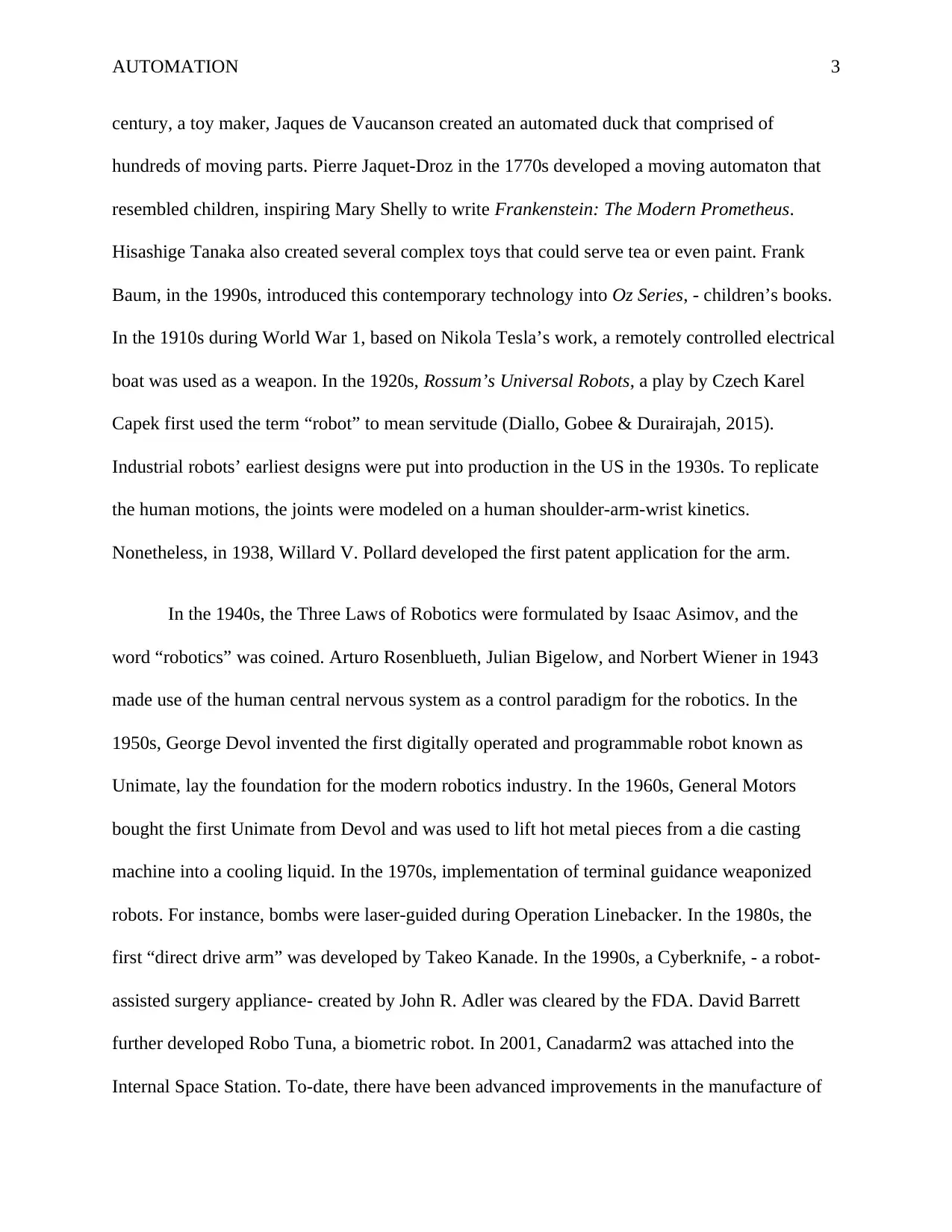
century, a toy maker, Jaques de Vaucanson created an automated duck that comprised of
hundreds of moving parts. Pierre Jaquet-Droz in the 1770s developed a moving automaton that
resembled children, inspiring Mary Shelly to write Frankenstein: The Modern Prometheus.
Hisashige Tanaka also created several complex toys that could serve tea or even paint. Frank
Baum, in the 1990s, introduced this contemporary technology into Oz Series, - children’s books.
In the 1910s during World War 1, based on Nikola Tesla’s work, a remotely controlled electrical
boat was used as a weapon. In the 1920s, Rossum’s Universal Robots, a play by Czech Karel
Capek first used the term “robot” to mean servitude (Diallo, Gobee & Durairajah, 2015).
Industrial robots’ earliest designs were put into production in the US in the 1930s. To replicate
the human motions, the joints were modeled on a human shoulder-arm-wrist kinetics.
Nonetheless, in 1938, Willard V. Pollard developed the first patent application for the arm.
In the 1940s, the Three Laws of Robotics were formulated by Isaac Asimov, and the
word “robotics” was coined. Arturo Rosenblueth, Julian Bigelow, and Norbert Wiener in 1943
made use of the human central nervous system as a control paradigm for the robotics. In the
1950s, George Devol invented the first digitally operated and programmable robot known as
Unimate, lay the foundation for the modern robotics industry. In the 1960s, General Motors
bought the first Unimate from Devol and was used to lift hot metal pieces from a die casting
machine into a cooling liquid. In the 1970s, implementation of terminal guidance weaponized
robots. For instance, bombs were laser-guided during Operation Linebacker. In the 1980s, the
first “direct drive arm” was developed by Takeo Kanade. In the 1990s, a Cyberknife, - a robot-
assisted surgery appliance- created by John R. Adler was cleared by the FDA. David Barrett
further developed Robo Tuna, a biometric robot. In 2001, Canadarm2 was attached into the
Internal Space Station. To-date, there have been advanced improvements in the manufacture of
century, a toy maker, Jaques de Vaucanson created an automated duck that comprised of
hundreds of moving parts. Pierre Jaquet-Droz in the 1770s developed a moving automaton that
resembled children, inspiring Mary Shelly to write Frankenstein: The Modern Prometheus.
Hisashige Tanaka also created several complex toys that could serve tea or even paint. Frank
Baum, in the 1990s, introduced this contemporary technology into Oz Series, - children’s books.
In the 1910s during World War 1, based on Nikola Tesla’s work, a remotely controlled electrical
boat was used as a weapon. In the 1920s, Rossum’s Universal Robots, a play by Czech Karel
Capek first used the term “robot” to mean servitude (Diallo, Gobee & Durairajah, 2015).
Industrial robots’ earliest designs were put into production in the US in the 1930s. To replicate
the human motions, the joints were modeled on a human shoulder-arm-wrist kinetics.
Nonetheless, in 1938, Willard V. Pollard developed the first patent application for the arm.
In the 1940s, the Three Laws of Robotics were formulated by Isaac Asimov, and the
word “robotics” was coined. Arturo Rosenblueth, Julian Bigelow, and Norbert Wiener in 1943
made use of the human central nervous system as a control paradigm for the robotics. In the
1950s, George Devol invented the first digitally operated and programmable robot known as
Unimate, lay the foundation for the modern robotics industry. In the 1960s, General Motors
bought the first Unimate from Devol and was used to lift hot metal pieces from a die casting
machine into a cooling liquid. In the 1970s, implementation of terminal guidance weaponized
robots. For instance, bombs were laser-guided during Operation Linebacker. In the 1980s, the
first “direct drive arm” was developed by Takeo Kanade. In the 1990s, a Cyberknife, - a robot-
assisted surgery appliance- created by John R. Adler was cleared by the FDA. David Barrett
further developed Robo Tuna, a biometric robot. In 2001, Canadarm2 was attached into the
Internal Space Station. To-date, there have been advanced improvements in the manufacture of
⊘ This is a preview!⊘
Do you want full access?
Subscribe today to unlock all pages.

Trusted by 1+ million students worldwide
AUTOMATION 4
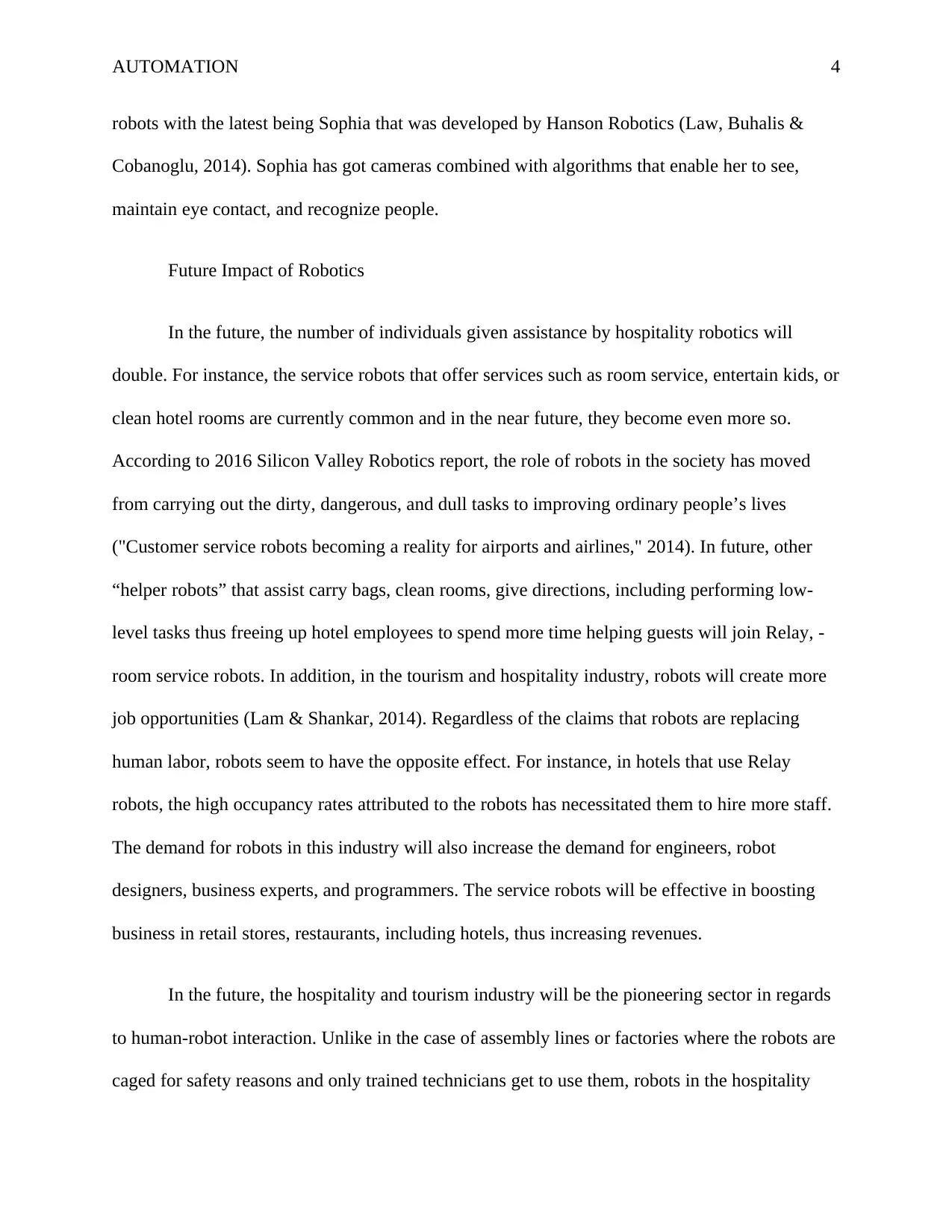
robots with the latest being Sophia that was developed by Hanson Robotics (Law, Buhalis &
Cobanoglu, 2014). Sophia has got cameras combined with algorithms that enable her to see,
maintain eye contact, and recognize people.
Future Impact of Robotics
In the future, the number of individuals given assistance by hospitality robotics will
double. For instance, the service robots that offer services such as room service, entertain kids, or
clean hotel rooms are currently common and in the near future, they become even more so.
According to 2016 Silicon Valley Robotics report, the role of robots in the society has moved
from carrying out the dirty, dangerous, and dull tasks to improving ordinary people’s lives
("Customer service robots becoming a reality for airports and airlines," 2014). In future, other
“helper robots” that assist carry bags, clean rooms, give directions, including performing low-
level tasks thus freeing up hotel employees to spend more time helping guests will join Relay, -
room service robots. In addition, in the tourism and hospitality industry, robots will create more
job opportunities (Lam & Shankar, 2014). Regardless of the claims that robots are replacing
human labor, robots seem to have the opposite effect. For instance, in hotels that use Relay
robots, the high occupancy rates attributed to the robots has necessitated them to hire more staff.
The demand for robots in this industry will also increase the demand for engineers, robot
designers, business experts, and programmers. The service robots will be effective in boosting
business in retail stores, restaurants, including hotels, thus increasing revenues.
In the future, the hospitality and tourism industry will be the pioneering sector in regards
to human-robot interaction. Unlike in the case of assembly lines or factories where the robots are
caged for safety reasons and only trained technicians get to use them, robots in the hospitality
robots with the latest being Sophia that was developed by Hanson Robotics (Law, Buhalis &
Cobanoglu, 2014). Sophia has got cameras combined with algorithms that enable her to see,
maintain eye contact, and recognize people.
Future Impact of Robotics
In the future, the number of individuals given assistance by hospitality robotics will
double. For instance, the service robots that offer services such as room service, entertain kids, or
clean hotel rooms are currently common and in the near future, they become even more so.
According to 2016 Silicon Valley Robotics report, the role of robots in the society has moved
from carrying out the dirty, dangerous, and dull tasks to improving ordinary people’s lives
("Customer service robots becoming a reality for airports and airlines," 2014). In future, other
“helper robots” that assist carry bags, clean rooms, give directions, including performing low-
level tasks thus freeing up hotel employees to spend more time helping guests will join Relay, -
room service robots. In addition, in the tourism and hospitality industry, robots will create more
job opportunities (Lam & Shankar, 2014). Regardless of the claims that robots are replacing
human labor, robots seem to have the opposite effect. For instance, in hotels that use Relay
robots, the high occupancy rates attributed to the robots has necessitated them to hire more staff.
The demand for robots in this industry will also increase the demand for engineers, robot
designers, business experts, and programmers. The service robots will be effective in boosting
business in retail stores, restaurants, including hotels, thus increasing revenues.
In the future, the hospitality and tourism industry will be the pioneering sector in regards
to human-robot interaction. Unlike in the case of assembly lines or factories where the robots are
caged for safety reasons and only trained technicians get to use them, robots in the hospitality
Paraphrase This Document
Need a fresh take? Get an instant paraphrase of this document with our AI Paraphraser
AUTOMATION 5
and tourism industry should be safe for every person and safe to use ("Travelers Expect Robots
on Their Holidays by 2020," 2016). As such, they should be helpful, non-threatening, and
approachable. Robots will be an essential source of data. As they serve the customers and
perform other tasks, robots will be in a position to collect any sort of data about the clients’
satisfaction, their purchase patterns, including other behaviors (Louie, McColl & Nejat, 2014).
According to Silicon Valleys, the future impact of robots in the hospitality and tourism industry
is that they will be “active mobile data collectors” that can be used to unlock data-driven
understanding by leveraging the global connectivity that has been enabled by cloud computing
(Kim, & Qu, 2014). Because robots are connected to the larger Internet of Things, they will be
used in the hospitality and tourism industry to serve as data collection points when interacting
with clients. The robot-generated data will then be used to improve the industry’s processes as
well as increase the returns on investment.
Criticism
The use of robotics has received criticism such as rendering people jobless. For instance,
an analysis conducted by the Bank of England suggests that approximately 80 million United
States’ job could be replaced by technology. A 2014 Per Research Center poll also indicated that
48% digital technology and robots will displace several blue and white-collar employees. There
are several arguments about robots displacing many workers; countries have room for several
STEM professionals. However, sending every person to robot boot camp or programming means
there will be more educated individuals compared to the open positions, which will, in turn,
lower salaries due to the oversupply of labor (Papathanassis, 2017). There are also criticisms that
AI is dangerous. Globally, huge strides related to AI have been made but there is still a long way
off from developing robots that are smart or even smarter than humans. People are worried that
and tourism industry should be safe for every person and safe to use ("Travelers Expect Robots
on Their Holidays by 2020," 2016). As such, they should be helpful, non-threatening, and
approachable. Robots will be an essential source of data. As they serve the customers and
perform other tasks, robots will be in a position to collect any sort of data about the clients’
satisfaction, their purchase patterns, including other behaviors (Louie, McColl & Nejat, 2014).
According to Silicon Valleys, the future impact of robots in the hospitality and tourism industry
is that they will be “active mobile data collectors” that can be used to unlock data-driven
understanding by leveraging the global connectivity that has been enabled by cloud computing
(Kim, & Qu, 2014). Because robots are connected to the larger Internet of Things, they will be
used in the hospitality and tourism industry to serve as data collection points when interacting
with clients. The robot-generated data will then be used to improve the industry’s processes as
well as increase the returns on investment.
Criticism
The use of robotics has received criticism such as rendering people jobless. For instance,
an analysis conducted by the Bank of England suggests that approximately 80 million United
States’ job could be replaced by technology. A 2014 Per Research Center poll also indicated that
48% digital technology and robots will displace several blue and white-collar employees. There
are several arguments about robots displacing many workers; countries have room for several
STEM professionals. However, sending every person to robot boot camp or programming means
there will be more educated individuals compared to the open positions, which will, in turn,
lower salaries due to the oversupply of labor (Papathanassis, 2017). There are also criticisms that
AI is dangerous. Globally, huge strides related to AI have been made but there is still a long way
off from developing robots that are smart or even smarter than humans. People are worried that
AUTOMATION 6
in the future, robots’ intelligence might be used against them. Critics also argue that the same
way that Google Home or Amazon Echo smart home assistants “listen” all the time to monitor
ambient noises and enable for their activation using “keywords”, the robots and machines will
act in a similar way. Thus, the organization will be in a position to capture the staff’s sensitive
information. The information captured could be used to infringe an employee’s privacy.
Recently, in the airline industry, there have been several high-profile customer service
fiasco. It is clear that the manner which an organization treats its clients can make or break its
reputation. With technological developments that comprise of buzzwords such as machine
learning, robotics, cognitive computing, and VR are viewed as the best means of managing
clients’ needs. The use of artificial intelligence in managing customer service is a global trend
that has been increasingly used (Gladstone, n.d.). However, critics argue that when it comes to
customer service, the robots cannot replace humans because human interaction is important. All
customer interactions are based on emotion and urgency. Artificial intelligence tools such as
robots are being used to address issues to do with high-urgency situations. However, regarding
scenarios requiring high-emotion, robots cannot replicate human empathy (Delener, 2010).
Depending on an organization’s number of customer service interactions, the speed of artificial
intelligence can be used for objective reasons such as running a query to determine if there are
unfilled seats in an airline in case a client needs to purchase an upgrade. Nevertheless, inquiries
that require a high emotional spectrum or likely involves unique problem solving, the robots
cannot replace the personal touch that a human offers. For instance, clients who lose their
luggage are likely to seek help from staff to locate the bag. Despite that the staff might use
artificial intelligence to locate the bag, the interaction is too emotional to remove the human
element.
in the future, robots’ intelligence might be used against them. Critics also argue that the same
way that Google Home or Amazon Echo smart home assistants “listen” all the time to monitor
ambient noises and enable for their activation using “keywords”, the robots and machines will
act in a similar way. Thus, the organization will be in a position to capture the staff’s sensitive
information. The information captured could be used to infringe an employee’s privacy.
Recently, in the airline industry, there have been several high-profile customer service
fiasco. It is clear that the manner which an organization treats its clients can make or break its
reputation. With technological developments that comprise of buzzwords such as machine
learning, robotics, cognitive computing, and VR are viewed as the best means of managing
clients’ needs. The use of artificial intelligence in managing customer service is a global trend
that has been increasingly used (Gladstone, n.d.). However, critics argue that when it comes to
customer service, the robots cannot replace humans because human interaction is important. All
customer interactions are based on emotion and urgency. Artificial intelligence tools such as
robots are being used to address issues to do with high-urgency situations. However, regarding
scenarios requiring high-emotion, robots cannot replicate human empathy (Delener, 2010).
Depending on an organization’s number of customer service interactions, the speed of artificial
intelligence can be used for objective reasons such as running a query to determine if there are
unfilled seats in an airline in case a client needs to purchase an upgrade. Nevertheless, inquiries
that require a high emotional spectrum or likely involves unique problem solving, the robots
cannot replace the personal touch that a human offers. For instance, clients who lose their
luggage are likely to seek help from staff to locate the bag. Despite that the staff might use
artificial intelligence to locate the bag, the interaction is too emotional to remove the human
element.
⊘ This is a preview!⊘
Do you want full access?
Subscribe today to unlock all pages.
Trusted by 1+ million students worldwide
AUTOMATION 7
Conclusion
Automation, AI, and the use of robots has entered the hospitality and tourism industry.
For instance, Japan’s Henn-na hotel has automated its services and the customers do not
experience the staff. In addition, Las Vegas’ Wynn hotel has also introduced Amazon’s Echo
voice-controlled speakers in all its rooms. Automation and the use of robots in the hospitality and
tourism industry have provided opportunities to improve on productivity as well as operations
and maintain consistency in quality. In the future, it is expected that the number of customers
receiving help from robots will double, robots will create more job opportunities, and they will
increase return on investment. However, critics argue that adopting robotics will lender people
jobless, there are fears that robot’s intelligence might be used against humans in the future, and
that using robots eliminates the human interaction which is crucial for the service industry.
Conclusion
Automation, AI, and the use of robots has entered the hospitality and tourism industry.
For instance, Japan’s Henn-na hotel has automated its services and the customers do not
experience the staff. In addition, Las Vegas’ Wynn hotel has also introduced Amazon’s Echo
voice-controlled speakers in all its rooms. Automation and the use of robots in the hospitality and
tourism industry have provided opportunities to improve on productivity as well as operations
and maintain consistency in quality. In the future, it is expected that the number of customers
receiving help from robots will double, robots will create more job opportunities, and they will
increase return on investment. However, critics argue that adopting robotics will lender people
jobless, there are fears that robot’s intelligence might be used against humans in the future, and
that using robots eliminates the human interaction which is crucial for the service industry.
Paraphrase This Document
Need a fresh take? Get an instant paraphrase of this document with our AI Paraphraser
AUTOMATION 8
References
Angulo, C., Pfeiffer, S., Tellez, R., & Alenyà, G. (2015). Evaluating the use of robots to enlarge
AAL services1. Journal of Ambient Intelligence and Smart Environments, 7(3), 301-313.
Belk, R. (2016). Understanding the robot: Comments on Goudey and Bonnin (2016). Recherche
et Applications en Marketing (English Edition), 31(4), 83-90.
Borràs, J., Moreno, A., & Valls, A. (2014). Intelligent tourism recommender systems: A
survey. Expert Systems with Applications, 41(16), 7370-7389.
Chen, Y., & Hu, H. (2013). Internet of intelligent things and robot as a service. Simulation
Modelling Practice and Theory, 34, 159-171.
Customer service robots becoming a reality for airports and airlines. (2014, March 10). Retrieved
from https://www.futuretravelexperience.com/2013/08/customer-service-robots-
becoming-a-reality-for-airports-and-airlines/
Delener, N. (2010). Current trends in the global tourism industry: evidence from the United
States. Revista de Administração Pública, 44(5), 1125-1137.
Diallo, A. D., Gobee, S., & Durairajah, V. (2015). Autonomous tour guide robot using embedded
system control. Procedia Computer Science, 76, 126-133.
Gladstone, N. (n.d.). Are Robots the Future of Hotels? Retrieved from
https://www.oyster.com/articles/53595-are-robots-the-future-of-hotels/
Kim, M., & Qu, H. (2014). Travelers' behavioral intention toward hotel self-service kiosks
usage. International Journal of Contemporary Hospitality Management, 26(2), 225-245.
References
Angulo, C., Pfeiffer, S., Tellez, R., & Alenyà, G. (2015). Evaluating the use of robots to enlarge
AAL services1. Journal of Ambient Intelligence and Smart Environments, 7(3), 301-313.
Belk, R. (2016). Understanding the robot: Comments on Goudey and Bonnin (2016). Recherche
et Applications en Marketing (English Edition), 31(4), 83-90.
Borràs, J., Moreno, A., & Valls, A. (2014). Intelligent tourism recommender systems: A
survey. Expert Systems with Applications, 41(16), 7370-7389.
Chen, Y., & Hu, H. (2013). Internet of intelligent things and robot as a service. Simulation
Modelling Practice and Theory, 34, 159-171.
Customer service robots becoming a reality for airports and airlines. (2014, March 10). Retrieved
from https://www.futuretravelexperience.com/2013/08/customer-service-robots-
becoming-a-reality-for-airports-and-airlines/
Delener, N. (2010). Current trends in the global tourism industry: evidence from the United
States. Revista de Administração Pública, 44(5), 1125-1137.
Diallo, A. D., Gobee, S., & Durairajah, V. (2015). Autonomous tour guide robot using embedded
system control. Procedia Computer Science, 76, 126-133.
Gladstone, N. (n.d.). Are Robots the Future of Hotels? Retrieved from
https://www.oyster.com/articles/53595-are-robots-the-future-of-hotels/
Kim, M., & Qu, H. (2014). Travelers' behavioral intention toward hotel self-service kiosks
usage. International Journal of Contemporary Hospitality Management, 26(2), 225-245.
AUTOMATION 9
Lam, S. Y., & Shankar, V. (2014). Asymmetries in the effects of drivers of brand loyalty
between early and late adopters and across technology generations. Journal of Interactive
Marketing, 28(1), 26-42.
Law, R., Buhalis, D., & Cobanoglu, C. (2014). Progress on information and communication
technologies in hospitality and tourism. International Journal of Contemporary
Hospitality Management, 26(5), 727-750.
Louie, W. Y. G., McColl, D., & Nejat, G. (2014). Acceptance and attitudes toward a human-like
socially assistive robot by older adults. Assistive Technology, 26(3), 140-150.
Papathanassis, A. (2017). Cruise tourism management: State of the art. Tourism Review, 72(1),
104-119.
Travellers Expect Robots on Their Holidays by 2020. (2016, March 16). Retrieved from
https://press.travelzoo.com/robophiles--robophobes--britons-divided-over-use-of-robots-
in-travel/
Lam, S. Y., & Shankar, V. (2014). Asymmetries in the effects of drivers of brand loyalty
between early and late adopters and across technology generations. Journal of Interactive
Marketing, 28(1), 26-42.
Law, R., Buhalis, D., & Cobanoglu, C. (2014). Progress on information and communication
technologies in hospitality and tourism. International Journal of Contemporary
Hospitality Management, 26(5), 727-750.
Louie, W. Y. G., McColl, D., & Nejat, G. (2014). Acceptance and attitudes toward a human-like
socially assistive robot by older adults. Assistive Technology, 26(3), 140-150.
Papathanassis, A. (2017). Cruise tourism management: State of the art. Tourism Review, 72(1),
104-119.
Travellers Expect Robots on Their Holidays by 2020. (2016, March 16). Retrieved from
https://press.travelzoo.com/robophiles--robophobes--britons-divided-over-use-of-robots-
in-travel/
⊘ This is a preview!⊘
Do you want full access?
Subscribe today to unlock all pages.
Trusted by 1+ million students worldwide

1 out of 9


Related Documents


Your All-in-One AI-Powered Toolkit for Academic Success.
+13062052269
info@desklib.com
Available 24*7 on WhatsApp / Email
![[object Object]](/_next/static/media/star-bottom.7253800d.svg)
Unlock your academic potential
Copyright © 2020–2026 A2Z Services. All Rights Reserved. Developed and managed by ZUCOL.