University Research Report: Mental Health Service User Involvement
VerifiedAdded on 2020/05/28
|11
|1931
|56
Report
AI Summary
This report investigates service user involvement in promoting mental health service delivery. It begins with an introduction to the concept and its growing importance, followed by the research methodology, which utilizes an interpretivism philosophy and a deductive approach to analyze secondary data. The report outlines the research questions, including primary and sub-questions focused on the concept of service user involvement and its integration into care planning. The research design is descriptive, and data collection involves both inclusive and exclusive data from peer-reviewed journals and academic books. The limitations of the study, such as time and financial constraints, are discussed, along with suggestions for further research, including a deeper analysis of the outcomes valued by service users. The timeline of the research study is also included. The conclusion emphasizes the development of the concept of service user involvement, its usefulness in theory and strategy expansion, and the importance of involving key stakeholders. Finally, the report provides a detailed reference list.
Running head: SERVICE USER INVOLVEMENT IN PROMOTING MENTAL HEALTH
SERVICE DELIVERY
Service User Involvement in Promoting Mental Health Service Delivery
Name of the Student:
Name of the University:
Author Note:
SERVICE DELIVERY
Service User Involvement in Promoting Mental Health Service Delivery
Name of the Student:
Name of the University:
Author Note:
Paraphrase This Document
Need a fresh take? Get an instant paraphrase of this document with our AI Paraphraser

2
SERVICE USER INVOLVEMENT IN PROMOTING MENTAL HEALTH SERVICE
DELIVERY
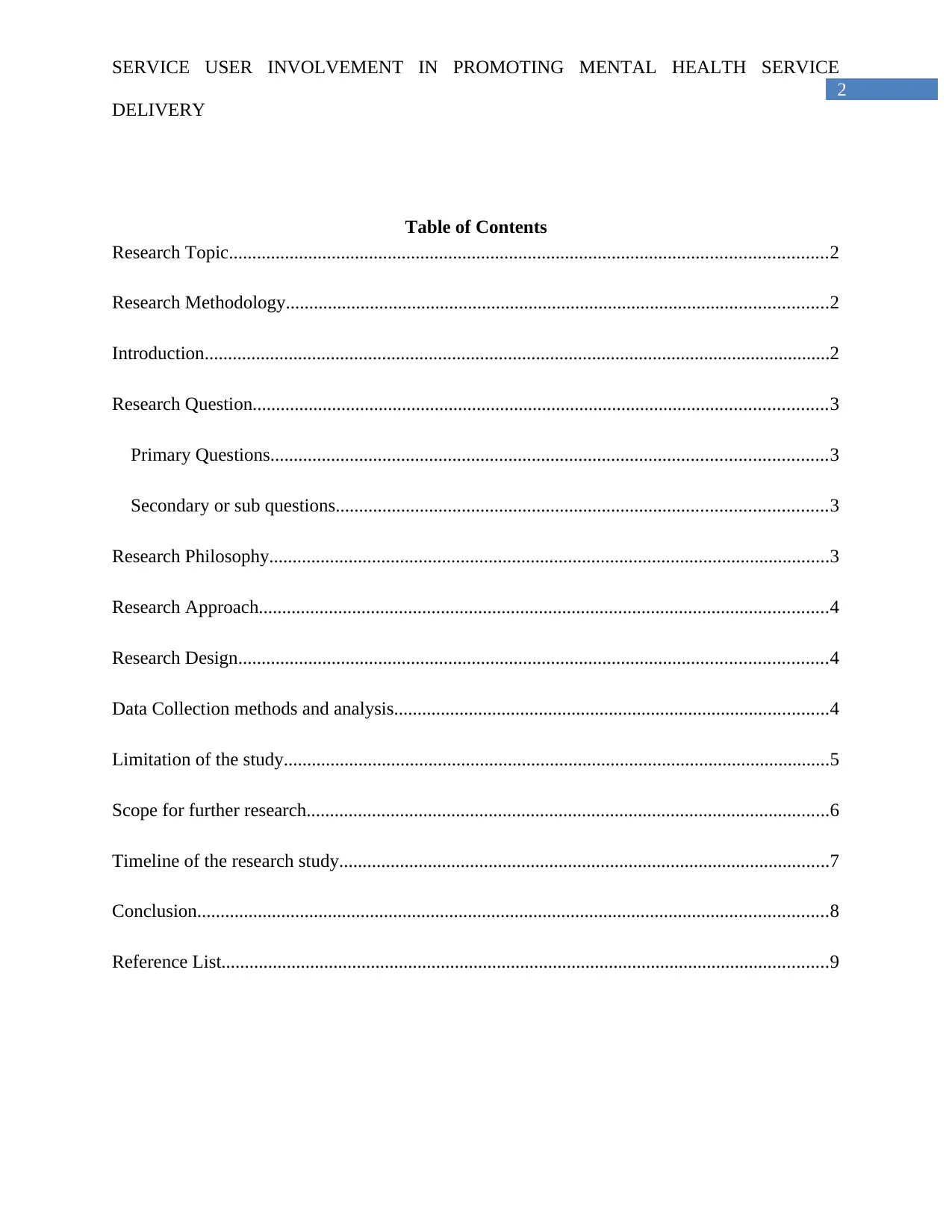
Table of Contents
Research Topic................................................................................................................................2
Research Methodology....................................................................................................................2
Introduction......................................................................................................................................2
Research Question...........................................................................................................................3
Primary Questions.......................................................................................................................3
Secondary or sub questions.........................................................................................................3
Research Philosophy........................................................................................................................3
Research Approach..........................................................................................................................4
Research Design..............................................................................................................................4
Data Collection methods and analysis.............................................................................................4
Limitation of the study.....................................................................................................................5
Scope for further research................................................................................................................6
Timeline of the research study.........................................................................................................7
Conclusion.......................................................................................................................................8
Reference List..................................................................................................................................9
SERVICE USER INVOLVEMENT IN PROMOTING MENTAL HEALTH SERVICE
DELIVERY
Table of Contents
Research Topic................................................................................................................................2
Research Methodology....................................................................................................................2
Introduction......................................................................................................................................2
Research Question...........................................................................................................................3
Primary Questions.......................................................................................................................3
Secondary or sub questions.........................................................................................................3
Research Philosophy........................................................................................................................3
Research Approach..........................................................................................................................4
Research Design..............................................................................................................................4
Data Collection methods and analysis.............................................................................................4
Limitation of the study.....................................................................................................................5
Scope for further research................................................................................................................6
Timeline of the research study.........................................................................................................7
Conclusion.......................................................................................................................................8
Reference List..................................................................................................................................9

3
SERVICE USER INVOLVEMENT IN PROMOTING MENTAL HEALTH SERVICE
DELIVERY
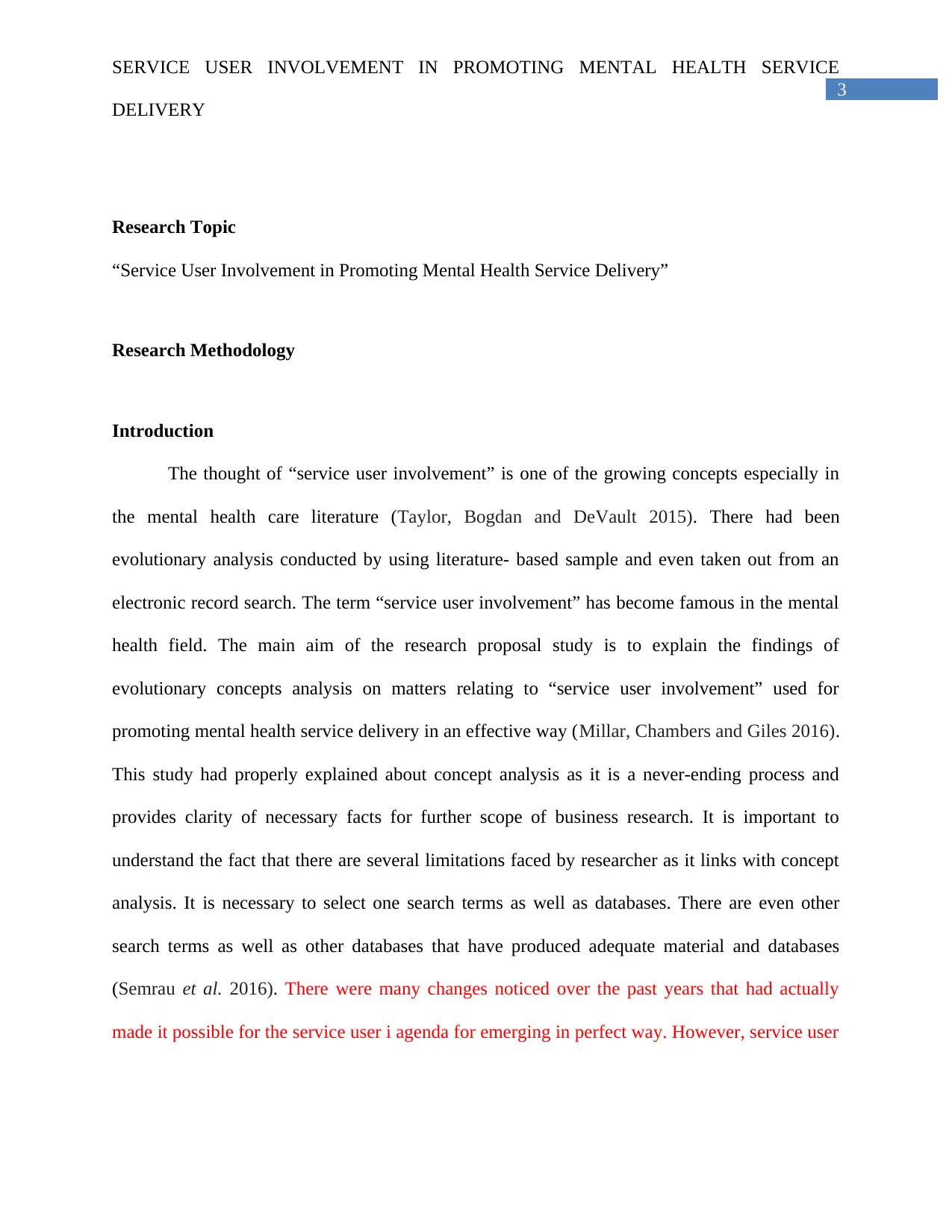
Research Topic
“Service User Involvement in Promoting Mental Health Service Delivery”
Research Methodology
Introduction
The thought of “service user involvement” is one of the growing concepts especially in
the mental health care literature (Taylor, Bogdan and DeVault 2015). There had been
evolutionary analysis conducted by using literature- based sample and even taken out from an
electronic record search. The term “service user involvement” has become famous in the mental
health field. The main aim of the research proposal study is to explain the findings of
evolutionary concepts analysis on matters relating to “service user involvement” used for
promoting mental health service delivery in an effective way (Millar, Chambers and Giles 2016).
This study had properly explained about concept analysis as it is a never-ending process and
provides clarity of necessary facts for further scope of business research. It is important to
understand the fact that there are several limitations faced by researcher as it links with concept
analysis. It is necessary to select one search terms as well as databases. There are even other
search terms as well as other databases that have produced adequate material and databases
(Semrau et al. 2016). There were many changes noticed over the past years that had actually
made it possible for the service user i agenda for emerging in perfect way. However, service user
SERVICE USER INVOLVEMENT IN PROMOTING MENTAL HEALTH SERVICE
DELIVERY
Research Topic
“Service User Involvement in Promoting Mental Health Service Delivery”
Research Methodology
Introduction
The thought of “service user involvement” is one of the growing concepts especially in
the mental health care literature (Taylor, Bogdan and DeVault 2015). There had been
evolutionary analysis conducted by using literature- based sample and even taken out from an
electronic record search. The term “service user involvement” has become famous in the mental
health field. The main aim of the research proposal study is to explain the findings of
evolutionary concepts analysis on matters relating to “service user involvement” used for
promoting mental health service delivery in an effective way (Millar, Chambers and Giles 2016).
This study had properly explained about concept analysis as it is a never-ending process and
provides clarity of necessary facts for further scope of business research. It is important to
understand the fact that there are several limitations faced by researcher as it links with concept
analysis. It is necessary to select one search terms as well as databases. There are even other
search terms as well as other databases that have produced adequate material and databases
(Semrau et al. 2016). There were many changes noticed over the past years that had actually
made it possible for the service user i agenda for emerging in perfect way. However, service user
⊘ This is a preview!⊘
Do you want full access?
Subscribe today to unlock all pages.

Trusted by 1+ million students worldwide

4
SERVICE USER INVOLVEMENT IN PROMOTING MENTAL HEALTH SERVICE
DELIVERY
involvement was considered as one of the key policy action that informs as well as underpins
both health as well as social services at the same time.
SERVICE USER INVOLVEMENT IN PROMOTING MENTAL HEALTH SERVICE
DELIVERY
involvement was considered as one of the key policy action that informs as well as underpins
both health as well as social services at the same time.
Paraphrase This Document
Need a fresh take? Get an instant paraphrase of this document with our AI Paraphraser

5
SERVICE USER INVOLVEMENT IN PROMOTING MENTAL HEALTH SERVICE
DELIVERY
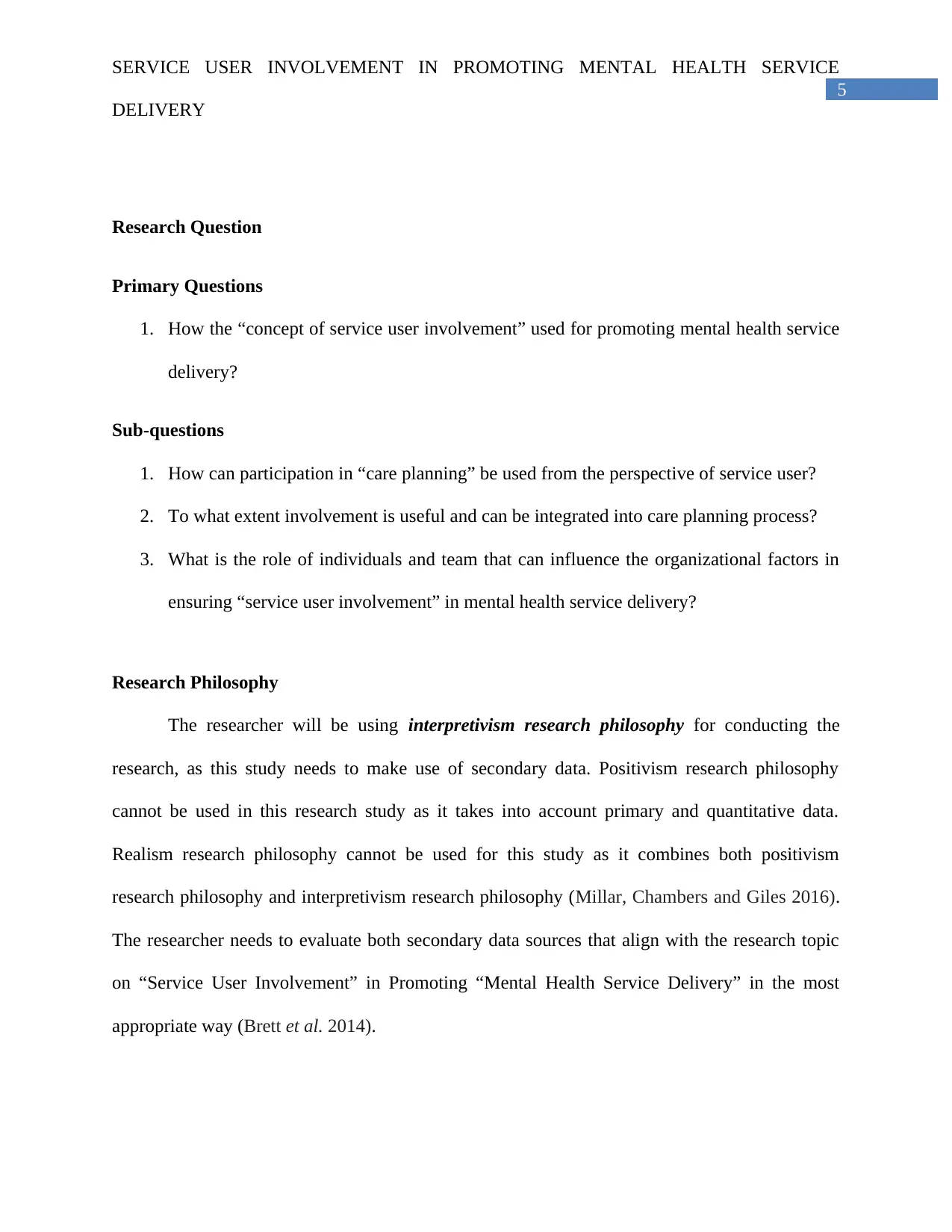
Research Question
Primary Questions
1. How the “concept of service user involvement” used for promoting mental health service
delivery?
Sub-questions
1. How can participation in “care planning” be used from the perspective of service user?
2. To what extent involvement is useful and can be integrated into care planning process?
3. What is the role of individuals and team that can influence the organizational factors in
ensuring “service user involvement” in mental health service delivery?
Research Philosophy
The researcher will be using interpretivism research philosophy for conducting the
research, as this study needs to make use of secondary data. Positivism research philosophy
cannot be used in this research study as it takes into account primary and quantitative data.
Realism research philosophy cannot be used for this study as it combines both positivism
research philosophy and interpretivism research philosophy (Millar, Chambers and Giles 2016).
The researcher needs to evaluate both secondary data sources that align with the research topic
on “Service User Involvement” in Promoting “Mental Health Service Delivery” in the most
appropriate way (Brett et al. 2014).
SERVICE USER INVOLVEMENT IN PROMOTING MENTAL HEALTH SERVICE
DELIVERY
Research Question
Primary Questions
1. How the “concept of service user involvement” used for promoting mental health service
delivery?
Sub-questions
1. How can participation in “care planning” be used from the perspective of service user?
2. To what extent involvement is useful and can be integrated into care planning process?
3. What is the role of individuals and team that can influence the organizational factors in
ensuring “service user involvement” in mental health service delivery?
Research Philosophy
The researcher will be using interpretivism research philosophy for conducting the
research, as this study needs to make use of secondary data. Positivism research philosophy
cannot be used in this research study as it takes into account primary and quantitative data.
Realism research philosophy cannot be used for this study as it combines both positivism
research philosophy and interpretivism research philosophy (Millar, Chambers and Giles 2016).
The researcher needs to evaluate both secondary data sources that align with the research topic
on “Service User Involvement” in Promoting “Mental Health Service Delivery” in the most
appropriate way (Brett et al. 2014).

6
SERVICE USER INVOLVEMENT IN PROMOTING MENTAL HEALTH SERVICE
DELIVERY
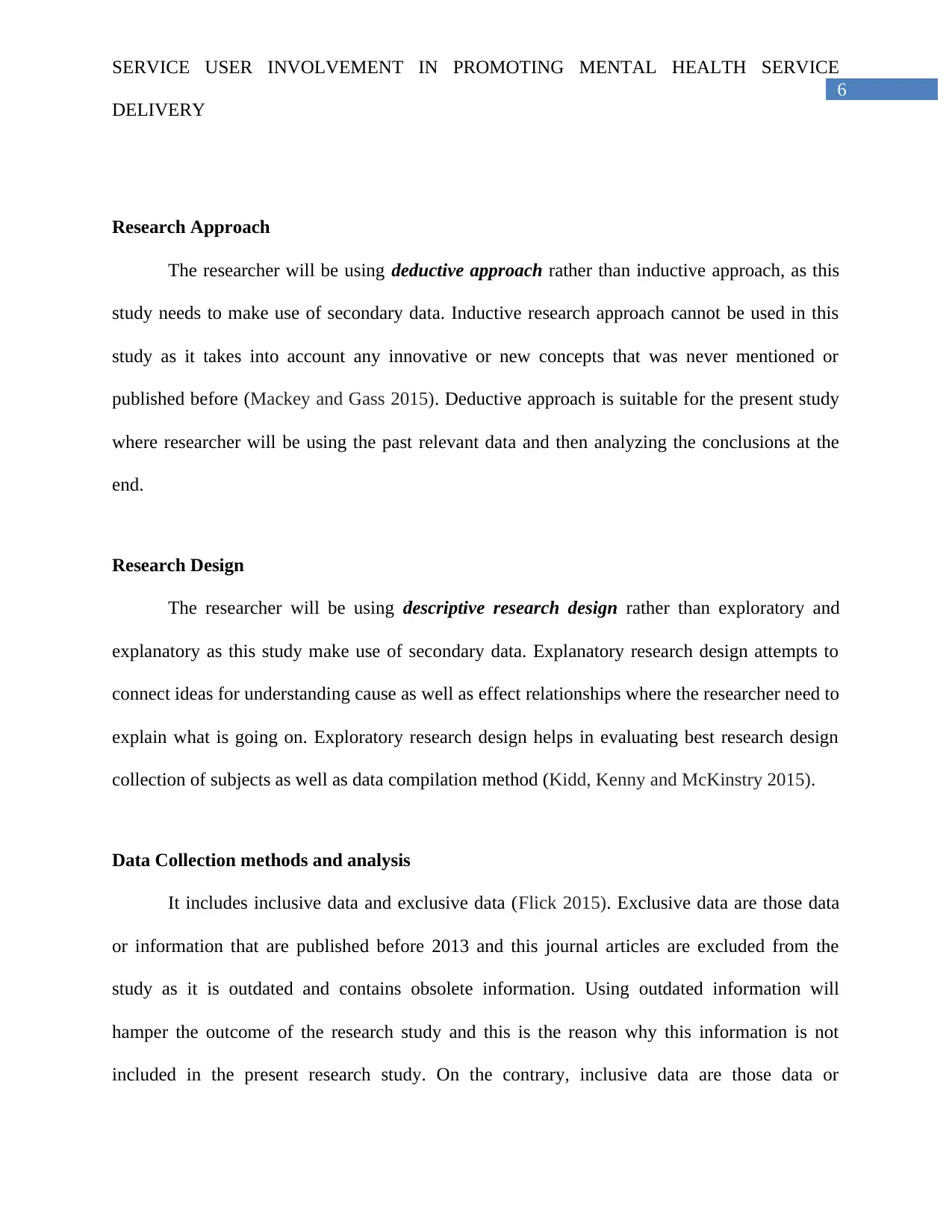
Research Approach
The researcher will be using deductive approach rather than inductive approach, as this
study needs to make use of secondary data. Inductive research approach cannot be used in this
study as it takes into account any innovative or new concepts that was never mentioned or
published before (Mackey and Gass 2015). Deductive approach is suitable for the present study
where researcher will be using the past relevant data and then analyzing the conclusions at the
end.
Research Design
The researcher will be using descriptive research design rather than exploratory and
explanatory as this study make use of secondary data. Explanatory research design attempts to
connect ideas for understanding cause as well as effect relationships where the researcher need to
explain what is going on. Exploratory research design helps in evaluating best research design
collection of subjects as well as data compilation method (Kidd, Kenny and McKinstry 2015).
Data Collection methods and analysis
It includes inclusive data and exclusive data (Flick 2015). Exclusive data are those data
or information that are published before 2013 and this journal articles are excluded from the
study as it is outdated and contains obsolete information. Using outdated information will
hamper the outcome of the research study and this is the reason why this information is not
included in the present research study. On the contrary, inclusive data are those data or
SERVICE USER INVOLVEMENT IN PROMOTING MENTAL HEALTH SERVICE
DELIVERY
Research Approach
The researcher will be using deductive approach rather than inductive approach, as this
study needs to make use of secondary data. Inductive research approach cannot be used in this
study as it takes into account any innovative or new concepts that was never mentioned or
published before (Mackey and Gass 2015). Deductive approach is suitable for the present study
where researcher will be using the past relevant data and then analyzing the conclusions at the
end.
Research Design
The researcher will be using descriptive research design rather than exploratory and
explanatory as this study make use of secondary data. Explanatory research design attempts to
connect ideas for understanding cause as well as effect relationships where the researcher need to
explain what is going on. Exploratory research design helps in evaluating best research design
collection of subjects as well as data compilation method (Kidd, Kenny and McKinstry 2015).
Data Collection methods and analysis
It includes inclusive data and exclusive data (Flick 2015). Exclusive data are those data
or information that are published before 2013 and this journal articles are excluded from the
study as it is outdated and contains obsolete information. Using outdated information will
hamper the outcome of the research study and this is the reason why this information is not
included in the present research study. On the contrary, inclusive data are those data or
⊘ This is a preview!⊘
Do you want full access?
Subscribe today to unlock all pages.

Trusted by 1+ million students worldwide

7
SERVICE USER INVOLVEMENT IN PROMOTING MENTAL HEALTH SERVICE
DELIVERY
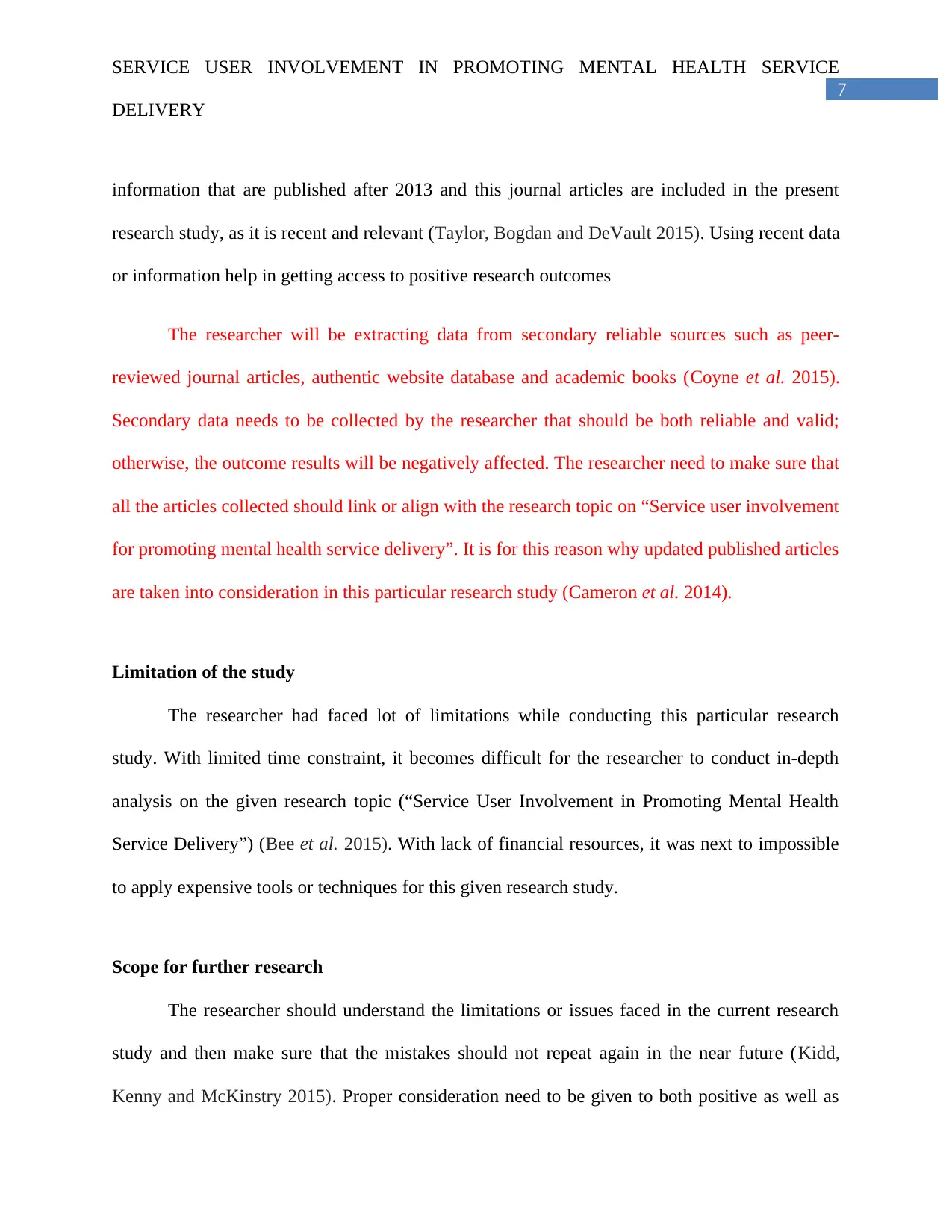
information that are published after 2013 and this journal articles are included in the present
research study, as it is recent and relevant (Taylor, Bogdan and DeVault 2015). Using recent data
or information help in getting access to positive research outcomes
The researcher will be extracting data from secondary reliable sources such as peer-
reviewed journal articles, authentic website database and academic books (Coyne et al. 2015).
Secondary data needs to be collected by the researcher that should be both reliable and valid;
otherwise, the outcome results will be negatively affected. The researcher need to make sure that
all the articles collected should link or align with the research topic on “Service user involvement
for promoting mental health service delivery”. It is for this reason why updated published articles
are taken into consideration in this particular research study (Cameron et al. 2014).
Limitation of the study
The researcher had faced lot of limitations while conducting this particular research
study. With limited time constraint, it becomes difficult for the researcher to conduct in-depth
analysis on the given research topic (“Service User Involvement in Promoting Mental Health
Service Delivery”) (Bee et al. 2015). With lack of financial resources, it was next to impossible
to apply expensive tools or techniques for this given research study.
Scope for further research
The researcher should understand the limitations or issues faced in the current research
study and then make sure that the mistakes should not repeat again in the near future (Kidd,
Kenny and McKinstry 2015). Proper consideration need to be given to both positive as well as
SERVICE USER INVOLVEMENT IN PROMOTING MENTAL HEALTH SERVICE
DELIVERY
information that are published after 2013 and this journal articles are included in the present
research study, as it is recent and relevant (Taylor, Bogdan and DeVault 2015). Using recent data
or information help in getting access to positive research outcomes
The researcher will be extracting data from secondary reliable sources such as peer-
reviewed journal articles, authentic website database and academic books (Coyne et al. 2015).
Secondary data needs to be collected by the researcher that should be both reliable and valid;
otherwise, the outcome results will be negatively affected. The researcher need to make sure that
all the articles collected should link or align with the research topic on “Service user involvement
for promoting mental health service delivery”. It is for this reason why updated published articles
are taken into consideration in this particular research study (Cameron et al. 2014).
Limitation of the study
The researcher had faced lot of limitations while conducting this particular research
study. With limited time constraint, it becomes difficult for the researcher to conduct in-depth
analysis on the given research topic (“Service User Involvement in Promoting Mental Health
Service Delivery”) (Bee et al. 2015). With lack of financial resources, it was next to impossible
to apply expensive tools or techniques for this given research study.
Scope for further research
The researcher should understand the limitations or issues faced in the current research
study and then make sure that the mistakes should not repeat again in the near future (Kidd,
Kenny and McKinstry 2015). Proper consideration need to be given to both positive as well as
Paraphrase This Document
Need a fresh take? Get an instant paraphrase of this document with our AI Paraphraser

8
SERVICE USER INVOLVEMENT IN PROMOTING MENTAL HEALTH SERVICE
DELIVERY
negative result of “service user involvement” as well as additional research is required for
determining which outcomes measured the service users mostly value within a stipulated period
(Millar, Chambers and Giles 2016). It is important for the researcher to understand the concepts
in detail and allocate more time so that they can involve in conducting in-depth analysis in the
future research purpose activities. The completed concept analysis renders rich data as it help in
producing empirical methods for measuring service user involvement as well as operationalzing
the concepts of service user involvement in the most appropriate way (Taylor, Bogdan and
DeVault 2015).
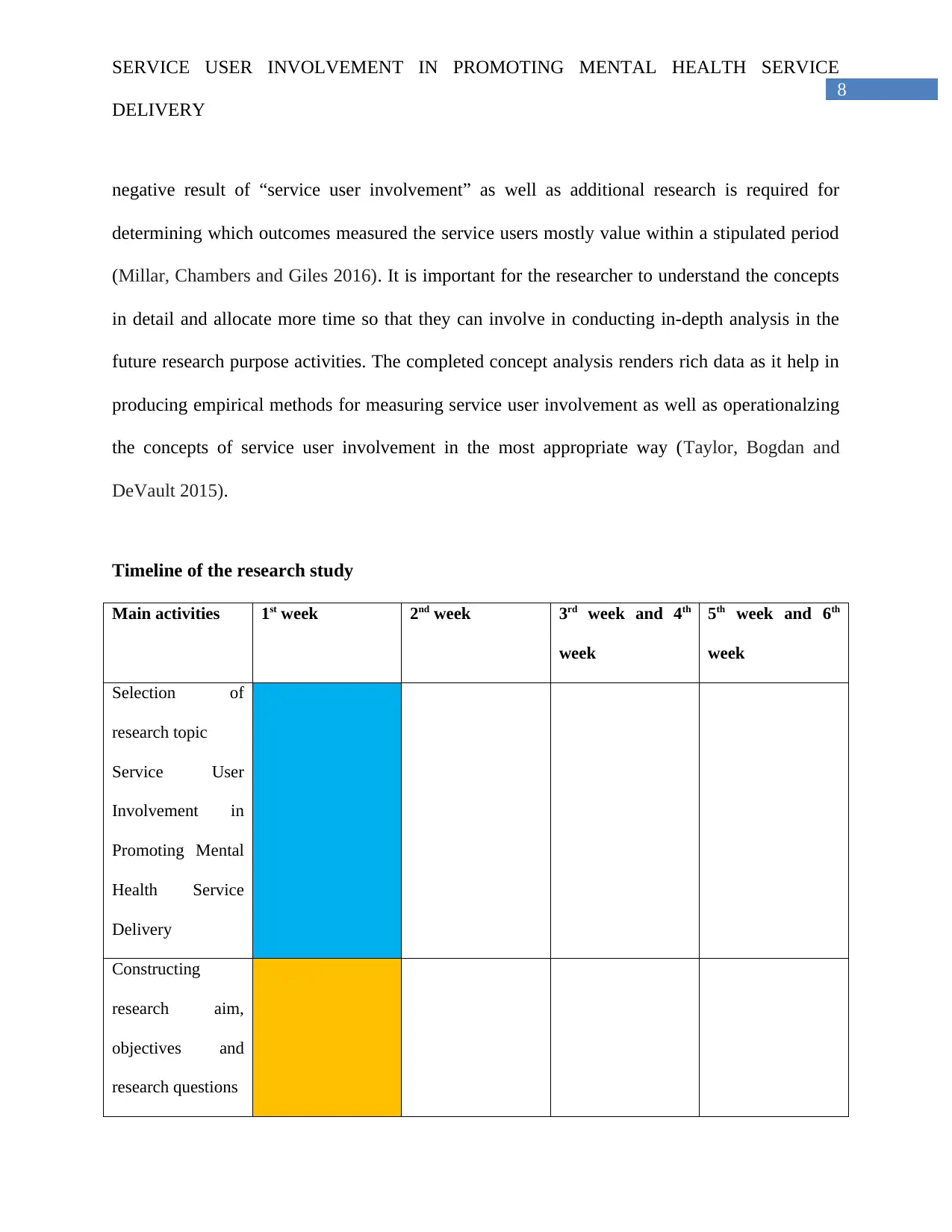
Timeline of the research study
Main activities 1st week 2nd week 3rd week and 4th
week
5th week and 6th
week
Selection of
research topic
Service User
Involvement in
Promoting Mental
Health Service
Delivery
Constructing
research aim,
objectives and
research questions
SERVICE USER INVOLVEMENT IN PROMOTING MENTAL HEALTH SERVICE
DELIVERY
negative result of “service user involvement” as well as additional research is required for
determining which outcomes measured the service users mostly value within a stipulated period
(Millar, Chambers and Giles 2016). It is important for the researcher to understand the concepts
in detail and allocate more time so that they can involve in conducting in-depth analysis in the
future research purpose activities. The completed concept analysis renders rich data as it help in
producing empirical methods for measuring service user involvement as well as operationalzing
the concepts of service user involvement in the most appropriate way (Taylor, Bogdan and
DeVault 2015).
Timeline of the research study
Main activities 1st week 2nd week 3rd week and 4th
week
5th week and 6th
week
Selection of
research topic
Service User
Involvement in
Promoting Mental
Health Service
Delivery
Constructing
research aim,
objectives and
research questions

9
SERVICE USER INVOLVEMENT IN PROMOTING MENTAL HEALTH SERVICE
DELIVERY
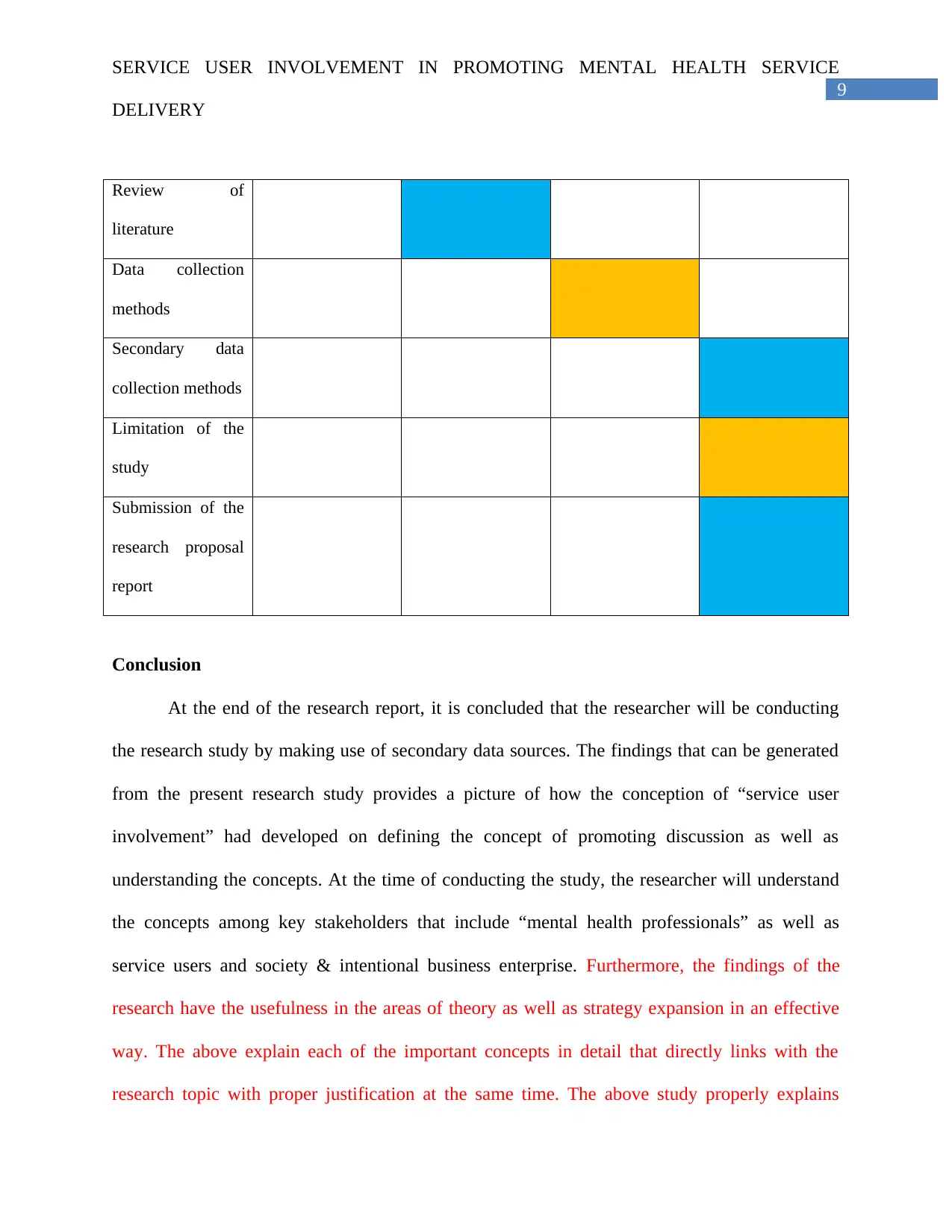
Review of
literature
Data collection
methods
Secondary data
collection methods
Limitation of the
study
Submission of the
research proposal
report
Conclusion
At the end of the research report, it is concluded that the researcher will be conducting
the research study by making use of secondary data sources. The findings that can be generated
from the present research study provides a picture of how the conception of “service user
involvement” had developed on defining the concept of promoting discussion as well as
understanding the concepts. At the time of conducting the study, the researcher will understand
the concepts among key stakeholders that include “mental health professionals” as well as
service users and society & intentional business enterprise. Furthermore, the findings of the
research have the usefulness in the areas of theory as well as strategy expansion in an effective
way. The above explain each of the important concepts in detail that directly links with the
research topic with proper justification at the same time. The above study properly explains
SERVICE USER INVOLVEMENT IN PROMOTING MENTAL HEALTH SERVICE
DELIVERY
Review of
literature
Data collection
methods
Secondary data
collection methods
Limitation of the
study
Submission of the
research proposal
report
Conclusion
At the end of the research report, it is concluded that the researcher will be conducting
the research study by making use of secondary data sources. The findings that can be generated
from the present research study provides a picture of how the conception of “service user
involvement” had developed on defining the concept of promoting discussion as well as
understanding the concepts. At the time of conducting the study, the researcher will understand
the concepts among key stakeholders that include “mental health professionals” as well as
service users and society & intentional business enterprise. Furthermore, the findings of the
research have the usefulness in the areas of theory as well as strategy expansion in an effective
way. The above explain each of the important concepts in detail that directly links with the
research topic with proper justification at the same time. The above study properly explains
⊘ This is a preview!⊘
Do you want full access?
Subscribe today to unlock all pages.

Trusted by 1+ million students worldwide

10
SERVICE USER INVOLVEMENT IN PROMOTING MENTAL HEALTH SERVICE
DELIVERY
about the contemporary interests that involve service users in their own care as well as treatment
as it derives from the philosophical point of view.
SERVICE USER INVOLVEMENT IN PROMOTING MENTAL HEALTH SERVICE
DELIVERY
about the contemporary interests that involve service users in their own care as well as treatment
as it derives from the philosophical point of view.
Paraphrase This Document
Need a fresh take? Get an instant paraphrase of this document with our AI Paraphraser

11
SERVICE USER INVOLVEMENT IN PROMOTING MENTAL HEALTH SERVICE
DELIVERY
Reference List
Bee, P., Brooks, H., Fraser, C. and Lovell, K., 2015. Professional perspectives on service user
and carer involvement in mental health care planning: a qualitative study. International journal
of nursing studies, 52(12), pp.1834-1845.
Brett, J., Staniszewska, S., Mockford, C., Herron‐Marx, S., Hughes, J., Tysall, C. and Suleman,
R., 2014. Mapping the impact of patient and public involvement on health and social care
research: a systematic review. Health Expectations, 17(5), pp.637-650.
Cameron, A., Lart, R., Bostock, L. and Coomber, C., 2014. Factors that promote and hinder joint
and integrated working between health and social care services: a review of research
literature. Health & social care in the community, 22(3), pp.225-233.
Coyne, I., McNamara, N., Healy, M., Gower, C., Sarkar, M. and McNicholas, F., 2015.
Adolescents' and parents' views of child and adolescent mental health services (CAMHS) in
Ireland. Journal of psychiatric and mental health nursing, 22(8), pp.561-569.
Flick, U., 2015. Introducing research methodology: A beginner's guide to doing a research
project. Sage.
Kidd, S., Kenny, A. and McKinstry, C., 2015. The meaning of recovery in a regional mental
health service: an action research study. Journal of advanced nursing, 71(1), pp.181-192.
Mackey, A. and Gass, S.M., 2015. Second language research: Methodology and design.
Routledge.
SERVICE USER INVOLVEMENT IN PROMOTING MENTAL HEALTH SERVICE
DELIVERY
Reference List
Bee, P., Brooks, H., Fraser, C. and Lovell, K., 2015. Professional perspectives on service user
and carer involvement in mental health care planning: a qualitative study. International journal
of nursing studies, 52(12), pp.1834-1845.
Brett, J., Staniszewska, S., Mockford, C., Herron‐Marx, S., Hughes, J., Tysall, C. and Suleman,
R., 2014. Mapping the impact of patient and public involvement on health and social care
research: a systematic review. Health Expectations, 17(5), pp.637-650.
Cameron, A., Lart, R., Bostock, L. and Coomber, C., 2014. Factors that promote and hinder joint
and integrated working between health and social care services: a review of research
literature. Health & social care in the community, 22(3), pp.225-233.
Coyne, I., McNamara, N., Healy, M., Gower, C., Sarkar, M. and McNicholas, F., 2015.
Adolescents' and parents' views of child and adolescent mental health services (CAMHS) in
Ireland. Journal of psychiatric and mental health nursing, 22(8), pp.561-569.
Flick, U., 2015. Introducing research methodology: A beginner's guide to doing a research
project. Sage.
Kidd, S., Kenny, A. and McKinstry, C., 2015. The meaning of recovery in a regional mental
health service: an action research study. Journal of advanced nursing, 71(1), pp.181-192.
Mackey, A. and Gass, S.M., 2015. Second language research: Methodology and design.
Routledge.
1 out of 11
Related Documents
Your All-in-One AI-Powered Toolkit for Academic Success.
+13062052269
info@desklib.com
Available 24*7 on WhatsApp / Email
Unlock your academic potential
Copyright © 2020–2026 A2Z Services. All Rights Reserved. Developed and managed by ZUCOL.