Financing Entrepreneurial Initiatives: Juner Material Report Analysis
VerifiedAdded on 2020/01/15
|12
|3237
|157
Report
AI Summary
This report analyzes the financing strategies and business model of Juner Material, a modified plastics manufacturer based in China. It begins by outlining the key determinants of value drivers and features of Juner's business model using the Seven Domain Framework, including market attractiveness, target market, and industry attractiveness. The report then examines the advantages and disadvantages of an Initial Public Offering (IPO) for Juner, including capital raising, public image, and potential loss of control, alongside factors to consider when listing on a stock exchange. Furthermore, it evaluates the market multiple approach for business valuation, discussing its usefulness and limitations. The report concludes with a discussion of the application of the free cash flow model for determining the implicit value of shares and provides recommendations for Juner's financial strategy. The report provides an overview of the company's current market position and recommendations for future financial strategy.
Financing Entrepreneurial Initiatives

Paraphrase This Document
Need a fresh take? Get an instant paraphrase of this document with our AI Paraphraser
Table of Contents
INTRODUCTION...........................................................................................................................3
1. Key determinants of value drivers, features of Juner's business model and business strategy3
2. Examine advantages and disadvantages of IPO......................................................................5
3. Factors to be consider while listing in stock exchange............................................................7
4. Evaluating market multiple approach .....................................................................................7
5. Compute implicit value of share..............................................................................................8
6. Application of free cash flow model........................................................................................9
CONCLUSION..............................................................................................................................10
REFERENCES..............................................................................................................................12
2
INTRODUCTION...........................................................................................................................3
1. Key determinants of value drivers, features of Juner's business model and business strategy3
2. Examine advantages and disadvantages of IPO......................................................................5
3. Factors to be consider while listing in stock exchange............................................................7
4. Evaluating market multiple approach .....................................................................................7
5. Compute implicit value of share..............................................................................................8
6. Application of free cash flow model........................................................................................9
CONCLUSION..............................................................................................................................10
REFERENCES..............................................................................................................................12
2
INTRODUCTION
The business role has increases by focusing on their existing strengths in order to beat
their competition. New Juner material has been selected for explaining the role of entrepreneur in
improving their financial conditions. This report is all about defining key features of the Seven
domain framework applied in assessing the efficiency of the business. The effectiveness of
decision of offering equity shares are also evaluated on certain parametres.
1. Key determinants of value drivers, features of Juner's business model and business strategy
The Juner material is a business developed by an entrepreneur who started their business
based in china (Mazzucato, 2015). The current business is based on the modified plastic industry
which manufactures unique quality and variety of products offered in front of customers. This
company has established with a total customer base of 300 employees who are regarded as the
strength of this entity and the owner. The capabilities of the business are strong enough to in
raising the customer satisfaction towards the products offered to the different set of customers.
The Juner's current business model and its business strategy are given as follows:
Seven Domain Framework
This approach is applied in assessing the existing business environment of Juner environment by
seeking market domain and the industry perspectives. This framework is based on the macro and
micro level of the business environment (Amorós, Bosma and Levie, 2013). There are certain
elements of this particular framework which are given as below:
1. Market attractiveness- This particular element emphasized on efficiency of the large scal
environment in relation with the internal business factors. The PESTLE analysis need tobe
considered in assessing the internal capabilities of an entity in relation with the external market.
Political environment- The rules and regulations framed by Chinese government by
imposing practices in manufacturing plastic products without producing in excess
quantity.
Economic environment- Juner material are required to consider the inflation rate which
increases their variable cost which in turn increases the price of products or services.
Social- The market can be dominated by attracting wide number of customers by
producing products according to the tastes and preferences of buyers.
3
The business role has increases by focusing on their existing strengths in order to beat
their competition. New Juner material has been selected for explaining the role of entrepreneur in
improving their financial conditions. This report is all about defining key features of the Seven
domain framework applied in assessing the efficiency of the business. The effectiveness of
decision of offering equity shares are also evaluated on certain parametres.
1. Key determinants of value drivers, features of Juner's business model and business strategy
The Juner material is a business developed by an entrepreneur who started their business
based in china (Mazzucato, 2015). The current business is based on the modified plastic industry
which manufactures unique quality and variety of products offered in front of customers. This
company has established with a total customer base of 300 employees who are regarded as the
strength of this entity and the owner. The capabilities of the business are strong enough to in
raising the customer satisfaction towards the products offered to the different set of customers.
The Juner's current business model and its business strategy are given as follows:
Seven Domain Framework
This approach is applied in assessing the existing business environment of Juner environment by
seeking market domain and the industry perspectives. This framework is based on the macro and
micro level of the business environment (Amorós, Bosma and Levie, 2013). There are certain
elements of this particular framework which are given as below:
1. Market attractiveness- This particular element emphasized on efficiency of the large scal
environment in relation with the internal business factors. The PESTLE analysis need tobe
considered in assessing the internal capabilities of an entity in relation with the external market.
Political environment- The rules and regulations framed by Chinese government by
imposing practices in manufacturing plastic products without producing in excess
quantity.
Economic environment- Juner material are required to consider the inflation rate which
increases their variable cost which in turn increases the price of products or services.
Social- The market can be dominated by attracting wide number of customers by
producing products according to the tastes and preferences of buyers.
3
⊘ This is a preview!⊘
Do you want full access?
Subscribe today to unlock all pages.

Trusted by 1+ million students worldwide
Technological- The competition can be curtailed in the existing business environment by
taking advantage of existing technology in polishing the fashion stones. The finishing in
products can be generated by using innovative technology.
Legal environment- The taxation requirements need to be taken into account as this will
affect an entity's business performance by increasing their expenses.
Environmental environment- The environment will not be affected by producing plastic
products as it affect the nature of business environment. The limits and standards need to
be maintained in order to achieve all kinds of objectives.
2. Target market- The current business entity of new Juner material deals in providing variety
of modified plastics products or services (Mazzucato, 2015). The overall market can be
segmented into different criteria used by an entity in accomplishing their objectives within a
given time period. The current market will be segmented into demographic, geographical, quality
of products, income level of employee and existing market conditions. The overall objectives
will be fragmented into various pieces to achieve their aims and targets within a give time frame.
3. Industry attractiveness- The attractiveness of the overall plastic industry can be assessed by
applying porter's five forces analysis.
Threat of new entrant(Moderate)-The new rival can enter in this industry as the
external market changes will invite newcomer to try their luck while operating their
business in earning higher amount of profit.
Bargaining power of suppliers(High)- The suppliers who provide raw materials in
processing them into finished products is high as they have power to dominant the
buyers.
Bargaining power of buyer(less)- It has no power to negotiate with the suppliers as
there primary need is to cater the needs of different individuals.
Threat of substitutes(High)- The products are offered to different customers in
affordable ranges will steal the interest of price sensitive customers.
Rivalry among current players(Moderate)- The uniqueness of products incorporate by
an entity in their original products will set their unique identity among the external
market.
4
taking advantage of existing technology in polishing the fashion stones. The finishing in
products can be generated by using innovative technology.
Legal environment- The taxation requirements need to be taken into account as this will
affect an entity's business performance by increasing their expenses.
Environmental environment- The environment will not be affected by producing plastic
products as it affect the nature of business environment. The limits and standards need to
be maintained in order to achieve all kinds of objectives.
2. Target market- The current business entity of new Juner material deals in providing variety
of modified plastics products or services (Mazzucato, 2015). The overall market can be
segmented into different criteria used by an entity in accomplishing their objectives within a
given time period. The current market will be segmented into demographic, geographical, quality
of products, income level of employee and existing market conditions. The overall objectives
will be fragmented into various pieces to achieve their aims and targets within a give time frame.
3. Industry attractiveness- The attractiveness of the overall plastic industry can be assessed by
applying porter's five forces analysis.
Threat of new entrant(Moderate)-The new rival can enter in this industry as the
external market changes will invite newcomer to try their luck while operating their
business in earning higher amount of profit.
Bargaining power of suppliers(High)- The suppliers who provide raw materials in
processing them into finished products is high as they have power to dominant the
buyers.
Bargaining power of buyer(less)- It has no power to negotiate with the suppliers as
there primary need is to cater the needs of different individuals.
Threat of substitutes(High)- The products are offered to different customers in
affordable ranges will steal the interest of price sensitive customers.
Rivalry among current players(Moderate)- The uniqueness of products incorporate by
an entity in their original products will set their unique identity among the external
market.
4
Paraphrase This Document
Need a fresh take? Get an instant paraphrase of this document with our AI Paraphraser
4. Sustainable advantage -The current capabilities that are the core competencies of an
entity are uses by the business entity in reducing the level of competition. The juner
material can take sustainable advantage by applying different approaches which are given
as follows:
USP analysis
An entity are required to develop unique selling position which creates the value of all
their products in comparison with the different products offered by variety of customers in the
same form of market. The competitive edge can be created in front of different competitors such
as Kingfa by presenting their unique abilities such as comfortness, affordable pricing, uniqueness
in quality, ability to grab higher market share of 70%, good financial position.
5. Mission, Aspirations, propensity for risk
The current focus of Juner material is to give more emphasize on improving current research and
development center and gaining new market share in the external markets (Colombo, Cumming
and Vismara, 2016). The strategic plans are framed by the business entity by considering all their
strengths and weaknesses. The objectives of an organization is to grab higher market share. The
market risk can be improved by stresses on the current market strengths and weaknesses in order
to provide higher market value.
6. Executing CSF- The critical success factors of the business entity need to be taken into
account that resolves all kinds of problems in the existing business. The sales and the revenue of
an entity are required to change as per the existing capabilities of an entity.
7. Connectedness- It includes all supporting factors which helps in maintaining the existence of
the business such as all kinds of stakeholders which helps in creating additional value for an
enterprise.
2. Examine advantages and disadvantages of IPO
Advantages
Capital raising- This approach can be used by an entity in order to raise capital to fund their
business requirement. The big investors will be attracted in order to strengthen the financial
structure of the business by taking external equity. An entrepreneur can raise heavy amount of
investment through this particular mode.
5
entity are uses by the business entity in reducing the level of competition. The juner
material can take sustainable advantage by applying different approaches which are given
as follows:
USP analysis
An entity are required to develop unique selling position which creates the value of all
their products in comparison with the different products offered by variety of customers in the
same form of market. The competitive edge can be created in front of different competitors such
as Kingfa by presenting their unique abilities such as comfortness, affordable pricing, uniqueness
in quality, ability to grab higher market share of 70%, good financial position.
5. Mission, Aspirations, propensity for risk
The current focus of Juner material is to give more emphasize on improving current research and
development center and gaining new market share in the external markets (Colombo, Cumming
and Vismara, 2016). The strategic plans are framed by the business entity by considering all their
strengths and weaknesses. The objectives of an organization is to grab higher market share. The
market risk can be improved by stresses on the current market strengths and weaknesses in order
to provide higher market value.
6. Executing CSF- The critical success factors of the business entity need to be taken into
account that resolves all kinds of problems in the existing business. The sales and the revenue of
an entity are required to change as per the existing capabilities of an entity.
7. Connectedness- It includes all supporting factors which helps in maintaining the existence of
the business such as all kinds of stakeholders which helps in creating additional value for an
enterprise.
2. Examine advantages and disadvantages of IPO
Advantages
Capital raising- This approach can be used by an entity in order to raise capital to fund their
business requirement. The big investors will be attracted in order to strengthen the financial
structure of the business by taking external equity. An entrepreneur can raise heavy amount of
investment through this particular mode.
5
Public image- The shares will be offered among customers in order to get their consent back in
form of investing in the business. The investment offered through this particular mode will
further help in enhancement of the business image (Kuratko, 2016). The image of an entity will
be improved in the external market by utilizing the resources of the public.
Stock options- There are variety of options available with an entity in order to fund their
business requirements through various forms of financing. The stock will be offered among
customers in form of equity, preference and debentures as per the convenience of the business
owner. The New Juner material has variety of option in order to fund their business requirement
in achieving their goals and the objectives.
Liquidity- This mode is also helpful for an entity in order to maintain their existing liquidity by
storing available cash in the business. The adequacy of capital held within the business will help
an entity in order to meet its short term obligations.
Corporate control- The existing governance structure will be amended in order to operate the
existing business in a systematic order. The official structure of the business such as board of
director and all other official who make significant actions in their business.
Financial gain- The primary advantage enjoyed by all kind of public user in this entity to get
equal share in the total profit earned by an enterprise. The profit will be shared among different
set of shareholder according to their specific share held by them.
Disadvantages
Expensive-Using initial public offer through equity shareholder mode is very expensive and time
consuming process (Mazzucato, 2015). The initial cost need to be borne by an enterprise owner
in offering shares among variety of customers.
Loss of control- The total share of the ownership will be shared among all the individuals who
take up the equity shareholder by investing in the business. The decisions of the business will be
shared among different individuals which reduces overall control of management on their own
entity.
Dilution- the raising of capital through equity shareholder invited to invest in the business is a
process of selling the existing share of ownership to the strangers.
Increasing reporting requirement- The shares offered through this particular mode needs to
comply with different reporting requirements. The involvement of different external party will
6
form of investing in the business. The investment offered through this particular mode will
further help in enhancement of the business image (Kuratko, 2016). The image of an entity will
be improved in the external market by utilizing the resources of the public.
Stock options- There are variety of options available with an entity in order to fund their
business requirements through various forms of financing. The stock will be offered among
customers in form of equity, preference and debentures as per the convenience of the business
owner. The New Juner material has variety of option in order to fund their business requirement
in achieving their goals and the objectives.
Liquidity- This mode is also helpful for an entity in order to maintain their existing liquidity by
storing available cash in the business. The adequacy of capital held within the business will help
an entity in order to meet its short term obligations.
Corporate control- The existing governance structure will be amended in order to operate the
existing business in a systematic order. The official structure of the business such as board of
director and all other official who make significant actions in their business.
Financial gain- The primary advantage enjoyed by all kind of public user in this entity to get
equal share in the total profit earned by an enterprise. The profit will be shared among different
set of shareholder according to their specific share held by them.
Disadvantages
Expensive-Using initial public offer through equity shareholder mode is very expensive and time
consuming process (Mazzucato, 2015). The initial cost need to be borne by an enterprise owner
in offering shares among variety of customers.
Loss of control- The total share of the ownership will be shared among all the individuals who
take up the equity shareholder by investing in the business. The decisions of the business will be
shared among different individuals which reduces overall control of management on their own
entity.
Dilution- the raising of capital through equity shareholder invited to invest in the business is a
process of selling the existing share of ownership to the strangers.
Increasing reporting requirement- The shares offered through this particular mode needs to
comply with different reporting requirements. The involvement of different external party will
6
⊘ This is a preview!⊘
Do you want full access?
Subscribe today to unlock all pages.
Trusted by 1+ million students worldwide
intervene in the current process of the business in ensuring its success in completing their tasks
and duties without affecting their current business practices.
3. Factors to be consider while listing in stock exchange
There are various factors which needs to be consider by the new Juner material while
listing their business in the recognized stock exchange which are given as follows:
Listing requirement- The requirement of new Juner material while add their name by
registering in the recognized stock entity based on their current capabilities. The existing
business efficiency needs to be consider while list their business in order to remain ahead in the
list of all kinds of competitors (Kuratko, 2016). The market risk will be created by focusing on
the existing strengths which is hiding the weakness and able to handle existing threat faced by an
enterprise owner.
Listing fees-The decision of the Juner will be based on the listing fees required to pay by the
entity in near future. The heavy burden of an entity will be imposed by assessing their current
fees of registration and further subscription fees to maintain their existence in the listing. The
Juner need to pay 25% of normality fee regarded as the secondary listing fees.
Reputation- the existing business image will play a significant role in supporting the decision
taken by an entity towards the listing of their business in a recognized stock of exchange.
4. Evaluating market multiple approach
The consistency of the overall plastic industry can be ascertained by using this particular
approach that is the valuation multiple approach (Sannajust, Roux and Chaibi, 2014). This
method signifies the evidences produces the value of market used as one of the asset in fighting
against their competitors. The New Juner material are required to pay attention on their
achievements which will used as one of the criteria in evaluating their current business. The
evaluation of the existing market will be based on one of the important criteria used by an entity
owner includes Price earning ratio, stock evaluation and enterprise value method. The efficiency
of this approach will be used in judging the current effectiveness of the business which are given
as below:
Advantages
7
and duties without affecting their current business practices.
3. Factors to be consider while listing in stock exchange
There are various factors which needs to be consider by the new Juner material while
listing their business in the recognized stock exchange which are given as follows:
Listing requirement- The requirement of new Juner material while add their name by
registering in the recognized stock entity based on their current capabilities. The existing
business efficiency needs to be consider while list their business in order to remain ahead in the
list of all kinds of competitors (Kuratko, 2016). The market risk will be created by focusing on
the existing strengths which is hiding the weakness and able to handle existing threat faced by an
enterprise owner.
Listing fees-The decision of the Juner will be based on the listing fees required to pay by the
entity in near future. The heavy burden of an entity will be imposed by assessing their current
fees of registration and further subscription fees to maintain their existence in the listing. The
Juner need to pay 25% of normality fee regarded as the secondary listing fees.
Reputation- the existing business image will play a significant role in supporting the decision
taken by an entity towards the listing of their business in a recognized stock of exchange.
4. Evaluating market multiple approach
The consistency of the overall plastic industry can be ascertained by using this particular
approach that is the valuation multiple approach (Sannajust, Roux and Chaibi, 2014). This
method signifies the evidences produces the value of market used as one of the asset in fighting
against their competitors. The New Juner material are required to pay attention on their
achievements which will used as one of the criteria in evaluating their current business. The
evaluation of the existing market will be based on one of the important criteria used by an entity
owner includes Price earning ratio, stock evaluation and enterprise value method. The efficiency
of this approach will be used in judging the current effectiveness of the business which are given
as below:
Advantages
7
Paraphrase This Document
Need a fresh take? Get an instant paraphrase of this document with our AI Paraphraser
Usefulness- This valuation method is used as one of the important framework in determining the
business efficiency. This is useful tool helps in amending the existing structures that provided
important information to an enterprise in forming their decisions.
Simplified structure- This is regarded as the user friendly structure which helps in determining
the current worth of an entity in relation with the external market variables. The enterprise value
will be formed as one of the standard criteria in comparing the business with its competitors.
Disadvantages
Dependence-This multiple approach is highly dependent on certain variables that identifies
relative and absolute amount of values assessing the current market attractiveness. The discount
cash flow model will create its dependency in achieving its goals.
Difficulty in comparison- This approach will be able produce multiple results by using different
variables which created pressure on an entity to compare its results.
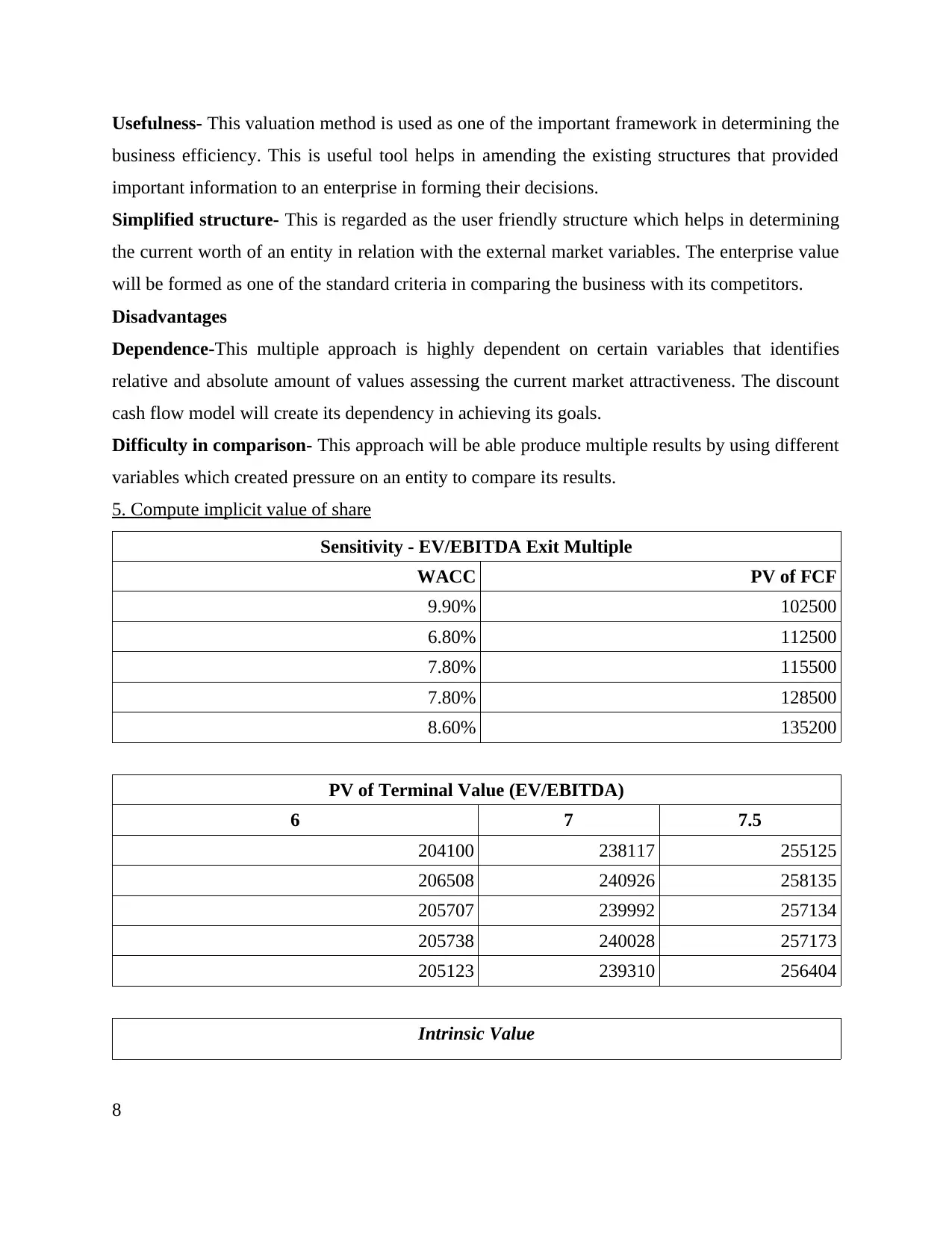
5. Compute implicit value of share
Sensitivity - EV/EBITDA Exit Multiple
WACC PV of FCF
9.90% 102500
6.80% 112500
7.80% 115500
7.80% 128500
8.60% 135200
PV of Terminal Value (EV/EBITDA)
6 7 7.5
204100 238117 255125
206508 240926 258135
205707 239992 257134
205738 240028 257173
205123 239310 256404
Intrinsic Value
8
business efficiency. This is useful tool helps in amending the existing structures that provided
important information to an enterprise in forming their decisions.
Simplified structure- This is regarded as the user friendly structure which helps in determining
the current worth of an entity in relation with the external market variables. The enterprise value
will be formed as one of the standard criteria in comparing the business with its competitors.
Disadvantages
Dependence-This multiple approach is highly dependent on certain variables that identifies
relative and absolute amount of values assessing the current market attractiveness. The discount
cash flow model will create its dependency in achieving its goals.
Difficulty in comparison- This approach will be able produce multiple results by using different
variables which created pressure on an entity to compare its results.
5. Compute implicit value of share
Sensitivity - EV/EBITDA Exit Multiple
WACC PV of FCF
9.90% 102500
6.80% 112500
7.80% 115500
7.80% 128500
8.60% 135200
PV of Terminal Value (EV/EBITDA)
6 7 7.5
204100 238117 255125
206508 240926 258135
205707 239992 257134
205738 240028 257173
205123 239310 256404
Intrinsic Value
8
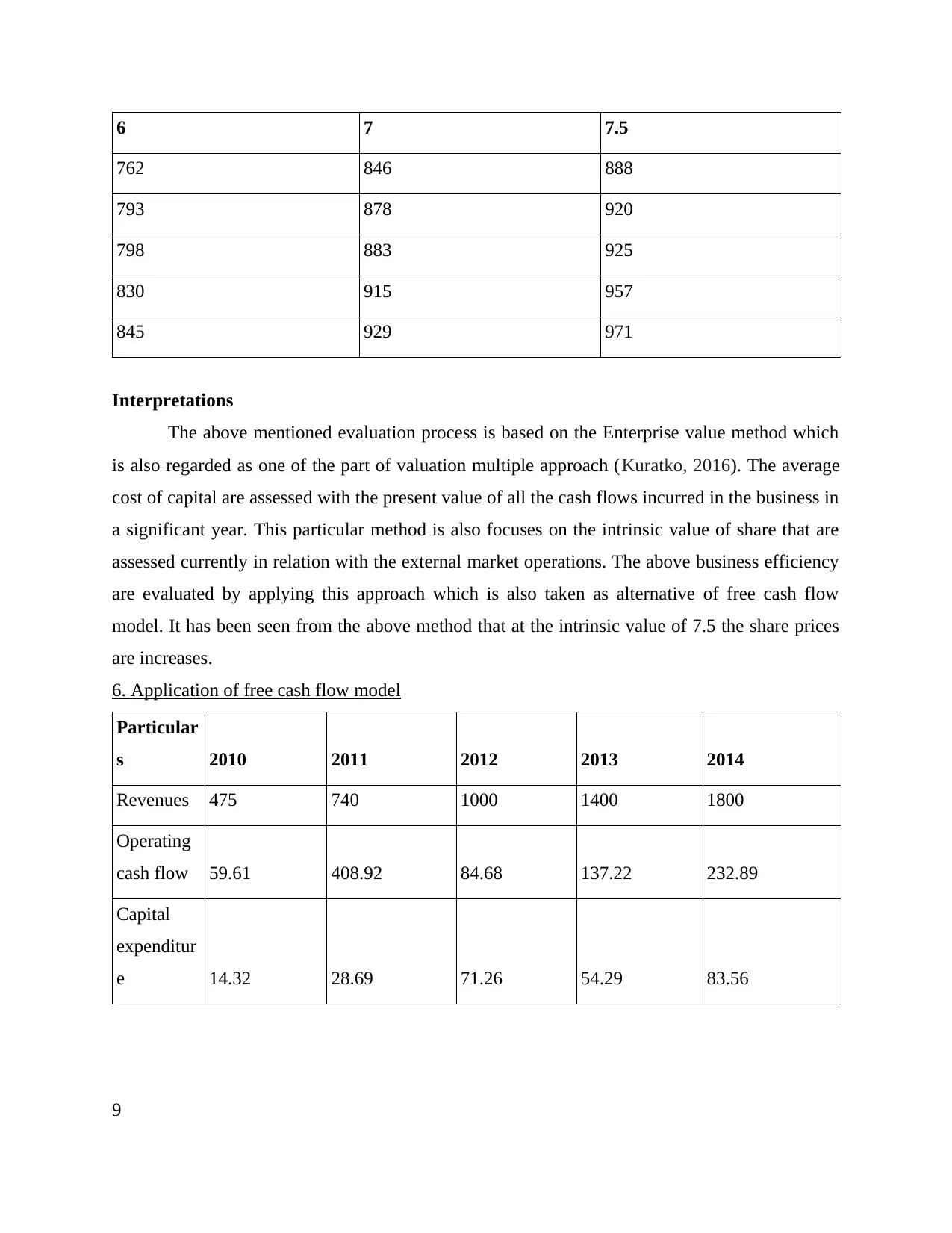
6 7 7.5
762 846 888
793 878 920
798 883 925
830 915 957
845 929 971
Interpretations
The above mentioned evaluation process is based on the Enterprise value method which
is also regarded as one of the part of valuation multiple approach (Kuratko, 2016). The average
cost of capital are assessed with the present value of all the cash flows incurred in the business in
a significant year. This particular method is also focuses on the intrinsic value of share that are
assessed currently in relation with the external market operations. The above business efficiency
are evaluated by applying this approach which is also taken as alternative of free cash flow
model. It has been seen from the above method that at the intrinsic value of 7.5 the share prices
are increases.
6. Application of free cash flow model
Particular
s 2010 2011 2012 2013 2014
Revenues 475 740 1000 1400 1800
Operating
cash flow 59.61 408.92 84.68 137.22 232.89
Capital
expenditur
e 14.32 28.69 71.26 54.29 83.56
9
762 846 888
793 878 920
798 883 925
830 915 957
845 929 971
Interpretations
The above mentioned evaluation process is based on the Enterprise value method which
is also regarded as one of the part of valuation multiple approach (Kuratko, 2016). The average
cost of capital are assessed with the present value of all the cash flows incurred in the business in
a significant year. This particular method is also focuses on the intrinsic value of share that are
assessed currently in relation with the external market operations. The above business efficiency
are evaluated by applying this approach which is also taken as alternative of free cash flow
model. It has been seen from the above method that at the intrinsic value of 7.5 the share prices
are increases.
6. Application of free cash flow model
Particular
s 2010 2011 2012 2013 2014
Revenues 475 740 1000 1400 1800
Operating
cash flow 59.61 408.92 84.68 137.22 232.89
Capital
expenditur
e 14.32 28.69 71.26 54.29 83.56
9
⊘ This is a preview!⊘
Do you want full access?
Subscribe today to unlock all pages.
Trusted by 1+ million students worldwide
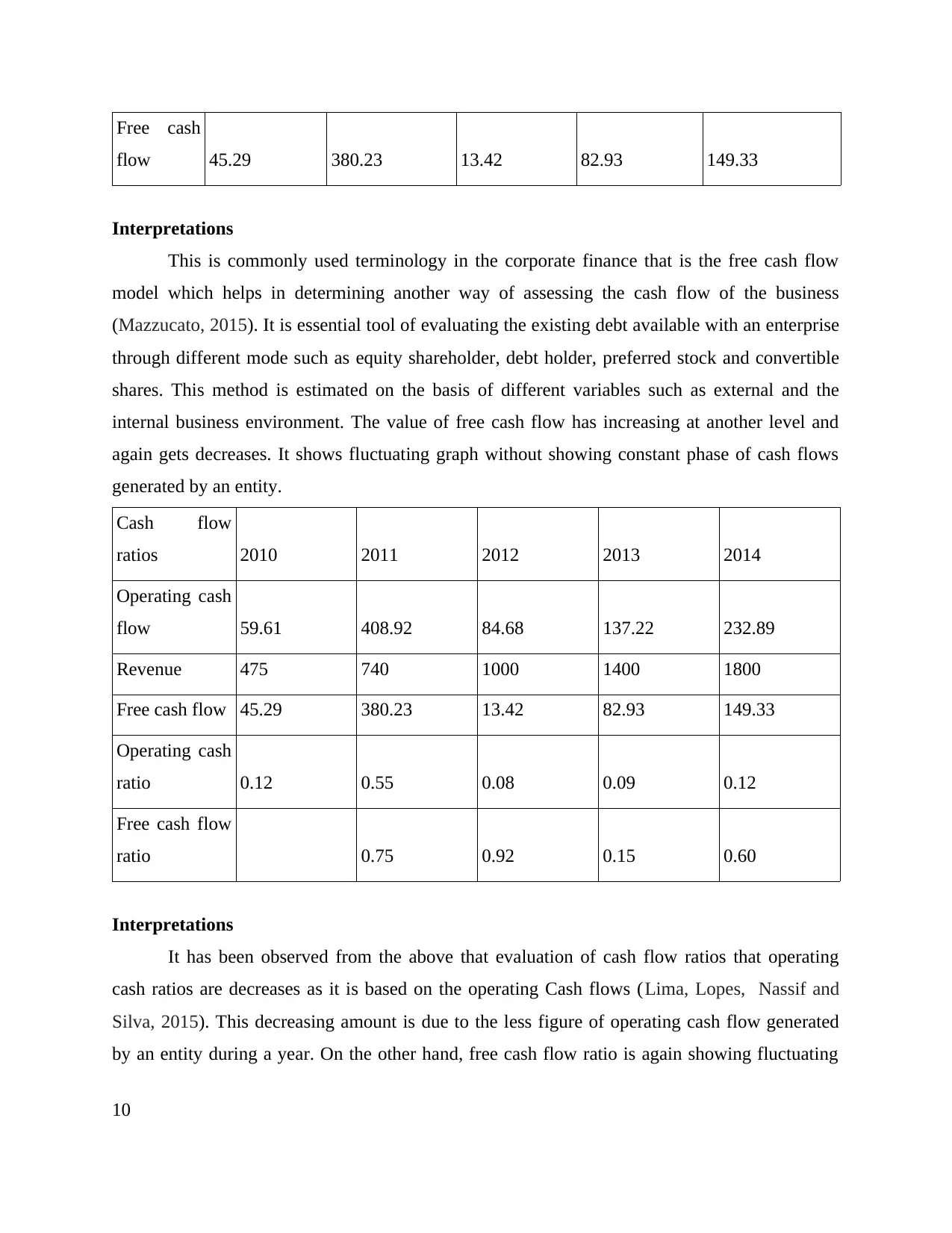
Free cash
flow 45.29 380.23 13.42 82.93 149.33
Interpretations
This is commonly used terminology in the corporate finance that is the free cash flow
model which helps in determining another way of assessing the cash flow of the business
(Mazzucato, 2015). It is essential tool of evaluating the existing debt available with an enterprise
through different mode such as equity shareholder, debt holder, preferred stock and convertible
shares. This method is estimated on the basis of different variables such as external and the
internal business environment. The value of free cash flow has increasing at another level and
again gets decreases. It shows fluctuating graph without showing constant phase of cash flows
generated by an entity.
Cash flow
ratios 2010 2011 2012 2013 2014
Operating cash
flow 59.61 408.92 84.68 137.22 232.89
Revenue 475 740 1000 1400 1800
Free cash flow 45.29 380.23 13.42 82.93 149.33
Operating cash
ratio 0.12 0.55 0.08 0.09 0.12
Free cash flow
ratio 0.75 0.92 0.15 0.60
Interpretations
It has been observed from the above that evaluation of cash flow ratios that operating
cash ratios are decreases as it is based on the operating Cash flows (Lima, Lopes, Nassif and
Silva, 2015). This decreasing amount is due to the less figure of operating cash flow generated
by an entity during a year. On the other hand, free cash flow ratio is again showing fluctuating
10
flow 45.29 380.23 13.42 82.93 149.33
Interpretations
This is commonly used terminology in the corporate finance that is the free cash flow
model which helps in determining another way of assessing the cash flow of the business
(Mazzucato, 2015). It is essential tool of evaluating the existing debt available with an enterprise
through different mode such as equity shareholder, debt holder, preferred stock and convertible
shares. This method is estimated on the basis of different variables such as external and the
internal business environment. The value of free cash flow has increasing at another level and
again gets decreases. It shows fluctuating graph without showing constant phase of cash flows
generated by an entity.
Cash flow
ratios 2010 2011 2012 2013 2014
Operating cash
flow 59.61 408.92 84.68 137.22 232.89
Revenue 475 740 1000 1400 1800
Free cash flow 45.29 380.23 13.42 82.93 149.33
Operating cash
ratio 0.12 0.55 0.08 0.09 0.12
Free cash flow
ratio 0.75 0.92 0.15 0.60
Interpretations
It has been observed from the above that evaluation of cash flow ratios that operating
cash ratios are decreases as it is based on the operating Cash flows (Lima, Lopes, Nassif and
Silva, 2015). This decreasing amount is due to the less figure of operating cash flow generated
by an entity during a year. On the other hand, free cash flow ratio is again showing fluctuating
10
Paraphrase This Document
Need a fresh take? Get an instant paraphrase of this document with our AI Paraphraser
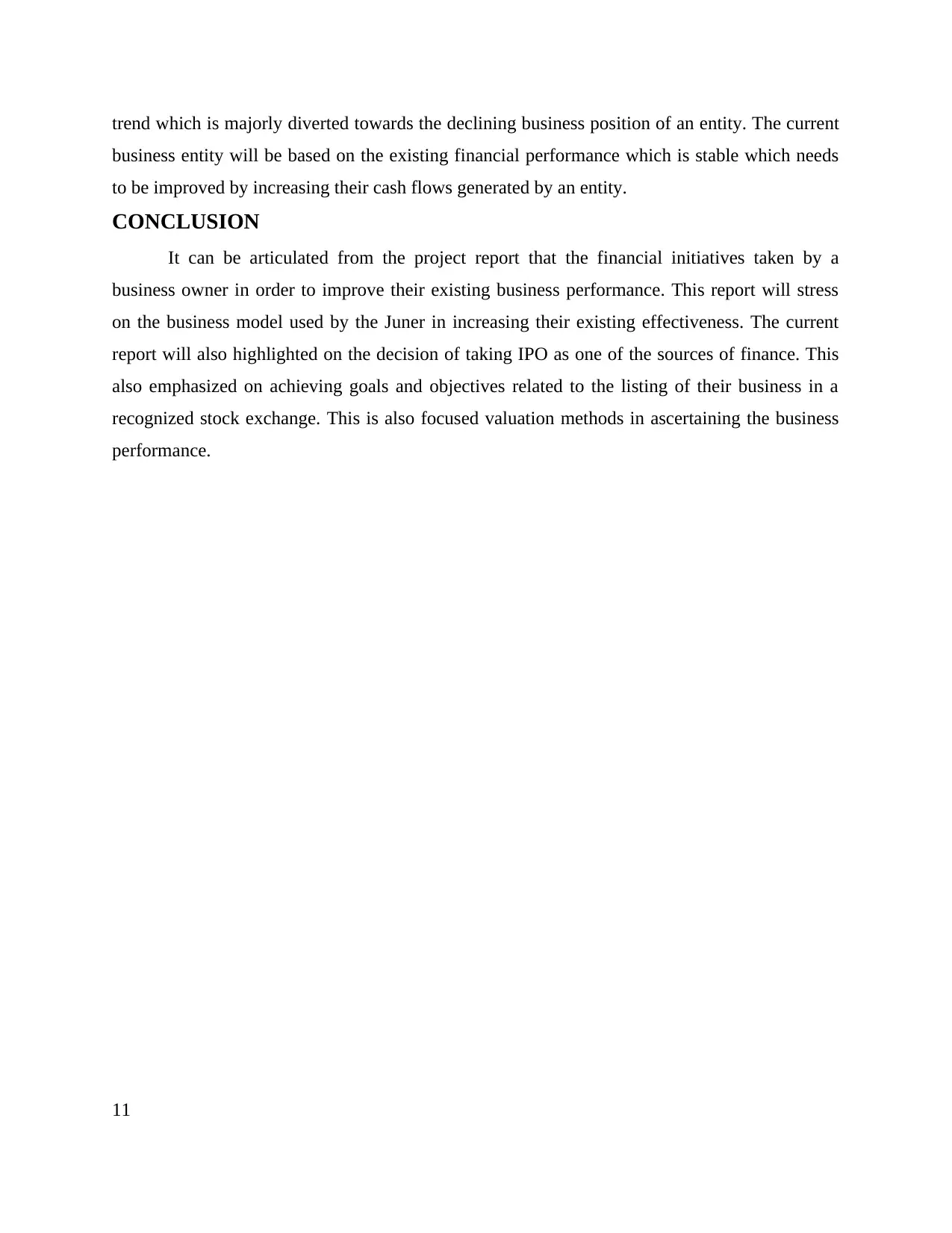
trend which is majorly diverted towards the declining business position of an entity. The current
business entity will be based on the existing financial performance which is stable which needs
to be improved by increasing their cash flows generated by an entity.
CONCLUSION
It can be articulated from the project report that the financial initiatives taken by a
business owner in order to improve their existing business performance. This report will stress
on the business model used by the Juner in increasing their existing effectiveness. The current
report will also highlighted on the decision of taking IPO as one of the sources of finance. This
also emphasized on achieving goals and objectives related to the listing of their business in a
recognized stock exchange. This is also focused valuation methods in ascertaining the business
performance.
11
business entity will be based on the existing financial performance which is stable which needs
to be improved by increasing their cash flows generated by an entity.
CONCLUSION
It can be articulated from the project report that the financial initiatives taken by a
business owner in order to improve their existing business performance. This report will stress
on the business model used by the Juner in increasing their existing effectiveness. The current
report will also highlighted on the decision of taking IPO as one of the sources of finance. This
also emphasized on achieving goals and objectives related to the listing of their business in a
recognized stock exchange. This is also focused valuation methods in ascertaining the business
performance.
11
REFERENCES
Ramadani, V., Gerguri-Rashiti, S. and Fayolle, A. eds., 2015. Female entrepreneurship in
transition economies: Trends and challenges. Springer.
Kuratko, D. F., 2016. Entrepreneurship: Theory, process, and practice. Cengage Learning.
Sannajust, A., Roux, F. and Chaibi, A., 2014. Crowdfunding In France: A New Revolution?.
Journal of Applied Business Research. 30(6). p.1919.
Amorós, J. E., Bosma, N. and Levie, J., 2013. Ten years of global entrepreneurship monitor:
Accomplishments and prospects. International Journal of Entrepreneurial Venturing. 5(2).
pp.120-152.
Audretsch, D. B., Lehmann, E. E., Paleari, S. and Vismara, S., 2016. Entrepreneurial finance and
technology transfer. The Journal of Technology Transfer. 41(1). pp.1-9.
Mazzucato, M., 2015. The entrepreneurial state: Debunking public vs. private sector myths.
Anthem Press.
Corbett, A., Covin, J. G., O'Connor, G. C. and Tucci, C. L., 2013. Corporate Entrepreneurship:
State‐of‐the‐Art Research and a Future Research Agenda.Journal of Product Innovation
Management. 30(5). pp.812-820.
Seghers, A., Manigart, S. and Vanacker, T., 2012. The impact of human and social capital on
entrepreneurs’ knowledge of finance alternatives. Journal of Small Business Management.
50(1). pp.63-86.
Colombo, M. G., Cumming, D. J. and Vismara, S., 2016. Governmental venture capital for
innovative young firms. The Journal of Technology Transfer. 41(1). pp.10-24.
Lima, E., Lopes, R. M., Nassif, V. and Silva, D., 2015. Opportunities to improve
entrepreneurship education: Contributions considering brazilian challenges. Journal of
Small Business Management. 53(4). pp.1033-1051.
12
Ramadani, V., Gerguri-Rashiti, S. and Fayolle, A. eds., 2015. Female entrepreneurship in
transition economies: Trends and challenges. Springer.
Kuratko, D. F., 2016. Entrepreneurship: Theory, process, and practice. Cengage Learning.
Sannajust, A., Roux, F. and Chaibi, A., 2014. Crowdfunding In France: A New Revolution?.
Journal of Applied Business Research. 30(6). p.1919.
Amorós, J. E., Bosma, N. and Levie, J., 2013. Ten years of global entrepreneurship monitor:
Accomplishments and prospects. International Journal of Entrepreneurial Venturing. 5(2).
pp.120-152.
Audretsch, D. B., Lehmann, E. E., Paleari, S. and Vismara, S., 2016. Entrepreneurial finance and
technology transfer. The Journal of Technology Transfer. 41(1). pp.1-9.
Mazzucato, M., 2015. The entrepreneurial state: Debunking public vs. private sector myths.
Anthem Press.
Corbett, A., Covin, J. G., O'Connor, G. C. and Tucci, C. L., 2013. Corporate Entrepreneurship:
State‐of‐the‐Art Research and a Future Research Agenda.Journal of Product Innovation
Management. 30(5). pp.812-820.
Seghers, A., Manigart, S. and Vanacker, T., 2012. The impact of human and social capital on
entrepreneurs’ knowledge of finance alternatives. Journal of Small Business Management.
50(1). pp.63-86.
Colombo, M. G., Cumming, D. J. and Vismara, S., 2016. Governmental venture capital for
innovative young firms. The Journal of Technology Transfer. 41(1). pp.10-24.
Lima, E., Lopes, R. M., Nassif, V. and Silva, D., 2015. Opportunities to improve
entrepreneurship education: Contributions considering brazilian challenges. Journal of
Small Business Management. 53(4). pp.1033-1051.
12
⊘ This is a preview!⊘
Do you want full access?
Subscribe today to unlock all pages.
Trusted by 1+ million students worldwide

1 out of 12


Related Documents


Your All-in-One AI-Powered Toolkit for Academic Success.
+13062052269
info@desklib.com
Available 24*7 on WhatsApp / Email
![[object Object]](/_next/static/media/star-bottom.7253800d.svg)
Unlock your academic potential
Copyright © 2020–2025 A2Z Services. All Rights Reserved. Developed and managed by ZUCOL.