Signals and Systems - Assignment Solutions, Analysis, and Explanation

Verified

Added on  2022/09/01

|6
|284
|17
Homework Assignment
AI Summary
This document presents solutions and analysis for a Signals and Systems homework assignment. The assignment covers topics such as signal representation, system properties (linearity, causality, and memoryless systems), and mathematical analysis of signals. Specific problems include signal characterization, piecewise function definition, and system classification based on their properties. The solutions include detailed explanations and mathematical derivations. The document also references several textbooks and academic resources related to the subject. The assignment is designed to help students understand and apply fundamental concepts in signals and systems. Desklib provides access to this and other solved assignments for students to aid in their studies.

Document Page
1
Signals and Systems
Student’s Name
Institutional Affiliation
Date
tabler-icon-diamond-filled.svg

Paraphrase This Document

Need a fresh take? Get an instant paraphrase of this document with our AI Paraphraser
Document Page
2
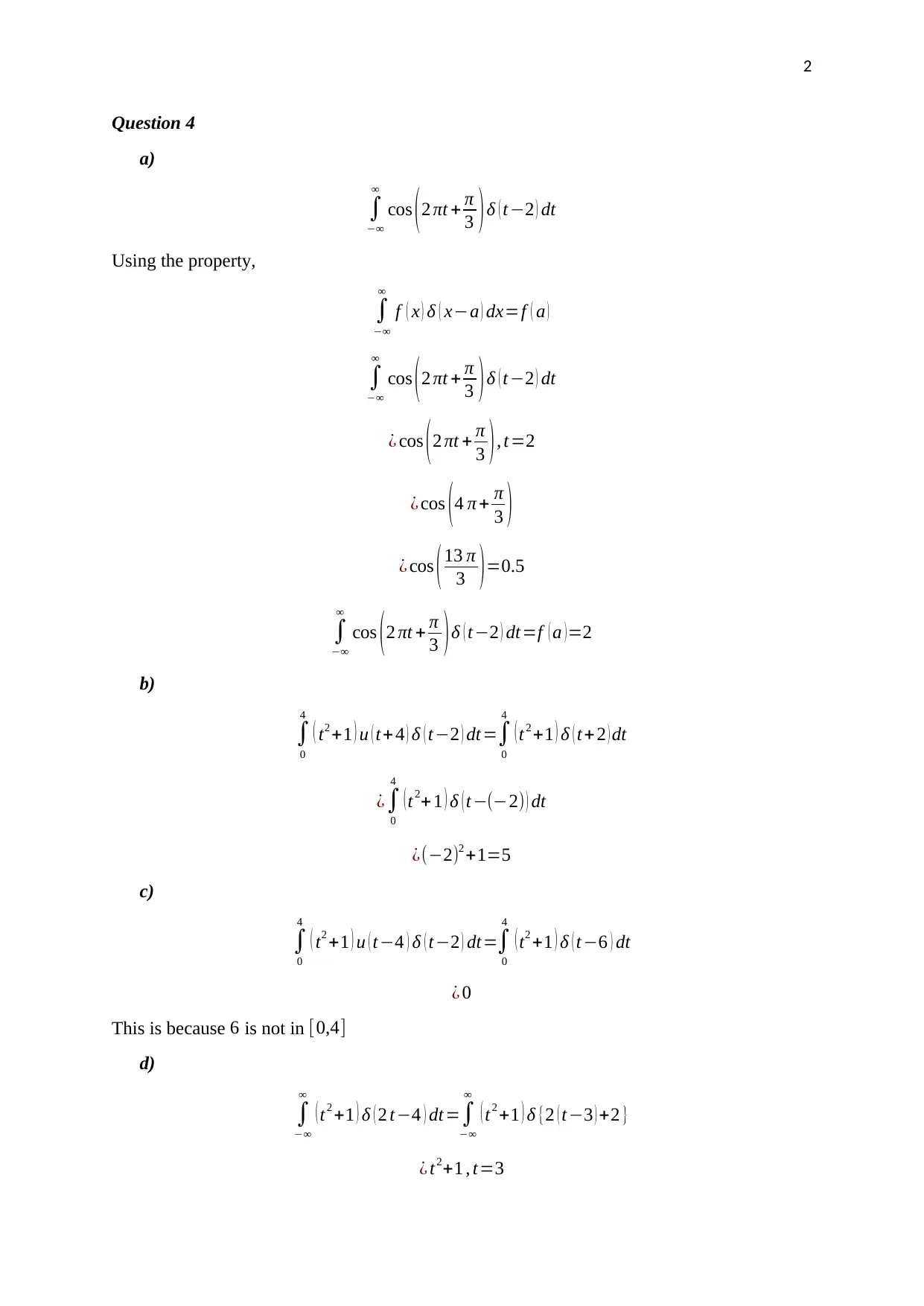
Question 4
a)


cos ( 2 πt + π
3 ) δ ( t2 ) dt
Using the property,


f ( x ) δ ( xa ) dx=f ( a )


cos ( 2 πt + π
3 ) δ ( t2 ) dt
¿ cos (2 πt + π
3 ), t=2
¿ cos (4 π + π
3 )
¿ cos (13 π
3 )=0.5


cos (2 πt + π
3 )δ ( t2 ) dt=f ( a )=2
b)

0
4
( t2 +1 ) u ( t+4 ) δ ( t2 ) dt=
0
4
( t2 +1 ) δ ( t+ 2 ) dt
¿
0
4
(t2+ 1 ) δ ( t (2) ) dt
¿(2)2 +1=5
c)

0
4
( t2 +1 ) u ( t4 ) δ ( t2 ) dt=
0
4
( t2 +1 ) δ ( t6 ) dt
¿ 0
This is because 6 is not in [0,4]
d)


( t2 +1 ) δ ( 2 t4 ) dt =


( t2 +1 ) δ {2 ( t3 ) +2 }
¿ t2+1 , t=3
Document Page
3
¿ 32 +1=10
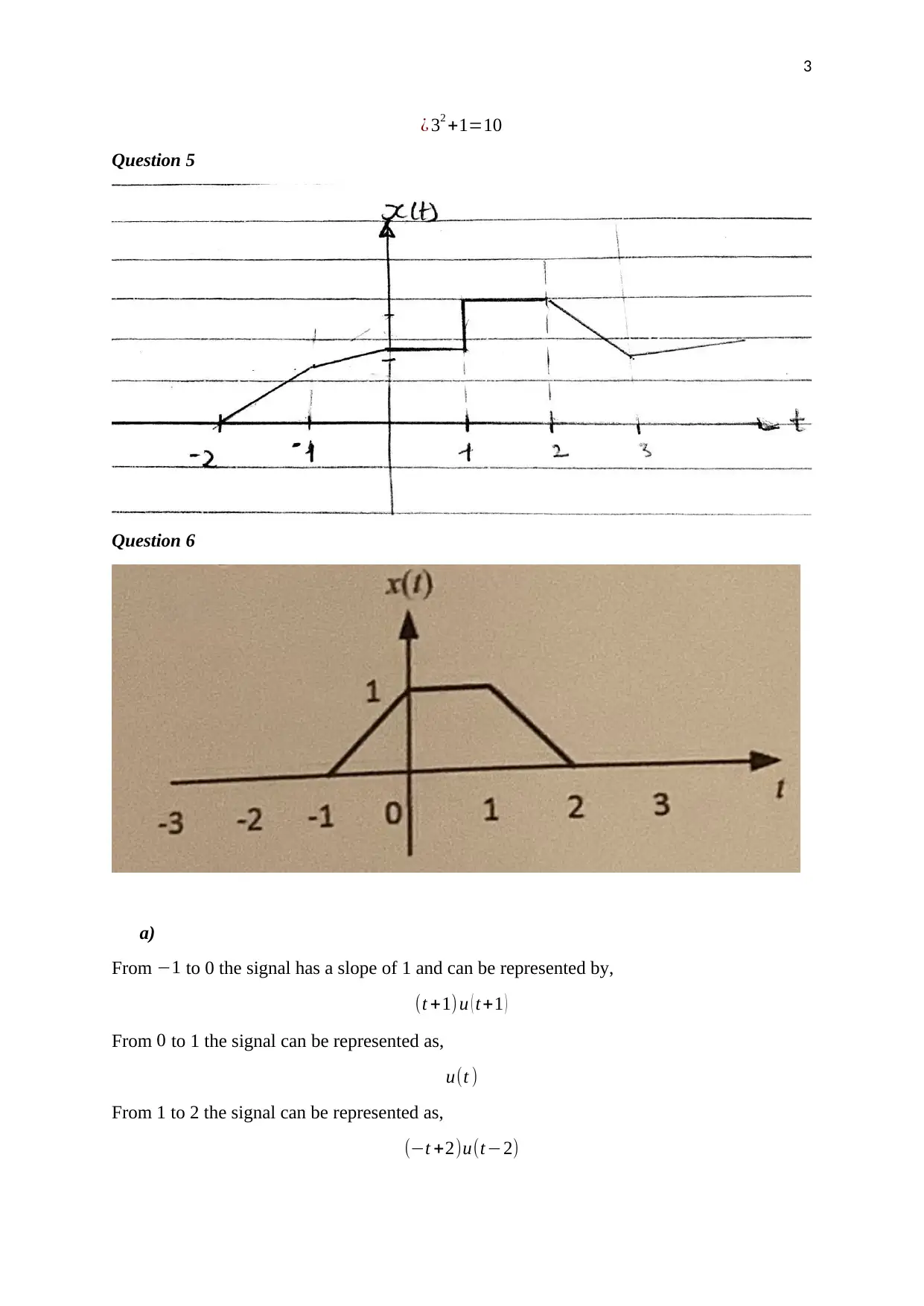
Question 5
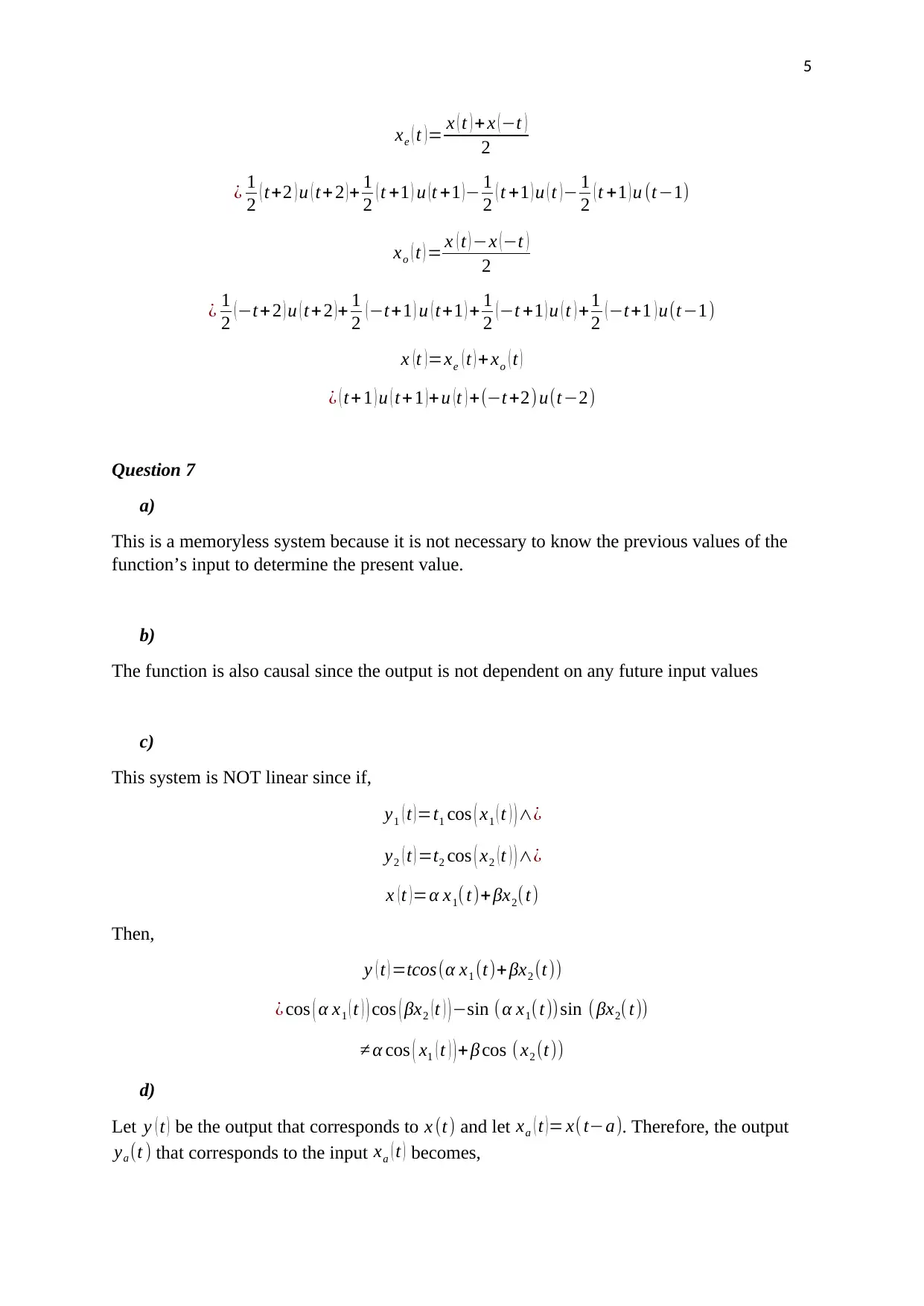
Question 6
a)
From 1 to 0 the signal has a slope of 1 and can be represented by,
(t +1) u ( t+1 )
From 0 to 1 the signal can be represented as,
u(t )
From 1 to 2 the signal can be represented as,
(t +2)u(t2)
Document Page
4
The signal becomes,
x ( t ) = ( t +1 ) u ( t+1 ) +u ( t ) +(t +2)u(t2)
b)
c)
x (t )= (t +1 ) u ( t+1 ) +u ( t )+(t +2)u(t2)
x (t ) = ( t+2 ) u ( t+2 ) +u ( t ) + (t+ 1 ) u ( t1 )
tabler-icon-diamond-filled.svg

Paraphrase This Document

Need a fresh take? Get an instant paraphrase of this document with our AI Paraphraser
Document Page
5
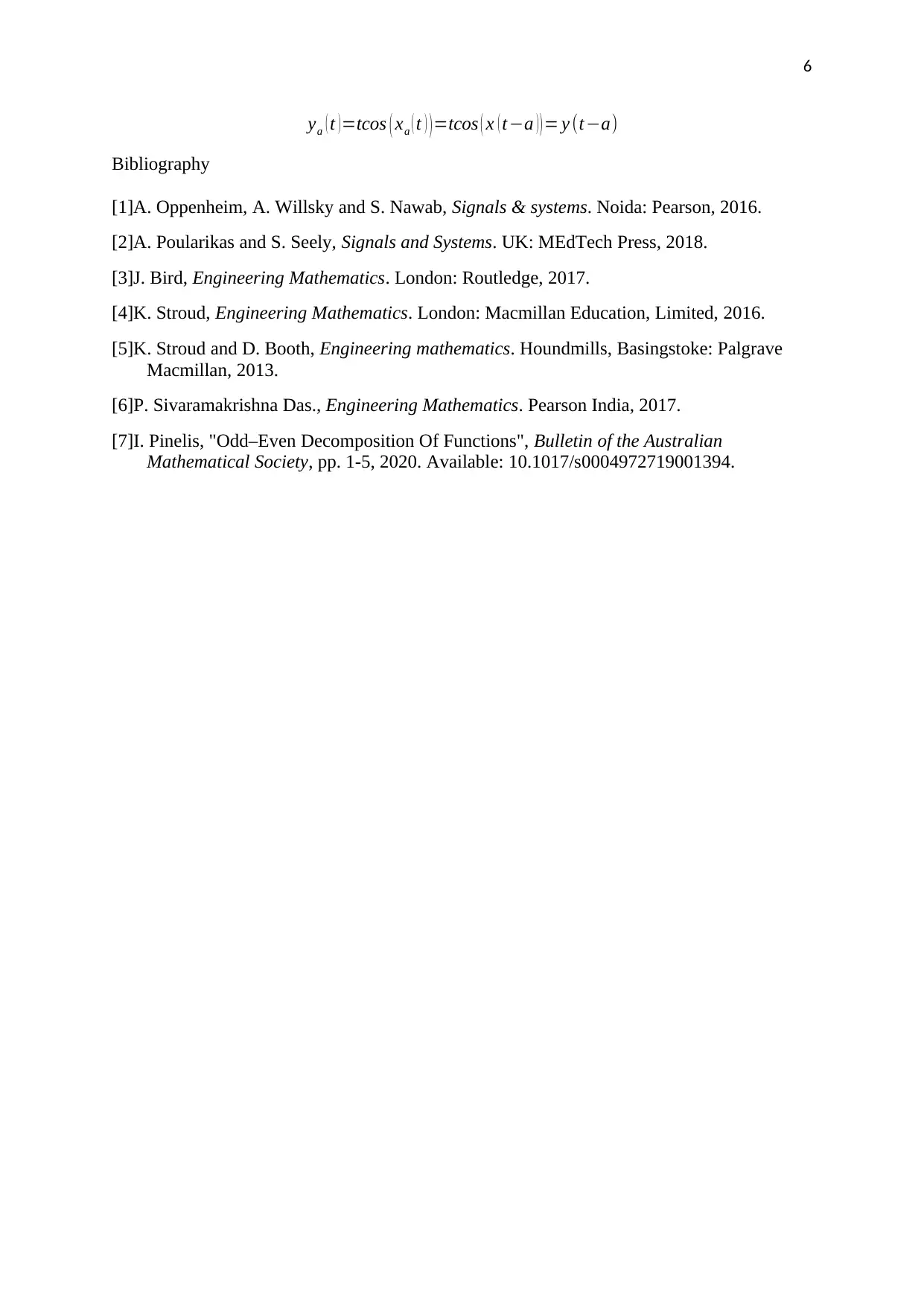
xe ( t ) = x ( t ) + x ( t )
2
¿ 1
2 ( t+2 ) u ( t+ 2 )+ 1
2 ( t +1 ) u (t +1 ) 1
2 ( t +1 ) u ( t ) 1
2 ( t +1 ) u (t1)
xo ( t ) = x ( t ) x (t )
2
¿ 1
2 (t+2 ) u ( t+2 )+ 1
2 (t+1 ) u ( t+1 ) + 1
2 (t +1 ) u ( t ) +1
2 (t+1 ) u(t1)
x ( t ) =xe ( t ) + xo ( t )
¿ ( t+ 1 ) u ( t+ 1 ) + u ( t ) +(t +2) u(t2)
Question 7
a)
This is a memoryless system because it is not necessary to know the previous values of the
function’s input to determine the present value.
b)
The function is also causal since the output is not dependent on any future input values
c)
This system is NOT linear since if,
y1 ( t )=t1 cos ( x1 ( t ) )¿
y2 ( t ) =t2 cos ( x2 (t ) )¿
x (t )=α x1( t)+βx2(t)
Then,
y ( t ) =tcos(α x1 (t)+ βx2 (t))
¿ cos ( α x1 ( t ) ) cos ( βx2 ( t ) ) sin (α x1(t))sin ( βx2( t))
α cos ( x1 ( t ) )+ β cos ( x2 (t))
d)
Let y ( t ) be the output that corresponds to x (t) and let xa ( t ) = x( ta). Therefore, the output
ya (t ) that corresponds to the input xa ( t ) becomes,
Document Page
6
ya ( t ) =tcos ( xa ( t ) ) =tcos ( x ( ta ) ) = y (ta)
Bibliography
[1]A. Oppenheim, A. Willsky and S. Nawab, Signals & systems. Noida: Pearson, 2016.
[2]A. Poularikas and S. Seely, Signals and Systems. UK: MEdTech Press, 2018.
[3]J. Bird, Engineering Mathematics. London: Routledge, 2017.
[4]K. Stroud, Engineering Mathematics. London: Macmillan Education, Limited, 2016.
[5]K. Stroud and D. Booth, Engineering mathematics. Houndmills, Basingstoke: Palgrave
Macmillan, 2013.
[6]P. Sivaramakrishna Das., Engineering Mathematics. Pearson India, 2017.
[7]I. Pinelis, "Odd–Even Decomposition Of Functions", Bulletin of the Australian
Mathematical Society, pp. 1-5, 2020. Available: 10.1017/s0004972719001394.
chevron_up_icon
1 out of 6
circle_padding
hide_on_mobile
zoom_out_icon
[object Object]