Financial Decision Making Report
VerifiedAdded on 2020/02/05
|30
|8731
|403
Report
AI Summary
This report provides a comprehensive financial analysis of Singapore Airlines, evaluating its performance using various accounting and financial techniques. A fundamental analysis of the company's financial statements is conducted, examining profitability, liquidity, and stability ratios to assess its financial strength. The report also discusses the impact of acquisitions (Tigerair and Scoot) on the company's financial performance, identifies key directors and their roles, and analyzes dividend ratios and asset value per share. The analysis concludes with an investment recommendation for long-term investors based on the findings. The report includes horizontal and vertical analyses of the balance sheet and profit and loss account, along with detailed calculations and interpretations of various financial ratios. Appendices provide supporting data and graphical representations of trends in sales, profit, assets, and liabilities.

Financial decision making

Paraphrase This Document
Need a fresh take? Get an instant paraphrase of this document with our AI Paraphraser
Executive Summary
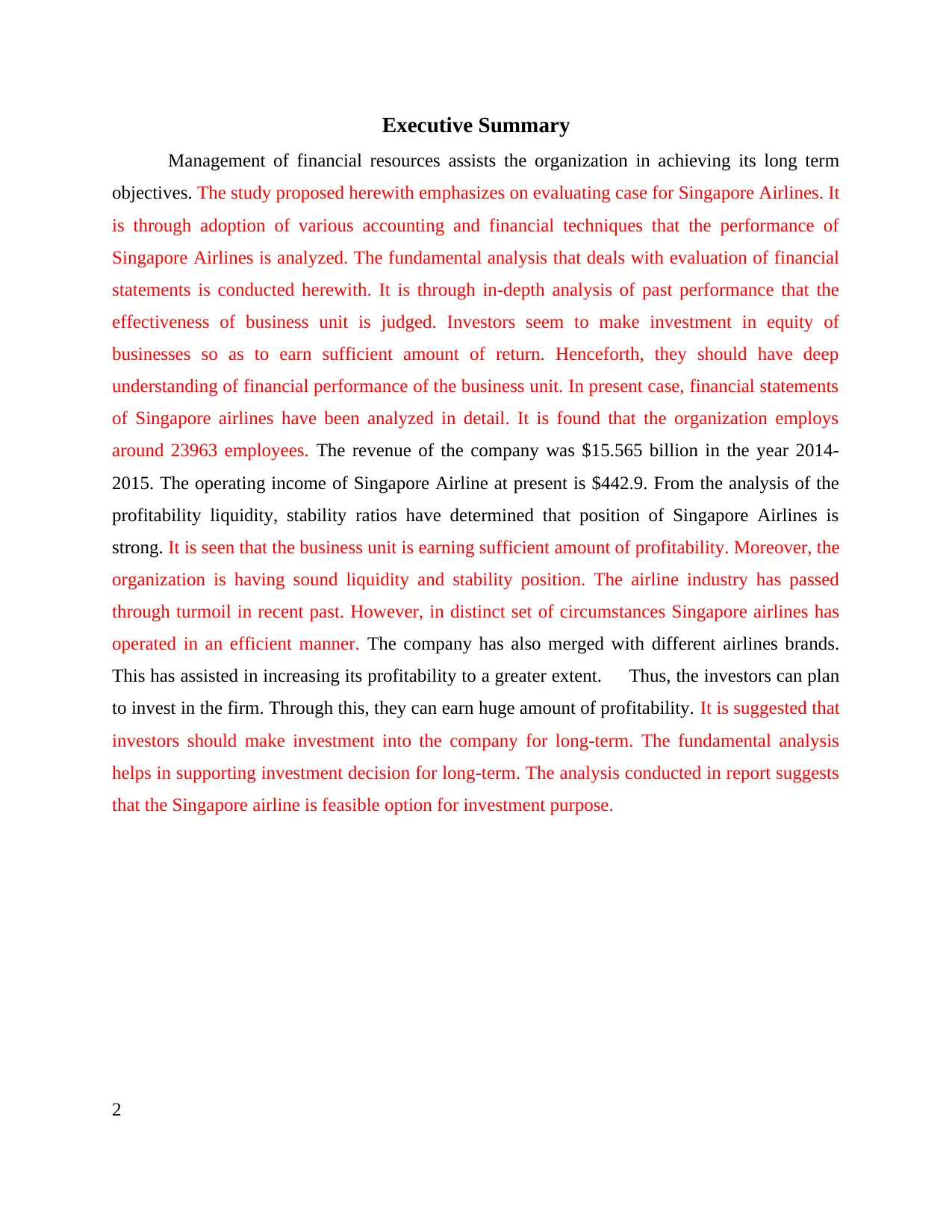
Management of financial resources assists the organization in achieving its long term
objectives. The study proposed herewith emphasizes on evaluating case for Singapore Airlines. It
is through adoption of various accounting and financial techniques that the performance of
Singapore Airlines is analyzed. The fundamental analysis that deals with evaluation of financial
statements is conducted herewith. It is through in-depth analysis of past performance that the
effectiveness of business unit is judged. Investors seem to make investment in equity of
businesses so as to earn sufficient amount of return. Henceforth, they should have deep
understanding of financial performance of the business unit. In present case, financial statements
of Singapore airlines have been analyzed in detail. It is found that the organization employs
around 23963 employees. The revenue of the company was $15.565 billion in the year 2014-
2015. The operating income of Singapore Airline at present is $442.9. From the analysis of the
profitability liquidity, stability ratios have determined that position of Singapore Airlines is
strong. It is seen that the business unit is earning sufficient amount of profitability. Moreover, the
organization is having sound liquidity and stability position. The airline industry has passed
through turmoil in recent past. However, in distinct set of circumstances Singapore airlines has
operated in an efficient manner. The company has also merged with different airlines brands.
This has assisted in increasing its profitability to a greater extent. Thus, the investors can plan
to invest in the firm. Through this, they can earn huge amount of profitability. It is suggested that
investors should make investment into the company for long-term. The fundamental analysis
helps in supporting investment decision for long-term. The analysis conducted in report suggests
that the Singapore airline is feasible option for investment purpose.
2
Management of financial resources assists the organization in achieving its long term
objectives. The study proposed herewith emphasizes on evaluating case for Singapore Airlines. It
is through adoption of various accounting and financial techniques that the performance of
Singapore Airlines is analyzed. The fundamental analysis that deals with evaluation of financial
statements is conducted herewith. It is through in-depth analysis of past performance that the
effectiveness of business unit is judged. Investors seem to make investment in equity of
businesses so as to earn sufficient amount of return. Henceforth, they should have deep
understanding of financial performance of the business unit. In present case, financial statements
of Singapore airlines have been analyzed in detail. It is found that the organization employs
around 23963 employees. The revenue of the company was $15.565 billion in the year 2014-
2015. The operating income of Singapore Airline at present is $442.9. From the analysis of the
profitability liquidity, stability ratios have determined that position of Singapore Airlines is
strong. It is seen that the business unit is earning sufficient amount of profitability. Moreover, the
organization is having sound liquidity and stability position. The airline industry has passed
through turmoil in recent past. However, in distinct set of circumstances Singapore airlines has
operated in an efficient manner. The company has also merged with different airlines brands.
This has assisted in increasing its profitability to a greater extent. Thus, the investors can plan
to invest in the firm. Through this, they can earn huge amount of profitability. It is suggested that
investors should make investment into the company for long-term. The fundamental analysis
helps in supporting investment decision for long-term. The analysis conducted in report suggests
that the Singapore airline is feasible option for investment purpose.
2
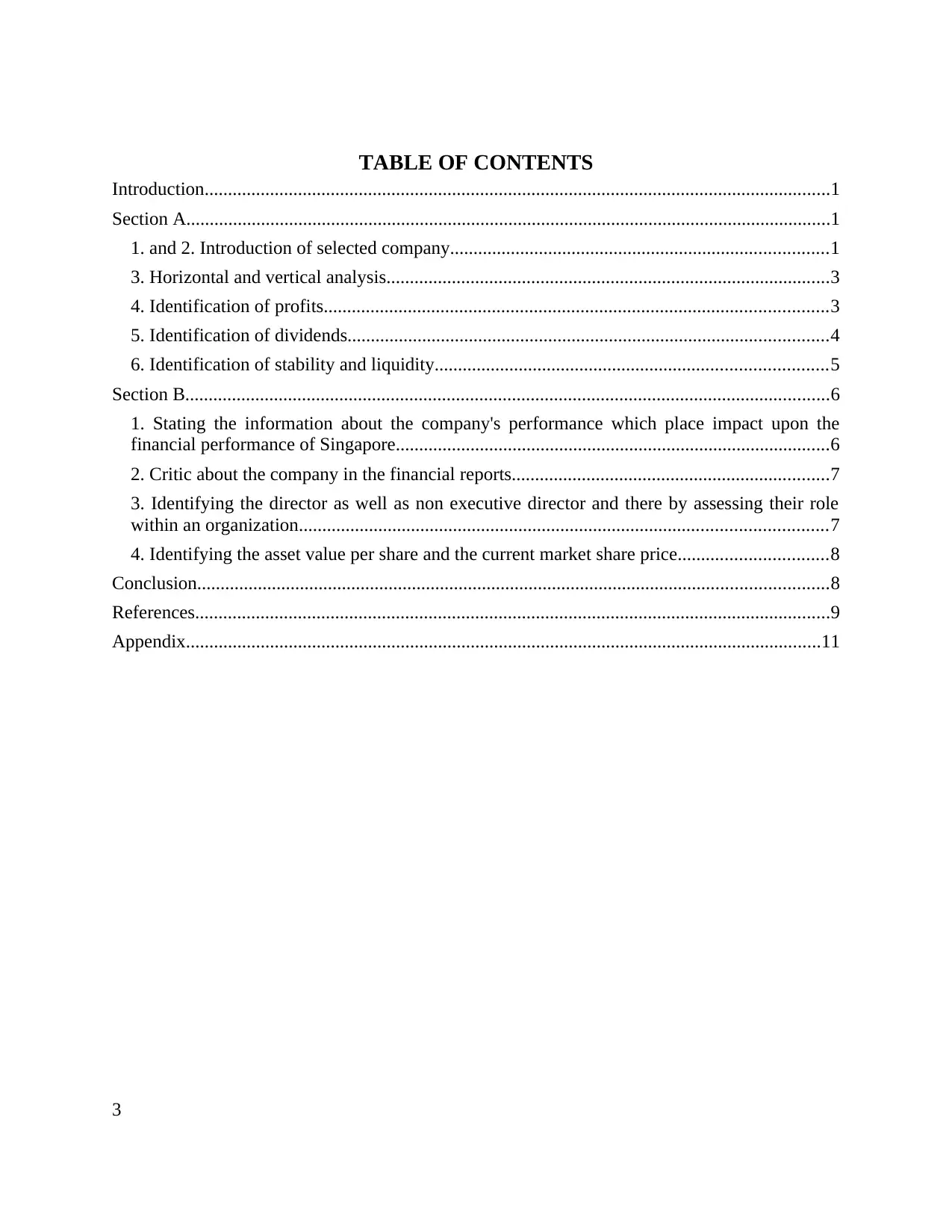
TABLE OF CONTENTS
Introduction......................................................................................................................................1
Section A..........................................................................................................................................1
1. and 2. Introduction of selected company.................................................................................1
3. Horizontal and vertical analysis...............................................................................................3
4. Identification of profits............................................................................................................3
5. Identification of dividends.......................................................................................................4
6. Identification of stability and liquidity....................................................................................5
Section B..........................................................................................................................................6
1. Stating the information about the company's performance which place impact upon the
financial performance of Singapore.............................................................................................6
2. Critic about the company in the financial reports....................................................................7
3. Identifying the director as well as non executive director and there by assessing their role
within an organization.................................................................................................................7
4. Identifying the asset value per share and the current market share price................................8
Conclusion.......................................................................................................................................8
References........................................................................................................................................9
Appendix........................................................................................................................................11
3
Introduction......................................................................................................................................1
Section A..........................................................................................................................................1
1. and 2. Introduction of selected company.................................................................................1
3. Horizontal and vertical analysis...............................................................................................3
4. Identification of profits............................................................................................................3
5. Identification of dividends.......................................................................................................4
6. Identification of stability and liquidity....................................................................................5
Section B..........................................................................................................................................6
1. Stating the information about the company's performance which place impact upon the
financial performance of Singapore.............................................................................................6
2. Critic about the company in the financial reports....................................................................7
3. Identifying the director as well as non executive director and there by assessing their role
within an organization.................................................................................................................7
4. Identifying the asset value per share and the current market share price................................8
Conclusion.......................................................................................................................................8
References........................................................................................................................................9
Appendix........................................................................................................................................11
3
⊘ This is a preview!⊘
Do you want full access?
Subscribe today to unlock all pages.

Trusted by 1+ million students worldwide
INTRODUCTION
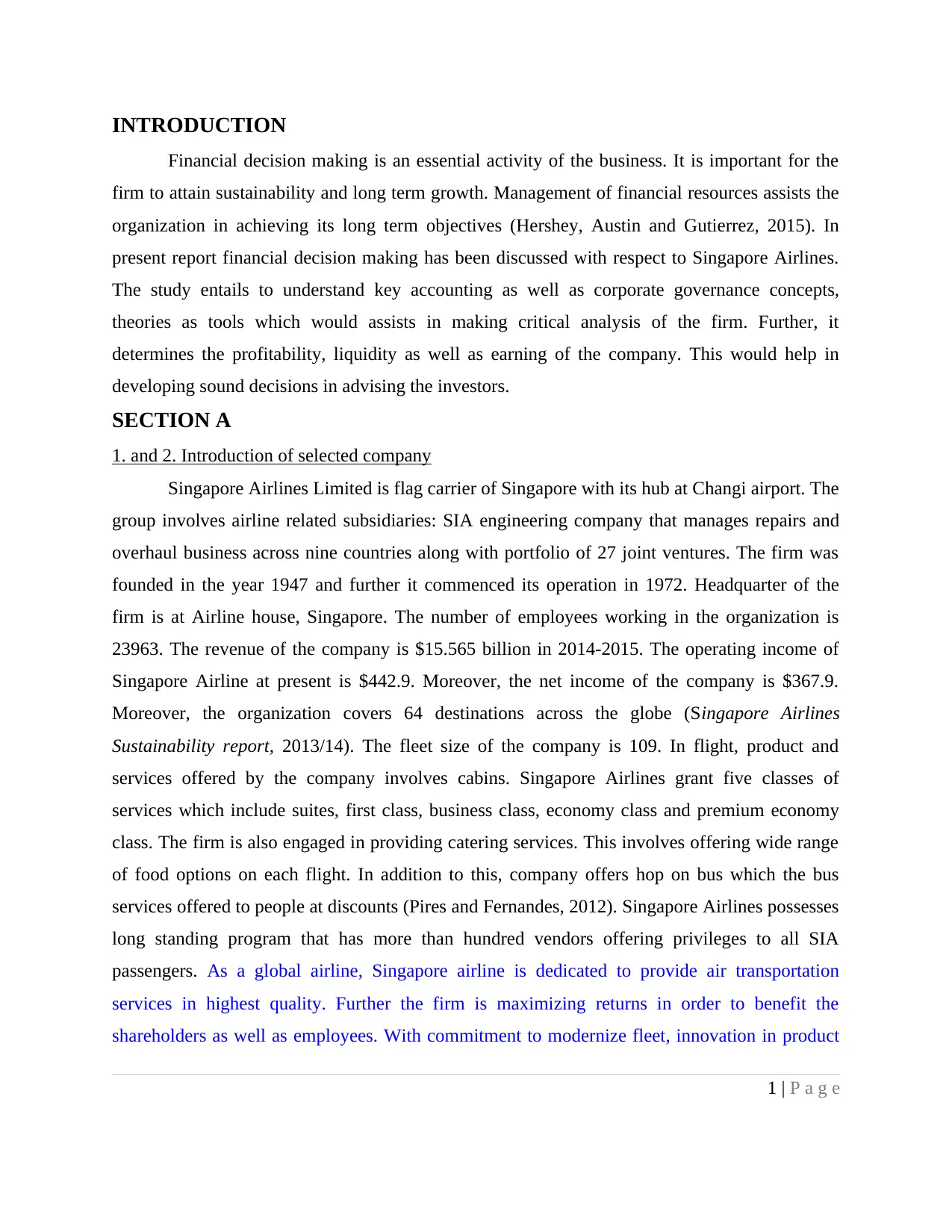
Financial decision making is an essential activity of the business. It is important for the
firm to attain sustainability and long term growth. Management of financial resources assists the
organization in achieving its long term objectives (Hershey, Austin and Gutierrez, 2015). In
present report financial decision making has been discussed with respect to Singapore Airlines.
The study entails to understand key accounting as well as corporate governance concepts,
theories as tools which would assists in making critical analysis of the firm. Further, it
determines the profitability, liquidity as well as earning of the company. This would help in
developing sound decisions in advising the investors.
SECTION A
1. and 2. Introduction of selected company
Singapore Airlines Limited is flag carrier of Singapore with its hub at Changi airport. The
group involves airline related subsidiaries: SIA engineering company that manages repairs and
overhaul business across nine countries along with portfolio of 27 joint ventures. The firm was
founded in the year 1947 and further it commenced its operation in 1972. Headquarter of the
firm is at Airline house, Singapore. The number of employees working in the organization is
23963. The revenue of the company is $15.565 billion in 2014-2015. The operating income of
Singapore Airline at present is $442.9. Moreover, the net income of the company is $367.9.
Moreover, the organization covers 64 destinations across the globe (Singapore Airlines
Sustainability report, 2013/14). The fleet size of the company is 109. In flight, product and
services offered by the company involves cabins. Singapore Airlines grant five classes of
services which include suites, first class, business class, economy class and premium economy
class. The firm is also engaged in providing catering services. This involves offering wide range
of food options on each flight. In addition to this, company offers hop on bus which the bus
services offered to people at discounts (Pires and Fernandes, 2012). Singapore Airlines possesses
long standing program that has more than hundred vendors offering privileges to all SIA
passengers. As a global airline, Singapore airline is dedicated to provide air transportation
services in highest quality. Further the firm is maximizing returns in order to benefit the
shareholders as well as employees. With commitment to modernize fleet, innovation in product
1 | P a g e
Financial decision making is an essential activity of the business. It is important for the
firm to attain sustainability and long term growth. Management of financial resources assists the
organization in achieving its long term objectives (Hershey, Austin and Gutierrez, 2015). In
present report financial decision making has been discussed with respect to Singapore Airlines.
The study entails to understand key accounting as well as corporate governance concepts,
theories as tools which would assists in making critical analysis of the firm. Further, it
determines the profitability, liquidity as well as earning of the company. This would help in
developing sound decisions in advising the investors.
SECTION A
1. and 2. Introduction of selected company
Singapore Airlines Limited is flag carrier of Singapore with its hub at Changi airport. The
group involves airline related subsidiaries: SIA engineering company that manages repairs and
overhaul business across nine countries along with portfolio of 27 joint ventures. The firm was
founded in the year 1947 and further it commenced its operation in 1972. Headquarter of the
firm is at Airline house, Singapore. The number of employees working in the organization is
23963. The revenue of the company is $15.565 billion in 2014-2015. The operating income of
Singapore Airline at present is $442.9. Moreover, the net income of the company is $367.9.
Moreover, the organization covers 64 destinations across the globe (Singapore Airlines
Sustainability report, 2013/14). The fleet size of the company is 109. In flight, product and
services offered by the company involves cabins. Singapore Airlines grant five classes of
services which include suites, first class, business class, economy class and premium economy
class. The firm is also engaged in providing catering services. This involves offering wide range
of food options on each flight. In addition to this, company offers hop on bus which the bus
services offered to people at discounts (Pires and Fernandes, 2012). Singapore Airlines possesses
long standing program that has more than hundred vendors offering privileges to all SIA
passengers. As a global airline, Singapore airline is dedicated to provide air transportation
services in highest quality. Further the firm is maximizing returns in order to benefit the
shareholders as well as employees. With commitment to modernize fleet, innovation in product
1 | P a g e
Paraphrase This Document
Need a fresh take? Get an instant paraphrase of this document with our AI Paraphraser

and services, market leadership, Singapore Airlines has emerged as one of the world's most
respected travel brands. At present Singapore Airlines is renowned as world's leading airline and
operates modern passenger fleet of greater than 100 aircraft.
2
respected travel brands. At present Singapore Airlines is renowned as world's leading airline and
operates modern passenger fleet of greater than 100 aircraft.
2
3. Horizontal and vertical analysis
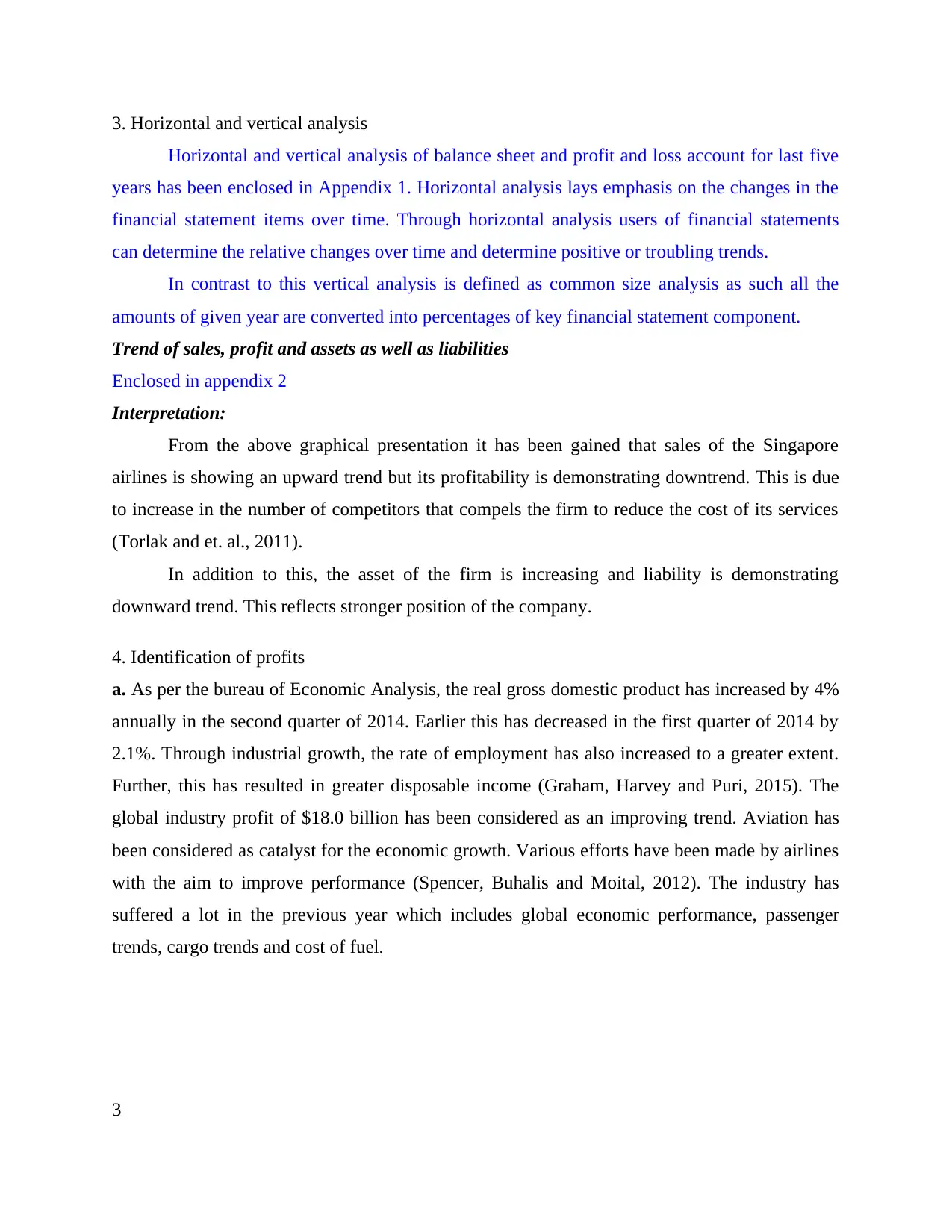
Horizontal and vertical analysis of balance sheet and profit and loss account for last five
years has been enclosed in Appendix 1. Horizontal analysis lays emphasis on the changes in the
financial statement items over time. Through horizontal analysis users of financial statements
can determine the relative changes over time and determine positive or troubling trends.
In contrast to this vertical analysis is defined as common size analysis as such all the
amounts of given year are converted into percentages of key financial statement component.
Trend of sales, profit and assets as well as liabilities
Enclosed in appendix 2
Interpretation:
From the above graphical presentation it has been gained that sales of the Singapore
airlines is showing an upward trend but its profitability is demonstrating downtrend. This is due
to increase in the number of competitors that compels the firm to reduce the cost of its services
(Torlak and et. al., 2011).
In addition to this, the asset of the firm is increasing and liability is demonstrating
downward trend. This reflects stronger position of the company.
4. Identification of profits
a. As per the bureau of Economic Analysis, the real gross domestic product has increased by 4%
annually in the second quarter of 2014. Earlier this has decreased in the first quarter of 2014 by
2.1%. Through industrial growth, the rate of employment has also increased to a greater extent.
Further, this has resulted in greater disposable income (Graham, Harvey and Puri, 2015). The
global industry profit of $18.0 billion has been considered as an improving trend. Aviation has
been considered as catalyst for the economic growth. Various efforts have been made by airlines
with the aim to improve performance (Spencer, Buhalis and Moital, 2012). The industry has
suffered a lot in the previous year which includes global economic performance, passenger
trends, cargo trends and cost of fuel.
3
Horizontal and vertical analysis of balance sheet and profit and loss account for last five
years has been enclosed in Appendix 1. Horizontal analysis lays emphasis on the changes in the
financial statement items over time. Through horizontal analysis users of financial statements
can determine the relative changes over time and determine positive or troubling trends.
In contrast to this vertical analysis is defined as common size analysis as such all the
amounts of given year are converted into percentages of key financial statement component.
Trend of sales, profit and assets as well as liabilities
Enclosed in appendix 2
Interpretation:
From the above graphical presentation it has been gained that sales of the Singapore
airlines is showing an upward trend but its profitability is demonstrating downtrend. This is due
to increase in the number of competitors that compels the firm to reduce the cost of its services
(Torlak and et. al., 2011).
In addition to this, the asset of the firm is increasing and liability is demonstrating
downward trend. This reflects stronger position of the company.
4. Identification of profits
a. As per the bureau of Economic Analysis, the real gross domestic product has increased by 4%
annually in the second quarter of 2014. Earlier this has decreased in the first quarter of 2014 by
2.1%. Through industrial growth, the rate of employment has also increased to a greater extent.
Further, this has resulted in greater disposable income (Graham, Harvey and Puri, 2015). The
global industry profit of $18.0 billion has been considered as an improving trend. Aviation has
been considered as catalyst for the economic growth. Various efforts have been made by airlines
with the aim to improve performance (Spencer, Buhalis and Moital, 2012). The industry has
suffered a lot in the previous year which includes global economic performance, passenger
trends, cargo trends and cost of fuel.
3
⊘ This is a preview!⊘
Do you want full access?
Subscribe today to unlock all pages.
Trusted by 1+ million students worldwide
b. and c.
Profitability ratio is a measure of profitability that assists in examining the performance
of the organization. It is the capacity of the firm to earn revenue after the deduction of costs and
expenses in relation with earning of income. Profitability ratio of Singapore Airline has been
enclosed in Appendix 3. From the analysis of profitability ratio it has been gained that operating
profit ratio, net profit ratio, return on shareholder's investment of the organization is increasing
significantly in the present year that is 2014-15. This presents that the firm possess the ability to
meet its expenses it an effective manner. By evaluating the profitability of the business it has
been determined that the sales of the company are increasing to a greater extent. This has
resulted in enhancing the overall performance of Singapore Airlines. During the past five years
there is not major difference in the values. However values differs slightly which has affected the
profitability position of the company. Further the total asset with the business is increasing this
implies that firm has potential to meet its contingencies for future in an effective manner.
5. Identification of dividends
a. and b.
In order to gain insight to the dividend of Singapore Airlines several ratios have been
calculated. This includes price earnings ratio, earning per share, dividend yield, dividend payout
ratio and dividend cover ratio. The dividend ratio has been enclosed in Appendix 4. From the
analysis of price earnings ratios it has been gained that such is increasing in case of Singapore
Airlines. It can be assessed that as the firm has higher price earnings ratio thus this implies
positive future performance if firm. Moreover the investors would be willing to pay more for the
shares of organization. Earnings per share ratio of the company have increased slightly in current
year as compared to previous year. This presents that firm is more profitable and possess greater
profits that can be distributed to its shareholders. Dividend yield ratio of the company can be
defined as financial ratio that measures the amount of cash dividends distributed to common
shareholders relative to the market value per share. For Singapore Airline dividend yield ratio is
decreasing this presents that firm is not making payment of large dividend to investors in
comparison with fair value of stock. The role of dividend payout ratio is very significant. It is
essential that this ratio demonstrates consistency rather than high and low trend. In case of
Singapore Airline there is downward trend which presents that company cannot afford to make
4
Profitability ratio is a measure of profitability that assists in examining the performance
of the organization. It is the capacity of the firm to earn revenue after the deduction of costs and
expenses in relation with earning of income. Profitability ratio of Singapore Airline has been
enclosed in Appendix 3. From the analysis of profitability ratio it has been gained that operating
profit ratio, net profit ratio, return on shareholder's investment of the organization is increasing
significantly in the present year that is 2014-15. This presents that the firm possess the ability to
meet its expenses it an effective manner. By evaluating the profitability of the business it has
been determined that the sales of the company are increasing to a greater extent. This has
resulted in enhancing the overall performance of Singapore Airlines. During the past five years
there is not major difference in the values. However values differs slightly which has affected the
profitability position of the company. Further the total asset with the business is increasing this
implies that firm has potential to meet its contingencies for future in an effective manner.
5. Identification of dividends
a. and b.
In order to gain insight to the dividend of Singapore Airlines several ratios have been
calculated. This includes price earnings ratio, earning per share, dividend yield, dividend payout
ratio and dividend cover ratio. The dividend ratio has been enclosed in Appendix 4. From the
analysis of price earnings ratios it has been gained that such is increasing in case of Singapore
Airlines. It can be assessed that as the firm has higher price earnings ratio thus this implies
positive future performance if firm. Moreover the investors would be willing to pay more for the
shares of organization. Earnings per share ratio of the company have increased slightly in current
year as compared to previous year. This presents that firm is more profitable and possess greater
profits that can be distributed to its shareholders. Dividend yield ratio of the company can be
defined as financial ratio that measures the amount of cash dividends distributed to common
shareholders relative to the market value per share. For Singapore Airline dividend yield ratio is
decreasing this presents that firm is not making payment of large dividend to investors in
comparison with fair value of stock. The role of dividend payout ratio is very significant. It is
essential that this ratio demonstrates consistency rather than high and low trend. In case of
Singapore Airline there is downward trend which presents that company cannot afford to make
4
Paraphrase This Document
Need a fresh take? Get an instant paraphrase of this document with our AI Paraphraser
payment of high dividend. This is as a result of poor operating performance. At last dividend
coverage ratio has been calculated which presents that ability of the firm to pay dividends out of
the profit attributable to shareholders. Dividend cover ratio of Singapore Airlines is below 1.5
thus it can be suggested that firm might not be able to maintain present level of dividends in
situation of adverse variation in profit in future.
6. Identification of stability and liquidity
a. The financial position of Singapore Airlines is sound. From the analysis carried above it has
been gained that profitability as well as sales of the firm are increasing. This assists the business
in gaining long term sustainability. In addition to this, company is able to achieve its growth
objectives in an effective manner (Anderson and et. al., 2015). With the increase in number of
services offered by company its number of customers has grown to a greater extent. This has
resulted in increasing sales of the organization as well. The assets of the firm have increased
whereas its liabilities have decreased greatly (Jenatabadi, 2015). This has raised the performance
of the firm and enhanced its capability to meet future expenses.
b. and c.
For the purpose of gaining insight to the liquidity and stability position of the
organization various ratios of Singapore Airlines have been calculated. This includes current
ratio, quick ratio, asset turnover and inventory turnover ratio. Such has been enclosed in
Appendix 5. The current ratio of firm assists creditors and investors in understanding liquidity of
the firm. This presents how easily business pay off its current liabilities. It has been determined
that current ratio sheds light on the overall debt burden of the organization. The current ratio of
company is decreasing which implies that its ability to pay current debts is declining. Quick ratio
of the company is effective in measuring the liquidity of the organization. The quick ratio of
Singapore Airlines is decreasing but it is more than 1. This implies that firm has ability to pay off
its current liabilities without selling any long term assets. Asset turnover ratio presents how
successfully firm uses its assets in order to generate revenue. Singapore Airlines has sound asset
turnover asset which demonstrates that firm is making effective utilization of its resources.
Times Company has sold its average inventory during a period. Such ratio is increasing for
Singapore Airlines which demonstrates increase in sales of the company.
Additional ratios have been enclosed in Appendix 6
5
coverage ratio has been calculated which presents that ability of the firm to pay dividends out of
the profit attributable to shareholders. Dividend cover ratio of Singapore Airlines is below 1.5
thus it can be suggested that firm might not be able to maintain present level of dividends in
situation of adverse variation in profit in future.
6. Identification of stability and liquidity
a. The financial position of Singapore Airlines is sound. From the analysis carried above it has
been gained that profitability as well as sales of the firm are increasing. This assists the business
in gaining long term sustainability. In addition to this, company is able to achieve its growth
objectives in an effective manner (Anderson and et. al., 2015). With the increase in number of
services offered by company its number of customers has grown to a greater extent. This has
resulted in increasing sales of the organization as well. The assets of the firm have increased
whereas its liabilities have decreased greatly (Jenatabadi, 2015). This has raised the performance
of the firm and enhanced its capability to meet future expenses.
b. and c.
For the purpose of gaining insight to the liquidity and stability position of the
organization various ratios of Singapore Airlines have been calculated. This includes current
ratio, quick ratio, asset turnover and inventory turnover ratio. Such has been enclosed in
Appendix 5. The current ratio of firm assists creditors and investors in understanding liquidity of
the firm. This presents how easily business pay off its current liabilities. It has been determined
that current ratio sheds light on the overall debt burden of the organization. The current ratio of
company is decreasing which implies that its ability to pay current debts is declining. Quick ratio
of the company is effective in measuring the liquidity of the organization. The quick ratio of
Singapore Airlines is decreasing but it is more than 1. This implies that firm has ability to pay off
its current liabilities without selling any long term assets. Asset turnover ratio presents how
successfully firm uses its assets in order to generate revenue. Singapore Airlines has sound asset
turnover asset which demonstrates that firm is making effective utilization of its resources.
Times Company has sold its average inventory during a period. Such ratio is increasing for
Singapore Airlines which demonstrates increase in sales of the company.
Additional ratios have been enclosed in Appendix 6
5
Profitability ratios: From the analysis of the above ratios it has been gained that the
profitability of the company is increasing currently from last year. But still it represents
lesser improvement in comparison with the year 2010-11. Thus it is essential for the
organization to keep a track on its expenses. Activity ratios: Through this ratio it has been gained that company is making payment to
its creditors on time. Further it is receiving funds from debtors on time. This assists the
organization in meeting its needs to a significant level.
Solvency ratios: It has been determined from the analysis that the company Singapore
Airline possesses the ability to meet its long term debt in an effective manner.
SECTION B
1. Stating the information about the company's performance which place impact upon the
financial performance of Singapore
Singapore Airlines have acquired Tigerair and Scoot Pte ltd. Tigerair offers services to
the regional destination in South Asia, China and India from its origin Singapore Changi Airport.
Singapore Airliner has offered entire shareholding of the unprofitable budget airline. In addition
to this, Scoot Pte Ltd is also acquired by Singapore airlines who offer services to the customer at
very low prices (Forbes and et. al., 2015). Singapore Airline has invested their money in the
growing unlisted premium airlines in order to increase its market share in all segment of the
market. Such acquisition has closely affected the financial performance of and organization.
After such acquisition, gross revenue of Singapore Airlines is showing increasing trend in
their performance. Through this acquisition, Singapore Airlines is able to serve the large number
of the customers. As company offers their service to wide customer base so they get synergies in
their financial performance. Besides this, by acquiring Tigerair and Scoot Pte ltd Company have
also acquired their customer base. It is also the main aspect behind increasing trend of gross
profit margin of an organization (Singapore Airlines reports higher profits but future outlook
hinges on Scoot & Tigerair improvements, 2015). In addition, expenditures of an organization
also decreased. This aspect clearly reflects that Singapore airlines enjoy the synergy of large
scale operations. It shows that acquisition have placed positive impact upon the financial
performance of Singapore Airlines.
6
profitability of the company is increasing currently from last year. But still it represents
lesser improvement in comparison with the year 2010-11. Thus it is essential for the
organization to keep a track on its expenses. Activity ratios: Through this ratio it has been gained that company is making payment to
its creditors on time. Further it is receiving funds from debtors on time. This assists the
organization in meeting its needs to a significant level.
Solvency ratios: It has been determined from the analysis that the company Singapore
Airline possesses the ability to meet its long term debt in an effective manner.
SECTION B
1. Stating the information about the company's performance which place impact upon the
financial performance of Singapore
Singapore Airlines have acquired Tigerair and Scoot Pte ltd. Tigerair offers services to
the regional destination in South Asia, China and India from its origin Singapore Changi Airport.
Singapore Airliner has offered entire shareholding of the unprofitable budget airline. In addition
to this, Scoot Pte Ltd is also acquired by Singapore airlines who offer services to the customer at
very low prices (Forbes and et. al., 2015). Singapore Airline has invested their money in the
growing unlisted premium airlines in order to increase its market share in all segment of the
market. Such acquisition has closely affected the financial performance of and organization.
After such acquisition, gross revenue of Singapore Airlines is showing increasing trend in
their performance. Through this acquisition, Singapore Airlines is able to serve the large number
of the customers. As company offers their service to wide customer base so they get synergies in
their financial performance. Besides this, by acquiring Tigerair and Scoot Pte ltd Company have
also acquired their customer base. It is also the main aspect behind increasing trend of gross
profit margin of an organization (Singapore Airlines reports higher profits but future outlook
hinges on Scoot & Tigerair improvements, 2015). In addition, expenditures of an organization
also decreased. This aspect clearly reflects that Singapore airlines enjoy the synergy of large
scale operations. It shows that acquisition have placed positive impact upon the financial
performance of Singapore Airlines.
6
⊘ This is a preview!⊘
Do you want full access?
Subscribe today to unlock all pages.
Trusted by 1+ million students worldwide
2. Critic about the company in the financial reports
On the basis of the financial reports of Singapore Airlines, it can be assessed that net
profitability aspect of the company shows consistency in their performance. Nevertheless, it
decreased in 2014 and 2015 as compared to 2012. This aspect states that company is required to
frame competent strategies and policies which help them in increasing their profitability aspect
with the high percentage (Zaimah and et. al., 2015). In addition to this, current ratio of an
organization shows fluctuating trend. As compared to the previous years in 2015, current ratio of
Singapore Airlines decreased. These aspects show that company does have the sufficient amount
of current assets to meet their current obligations.
Further, current ratio of an organization is far from the ideal ratio which is 2:1. Thus,
organization is required to make efforts to improve their liquidity aspects. Along with it,
dividend yield of a Singapore is decreasing which shows that profitability aspect of an
organization is not increasing with the high rate of percentage. Such critics may negatively
impact the investment decisions of the existing as well as potential shareholders. Thus,
organization needs to frame the cost effective strategies which enables them to improve their
profitability aspect with the high rate of percentage (Kauffman, Liu and Ma, 2015). Through this,
Singapore Airlines is able to build and sustain competitive advantage over others.
3. Identifying the director as well as non executive director and there by assessing their role
within an organization
Singapore Airlines have appointed Choong Phong Goh MS as a director of an
organization. Board of directors plays a crucial role in the growth and development of an
organization. Choong Phong Goh MS is the part of the board of directors’ team who makes the
mission, vision and values of an organization. In addition to this, they also frame strategies and
structure of an organization (Copur, 2015). Board of directors also delegates the authority of the
management and monitors their performance. Further, they also take responsibility to give fair
treatment to the shareholders as well as other stakeholders. All the above mentioned activities of
directors have high level of influence upon performance and operations of Singapore Airlines.
Besides this, Dr. Helmut Panke appointed as a non executive director of an organization.
They provide assistance to an organization in achieving success in the strategic business
environment. They have expertise in the field of the management. Besides this, they also play an
7
On the basis of the financial reports of Singapore Airlines, it can be assessed that net
profitability aspect of the company shows consistency in their performance. Nevertheless, it
decreased in 2014 and 2015 as compared to 2012. This aspect states that company is required to
frame competent strategies and policies which help them in increasing their profitability aspect
with the high percentage (Zaimah and et. al., 2015). In addition to this, current ratio of an
organization shows fluctuating trend. As compared to the previous years in 2015, current ratio of
Singapore Airlines decreased. These aspects show that company does have the sufficient amount
of current assets to meet their current obligations.
Further, current ratio of an organization is far from the ideal ratio which is 2:1. Thus,
organization is required to make efforts to improve their liquidity aspects. Along with it,
dividend yield of a Singapore is decreasing which shows that profitability aspect of an
organization is not increasing with the high rate of percentage. Such critics may negatively
impact the investment decisions of the existing as well as potential shareholders. Thus,
organization needs to frame the cost effective strategies which enables them to improve their
profitability aspect with the high rate of percentage (Kauffman, Liu and Ma, 2015). Through this,
Singapore Airlines is able to build and sustain competitive advantage over others.
3. Identifying the director as well as non executive director and there by assessing their role
within an organization
Singapore Airlines have appointed Choong Phong Goh MS as a director of an
organization. Board of directors plays a crucial role in the growth and development of an
organization. Choong Phong Goh MS is the part of the board of directors’ team who makes the
mission, vision and values of an organization. In addition to this, they also frame strategies and
structure of an organization (Copur, 2015). Board of directors also delegates the authority of the
management and monitors their performance. Further, they also take responsibility to give fair
treatment to the shareholders as well as other stakeholders. All the above mentioned activities of
directors have high level of influence upon performance and operations of Singapore Airlines.
Besides this, Dr. Helmut Panke appointed as a non executive director of an organization.
They provide assistance to an organization in achieving success in the strategic business
environment. They have expertise in the field of the management. Besides this, they also play an
7
Paraphrase This Document
Need a fresh take? Get an instant paraphrase of this document with our AI Paraphraser
important role in solving the problem which may arise in the future. Further, they also appoint
the board of directors of an organization as well as set their remuneration (Financial Decision
making and the Techniques used in Financial Analysis, n.d. [Pdf], 2015.). This aspect reflects
that non executive directors also have high level of influence upon the Singapore Airlines.
4. Identifying the asset value per share and the current market share price
Net asset value consists of the value of the assets after subtracting the values of liabilities
from it. It is the measure which helps the organization in assessing the financial health and
performance of an organization. On the basis of the financial statements it has been assessed that
in 2013 net asset value is 11.26 whereas in 2015 it is 10.66. This aspect shows decreasing trend
in the performance of an organization. It reflects that Singapore airlines have fewer amounts of
assets in comparison to the previous years (Wensveen, 2010). Thus, organization is required to
make efforts to improve their financial aspect. Through this, company is able to attract large
number of investors to make investment in the operations of the business organization.
CONCLUSION
From this project report it can be recommended to investors that they should make
investment in the business operations and functions of Singapore Airlines. As productivity and
profitability aspect of the corporation is increasing. This aspect clearly indicates that company
has enough amount of profit which they can distribute among the shareholders in the form of
dividend. In addition to this, earning per share also shows increasing trend. This is the positive
sign for the investors which attract them invest in the operations of Singapore Airlines. It can be
seen in the report that dividend yield shows fluctuating trend but management of Singapore
Airlines is very sound. Thus, investor will get dividend at very consistent rate by making
investment in the company. Further, government policies have positive influence upon Singapore
Airlines. On the basis of all the above mentioned aspects it is advised to the potential investors
that they need to invest money in Singapore Airlines and thereby take benefit from it.
8
the board of directors of an organization as well as set their remuneration (Financial Decision
making and the Techniques used in Financial Analysis, n.d. [Pdf], 2015.). This aspect reflects
that non executive directors also have high level of influence upon the Singapore Airlines.
4. Identifying the asset value per share and the current market share price
Net asset value consists of the value of the assets after subtracting the values of liabilities
from it. It is the measure which helps the organization in assessing the financial health and
performance of an organization. On the basis of the financial statements it has been assessed that
in 2013 net asset value is 11.26 whereas in 2015 it is 10.66. This aspect shows decreasing trend
in the performance of an organization. It reflects that Singapore airlines have fewer amounts of
assets in comparison to the previous years (Wensveen, 2010). Thus, organization is required to
make efforts to improve their financial aspect. Through this, company is able to attract large
number of investors to make investment in the operations of the business organization.
CONCLUSION
From this project report it can be recommended to investors that they should make
investment in the business operations and functions of Singapore Airlines. As productivity and
profitability aspect of the corporation is increasing. This aspect clearly indicates that company
has enough amount of profit which they can distribute among the shareholders in the form of
dividend. In addition to this, earning per share also shows increasing trend. This is the positive
sign for the investors which attract them invest in the operations of Singapore Airlines. It can be
seen in the report that dividend yield shows fluctuating trend but management of Singapore
Airlines is very sound. Thus, investor will get dividend at very consistent rate by making
investment in the company. Further, government policies have positive influence upon Singapore
Airlines. On the basis of all the above mentioned aspects it is advised to the potential investors
that they need to invest money in Singapore Airlines and thereby take benefit from it.
8
REFERENCES
Journals and Books
Anderson, D. and et. al., 2015. An introduction to management science: quantitative approaches
to decision making. Cengage Learning.
Copur, Z., 2015. Handbook of Research on Behavioral Finance and Investment Strategies:
Decision Making in the Financial Industry. IGI Global.
Forbes, W. and et. al., 2015. Which heuristics can aid financial-decision-making?. International
Review of Financial Analysis. 42. pp. 199-210.
Graham, J. R., Harvey, C. R. and Puri, M., 2015. Capital allocation and delegation of decision-
making authority within firms. Journal of Financial Economics. 115(3). pp. 449-470.
Hershey, D. A., Austin, J. T. and Gutierrez, H. C., 2015. Financial Decision Making across the
Adult Life Span: Dynamic Cognitive Capacities and Real-World Competence. Aging and
decision making: Empirical and applied perspectives. pp.329.
Jenatabadi, H. S., 2015. Knowledge Manager and Airline Performance Modeling. Available at
SSRN 2599158.
Kauffman, R. J., Liu, J. and Ma, D., 2015. Technology investment decision-making under
uncertainty. Information Technology and Management. 16(2). pp. 153-172.
Pires, H. M. and Fernandes, E., 2012. Malmquist financial efficiency analysis for airlines.
Transportation Research Part E: Logistics and Transportation Review. 48(5). pp. 1049-
1055.
Spencer, A. J., Buhalis, D. and Moital, M., 2012. A hierarchical model of technology adoption
for small owner-managed travel firms: An organizational decision-making and leadership
perspective. Tourism Management. 33(5). pp. 1195-1208.
Torlak, G. and et. al., 2011. Analyzing business competition by using fuzzy TOPSIS method: An
example of Turkish domestic airline industry. Expert Systems with Applications. 38(4). pp.
3396-3406.
Zaimah, R. and et. al., 2015. Financial decision making among the dual-income families in
Malaysia. Mediterranean Journal of Social Sciences. 6(4). pp. 70.
Online
Financial Decision making and the Techniques used in Financial Analysis, n.d. [Pdf]. 2015.
Available through:<http://www.flexstudy.com/catalog/schpdf.cfm?coursenum=96088>.
[Accessed on 4th January 2016].
9
Journals and Books
Anderson, D. and et. al., 2015. An introduction to management science: quantitative approaches
to decision making. Cengage Learning.
Copur, Z., 2015. Handbook of Research on Behavioral Finance and Investment Strategies:
Decision Making in the Financial Industry. IGI Global.
Forbes, W. and et. al., 2015. Which heuristics can aid financial-decision-making?. International
Review of Financial Analysis. 42. pp. 199-210.
Graham, J. R., Harvey, C. R. and Puri, M., 2015. Capital allocation and delegation of decision-
making authority within firms. Journal of Financial Economics. 115(3). pp. 449-470.
Hershey, D. A., Austin, J. T. and Gutierrez, H. C., 2015. Financial Decision Making across the
Adult Life Span: Dynamic Cognitive Capacities and Real-World Competence. Aging and
decision making: Empirical and applied perspectives. pp.329.
Jenatabadi, H. S., 2015. Knowledge Manager and Airline Performance Modeling. Available at
SSRN 2599158.
Kauffman, R. J., Liu, J. and Ma, D., 2015. Technology investment decision-making under
uncertainty. Information Technology and Management. 16(2). pp. 153-172.
Pires, H. M. and Fernandes, E., 2012. Malmquist financial efficiency analysis for airlines.
Transportation Research Part E: Logistics and Transportation Review. 48(5). pp. 1049-
1055.
Spencer, A. J., Buhalis, D. and Moital, M., 2012. A hierarchical model of technology adoption
for small owner-managed travel firms: An organizational decision-making and leadership
perspective. Tourism Management. 33(5). pp. 1195-1208.
Torlak, G. and et. al., 2011. Analyzing business competition by using fuzzy TOPSIS method: An
example of Turkish domestic airline industry. Expert Systems with Applications. 38(4). pp.
3396-3406.
Zaimah, R. and et. al., 2015. Financial decision making among the dual-income families in
Malaysia. Mediterranean Journal of Social Sciences. 6(4). pp. 70.
Online
Financial Decision making and the Techniques used in Financial Analysis, n.d. [Pdf]. 2015.
Available through:<http://www.flexstudy.com/catalog/schpdf.cfm?coursenum=96088>.
[Accessed on 4th January 2016].
9
⊘ This is a preview!⊘
Do you want full access?
Subscribe today to unlock all pages.
Trusted by 1+ million students worldwide

1 out of 30


Related Documents


Your All-in-One AI-Powered Toolkit for Academic Success.
+13062052269
info@desklib.com
Available 24*7 on WhatsApp / Email
![[object Object]](/_next/static/media/star-bottom.7253800d.svg)
Unlock your academic potential
Copyright © 2020–2025 A2Z Services. All Rights Reserved. Developed and managed by ZUCOL.