SIS40215 Certificate IV Fitness: Strength and Conditioning Portfolio
VerifiedAdded on 2023/06/05
|53
|12026
|167
Portfolio
AI Summary
This portfolio is part of the SIS40215 Certificate IV in Fitness, focusing on strength and conditioning program development and implementation. It includes client case studies, fitness testing, program design incorporating body composition goals, and evaluation of performance and professional practice. The portfolio demonstrates the student's ability to effectively train adults, communicate with clients, apply strength and conditioning principles, and collaborate with healthcare professionals. The assessment covers functional movement, nutrition, and observation checklists, showcasing the student's understanding of industry standards and sustainable work practices. Desklib provides access to this and similar solved assignments for students.
Assessment Task 3
Cycle C
Portfolio
SIS40215
CERTIFICATE IV in Fitness
Cycle C
Portfolio
SIS40215
CERTIFICATE IV in Fitness

Paraphrase This Document
Need a fresh take? Get an instant paraphrase of this document with our AI Paraphraser
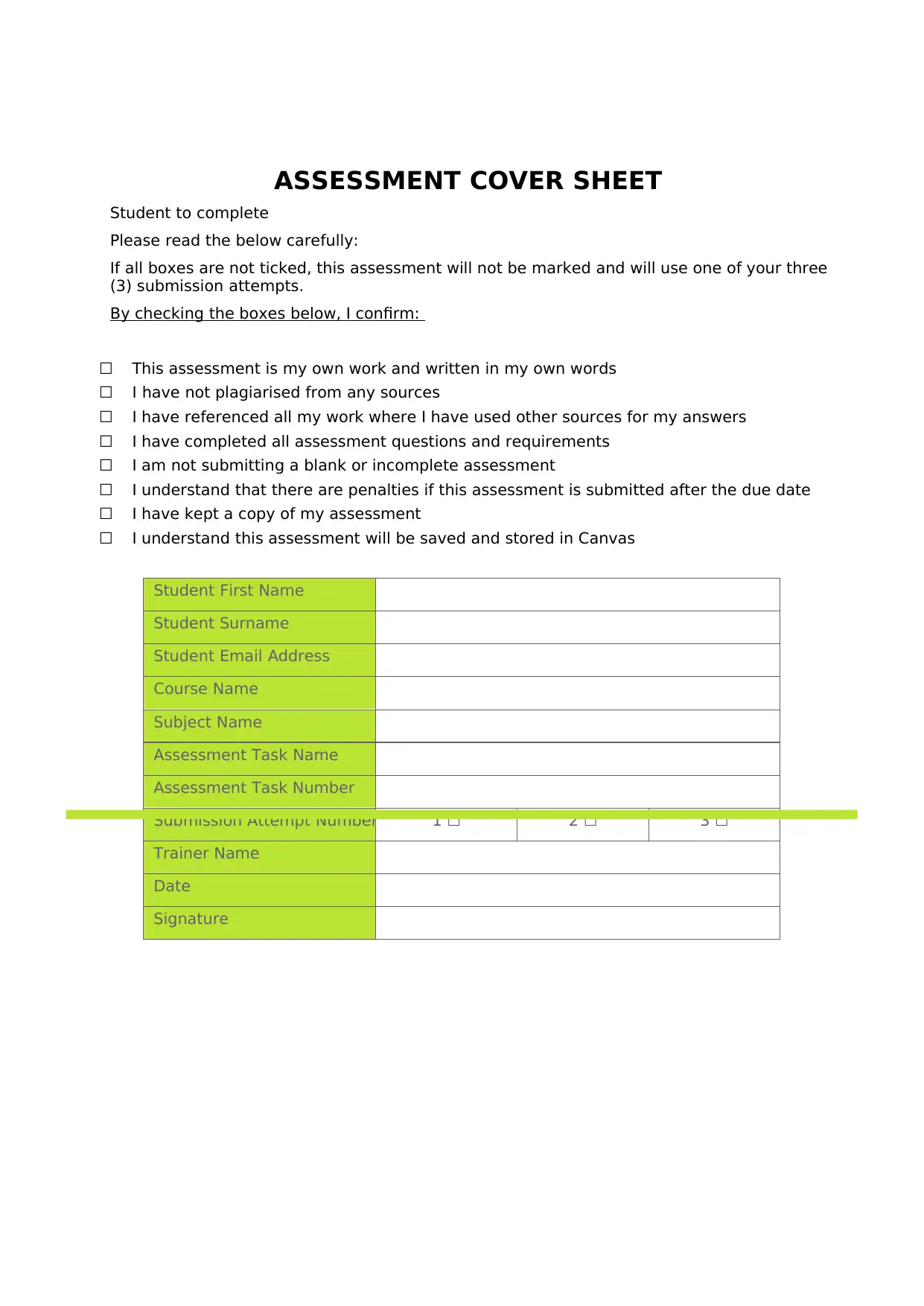
ASSESSMENT COVER SHEET
Student to complete
Please read the below carefully:
If all boxes are not ticked, this assessment will not be marked and will use one of your three
(3) submission attempts.
By checking the boxes below, I confirm:
☐ This assessment is my own work and written in my own words
☐ I have not plagiarised from any sources
☐ I have referenced all my work where I have used other sources for my answers
☐ I have completed all assessment questions and requirements
☐ I am not submitting a blank or incomplete assessment
☐ I understand that there are penalties if this assessment is submitted after the due date
☐ I have kept a copy of my assessment
☐ I understand this assessment will be saved and stored in Canvas
Student First Name
Student Surname
Student Email Address
Course Name
Subject Name
Assessment Task Name
Assessment Task Number
Submission Attempt Number 1 ☐ 2 ☐ 3 ☐
Trainer Name
Date
Signature
Student to complete
Please read the below carefully:
If all boxes are not ticked, this assessment will not be marked and will use one of your three
(3) submission attempts.
By checking the boxes below, I confirm:
☐ This assessment is my own work and written in my own words
☐ I have not plagiarised from any sources
☐ I have referenced all my work where I have used other sources for my answers
☐ I have completed all assessment questions and requirements
☐ I am not submitting a blank or incomplete assessment
☐ I understand that there are penalties if this assessment is submitted after the due date
☐ I have kept a copy of my assessment
☐ I understand this assessment will be saved and stored in Canvas
Student First Name
Student Surname
Student Email Address
Course Name
Subject Name
Assessment Task Name
Assessment Task Number
Submission Attempt Number 1 ☐ 2 ☐ 3 ☐
Trainer Name
Date
Signature
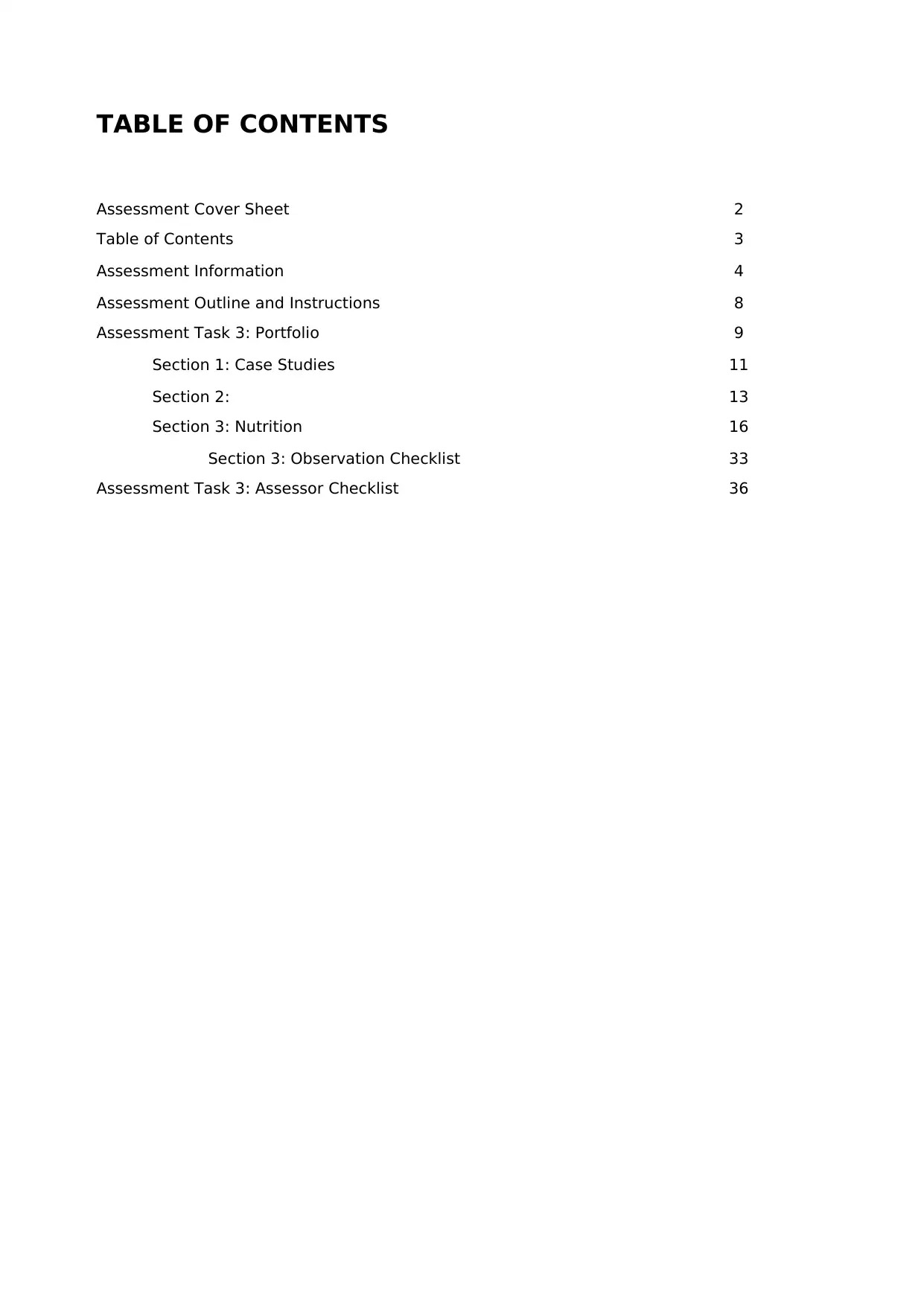
TABLE OF CONTENTS
Assessment Cover Sheet 2
Table of Contents 3
Assessment Information 4
Assessment Outline and Instructions 8
Assessment Task 3: Portfolio 9
Section 1: Case Studies 11
Section 2: 13
Section 3: Nutrition 16
Section 3: Observation Checklist 33
Assessment Task 3: Assessor Checklist 36
Assessment Cover Sheet 2
Table of Contents 3
Assessment Information 4
Assessment Outline and Instructions 8
Assessment Task 3: Portfolio 9
Section 1: Case Studies 11
Section 2: 13
Section 3: Nutrition 16
Section 3: Observation Checklist 33
Assessment Task 3: Assessor Checklist 36
⊘ This is a preview!⊘
Do you want full access?
Subscribe today to unlock all pages.

Trusted by 1+ million students worldwide
Assessment Information
You are advised to start working on your assessment in Week 1 of term and submit all tasks by
their due date. It is a condition of enrolment that you actively participate in your studies. The
following information includes general assessment requirements and information for students
at ALG.
About your Assessments
A requirement of the qualification you are undertaking is the application of the knowledge and
skills you have been learning. The assessment tasks are an essential part of your training
program as they provide an opportunity to apply what you have been learning, and they give
both you and your trainer feedback on your progress.
Assessment Evidence
Your completed assessment tasks will provide evidence for your trainer to determine whether
you have successfully performed and satisfied all the requirements to achieve competency.
Recognition of Prior Learning (RPL)
This is a process of recognising student’s formal and informal learning from work experience
that is related to the qualification being studied in Australia. Students will need to provide
documented evidence of their learning, which will then be assessed by an ALG assessor to
determine the competency outcomes of the qualification. Other forms of recognition include:
• Recognition of Current Competencies (RCC)
This is a process of recognising students’ current knowledge and skills gained from current
work experience.
• Direct Credit Transfer (CT)
This is a process of crediting students’ completed units through an Australian Training Provider.
Students will need to provide a Statement of Attainment or Transcript as evidence to be
granted credit for a unit of competency.
Reasonable Adjustment
This process supports a student who has an impairment, disability, or long-term condition. This
may include modifying course material, modifying or providing equipment as well as modifying
an environment. ALG provides reasonable adjustment for a student to complete required
assessments. This may take place online and/or in the workplace. Please refer to the student
handbook link here for further information or refer to the ALG website.
NOTE: Any modification cannot affect competency outcomes.
You are advised to start working on your assessment in Week 1 of term and submit all tasks by
their due date. It is a condition of enrolment that you actively participate in your studies. The
following information includes general assessment requirements and information for students
at ALG.
About your Assessments
A requirement of the qualification you are undertaking is the application of the knowledge and
skills you have been learning. The assessment tasks are an essential part of your training
program as they provide an opportunity to apply what you have been learning, and they give
both you and your trainer feedback on your progress.
Assessment Evidence
Your completed assessment tasks will provide evidence for your trainer to determine whether
you have successfully performed and satisfied all the requirements to achieve competency.
Recognition of Prior Learning (RPL)
This is a process of recognising student’s formal and informal learning from work experience
that is related to the qualification being studied in Australia. Students will need to provide
documented evidence of their learning, which will then be assessed by an ALG assessor to
determine the competency outcomes of the qualification. Other forms of recognition include:
• Recognition of Current Competencies (RCC)
This is a process of recognising students’ current knowledge and skills gained from current
work experience.
• Direct Credit Transfer (CT)
This is a process of crediting students’ completed units through an Australian Training Provider.
Students will need to provide a Statement of Attainment or Transcript as evidence to be
granted credit for a unit of competency.
Reasonable Adjustment
This process supports a student who has an impairment, disability, or long-term condition. This
may include modifying course material, modifying or providing equipment as well as modifying
an environment. ALG provides reasonable adjustment for a student to complete required
assessments. This may take place online and/or in the workplace. Please refer to the student
handbook link here for further information or refer to the ALG website.
NOTE: Any modification cannot affect competency outcomes.
Paraphrase This Document
Need a fresh take? Get an instant paraphrase of this document with our AI Paraphraser
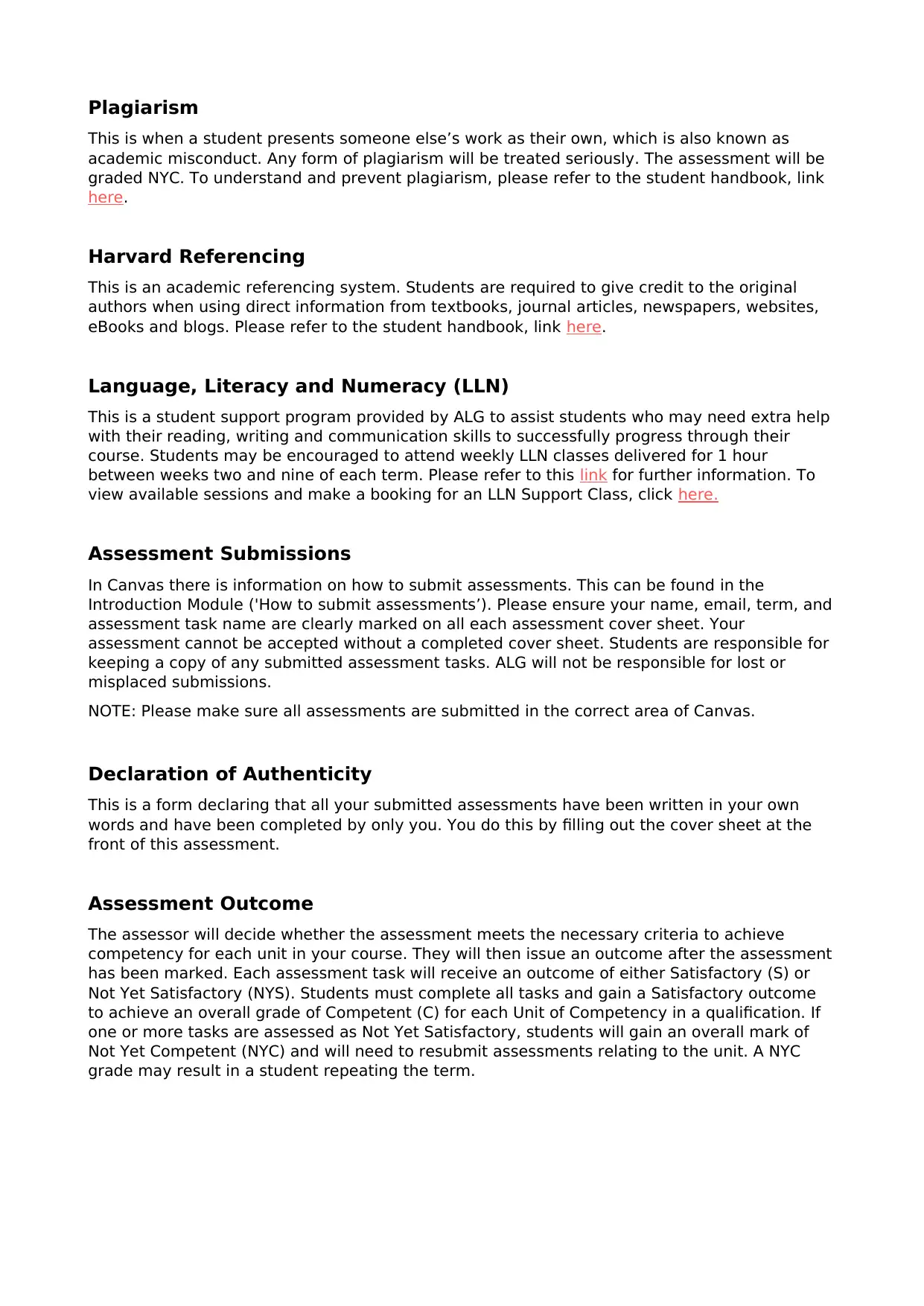
Plagiarism
This is when a student presents someone else’s work as their own, which is also known as
academic misconduct. Any form of plagiarism will be treated seriously. The assessment will be
graded NYC. To understand and prevent plagiarism, please refer to the student handbook, link
here.
Harvard Referencing
This is an academic referencing system. Students are required to give credit to the original
authors when using direct information from textbooks, journal articles, newspapers, websites,
eBooks and blogs. Please refer to the student handbook, link here.
Language, Literacy and Numeracy (LLN)
This is a student support program provided by ALG to assist students who may need extra help
with their reading, writing and communication skills to successfully progress through their
course. Students may be encouraged to attend weekly LLN classes delivered for 1 hour
between weeks two and nine of each term. Please refer to this link for further information. To
view available sessions and make a booking for an LLN Support Class, click here.
Assessment Submissions
In Canvas there is information on how to submit assessments. This can be found in the
Introduction Module ('How to submit assessments’). Please ensure your name, email, term, and
assessment task name are clearly marked on all each assessment cover sheet. Your
assessment cannot be accepted without a completed cover sheet. Students are responsible for
keeping a copy of any submitted assessment tasks. ALG will not be responsible for lost or
misplaced submissions.
NOTE: Please make sure all assessments are submitted in the correct area of Canvas.
Declaration of Authenticity
This is a form declaring that all your submitted assessments have been written in your own
words and have been completed by only you. You do this by filling out the cover sheet at the
front of this assessment.
Assessment Outcome
The assessor will decide whether the assessment meets the necessary criteria to achieve
competency for each unit in your course. They will then issue an outcome after the assessment
has been marked. Each assessment task will receive an outcome of either Satisfactory (S) or
Not Yet Satisfactory (NYS). Students must complete all tasks and gain a Satisfactory outcome
to achieve an overall grade of Competent (C) for each Unit of Competency in a qualification. If
one or more tasks are assessed as Not Yet Satisfactory, students will gain an overall mark of
Not Yet Competent (NYC) and will need to resubmit assessments relating to the unit. A NYC
grade may result in a student repeating the term.
This is when a student presents someone else’s work as their own, which is also known as
academic misconduct. Any form of plagiarism will be treated seriously. The assessment will be
graded NYC. To understand and prevent plagiarism, please refer to the student handbook, link
here.
Harvard Referencing
This is an academic referencing system. Students are required to give credit to the original
authors when using direct information from textbooks, journal articles, newspapers, websites,
eBooks and blogs. Please refer to the student handbook, link here.
Language, Literacy and Numeracy (LLN)
This is a student support program provided by ALG to assist students who may need extra help
with their reading, writing and communication skills to successfully progress through their
course. Students may be encouraged to attend weekly LLN classes delivered for 1 hour
between weeks two and nine of each term. Please refer to this link for further information. To
view available sessions and make a booking for an LLN Support Class, click here.
Assessment Submissions
In Canvas there is information on how to submit assessments. This can be found in the
Introduction Module ('How to submit assessments’). Please ensure your name, email, term, and
assessment task name are clearly marked on all each assessment cover sheet. Your
assessment cannot be accepted without a completed cover sheet. Students are responsible for
keeping a copy of any submitted assessment tasks. ALG will not be responsible for lost or
misplaced submissions.
NOTE: Please make sure all assessments are submitted in the correct area of Canvas.
Declaration of Authenticity
This is a form declaring that all your submitted assessments have been written in your own
words and have been completed by only you. You do this by filling out the cover sheet at the
front of this assessment.
Assessment Outcome
The assessor will decide whether the assessment meets the necessary criteria to achieve
competency for each unit in your course. They will then issue an outcome after the assessment
has been marked. Each assessment task will receive an outcome of either Satisfactory (S) or
Not Yet Satisfactory (NYS). Students must complete all tasks and gain a Satisfactory outcome
to achieve an overall grade of Competent (C) for each Unit of Competency in a qualification. If
one or more tasks are assessed as Not Yet Satisfactory, students will gain an overall mark of
Not Yet Competent (NYC) and will need to resubmit assessments relating to the unit. A NYC
grade may result in a student repeating the term.
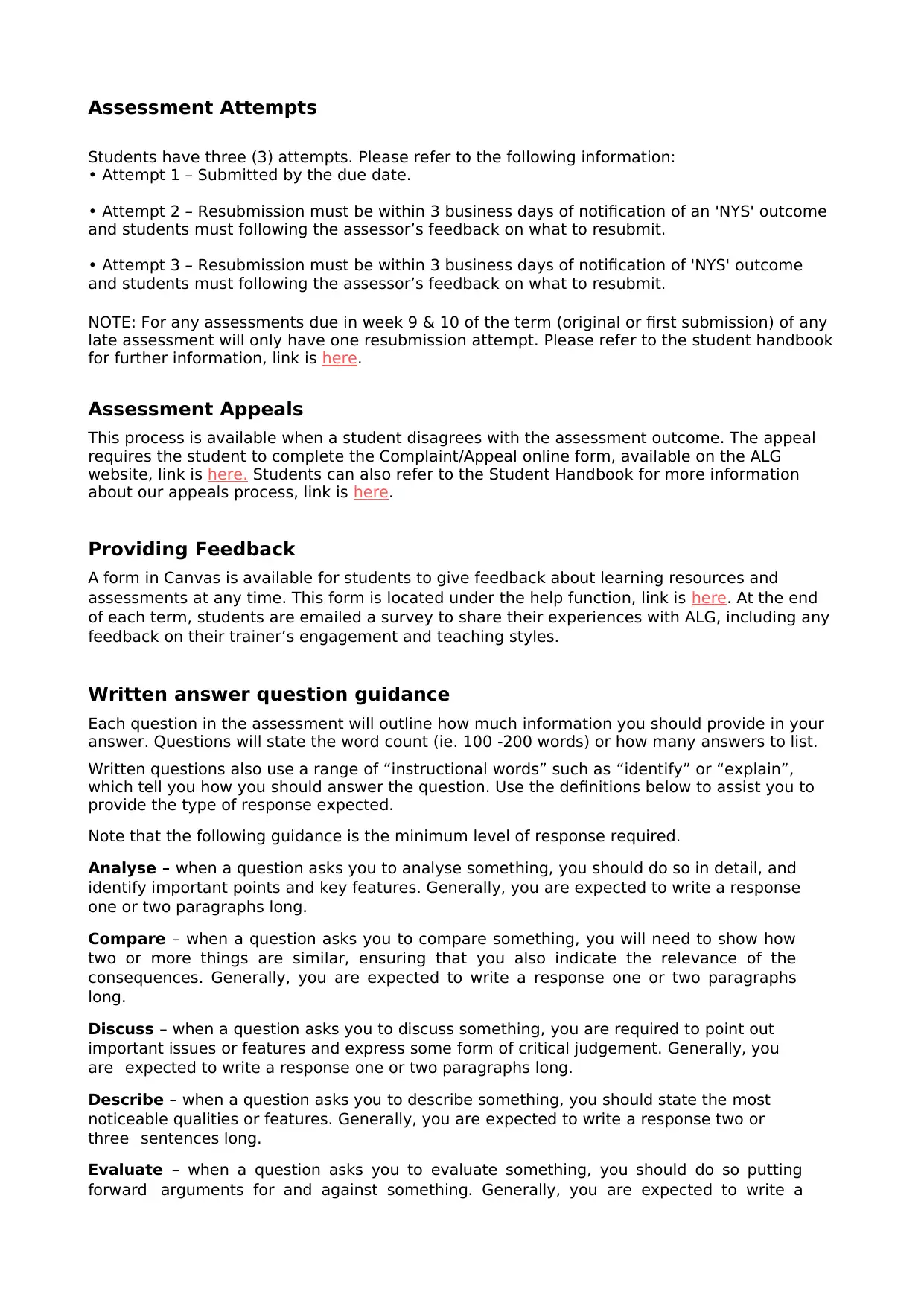
Assessment Attempts
Students have three (3) attempts. Please refer to the following information:
• Attempt 1 – Submitted by the due date.
• Attempt 2 – Resubmission must be within 3 business days of notification of an 'NYS' outcome
and students must following the assessor’s feedback on what to resubmit.
• Attempt 3 – Resubmission must be within 3 business days of notification of 'NYS' outcome
and students must following the assessor’s feedback on what to resubmit.
NOTE: For any assessments due in week 9 & 10 of the term (original or first submission) of any
late assessment will only have one resubmission attempt. Please refer to the student handbook
for further information, link is here.
Assessment Appeals
This process is available when a student disagrees with the assessment outcome. The appeal
requires the student to complete the Complaint/Appeal online form, available on the ALG
website, link is here. Students can also refer to the Student Handbook for more information
about our appeals process, link is here.
Providing Feedback
A form in Canvas is available for students to give feedback about learning resources and
assessments at any time. This form is located under the help function, link is here. At the end
of each term, students are emailed a survey to share their experiences with ALG, including any
feedback on their trainer’s engagement and teaching styles.
Written answer question guidance
Each question in the assessment will outline how much information you should provide in your
answer. Questions will state the word count (ie. 100 -200 words) or how many answers to list.
Written questions also use a range of “instructional words” such as “identify” or “explain”,
which tell you how you should answer the question. Use the definitions below to assist you to
provide the type of response expected.
Note that the following guidance is the minimum level of response required.
Analyse – when a question asks you to analyse something, you should do so in detail, and
identify important points and key features. Generally, you are expected to write a response
one or two paragraphs long.
Compare – when a question asks you to compare something, you will need to show how
two or more things are similar, ensuring that you also indicate the relevance of the
consequences. Generally, you are expected to write a response one or two paragraphs
long.
Discuss – when a question asks you to discuss something, you are required to point out
important issues or features and express some form of critical judgement. Generally, you
are expected to write a response one or two paragraphs long.
Describe – when a question asks you to describe something, you should state the most
noticeable qualities or features. Generally, you are expected to write a response two or
three sentences long.
Evaluate – when a question asks you to evaluate something, you should do so putting
forward arguments for and against something. Generally, you are expected to write a
Students have three (3) attempts. Please refer to the following information:
• Attempt 1 – Submitted by the due date.
• Attempt 2 – Resubmission must be within 3 business days of notification of an 'NYS' outcome
and students must following the assessor’s feedback on what to resubmit.
• Attempt 3 – Resubmission must be within 3 business days of notification of 'NYS' outcome
and students must following the assessor’s feedback on what to resubmit.
NOTE: For any assessments due in week 9 & 10 of the term (original or first submission) of any
late assessment will only have one resubmission attempt. Please refer to the student handbook
for further information, link is here.
Assessment Appeals
This process is available when a student disagrees with the assessment outcome. The appeal
requires the student to complete the Complaint/Appeal online form, available on the ALG
website, link is here. Students can also refer to the Student Handbook for more information
about our appeals process, link is here.
Providing Feedback
A form in Canvas is available for students to give feedback about learning resources and
assessments at any time. This form is located under the help function, link is here. At the end
of each term, students are emailed a survey to share their experiences with ALG, including any
feedback on their trainer’s engagement and teaching styles.
Written answer question guidance
Each question in the assessment will outline how much information you should provide in your
answer. Questions will state the word count (ie. 100 -200 words) or how many answers to list.
Written questions also use a range of “instructional words” such as “identify” or “explain”,
which tell you how you should answer the question. Use the definitions below to assist you to
provide the type of response expected.
Note that the following guidance is the minimum level of response required.
Analyse – when a question asks you to analyse something, you should do so in detail, and
identify important points and key features. Generally, you are expected to write a response
one or two paragraphs long.
Compare – when a question asks you to compare something, you will need to show how
two or more things are similar, ensuring that you also indicate the relevance of the
consequences. Generally, you are expected to write a response one or two paragraphs
long.
Discuss – when a question asks you to discuss something, you are required to point out
important issues or features and express some form of critical judgement. Generally, you
are expected to write a response one or two paragraphs long.
Describe – when a question asks you to describe something, you should state the most
noticeable qualities or features. Generally, you are expected to write a response two or
three sentences long.
Evaluate – when a question asks you to evaluate something, you should do so putting
forward arguments for and against something. Generally, you are expected to write a
⊘ This is a preview!⊘
Do you want full access?
Subscribe today to unlock all pages.
Trusted by 1+ million students worldwide
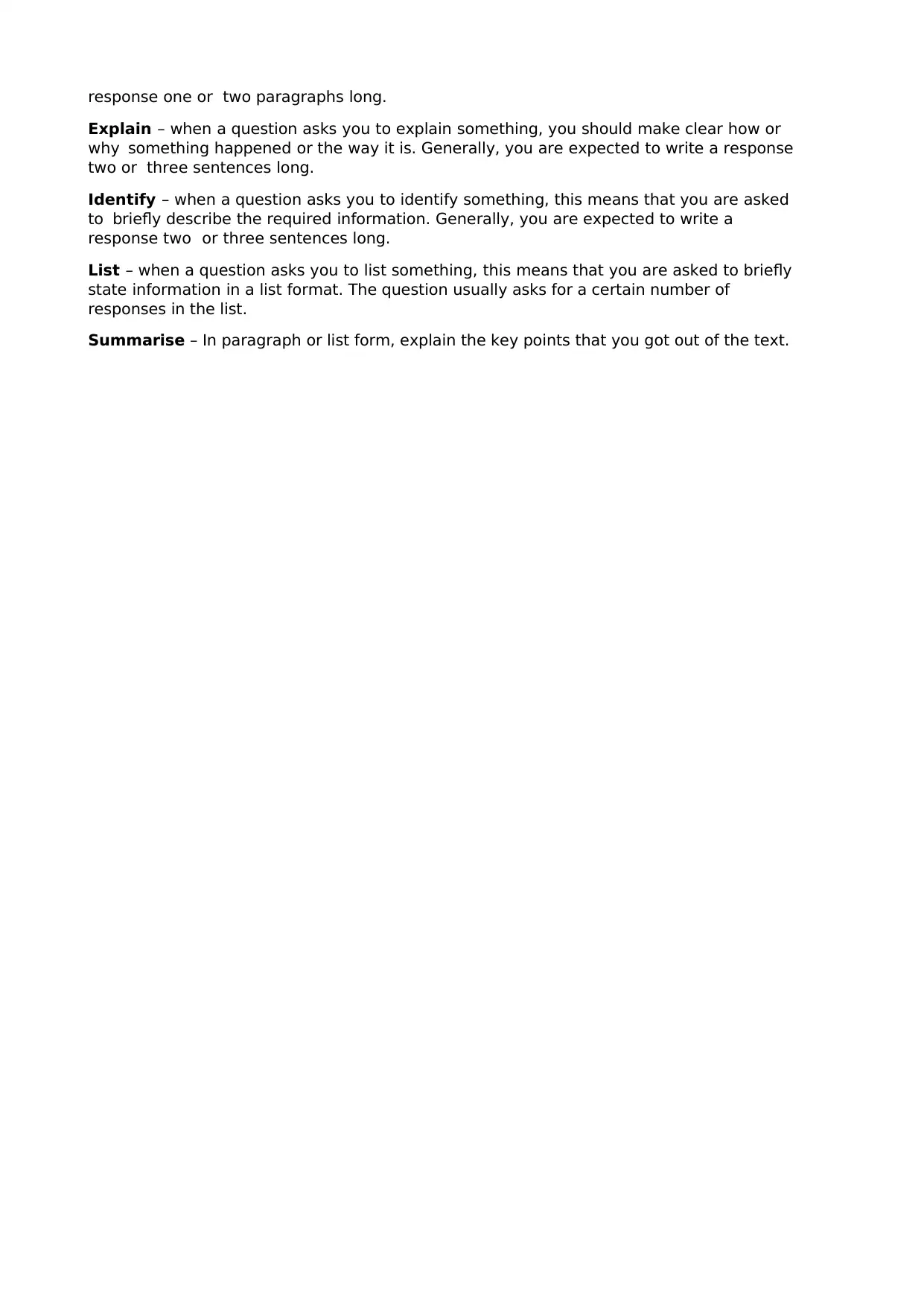
response one or two paragraphs long.
Explain – when a question asks you to explain something, you should make clear how or
why something happened or the way it is. Generally, you are expected to write a response
two or three sentences long.
Identify – when a question asks you to identify something, this means that you are asked
to briefly describe the required information. Generally, you are expected to write a
response two or three sentences long.
List – when a question asks you to list something, this means that you are asked to briefly
state information in a list format. The question usually asks for a certain number of
responses in the list.
Summarise – In paragraph or list form, explain the key points that you got out of the text.
Explain – when a question asks you to explain something, you should make clear how or
why something happened or the way it is. Generally, you are expected to write a response
two or three sentences long.
Identify – when a question asks you to identify something, this means that you are asked
to briefly describe the required information. Generally, you are expected to write a
response two or three sentences long.
List – when a question asks you to list something, this means that you are asked to briefly
state information in a list format. The question usually asks for a certain number of
responses in the list.
Summarise – In paragraph or list form, explain the key points that you got out of the text.
Paraphrase This Document
Need a fresh take? Get an instant paraphrase of this document with our AI Paraphraser
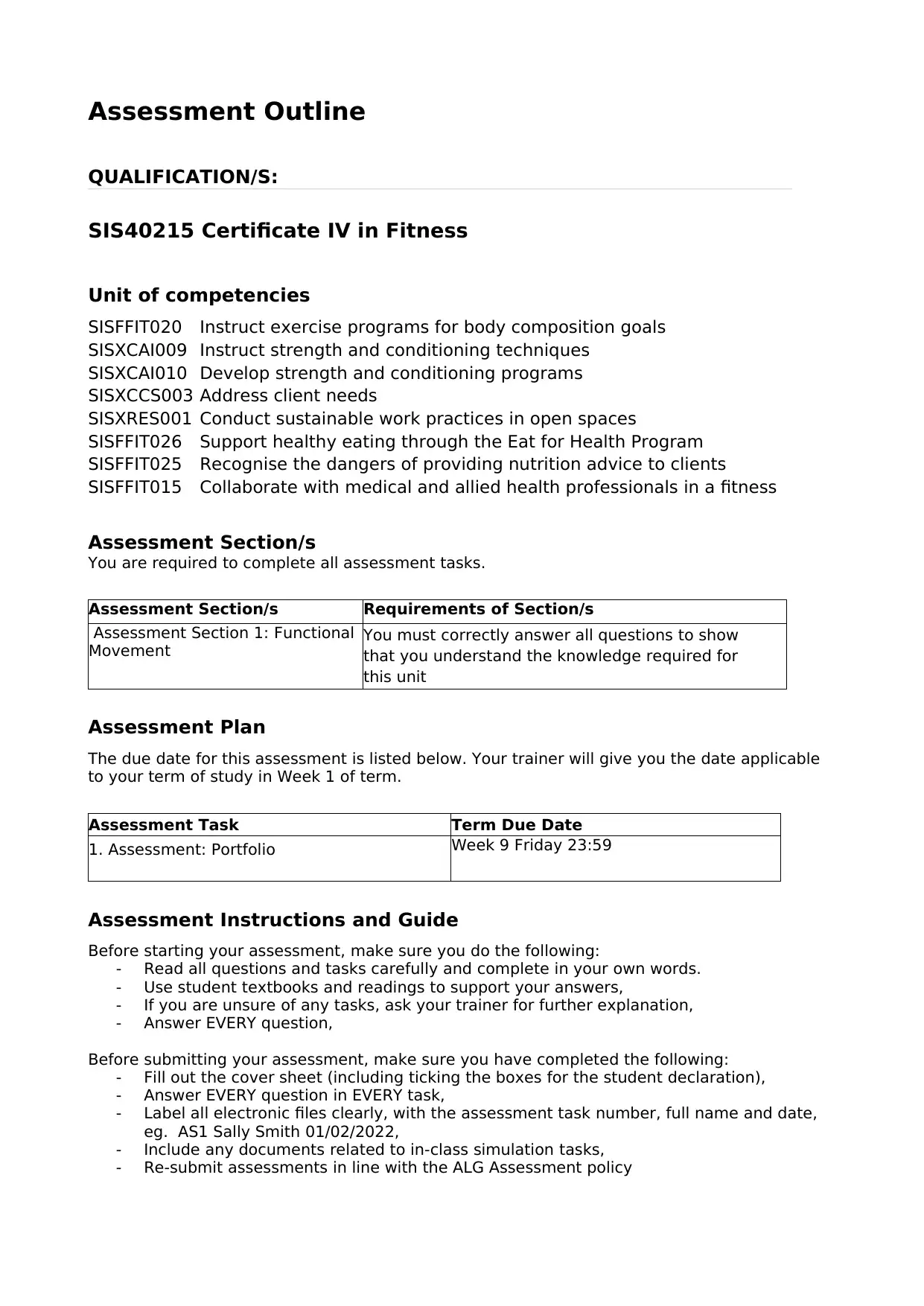
Assessment Outline
QUALIFICATION/S:
SIS40215 Certificate IV in Fitness
Unit of competencies
SISFFIT020 Instruct exercise programs for body composition goals
SISXCAI009 Instruct strength and conditioning techniques
SISXCAI010 Develop strength and conditioning programs
SISXCCS003 Address client needs
SISXRES001 Conduct sustainable work practices in open spaces
SISFFIT026 Support healthy eating through the Eat for Health Program
SISFFIT025 Recognise the dangers of providing nutrition advice to clients
SISFFIT015 Collaborate with medical and allied health professionals in a fitness
Assessment Section/s
You are required to complete all assessment tasks.
Assessment Section/s Requirements of Section/s
Assessment Section 1: Functional
Movement
You must correctly answer all questions to show
that you understand the knowledge required for
this unit
Assessment Plan
The due date for this assessment is listed below. Your trainer will give you the date applicable
to your term of study in Week 1 of term.
Assessment Task Term Due Date
1. Assessment: Portfolio Week 9 Friday 23:59
Assessment Instructions and Guide
Before starting your assessment, make sure you do the following:
- Read all questions and tasks carefully and complete in your own words.
- Use student textbooks and readings to support your answers,
- If you are unsure of any tasks, ask your trainer for further explanation,
- Answer EVERY question,
Before submitting your assessment, make sure you have completed the following:
- Fill out the cover sheet (including ticking the boxes for the student declaration),
- Answer EVERY question in EVERY task,
- Label all electronic files clearly, with the assessment task number, full name and date,
eg. AS1 Sally Smith 01/02/2022,
- Include any documents related to in-class simulation tasks,
- Re-submit assessments in line with the ALG Assessment policy
QUALIFICATION/S:
SIS40215 Certificate IV in Fitness
Unit of competencies
SISFFIT020 Instruct exercise programs for body composition goals
SISXCAI009 Instruct strength and conditioning techniques
SISXCAI010 Develop strength and conditioning programs
SISXCCS003 Address client needs
SISXRES001 Conduct sustainable work practices in open spaces
SISFFIT026 Support healthy eating through the Eat for Health Program
SISFFIT025 Recognise the dangers of providing nutrition advice to clients
SISFFIT015 Collaborate with medical and allied health professionals in a fitness
Assessment Section/s
You are required to complete all assessment tasks.
Assessment Section/s Requirements of Section/s
Assessment Section 1: Functional
Movement
You must correctly answer all questions to show
that you understand the knowledge required for
this unit
Assessment Plan
The due date for this assessment is listed below. Your trainer will give you the date applicable
to your term of study in Week 1 of term.
Assessment Task Term Due Date
1. Assessment: Portfolio Week 9 Friday 23:59
Assessment Instructions and Guide
Before starting your assessment, make sure you do the following:
- Read all questions and tasks carefully and complete in your own words.
- Use student textbooks and readings to support your answers,
- If you are unsure of any tasks, ask your trainer for further explanation,
- Answer EVERY question,
Before submitting your assessment, make sure you have completed the following:
- Fill out the cover sheet (including ticking the boxes for the student declaration),
- Answer EVERY question in EVERY task,
- Label all electronic files clearly, with the assessment task number, full name and date,
eg. AS1 Sally Smith 01/02/2022,
- Include any documents related to in-class simulation tasks,
- Re-submit assessments in line with the ALG Assessment policy
Assessment Task 3: Portfolio
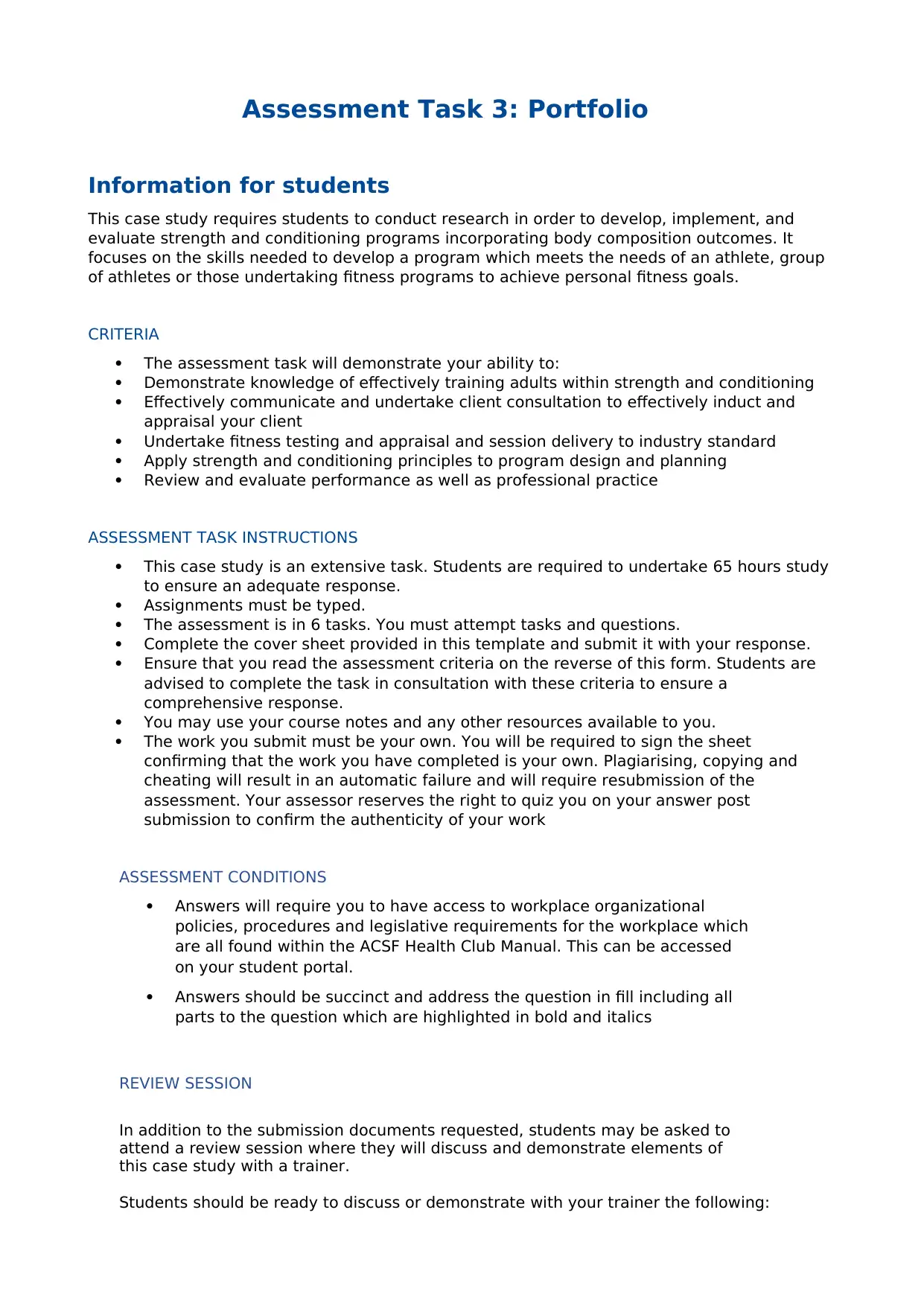
Information for students
This case study requires students to conduct research in order to develop, implement, and
evaluate strength and conditioning programs incorporating body composition outcomes. It
focuses on the skills needed to develop a program which meets the needs of an athlete, group
of athletes or those undertaking fitness programs to achieve personal fitness goals.
CRITERIA
The assessment task will demonstrate your ability to:
Demonstrate knowledge of effectively training adults within strength and conditioning
Effectively communicate and undertake client consultation to effectively induct and
appraisal your client
Undertake fitness testing and appraisal and session delivery to industry standard
Apply strength and conditioning principles to program design and planning
Review and evaluate performance as well as professional practice
ASSESSMENT TASK INSTRUCTIONS
This case study is an extensive task. Students are required to undertake 65 hours study
to ensure an adequate response.
Assignments must be typed.
The assessment is in 6 tasks. You must attempt tasks and questions.
Complete the cover sheet provided in this template and submit it with your response.
Ensure that you read the assessment criteria on the reverse of this form. Students are
advised to complete the task in consultation with these criteria to ensure a
comprehensive response.
You may use your course notes and any other resources available to you.
The work you submit must be your own. You will be required to sign the sheet
confirming that the work you have completed is your own. Plagiarising, copying and
cheating will result in an automatic failure and will require resubmission of the
assessment. Your assessor reserves the right to quiz you on your answer post
submission to confirm the authenticity of your work
ASSESSMENT CONDITIONS
Answers will require you to have access to workplace organizational
policies, procedures and legislative requirements for the workplace which
are all found within the ACSF Health Club Manual. This can be accessed
on your student portal.
Answers should be succinct and address the question in fill including all
parts to the question which are highlighted in bold and italics
REVIEW SESSION
In addition to the submission documents requested, students may be asked to
attend a review session where they will discuss and demonstrate elements of
this case study with a trainer.
Students should be ready to discuss or demonstrate with your trainer the following:
Information for students
This case study requires students to conduct research in order to develop, implement, and
evaluate strength and conditioning programs incorporating body composition outcomes. It
focuses on the skills needed to develop a program which meets the needs of an athlete, group
of athletes or those undertaking fitness programs to achieve personal fitness goals.
CRITERIA
The assessment task will demonstrate your ability to:
Demonstrate knowledge of effectively training adults within strength and conditioning
Effectively communicate and undertake client consultation to effectively induct and
appraisal your client
Undertake fitness testing and appraisal and session delivery to industry standard
Apply strength and conditioning principles to program design and planning
Review and evaluate performance as well as professional practice
ASSESSMENT TASK INSTRUCTIONS
This case study is an extensive task. Students are required to undertake 65 hours study
to ensure an adequate response.
Assignments must be typed.
The assessment is in 6 tasks. You must attempt tasks and questions.
Complete the cover sheet provided in this template and submit it with your response.
Ensure that you read the assessment criteria on the reverse of this form. Students are
advised to complete the task in consultation with these criteria to ensure a
comprehensive response.
You may use your course notes and any other resources available to you.
The work you submit must be your own. You will be required to sign the sheet
confirming that the work you have completed is your own. Plagiarising, copying and
cheating will result in an automatic failure and will require resubmission of the
assessment. Your assessor reserves the right to quiz you on your answer post
submission to confirm the authenticity of your work
ASSESSMENT CONDITIONS
Answers will require you to have access to workplace organizational
policies, procedures and legislative requirements for the workplace which
are all found within the ACSF Health Club Manual. This can be accessed
on your student portal.
Answers should be succinct and address the question in fill including all
parts to the question which are highlighted in bold and italics
REVIEW SESSION
In addition to the submission documents requested, students may be asked to
attend a review session where they will discuss and demonstrate elements of
this case study with a trainer.
Students should be ready to discuss or demonstrate with your trainer the following:
⊘ This is a preview!⊘
Do you want full access?
Subscribe today to unlock all pages.
Trusted by 1+ million students worldwide
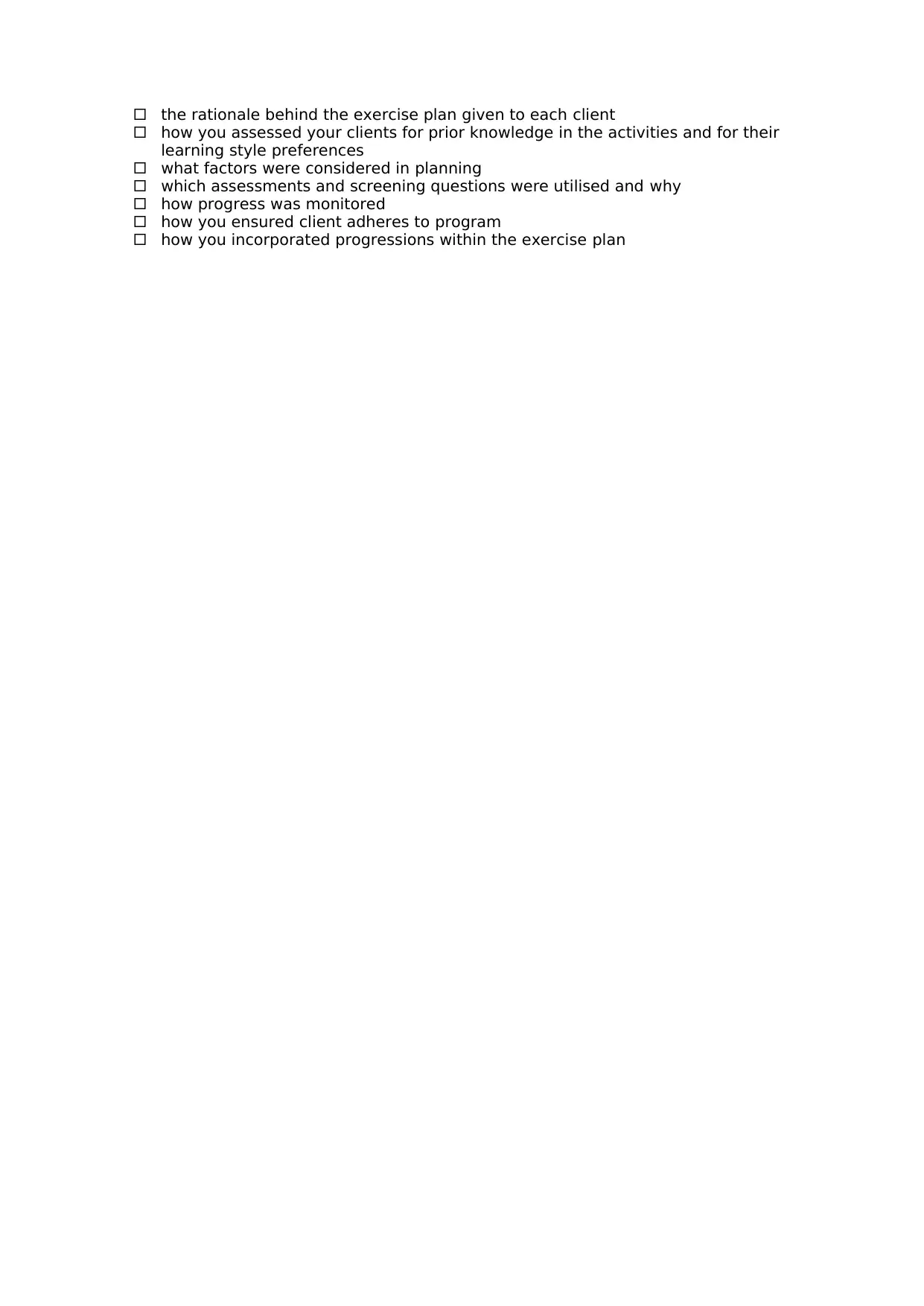
the rationale behind the exercise plan given to each client
how you assessed your clients for prior knowledge in the activities and for their
learning style preferences
what factors were considered in planning
which assessments and screening questions were utilised and why
how progress was monitored
how you ensured client adheres to program
how you incorporated progressions within the exercise plan
how you assessed your clients for prior knowledge in the activities and for their
learning style preferences
what factors were considered in planning
which assessments and screening questions were utilised and why
how progress was monitored
how you ensured client adheres to program
how you incorporated progressions within the exercise plan
Paraphrase This Document
Need a fresh take? Get an instant paraphrase of this document with our AI Paraphraser
Section 1 - Case Studies
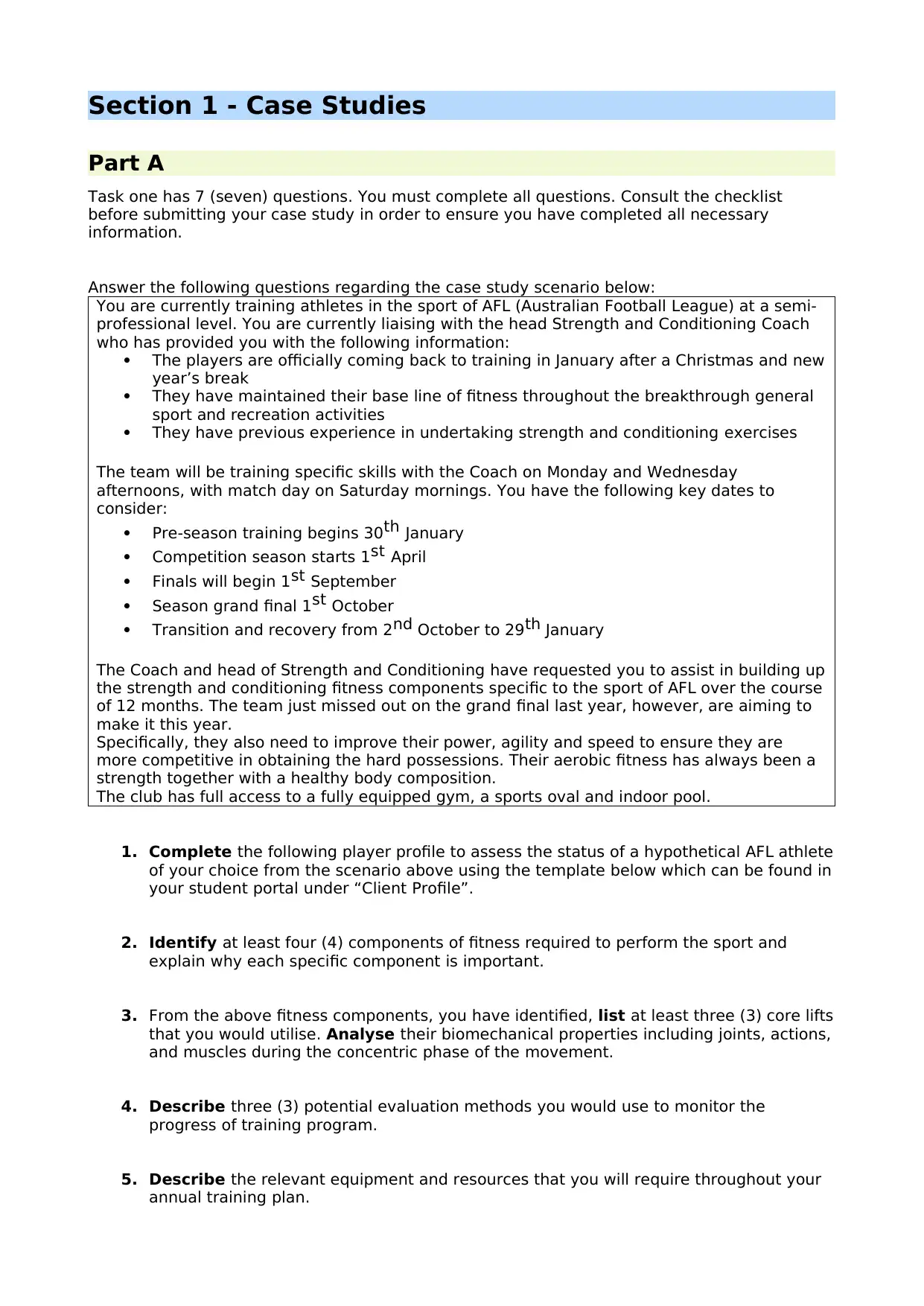
Part A
Task one has 7 (seven) questions. You must complete all questions. Consult the checklist
before submitting your case study in order to ensure you have completed all necessary
information.
Answer the following questions regarding the case study scenario below:
You are currently training athletes in the sport of AFL (Australian Football League) at a semi-
professional level. You are currently liaising with the head Strength and Conditioning Coach
who has provided you with the following information:
The players are officially coming back to training in January after a Christmas and new
year’s break
They have maintained their base line of fitness throughout the breakthrough general
sport and recreation activities
They have previous experience in undertaking strength and conditioning exercises
The team will be training specific skills with the Coach on Monday and Wednesday
afternoons, with match day on Saturday mornings. You have the following key dates to
consider:
Pre-season training begins 30th January
Competition season starts 1st April
Finals will begin 1st September
Season grand final 1st October
Transition and recovery from 2nd October to 29th January
The Coach and head of Strength and Conditioning have requested you to assist in building up
the strength and conditioning fitness components specific to the sport of AFL over the course
of 12 months. The team just missed out on the grand final last year, however, are aiming to
make it this year.
Specifically, they also need to improve their power, agility and speed to ensure they are
more competitive in obtaining the hard possessions. Their aerobic fitness has always been a
strength together with a healthy body composition.
The club has full access to a fully equipped gym, a sports oval and indoor pool.
1. Complete the following player profile to assess the status of a hypothetical AFL athlete
of your choice from the scenario above using the template below which can be found in
your student portal under “Client Profile”.
2. Identify at least four (4) components of fitness required to perform the sport and
explain why each specific component is important.
3. From the above fitness components, you have identified, list at least three (3) core lifts
that you would utilise. Analyse their biomechanical properties including joints, actions,
and muscles during the concentric phase of the movement.
4. Describe three (3) potential evaluation methods you would use to monitor the
progress of training program.
5. Describe the relevant equipment and resources that you will require throughout your
annual training plan.
Part A
Task one has 7 (seven) questions. You must complete all questions. Consult the checklist
before submitting your case study in order to ensure you have completed all necessary
information.
Answer the following questions regarding the case study scenario below:
You are currently training athletes in the sport of AFL (Australian Football League) at a semi-
professional level. You are currently liaising with the head Strength and Conditioning Coach
who has provided you with the following information:
The players are officially coming back to training in January after a Christmas and new
year’s break
They have maintained their base line of fitness throughout the breakthrough general
sport and recreation activities
They have previous experience in undertaking strength and conditioning exercises
The team will be training specific skills with the Coach on Monday and Wednesday
afternoons, with match day on Saturday mornings. You have the following key dates to
consider:
Pre-season training begins 30th January
Competition season starts 1st April
Finals will begin 1st September
Season grand final 1st October
Transition and recovery from 2nd October to 29th January
The Coach and head of Strength and Conditioning have requested you to assist in building up
the strength and conditioning fitness components specific to the sport of AFL over the course
of 12 months. The team just missed out on the grand final last year, however, are aiming to
make it this year.
Specifically, they also need to improve their power, agility and speed to ensure they are
more competitive in obtaining the hard possessions. Their aerobic fitness has always been a
strength together with a healthy body composition.
The club has full access to a fully equipped gym, a sports oval and indoor pool.
1. Complete the following player profile to assess the status of a hypothetical AFL athlete
of your choice from the scenario above using the template below which can be found in
your student portal under “Client Profile”.
2. Identify at least four (4) components of fitness required to perform the sport and
explain why each specific component is important.
3. From the above fitness components, you have identified, list at least three (3) core lifts
that you would utilise. Analyse their biomechanical properties including joints, actions,
and muscles during the concentric phase of the movement.
4. Describe three (3) potential evaluation methods you would use to monitor the
progress of training program.
5. Describe the relevant equipment and resources that you will require throughout your
annual training plan.
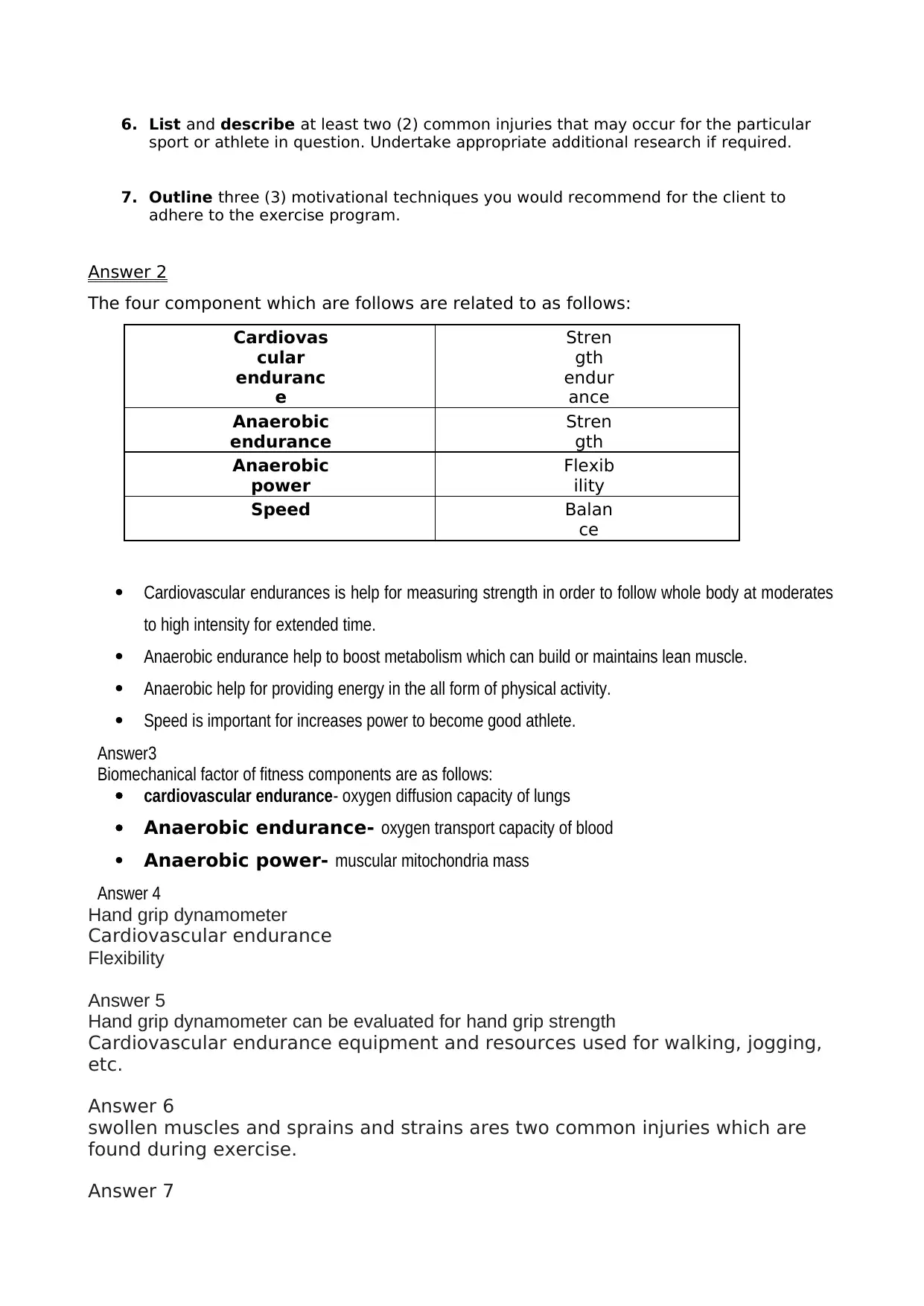
6. List and describe at least two (2) common injuries that may occur for the particular
sport or athlete in question. Undertake appropriate additional research if required.
7. Outline three (3) motivational techniques you would recommend for the client to
adhere to the exercise program.
Answer 2
The four component which are follows are related to as follows:
Cardiovas
cular
enduranc
e
Stren
gth
endur
ance
Anaerobic
endurance
Stren
gth
Anaerobic
power
Flexib
ility
Speed Balan
ce
Cardiovascular endurances is help for measuring strength in order to follow whole body at moderates
to high intensity for extended time.
Anaerobic endurance help to boost metabolism which can build or maintains lean muscle.
Anaerobic help for providing energy in the all form of physical activity.
Speed is important for increases power to become good athlete.
Answer3
Biomechanical factor of fitness components are as follows:
cardiovascular endurance- oxygen diffusion capacity of lungs
Anaerobic endurance- oxygen transport capacity of blood
Anaerobic power- muscular mitochondria mass
Answer 4
Hand grip dynamometer
Cardiovascular endurance
Flexibility
Answer 5
Hand grip dynamometer can be evaluated for hand grip strength
Cardiovascular endurance equipment and resources used for walking, jogging,
etc.
Answer 6
swollen muscles and sprains and strains ares two common injuries which are
found during exercise.
Answer 7
sport or athlete in question. Undertake appropriate additional research if required.
7. Outline three (3) motivational techniques you would recommend for the client to
adhere to the exercise program.
Answer 2
The four component which are follows are related to as follows:
Cardiovas
cular
enduranc
e
Stren
gth
endur
ance
Anaerobic
endurance
Stren
gth
Anaerobic
power
Flexib
ility
Speed Balan
ce
Cardiovascular endurances is help for measuring strength in order to follow whole body at moderates
to high intensity for extended time.
Anaerobic endurance help to boost metabolism which can build or maintains lean muscle.
Anaerobic help for providing energy in the all form of physical activity.
Speed is important for increases power to become good athlete.
Answer3
Biomechanical factor of fitness components are as follows:
cardiovascular endurance- oxygen diffusion capacity of lungs
Anaerobic endurance- oxygen transport capacity of blood
Anaerobic power- muscular mitochondria mass
Answer 4
Hand grip dynamometer
Cardiovascular endurance
Flexibility
Answer 5
Hand grip dynamometer can be evaluated for hand grip strength
Cardiovascular endurance equipment and resources used for walking, jogging,
etc.
Answer 6
swollen muscles and sprains and strains ares two common injuries which are
found during exercise.
Answer 7
⊘ This is a preview!⊘
Do you want full access?
Subscribe today to unlock all pages.
Trusted by 1+ million students worldwide

1 out of 53


Related Documents


Your All-in-One AI-Powered Toolkit for Academic Success.
+13062052269
info@desklib.com
Available 24*7 on WhatsApp / Email
![[object Object]](/_next/static/media/star-bottom.7253800d.svg)
Unlock your academic potential
Copyright © 2020–2025 A2Z Services. All Rights Reserved. Developed and managed by ZUCOL.