Tropical Industry: A Case Study on Situational Theory Application

Verified

Added on  2023/06/11

|7
|1451
|296
Case Study
AI Summary
This case study delves into the application of Situational Theory within Tropical Industry, focusing on the company's project management strategies and team dynamics. It highlights how Peter, a team leader, effectively utilized the principles of Situational Theory to foster cooperation and ensure active participation among his team members. The analysis emphasizes the importance of understanding different public subgroups and tailoring communication to address their specific needs and levels of involvement. The study also underscores the broader implications of Situational Theory for organizational development, problem-solving, and disaster preparedness, illustrating its value in guiding communication and action in various contexts. Desklib provides access to this and other solved assignments for students.
Document Page
Situational theory 1
SITUATIONAL THEORY
Student name
Professor’s name
Course
Institution
State
Date
tabler-icon-diamond-filled.svg

Paraphrase This Document

Need a fresh take? Get an instant paraphrase of this document with our AI Paraphraser
Document Page
Situational theory 2
Situational theory
Introduction
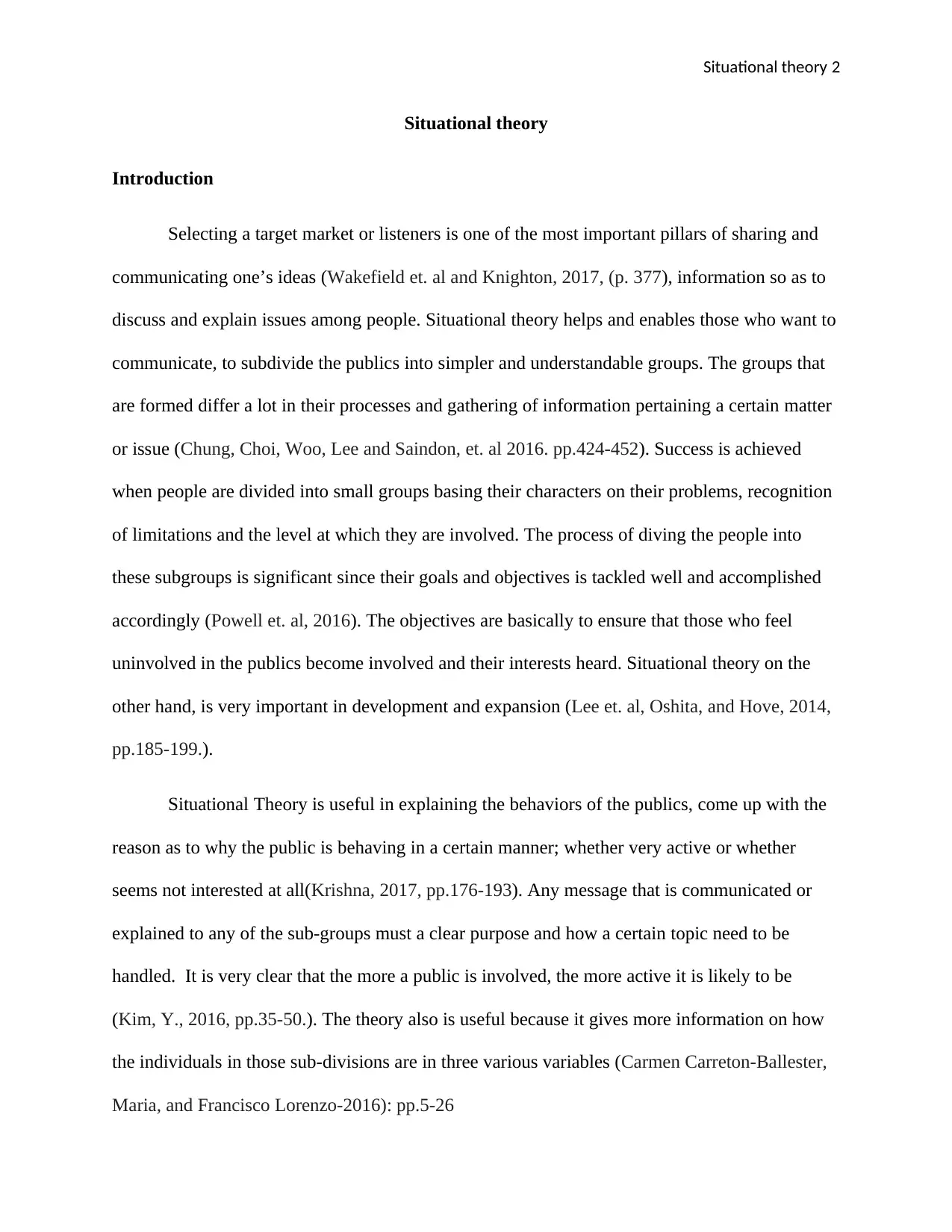
Selecting a target market or listeners is one of the most important pillars of sharing and
communicating one’s ideas (Wakefield et. al and Knighton, 2017, (p. 377), information so as to
discuss and explain issues among people. Situational theory helps and enables those who want to
communicate, to subdivide the publics into simpler and understandable groups. The groups that
are formed differ a lot in their processes and gathering of information pertaining a certain matter
or issue (Chung, Choi, Woo, Lee and Saindon, et. al 2016. pp.424-452). Success is achieved
when people are divided into small groups basing their characters on their problems, recognition
of limitations and the level at which they are involved. The process of diving the people into
these subgroups is significant since their goals and objectives is tackled well and accomplished
accordingly (Powell et. al, 2016). The objectives are basically to ensure that those who feel
uninvolved in the publics become involved and their interests heard. Situational theory on the
other hand, is very important in development and expansion (Lee et. al, Oshita, and Hove, 2014,
pp.185-199.).
Situational Theory is useful in explaining the behaviors of the publics, come up with the
reason as to why the public is behaving in a certain manner; whether very active or whether
seems not interested at all(Krishna, 2017, pp.176-193). Any message that is communicated or
explained to any of the sub-groups must a clear purpose and how a certain topic need to be
handled. It is very clear that the more a public is involved, the more active it is likely to be
(Kim, Y., 2016, pp.35-50.). The theory also is useful because it gives more information on how
the individuals in those sub-divisions are in three various variables (Carmen Carreton-Ballester,
Maria, and Francisco Lorenzo-2016): pp.5-26
Document Page
Situational theory 3
Case study
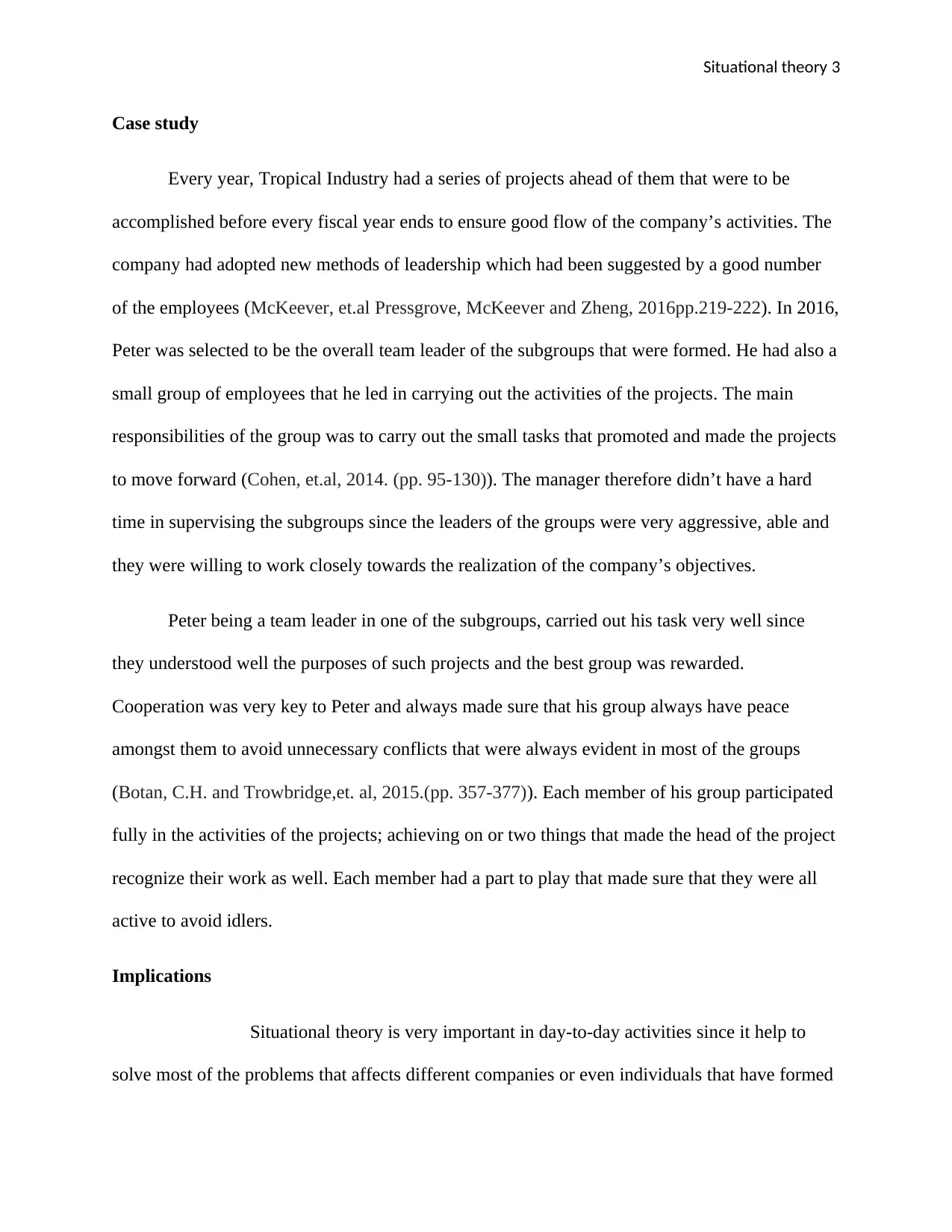
Every year, Tropical Industry had a series of projects ahead of them that were to be
accomplished before every fiscal year ends to ensure good flow of the company’s activities. The
company had adopted new methods of leadership which had been suggested by a good number
of the employees (McKeever, et.al Pressgrove, McKeever and Zheng, 2016pp.219-222). In 2016,
Peter was selected to be the overall team leader of the subgroups that were formed. He had also a
small group of employees that he led in carrying out the activities of the projects. The main
responsibilities of the group was to carry out the small tasks that promoted and made the projects
to move forward (Cohen, et.al, 2014. (pp. 95-130)). The manager therefore didn’t have a hard
time in supervising the subgroups since the leaders of the groups were very aggressive, able and
they were willing to work closely towards the realization of the company’s objectives.
Peter being a team leader in one of the subgroups, carried out his task very well since
they understood well the purposes of such projects and the best group was rewarded.
Cooperation was very key to Peter and always made sure that his group always have peace
amongst them to avoid unnecessary conflicts that were always evident in most of the groups
(Botan, C.H. and Trowbridge,et. al, 2015.(pp. 357-377)). Each member of his group participated
fully in the activities of the projects; achieving on or two things that made the head of the project
recognize their work as well. Each member had a part to play that made sure that they were all
active to avoid idlers.
Implications
Situational theory is very important in day-to-day activities since it help to
solve most of the problems that affects different companies or even individuals that have formed
Document Page
Situational theory 4
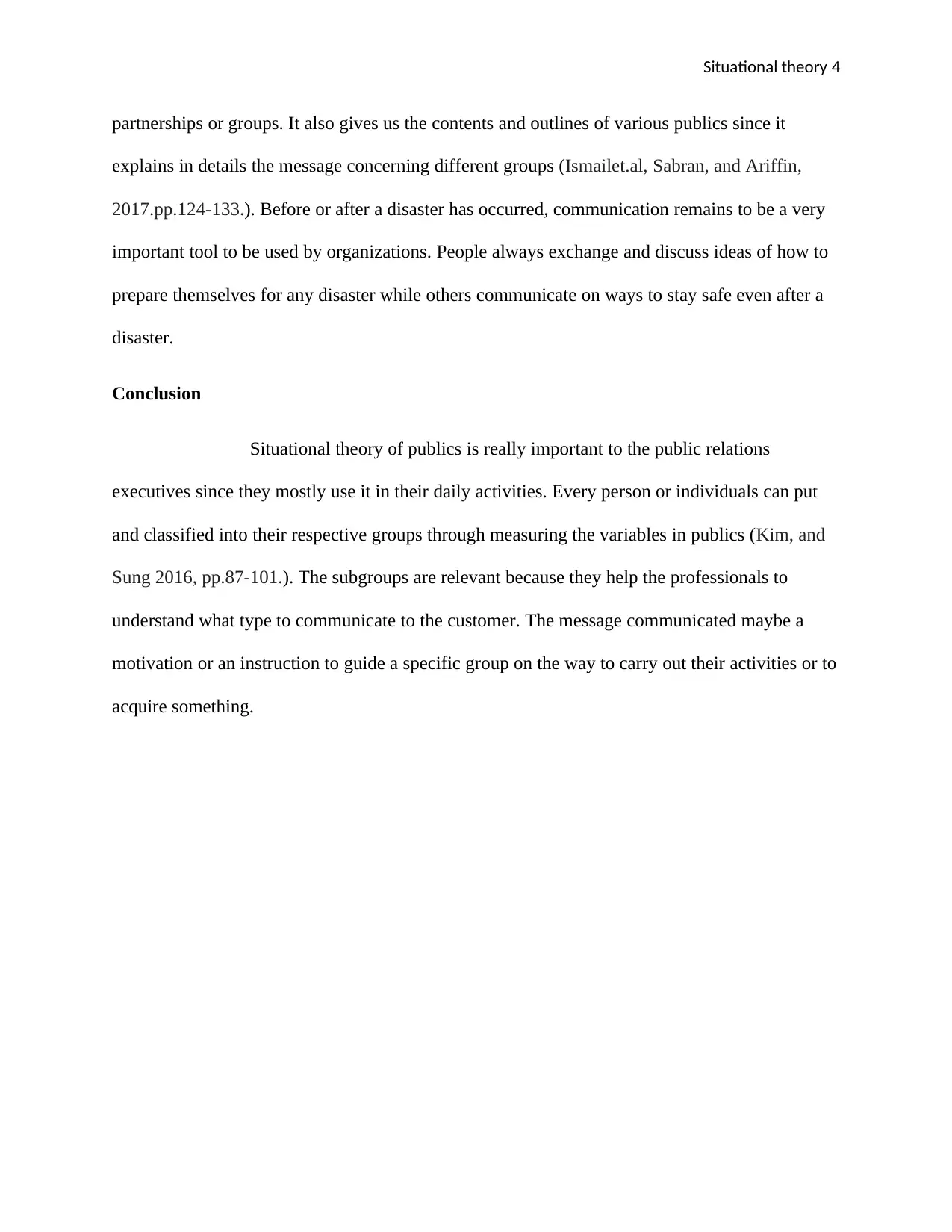
partnerships or groups. It also gives us the contents and outlines of various publics since it
explains in details the message concerning different groups (Ismailet.al, Sabran, and Ariffin,
2017.pp.124-133.). Before or after a disaster has occurred, communication remains to be a very
important tool to be used by organizations. People always exchange and discuss ideas of how to
prepare themselves for any disaster while others communicate on ways to stay safe even after a
disaster.
Conclusion
Situational theory of publics is really important to the public relations
executives since they mostly use it in their daily activities. Every person or individuals can put
and classified into their respective groups through measuring the variables in publics (Kim, and
Sung 2016, pp.87-101.). The subgroups are relevant because they help the professionals to
understand what type to communicate to the customer. The message communicated maybe a
motivation or an instruction to guide a specific group on the way to carry out their activities or to
acquire something.
tabler-icon-diamond-filled.svg

Paraphrase This Document

Need a fresh take? Get an instant paraphrase of this document with our AI Paraphraser
Document Page
Situational theory 5
Bibliography
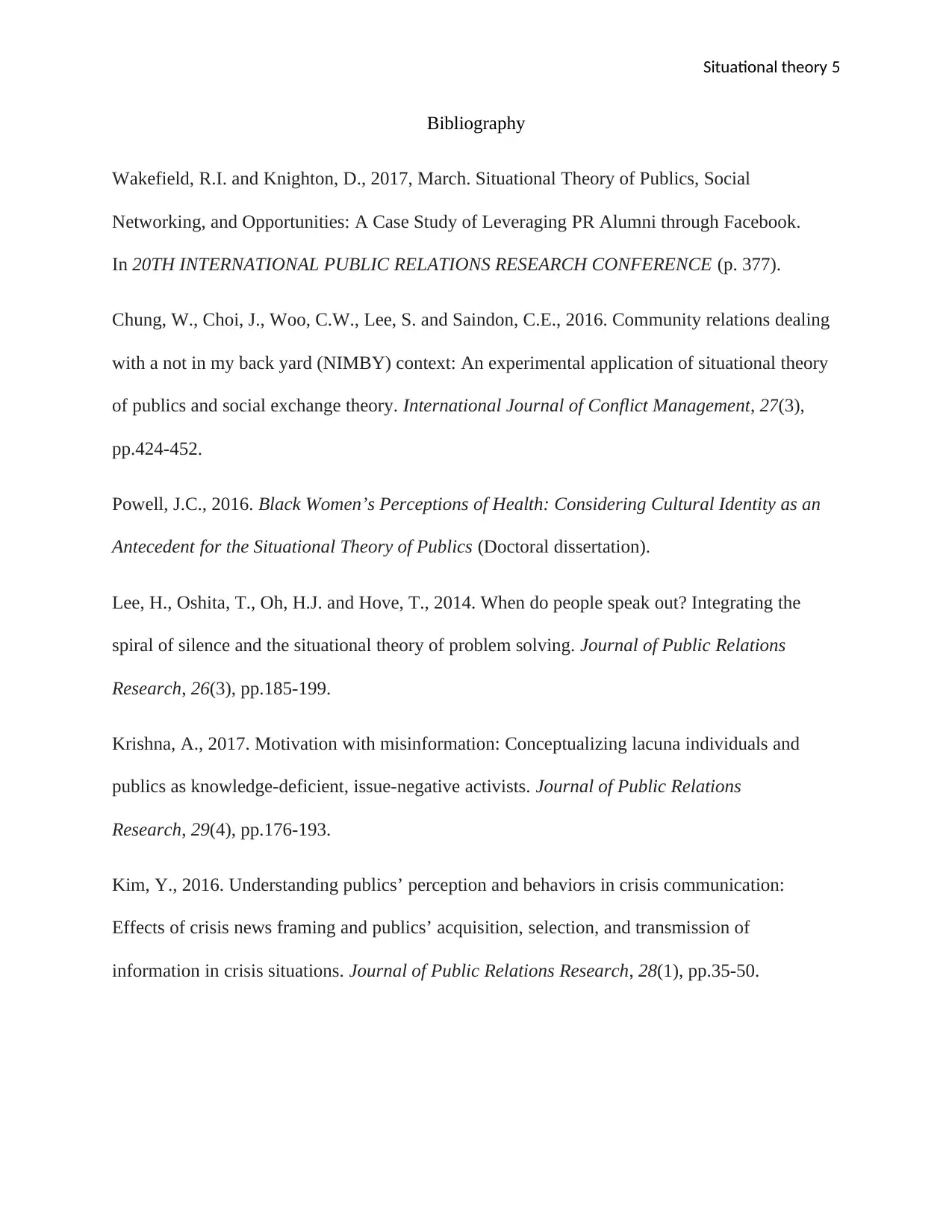
Wakefield, R.I. and Knighton, D., 2017, March. Situational Theory of Publics, Social
Networking, and Opportunities: A Case Study of Leveraging PR Alumni through Facebook.
In 20TH INTERNATIONAL PUBLIC RELATIONS RESEARCH CONFERENCE (p. 377).
Chung, W., Choi, J., Woo, C.W., Lee, S. and Saindon, C.E., 2016. Community relations dealing
with a not in my back yard (NIMBY) context: An experimental application of situational theory
of publics and social exchange theory. International Journal of Conflict Management, 27(3),
pp.424-452.
Powell, J.C., 2016. Black Women’s Perceptions of Health: Considering Cultural Identity as an
Antecedent for the Situational Theory of Publics (Doctoral dissertation).
Lee, H., Oshita, T., Oh, H.J. and Hove, T., 2014. When do people speak out? Integrating the
spiral of silence and the situational theory of problem solving. Journal of Public Relations
Research, 26(3), pp.185-199.
Krishna, A., 2017. Motivation with misinformation: Conceptualizing lacuna individuals and
publics as knowledge-deficient, issue-negative activists. Journal of Public Relations
Research, 29(4), pp.176-193.
Kim, Y., 2016. Understanding publics’ perception and behaviors in crisis communication:
Effects of crisis news framing and publics’ acquisition, selection, and transmission of
information in crisis situations. Journal of Public Relations Research, 28(1), pp.35-50.
Document Page
Situational theory 6
Carmen Carreton-Ballester, Maria, and Francisco Lorenzo-Sola. "Situational Theory public in
the guidelines on bullying. Analysis for a campaign on bullying as a social problem." REVISTA
INTERNACIONAL DE RELACIONES PUBLICAS 6, no. 11 (2016): 5-26.
McKeever, B.W., Pressgrove, G., McKeever, R. and Zheng, Y., 2016. Toward a theory of
situational support: A model for exploring fundraising, advocacy and organizational
support. Public Relations Review, 42(1), pp.219-222.
Cohen, E.L., 2014. Publics and Lay Informatics: A Review of the Situational Theory of Problem
Solving. In Communication Yearbook 38 (pp. 95-130). Routledge.
Botan, C.H. and Trowbridge, J.G., 2015. Public relations theory: Past, present and future.
In Handbuch der Public Relations (pp. 357-377). Springer VS, Wiesbaden.
Ismail, I.B., Sabran, R. and Ariffin, M.Y.B.M., 2017. STUDY OF SITUATIONAL THEORY
OF PROBLEM SOLVING (STOPS) IN CONCEPTUALIZING FARMER’S RESPONSE
TOWARDS INSUFFICIENT INFORMATION DELIVERY IN MALAYSIA. Humanities &
Social Sciences Reviews, 5(2), pp.124-133.
Kim, J. and Sung, M., 2016. The value of public relations: Different impacts of communal and
exchange relationships on perceptions and communicative behavior. Journal of Public Relations
Research, 28(2), pp.87-101.
Document Page
Situational theory 7
chevron_up_icon
1 out of 7
circle_padding
hide_on_mobile
zoom_out_icon
[object Object]