An Analysis of Slander, Libel, and Defamation in US Legal System
VerifiedAdded on 2022/08/13
|6
|2956
|14
Essay
AI Summary
This essay critically analyzes the legal concepts of slander and libel, exploring how these forms of communication can constitute defamation. It differentiates between slander (oral) and libel (written) false statements that harm an individual's reputation. The paper examines the circumstances under which such statements become defamatory, particularly in relation to the First Amendment and freedom of the press. Through case studies like "New York Times v. Sullivan," "Gertz v. Robert Welch, Inc.," and "Time, Inc. v. Hill," the essay explores the nuances of defamation law, including the standards of actual malice and the protection of public figures versus private individuals. The essay highlights the complexities of balancing freedom of speech with the right to protect one's reputation, offering insights into the historical and contemporary significance of these legal precedents within the U.S. legal system.
Running head: SLANDER, LIBEL AND DEFAMATION
SLANDER, LIBEL AND DEFAMATION
Name of the Student:
Name of the University:
Author’s Note:
SLANDER, LIBEL AND DEFAMATION
Name of the Student:
Name of the University:
Author’s Note:

Paraphrase This Document
Need a fresh take? Get an instant paraphrase of this document with our AI Paraphraser
1SLANDER, LIBEL AND DEFAMATION
As stated by Kenyon, the human beings have been concerned regarding their reputation
since the traditional times and it had been seen that the different actions which are being
undertaken by the human beings are intended for the enhancement of their reputation. Cavico
and Mujtaba are of the viewpoint that the importance of reputation from the perspective of the
human beings become apparent from the fact that they do not tolerate or for that matter entertain
any damage to their reputation be it for any reason possible. More importantly, the national
governments of the different nations of the world realizing the importance that the entity of
reputation holds in the life of the individuals had formulated various legislations, regulations,
mandates and others over the years which are intended to safeguard the reputation of the
individuals from any defamation, slander, libel and other similar aspects (Rolph). However, at
the same time it had been seen that the reputation of the individuals is not above the right of
“Freedom of Speech” or the different rights held by the different states or the nations. The
purpose of this paper is to undertake a critical analysis of the concepts of slander and libel and
thereby to determine under what circumstances they constitute defamation through the usage of
the cases of “New York Times vs. Sullivan”, “Gertz vs. Robert Welch, Inc.” and “Time, Inc. vs.
Hill”.
Acheson and Wohlschlegel are of the viewpoint that slander is the crime or the action of
making false acquisitions against an individual which can be damaging to the reputation of the
concerned individual. Adding to this, Perry has noted that slander can also refer to the
misrepresentation of information about an individual which can significantly damage or for that
matter adversely affect the reputation of the concerned individual. Thus, it can be said that the
primary objective of the individuals taking the help of slander is to defame or for that matter to
malign the reputation of the other individuals. More importantly, it had been seen that the
slanders are largely oral in nature or oral statements and does it becomes very difficult for the
individuals to file any defamation claims against the individuals who have tried to slander or
malign their reputation (Kenyon). Furthermore, in the majority of the cases it is seen that the
slanders are largely false in nature and do not have their footing in truth and it is precisely
because of this aspect that they have the potentiality to adversely affect or for that matter to
malign the reputation of the individuals regarding whom they are being made (Vohra).
As discussed by Mishra, libel is similar to the evil of slander however the only difference
between the two is the fact that slander is oral in nature whereas libel is written in nature. Adding
to this, Hall‐Lipsy and Malanga have noted that libel can be defined as a published or a written
false statement about an individual which is intended to adversely affect or for that matter to
malign the reputation of the concerned individual. More importantly, presently it is seen that
libels are being extensively used within the different forms of print media as written statements,
pictures, caricature images, signs, effigies, cartoon images or in other forms of communication
agencies which are physical in nature (Rolph). In this relation, it needs to be said that just like the
tool of slander, the primary idea behind the usage of libel by the individuals is to defame or for
that matter to malign the reputation or the image of the individuals whom they target.
Berg and Kim are of the viewpoint that an important debate which had formed the central
lacuna of different legal studies over the years is under what circumstances libel and slander can
be considered as defamation. Adding to this, Rubin has noted that an important factor which is
being taken into account while determining whether a statement is intended for defamation of the
individuals is the extent to which they are in synchronicity with the precepts of the First
As stated by Kenyon, the human beings have been concerned regarding their reputation
since the traditional times and it had been seen that the different actions which are being
undertaken by the human beings are intended for the enhancement of their reputation. Cavico
and Mujtaba are of the viewpoint that the importance of reputation from the perspective of the
human beings become apparent from the fact that they do not tolerate or for that matter entertain
any damage to their reputation be it for any reason possible. More importantly, the national
governments of the different nations of the world realizing the importance that the entity of
reputation holds in the life of the individuals had formulated various legislations, regulations,
mandates and others over the years which are intended to safeguard the reputation of the
individuals from any defamation, slander, libel and other similar aspects (Rolph). However, at
the same time it had been seen that the reputation of the individuals is not above the right of
“Freedom of Speech” or the different rights held by the different states or the nations. The
purpose of this paper is to undertake a critical analysis of the concepts of slander and libel and
thereby to determine under what circumstances they constitute defamation through the usage of
the cases of “New York Times vs. Sullivan”, “Gertz vs. Robert Welch, Inc.” and “Time, Inc. vs.
Hill”.
Acheson and Wohlschlegel are of the viewpoint that slander is the crime or the action of
making false acquisitions against an individual which can be damaging to the reputation of the
concerned individual. Adding to this, Perry has noted that slander can also refer to the
misrepresentation of information about an individual which can significantly damage or for that
matter adversely affect the reputation of the concerned individual. Thus, it can be said that the
primary objective of the individuals taking the help of slander is to defame or for that matter to
malign the reputation of the other individuals. More importantly, it had been seen that the
slanders are largely oral in nature or oral statements and does it becomes very difficult for the
individuals to file any defamation claims against the individuals who have tried to slander or
malign their reputation (Kenyon). Furthermore, in the majority of the cases it is seen that the
slanders are largely false in nature and do not have their footing in truth and it is precisely
because of this aspect that they have the potentiality to adversely affect or for that matter to
malign the reputation of the individuals regarding whom they are being made (Vohra).
As discussed by Mishra, libel is similar to the evil of slander however the only difference
between the two is the fact that slander is oral in nature whereas libel is written in nature. Adding
to this, Hall‐Lipsy and Malanga have noted that libel can be defined as a published or a written
false statement about an individual which is intended to adversely affect or for that matter to
malign the reputation of the concerned individual. More importantly, presently it is seen that
libels are being extensively used within the different forms of print media as written statements,
pictures, caricature images, signs, effigies, cartoon images or in other forms of communication
agencies which are physical in nature (Rolph). In this relation, it needs to be said that just like the
tool of slander, the primary idea behind the usage of libel by the individuals is to defame or for
that matter to malign the reputation or the image of the individuals whom they target.
Berg and Kim are of the viewpoint that an important debate which had formed the central
lacuna of different legal studies over the years is under what circumstances libel and slander can
be considered as defamation. Adding to this, Rubin has noted that an important factor which is
being taken into account while determining whether a statement is intended for defamation of the
individuals is the extent to which they are in synchronicity with the precepts of the First
2SLANDER, LIBEL AND DEFAMATION
Amendment of USA and also the concept of “Freedom of Press”. In this regard, it needs to be the
precepts of the First Amendment and the “Freedom of Press” are considered to be the founding
pillars of the American democracy and thus the instances in which these two are being violated
strict penalties as well as punishments are being imposed on the culprits (Perry). This becomes
apparent from the analysis of the case Time, Inc. v. Hill, 385 U.S. 374 (1967) which even today
is considered to be one of the landmark judgments in the judicial history of the nation of USA
because of the implications of the verdict or the decision which was given by the Supreme Court
of USA in the concerned case. James Hill and his wife were held hostages in their own home in
Whitemarsh Township, Pennsylvania in 1952 by three convicts by three convicts for 19 hours
(Wermiel). Furthermore, during these 19 hours they were treated with dignity by the convicts
however in order to escape the negative media attention the Hill family shifted to Connecticut.
Joseph Hayes in the year 1953 write a novel named “The Desperate Hours” which was based on
the same theme however the problem arose when the Broadway version of the same novel
depicted scenes wherein the hostages were subjected to sexual torture (Barbas). However, the
Life Magazine wrote an article on the concerned play wherein the casts of the play took photos
in the home of the Hill family which the concerned family considered to be highly defamatory
and thereby a case was filed by them. The judgment of the court in this particular case was given
on the basis of the popular notion of “false light as related to privacy law” and thereby the
concerned magazine was reprimanded and thereby asked to pay defamation charges to the Hill
family which was around US $30,000 (Wermiel). However, upon subsequent hearing of the
concerned case in the Supreme Case of USA in 1967, the Supreme Court reversed the decision
of the New York Supreme Court, Appellate Division by stating that “The guarantees for speech
and press are not the preserve of political expression or comment upon public affairs….One need
only pick up any newspaper or magazine to comprehend the vast range of published matter
which exposes persons to public view…places a primary value on freedom of speech and press”
(Pember and Teeter Jr.). Thus, the magazine was relieved of any charges on the basis of the fact
that the article written by it was within the premise of the First Amendment and the “Freedom of
Press” (Barbas).
Another similar case which needs mention in this regard was the New York Times Co. v.
Sullivan, 376 U.S. 254 (1964) wherein a similar decision was being given by the Supreme Court
of USA. The New York Times in the year 1960 published an advertisement which was created
by the supporters of Martin Luther King Jr. and focused on the inhumane treatment that they
have to face at the hands of the Montgomery, Alabama police officers (Chemerinsky).
Montgomery police commissioner L. B. Sullivan took offense from the concerned advertisement
and thereby filed a defamation case against the concerned newspaper (Koffler). More
importantly, it was seen that the local country judge ruled in favor of Sullivan and thereby the
newspaper was asked to pay $500,000 for the alleged defamation that the advertisement had
caused to the policy department of Montgomery, Alabama (Tang). This verdict as a matter of
fact was even supported by the Supreme Court of Alabama wherein the New York Times filed
the case for rehearing. However, when the case was brought before the Supreme Court of
America, the decision of the lower courts was reversed and the newspaper under discussion here
was exempted from any charges for defamation of the Montgomery, Alabama police (Dienes and
Levine). Moreover, the court also stated that the public servants in such cases need to prove that
the defamatory statements against them were made with actual malice rather than ignorance of
the actual facts (Bertelsman). Furthermore, in the case under discussion it was true that some of
the facts highlighted in the advertisement published by the New York Times were not completely
Amendment of USA and also the concept of “Freedom of Press”. In this regard, it needs to be the
precepts of the First Amendment and the “Freedom of Press” are considered to be the founding
pillars of the American democracy and thus the instances in which these two are being violated
strict penalties as well as punishments are being imposed on the culprits (Perry). This becomes
apparent from the analysis of the case Time, Inc. v. Hill, 385 U.S. 374 (1967) which even today
is considered to be one of the landmark judgments in the judicial history of the nation of USA
because of the implications of the verdict or the decision which was given by the Supreme Court
of USA in the concerned case. James Hill and his wife were held hostages in their own home in
Whitemarsh Township, Pennsylvania in 1952 by three convicts by three convicts for 19 hours
(Wermiel). Furthermore, during these 19 hours they were treated with dignity by the convicts
however in order to escape the negative media attention the Hill family shifted to Connecticut.
Joseph Hayes in the year 1953 write a novel named “The Desperate Hours” which was based on
the same theme however the problem arose when the Broadway version of the same novel
depicted scenes wherein the hostages were subjected to sexual torture (Barbas). However, the
Life Magazine wrote an article on the concerned play wherein the casts of the play took photos
in the home of the Hill family which the concerned family considered to be highly defamatory
and thereby a case was filed by them. The judgment of the court in this particular case was given
on the basis of the popular notion of “false light as related to privacy law” and thereby the
concerned magazine was reprimanded and thereby asked to pay defamation charges to the Hill
family which was around US $30,000 (Wermiel). However, upon subsequent hearing of the
concerned case in the Supreme Case of USA in 1967, the Supreme Court reversed the decision
of the New York Supreme Court, Appellate Division by stating that “The guarantees for speech
and press are not the preserve of political expression or comment upon public affairs….One need
only pick up any newspaper or magazine to comprehend the vast range of published matter
which exposes persons to public view…places a primary value on freedom of speech and press”
(Pember and Teeter Jr.). Thus, the magazine was relieved of any charges on the basis of the fact
that the article written by it was within the premise of the First Amendment and the “Freedom of
Press” (Barbas).
Another similar case which needs mention in this regard was the New York Times Co. v.
Sullivan, 376 U.S. 254 (1964) wherein a similar decision was being given by the Supreme Court
of USA. The New York Times in the year 1960 published an advertisement which was created
by the supporters of Martin Luther King Jr. and focused on the inhumane treatment that they
have to face at the hands of the Montgomery, Alabama police officers (Chemerinsky).
Montgomery police commissioner L. B. Sullivan took offense from the concerned advertisement
and thereby filed a defamation case against the concerned newspaper (Koffler). More
importantly, it was seen that the local country judge ruled in favor of Sullivan and thereby the
newspaper was asked to pay $500,000 for the alleged defamation that the advertisement had
caused to the policy department of Montgomery, Alabama (Tang). This verdict as a matter of
fact was even supported by the Supreme Court of Alabama wherein the New York Times filed
the case for rehearing. However, when the case was brought before the Supreme Court of
America, the decision of the lower courts was reversed and the newspaper under discussion here
was exempted from any charges for defamation of the Montgomery, Alabama police (Dienes and
Levine). Moreover, the court also stated that the public servants in such cases need to prove that
the defamatory statements against them were made with actual malice rather than ignorance of
the actual facts (Bertelsman). Furthermore, in the case under discussion it was true that some of
the facts highlighted in the advertisement published by the New York Times were not completely
⊘ This is a preview!⊘
Do you want full access?
Subscribe today to unlock all pages.

Trusted by 1+ million students worldwide
3SLANDER, LIBEL AND DEFAMATION
true however they were not intended with malice and was well within the right of “Freedom of
Press” which the concerned newspaper enjoyed within the nation of USA by virtue of the First
Amendment. As a matter of fact, the judgment of the Supreme Court in this case is considered
important event today and is being largely used as a reference point for similar cases.
Highlighting the historical significance of this case, The New York Times on the 50th anniversary
of this case itself stated that “The ruling was revolutionary, because the court for the first time
rejected virtually any attempt to squelch criticism of public officials—even if false—as
antithetical to ‘the central meaning of the First Amendment’……capable of calling public
officials instantly to account for their actions, and also of ruining reputations with the click of a
mouse” (Dienes and Levine).
Cavico and Mujtaba are of the viewpoint that there have been cases wherein it had been
seen that even though the statements were supported by the construct of “Freedom of Press” yet
they have been treated as defamatory by the legal authorities and the state norms or standards
were being used for deciding whether or not a particular statement is defamatory. The verdict of
the Gertz v. Robert Welch, Inc., 418 U.S. 323 (1974) case sheds insightful light on this particular
aspect. In the year 1969, the American opinion, which was owned by the John Birch Society
published an article in which the association of the lawyer Elmer Gertz was humorously
questioned in the case which he fought for Ronald Nelson, who was killed by a Chicago police
officer, Richard Nuccio in the year 1968 (Frederick). Gertz did not like the article and thought
that it was intended to defame his character and thereby filed a defamation suit against Robert
Welch, the legal name of John Birch Society (Long). In the lower court, Robert Welch was asked
to pay a defamation fine of $50,000 to Gertz (Collins and Drushal). However, the Supreme Court
of USA reversed the decision of the lower court which was given by taking into account the fact
that Gertz’s rights had been violated which was clearly inappropriate since Gertz was neither a
public figure nor a public official (Frederick). In the subsequent case, Robert Welsh was asked to
pay a defamation fine of $400,000 to Gertz stating that the courts “so long as they do not impose
liability without fault, states are free to establish their own standards of liability for defamatory
statements made about private individuals. However, the Court also ruled that if the state
standard is lower than actual malice, the standard applying to public figures, then only actual
damages may be awarded” (Robertson). In this connection, it needs to be said that this particular
case is often considered to be a serious blow to the “Freedom of Press” since it offered the right
to the states to impose penalties for cases against defamation as per the state standards.
To conclude, the constructs of slander and libel are usually being used for the purpose of
defaming the reputation or for that matter the character of the individuals. More importantly,
they are completely false in nature and cause much harm to the individuals against whom they
are intended. However, at the same time it needs to be said that the slanders and libels within the
nation of USA are usually not considered to be defamatory if they are within the precepts of the
“Freedom of Press” which is being supported by the First Amendment. This becomes apparent
from the above analysis of the two cases New York Times Co. v. Sullivan and Time, Inc. v. Hill.
However, the above given analysis of the case Gertz v. Robert Welch clearly indicate that this is
not always the case and sometimes the state norms or the standards are also being taken into
account for the purpose of making the decision.
true however they were not intended with malice and was well within the right of “Freedom of
Press” which the concerned newspaper enjoyed within the nation of USA by virtue of the First
Amendment. As a matter of fact, the judgment of the Supreme Court in this case is considered
important event today and is being largely used as a reference point for similar cases.
Highlighting the historical significance of this case, The New York Times on the 50th anniversary
of this case itself stated that “The ruling was revolutionary, because the court for the first time
rejected virtually any attempt to squelch criticism of public officials—even if false—as
antithetical to ‘the central meaning of the First Amendment’……capable of calling public
officials instantly to account for their actions, and also of ruining reputations with the click of a
mouse” (Dienes and Levine).
Cavico and Mujtaba are of the viewpoint that there have been cases wherein it had been
seen that even though the statements were supported by the construct of “Freedom of Press” yet
they have been treated as defamatory by the legal authorities and the state norms or standards
were being used for deciding whether or not a particular statement is defamatory. The verdict of
the Gertz v. Robert Welch, Inc., 418 U.S. 323 (1974) case sheds insightful light on this particular
aspect. In the year 1969, the American opinion, which was owned by the John Birch Society
published an article in which the association of the lawyer Elmer Gertz was humorously
questioned in the case which he fought for Ronald Nelson, who was killed by a Chicago police
officer, Richard Nuccio in the year 1968 (Frederick). Gertz did not like the article and thought
that it was intended to defame his character and thereby filed a defamation suit against Robert
Welch, the legal name of John Birch Society (Long). In the lower court, Robert Welch was asked
to pay a defamation fine of $50,000 to Gertz (Collins and Drushal). However, the Supreme Court
of USA reversed the decision of the lower court which was given by taking into account the fact
that Gertz’s rights had been violated which was clearly inappropriate since Gertz was neither a
public figure nor a public official (Frederick). In the subsequent case, Robert Welsh was asked to
pay a defamation fine of $400,000 to Gertz stating that the courts “so long as they do not impose
liability without fault, states are free to establish their own standards of liability for defamatory
statements made about private individuals. However, the Court also ruled that if the state
standard is lower than actual malice, the standard applying to public figures, then only actual
damages may be awarded” (Robertson). In this connection, it needs to be said that this particular
case is often considered to be a serious blow to the “Freedom of Press” since it offered the right
to the states to impose penalties for cases against defamation as per the state standards.
To conclude, the constructs of slander and libel are usually being used for the purpose of
defaming the reputation or for that matter the character of the individuals. More importantly,
they are completely false in nature and cause much harm to the individuals against whom they
are intended. However, at the same time it needs to be said that the slanders and libels within the
nation of USA are usually not considered to be defamatory if they are within the precepts of the
“Freedom of Press” which is being supported by the First Amendment. This becomes apparent
from the above analysis of the two cases New York Times Co. v. Sullivan and Time, Inc. v. Hill.
However, the above given analysis of the case Gertz v. Robert Welch clearly indicate that this is
not always the case and sometimes the state norms or the standards are also being taken into
account for the purpose of making the decision.
Paraphrase This Document
Need a fresh take? Get an instant paraphrase of this document with our AI Paraphraser
4SLANDER, LIBEL AND DEFAMATION
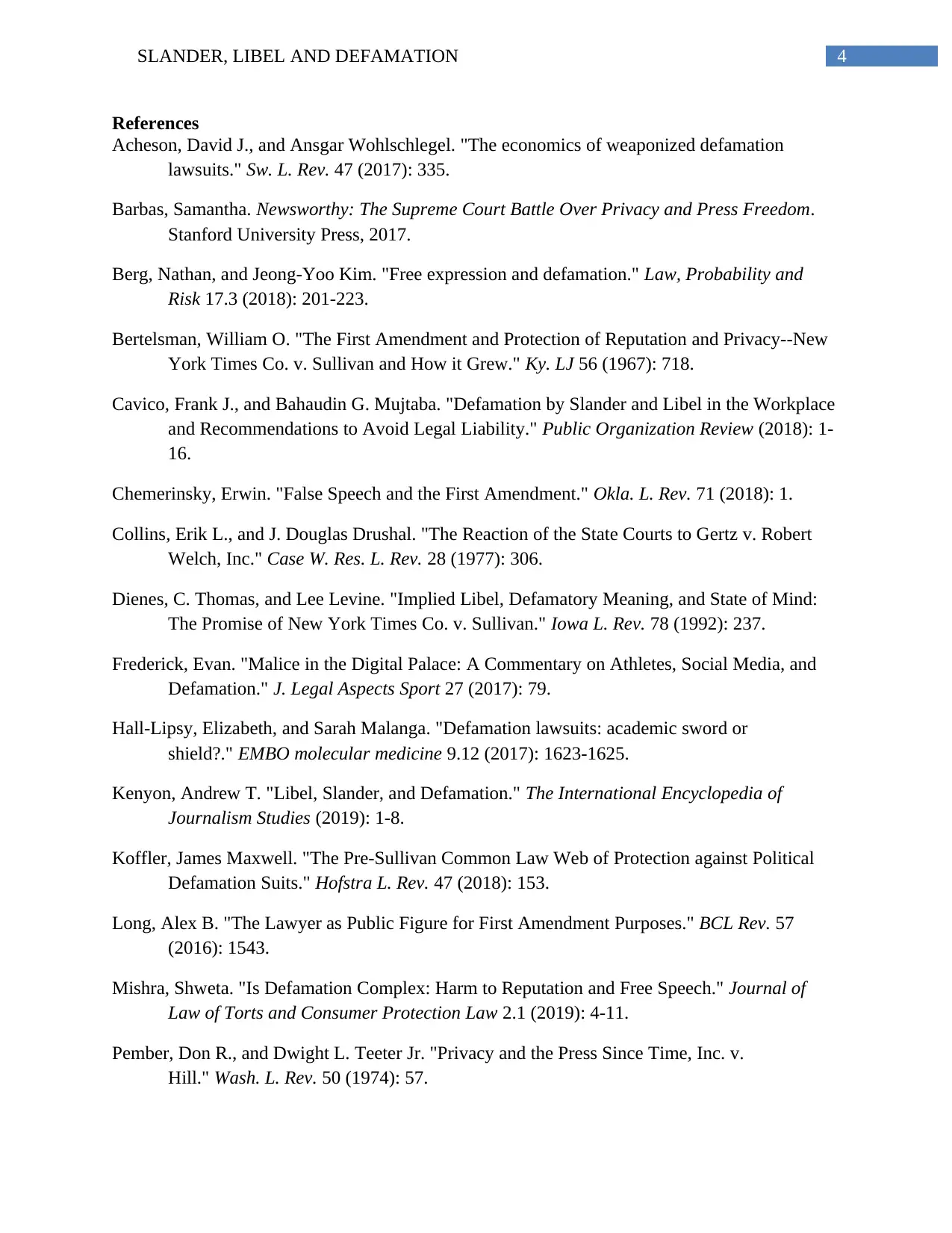
References
Acheson, David J., and Ansgar Wohlschlegel. "The economics of weaponized defamation
lawsuits." Sw. L. Rev. 47 (2017): 335.
Barbas, Samantha. Newsworthy: The Supreme Court Battle Over Privacy and Press Freedom.
Stanford University Press, 2017.
Berg, Nathan, and Jeong-Yoo Kim. "Free expression and defamation." Law, Probability and
Risk 17.3 (2018): 201-223.
Bertelsman, William O. "The First Amendment and Protection of Reputation and Privacy--New
York Times Co. v. Sullivan and How it Grew." Ky. LJ 56 (1967): 718.
Cavico, Frank J., and Bahaudin G. Mujtaba. "Defamation by Slander and Libel in the Workplace
and Recommendations to Avoid Legal Liability." Public Organization Review (2018): 1-
16.
Chemerinsky, Erwin. "False Speech and the First Amendment." Okla. L. Rev. 71 (2018): 1.
Collins, Erik L., and J. Douglas Drushal. "The Reaction of the State Courts to Gertz v. Robert
Welch, Inc." Case W. Res. L. Rev. 28 (1977): 306.
Dienes, C. Thomas, and Lee Levine. "Implied Libel, Defamatory Meaning, and State of Mind:
The Promise of New York Times Co. v. Sullivan." Iowa L. Rev. 78 (1992): 237.
Frederick, Evan. "Malice in the Digital Palace: A Commentary on Athletes, Social Media, and
Defamation." J. Legal Aspects Sport 27 (2017): 79.
Hall‐Lipsy, Elizabeth, and Sarah Malanga. "Defamation lawsuits: academic sword or
shield?." EMBO molecular medicine 9.12 (2017): 1623-1625.
Kenyon, Andrew T. "Libel, Slander, and Defamation." The International Encyclopedia of
Journalism Studies (2019): 1-8.
Koffler, James Maxwell. "The Pre-Sullivan Common Law Web of Protection against Political
Defamation Suits." Hofstra L. Rev. 47 (2018): 153.
Long, Alex B. "The Lawyer as Public Figure for First Amendment Purposes." BCL Rev. 57
(2016): 1543.
Mishra, Shweta. "Is Defamation Complex: Harm to Reputation and Free Speech." Journal of
Law of Torts and Consumer Protection Law 2.1 (2019): 4-11.
Pember, Don R., and Dwight L. Teeter Jr. "Privacy and the Press Since Time, Inc. v.
Hill." Wash. L. Rev. 50 (1974): 57.
References
Acheson, David J., and Ansgar Wohlschlegel. "The economics of weaponized defamation
lawsuits." Sw. L. Rev. 47 (2017): 335.
Barbas, Samantha. Newsworthy: The Supreme Court Battle Over Privacy and Press Freedom.
Stanford University Press, 2017.
Berg, Nathan, and Jeong-Yoo Kim. "Free expression and defamation." Law, Probability and
Risk 17.3 (2018): 201-223.
Bertelsman, William O. "The First Amendment and Protection of Reputation and Privacy--New
York Times Co. v. Sullivan and How it Grew." Ky. LJ 56 (1967): 718.
Cavico, Frank J., and Bahaudin G. Mujtaba. "Defamation by Slander and Libel in the Workplace
and Recommendations to Avoid Legal Liability." Public Organization Review (2018): 1-
16.
Chemerinsky, Erwin. "False Speech and the First Amendment." Okla. L. Rev. 71 (2018): 1.
Collins, Erik L., and J. Douglas Drushal. "The Reaction of the State Courts to Gertz v. Robert
Welch, Inc." Case W. Res. L. Rev. 28 (1977): 306.
Dienes, C. Thomas, and Lee Levine. "Implied Libel, Defamatory Meaning, and State of Mind:
The Promise of New York Times Co. v. Sullivan." Iowa L. Rev. 78 (1992): 237.
Frederick, Evan. "Malice in the Digital Palace: A Commentary on Athletes, Social Media, and
Defamation." J. Legal Aspects Sport 27 (2017): 79.
Hall‐Lipsy, Elizabeth, and Sarah Malanga. "Defamation lawsuits: academic sword or
shield?." EMBO molecular medicine 9.12 (2017): 1623-1625.
Kenyon, Andrew T. "Libel, Slander, and Defamation." The International Encyclopedia of
Journalism Studies (2019): 1-8.
Koffler, James Maxwell. "The Pre-Sullivan Common Law Web of Protection against Political
Defamation Suits." Hofstra L. Rev. 47 (2018): 153.
Long, Alex B. "The Lawyer as Public Figure for First Amendment Purposes." BCL Rev. 57
(2016): 1543.
Mishra, Shweta. "Is Defamation Complex: Harm to Reputation and Free Speech." Journal of
Law of Torts and Consumer Protection Law 2.1 (2019): 4-11.
Pember, Don R., and Dwight L. Teeter Jr. "Privacy and the Press Since Time, Inc. v.
Hill." Wash. L. Rev. 50 (1974): 57.
5SLANDER, LIBEL AND DEFAMATION
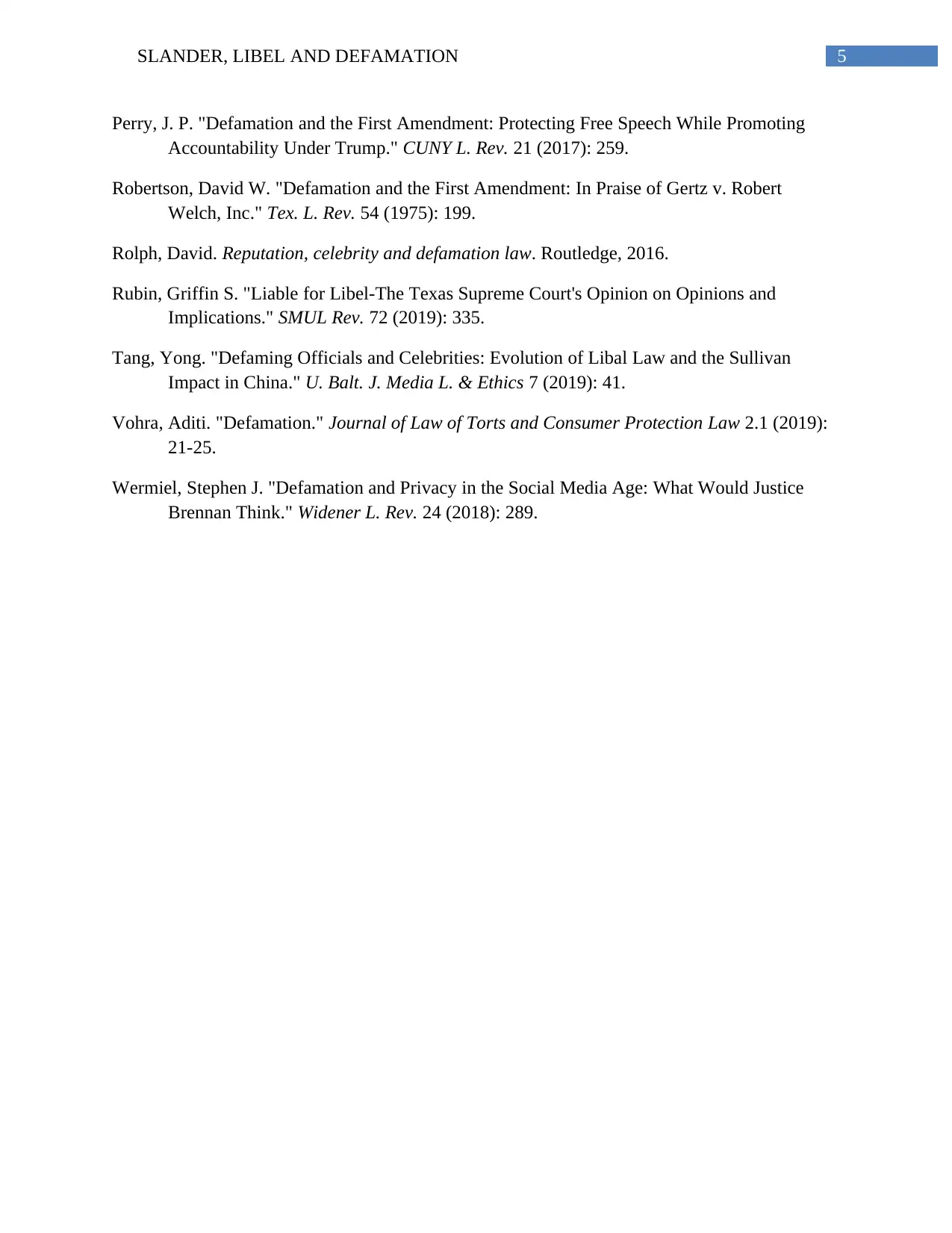
Perry, J. P. "Defamation and the First Amendment: Protecting Free Speech While Promoting
Accountability Under Trump." CUNY L. Rev. 21 (2017): 259.
Robertson, David W. "Defamation and the First Amendment: In Praise of Gertz v. Robert
Welch, Inc." Tex. L. Rev. 54 (1975): 199.
Rolph, David. Reputation, celebrity and defamation law. Routledge, 2016.
Rubin, Griffin S. "Liable for Libel-The Texas Supreme Court's Opinion on Opinions and
Implications." SMUL Rev. 72 (2019): 335.
Tang, Yong. "Defaming Officials and Celebrities: Evolution of Libal Law and the Sullivan
Impact in China." U. Balt. J. Media L. & Ethics 7 (2019): 41.
Vohra, Aditi. "Defamation." Journal of Law of Torts and Consumer Protection Law 2.1 (2019):
21-25.
Wermiel, Stephen J. "Defamation and Privacy in the Social Media Age: What Would Justice
Brennan Think." Widener L. Rev. 24 (2018): 289.
Perry, J. P. "Defamation and the First Amendment: Protecting Free Speech While Promoting
Accountability Under Trump." CUNY L. Rev. 21 (2017): 259.
Robertson, David W. "Defamation and the First Amendment: In Praise of Gertz v. Robert
Welch, Inc." Tex. L. Rev. 54 (1975): 199.
Rolph, David. Reputation, celebrity and defamation law. Routledge, 2016.
Rubin, Griffin S. "Liable for Libel-The Texas Supreme Court's Opinion on Opinions and
Implications." SMUL Rev. 72 (2019): 335.
Tang, Yong. "Defaming Officials and Celebrities: Evolution of Libal Law and the Sullivan
Impact in China." U. Balt. J. Media L. & Ethics 7 (2019): 41.
Vohra, Aditi. "Defamation." Journal of Law of Torts and Consumer Protection Law 2.1 (2019):
21-25.
Wermiel, Stephen J. "Defamation and Privacy in the Social Media Age: What Would Justice
Brennan Think." Widener L. Rev. 24 (2018): 289.
⊘ This is a preview!⊘
Do you want full access?
Subscribe today to unlock all pages.
Trusted by 1+ million students worldwide

1 out of 6


Related Documents


Your All-in-One AI-Powered Toolkit for Academic Success.
+13062052269
info@desklib.com
Available 24*7 on WhatsApp / Email
![[object Object]](/_next/static/media/star-bottom.7253800d.svg)
Unlock your academic potential
Copyright © 2020–2025 A2Z Services. All Rights Reserved. Developed and managed by ZUCOL.