Business Development: SMART Technique for International Expansion
VerifiedAdded on 2021/02/19
|15
|4033
|128
Report
AI Summary
This report examines the application of the SMART (Simply Multi-Attribute Rating Technique) technique as a decision-making tool for international expansion. It begins with an overview of why decision aids are crucial for businesses, especially in the context of global market dynamics and the need for prudent country selection. The report outlines the aims and objectives, which include investigating the use of SMART in selecting an EU country for international expansion. The methodology involves a seven-step process that includes identifying alternatives, assessing the context, and identifying stakeholders. The report also discusses programmed and non-programmed decisions, along with the factors influencing decision-making. A key focus is the SMART technique itself, detailing its steps and benefits for evaluating expansion alternatives. The report also uses the PEST analysis for assessing the context for international expansion. The report concludes with recommendations and references, providing a comprehensive guide to applying the SMART technique in a business context.
SMART (Simply Multi - Attribute Rating Technique)

Paraphrase This Document
Need a fresh take? Get an instant paraphrase of this document with our AI Paraphraser
Table of Contents
Background..............................................................................................................................1
Why decision aids are necessary.......................................................................................1
Aims and objectives..................................................................................................................4
The decision aid- SMART............................................................................................................5
CONCLUSION...............................................................................................................................9
RECOMMENDATIONS..............................................................................................................10
REFERENCES............................................................................................................................12
Background..............................................................................................................................1
Why decision aids are necessary.......................................................................................1
Aims and objectives..................................................................................................................4
The decision aid- SMART............................................................................................................5
CONCLUSION...............................................................................................................................9
RECOMMENDATIONS..............................................................................................................10
REFERENCES............................................................................................................................12
Background
Companies invest and build capacity for creating economies of scale. Companies
target expansion into new markets by efficiently using their potentials (resources,
capabilities, brand and infrastructure) and creating additional sustainable income
opportunities. But (Ignatius, 2017, p.110) recent global movements, the election of
Donald Trump, Brexit, and the rise of ultra-right parties in Europe are all signs of
growing popular displeasure with the free movement of trade, capital, people, and
information (Italics in original). Therefore, in this environment an international expansion
strategy comprises market entry strategy includes crucial choices in regard to
determination of target market and consideration of all attributes or factors including
micro and macro that affect the selection of the country. The company needs to select
the country prudently as failure of consideration of any important factor would
compromise the success (resource and capital spent) and of the strategy. Therefore,
careful selection of the country is very important.
XYZ’s operation strategy in Europe is to grow and invest in the business by
building a strong brand by 2023. Therefore, Water Ops strategy was ‘Strategy for
Growth in and Country Plans.
Why decision aids are necessary
There are different types of decisions which any company need to take for their
successful building up of management and strategies for them. All the type of decision
will be related with organisations as there are different problems which are faced by
them all. There are many decision aids that can be used in international expansion.
Also, some other decision aids are available such as SWOT, PEST analysis, decision
tree, etc. the benefit of SWOT is by identifying opportunities and threats, expansion can
be done. The benefit of PEST is it helps in finding out factors and analysing its impact.
Moreover, it provides brief description of overall market situation of country.
In present situation, decision tree is suitable as it shows different alternatives. By
this it is easy to select the best one and implement it.
There are different risk and uncertainties related to international expansion. The
risk includes political, financial risk, economic risk, etc. They highly impact on expansion
strategy. The uncertainty includes entry barriers and operational obstacles. It may
1
Companies invest and build capacity for creating economies of scale. Companies
target expansion into new markets by efficiently using their potentials (resources,
capabilities, brand and infrastructure) and creating additional sustainable income
opportunities. But (Ignatius, 2017, p.110) recent global movements, the election of
Donald Trump, Brexit, and the rise of ultra-right parties in Europe are all signs of
growing popular displeasure with the free movement of trade, capital, people, and
information (Italics in original). Therefore, in this environment an international expansion
strategy comprises market entry strategy includes crucial choices in regard to
determination of target market and consideration of all attributes or factors including
micro and macro that affect the selection of the country. The company needs to select
the country prudently as failure of consideration of any important factor would
compromise the success (resource and capital spent) and of the strategy. Therefore,
careful selection of the country is very important.
XYZ’s operation strategy in Europe is to grow and invest in the business by
building a strong brand by 2023. Therefore, Water Ops strategy was ‘Strategy for
Growth in and Country Plans.
Why decision aids are necessary
There are different types of decisions which any company need to take for their
successful building up of management and strategies for them. All the type of decision
will be related with organisations as there are different problems which are faced by
them all. There are many decision aids that can be used in international expansion.
Also, some other decision aids are available such as SWOT, PEST analysis, decision
tree, etc. the benefit of SWOT is by identifying opportunities and threats, expansion can
be done. The benefit of PEST is it helps in finding out factors and analysing its impact.
Moreover, it provides brief description of overall market situation of country.
In present situation, decision tree is suitable as it shows different alternatives. By
this it is easy to select the best one and implement it.
There are different risk and uncertainties related to international expansion. The
risk includes political, financial risk, economic risk, etc. They highly impact on expansion
strategy. The uncertainty includes entry barriers and operational obstacles. It may
1
⊘ This is a preview!⊘
Do you want full access?
Subscribe today to unlock all pages.

Trusted by 1+ million students worldwide
restrict organization to enter in other country. Moreover, due to this business may fail in
that country and it results in huge loss.
Programmed and non-programmed decisions-
This is concerned with all sort of problems which are of repetitive nature or of
regular type so for resolving them a standard procedure should be followed. While on
other hand non-programmed decision is that which is related with different situation for
which there is not easy solution.
Routine and strategic decision-
This will be related with general overall function of company which will not be
requiring much of the evaluation or analysis. While strategic decision is termed as
important one which affect goals and objectives of company.
Effective management decision making will be based on evidence-based
approaches from risk management, cognitive psychology, and behavioural economics.
In every organisation management taking decision every day. Depending upon the
manager role they are taking strategic, tactical and operational decisions. The decisions
are taken on basis of situation and its impact in future or perception of risk. Structural
decision has clearly defined objectives and alternatives and is based in decision theory
and risk analysis; while unstructured decision has unclear goals, or no predetermined
and explicit set of ordered responses exists. These are those decisions which are made
for all situation which are completely clear and understood. The main reason behind
choosing structural decision making will be for organising problems and reaching out for
decisions. Each and every decisions is consisting of several primary element
management objectives.
In Organisational decision making if decision is not correct it can highly affect on overall
business operations. For this it is required an effective decision support system that
assist in taking decision (Nurmalini and Rahim, 2017).
Decision Theory- This is an interdisciplinary approach which is determining why
in which decisions could be made so that uncertain decisions could be given for
variables (Sahir, Rosmawati and Minan, 2017). The theory help into bringing
2
that country and it results in huge loss.
Programmed and non-programmed decisions-
This is concerned with all sort of problems which are of repetitive nature or of
regular type so for resolving them a standard procedure should be followed. While on
other hand non-programmed decision is that which is related with different situation for
which there is not easy solution.
Routine and strategic decision-
This will be related with general overall function of company which will not be
requiring much of the evaluation or analysis. While strategic decision is termed as
important one which affect goals and objectives of company.
Effective management decision making will be based on evidence-based
approaches from risk management, cognitive psychology, and behavioural economics.
In every organisation management taking decision every day. Depending upon the
manager role they are taking strategic, tactical and operational decisions. The decisions
are taken on basis of situation and its impact in future or perception of risk. Structural
decision has clearly defined objectives and alternatives and is based in decision theory
and risk analysis; while unstructured decision has unclear goals, or no predetermined
and explicit set of ordered responses exists. These are those decisions which are made
for all situation which are completely clear and understood. The main reason behind
choosing structural decision making will be for organising problems and reaching out for
decisions. Each and every decisions is consisting of several primary element
management objectives.
In Organisational decision making if decision is not correct it can highly affect on overall
business operations. For this it is required an effective decision support system that
assist in taking decision (Nurmalini and Rahim, 2017).
Decision Theory- This is an interdisciplinary approach which is determining why
in which decisions could be made so that uncertain decisions could be given for
variables (Sahir, Rosmawati and Minan, 2017). The theory help into bringing
2
Paraphrase This Document
Need a fresh take? Get an instant paraphrase of this document with our AI Paraphraser
together all philosophical, mathematical, statistical and psychological analyse
within decision making process.
Normative/value-based theory- This states the right and wrong or undesirable
which can be just for society. Majority of the sociologist will be considering for
moving to evaluation after explanation (Nurmalini and Rahim, 2017).
Wally and Baum (1994) stated that strategic decisions are process of choice that can be
conceptualized into three knotted activities; intelligent activity (required data collection
and processing ), design activity (one can formulate likely outcome when satisfy goals)
and choice activity (judgment /choice among alternatives).
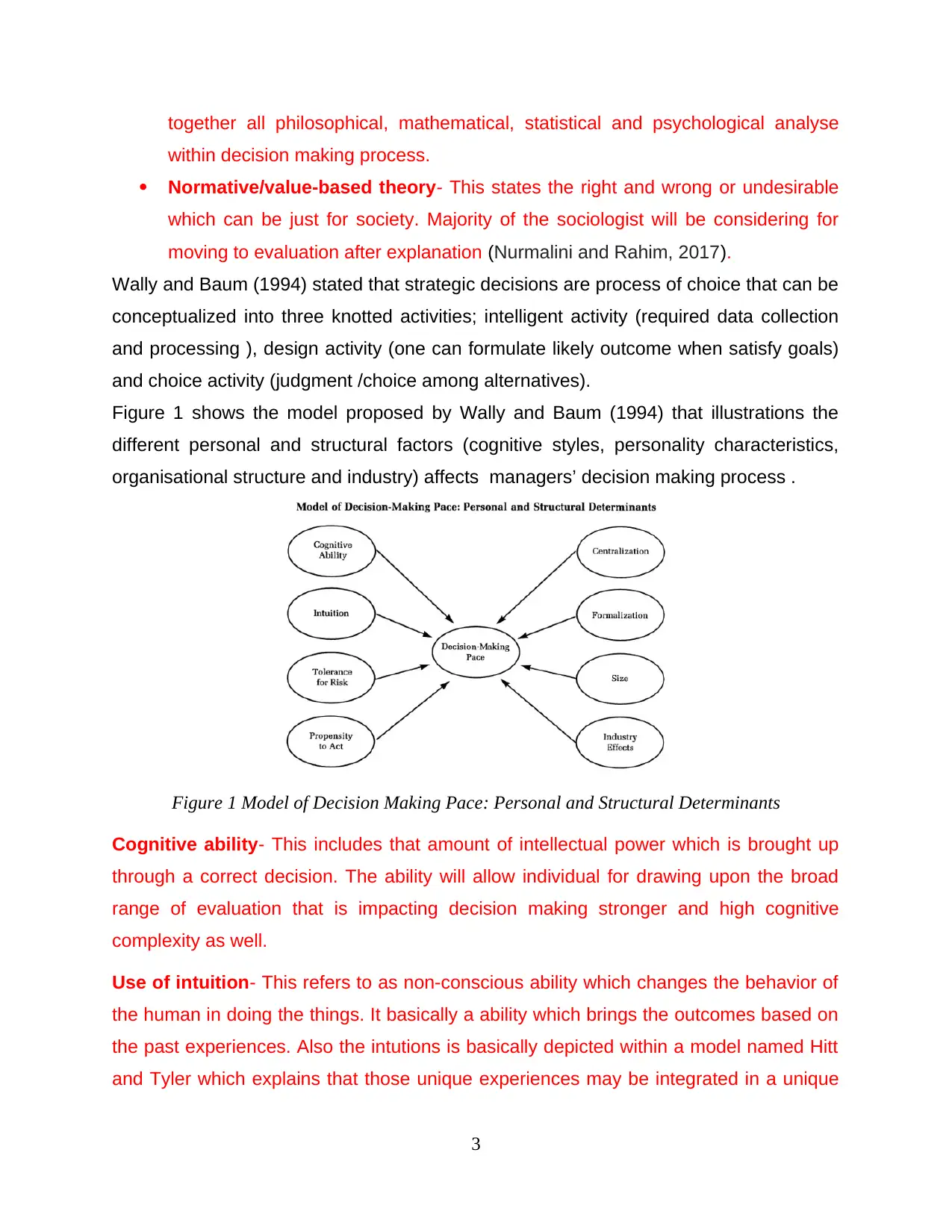
Figure 1 shows the model proposed by Wally and Baum (1994) that illustrations the
different personal and structural factors (cognitive styles, personality characteristics,
organisational structure and industry) affects managers’ decision making process .
Figure 1 Model of Decision Making Pace: Personal and Structural Determinants
Cognitive ability- This includes that amount of intellectual power which is brought up
through a correct decision. The ability will allow individual for drawing upon the broad
range of evaluation that is impacting decision making stronger and high cognitive
complexity as well.
Use of intuition- This refers to as non-conscious ability which changes the behavior of
the human in doing the things. It basically a ability which brings the outcomes based on
the past experiences. Also the intutions is basically depicted within a model named Hitt
and Tyler which explains that those unique experiences may be integrated in a unique
3
within decision making process.
Normative/value-based theory- This states the right and wrong or undesirable
which can be just for society. Majority of the sociologist will be considering for
moving to evaluation after explanation (Nurmalini and Rahim, 2017).
Wally and Baum (1994) stated that strategic decisions are process of choice that can be
conceptualized into three knotted activities; intelligent activity (required data collection
and processing ), design activity (one can formulate likely outcome when satisfy goals)
and choice activity (judgment /choice among alternatives).
Figure 1 shows the model proposed by Wally and Baum (1994) that illustrations the
different personal and structural factors (cognitive styles, personality characteristics,
organisational structure and industry) affects managers’ decision making process .
Figure 1 Model of Decision Making Pace: Personal and Structural Determinants
Cognitive ability- This includes that amount of intellectual power which is brought up
through a correct decision. The ability will allow individual for drawing upon the broad
range of evaluation that is impacting decision making stronger and high cognitive
complexity as well.
Use of intuition- This refers to as non-conscious ability which changes the behavior of
the human in doing the things. It basically a ability which brings the outcomes based on
the past experiences. Also the intutions is basically depicted within a model named Hitt
and Tyler which explains that those unique experiences may be integrated in a unique
3
manner. Therefore it basically denotes a compressed experience which impacts on the
present decision making requirements of the individual
Tolerance for risk- This is a universally important as it can be uncertainly arrive at any
situations of the life. Risk seeking and Risk awareness are two indifferent topics which
are basically concerned with the psychological flexibility of individual. It can also be
related with the assertiveness and responsiveness to decision making
Propensity to act- This is commonly associated with the high ambition and
decisiveness nature in which individual performs the intelligent actions. In this
executives probably brings high level of energy in taking decisions.
Centralization- It is commonly referred to as a centralization of authority in which
decision making powers are generally held by few. Also, top executives generally have
less responsibility but have a power to order their subordinates and all the other
responsibilities are now given in the hands of the subordinates. They handle the
decisions and ultimately cannot define the ideas but provide the ultimate results to their
boses.
Formalization- It refers to the organization in which policies and hierarchies depict the
communication process within the firm. Here decision making is distributed among most
of the people and thus it slows the decision making within the company.
Size- The complexity of the firm increases with the increase in the size that is quantity
of employees. This ultimately impacts on the decision making power within the firm as
decisions have to be passed through multiple channels.
Industry effect- It basically changes with the change in the trend and customer
perceptions. Therefore according to the demands of the customers, all the decisions are
generally changed. It ultimately changes strategic decisions.
A decision maker has many alternatives available which enables them to
evaluate each one and then focus on other. Basically, a decision support system is
used to take decisions. It stores data and information which is analysed and outcomes
are obtained. This system combines the features of information system and processing
of data. The solving of problem is highly dependent on what type of decision is taken
4
present decision making requirements of the individual
Tolerance for risk- This is a universally important as it can be uncertainly arrive at any
situations of the life. Risk seeking and Risk awareness are two indifferent topics which
are basically concerned with the psychological flexibility of individual. It can also be
related with the assertiveness and responsiveness to decision making
Propensity to act- This is commonly associated with the high ambition and
decisiveness nature in which individual performs the intelligent actions. In this
executives probably brings high level of energy in taking decisions.
Centralization- It is commonly referred to as a centralization of authority in which
decision making powers are generally held by few. Also, top executives generally have
less responsibility but have a power to order their subordinates and all the other
responsibilities are now given in the hands of the subordinates. They handle the
decisions and ultimately cannot define the ideas but provide the ultimate results to their
boses.
Formalization- It refers to the organization in which policies and hierarchies depict the
communication process within the firm. Here decision making is distributed among most
of the people and thus it slows the decision making within the company.
Size- The complexity of the firm increases with the increase in the size that is quantity
of employees. This ultimately impacts on the decision making power within the firm as
decisions have to be passed through multiple channels.
Industry effect- It basically changes with the change in the trend and customer
perceptions. Therefore according to the demands of the customers, all the decisions are
generally changed. It ultimately changes strategic decisions.
A decision maker has many alternatives available which enables them to
evaluate each one and then focus on other. Basically, a decision support system is
used to take decisions. It stores data and information which is analysed and outcomes
are obtained. This system combines the features of information system and processing
of data. The solving of problem is highly dependent on what type of decision is taken
4
⊘ This is a preview!⊘
Do you want full access?
Subscribe today to unlock all pages.
Trusted by 1+ million students worldwide
and how it is been applied. It is important to take crucial and right decision so that
performance is not affected (Ramalingam and Maheswari, 2016). However, when in
case when there are viable options available SMART technique is used. It is highly
useful in selecting the best option. The decision aids are beneficial in evaluating and
getting desired results. It assists in taking decision according to situation. There are
many tools and techniques available which support in facilitating. It provides data and
information that clarify. Furthermore, decision maker is able to get variety of options.
SMART technique is appropriate in such a situation as it helps in analysing overall. By
using this technique it was easy to evaluate. Moreover, it provided in depth data and
information that what will be the benefit of decision is taken. Many times it happens that
in organisation decisions are not been taken effectively (Sahir, Rosmawati and Minan,
2017). It is because situation is not analyzed and information is not provided. There are
many other tools available but in this method it is simple to give rating on weighting
purpose. By this evaluation is done and then option is eliminated. This method is better
and efficient than other because in that ratings are given. So, it highly support in
selecting the best one. The decisions are taken with simple objectives. This helps in
moving in right direction and attaining those objectives. In similar way, other objectives
are stated and formed. On basis of it, all decisions are taken which simplifies situation. It
makes situation easy to understand and solve it.
Aims and objectives
Aim – To investigate the use of SMART technique in selection of the EU country for
International Expansion
Objective - The objective is to find out how SMART technique support in finding out
total weight of each decision available and doing calculations. It will show overall
process and stages required in using SMART method and how a decision maker is able
to solve situation. Besides this, purpose of report is to get use of decision making tools.
In this report there are many sections discussed in it. Here, first in first section it
is described about the situation (Molnar and et.al 2017). In second section things
related to what actions were taken to solve situation and how things were analyzed.
This section describe how using decision making tools helps in solving situation by
5
performance is not affected (Ramalingam and Maheswari, 2016). However, when in
case when there are viable options available SMART technique is used. It is highly
useful in selecting the best option. The decision aids are beneficial in evaluating and
getting desired results. It assists in taking decision according to situation. There are
many tools and techniques available which support in facilitating. It provides data and
information that clarify. Furthermore, decision maker is able to get variety of options.
SMART technique is appropriate in such a situation as it helps in analysing overall. By
using this technique it was easy to evaluate. Moreover, it provided in depth data and
information that what will be the benefit of decision is taken. Many times it happens that
in organisation decisions are not been taken effectively (Sahir, Rosmawati and Minan,
2017). It is because situation is not analyzed and information is not provided. There are
many other tools available but in this method it is simple to give rating on weighting
purpose. By this evaluation is done and then option is eliminated. This method is better
and efficient than other because in that ratings are given. So, it highly support in
selecting the best one. The decisions are taken with simple objectives. This helps in
moving in right direction and attaining those objectives. In similar way, other objectives
are stated and formed. On basis of it, all decisions are taken which simplifies situation. It
makes situation easy to understand and solve it.
Aims and objectives
Aim – To investigate the use of SMART technique in selection of the EU country for
International Expansion
Objective - The objective is to find out how SMART technique support in finding out
total weight of each decision available and doing calculations. It will show overall
process and stages required in using SMART method and how a decision maker is able
to solve situation. Besides this, purpose of report is to get use of decision making tools.
In this report there are many sections discussed in it. Here, first in first section it
is described about the situation (Molnar and et.al 2017). In second section things
related to what actions were taken to solve situation and how things were analyzed.
This section describe how using decision making tools helps in solving situation by
5
Paraphrase This Document
Need a fresh take? Get an instant paraphrase of this document with our AI Paraphraser
taking effective decision. Moreover, it is discussed about various stages of SMART
technique and how it support in making proper and appropriate decision.
The decision aid- SMART
It is technique which helps companies to evaluate alternatives for expansion. It is
a 7 step procedure that analyzes alternatives on basis of certain criteria. Also, here
different factors are also included and its affect is analyzed (Ortiz-Urbina and et.al.
2019). This benefit in giving score and values accordingly. In addition, each alternative
is calculated through which value is obtained. By this alternative is selected. Here, a
flexible procedure is followed to gather data and make precise decision. This process is
beneficial for business as it gives brief information about choices. Another feature is key
stakeholders are identified which is helps in getting information. The attributes are
specified as well which make it simple to evaluate.
In this section explain stepped SMART process.
Step 1 :Identify alternatives and context assessment
It is the first step in which alternatives are identified. They are selected on basis of
certain criteria which is related to socio political context . For this usually PEST analysis
is done where factors are determined and its impact is analyzed. Similarly, for
international expansion four countries were chosen that are Norway, Sweden, Poland
and Denmark. Then, on basis of several factors evaluation was done. This step is
important as it helps in providing background of country, neighbouring groups, etc. Also,
this step benefit in proceeding of remaining one in SMART decision aid (Baykasoğlu
and Gölcük, 2015). Besides this, it enables in providing information about countries
political condition.
The four-countries identified are shortlisted out of EU country based on matrix analysis;
6
technique and how it support in making proper and appropriate decision.
The decision aid- SMART
It is technique which helps companies to evaluate alternatives for expansion. It is
a 7 step procedure that analyzes alternatives on basis of certain criteria. Also, here
different factors are also included and its affect is analyzed (Ortiz-Urbina and et.al.
2019). This benefit in giving score and values accordingly. In addition, each alternative
is calculated through which value is obtained. By this alternative is selected. Here, a
flexible procedure is followed to gather data and make precise decision. This process is
beneficial for business as it gives brief information about choices. Another feature is key
stakeholders are identified which is helps in getting information. The attributes are
specified as well which make it simple to evaluate.
In this section explain stepped SMART process.
Step 1 :Identify alternatives and context assessment
It is the first step in which alternatives are identified. They are selected on basis of
certain criteria which is related to socio political context . For this usually PEST analysis
is done where factors are determined and its impact is analyzed. Similarly, for
international expansion four countries were chosen that are Norway, Sweden, Poland
and Denmark. Then, on basis of several factors evaluation was done. This step is
important as it helps in providing background of country, neighbouring groups, etc. Also,
this step benefit in proceeding of remaining one in SMART decision aid (Baykasoğlu
and Gölcük, 2015). Besides this, it enables in providing information about countries
political condition.
The four-countries identified are shortlisted out of EU country based on matrix analysis;
6
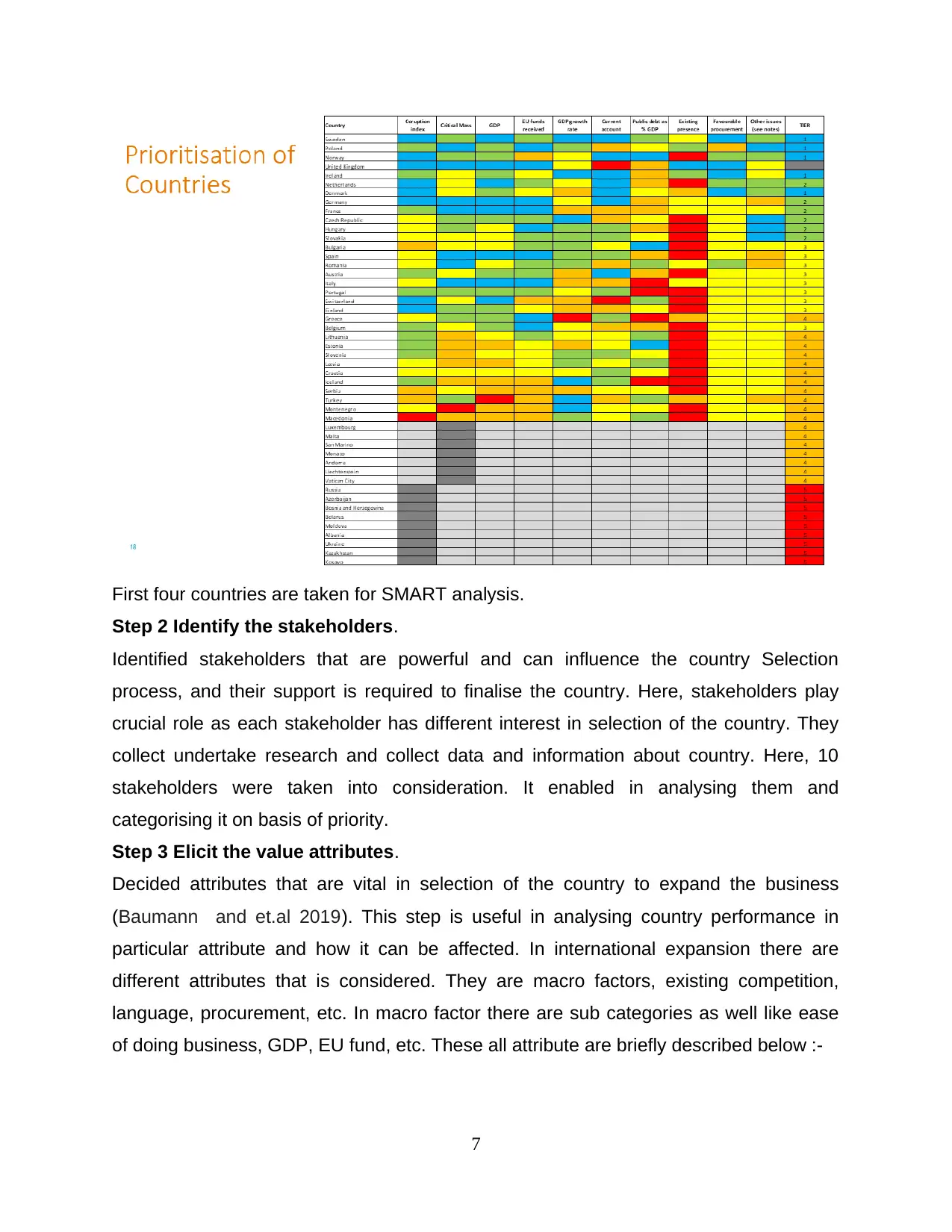
First four countries are taken for SMART analysis.
Step 2 Identify the stakeholders.
Identified stakeholders that are powerful and can influence the country Selection
process, and their support is required to finalise the country. Here, stakeholders play
crucial role as each stakeholder has different interest in selection of the country. They
collect undertake research and collect data and information about country. Here, 10
stakeholders were taken into consideration. It enabled in analysing them and
categorising it on basis of priority.
Step 3 Elicit the value attributes.
Decided attributes that are vital in selection of the country to expand the business
(Baumann and et.al 2019). This step is useful in analysing country performance in
particular attribute and how it can be affected. In international expansion there are
different attributes that is considered. They are macro factors, existing competition,
language, procurement, etc. In macro factor there are sub categories as well like ease
of doing business, GDP, EU fund, etc. These all attribute are briefly described below :-
7
Step 2 Identify the stakeholders.
Identified stakeholders that are powerful and can influence the country Selection
process, and their support is required to finalise the country. Here, stakeholders play
crucial role as each stakeholder has different interest in selection of the country. They
collect undertake research and collect data and information about country. Here, 10
stakeholders were taken into consideration. It enabled in analysing them and
categorising it on basis of priority.
Step 3 Elicit the value attributes.
Decided attributes that are vital in selection of the country to expand the business
(Baumann and et.al 2019). This step is useful in analysing country performance in
particular attribute and how it can be affected. In international expansion there are
different attributes that is considered. They are macro factors, existing competition,
language, procurement, etc. In macro factor there are sub categories as well like ease
of doing business, GDP, EU fund, etc. These all attribute are briefly described below :-
7
⊘ This is a preview!⊘
Do you want full access?
Subscribe today to unlock all pages.
Trusted by 1+ million students worldwide
Macro factor – it shows the economic condition of country with others. Also, change in
macro factor can impact on nation economy. It consists of ease of doing business, GDP
growth and corruption index (Risawandi, 2016).
Existing competition – From this it is identified that how much is the level of
competition in nation. Moreover, the number of companies exists and how they are
operating in that nation is analysed. If there are the UK competitors are already exist
then the country is less favourable.
Procurement – this attribute indicate supply and availability of goods and services. It
helps in finding out how well goods and services in specific country are available. Other
than this, procurement provides detail of infrastructure as well (Santoso, Ernawati and
Anggriani, 2019).
Local government infrastructure investment plan- It provides information about the
investment plan of local government in infrastructure (Santoso, Ernawati and Anggriani,
2019). In this data is gathered about contribution of local government in past and what
are their future plans regarding improving infrastructure.
Language- As name suggests it gives information about what language is spoken in
particular country. Alongside it, what other languages are spoken as well. This will help
in defining ease to communicate and doing business; whether management staff can be
transferred to new country or due to language barrier have to recruit locally.
The step is useful in evaluating each attribute and collecting in depth data. From this it
is analyzed that how each attribute will help in generating value. The facts and statistics
are collected of each country. It eases in making decision to select one country
according to economic condition.
Step-4 Assess scores {values}
Value has been scored based on statistical data and it importance. From step 3 each
attribute is given value between 0-100; 0 as the worst and 100 the best. This score
helps in selecting the best country by calculating overall score of attributes. It is
important to access score so that it is easy to take decision. Thus, by giving weight the
countries can be eliminated who is having worst score in specific attribute; it gives
preference of attribute. The main purpose of this step is it provides description of score
given to particular attribute (Saputra and Mawartika, 2019).
8
macro factor can impact on nation economy. It consists of ease of doing business, GDP
growth and corruption index (Risawandi, 2016).
Existing competition – From this it is identified that how much is the level of
competition in nation. Moreover, the number of companies exists and how they are
operating in that nation is analysed. If there are the UK competitors are already exist
then the country is less favourable.
Procurement – this attribute indicate supply and availability of goods and services. It
helps in finding out how well goods and services in specific country are available. Other
than this, procurement provides detail of infrastructure as well (Santoso, Ernawati and
Anggriani, 2019).
Local government infrastructure investment plan- It provides information about the
investment plan of local government in infrastructure (Santoso, Ernawati and Anggriani,
2019). In this data is gathered about contribution of local government in past and what
are their future plans regarding improving infrastructure.
Language- As name suggests it gives information about what language is spoken in
particular country. Alongside it, what other languages are spoken as well. This will help
in defining ease to communicate and doing business; whether management staff can be
transferred to new country or due to language barrier have to recruit locally.
The step is useful in evaluating each attribute and collecting in depth data. From this it
is analyzed that how each attribute will help in generating value. The facts and statistics
are collected of each country. It eases in making decision to select one country
according to economic condition.
Step-4 Assess scores {values}
Value has been scored based on statistical data and it importance. From step 3 each
attribute is given value between 0-100; 0 as the worst and 100 the best. This score
helps in selecting the best country by calculating overall score of attributes. It is
important to access score so that it is easy to take decision. Thus, by giving weight the
countries can be eliminated who is having worst score in specific attribute; it gives
preference of attribute. The main purpose of this step is it provides description of score
given to particular attribute (Saputra and Mawartika, 2019).
8
Paraphrase This Document
Need a fresh take? Get an instant paraphrase of this document with our AI Paraphraser
Step-5 Assignment of importance weights
Here, weights are calculated of each attribute on basis of value score. This is done
because all attribute might not be given equally important but it has to be discussed.
Here, for instance one attribute might be an important factor but in taking decision it is
not important compare to other. So, in order to tackle this weight is allotted.
Furthermore, stakeholders are also included in it and it weight is calculated. Moreover,
different stakeholders grouping are done on basis of socio economic context
(Ramalingam and Maheswari, 2016). It helps in taking sensible decision and finding out
solution. The solution is based on weight. This step is important as shows weight of
attribute and stakeholder.
Step-6 Aggregation
Quick explanation on formula used to calculate aggregate. It benefit in comparing value
and cost. This helps in finding out the best value of each alternative. The overall
aggregate enables in calculating average score of all attributes and weights. The
analysis shows highest aggregate alternative. So, here it becomes sorted as it is easy
to find out which alternative is best.
By calculating the aggregation it can be observed that Sweden is having highest
aggregate of 68.33 whereas Poland score is 52.22. The other country is also having low
score.
Step-7 Choice and Sensitivity Analysis
It is the last step where sensitivity analysis is done to take decision. Here, in
international expansion the comparison is made between utility and capital cost of four
countries. With help of it, maximum cost and value is determined. However, in situation
where two alternatives get same data it means that in both favour decision can be
taken.
9
Here, weights are calculated of each attribute on basis of value score. This is done
because all attribute might not be given equally important but it has to be discussed.
Here, for instance one attribute might be an important factor but in taking decision it is
not important compare to other. So, in order to tackle this weight is allotted.
Furthermore, stakeholders are also included in it and it weight is calculated. Moreover,
different stakeholders grouping are done on basis of socio economic context
(Ramalingam and Maheswari, 2016). It helps in taking sensible decision and finding out
solution. The solution is based on weight. This step is important as shows weight of
attribute and stakeholder.
Step-6 Aggregation
Quick explanation on formula used to calculate aggregate. It benefit in comparing value
and cost. This helps in finding out the best value of each alternative. The overall
aggregate enables in calculating average score of all attributes and weights. The
analysis shows highest aggregate alternative. So, here it becomes sorted as it is easy
to find out which alternative is best.
By calculating the aggregation it can be observed that Sweden is having highest
aggregate of 68.33 whereas Poland score is 52.22. The other country is also having low
score.
Step-7 Choice and Sensitivity Analysis
It is the last step where sensitivity analysis is done to take decision. Here, in
international expansion the comparison is made between utility and capital cost of four
countries. With help of it, maximum cost and value is determined. However, in situation
where two alternatives get same data it means that in both favour decision can be
taken.
9
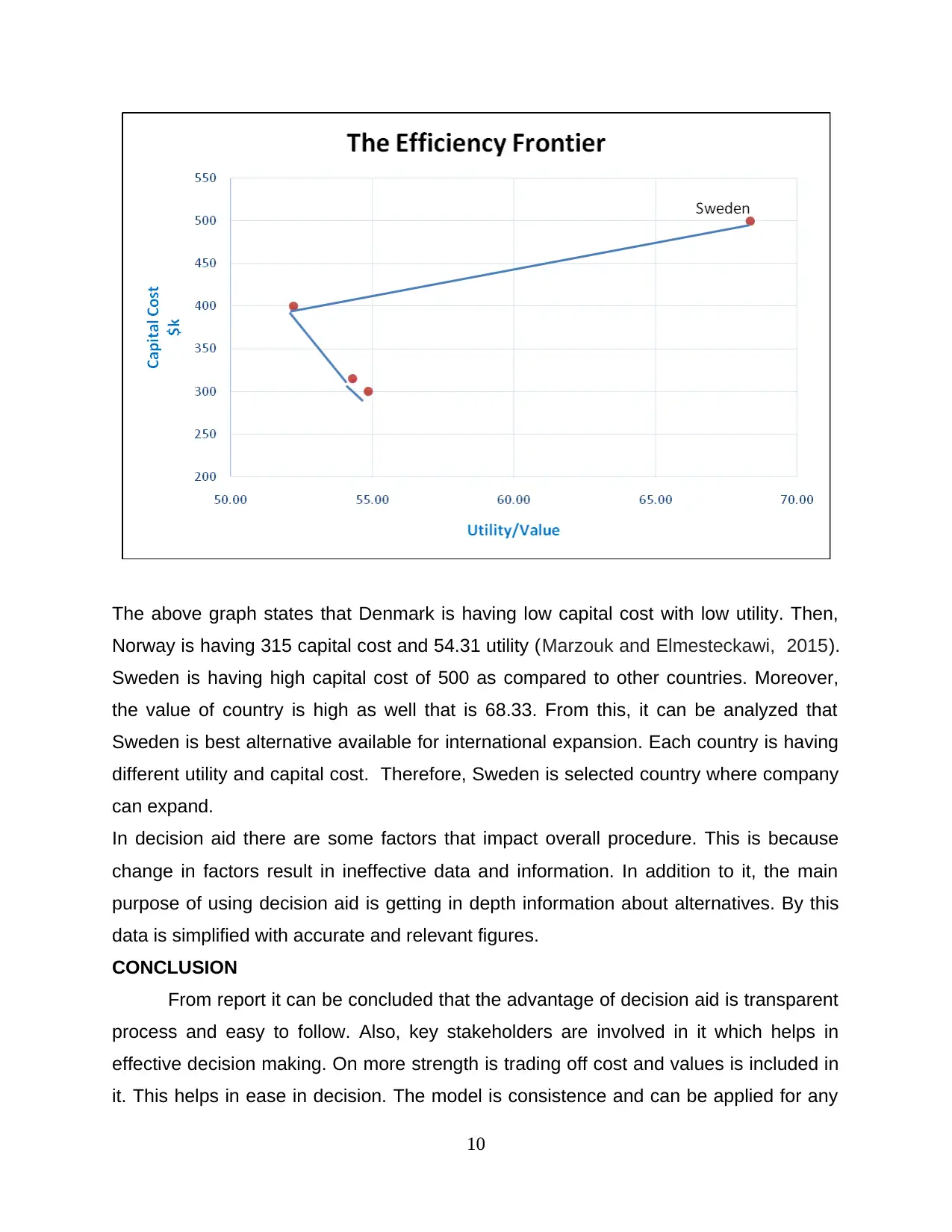
The above graph states that Denmark is having low capital cost with low utility. Then,
Norway is having 315 capital cost and 54.31 utility (Marzouk and Elmesteckawi, 2015).
Sweden is having high capital cost of 500 as compared to other countries. Moreover,
the value of country is high as well that is 68.33. From this, it can be analyzed that
Sweden is best alternative available for international expansion. Each country is having
different utility and capital cost. Therefore, Sweden is selected country where company
can expand.
In decision aid there are some factors that impact overall procedure. This is because
change in factors result in ineffective data and information. In addition to it, the main
purpose of using decision aid is getting in depth information about alternatives. By this
data is simplified with accurate and relevant figures.
CONCLUSION
From report it can be concluded that the advantage of decision aid is transparent
process and easy to follow. Also, key stakeholders are involved in it which helps in
effective decision making. On more strength is trading off cost and values is included in
it. This helps in ease in decision. The model is consistence and can be applied for any
10
Norway is having 315 capital cost and 54.31 utility (Marzouk and Elmesteckawi, 2015).
Sweden is having high capital cost of 500 as compared to other countries. Moreover,
the value of country is high as well that is 68.33. From this, it can be analyzed that
Sweden is best alternative available for international expansion. Each country is having
different utility and capital cost. Therefore, Sweden is selected country where company
can expand.
In decision aid there are some factors that impact overall procedure. This is because
change in factors result in ineffective data and information. In addition to it, the main
purpose of using decision aid is getting in depth information about alternatives. By this
data is simplified with accurate and relevant figures.
CONCLUSION
From report it can be concluded that the advantage of decision aid is transparent
process and easy to follow. Also, key stakeholders are involved in it which helps in
effective decision making. On more strength is trading off cost and values is included in
it. This helps in ease in decision. The model is consistence and can be applied for any
10
⊘ This is a preview!⊘
Do you want full access?
Subscribe today to unlock all pages.
Trusted by 1+ million students worldwide

1 out of 15


Related Documents


Your All-in-One AI-Powered Toolkit for Academic Success.
+13062052269
info@desklib.com
Available 24*7 on WhatsApp / Email
![[object Object]](/_next/static/media/star-bottom.7253800d.svg)
Unlock your academic potential
Copyright © 2020–2026 A2Z Services. All Rights Reserved. Developed and managed by ZUCOL.