Social Capital, Knowledge Sharing and Organization Performance

Verified

Added on  2020/05/04

|5
|940
|58
Homework Assignment
AI Summary
This assignment delves into the multifaceted concept of social capital and its profound impact on organizational dynamics. It begins by examining the individual motivational factors, such as reciprocity, organizational rewards, and enjoyment, and their influence on employees' intentions to share both explicit and tacit knowledge. The assignment then explores the tangible benefits organizations derive from employee knowledge sharing, emphasizing its role in fostering innovation, trust, and collegiality. Furthermore, it investigates the relationship between social capital and social networking, assessing how these connections affect overall organizational performance and competitive advantage. The analysis extends to comparing the performance of organizations with varying networking relationships, including those with top managers of other firms, community leaders, and government officials. The assignment draws upon the research of Yong et al. (2012) and Moses (2007) to provide a comprehensive understanding of the subject.

Document Page
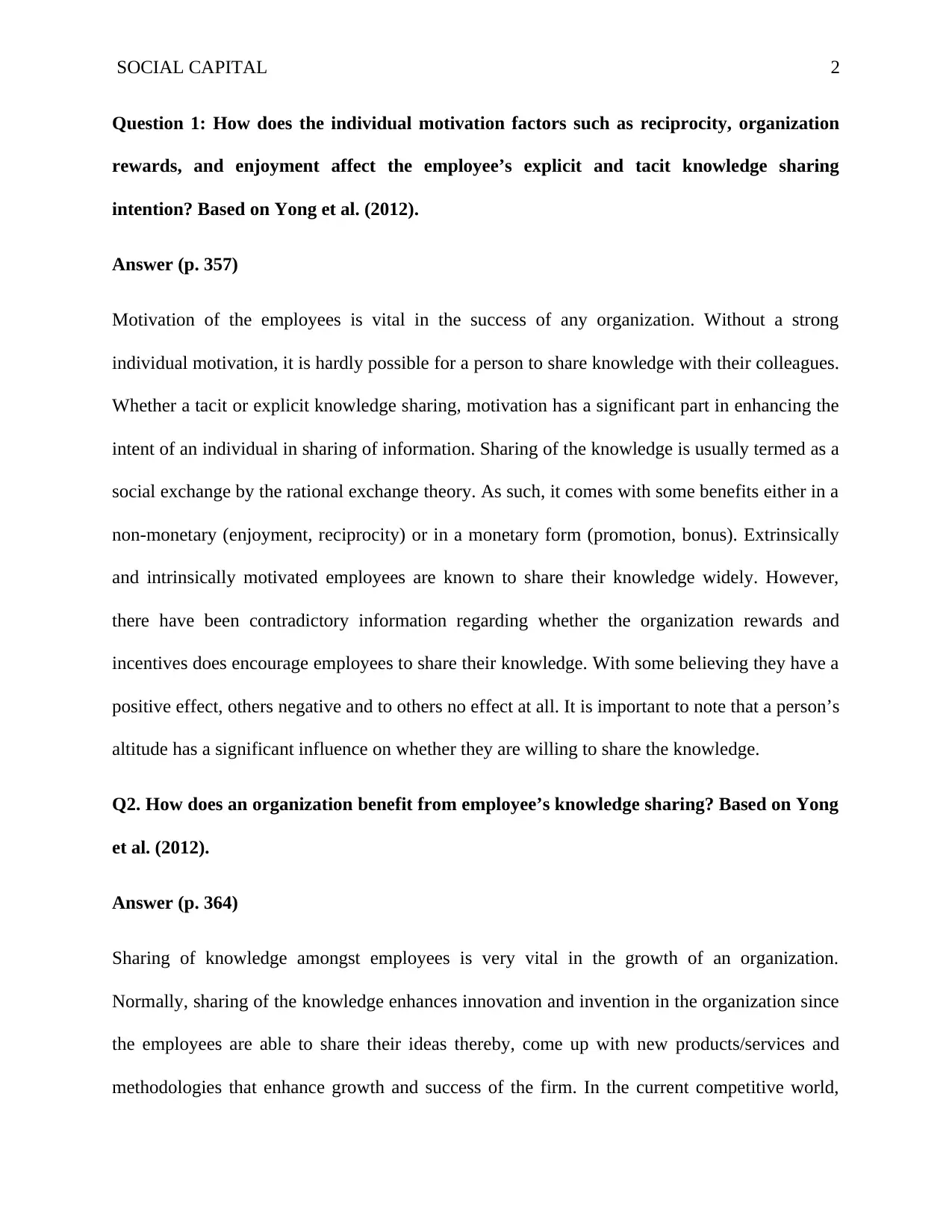
Running head: SOCIAL CAPITAL
Social capital
Name
Institution
Date of submission
tabler-icon-diamond-filled.svg

Paraphrase This Document

Need a fresh take? Get an instant paraphrase of this document with our AI Paraphraser
Document Page
SOCIAL CAPITAL 2
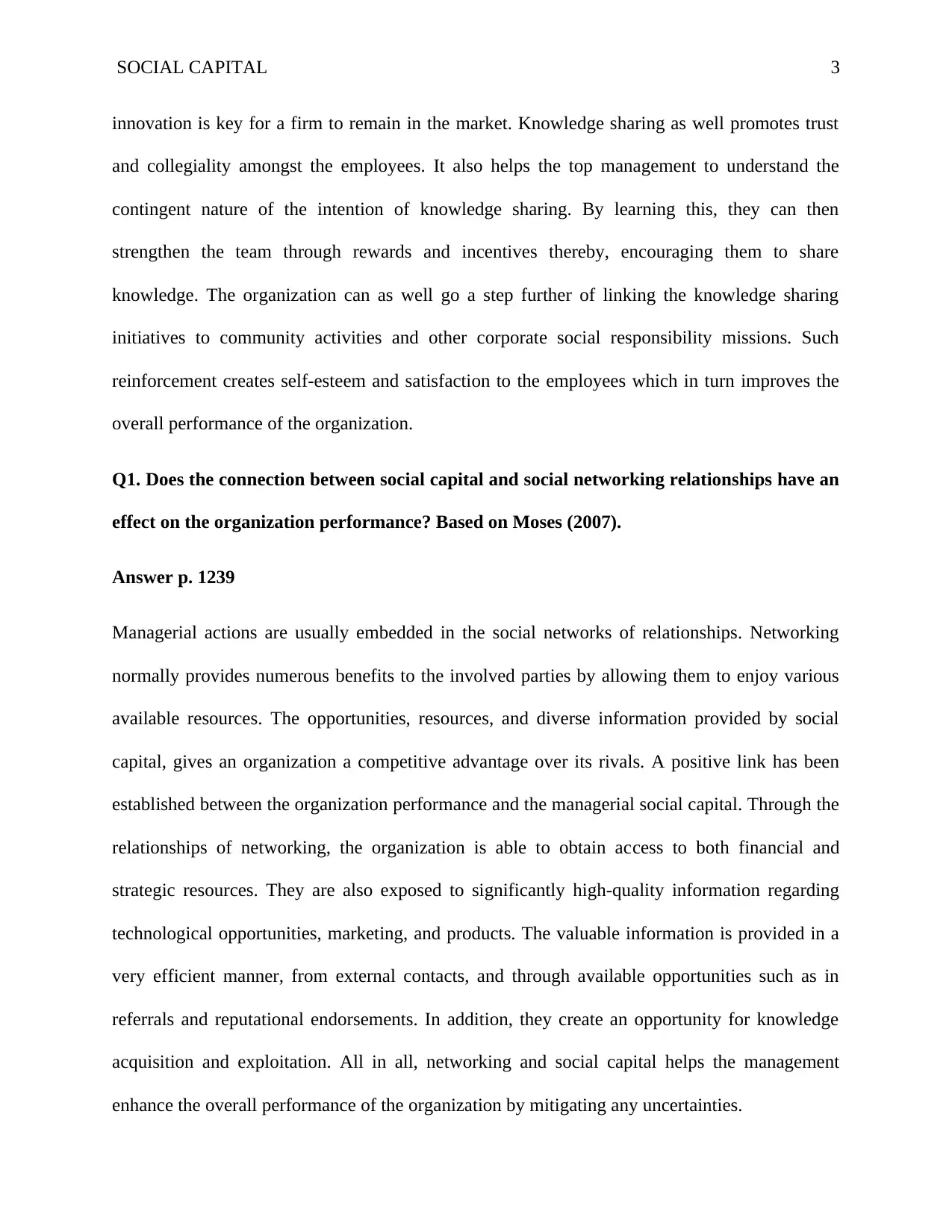
Question 1: How does the individual motivation factors such as reciprocity, organization
rewards, and enjoyment affect the employee’s explicit and tacit knowledge sharing
intention? Based on Yong et al. (2012).
Answer (p. 357)
Motivation of the employees is vital in the success of any organization. Without a strong
individual motivation, it is hardly possible for a person to share knowledge with their colleagues.
Whether a tacit or explicit knowledge sharing, motivation has a significant part in enhancing the
intent of an individual in sharing of information. Sharing of the knowledge is usually termed as a
social exchange by the rational exchange theory. As such, it comes with some benefits either in a
non-monetary (enjoyment, reciprocity) or in a monetary form (promotion, bonus). Extrinsically
and intrinsically motivated employees are known to share their knowledge widely. However,
there have been contradictory information regarding whether the organization rewards and
incentives does encourage employees to share their knowledge. With some believing they have a
positive effect, others negative and to others no effect at all. It is important to note that a person’s
altitude has a significant influence on whether they are willing to share the knowledge.
Q2. How does an organization benefit from employee’s knowledge sharing? Based on Yong
et al. (2012).
Answer (p. 364)
Sharing of knowledge amongst employees is very vital in the growth of an organization.
Normally, sharing of the knowledge enhances innovation and invention in the organization since
the employees are able to share their ideas thereby, come up with new products/services and
methodologies that enhance growth and success of the firm. In the current competitive world,
Document Page
SOCIAL CAPITAL 3
innovation is key for a firm to remain in the market. Knowledge sharing as well promotes trust
and collegiality amongst the employees. It also helps the top management to understand the
contingent nature of the intention of knowledge sharing. By learning this, they can then
strengthen the team through rewards and incentives thereby, encouraging them to share
knowledge. The organization can as well go a step further of linking the knowledge sharing
initiatives to community activities and other corporate social responsibility missions. Such
reinforcement creates self-esteem and satisfaction to the employees which in turn improves the
overall performance of the organization.
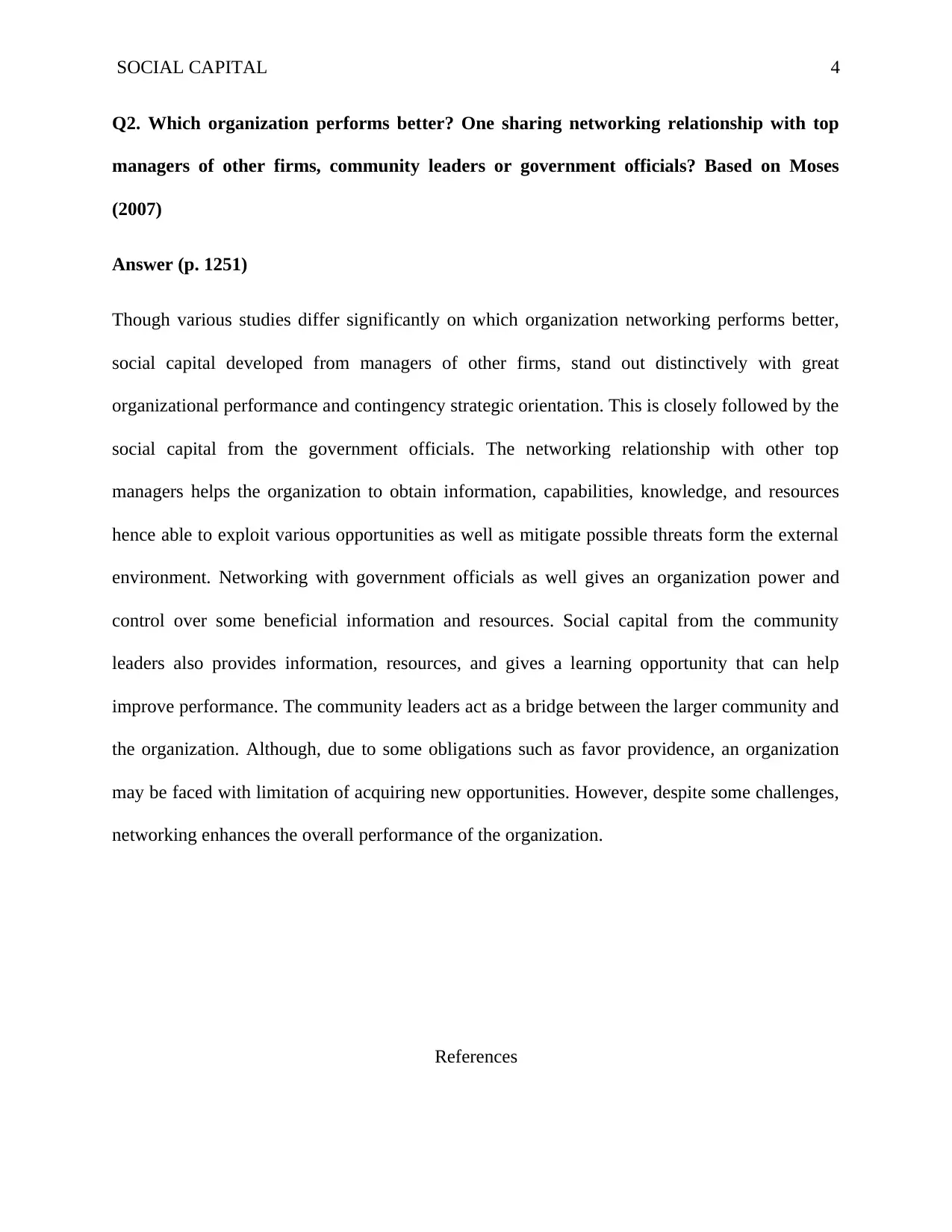
Q1. Does the connection between social capital and social networking relationships have an
effect on the organization performance? Based on Moses (2007).
Answer p. 1239
Managerial actions are usually embedded in the social networks of relationships. Networking
normally provides numerous benefits to the involved parties by allowing them to enjoy various
available resources. The opportunities, resources, and diverse information provided by social
capital, gives an organization a competitive advantage over its rivals. A positive link has been
established between the organization performance and the managerial social capital. Through the
relationships of networking, the organization is able to obtain access to both financial and
strategic resources. They are also exposed to significantly high-quality information regarding
technological opportunities, marketing, and products. The valuable information is provided in a
very efficient manner, from external contacts, and through available opportunities such as in
referrals and reputational endorsements. In addition, they create an opportunity for knowledge
acquisition and exploitation. All in all, networking and social capital helps the management
enhance the overall performance of the organization by mitigating any uncertainties.
Document Page
SOCIAL CAPITAL 4
Q2. Which organization performs better? One sharing networking relationship with top
managers of other firms, community leaders or government officials? Based on Moses
(2007)
Answer (p. 1251)
Though various studies differ significantly on which organization networking performs better,
social capital developed from managers of other firms, stand out distinctively with great
organizational performance and contingency strategic orientation. This is closely followed by the
social capital from the government officials. The networking relationship with other top
managers helps the organization to obtain information, capabilities, knowledge, and resources
hence able to exploit various opportunities as well as mitigate possible threats form the external
environment. Networking with government officials as well gives an organization power and
control over some beneficial information and resources. Social capital from the community
leaders also provides information, resources, and gives a learning opportunity that can help
improve performance. The community leaders act as a bridge between the larger community and
the organization. Although, due to some obligations such as favor providence, an organization
may be faced with limitation of acquiring new opportunities. However, despite some challenges,
networking enhances the overall performance of the organization.
References
tabler-icon-diamond-filled.svg

Paraphrase This Document

Need a fresh take? Get an instant paraphrase of this document with our AI Paraphraser
Document Page
SOCIAL CAPITAL 5
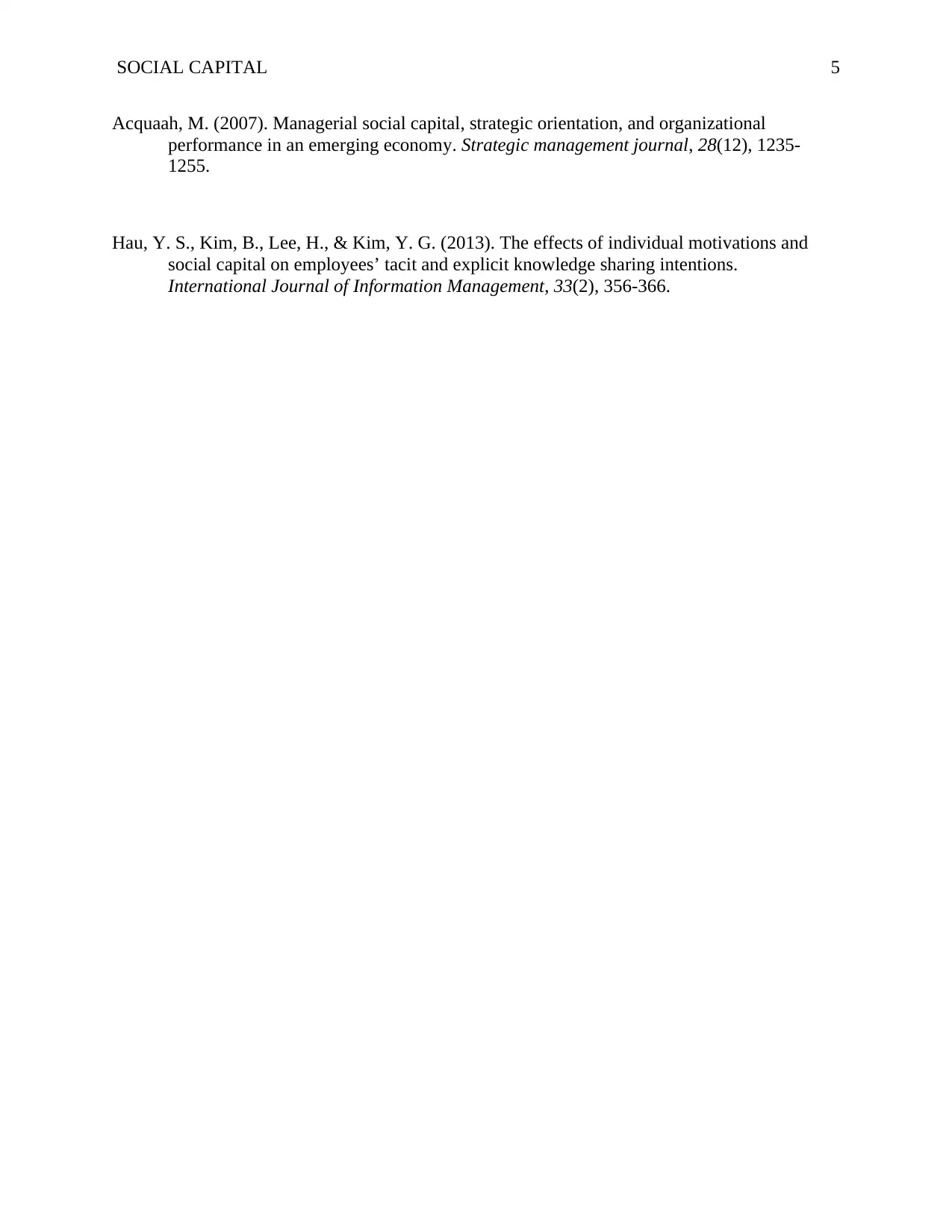
Acquaah, M. (2007). Managerial social capital, strategic orientation, and organizational
performance in an emerging economy. Strategic management journal, 28(12), 1235-
1255.
Hau, Y. S., Kim, B., Lee, H., & Kim, Y. G. (2013). The effects of individual motivations and
social capital on employees’ tacit and explicit knowledge sharing intentions.
International Journal of Information Management, 33(2), 356-366.
chevron_up_icon
1 out of 5
circle_padding
hide_on_mobile
zoom_out_icon
[object Object]