Comprehensive Analysis of Social Protection in Reformlandia: A Report
VerifiedAdded on 2020/07/23
|8
|2319
|43
Report
AI Summary
This report provides a comprehensive analysis of the social security landscape in Reformlandia, a middle-income country grappling with poverty and social protection challenges. The analysis begins with a need and risk assessment, exploring measures to limit population growth, the role of development indices, and the changing old-age dependency ratio. It identifies groups facing higher risks of absolute poverty, particularly women and specific age cohorts, and examines the political economy of social security, including the implications of universal versus means-tested pension schemes. The report highlights crucial policy linkages between different social programs, addresses potential challenges in service integration, and assesses capacity needs, including workforce structuring and the role of NGOs in policy implementation. The findings suggest targeted interventions for vulnerable groups, improved policy coordination, and capacity building to enhance the effectiveness of social protection measures.
Social Protection/Security
Table of Contents
Table of Contents

Paraphrase This Document
Need a fresh take? Get an instant paraphrase of this document with our AI Paraphraser
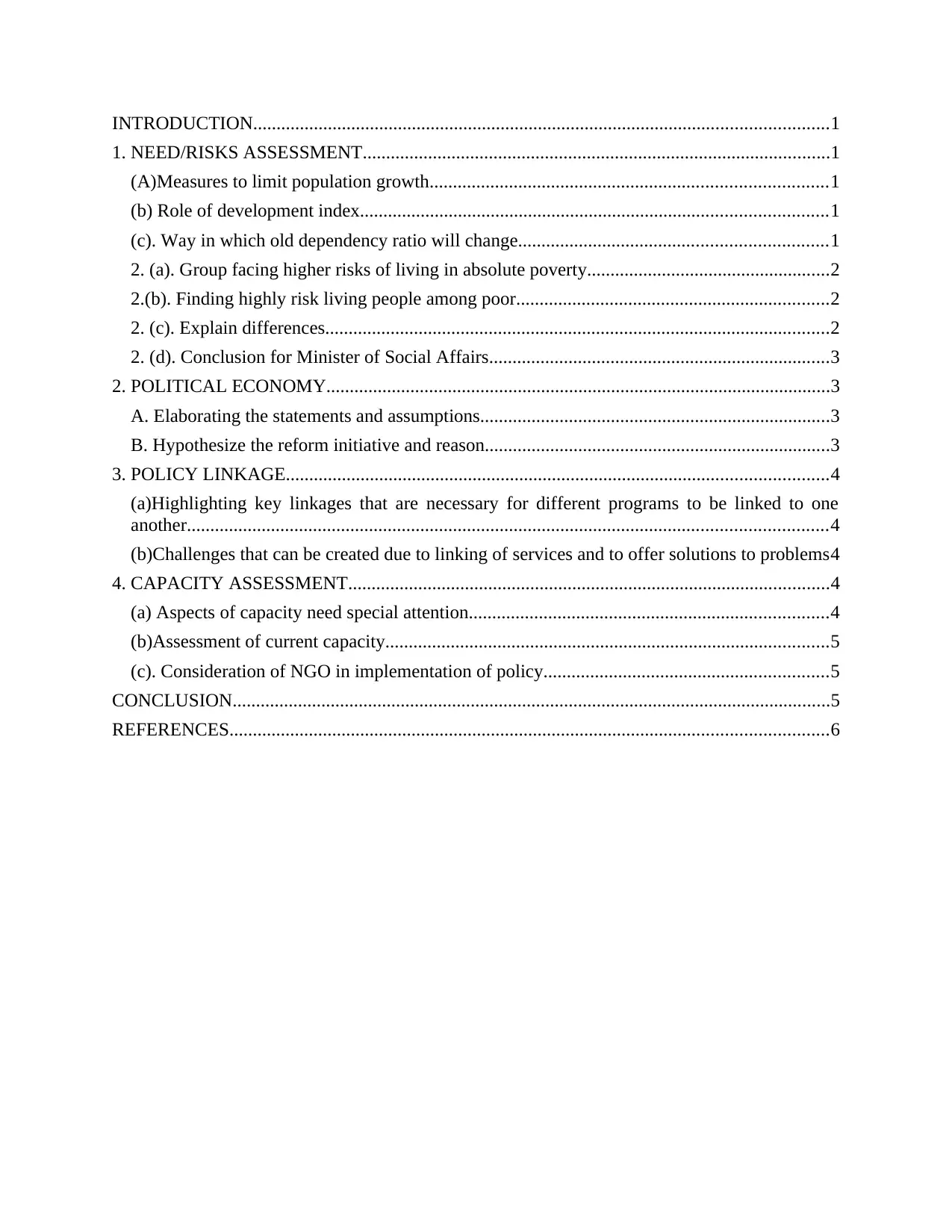
INTRODUCTION...........................................................................................................................1
1. NEED/RISKS ASSESSMENT....................................................................................................1
(A)Measures to limit population growth.....................................................................................1
(b) Role of development index....................................................................................................1
(c). Way in which old dependency ratio will change..................................................................1
2. (a). Group facing higher risks of living in absolute poverty....................................................2
2.(b). Finding highly risk living people among poor...................................................................2
2. (c). Explain differences............................................................................................................2
2. (d). Conclusion for Minister of Social Affairs.........................................................................3
2. POLITICAL ECONOMY............................................................................................................3
A. Elaborating the statements and assumptions...........................................................................3
B. Hypothesize the reform initiative and reason..........................................................................3
3. POLICY LINKAGE....................................................................................................................4
(a)Highlighting key linkages that are necessary for different programs to be linked to one
another.........................................................................................................................................4
(b)Challenges that can be created due to linking of services and to offer solutions to problems4
4. CAPACITY ASSESSMENT.......................................................................................................4
(a) Aspects of capacity need special attention.............................................................................4
(b)Assessment of current capacity...............................................................................................5
(c). Consideration of NGO in implementation of policy.............................................................5
CONCLUSION................................................................................................................................5
REFERENCES................................................................................................................................6
1. NEED/RISKS ASSESSMENT....................................................................................................1
(A)Measures to limit population growth.....................................................................................1
(b) Role of development index....................................................................................................1
(c). Way in which old dependency ratio will change..................................................................1
2. (a). Group facing higher risks of living in absolute poverty....................................................2
2.(b). Finding highly risk living people among poor...................................................................2
2. (c). Explain differences............................................................................................................2
2. (d). Conclusion for Minister of Social Affairs.........................................................................3
2. POLITICAL ECONOMY............................................................................................................3
A. Elaborating the statements and assumptions...........................................................................3
B. Hypothesize the reform initiative and reason..........................................................................3
3. POLICY LINKAGE....................................................................................................................4
(a)Highlighting key linkages that are necessary for different programs to be linked to one
another.........................................................................................................................................4
(b)Challenges that can be created due to linking of services and to offer solutions to problems4
4. CAPACITY ASSESSMENT.......................................................................................................4
(a) Aspects of capacity need special attention.............................................................................4
(b)Assessment of current capacity...............................................................................................5
(c). Consideration of NGO in implementation of policy.............................................................5
CONCLUSION................................................................................................................................5
REFERENCES................................................................................................................................6
INTRODUCTION
Reformlandia is a middle income generating country with per capital GDP of USD 1,700.
The government and policymakers are striving for establishing social security and as a beginning
step, Ministry of Social Affairs (MSA) is giving small old age grant to elderly people and 60%
elderly population are receiving additional pension that is managed by Ministry of Labor and
Pension. MSA is the key authority who is responsible for managing and coordinating social
protection issues for the community. Here, the paper will investigate current prevailing social
security threats faced by the people and based on it, necessary suggestions will be given to better
protect people.
1. NEED/RISKS ASSESSMENT
(A)Measures to limit population growth Education: Education is one of the important measures to limit population growth as
under this approach if people will be educated about negative consequences of population
growth on their family population can be controlled. Development: Country development growth rate accelerated then in that case people
think more economically and prefer to keep small size of family. Hence, it is another
measure that can be adopt for population growth (Brown and Vaughn, 2011). Women empowerment: Women prefer to keep small family size as it is difficult task to
nurture all children in proper manner. Thus, women empowerment is also solution to the
problem.
(b) Role of development index
Development index refers to the state of the nation in respect to life expectancy,
education and per capita income. If development index value is very less value then in that case
it can be assumed that people will understand that increase in population is not in their interest
and hence, they can avoid increase family size
(c). Way in which old dependency ratio will change
Old age dependency ratio will increased in 50 years because birth control related
programs would lead to reduction in number of childs. Hence, number of people employed will
reduce after some years in next 50 years. There may be best possible implications of scoial
1
Reformlandia is a middle income generating country with per capital GDP of USD 1,700.
The government and policymakers are striving for establishing social security and as a beginning
step, Ministry of Social Affairs (MSA) is giving small old age grant to elderly people and 60%
elderly population are receiving additional pension that is managed by Ministry of Labor and
Pension. MSA is the key authority who is responsible for managing and coordinating social
protection issues for the community. Here, the paper will investigate current prevailing social
security threats faced by the people and based on it, necessary suggestions will be given to better
protect people.
1. NEED/RISKS ASSESSMENT
(A)Measures to limit population growth Education: Education is one of the important measures to limit population growth as
under this approach if people will be educated about negative consequences of population
growth on their family population can be controlled. Development: Country development growth rate accelerated then in that case people
think more economically and prefer to keep small size of family. Hence, it is another
measure that can be adopt for population growth (Brown and Vaughn, 2011). Women empowerment: Women prefer to keep small family size as it is difficult task to
nurture all children in proper manner. Thus, women empowerment is also solution to the
problem.
(b) Role of development index
Development index refers to the state of the nation in respect to life expectancy,
education and per capita income. If development index value is very less value then in that case
it can be assumed that people will understand that increase in population is not in their interest
and hence, they can avoid increase family size
(c). Way in which old dependency ratio will change
Old age dependency ratio will increased in 50 years because birth control related
programs would lead to reduction in number of childs. Hence, number of people employed will
reduce after some years in next 50 years. There may be best possible implications of scoial
1
⊘ This is a preview!⊘
Do you want full access?
Subscribe today to unlock all pages.

Trusted by 1+ million students worldwide
policy for elders because government is planning to prepare and implement policy in proper
manner.
2. (a). Group facing higher risks of living in absolute poverty
Absolute poverty is a condition that represents severe deprivation of basic requirements
of people such as safe drinking water, food, better sanitation, healthcare facilities, education,
shelter and others. It not only depends on the level of income but also depends on their capability
to access necessary requirements (Loayza and Rigolini, 2016). Extreme poverty headcount ratio
is a straightforward measure of percentage of population living below the minimum set level. An
absolute ratio or measure is use to determine the percentage of people living below the threshold.
It is necessary for the regulators to focus on extreme poverty in the country to determine people
who require more social security and protection (Kang and et.al., 2016). In context to
Reformlandia, poverty indicator table demonstrates higher headcounts of 11.4% for female
group shows that they are more struggling with the risk of poverty.
The main problem with the headcount ratio is that it does not examine poverty depth,
which determined by poverty gap. Looking to the results, extreme poverty gap % is
comparatively higher for male to 1.6% shows more severe impact of poverty on these group.
However, poverty severity depicts sensitivity of poverty in relation to distribution of income
expenditures and in Reformlandia, it shows equal results to 0.3 for both the masculine and
feminine, exhibit that the difference is not significant at 10% level.
2.(b). Finding highly risk living people among poor
Yes, female group constitutes a higher percentage or share in the extremely poor
population as it is 52.5%, which is just 47.5% in male. Similarly, relative poverty measure shows
higher poverty among female with 51.8% share in total population while male share is only
48.2%.
2. (c). Explain differences
Lack of basic facilities i.e. food, shelter, sanitation and inability to access better quality
healthcare are the reasons behind higher absolute poverty faced by women. Gender
discrimination in social practice also may be a reason, due to which, girls and women are facing
extreme poverty problems that had severe impact on their living standard (Tirado, 2017).
Considering the age factor, people under 6-15 years and 21-40 years found highly risky because
2
manner.
2. (a). Group facing higher risks of living in absolute poverty
Absolute poverty is a condition that represents severe deprivation of basic requirements
of people such as safe drinking water, food, better sanitation, healthcare facilities, education,
shelter and others. It not only depends on the level of income but also depends on their capability
to access necessary requirements (Loayza and Rigolini, 2016). Extreme poverty headcount ratio
is a straightforward measure of percentage of population living below the minimum set level. An
absolute ratio or measure is use to determine the percentage of people living below the threshold.
It is necessary for the regulators to focus on extreme poverty in the country to determine people
who require more social security and protection (Kang and et.al., 2016). In context to
Reformlandia, poverty indicator table demonstrates higher headcounts of 11.4% for female
group shows that they are more struggling with the risk of poverty.
The main problem with the headcount ratio is that it does not examine poverty depth,
which determined by poverty gap. Looking to the results, extreme poverty gap % is
comparatively higher for male to 1.6% shows more severe impact of poverty on these group.
However, poverty severity depicts sensitivity of poverty in relation to distribution of income
expenditures and in Reformlandia, it shows equal results to 0.3 for both the masculine and
feminine, exhibit that the difference is not significant at 10% level.
2.(b). Finding highly risk living people among poor
Yes, female group constitutes a higher percentage or share in the extremely poor
population as it is 52.5%, which is just 47.5% in male. Similarly, relative poverty measure shows
higher poverty among female with 51.8% share in total population while male share is only
48.2%.
2. (c). Explain differences
Lack of basic facilities i.e. food, shelter, sanitation and inability to access better quality
healthcare are the reasons behind higher absolute poverty faced by women. Gender
discrimination in social practice also may be a reason, due to which, girls and women are facing
extreme poverty problems that had severe impact on their living standard (Tirado, 2017).
Considering the age factor, people under 6-15 years and 21-40 years found highly risky because
2
Paraphrase This Document
Need a fresh take? Get an instant paraphrase of this document with our AI Paraphraser
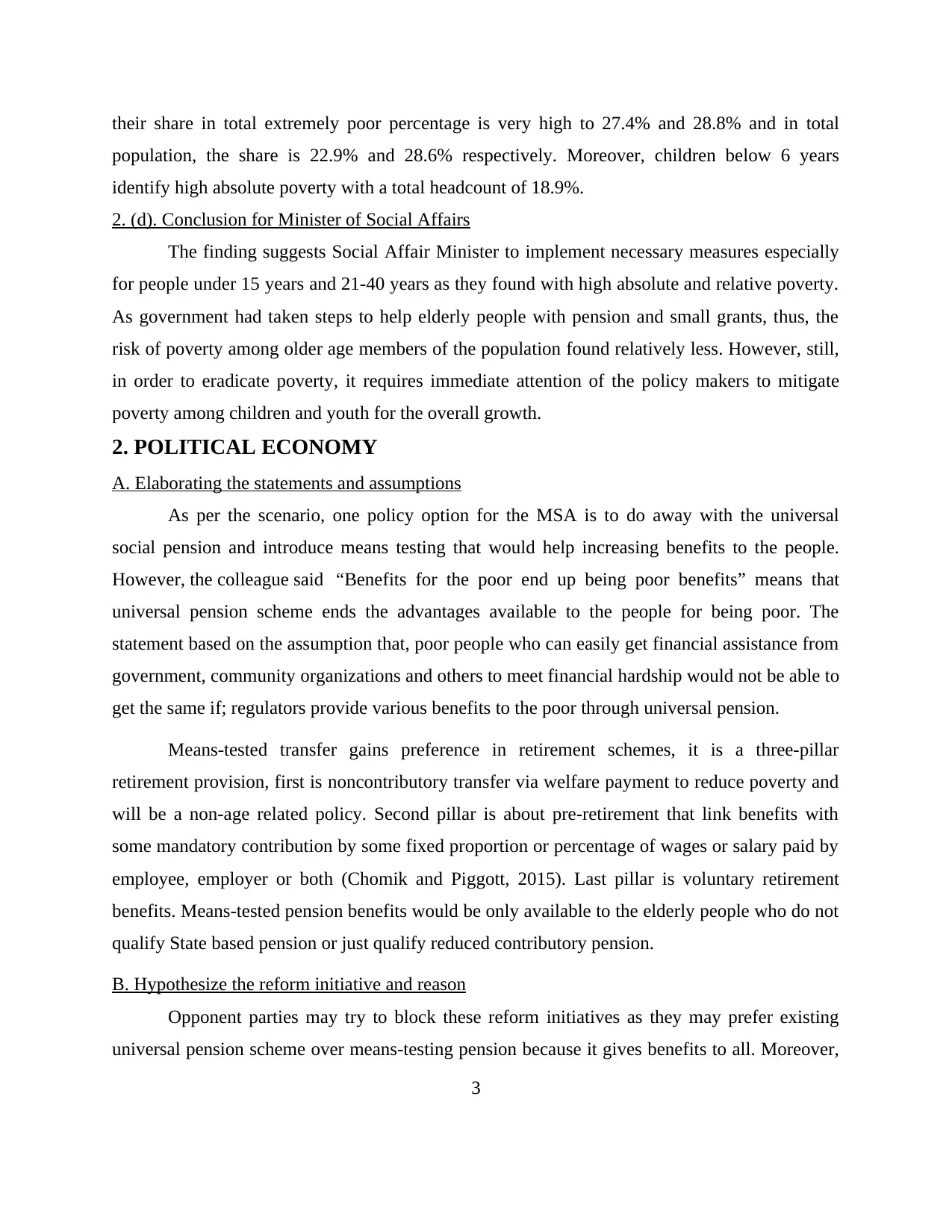
their share in total extremely poor percentage is very high to 27.4% and 28.8% and in total
population, the share is 22.9% and 28.6% respectively. Moreover, children below 6 years
identify high absolute poverty with a total headcount of 18.9%.
2. (d). Conclusion for Minister of Social Affairs
The finding suggests Social Affair Minister to implement necessary measures especially
for people under 15 years and 21-40 years as they found with high absolute and relative poverty.
As government had taken steps to help elderly people with pension and small grants, thus, the
risk of poverty among older age members of the population found relatively less. However, still,
in order to eradicate poverty, it requires immediate attention of the policy makers to mitigate
poverty among children and youth for the overall growth.
2. POLITICAL ECONOMY
A. Elaborating the statements and assumptions
As per the scenario, one policy option for the MSA is to do away with the universal
social pension and introduce means testing that would help increasing benefits to the people.
However, the colleague said “Benefits for the poor end up being poor benefits” means that
universal pension scheme ends the advantages available to the people for being poor. The
statement based on the assumption that, poor people who can easily get financial assistance from
government, community organizations and others to meet financial hardship would not be able to
get the same if; regulators provide various benefits to the poor through universal pension.
Means-tested transfer gains preference in retirement schemes, it is a three-pillar
retirement provision, first is noncontributory transfer via welfare payment to reduce poverty and
will be a non-age related policy. Second pillar is about pre-retirement that link benefits with
some mandatory contribution by some fixed proportion or percentage of wages or salary paid by
employee, employer or both (Chomik and Piggott, 2015). Last pillar is voluntary retirement
benefits. Means-tested pension benefits would be only available to the elderly people who do not
qualify State based pension or just qualify reduced contributory pension.
B. Hypothesize the reform initiative and reason
Opponent parties may try to block these reform initiatives as they may prefer existing
universal pension scheme over means-testing pension because it gives benefits to all. Moreover,
3
population, the share is 22.9% and 28.6% respectively. Moreover, children below 6 years
identify high absolute poverty with a total headcount of 18.9%.
2. (d). Conclusion for Minister of Social Affairs
The finding suggests Social Affair Minister to implement necessary measures especially
for people under 15 years and 21-40 years as they found with high absolute and relative poverty.
As government had taken steps to help elderly people with pension and small grants, thus, the
risk of poverty among older age members of the population found relatively less. However, still,
in order to eradicate poverty, it requires immediate attention of the policy makers to mitigate
poverty among children and youth for the overall growth.
2. POLITICAL ECONOMY
A. Elaborating the statements and assumptions
As per the scenario, one policy option for the MSA is to do away with the universal
social pension and introduce means testing that would help increasing benefits to the people.
However, the colleague said “Benefits for the poor end up being poor benefits” means that
universal pension scheme ends the advantages available to the people for being poor. The
statement based on the assumption that, poor people who can easily get financial assistance from
government, community organizations and others to meet financial hardship would not be able to
get the same if; regulators provide various benefits to the poor through universal pension.
Means-tested transfer gains preference in retirement schemes, it is a three-pillar
retirement provision, first is noncontributory transfer via welfare payment to reduce poverty and
will be a non-age related policy. Second pillar is about pre-retirement that link benefits with
some mandatory contribution by some fixed proportion or percentage of wages or salary paid by
employee, employer or both (Chomik and Piggott, 2015). Last pillar is voluntary retirement
benefits. Means-tested pension benefits would be only available to the elderly people who do not
qualify State based pension or just qualify reduced contributory pension.
B. Hypothesize the reform initiative and reason
Opponent parties may try to block these reform initiatives as they may prefer existing
universal pension scheme over means-testing pension because it gives benefits to all. Moreover,
3
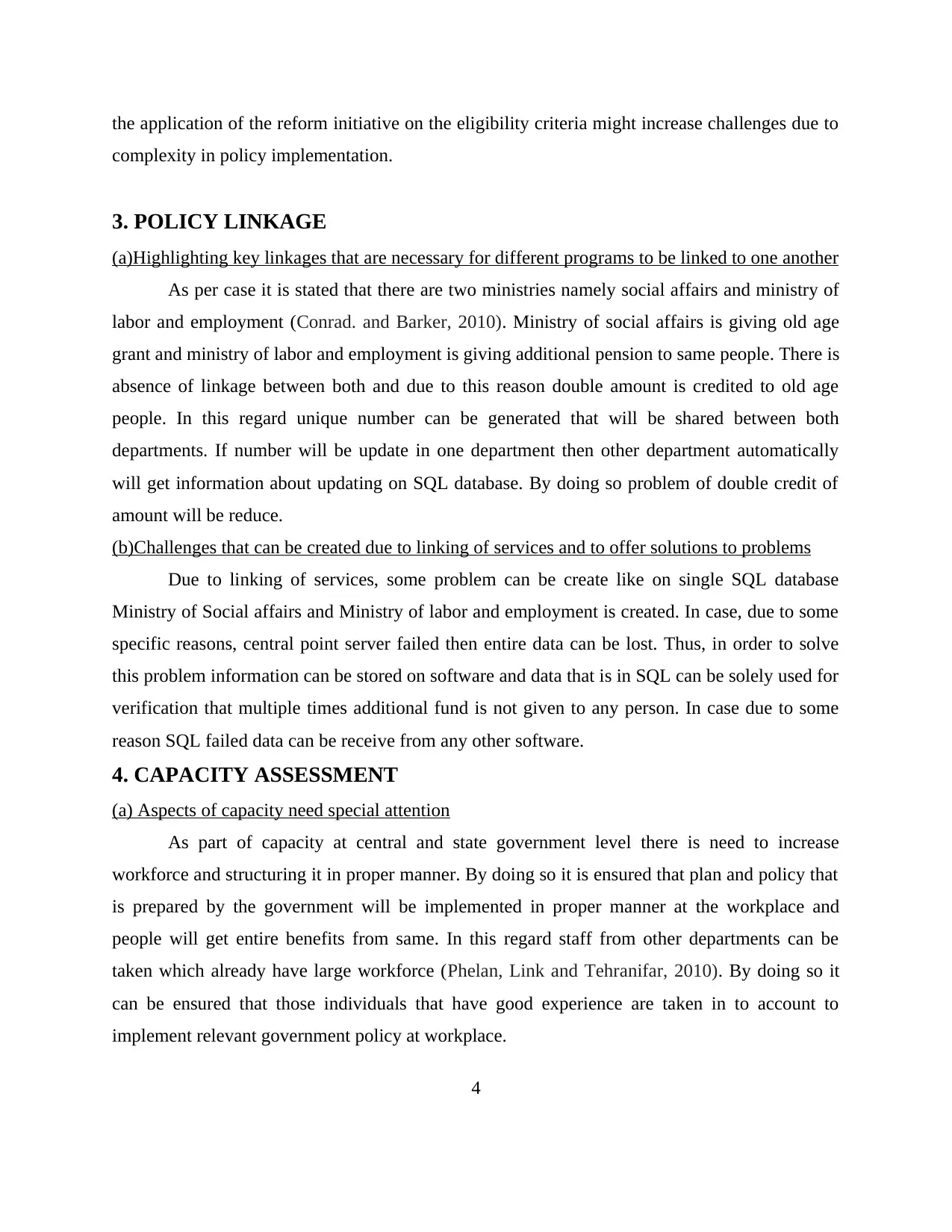
the application of the reform initiative on the eligibility criteria might increase challenges due to
complexity in policy implementation.
3. POLICY LINKAGE
(a)Highlighting key linkages that are necessary for different programs to be linked to one another
As per case it is stated that there are two ministries namely social affairs and ministry of
labor and employment (Conrad. and Barker, 2010). Ministry of social affairs is giving old age
grant and ministry of labor and employment is giving additional pension to same people. There is
absence of linkage between both and due to this reason double amount is credited to old age
people. In this regard unique number can be generated that will be shared between both
departments. If number will be update in one department then other department automatically
will get information about updating on SQL database. By doing so problem of double credit of
amount will be reduce.
(b)Challenges that can be created due to linking of services and to offer solutions to problems
Due to linking of services, some problem can be create like on single SQL database
Ministry of Social affairs and Ministry of labor and employment is created. In case, due to some
specific reasons, central point server failed then entire data can be lost. Thus, in order to solve
this problem information can be stored on software and data that is in SQL can be solely used for
verification that multiple times additional fund is not given to any person. In case due to some
reason SQL failed data can be receive from any other software.
4. CAPACITY ASSESSMENT
(a) Aspects of capacity need special attention
As part of capacity at central and state government level there is need to increase
workforce and structuring it in proper manner. By doing so it is ensured that plan and policy that
is prepared by the government will be implemented in proper manner at the workplace and
people will get entire benefits from same. In this regard staff from other departments can be
taken which already have large workforce (Phelan, Link and Tehranifar, 2010). By doing so it
can be ensured that those individuals that have good experience are taken in to account to
implement relevant government policy at workplace.
4
complexity in policy implementation.
3. POLICY LINKAGE
(a)Highlighting key linkages that are necessary for different programs to be linked to one another
As per case it is stated that there are two ministries namely social affairs and ministry of
labor and employment (Conrad. and Barker, 2010). Ministry of social affairs is giving old age
grant and ministry of labor and employment is giving additional pension to same people. There is
absence of linkage between both and due to this reason double amount is credited to old age
people. In this regard unique number can be generated that will be shared between both
departments. If number will be update in one department then other department automatically
will get information about updating on SQL database. By doing so problem of double credit of
amount will be reduce.
(b)Challenges that can be created due to linking of services and to offer solutions to problems
Due to linking of services, some problem can be create like on single SQL database
Ministry of Social affairs and Ministry of labor and employment is created. In case, due to some
specific reasons, central point server failed then entire data can be lost. Thus, in order to solve
this problem information can be stored on software and data that is in SQL can be solely used for
verification that multiple times additional fund is not given to any person. In case due to some
reason SQL failed data can be receive from any other software.
4. CAPACITY ASSESSMENT
(a) Aspects of capacity need special attention
As part of capacity at central and state government level there is need to increase
workforce and structuring it in proper manner. By doing so it is ensured that plan and policy that
is prepared by the government will be implemented in proper manner at the workplace and
people will get entire benefits from same. In this regard staff from other departments can be
taken which already have large workforce (Phelan, Link and Tehranifar, 2010). By doing so it
can be ensured that those individuals that have good experience are taken in to account to
implement relevant government policy at workplace.
4
⊘ This is a preview!⊘
Do you want full access?
Subscribe today to unlock all pages.
Trusted by 1+ million students worldwide
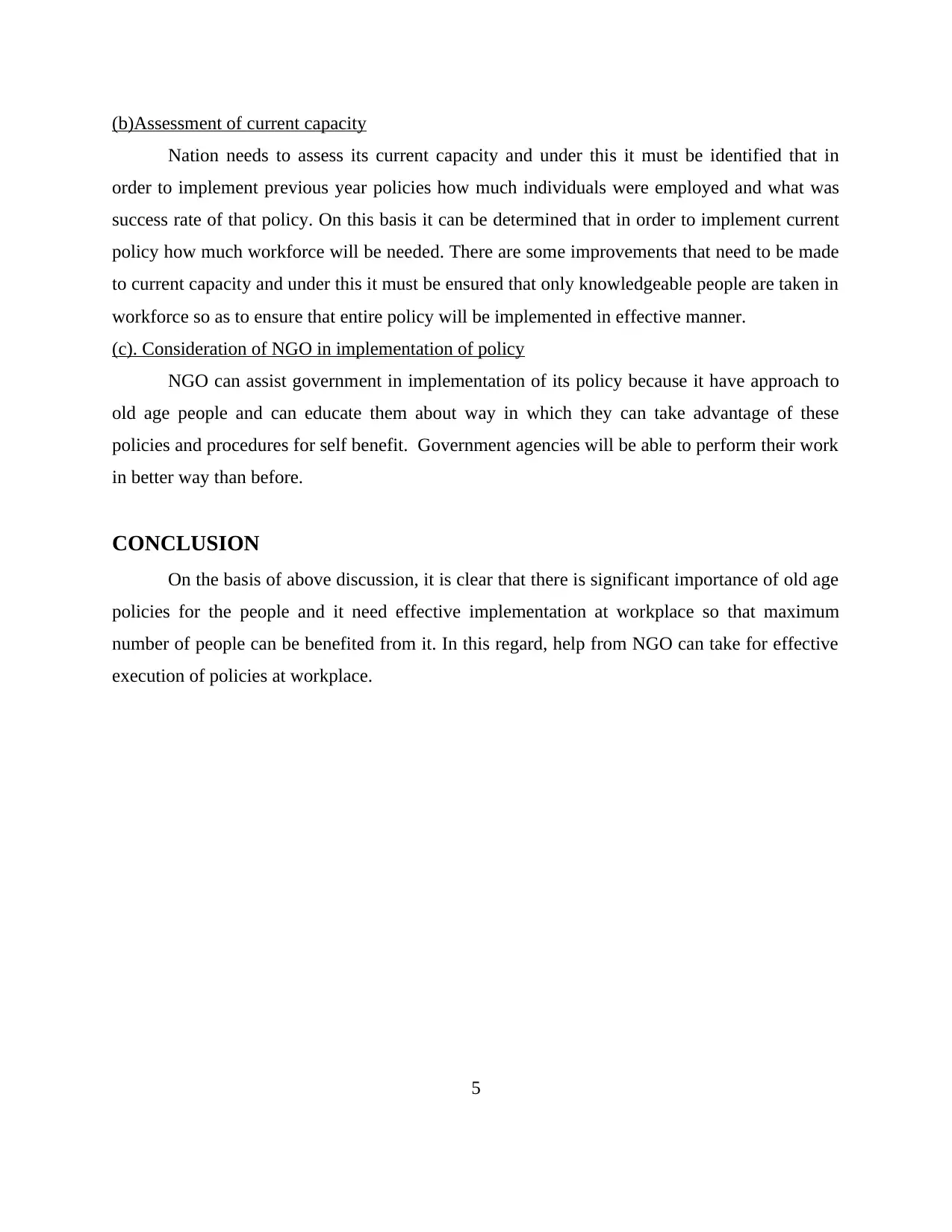
(b)Assessment of current capacity
Nation needs to assess its current capacity and under this it must be identified that in
order to implement previous year policies how much individuals were employed and what was
success rate of that policy. On this basis it can be determined that in order to implement current
policy how much workforce will be needed. There are some improvements that need to be made
to current capacity and under this it must be ensured that only knowledgeable people are taken in
workforce so as to ensure that entire policy will be implemented in effective manner.
(c). Consideration of NGO in implementation of policy
NGO can assist government in implementation of its policy because it have approach to
old age people and can educate them about way in which they can take advantage of these
policies and procedures for self benefit. Government agencies will be able to perform their work
in better way than before.
CONCLUSION
On the basis of above discussion, it is clear that there is significant importance of old age
policies for the people and it need effective implementation at workplace so that maximum
number of people can be benefited from it. In this regard, help from NGO can take for effective
execution of policies at workplace.
5
Nation needs to assess its current capacity and under this it must be identified that in
order to implement previous year policies how much individuals were employed and what was
success rate of that policy. On this basis it can be determined that in order to implement current
policy how much workforce will be needed. There are some improvements that need to be made
to current capacity and under this it must be ensured that only knowledgeable people are taken in
workforce so as to ensure that entire policy will be implemented in effective manner.
(c). Consideration of NGO in implementation of policy
NGO can assist government in implementation of its policy because it have approach to
old age people and can educate them about way in which they can take advantage of these
policies and procedures for self benefit. Government agencies will be able to perform their work
in better way than before.
CONCLUSION
On the basis of above discussion, it is clear that there is significant importance of old age
policies for the people and it need effective implementation at workplace so that maximum
number of people can be benefited from it. In this regard, help from NGO can take for effective
execution of policies at workplace.
5
Paraphrase This Document
Need a fresh take? Get an instant paraphrase of this document with our AI Paraphraser
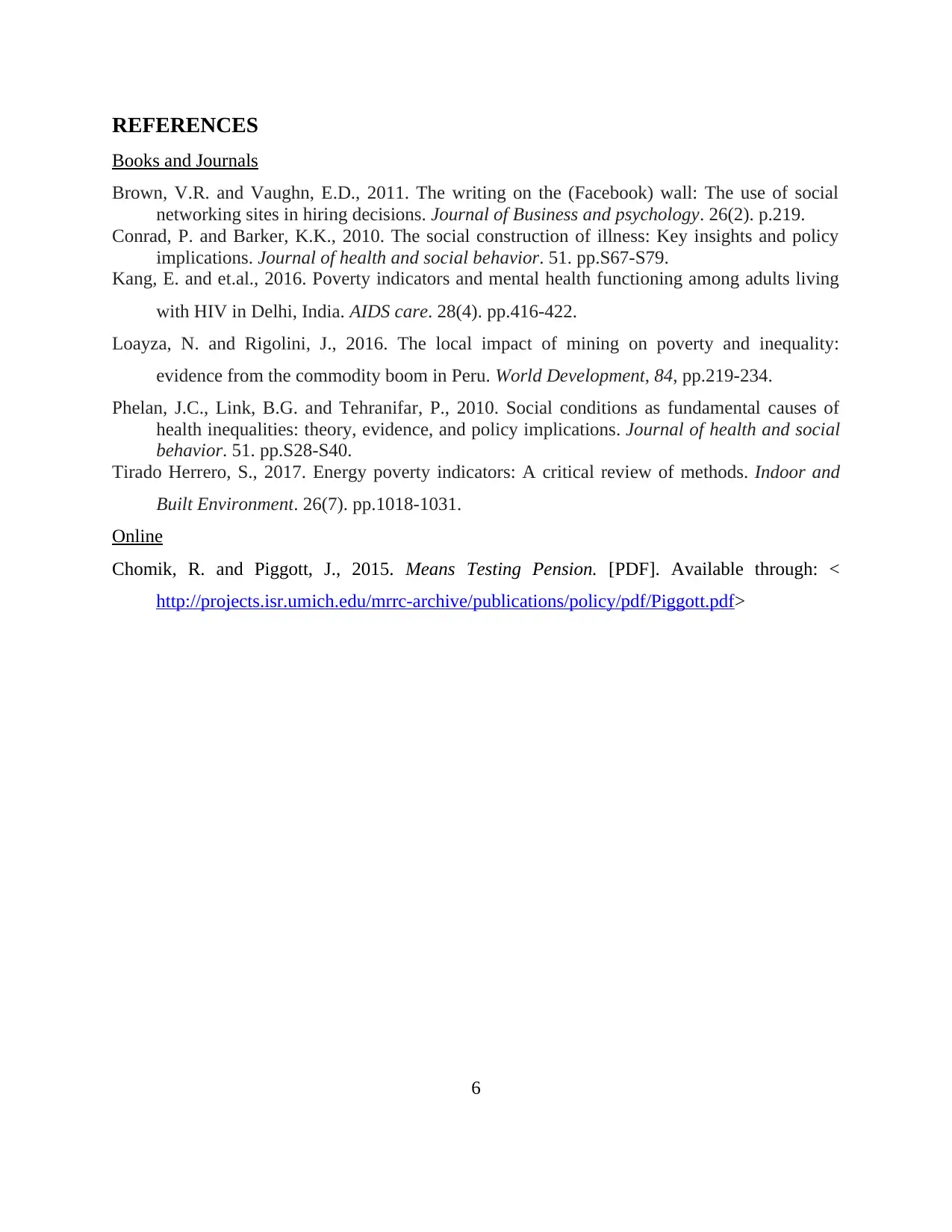
REFERENCES
Books and Journals
Brown, V.R. and Vaughn, E.D., 2011. The writing on the (Facebook) wall: The use of social
networking sites in hiring decisions. Journal of Business and psychology. 26(2). p.219.
Conrad, P. and Barker, K.K., 2010. The social construction of illness: Key insights and policy
implications. Journal of health and social behavior. 51. pp.S67-S79.
Kang, E. and et.al., 2016. Poverty indicators and mental health functioning among adults living
with HIV in Delhi, India. AIDS care. 28(4). pp.416-422.
Loayza, N. and Rigolini, J., 2016. The local impact of mining on poverty and inequality:
evidence from the commodity boom in Peru. World Development, 84, pp.219-234.
Phelan, J.C., Link, B.G. and Tehranifar, P., 2010. Social conditions as fundamental causes of
health inequalities: theory, evidence, and policy implications. Journal of health and social
behavior. 51. pp.S28-S40.
Tirado Herrero, S., 2017. Energy poverty indicators: A critical review of methods. Indoor and
Built Environment. 26(7). pp.1018-1031.
Online
Chomik, R. and Piggott, J., 2015. Means Testing Pension. [PDF]. Available through: <
http://projects.isr.umich.edu/mrrc-archive/publications/policy/pdf/Piggott.pdf>
6
Books and Journals
Brown, V.R. and Vaughn, E.D., 2011. The writing on the (Facebook) wall: The use of social
networking sites in hiring decisions. Journal of Business and psychology. 26(2). p.219.
Conrad, P. and Barker, K.K., 2010. The social construction of illness: Key insights and policy
implications. Journal of health and social behavior. 51. pp.S67-S79.
Kang, E. and et.al., 2016. Poverty indicators and mental health functioning among adults living
with HIV in Delhi, India. AIDS care. 28(4). pp.416-422.
Loayza, N. and Rigolini, J., 2016. The local impact of mining on poverty and inequality:
evidence from the commodity boom in Peru. World Development, 84, pp.219-234.
Phelan, J.C., Link, B.G. and Tehranifar, P., 2010. Social conditions as fundamental causes of
health inequalities: theory, evidence, and policy implications. Journal of health and social
behavior. 51. pp.S28-S40.
Tirado Herrero, S., 2017. Energy poverty indicators: A critical review of methods. Indoor and
Built Environment. 26(7). pp.1018-1031.
Online
Chomik, R. and Piggott, J., 2015. Means Testing Pension. [PDF]. Available through: <
http://projects.isr.umich.edu/mrrc-archive/publications/policy/pdf/Piggott.pdf>
6

1 out of 8


Your All-in-One AI-Powered Toolkit for Academic Success.
+13062052269
info@desklib.com
Available 24*7 on WhatsApp / Email
![[object Object]](/_next/static/media/star-bottom.7253800d.svg)
Unlock your academic potential
Copyright © 2020–2026 A2Z Services. All Rights Reserved. Developed and managed by ZUCOL.