Social Responsibility, HR Management, and Diversity in Organizations
VerifiedAdded on 2023/05/28
|9
|2520
|359
Report
AI Summary
This report provides a comprehensive analysis of social responsibility and human resource management (HRM). It begins by introducing the core concepts and then delves into the challenges organizations face in managing diversity, including demographic shifts and legal compliance. The report highlights the differences between managing diversity and ensuring legal compliance, emphasizing the importance of internal and voluntary initiatives. It examines generational differences in the workplace, addressing potential conflicts and the evolving views on sexual orientation and individuals with disabilities. Furthermore, the report explores the strategic management of diversity, emphasizing the need to align diversity objectives with organizational goals and understand the ethical behavior expected of employees. The conclusion stresses the importance of adapting HRM practices to incorporate changes in workforce demographics and the significance of ethical policies, accountability, and social responsibility for organizational success. References are provided at the end.
Running head: SOCIAL RESPONSIBILITY AND HUMAN RESOURCE MANAGEMENT
SOCIAL RESPONSIBILITY AND HUMAN RESOURCE
MANAGEMENT
Name of the Student
Name of the University
Author Note
SOCIAL RESPONSIBILITY AND HUMAN RESOURCE
MANAGEMENT
Name of the Student
Name of the University
Author Note

Paraphrase This Document
Need a fresh take? Get an instant paraphrase of this document with our AI Paraphraser
1SOCIAL RESPONSIBILITY AND HUMAN RESOURCE MANAGEMENT
Introduction
The aim of this report is to analyse the social responsibilities and human resource
managements. The report will also review the contents of the book. The main objective is to
understand the challenges faced by organization in managing the diversity. The need of
human resources are also going to be discussed. Apart from this it is important to have
awareness about the ethics, compliance and the role of critical contributors in making the
human resources better (Lynch, 2017). It is also important to have a movement awareness that
will help in contributing towards the human resources. The report will describe the need of
developing a female leaders, the need for strategic management of diversity and the ethical
behaviour.
Social responsibilities and human resource management
The book contains a perspective on human resource management. This is important to
understand the human resource management in details so that the organization can manage
the working and take care of the employees. The second chapter discusses about the social
responsibility and human resource management (Garavan & McGuire, 2010). This report will
discuss about the responsibility of human being socially and human resource management.
The later chapter discusses about the strategic management necessary for every organization
(Martins, 2015). It is also equally important to discuss about the strategic role of human
resources management. The book has implemented the need of strategic workforce plan and
the design and redesign of work system. The employment law has included the need of
employment law in each organization (Jensen ET AL., 2016). This is important to have a
proper development and training in the organization. Apart from all this it is important to
have a global human resource management that will help in strategizing the employees within
Introduction
The aim of this report is to analyse the social responsibilities and human resource
managements. The report will also review the contents of the book. The main objective is to
understand the challenges faced by organization in managing the diversity. The need of
human resources are also going to be discussed. Apart from this it is important to have
awareness about the ethics, compliance and the role of critical contributors in making the
human resources better (Lynch, 2017). It is also important to have a movement awareness that
will help in contributing towards the human resources. The report will describe the need of
developing a female leaders, the need for strategic management of diversity and the ethical
behaviour.
Social responsibilities and human resource management
The book contains a perspective on human resource management. This is important to
understand the human resource management in details so that the organization can manage
the working and take care of the employees. The second chapter discusses about the social
responsibility and human resource management (Garavan & McGuire, 2010). This report will
discuss about the responsibility of human being socially and human resource management.
The later chapter discusses about the strategic management necessary for every organization
(Martins, 2015). It is also equally important to discuss about the strategic role of human
resources management. The book has implemented the need of strategic workforce plan and
the design and redesign of work system. The employment law has included the need of
employment law in each organization (Jensen ET AL., 2016). This is important to have a
proper development and training in the organization. Apart from all this it is important to
have a global human resource management that will help in strategizing the employees within
2SOCIAL RESPONSIBILITY AND HUMAN RESOURCE MANAGEMENT
the organization. It becomes important to understand the challenges faced by an organization
and manage their diversity.
Need for change in workforce demographic and diversity change
With the need of demographic changes and composition workforce a number of
challenges are faced by the management of HR. the diversity factor has become one of the
major factor for both private and public organizations. For every organization it becomes
important to recognize and promote the diversity. The reason varies from diversity and
ensures compliance with state, federal and local employment laws (Ekstrom & Smith, 2017).
Several laws were passed by congress in order to avoid discrimination in both public sector
organization and private sector organization.
Major differences between managing diversity and legal compliance
The compliance mainly focuses on productivity and compliance. The elements of this
is limited to race, ethnicity and gender. The impetus are forced, external and mandatory.
Apart from this it is the responsibility of company to fit with the existing employee’s culture
and focuses on the outcome that includes preferences and quotas. The time frame set for legal
compliance is short term or one shot (McDonald & Kuhn, 2016). The scope of managing the
legal compliance includes providing independency towards the activities performed by the
HR and the strategy implemented by the company.
In case of managing diversity the main focus turns to understanding the diversity well
so that it can be beneficial for the organization. The impetus includes internal and voluntary.
Each and every element of diversity is essential and helps in creating a culture that is adaptive
in nature (Mello, 2011). The process managing diversity goes on with the working of
organization. Managing the diversity is a part of managing HR activities and also integrated
with the strategies implemented by company (Ravazzani, 2016). The main challenges faced by
the organization. It becomes important to understand the challenges faced by an organization
and manage their diversity.
Need for change in workforce demographic and diversity change
With the need of demographic changes and composition workforce a number of
challenges are faced by the management of HR. the diversity factor has become one of the
major factor for both private and public organizations. For every organization it becomes
important to recognize and promote the diversity. The reason varies from diversity and
ensures compliance with state, federal and local employment laws (Ekstrom & Smith, 2017).
Several laws were passed by congress in order to avoid discrimination in both public sector
organization and private sector organization.
Major differences between managing diversity and legal compliance
The compliance mainly focuses on productivity and compliance. The elements of this
is limited to race, ethnicity and gender. The impetus are forced, external and mandatory.
Apart from this it is the responsibility of company to fit with the existing employee’s culture
and focuses on the outcome that includes preferences and quotas. The time frame set for legal
compliance is short term or one shot (McDonald & Kuhn, 2016). The scope of managing the
legal compliance includes providing independency towards the activities performed by the
HR and the strategy implemented by the company.
In case of managing diversity the main focus turns to understanding the diversity well
so that it can be beneficial for the organization. The impetus includes internal and voluntary.
Each and every element of diversity is essential and helps in creating a culture that is adaptive
in nature (Mello, 2011). The process managing diversity goes on with the working of
organization. Managing the diversity is a part of managing HR activities and also integrated
with the strategies implemented by company (Ravazzani, 2016). The main challenges faced by
⊘ This is a preview!⊘
Do you want full access?
Subscribe today to unlock all pages.

Trusted by 1+ million students worldwide
3SOCIAL RESPONSIBILITY AND HUMAN RESOURCE MANAGEMENT
an organization while managing the diversity includes overcoming the stereotypes followed
by employees of the organization.
Generations within an organization
There are several generations seen over years and each generation contributes a lot
towards the society. The generation includes traditionalists with a workforce around 8% and
their contribution includes diligent, loyal, focused, emotionally mature and stable. The
leadership followed by this generation includes consistent, respectful, fair and direct. Baby
boomers are the next generation with a workforce of 44% with a leadership preferences
equality, personable, focused towards the mission and democratic (de Janasz & Crossman,
2018). The contribution of this generation includes team oriented, knowledgeable, loyal and
experienced. The last one that came into action is generation Y/Millennial with a workforce
around 14% and still increasing. The contribution includes multitasking, being responsive
socially, diversified and tech savvy (Ryan & Wessel, 2015). The preferences for leadership
includes positive, motivational and organized. According to recent survey conducted by
human resource management for society around 25 % organization reported that there exists
intergenerational conflicts within every workplace. The worker criticized about the poor
ethics performed by the younger employees (Shah, Ullah & Malik, 2018). On the other hand the
younger employees complained that the older employees was not ready to recognize the
efforts. This lead to disputes within the organization.
Sexual orientation
This area has been embraced by every employee of organization does not matter the
organizations length. According to the survey made, it is being analysed that nine out of 10
largest corporations in United States has prohibited discrimination based on sexual
orientation. Sexual orientation has implemented several strategies that helps in providing
coverage for transgender related medical treatment and also offers full benefits for domestic
an organization while managing the diversity includes overcoming the stereotypes followed
by employees of the organization.
Generations within an organization
There are several generations seen over years and each generation contributes a lot
towards the society. The generation includes traditionalists with a workforce around 8% and
their contribution includes diligent, loyal, focused, emotionally mature and stable. The
leadership followed by this generation includes consistent, respectful, fair and direct. Baby
boomers are the next generation with a workforce of 44% with a leadership preferences
equality, personable, focused towards the mission and democratic (de Janasz & Crossman,
2018). The contribution of this generation includes team oriented, knowledgeable, loyal and
experienced. The last one that came into action is generation Y/Millennial with a workforce
around 14% and still increasing. The contribution includes multitasking, being responsive
socially, diversified and tech savvy (Ryan & Wessel, 2015). The preferences for leadership
includes positive, motivational and organized. According to recent survey conducted by
human resource management for society around 25 % organization reported that there exists
intergenerational conflicts within every workplace. The worker criticized about the poor
ethics performed by the younger employees (Shah, Ullah & Malik, 2018). On the other hand the
younger employees complained that the older employees was not ready to recognize the
efforts. This lead to disputes within the organization.
Sexual orientation
This area has been embraced by every employee of organization does not matter the
organizations length. According to the survey made, it is being analysed that nine out of 10
largest corporations in United States has prohibited discrimination based on sexual
orientation. Sexual orientation has implemented several strategies that helps in providing
coverage for transgender related medical treatment and also offers full benefits for domestic
Paraphrase This Document
Need a fresh take? Get an instant paraphrase of this document with our AI Paraphraser
4SOCIAL RESPONSIBILITY AND HUMAN RESOURCE MANAGEMENT
partners (Stewart, 2017). However there is no federal law exist for employees that will prohibit
the perception based on sexual orientation. There are several non-discrimination laws and
ordinances passed by a municipalities and states. However apart from the laws for sexual
orientation several employees are there who still fears about disclosure on their workplace.
According to an article published around 48 percent of the LGBT (lesbian, gay, bisexual and
transgender) community accompanying with an organization does not feel easy to disclose
about their sexual orientation at work (Tran ET AL., 2018).
Individuals with disabilities
It is important to protect rights for the individuals with disabilities. Under the act of
1990 Americans with disabilities, states that the individuals with disabilities are being
protected from any kind of discrimination at their workplace. Around 54 million Americans
are with disabilities and nearly 70 percent of this community who has the ability to work are
unemployed (Turker, 2018). There is a lack of understanding within every organization and
they don’t think that there is need of people with disabilities. Thus it is the responsibility of
diversity management to take initiatives that will focus on removing the misperceptions about
the individual’s with disabilities. The organization with disabled employee present
uncommon challenges to dimension of diversity and will also help in the growth of
dimension (Mello, 2011). This is one of the minority groups that are needed to be taken care of
so that they can contribute towards the growth of organization.
Managing diversity strategically
In order to organize the diversity strategically it becomes important to determine
importance of diversity within an organization. The strategic objective of an organization is
needed to be understood properly so that it can be related to the diversity. The effects of
diversity is needed to be understood and the efforts that will help in proper management
(Bailey, 2006). The organization needs to understand the necessity of special efforts for
partners (Stewart, 2017). However there is no federal law exist for employees that will prohibit
the perception based on sexual orientation. There are several non-discrimination laws and
ordinances passed by a municipalities and states. However apart from the laws for sexual
orientation several employees are there who still fears about disclosure on their workplace.
According to an article published around 48 percent of the LGBT (lesbian, gay, bisexual and
transgender) community accompanying with an organization does not feel easy to disclose
about their sexual orientation at work (Tran ET AL., 2018).
Individuals with disabilities
It is important to protect rights for the individuals with disabilities. Under the act of
1990 Americans with disabilities, states that the individuals with disabilities are being
protected from any kind of discrimination at their workplace. Around 54 million Americans
are with disabilities and nearly 70 percent of this community who has the ability to work are
unemployed (Turker, 2018). There is a lack of understanding within every organization and
they don’t think that there is need of people with disabilities. Thus it is the responsibility of
diversity management to take initiatives that will focus on removing the misperceptions about
the individual’s with disabilities. The organization with disabled employee present
uncommon challenges to dimension of diversity and will also help in the growth of
dimension (Mello, 2011). This is one of the minority groups that are needed to be taken care of
so that they can contribute towards the growth of organization.
Managing diversity strategically
In order to organize the diversity strategically it becomes important to determine
importance of diversity within an organization. The strategic objective of an organization is
needed to be understood properly so that it can be related to the diversity. The effects of
diversity is needed to be understood and the efforts that will help in proper management
(Bailey, 2006). The organization needs to understand the necessity of special efforts for
5SOCIAL RESPONSIBILITY AND HUMAN RESOURCE MANAGEMENT
attracting a diverse workforce. It is the responsibility of organization to determine the
thinking of the employees, customers and other stakeholders associated with the organization
about the diversity concept.
Ethical behaviour
Employees of each organization needs to work while maintain a particular behaviour.
No one is allowed to perform any activity that will harm the reputation of organization or will
hurt anyone’s moral values. With increase in crimes such as scandals, business meltdown and
bankruptcies ethical behaviour of organizations are questioned (Mainiero & Sullivan, 2005).
Ethics followed by an organization is used to determine the values followed. In a recent
survey it is noted that around 65 percent of executive stated that they would investigate
properly about the culture and value system of every potential company (Ashen). In addition
to this, the report stated that 40 percent of administrative has resigned from organization at
least once as the organization has followed unethical business practices. Maximum
organization tends to hide such activities and never reveals the matter (Mello, 2011). However
there are several other organizations that perform their business without compromising with
the ethical and social responsibilities. Federal Sentencing Guidelines for organisations has set
standards for every employers and has implemented code of ethical conduct, training for the
officers and employees regarding the ethics. With the recent amendment made in FSGO
more specific guideline are provided for ethics training (Turker, 2018). This also focuses on
the responsibility of every organization to create a culture that will help in the growth of
ethics. Several dimensions are there that includes senior management team to make proper
ethical decision. The challenges faced by employees within an organization not only focuses
on the defined ethics but also subjected to values and convictions applied by an individual.
attracting a diverse workforce. It is the responsibility of organization to determine the
thinking of the employees, customers and other stakeholders associated with the organization
about the diversity concept.
Ethical behaviour
Employees of each organization needs to work while maintain a particular behaviour.
No one is allowed to perform any activity that will harm the reputation of organization or will
hurt anyone’s moral values. With increase in crimes such as scandals, business meltdown and
bankruptcies ethical behaviour of organizations are questioned (Mainiero & Sullivan, 2005).
Ethics followed by an organization is used to determine the values followed. In a recent
survey it is noted that around 65 percent of executive stated that they would investigate
properly about the culture and value system of every potential company (Ashen). In addition
to this, the report stated that 40 percent of administrative has resigned from organization at
least once as the organization has followed unethical business practices. Maximum
organization tends to hide such activities and never reveals the matter (Mello, 2011). However
there are several other organizations that perform their business without compromising with
the ethical and social responsibilities. Federal Sentencing Guidelines for organisations has set
standards for every employers and has implemented code of ethical conduct, training for the
officers and employees regarding the ethics. With the recent amendment made in FSGO
more specific guideline are provided for ethics training (Turker, 2018). This also focuses on
the responsibility of every organization to create a culture that will help in the growth of
ethics. Several dimensions are there that includes senior management team to make proper
ethical decision. The challenges faced by employees within an organization not only focuses
on the defined ethics but also subjected to values and convictions applied by an individual.
⊘ This is a preview!⊘
Do you want full access?
Subscribe today to unlock all pages.
Trusted by 1+ million students worldwide
6SOCIAL RESPONSIBILITY AND HUMAN RESOURCE MANAGEMENT
Conclusion
From the above report it can be stated that there is a need to understand the working
of HR and the way they manage their organization with respect to changes. Each organization
continues to incorporate change that will help in the growth of an organization. Apart from
this it is the responsibility of HR to look after the ethics policies applied, the accountability
followed, workforce composition and the social responsibility followed by them. The
organizations in this century needs to have a proper understanding about the changes needed.
Thus proper HR practices will help in effectively implementation of the system and will also
improve the performance of an organization. Thus managing the social responsibility and
human resources are important aspects of every organization.
Conclusion
From the above report it can be stated that there is a need to understand the working
of HR and the way they manage their organization with respect to changes. Each organization
continues to incorporate change that will help in the growth of an organization. Apart from
this it is the responsibility of HR to look after the ethics policies applied, the accountability
followed, workforce composition and the social responsibility followed by them. The
organizations in this century needs to have a proper understanding about the changes needed.
Thus proper HR practices will help in effectively implementation of the system and will also
improve the performance of an organization. Thus managing the social responsibility and
human resources are important aspects of every organization.
Paraphrase This Document
Need a fresh take? Get an instant paraphrase of this document with our AI Paraphraser
7SOCIAL RESPONSIBILITY AND HUMAN RESOURCE MANAGEMENT
References
Ansett, S. (2006). Labor Standards in the Supply Chain: The Steep Climb to
Sustainability. Perspectives on Work, 9(2), 11-13.
Ashen, F. Z. “Corporate Ethics—Who Is Minding the Store?” Society for Human Resource
Management White
Paper, www.shrm.org/hrresources/whitepapers_published/CMS_00248.asp
Bailey, K. B. (2006). When hell freezes over: disabilities and the ADA (Doctoral dissertation, Texas
Tech University).
de Janasz, S. C., & Crossman, J. (Eds.). (2018). Teaching Human Resource Management: An
Experiential Approach. Edward Elgar Publishing.
Ekstrom, R. B., & Smith, D. K. (2017). Assessing individuals with disabilities in educational,
employment, and counseling settings. American Psychological Association.
Garavan, T. N., & McGuire, D. (2010). Human resource development and society: Human resource
development’s role in embedding corporate social responsibility, sustainability, and ethics in
organizations. Advances in Developing Human Resources, 12(5), 487-507.
Jensen, M. P., Smith, A. E., Alschuler, K. N., Gillanders, D. T., Amtmann, D., & Molton, I. R.
(2016). The role of pain acceptance on function in individuals with disabilities: a longitudinal
study. Pain, 157(1), 247-254.
Lynch, F. R. (2017). The diversity machine: The drive to change the white male workplace.
Routledge.
Mainiero, L. A., & Sullivan, S. E. (2005). Kaleidoscope careers: An alternate explanation for the “opt-
out “revolution. Academy of Management Perspectives, 19(1), 106-123.
References
Ansett, S. (2006). Labor Standards in the Supply Chain: The Steep Climb to
Sustainability. Perspectives on Work, 9(2), 11-13.
Ashen, F. Z. “Corporate Ethics—Who Is Minding the Store?” Society for Human Resource
Management White
Paper, www.shrm.org/hrresources/whitepapers_published/CMS_00248.asp
Bailey, K. B. (2006). When hell freezes over: disabilities and the ADA (Doctoral dissertation, Texas
Tech University).
de Janasz, S. C., & Crossman, J. (Eds.). (2018). Teaching Human Resource Management: An
Experiential Approach. Edward Elgar Publishing.
Ekstrom, R. B., & Smith, D. K. (2017). Assessing individuals with disabilities in educational,
employment, and counseling settings. American Psychological Association.
Garavan, T. N., & McGuire, D. (2010). Human resource development and society: Human resource
development’s role in embedding corporate social responsibility, sustainability, and ethics in
organizations. Advances in Developing Human Resources, 12(5), 487-507.
Jensen, M. P., Smith, A. E., Alschuler, K. N., Gillanders, D. T., Amtmann, D., & Molton, I. R.
(2016). The role of pain acceptance on function in individuals with disabilities: a longitudinal
study. Pain, 157(1), 247-254.
Lynch, F. R. (2017). The diversity machine: The drive to change the white male workplace.
Routledge.
Mainiero, L. A., & Sullivan, S. E. (2005). Kaleidoscope careers: An alternate explanation for the “opt-
out “revolution. Academy of Management Perspectives, 19(1), 106-123.
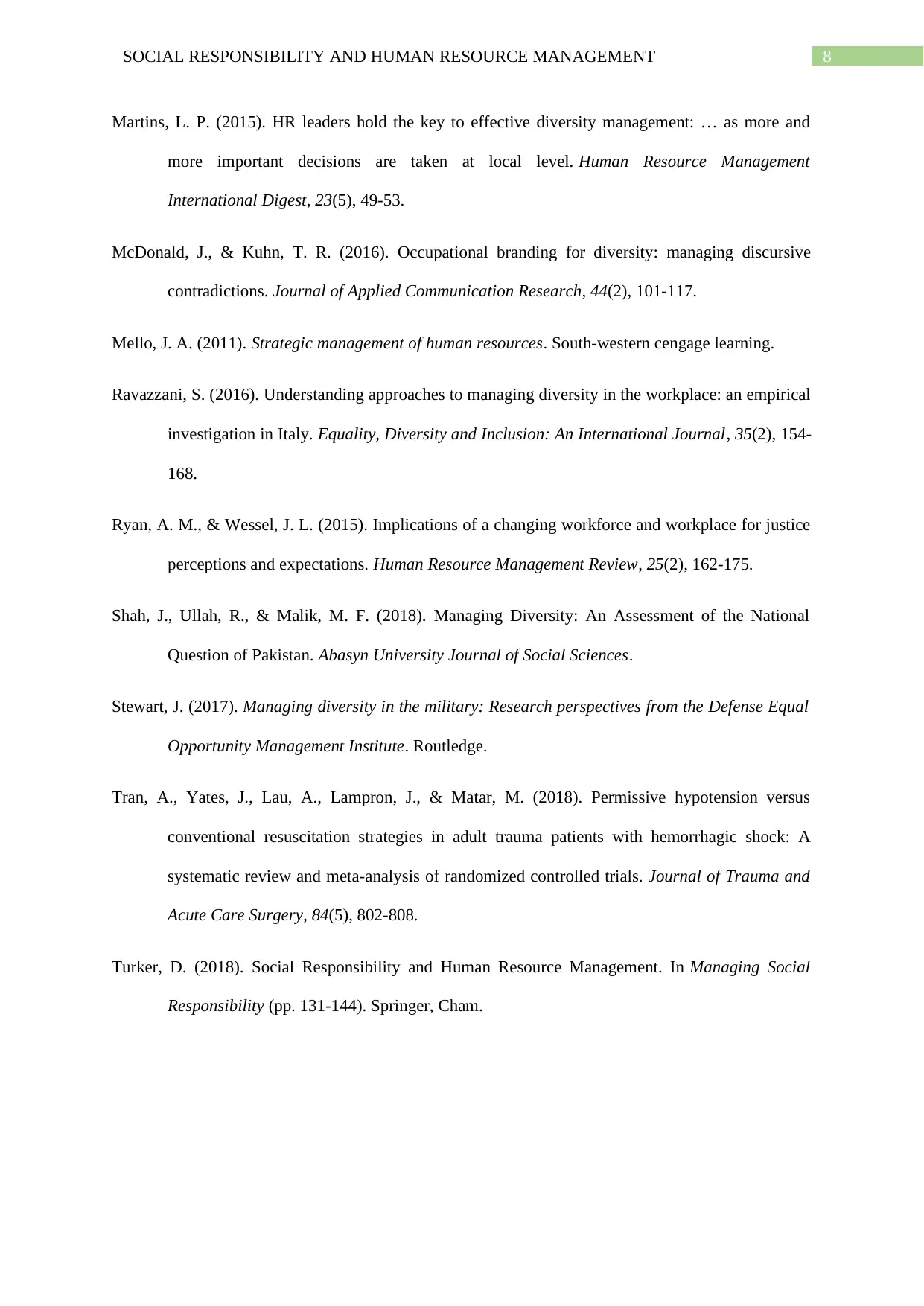
8SOCIAL RESPONSIBILITY AND HUMAN RESOURCE MANAGEMENT
Martins, L. P. (2015). HR leaders hold the key to effective diversity management: … as more and
more important decisions are taken at local level. Human Resource Management
International Digest, 23(5), 49-53.
McDonald, J., & Kuhn, T. R. (2016). Occupational branding for diversity: managing discursive
contradictions. Journal of Applied Communication Research, 44(2), 101-117.
Mello, J. A. (2011). Strategic management of human resources. South-western cengage learning.
Ravazzani, S. (2016). Understanding approaches to managing diversity in the workplace: an empirical
investigation in Italy. Equality, Diversity and Inclusion: An International Journal, 35(2), 154-
168.
Ryan, A. M., & Wessel, J. L. (2015). Implications of a changing workforce and workplace for justice
perceptions and expectations. Human Resource Management Review, 25(2), 162-175.
Shah, J., Ullah, R., & Malik, M. F. (2018). Managing Diversity: An Assessment of the National
Question of Pakistan. Abasyn University Journal of Social Sciences.
Stewart, J. (2017). Managing diversity in the military: Research perspectives from the Defense Equal
Opportunity Management Institute. Routledge.
Tran, A., Yates, J., Lau, A., Lampron, J., & Matar, M. (2018). Permissive hypotension versus
conventional resuscitation strategies in adult trauma patients with hemorrhagic shock: A
systematic review and meta-analysis of randomized controlled trials. Journal of Trauma and
Acute Care Surgery, 84(5), 802-808.
Turker, D. (2018). Social Responsibility and Human Resource Management. In Managing Social
Responsibility (pp. 131-144). Springer, Cham.
Martins, L. P. (2015). HR leaders hold the key to effective diversity management: … as more and
more important decisions are taken at local level. Human Resource Management
International Digest, 23(5), 49-53.
McDonald, J., & Kuhn, T. R. (2016). Occupational branding for diversity: managing discursive
contradictions. Journal of Applied Communication Research, 44(2), 101-117.
Mello, J. A. (2011). Strategic management of human resources. South-western cengage learning.
Ravazzani, S. (2016). Understanding approaches to managing diversity in the workplace: an empirical
investigation in Italy. Equality, Diversity and Inclusion: An International Journal, 35(2), 154-
168.
Ryan, A. M., & Wessel, J. L. (2015). Implications of a changing workforce and workplace for justice
perceptions and expectations. Human Resource Management Review, 25(2), 162-175.
Shah, J., Ullah, R., & Malik, M. F. (2018). Managing Diversity: An Assessment of the National
Question of Pakistan. Abasyn University Journal of Social Sciences.
Stewart, J. (2017). Managing diversity in the military: Research perspectives from the Defense Equal
Opportunity Management Institute. Routledge.
Tran, A., Yates, J., Lau, A., Lampron, J., & Matar, M. (2018). Permissive hypotension versus
conventional resuscitation strategies in adult trauma patients with hemorrhagic shock: A
systematic review and meta-analysis of randomized controlled trials. Journal of Trauma and
Acute Care Surgery, 84(5), 802-808.
Turker, D. (2018). Social Responsibility and Human Resource Management. In Managing Social
Responsibility (pp. 131-144). Springer, Cham.
⊘ This is a preview!⊘
Do you want full access?
Subscribe today to unlock all pages.
Trusted by 1+ million students worldwide

1 out of 9


Related Documents


Your All-in-One AI-Powered Toolkit for Academic Success.
+13062052269
info@desklib.com
Available 24*7 on WhatsApp / Email
![[object Object]](/_next/static/media/star-bottom.7253800d.svg)
Unlock your academic potential
Copyright © 2020–2026 A2Z Services. All Rights Reserved. Developed and managed by ZUCOL.