Social Science Assignment on Social Change, Crime and Socialization
VerifiedAdded on 2021/04/17
|13
|2945
|92
Homework Assignment
AI Summary
This assignment delves into key concepts in social science, examining factors that drive social change, such as environmental shifts and population dynamics, and providing examples like the transformation of the Sahara Desert. It explores control theory, defining it as the mechanisms preventing deviant behavior, and discusses the elements of social bonds as identified by Hirschi, including attachment, commitment, involvement, and belief. The assignment also analyzes the conflict theory perspective of society, highlighting inequalities in power and resource distribution, and contrasts qualitative and quantitative research methods, with examples. Finally, it explores agents of socialization like family, schools, and peers, using personal experiences to illustrate their impact, and examines various types of crime with real-world examples.

Running head: SOCIAL SCIENCE
Social Science
Name of the Student
Name of the University
Author note
Social Science
Name of the Student
Name of the University
Author note

Paraphrase This Document
Need a fresh take? Get an instant paraphrase of this document with our AI Paraphraser

1SOCIAL SCIENCE
Subject A
Question 1
a. Elaborate with examples any two (2) factors that cause social change.
Social change can be defined as the change in the social order of the society. Social change
chiefly refers to change in social institutions, nature, social relation and social behaviors. The
two major factors that cause social changes are Physical Environment and change in population.
Physical environment
Geographical changes can bring about a huge amount of social change. Change in physical
environment that include storms, climatic change, floods, droughts and earthquakes imposes a
highly negative impact on the social life of individual and therefore induces social change
(Altman & Wohlwill, 2012). The fact that life of human being is closely related to the
geographical condition of the world cannot be ignored. An example of major social change is
that the North African desert was once green and highly populated. Another example of change
in society due to environmental change is shift of community from the Sahara Desert. The
Sahara desert was once highly populated and green. The major reason behind environmental
change is environmental destruction by human beings.
Population change
In spite of being a social change by itself, population change can be considered as another
major factor that brings about cultural and social change. In cases where a thinly settled frontier
gets filled by individuals, the pattern of hospitality slowly fades away, growth of institutional
structure is noticed and secondary group relation multiplies. While a population which is stable,
Subject A
Question 1
a. Elaborate with examples any two (2) factors that cause social change.
Social change can be defined as the change in the social order of the society. Social change
chiefly refers to change in social institutions, nature, social relation and social behaviors. The
two major factors that cause social changes are Physical Environment and change in population.
Physical environment
Geographical changes can bring about a huge amount of social change. Change in physical
environment that include storms, climatic change, floods, droughts and earthquakes imposes a
highly negative impact on the social life of individual and therefore induces social change
(Altman & Wohlwill, 2012). The fact that life of human being is closely related to the
geographical condition of the world cannot be ignored. An example of major social change is
that the North African desert was once green and highly populated. Another example of change
in society due to environmental change is shift of community from the Sahara Desert. The
Sahara desert was once highly populated and green. The major reason behind environmental
change is environmental destruction by human beings.
Population change
In spite of being a social change by itself, population change can be considered as another
major factor that brings about cultural and social change. In cases where a thinly settled frontier
gets filled by individuals, the pattern of hospitality slowly fades away, growth of institutional
structure is noticed and secondary group relation multiplies. While a population which is stable,

2SOCIAL SCIENCE
will be able to resist the changes, population that are growing rapidly needs to improve
productivity and migrate in order to cope up with the change in population. Historic conquests
and migration of Vikings, Romans, Huns and Spartans can be considered as an example of
pressure of growing population over limited amount of resources (Giddens et al., 2016).
a. Elaborate with examples the three (3) factors which stabilize culture.
The factors responsible for stabilizing culture are as follows:
Positive relationship between a culture and its components: Religious beliefs of the
Indians are a major reason behind their cultural stability. On the other hand, the climate
of Iran is the reason behind the tradition of Nourooz followed since time immemorial by
the Iranians.
Time: The more is the age of the culture, the more stable will it be. In spite of the fact
that unlike other factors, this factor cannot be accounted, examples are there to prove that
stability increases with prolonged practices. Throughout the whole history of mankind,
selfishness has existed and even in this era of modernization a majority of the mankind
has seen to be falling for ill-mannered selfishness instead of maintaining proper virtue
and logic (Safiullin et al., 2013). The belief of the Indians on various kinds of gods and
goddesses from time immemorial has become a part of their culture now. Idol worship is
common in various parts of India.
Customs, traditions and believes: A society has been given a particular nationality by
relating the culture to various kinds of tradition, believes and customs. This factor makes
the individuals more organized and focused. These elements slowly become the identity
of the society.
will be able to resist the changes, population that are growing rapidly needs to improve
productivity and migrate in order to cope up with the change in population. Historic conquests
and migration of Vikings, Romans, Huns and Spartans can be considered as an example of
pressure of growing population over limited amount of resources (Giddens et al., 2016).
a. Elaborate with examples the three (3) factors which stabilize culture.
The factors responsible for stabilizing culture are as follows:
Positive relationship between a culture and its components: Religious beliefs of the
Indians are a major reason behind their cultural stability. On the other hand, the climate
of Iran is the reason behind the tradition of Nourooz followed since time immemorial by
the Iranians.
Time: The more is the age of the culture, the more stable will it be. In spite of the fact
that unlike other factors, this factor cannot be accounted, examples are there to prove that
stability increases with prolonged practices. Throughout the whole history of mankind,
selfishness has existed and even in this era of modernization a majority of the mankind
has seen to be falling for ill-mannered selfishness instead of maintaining proper virtue
and logic (Safiullin et al., 2013). The belief of the Indians on various kinds of gods and
goddesses from time immemorial has become a part of their culture now. Idol worship is
common in various parts of India.
Customs, traditions and believes: A society has been given a particular nationality by
relating the culture to various kinds of tradition, believes and customs. This factor makes
the individuals more organized and focused. These elements slowly become the identity
of the society.
⊘ This is a preview!⊘
Do you want full access?
Subscribe today to unlock all pages.

Trusted by 1+ million students worldwide
3SOCIAL SCIENCE
Question 2
a. Define control theory. Give one (1) example in your definition.
Control theory can be defined as the view that individuals refrain from executing deviant
behaviors since diverse social factors prevent them from breaking norms of the society.
According to the control theory, every individual’s tendency to deviate is controlled by inner and
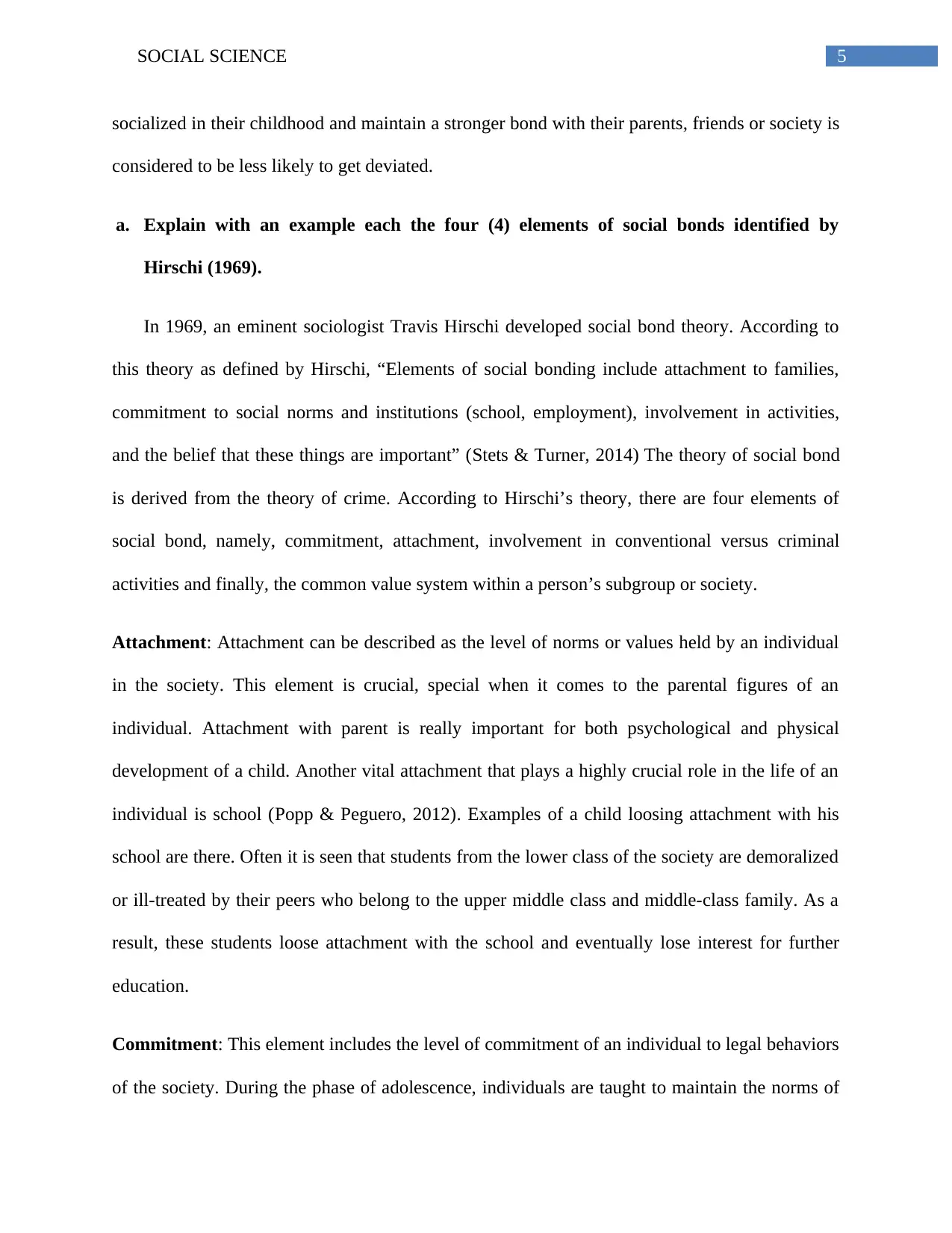
outer control systems (Lamont, 2012). Control theory can be divided into two types namely,
centralized and decentralized control. While decentralized control can be defined as market
control, centralized control can b defined as bureaucratic control. Another type of control named
as clan control is the mixture o both centralized and decentralized control.
Question 2
a. Define control theory. Give one (1) example in your definition.
Control theory can be defined as the view that individuals refrain from executing deviant
behaviors since diverse social factors prevent them from breaking norms of the society.
According to the control theory, every individual’s tendency to deviate is controlled by inner and
outer control systems (Lamont, 2012). Control theory can be divided into two types namely,
centralized and decentralized control. While decentralized control can be defined as market
control, centralized control can b defined as bureaucratic control. Another type of control named
as clan control is the mixture o both centralized and decentralized control.
Paraphrase This Document
Need a fresh take? Get an instant paraphrase of this document with our AI Paraphraser
4SOCIAL SCIENCE
Figure 1: Control Theory Diagram
Source (Ridgeway, 2014)
According two of the eminent sociologists, Walter Reckless and Travis Hirschi, an
individual can be controlled by both internal and external controls (Downes & McLaughlin,
2016). While internal control comprises of motivation to be successful and conscience, external
controls include parents, peers and legal codes. For instance, a person’s desire to steal is quelled
by fear of embarrassment and legal punishment. This non deviant behavior is linked to social
bonds and socialization by control theory. According to this theory individuals who were more
Figure 1: Control Theory Diagram
Source (Ridgeway, 2014)
According two of the eminent sociologists, Walter Reckless and Travis Hirschi, an
individual can be controlled by both internal and external controls (Downes & McLaughlin,
2016). While internal control comprises of motivation to be successful and conscience, external
controls include parents, peers and legal codes. For instance, a person’s desire to steal is quelled
by fear of embarrassment and legal punishment. This non deviant behavior is linked to social
bonds and socialization by control theory. According to this theory individuals who were more
5SOCIAL SCIENCE
socialized in their childhood and maintain a stronger bond with their parents, friends or society is
considered to be less likely to get deviated.
a. Explain with an example each the four (4) elements of social bonds identified by
Hirschi (1969).
In 1969, an eminent sociologist Travis Hirschi developed social bond theory. According to
this theory as defined by Hirschi, “Elements of social bonding include attachment to families,
commitment to social norms and institutions (school, employment), involvement in activities,
and the belief that these things are important” (Stets & Turner, 2014) The theory of social bond
is derived from the theory of crime. According to Hirschi’s theory, there are four elements of
social bond, namely, commitment, attachment, involvement in conventional versus criminal
activities and finally, the common value system within a person’s subgroup or society.
Attachment: Attachment can be described as the level of norms or values held by an individual
in the society. This element is crucial, special when it comes to the parental figures of an
individual. Attachment with parent is really important for both psychological and physical
development of a child. Another vital attachment that plays a highly crucial role in the life of an
individual is school (Popp & Peguero, 2012). Examples of a child loosing attachment with his
school are there. Often it is seen that students from the lower class of the society are demoralized
or ill-treated by their peers who belong to the upper middle class and middle-class family. As a
result, these students loose attachment with the school and eventually lose interest for further
education.
Commitment: This element includes the level of commitment of an individual to legal behaviors
of the society. During the phase of adolescence, individuals are taught to maintain the norms of
socialized in their childhood and maintain a stronger bond with their parents, friends or society is
considered to be less likely to get deviated.
a. Explain with an example each the four (4) elements of social bonds identified by
Hirschi (1969).
In 1969, an eminent sociologist Travis Hirschi developed social bond theory. According to
this theory as defined by Hirschi, “Elements of social bonding include attachment to families,
commitment to social norms and institutions (school, employment), involvement in activities,
and the belief that these things are important” (Stets & Turner, 2014) The theory of social bond
is derived from the theory of crime. According to Hirschi’s theory, there are four elements of
social bond, namely, commitment, attachment, involvement in conventional versus criminal
activities and finally, the common value system within a person’s subgroup or society.
Attachment: Attachment can be described as the level of norms or values held by an individual
in the society. This element is crucial, special when it comes to the parental figures of an
individual. Attachment with parent is really important for both psychological and physical
development of a child. Another vital attachment that plays a highly crucial role in the life of an
individual is school (Popp & Peguero, 2012). Examples of a child loosing attachment with his
school are there. Often it is seen that students from the lower class of the society are demoralized
or ill-treated by their peers who belong to the upper middle class and middle-class family. As a
result, these students loose attachment with the school and eventually lose interest for further
education.
Commitment: This element includes the level of commitment of an individual to legal behaviors
of the society. During the phase of adolescence, individuals are taught to maintain the norms of
⊘ This is a preview!⊘
Do you want full access?
Subscribe today to unlock all pages.
Trusted by 1+ million students worldwide
6SOCIAL SCIENCE
the society and this teaching bears immense importance throughout the whole life of the
individual. For example, if a child is raised in an environment where unethical objects like drugs
and dealt with, he will not develop commitment towards the society.
Involvement: According to Hirschi, an individual should always involve in conventional
activities in order keep himself away from criminal acts. It has been found that individuals who
are involved highly in conventional activities are less likely to perform criminal activities due to
lack of time (Salvatore & Taniguchi, 2012).
Belief: Belief plays a major role when it comes to prevention from deviation. An individual
should believe in morals and common goals of the society. Lack of believe tends to push an
individual to perform unethical activities. Examples are there where a criminal, in order to justify
his deviant behavior believes that whatever he is doing is right.
Subject B
Question 1:
i. Discuss with examples the conflict theory perspective of society.
According to the conflict theory, struggle in the society arises when power, status and
resources are unevenly distributed among the society and this conflict shows up as the engine of
the society. The founder of the conflict theory is Karl Marx. In his work, Marx has focused on
the causes as well as the consequences due to conflicts between the bourgeoisie that includes the
capitalists and the owners and the proletariat (Ritzer & Stepnisky, 2017). Conflicts theory has
been used by a good number of socialists in order to assess a range of problems prevailing in the
society. Some of the examples of the problems are:
the society and this teaching bears immense importance throughout the whole life of the
individual. For example, if a child is raised in an environment where unethical objects like drugs
and dealt with, he will not develop commitment towards the society.
Involvement: According to Hirschi, an individual should always involve in conventional
activities in order keep himself away from criminal acts. It has been found that individuals who
are involved highly in conventional activities are less likely to perform criminal activities due to
lack of time (Salvatore & Taniguchi, 2012).
Belief: Belief plays a major role when it comes to prevention from deviation. An individual
should believe in morals and common goals of the society. Lack of believe tends to push an
individual to perform unethical activities. Examples are there where a criminal, in order to justify
his deviant behavior believes that whatever he is doing is right.
Subject B
Question 1:
i. Discuss with examples the conflict theory perspective of society.
According to the conflict theory, struggle in the society arises when power, status and
resources are unevenly distributed among the society and this conflict shows up as the engine of
the society. The founder of the conflict theory is Karl Marx. In his work, Marx has focused on
the causes as well as the consequences due to conflicts between the bourgeoisie that includes the
capitalists and the owners and the proletariat (Ritzer & Stepnisky, 2017). Conflicts theory has
been used by a good number of socialists in order to assess a range of problems prevailing in the
society. Some of the examples of the problems are:
Paraphrase This Document
Need a fresh take? Get an instant paraphrase of this document with our AI Paraphraser
7SOCIAL SCIENCE
Exposures to environmental hazards are shaped by class and race.
A minority community of US died in 2016, due to the intake of intoxicated water. According to
researchers, a majority of the worst toxic polluters are located in areas where poor and non-white
communities reside (Alexander, 2014).
A good number of women, even in today’s world, experience gender oppression.
When it comes to politics, health care, economy and safety, the condition of women irrespective
of the fact whether they reside in an underdeveloped, developing or bellow developed country, is
far worse compared to the condition of men. Women suffer underrepresentation in Politics, are
often found to be ripped of economically and lack reproductive rights and health care options.
Even in this era of modernization, capitalism has created a global system of
inequality and power.
Global capitalism includes a tiny group of capitalists or elites control a major part of the global
resources. Researcher states, more than 40 percent of the corporate wealth is controlled by just
147 global investment group and approximately 700 groups across the world controls 80 percent
of the global resources. This unequal distribution of wealth is resulting in enhanced gap between
the rich and the poor (Seidman, 2016).
ii. Discuss briefly what are quantitative and qualitative research methods? Give one
example of research that has been done on each of these methods.
Qualitative research may be defined chiefly as exploratory research method. This type of
research is performed when the researcher wants to gain an in-depth understanding of the
underlying opinions, reasons and motivations. Qualitative research method provides insights into
Exposures to environmental hazards are shaped by class and race.
A minority community of US died in 2016, due to the intake of intoxicated water. According to
researchers, a majority of the worst toxic polluters are located in areas where poor and non-white
communities reside (Alexander, 2014).
A good number of women, even in today’s world, experience gender oppression.
When it comes to politics, health care, economy and safety, the condition of women irrespective
of the fact whether they reside in an underdeveloped, developing or bellow developed country, is
far worse compared to the condition of men. Women suffer underrepresentation in Politics, are
often found to be ripped of economically and lack reproductive rights and health care options.
Even in this era of modernization, capitalism has created a global system of
inequality and power.
Global capitalism includes a tiny group of capitalists or elites control a major part of the global
resources. Researcher states, more than 40 percent of the corporate wealth is controlled by just
147 global investment group and approximately 700 groups across the world controls 80 percent
of the global resources. This unequal distribution of wealth is resulting in enhanced gap between
the rich and the poor (Seidman, 2016).
ii. Discuss briefly what are quantitative and qualitative research methods? Give one
example of research that has been done on each of these methods.
Qualitative research may be defined chiefly as exploratory research method. This type of
research is performed when the researcher wants to gain an in-depth understanding of the
underlying opinions, reasons and motivations. Qualitative research method provides insights into
8SOCIAL SCIENCE
the research issue and the data collection method in this research method is unstructured and
semi-structured (Neuman, 2013). Some of the data collection method for qualitative analysis
includes open-ended interviews, surveys and focus groups.
Quantitative research method includes quantifying the research issue by generating
numerical data which are transformed into usable statistics. In this method, opinions, attitudes,
behaviors and other measurable deliverables are quantified. The data collection method of
quantitative analysis is more structured than that of qualitative analysis. Some of the data
collection methods include close ended interviews, online polls, website interceptors and other
systematic observation. In order to conduct a research on how social media affect global
marketing, both qualitative research method and quantitative research method can be used
(Bernard, 2017).
Question 2:
i. Discuss with your own experiences as examples any three (3) agents of
socialization.
Agents of socialization may be defined as the institutional sources of socialization that
exist in the society. The chief three agents of socialization are family, schools and peers.
Family
Family is considered to be one of the chief agents of socialization as an individual
receives his 1st learning of social development from his family. Parents or individuals who play
the parental role in the family teach socialization that includes close relationship, sharing of
resources and group life (Bernard, 2017). However, the teaching of socialization may differ from
the research issue and the data collection method in this research method is unstructured and
semi-structured (Neuman, 2013). Some of the data collection method for qualitative analysis
includes open-ended interviews, surveys and focus groups.
Quantitative research method includes quantifying the research issue by generating
numerical data which are transformed into usable statistics. In this method, opinions, attitudes,
behaviors and other measurable deliverables are quantified. The data collection method of
quantitative analysis is more structured than that of qualitative analysis. Some of the data
collection methods include close ended interviews, online polls, website interceptors and other
systematic observation. In order to conduct a research on how social media affect global
marketing, both qualitative research method and quantitative research method can be used
(Bernard, 2017).
Question 2:
i. Discuss with your own experiences as examples any three (3) agents of
socialization.
Agents of socialization may be defined as the institutional sources of socialization that
exist in the society. The chief three agents of socialization are family, schools and peers.
Family
Family is considered to be one of the chief agents of socialization as an individual
receives his 1st learning of social development from his family. Parents or individuals who play
the parental role in the family teach socialization that includes close relationship, sharing of
resources and group life (Bernard, 2017). However, the teaching of socialization may differ from
⊘ This is a preview!⊘
Do you want full access?
Subscribe today to unlock all pages.
Trusted by 1+ million students worldwide
9SOCIAL SCIENCE
family to family. While being from an immigrant family I grew up bilingual and was taught to
give importance to collectivistic values, one of my friends who was from a traditional American
family was taught to put emphasis on the English languages and individualistic values.
Schools
In spite of the fact that the official purpose of the school is to educate an individual,
schools do play an effective role in socialization. Students learn social skills during interaction
with the teachers and other students. For instance, I learned the importance of obeying authority,
to maintain silence when others are studying and show interest in acts that may seem boring but
have beneficial effect in future.
Peers
The phenomenon of choosing peers starts from the earliest years of an individual. Per
groups are crucial for an individual since it helps him to exert independent thinking process and
develop an identity and personality of his own (Giddens et al., 2016). I have learned various
social values like loyalty towards friendship, trusting an individual and helping my peers when
they are in distress, from my peer group.
ii. Discuss the any three (3) types of crime with real cases as examples.
The three types of criminal offence are simple offences, minor indictable offences and
major indictable offences. While simple offences deal with driving under influence of drugs or
alcohol or minor criminal damage to property, minor indictable offence deal with deception,
stalking, theft, serious stress pass and others(Golovkin, 2015). Major indictable offences are
family to family. While being from an immigrant family I grew up bilingual and was taught to
give importance to collectivistic values, one of my friends who was from a traditional American
family was taught to put emphasis on the English languages and individualistic values.
Schools
In spite of the fact that the official purpose of the school is to educate an individual,
schools do play an effective role in socialization. Students learn social skills during interaction
with the teachers and other students. For instance, I learned the importance of obeying authority,
to maintain silence when others are studying and show interest in acts that may seem boring but
have beneficial effect in future.
Peers
The phenomenon of choosing peers starts from the earliest years of an individual. Per
groups are crucial for an individual since it helps him to exert independent thinking process and
develop an identity and personality of his own (Giddens et al., 2016). I have learned various
social values like loyalty towards friendship, trusting an individual and helping my peers when
they are in distress, from my peer group.
ii. Discuss the any three (3) types of crime with real cases as examples.
The three types of criminal offence are simple offences, minor indictable offences and
major indictable offences. While simple offences deal with driving under influence of drugs or
alcohol or minor criminal damage to property, minor indictable offence deal with deception,
stalking, theft, serious stress pass and others(Golovkin, 2015). Major indictable offences are
Paraphrase This Document
Need a fresh take? Get an instant paraphrase of this document with our AI Paraphraser

10SOCIAL SCIENCE
rape, murder, treason, robbery, unlawful sexual intercourse and damage to property more than
30.000 dollars.
A real-life example of simple offence is when an individual of Australia named Duncan
Smith had been arrested and fined for driving under the influence of alcohol. Another instance
of an American Individual who was arrested for damaging a property worth 3000 dollars can be
seen as an example of minor indictable offence. A horrifying real case can be given as an
example of major indictable offences, where John Wayne Gacy, an entertainer by profession
murdered about 33 young men after raping and torturing them (Anderson & Bokor, 2012).
rape, murder, treason, robbery, unlawful sexual intercourse and damage to property more than
30.000 dollars.
A real-life example of simple offence is when an individual of Australia named Duncan
Smith had been arrested and fined for driving under the influence of alcohol. Another instance
of an American Individual who was arrested for damaging a property worth 3000 dollars can be
seen as an example of minor indictable offence. A horrifying real case can be given as an
example of major indictable offences, where John Wayne Gacy, an entertainer by profession
murdered about 33 young men after raping and torturing them (Anderson & Bokor, 2012).

11SOCIAL SCIENCE
Reference List:
Alexander, J. C. (2014). The Antinomies of Classical Thought: Marx and Durkheim
(Theoretical Logic in Sociology) (Vol. 2). Routledge, 56-59
Altman, I., & Wohlwill, J. F. (2012). Human behavior and environment: Advances in theory
and research (Vol. 2). Springer Science & Business Media, 12-34
Anderson, P. D., & Bokor, G. (2012). Forensic aspects of drug-induced violence. Journal of
pharmacy practice, 25(1), 41-49.
Bernard, H. R. (2017). Research methods in anthropology: Qualitative and quantitative
approaches. Rowman & Littlefield, 45-47
Downes, D., Rock, P., & McLaughlin, E. (2016). Understanding deviance: a guide to the
sociology of crime and rule-breaking. Oxford University Press, 190-198
Giddens, A., Duneier, M., Appelbaum, R. P., & Carr, D. S. (2016). Introduction to sociology.
WW Norton, 43-45
Golovkin, B. M. (2015). Types of Crime. JE Eur. L., 14.
Grusec, J. E., & Hastings, P. D. (Eds.). (2014). Handbook of socialization: Theory and
research. Guilford Publications, 21-28
Lamont, M. (2012). Toward a comparative sociology of valuation and evaluation. Annual
Review of Sociology, 38.
Neuman, W. L. (2013). Social research methods: Qualitative and quantitative approaches.
Pearson education, 78-81
Reference List:
Alexander, J. C. (2014). The Antinomies of Classical Thought: Marx and Durkheim
(Theoretical Logic in Sociology) (Vol. 2). Routledge, 56-59
Altman, I., & Wohlwill, J. F. (2012). Human behavior and environment: Advances in theory
and research (Vol. 2). Springer Science & Business Media, 12-34
Anderson, P. D., & Bokor, G. (2012). Forensic aspects of drug-induced violence. Journal of
pharmacy practice, 25(1), 41-49.
Bernard, H. R. (2017). Research methods in anthropology: Qualitative and quantitative
approaches. Rowman & Littlefield, 45-47
Downes, D., Rock, P., & McLaughlin, E. (2016). Understanding deviance: a guide to the
sociology of crime and rule-breaking. Oxford University Press, 190-198
Giddens, A., Duneier, M., Appelbaum, R. P., & Carr, D. S. (2016). Introduction to sociology.
WW Norton, 43-45
Golovkin, B. M. (2015). Types of Crime. JE Eur. L., 14.
Grusec, J. E., & Hastings, P. D. (Eds.). (2014). Handbook of socialization: Theory and
research. Guilford Publications, 21-28
Lamont, M. (2012). Toward a comparative sociology of valuation and evaluation. Annual
Review of Sociology, 38.
Neuman, W. L. (2013). Social research methods: Qualitative and quantitative approaches.
Pearson education, 78-81
⊘ This is a preview!⊘
Do you want full access?
Subscribe today to unlock all pages.
Trusted by 1+ million students worldwide

1 out of 13


Your All-in-One AI-Powered Toolkit for Academic Success.
+13062052269
info@desklib.com
Available 24*7 on WhatsApp / Email
![[object Object]](/_next/static/media/star-bottom.7253800d.svg)
Unlock your academic potential
Copyright © 2020–2026 A2Z Services. All Rights Reserved. Developed and managed by ZUCOL.