Social Theories and Policies: Theories, Research, and Societal Impact
VerifiedAdded on 2023/02/01
|16
|4455
|98
Essay
AI Summary
This essay delves into the realm of social theories and policies, providing a comprehensive overview of key concepts and their impact on societal structures. The paper begins by defining social theories and policies, emphasizing their role in regulating and guiding social interactions. It then introduces three major theoretical frameworks: symbolic interactionism, functionalism, and conflict theory, explaining their core tenets and perspectives. The essay further explores the influence of social research in shaping and refining these theories, highlighting the importance of empirical investigation. It also examines the impact of values on social policies and professional practice, recognizing the role of cultural context. The paper concludes by summarizing the discussed theories and their practical implications for understanding and addressing social issues.
Social Theories and Policies 1
SOCIAL THEORIES AND POLICIES
Name
Course
Instructor
Institution
Date
SOCIAL THEORIES AND POLICIES
Name
Course
Instructor
Institution
Date

Paraphrase This Document
Need a fresh take? Get an instant paraphrase of this document with our AI Paraphraser
Social Theories and Policies 2
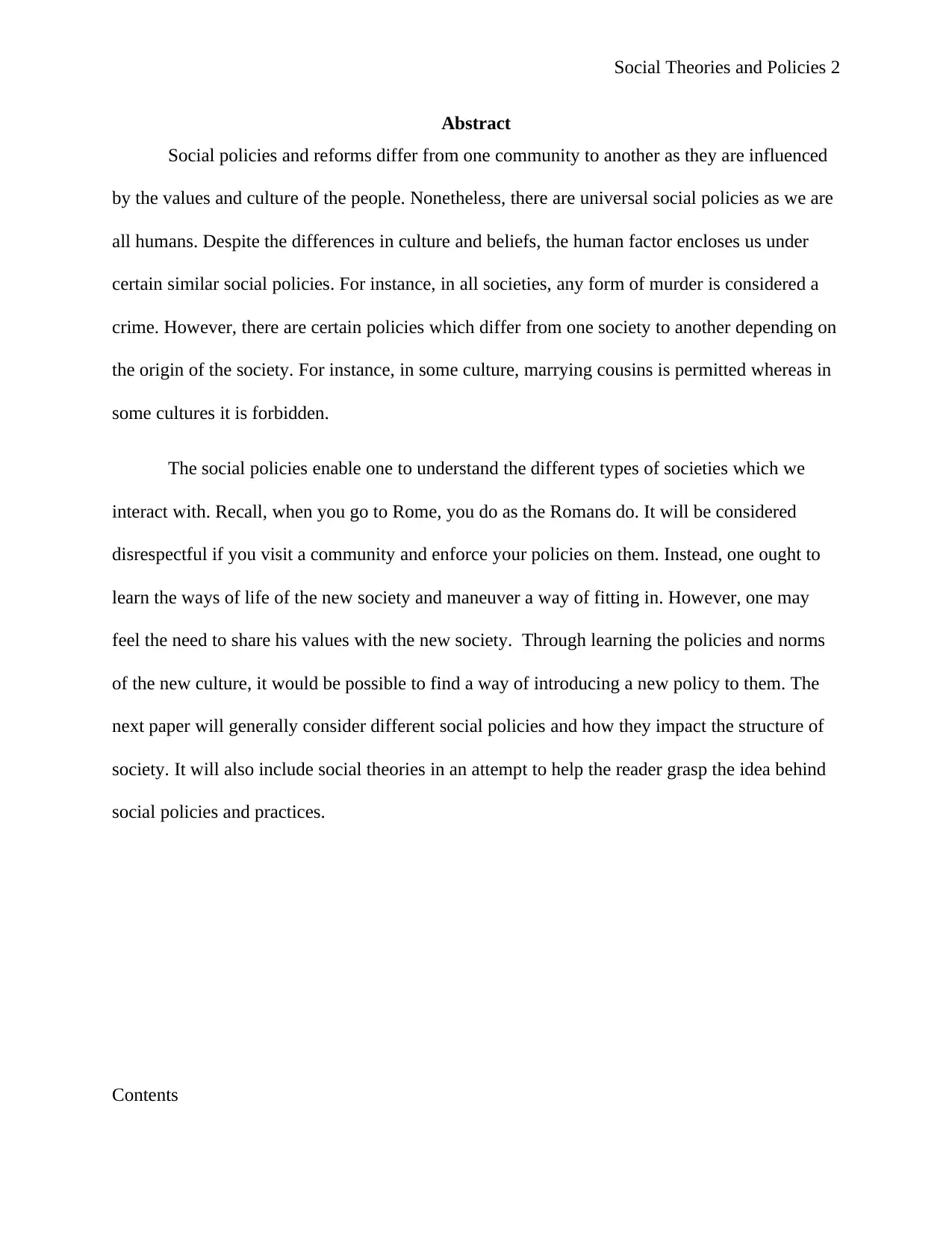
Abstract
Social policies and reforms differ from one community to another as they are influenced
by the values and culture of the people. Nonetheless, there are universal social policies as we are
all humans. Despite the differences in culture and beliefs, the human factor encloses us under
certain similar social policies. For instance, in all societies, any form of murder is considered a
crime. However, there are certain policies which differ from one society to another depending on
the origin of the society. For instance, in some culture, marrying cousins is permitted whereas in
some cultures it is forbidden.
The social policies enable one to understand the different types of societies which we
interact with. Recall, when you go to Rome, you do as the Romans do. It will be considered
disrespectful if you visit a community and enforce your policies on them. Instead, one ought to
learn the ways of life of the new society and maneuver a way of fitting in. However, one may
feel the need to share his values with the new society. Through learning the policies and norms
of the new culture, it would be possible to find a way of introducing a new policy to them. The
next paper will generally consider different social policies and how they impact the structure of
society. It will also include social theories in an attempt to help the reader grasp the idea behind
social policies and practices.
Contents
Abstract
Social policies and reforms differ from one community to another as they are influenced
by the values and culture of the people. Nonetheless, there are universal social policies as we are
all humans. Despite the differences in culture and beliefs, the human factor encloses us under
certain similar social policies. For instance, in all societies, any form of murder is considered a
crime. However, there are certain policies which differ from one society to another depending on
the origin of the society. For instance, in some culture, marrying cousins is permitted whereas in
some cultures it is forbidden.
The social policies enable one to understand the different types of societies which we
interact with. Recall, when you go to Rome, you do as the Romans do. It will be considered
disrespectful if you visit a community and enforce your policies on them. Instead, one ought to
learn the ways of life of the new society and maneuver a way of fitting in. However, one may
feel the need to share his values with the new society. Through learning the policies and norms
of the new culture, it would be possible to find a way of introducing a new policy to them. The
next paper will generally consider different social policies and how they impact the structure of
society. It will also include social theories in an attempt to help the reader grasp the idea behind
social policies and practices.
Contents
Social Theories and Policies 3
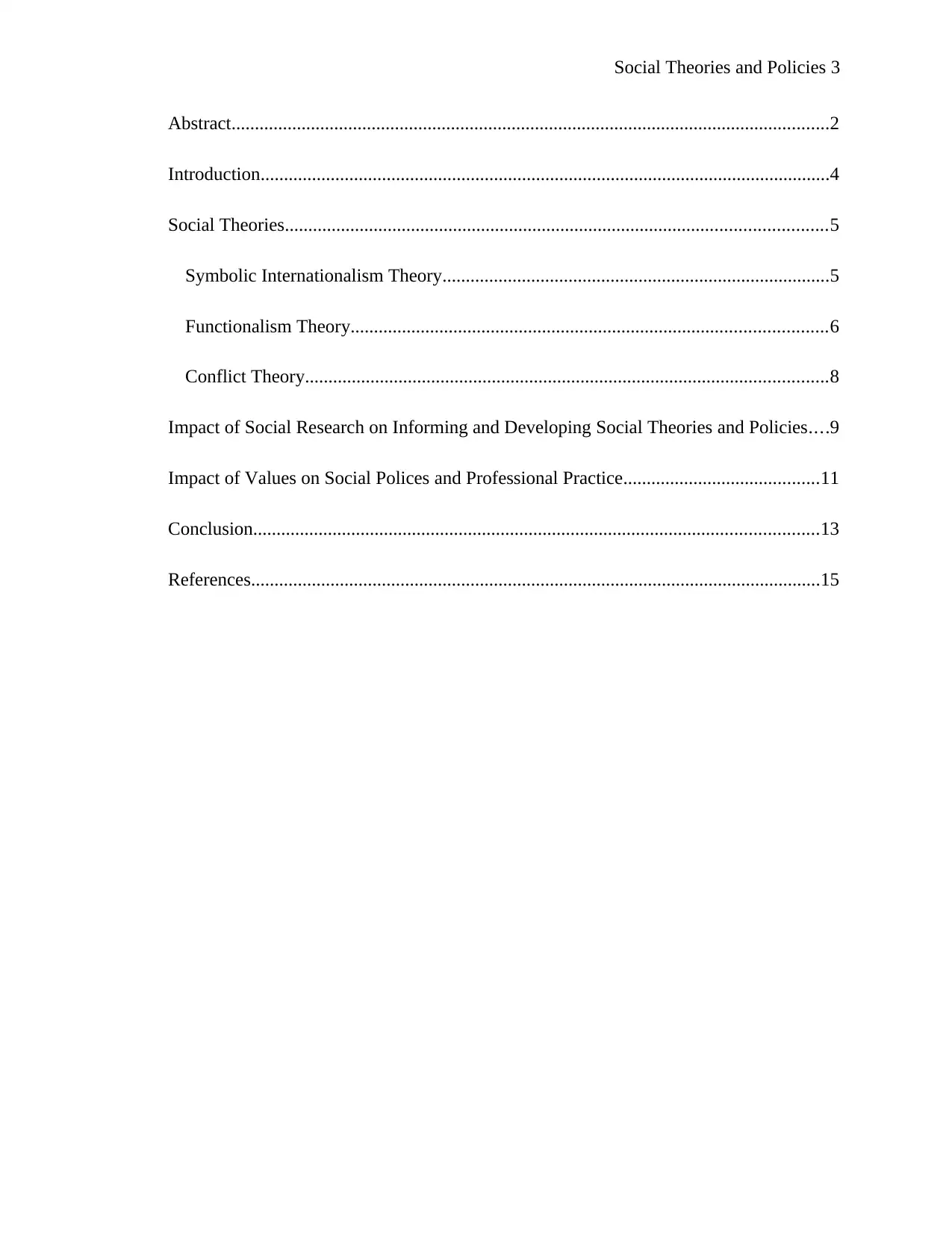
Abstract................................................................................................................................2
Introduction..........................................................................................................................4
Social Theories....................................................................................................................5
Symbolic Internationalism Theory...................................................................................5
Functionalism Theory......................................................................................................6
Conflict Theory................................................................................................................8
Impact of Social Research on Informing and Developing Social Theories and Policies....9
Impact of Values on Social Polices and Professional Practice..........................................11
Conclusion.........................................................................................................................13
References..........................................................................................................................15
Abstract................................................................................................................................2
Introduction..........................................................................................................................4
Social Theories....................................................................................................................5
Symbolic Internationalism Theory...................................................................................5
Functionalism Theory......................................................................................................6
Conflict Theory................................................................................................................8
Impact of Social Research on Informing and Developing Social Theories and Policies....9
Impact of Values on Social Polices and Professional Practice..........................................11
Conclusion.........................................................................................................................13
References..........................................................................................................................15
⊘ This is a preview!⊘
Do you want full access?
Subscribe today to unlock all pages.

Trusted by 1+ million students worldwide
Social Theories and Policies 4
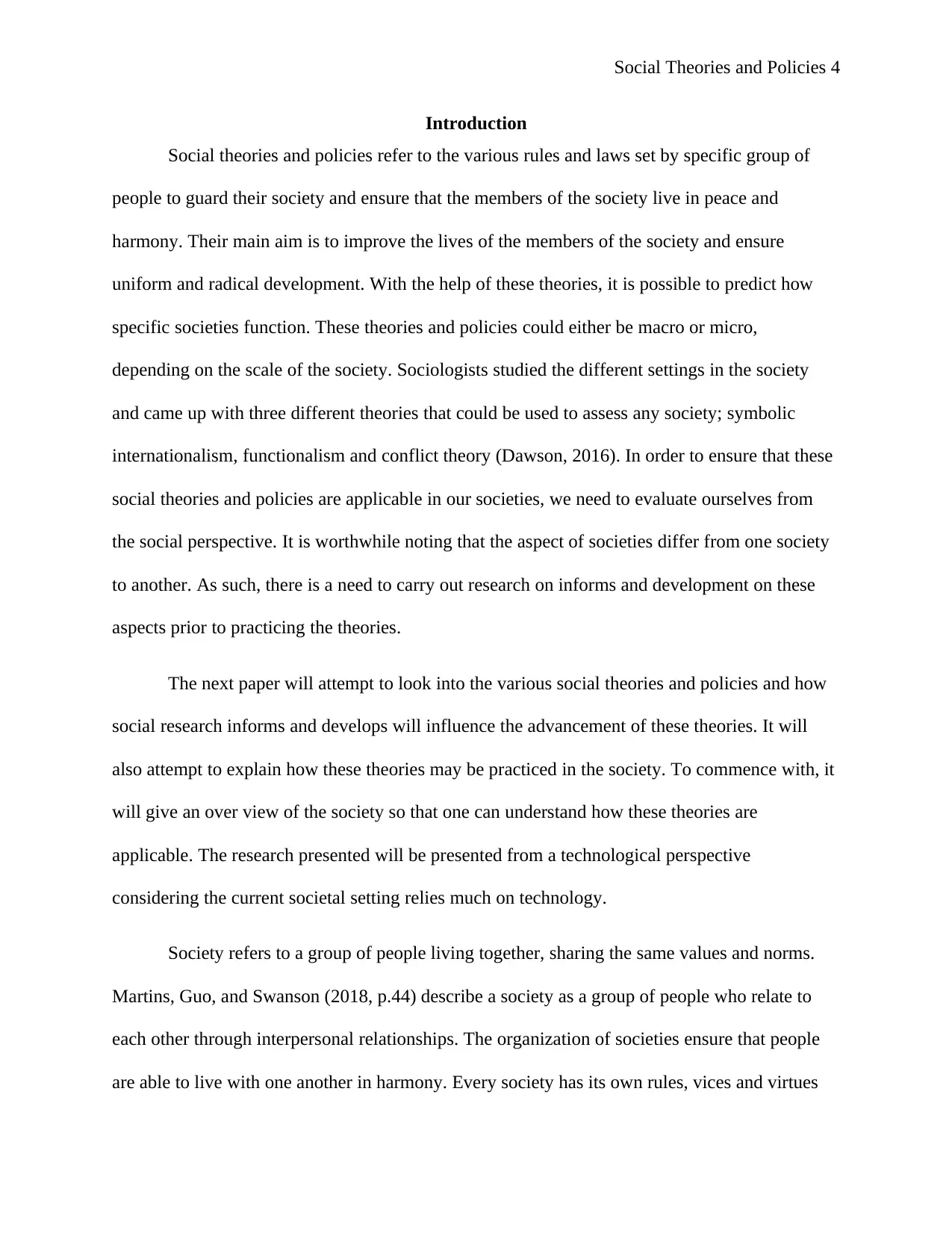
Introduction
Social theories and policies refer to the various rules and laws set by specific group of
people to guard their society and ensure that the members of the society live in peace and
harmony. Their main aim is to improve the lives of the members of the society and ensure
uniform and radical development. With the help of these theories, it is possible to predict how
specific societies function. These theories and policies could either be macro or micro,
depending on the scale of the society. Sociologists studied the different settings in the society
and came up with three different theories that could be used to assess any society; symbolic
internationalism, functionalism and conflict theory (Dawson, 2016). In order to ensure that these
social theories and policies are applicable in our societies, we need to evaluate ourselves from
the social perspective. It is worthwhile noting that the aspect of societies differ from one society
to another. As such, there is a need to carry out research on informs and development on these
aspects prior to practicing the theories.
The next paper will attempt to look into the various social theories and policies and how
social research informs and develops will influence the advancement of these theories. It will
also attempt to explain how these theories may be practiced in the society. To commence with, it
will give an over view of the society so that one can understand how these theories are
applicable. The research presented will be presented from a technological perspective
considering the current societal setting relies much on technology.
Society refers to a group of people living together, sharing the same values and norms.
Martins, Guo, and Swanson (2018, p.44) describe a society as a group of people who relate to
each other through interpersonal relationships. The organization of societies ensure that people
are able to live with one another in harmony. Every society has its own rules, vices and virtues
Introduction
Social theories and policies refer to the various rules and laws set by specific group of
people to guard their society and ensure that the members of the society live in peace and
harmony. Their main aim is to improve the lives of the members of the society and ensure
uniform and radical development. With the help of these theories, it is possible to predict how
specific societies function. These theories and policies could either be macro or micro,
depending on the scale of the society. Sociologists studied the different settings in the society
and came up with three different theories that could be used to assess any society; symbolic
internationalism, functionalism and conflict theory (Dawson, 2016). In order to ensure that these
social theories and policies are applicable in our societies, we need to evaluate ourselves from
the social perspective. It is worthwhile noting that the aspect of societies differ from one society
to another. As such, there is a need to carry out research on informs and development on these
aspects prior to practicing the theories.
The next paper will attempt to look into the various social theories and policies and how
social research informs and develops will influence the advancement of these theories. It will
also attempt to explain how these theories may be practiced in the society. To commence with, it
will give an over view of the society so that one can understand how these theories are
applicable. The research presented will be presented from a technological perspective
considering the current societal setting relies much on technology.
Society refers to a group of people living together, sharing the same values and norms.
Martins, Guo, and Swanson (2018, p.44) describe a society as a group of people who relate to
each other through interpersonal relationships. The organization of societies ensure that people
are able to live with one another in harmony. Every society has its own rules, vices and virtues
Paraphrase This Document
Need a fresh take? Get an instant paraphrase of this document with our AI Paraphraser
Social Theories and Policies 5
which ensure everyone is equal to the other. The rules of various societal settings differ
depending on the beliefs of the people. Although there are general laws for the entire land,
individual societies have their own rules. It is these rules that make societies stand out from one
another. Before implementing any rules, the people need to understand their structure and know
what will work best for them. Replicating the laws of another society may cause discord and lack
of development within the society.
Social Theories
Social theories refer to the various frameworks set to help understand the structure and
functionality of different societies. Wynne (2016) noted that sociologists were able to analyze the
various structure of societies and thus designed the current social theories. In a bid to understand
these structures, the theorists studied the social behavior and relations of different groups. They
were able to point out distinct features from the different societies, thus design the various
theories. Before one understands how social research informs and develops these theories, one
must be familiar with the theories. Therefore, this section will highlight the theories, giving a
brief explanation of each of them. After thorough research sociologists came up with three major
frameworks that would help understand different societies. These frameworks are symbolic
internationalism, the conflict theory, and the functionalism theory. While looking into these
frameworks, the paper will state whether each of them is a micro or macro perspective.
Symbolic Internationalism Theory
The symbolic theory refers to the use of symbols and other simple details to communicate
with one another. As humans interact with one another, they feel the need to express themselves
by use of more than just words to ensure that the other person can properly grasp whatever they
which ensure everyone is equal to the other. The rules of various societal settings differ
depending on the beliefs of the people. Although there are general laws for the entire land,
individual societies have their own rules. It is these rules that make societies stand out from one
another. Before implementing any rules, the people need to understand their structure and know
what will work best for them. Replicating the laws of another society may cause discord and lack
of development within the society.
Social Theories
Social theories refer to the various frameworks set to help understand the structure and
functionality of different societies. Wynne (2016) noted that sociologists were able to analyze the
various structure of societies and thus designed the current social theories. In a bid to understand
these structures, the theorists studied the social behavior and relations of different groups. They
were able to point out distinct features from the different societies, thus design the various
theories. Before one understands how social research informs and develops these theories, one
must be familiar with the theories. Therefore, this section will highlight the theories, giving a
brief explanation of each of them. After thorough research sociologists came up with three major
frameworks that would help understand different societies. These frameworks are symbolic
internationalism, the conflict theory, and the functionalism theory. While looking into these
frameworks, the paper will state whether each of them is a micro or macro perspective.
Symbolic Internationalism Theory
The symbolic theory refers to the use of symbols and other simple details to communicate
with one another. As humans interact with one another, they feel the need to express themselves
by use of more than just words to ensure that the other person can properly grasp whatever they
Social Theories and Policies 6
need to express. Needless to say, a plain conversation with no hand signs nor facial expression
would be meaningless. Labanca and Bertoldi (2018, p.499) argue that the use of symbols and
expressions not only allows one to understand a particular piece of information but also allows
the other party to grasp the message relayed properly. Such factors allow one to express their
emotion properly.
George H. Mead (1863–1931), a philosopher, introduced the symbolic interactionist
perspective theory (Labanca and Bertoldi, 2018, p.499). He argued that people attach important
emotions and details to the symbols and expressions which accompany conversations. However,
it is worthwhile noting that one symbol may have different meanings in different meanings in
different cultures. For instance, nodding of the head upwards and downwards implies a yes
reaction in some cultures whereas in other cultures it signifies a greeting (Labanca and Bertoldi,
2018, p.499). Therefore, before using a specific gesture, it is important to find out its meaning in
the given community.
Functionalism Theory
As the name suggests, functionalism theory helps one understand how the different
sections of the society interact and adapt to each other to produce a functional society. To
properly understand how this theory functions, it is crucial to take into account every aspect of
society. According to Shove, Pantzar, and Watson (2012), regardless of the difference in societal
structures, there are common aspects which define all societies. Every society has its virtues and
vices which are dictated by their beliefs. Some aspects such as respect for elders are common
across the board.
The functionalism theory attempts to explain that every aspect of a society is important
on its own, but when combined with other, they define a unique society (Shove, Pantzar, and
need to express. Needless to say, a plain conversation with no hand signs nor facial expression
would be meaningless. Labanca and Bertoldi (2018, p.499) argue that the use of symbols and
expressions not only allows one to understand a particular piece of information but also allows
the other party to grasp the message relayed properly. Such factors allow one to express their
emotion properly.
George H. Mead (1863–1931), a philosopher, introduced the symbolic interactionist
perspective theory (Labanca and Bertoldi, 2018, p.499). He argued that people attach important
emotions and details to the symbols and expressions which accompany conversations. However,
it is worthwhile noting that one symbol may have different meanings in different meanings in
different cultures. For instance, nodding of the head upwards and downwards implies a yes
reaction in some cultures whereas in other cultures it signifies a greeting (Labanca and Bertoldi,
2018, p.499). Therefore, before using a specific gesture, it is important to find out its meaning in
the given community.
Functionalism Theory
As the name suggests, functionalism theory helps one understand how the different
sections of the society interact and adapt to each other to produce a functional society. To
properly understand how this theory functions, it is crucial to take into account every aspect of
society. According to Shove, Pantzar, and Watson (2012), regardless of the difference in societal
structures, there are common aspects which define all societies. Every society has its virtues and
vices which are dictated by their beliefs. Some aspects such as respect for elders are common
across the board.
The functionalism theory attempts to explain that every aspect of a society is important
on its own, but when combined with other, they define a unique society (Shove, Pantzar, and
⊘ This is a preview!⊘
Do you want full access?
Subscribe today to unlock all pages.
Trusted by 1+ million students worldwide
Social Theories and Policies 7
Watson, 2012). All these aspects are necessary for the general growth of the society. The key
units for any society are family and government. A family is the smallest unit in the society
while the government is considered the largest unit as it controls all affairs of the society (Cass,
and Faulconbridge, 2016). Independent families can function properly and strive to get their
needs. However, if families work on their own, they would not have tremendous growth as they
would when they work with other families. On the other hand, the government relies on families
to provide labor and intellectual advice to the government. Therefore, the government will fail to
function if it is not supported by members of the society, who are from these families.
Aside from family and government, there are other aspects of the society needed to
ensure harmony and progress within the community such as school and religion. Robert Merton,
a sociologist, categorized the elements of functionalism theory into two; manifest and latent
functions (Cass, and Faulconbridge, 2016). Manifest elements are those which are obvious and
intentional as they are easily notable in any society. For instance, education is religion are
considered to manifest as they are necessary are noticeable in any given society. Latent elements
are also considered passive functions as they are not noticeable nor obvious. Latent elements
may be considered as personal human values which distinguish them from each other (Cass, and
Faulconbridge, 2016). No person can survive entirely on the values of the society. Each person
has a schedule and values they ought to adhere to, thus making them unique. Individual members
of the society may point out other members based on the values. However, it may not be possible
for the government to single out any individual based on their values and beliefs. Nonetheless, it
is aware that each person’s value plays a significant role in building the government.
Watson, 2012). All these aspects are necessary for the general growth of the society. The key
units for any society are family and government. A family is the smallest unit in the society
while the government is considered the largest unit as it controls all affairs of the society (Cass,
and Faulconbridge, 2016). Independent families can function properly and strive to get their
needs. However, if families work on their own, they would not have tremendous growth as they
would when they work with other families. On the other hand, the government relies on families
to provide labor and intellectual advice to the government. Therefore, the government will fail to
function if it is not supported by members of the society, who are from these families.
Aside from family and government, there are other aspects of the society needed to
ensure harmony and progress within the community such as school and religion. Robert Merton,
a sociologist, categorized the elements of functionalism theory into two; manifest and latent
functions (Cass, and Faulconbridge, 2016). Manifest elements are those which are obvious and
intentional as they are easily notable in any society. For instance, education is religion are
considered to manifest as they are necessary are noticeable in any given society. Latent elements
are also considered passive functions as they are not noticeable nor obvious. Latent elements
may be considered as personal human values which distinguish them from each other (Cass, and
Faulconbridge, 2016). No person can survive entirely on the values of the society. Each person
has a schedule and values they ought to adhere to, thus making them unique. Individual members
of the society may point out other members based on the values. However, it may not be possible
for the government to single out any individual based on their values and beliefs. Nonetheless, it
is aware that each person’s value plays a significant role in building the government.
Paraphrase This Document
Need a fresh take? Get an instant paraphrase of this document with our AI Paraphraser
Social Theories and Policies 8
Conflict Theory
Designed by Karl Marx, the conflict theory of sociology is the most common and of the
three theories. Karl Marx based his argument on the fact that every society must have its flaws
(Platteau, 2015). The other two theories focus on the orderly aspects of society. He designed his
theory to depict the struggle for resources between the wealthy and the weak people in society.
Any society has people of different aspect and capabilities. Although the social perspective aims
at enlightening one on how societies steer forward, one must note that people are not entitled to
equal resources. It is this difference that brings about the difference in social classes in any
society. Some societies work day and night to ensure that there is only a slight gap between these
two bridges whereas, in other societies the wealthy focus on making themselves more wealthy
leaving the poor to wallow in poverty.
According to Shove, Pantzar, and Watson (2012), the conflict theory explains the
overcharging aspects of society and the need struggles experienced by different members to
achieve stability. This aspect focuses on both negative and positive aspects as it takes into
account that every society has its weaknesses. Also, it considers that society is a social rather
than a personal development plan. This theory was ignored for a long time in favor of the
functionalism theory as it depicted the loopholes in society. In most societies, the elite strive to
paint a perfect picture on their side without considering how they impact the less fortunate
(Young, 2015, p.362). Societies which have managed to embrace this theory have managed to
reduce the gap between the wealthy and the less fortunate. However, those that choose to assume
they is left struggling with debts and struggle for scares resources. The elite members are
however able to get whatever they want as they can manipulate their resources to their desires.
However, the less fortunate are left struggling not just for resources, but how to survive.
Conflict Theory
Designed by Karl Marx, the conflict theory of sociology is the most common and of the
three theories. Karl Marx based his argument on the fact that every society must have its flaws
(Platteau, 2015). The other two theories focus on the orderly aspects of society. He designed his
theory to depict the struggle for resources between the wealthy and the weak people in society.
Any society has people of different aspect and capabilities. Although the social perspective aims
at enlightening one on how societies steer forward, one must note that people are not entitled to
equal resources. It is this difference that brings about the difference in social classes in any
society. Some societies work day and night to ensure that there is only a slight gap between these
two bridges whereas, in other societies the wealthy focus on making themselves more wealthy
leaving the poor to wallow in poverty.
According to Shove, Pantzar, and Watson (2012), the conflict theory explains the
overcharging aspects of society and the need struggles experienced by different members to
achieve stability. This aspect focuses on both negative and positive aspects as it takes into
account that every society has its weaknesses. Also, it considers that society is a social rather
than a personal development plan. This theory was ignored for a long time in favor of the
functionalism theory as it depicted the loopholes in society. In most societies, the elite strive to
paint a perfect picture on their side without considering how they impact the less fortunate
(Young, 2015, p.362). Societies which have managed to embrace this theory have managed to
reduce the gap between the wealthy and the less fortunate. However, those that choose to assume
they is left struggling with debts and struggle for scares resources. The elite members are
however able to get whatever they want as they can manipulate their resources to their desires.
However, the less fortunate are left struggling not just for resources, but how to survive.
Social Theories and Policies 9
Impact of Social Research on Informing and Developing Social Theories and Policies
As a researcher, one needs to be open to receiving new ideas from the societies they visit.
Before designing these theories, the sociologists carried out numerous researches among several
communities and noted similar aspects (Acemoglu, and Jackson, 2017, p.268). Research involves
systematic investigation and organization of study material to establish a hypothesis as a fact or
theory. Numerous researchers must thoroughly scrutinize a theory before it is accepted as
applicable. With such knowledge, it is definite that Karl Marx and other sociologists did not just
sit down and designed the theories, rather studies numerous societal settings and designed
appropriate plans. Therefore, as one embarks on this study, they must understand that through
research must be informed to design meaningful theories that suit the current settings. This study
does not formulate new theories rather attempts to depict the necessity of research towards the
building of these theories.
One great importance of research is to ensure that any information that is provided is
accurate and up to date. The world today undergoes a constant revolution in all aspects due to the
introduction of technology (Shove, Pantzar, and Watson, 2012). For instance, interaction
nowadays does not have to be one on one as people can communicate through the internet or
even phone calls. Modes such as letters continue to become outdated. Post offices have been left
to send parcels and heavy packages. Communication is a crucial part of the development of these
social theories. Understanding it revolution helps paint a picture on the need for research to help
understand these theories.
The use of research helps build new knowledge from time to time. The development of
different countries varies depending on their exposure to resources and technology. Some
countries such as North Korea, Japan, Canada, and the United States are more technologically
Impact of Social Research on Informing and Developing Social Theories and Policies
As a researcher, one needs to be open to receiving new ideas from the societies they visit.
Before designing these theories, the sociologists carried out numerous researches among several
communities and noted similar aspects (Acemoglu, and Jackson, 2017, p.268). Research involves
systematic investigation and organization of study material to establish a hypothesis as a fact or
theory. Numerous researchers must thoroughly scrutinize a theory before it is accepted as
applicable. With such knowledge, it is definite that Karl Marx and other sociologists did not just
sit down and designed the theories, rather studies numerous societal settings and designed
appropriate plans. Therefore, as one embarks on this study, they must understand that through
research must be informed to design meaningful theories that suit the current settings. This study
does not formulate new theories rather attempts to depict the necessity of research towards the
building of these theories.
One great importance of research is to ensure that any information that is provided is
accurate and up to date. The world today undergoes a constant revolution in all aspects due to the
introduction of technology (Shove, Pantzar, and Watson, 2012). For instance, interaction
nowadays does not have to be one on one as people can communicate through the internet or
even phone calls. Modes such as letters continue to become outdated. Post offices have been left
to send parcels and heavy packages. Communication is a crucial part of the development of these
social theories. Understanding it revolution helps paint a picture on the need for research to help
understand these theories.
The use of research helps build new knowledge from time to time. The development of
different countries varies depending on their exposure to resources and technology. Some
countries such as North Korea, Japan, Canada, and the United States are more technologically
⊘ This is a preview!⊘
Do you want full access?
Subscribe today to unlock all pages.
Trusted by 1+ million students worldwide
Social Theories and Policies 10
advanced in comparison to the developing countries. However, according to the industrialization
plan of the United Nations, countries should attempt to progress in the same direction (Shove,
Pantzar, and Watson, 2012). Therefore, the use of research helps to share information about
development across countries. In doing so, the countries may achieve the industrialization goal at
a faster pace, although not at the same time.
Although there is a variation in the policies from one society to another, some of these
policies are lies meant to protect the members of the society from evil doings (Morris et al. 2015,
p.4). Through research, sociologists can differentiate the truth from lies, rather than accepting
any given information. For instance, there is a common myth that when one person beats the
other one with a broom, they will grow slim. According to science, this is impossible as there is
no correlation between the beating and the development of the cells. The growth of cells is
primarily determined by the food an individual consumes and their environment. This myth was
only invented to prevent people from beating others with dirty objects. People who believe such
myths live in fear of having a misfortune in case they break the stipulated myth. As such,
societies protect their people from violence using such myths (Morris et al. 2015, p.4).
Therefore, it is crucial to carry out proper research on any given policy of the different groups
before embracing it as a theory or policy.
As one interacts with different societies, they can identify different niches and
opportunities for growth in the society. Although one may have found a growth opportunity, they
need to know the level the community has exploited the resource and whether there is room for
growth. Such opportunities are only discoverable through research (Cass, and Faulconbridge,
2016). For instance, a community may have settled on an area that has rich fertile land for
farming, but they do not practice any agricultural activity. As a sociologist, one needs to research
advanced in comparison to the developing countries. However, according to the industrialization
plan of the United Nations, countries should attempt to progress in the same direction (Shove,
Pantzar, and Watson, 2012). Therefore, the use of research helps to share information about
development across countries. In doing so, the countries may achieve the industrialization goal at
a faster pace, although not at the same time.
Although there is a variation in the policies from one society to another, some of these
policies are lies meant to protect the members of the society from evil doings (Morris et al. 2015,
p.4). Through research, sociologists can differentiate the truth from lies, rather than accepting
any given information. For instance, there is a common myth that when one person beats the
other one with a broom, they will grow slim. According to science, this is impossible as there is
no correlation between the beating and the development of the cells. The growth of cells is
primarily determined by the food an individual consumes and their environment. This myth was
only invented to prevent people from beating others with dirty objects. People who believe such
myths live in fear of having a misfortune in case they break the stipulated myth. As such,
societies protect their people from violence using such myths (Morris et al. 2015, p.4).
Therefore, it is crucial to carry out proper research on any given policy of the different groups
before embracing it as a theory or policy.
As one interacts with different societies, they can identify different niches and
opportunities for growth in the society. Although one may have found a growth opportunity, they
need to know the level the community has exploited the resource and whether there is room for
growth. Such opportunities are only discoverable through research (Cass, and Faulconbridge,
2016). For instance, a community may have settled on an area that has rich fertile land for
farming, but they do not practice any agricultural activity. As a sociologist, one needs to research
Paraphrase This Document
Need a fresh take? Get an instant paraphrase of this document with our AI Paraphraser
Social Theories and Policies 11
why the community has opted to leave the land unexploited. There could be underlying beliefs or
simply the society may have no idea on the resources they are sitting on. After carrying out the
research, a sociologist may determine whether the land could be exploited by the government, by
the society or left idle as it was. Cass and Faulconbridge (2016), advice people to respect the
beliefs of others even though they may completely differ from theirs. Lack of respect may lead to
war between societies, consequently death.
Lastly, proper research enables one to appreciate the culture and policies of the new
community. People tend to despise each other because they are of a particular ethnic background.
However, as one researches the policies and theories upheld by a community, they will
appreciate the value of such believes to the community (Segre, 2016). They will begin to
understand the reasons as to why the community carries out certain activities and ceremonies in
certain ways. For instance, on March 17th every year, United States citizens celebrate the St.
Patrick’s Day to commemorate and celebrate the Irish culture. Other Irish people globally also
join in the celebration. However, during this holiday, most people take advantage to do drugs,
forgetting the essence of the day. People who are unaware of the meaning of the day may end up
hating the day as they believe it is a holiday filled with numerous drug activities. Instead of
hating the day, one needs to interact with true Irish people and learn the meaning behind the
celebration. In doing so, not only will they understand the day, but enjoy as well.
Impact of Values on Social Polices and Professional Practice
In everything that one embarks to do, they need to ensure that they uphold their values
and those of the society in they set to explore. Remember, it is not advisable for one to break a
personal value just because they interact with other people (Dahms, 2013). For instance, when a
why the community has opted to leave the land unexploited. There could be underlying beliefs or
simply the society may have no idea on the resources they are sitting on. After carrying out the
research, a sociologist may determine whether the land could be exploited by the government, by
the society or left idle as it was. Cass and Faulconbridge (2016), advice people to respect the
beliefs of others even though they may completely differ from theirs. Lack of respect may lead to
war between societies, consequently death.
Lastly, proper research enables one to appreciate the culture and policies of the new
community. People tend to despise each other because they are of a particular ethnic background.
However, as one researches the policies and theories upheld by a community, they will
appreciate the value of such believes to the community (Segre, 2016). They will begin to
understand the reasons as to why the community carries out certain activities and ceremonies in
certain ways. For instance, on March 17th every year, United States citizens celebrate the St.
Patrick’s Day to commemorate and celebrate the Irish culture. Other Irish people globally also
join in the celebration. However, during this holiday, most people take advantage to do drugs,
forgetting the essence of the day. People who are unaware of the meaning of the day may end up
hating the day as they believe it is a holiday filled with numerous drug activities. Instead of
hating the day, one needs to interact with true Irish people and learn the meaning behind the
celebration. In doing so, not only will they understand the day, but enjoy as well.
Impact of Values on Social Polices and Professional Practice
In everything that one embarks to do, they need to ensure that they uphold their values
and those of the society in they set to explore. Remember, it is not advisable for one to break a
personal value just because they interact with other people (Dahms, 2013). For instance, when a
Social Theories and Policies 12
Muslim or Jew visits a Christian home, they should not be forced, nor tricked into taking pork as
a delicacy. Their religious beliefs restrict them from consuming swine meat as it is deemed
unclean. Therefore, as one interacts with other people, they need to keep their values in mind.
This section will therefore attempt to elaborate on the essence of values in informing social
policy and professional practice.
There are five co-values which every worker is expected to adhere to regardless of their
assigned area of work. Sociologists are not exempted from these values as they also ought to
maintain high discipline standards to ensure the success of their work. The first value is that of
service. As a social worker, one needs to show they accept the members of the new society by
assisting each with chores, participating in their activities and also indulging in small talk. This
raises a level of trust and ensures that the members of the community are willing to provide
crucial information required for the research.
The second value one ought to uphold as a social worker is that of social justice. As a
good citizen, one needs to always stand for the right, no matter how difficult the scenario could
be (Kadushin, 2012). Also, one may come across a certain value in a different society which is
considered a virtue, yet is a vice in the majority of the societies or vice versa. Rather than
jumping into conclusions and ridiculing the members of society, it is crucial to understand why
society treats the value as a virtue, yet it causes more harm than good. For instance, in the olden
times, whenever someone stole an item, their hands would be chopped off. Also, anyone who
would have been found to have committed any crime would have one of their body parts
removed. Although this person would not be able to steal or commit any offense thereafter, they
would have been maimed for life. Therefore, they would be forced to depend on other people for
survival. However, this was found to cause more harm than good, especially among the less
Muslim or Jew visits a Christian home, they should not be forced, nor tricked into taking pork as
a delicacy. Their religious beliefs restrict them from consuming swine meat as it is deemed
unclean. Therefore, as one interacts with other people, they need to keep their values in mind.
This section will therefore attempt to elaborate on the essence of values in informing social
policy and professional practice.
There are five co-values which every worker is expected to adhere to regardless of their
assigned area of work. Sociologists are not exempted from these values as they also ought to
maintain high discipline standards to ensure the success of their work. The first value is that of
service. As a social worker, one needs to show they accept the members of the new society by
assisting each with chores, participating in their activities and also indulging in small talk. This
raises a level of trust and ensures that the members of the community are willing to provide
crucial information required for the research.
The second value one ought to uphold as a social worker is that of social justice. As a
good citizen, one needs to always stand for the right, no matter how difficult the scenario could
be (Kadushin, 2012). Also, one may come across a certain value in a different society which is
considered a virtue, yet is a vice in the majority of the societies or vice versa. Rather than
jumping into conclusions and ridiculing the members of society, it is crucial to understand why
society treats the value as a virtue, yet it causes more harm than good. For instance, in the olden
times, whenever someone stole an item, their hands would be chopped off. Also, anyone who
would have been found to have committed any crime would have one of their body parts
removed. Although this person would not be able to steal or commit any offense thereafter, they
would have been maimed for life. Therefore, they would be forced to depend on other people for
survival. However, this was found to cause more harm than good, especially among the less
⊘ This is a preview!⊘
Do you want full access?
Subscribe today to unlock all pages.
Trusted by 1+ million students worldwide

1 out of 16


Related Documents


Your All-in-One AI-Powered Toolkit for Academic Success.
+13062052269
info@desklib.com
Available 24*7 on WhatsApp / Email
![[object Object]](/_next/static/media/star-bottom.7253800d.svg)
Unlock your academic potential
Copyright © 2020–2026 A2Z Services. All Rights Reserved. Developed and managed by ZUCOL.