Social Work Assessment and Interventions: A Case Study Analysis
VerifiedAdded on 2023/06/11
|12
|3779
|304
Case Study
AI Summary
This case study presents a social work assessment and proposed interventions for an individual at risk of self-harm and suicide. It includes a risk assessment, mental state exam, and needs assessment, following the Needs-for-Service Assessment format. The risk assessment considers biological, psychological, and social factors, as well as trauma and crisis signs. The mental state exam appraises behavior, appearance, mental functioning, and overall psychological state. The case focuses on Steven, whose issues include substance abuse, depression, relational loss, and work-related stress. The assessment concludes that Steven is at increased risk of self-harm and suicide, highlighting the importance of protective factors and intervention strategies. Desklib provides students with access to this and many other solved assignments.
Social work assessment and interventions
in self harm and suicide
0 | P a g e
in self harm and suicide
0 | P a g e

Paraphrase This Document
Need a fresh take? Get an instant paraphrase of this document with our AI Paraphraser
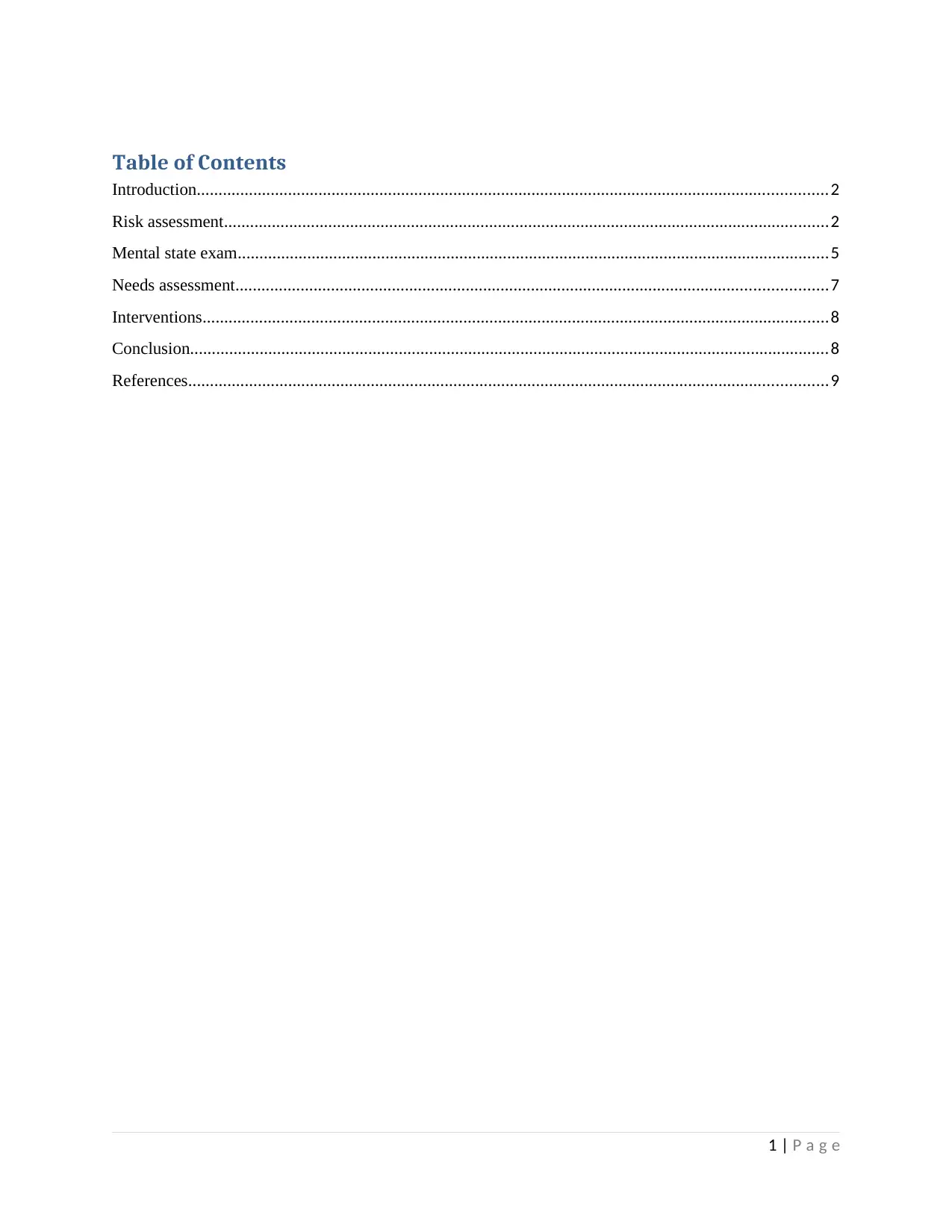
Table of Contents
Introduction.................................................................................................................................................2
Risk assessment...........................................................................................................................................2
Mental state exam........................................................................................................................................5
Needs assessment........................................................................................................................................7
Interventions................................................................................................................................................8
Conclusion...................................................................................................................................................8
References...................................................................................................................................................9
1 | P a g e
Introduction.................................................................................................................................................2
Risk assessment...........................................................................................................................................2
Mental state exam........................................................................................................................................5
Needs assessment........................................................................................................................................7
Interventions................................................................................................................................................8
Conclusion...................................................................................................................................................8
References...................................................................................................................................................9
1 | P a g e
Introduction
Acts that are fatal in nature, underlying intension behind which is ending one’s life which is self-
harm initiated. From a generic perspective, such acts are considered to be an impulsive act.
However, in reality such incidents associated with self-harm and suicidal tendency are associated
with years if suicidal behavior which includes suicidal acts or ideation associated with, deliberate
self-harm. In this context, self-harm can be considered as any kind of act of harm that may result
in causing self harm which is associated with an increased suicidal risk. The severity of the issue
is well established with the help of the statistics that reflects that as of 2016 the suicide rate in
Australia was 11.7 deaths per 100,000 people which increased from 10.6 per 100,000 individuals
as of 2007.
Considering the above made discussion the present Needs-for- service-assessment would focus
on risk assessment, mental state exam and needs assessment in regards to the provided case of
Steven.
Risk assessment
In case of individuals who demonstrate suicidal tendencies, as observed in case of Steven, in
majority of these incidents they display warning signs and clues. In case of these individuals who
tend to commit suicide, in most of the cases do not want to die, all they want is to stop the pain
they are going through (Lindsay, 2017). Most of these cases of suicide are preventable, with the
help of effective risk assessment.
In case of Steven, with the help of effective risk assessment, the risks which promoted him
towards committing such an act of self-harm followed by getting drunk can be effectively
analyzed (YouTube, 2018). This would help in preventing him in the future from further
committing such an act. Hence, for the purpose of performing effective risk assessment in case
of Steven there is certain aspects which are needed to be taken into considered which are as
follows:
The first factor which is needed to be taken into consideration in context to risk assessment is
Who is at risk?
2 | P a g e
Acts that are fatal in nature, underlying intension behind which is ending one’s life which is self-
harm initiated. From a generic perspective, such acts are considered to be an impulsive act.
However, in reality such incidents associated with self-harm and suicidal tendency are associated
with years if suicidal behavior which includes suicidal acts or ideation associated with, deliberate
self-harm. In this context, self-harm can be considered as any kind of act of harm that may result
in causing self harm which is associated with an increased suicidal risk. The severity of the issue
is well established with the help of the statistics that reflects that as of 2016 the suicide rate in
Australia was 11.7 deaths per 100,000 people which increased from 10.6 per 100,000 individuals
as of 2007.
Considering the above made discussion the present Needs-for- service-assessment would focus
on risk assessment, mental state exam and needs assessment in regards to the provided case of
Steven.
Risk assessment
In case of individuals who demonstrate suicidal tendencies, as observed in case of Steven, in
majority of these incidents they display warning signs and clues. In case of these individuals who
tend to commit suicide, in most of the cases do not want to die, all they want is to stop the pain
they are going through (Lindsay, 2017). Most of these cases of suicide are preventable, with the
help of effective risk assessment.
In case of Steven, with the help of effective risk assessment, the risks which promoted him
towards committing such an act of self-harm followed by getting drunk can be effectively
analyzed (YouTube, 2018). This would help in preventing him in the future from further
committing such an act. Hence, for the purpose of performing effective risk assessment in case
of Steven there is certain aspects which are needed to be taken into considered which are as
follows:
The first factor which is needed to be taken into consideration in context to risk assessment is
Who is at risk?
2 | P a g e
⊘ This is a preview!⊘
Do you want full access?
Subscribe today to unlock all pages.

Trusted by 1+ million students worldwide
There are three factors which are needed to be considered in this context which are biological
factor, psychological factor and social factor. In biological factors it has been observed that
substance abusers, individuals suffering from depression, suffering from mental illness, physical
illness, high risk behaviors, family history of suicide, individuals who are disfigured or disabled,
fatigued, individuals at the life stage of being elderly or adolescence are aspects the presence of
which if observed in any individual increases the risk of self-harm and suicidal tendencies
(rcpsych, 2018). In regards of these biological factors, if the case of Steven is analyzed it may be
observed that he was using alcohol in an excessive amount in the recent time. It reflects that in
regards to biological factors, the factor of substance abuse was present in his case (Rajwal &
Gash, 2006). Other associated biological factor like high risk behavior, fatigue because of work
load, and symptoms of depression because of turmoil he is going through due to broken marriage
and not being able to meet his children was also observable in his case. Basing on the analysis of
the biological factors establishes the fact that he is at increased risk of self-harm and suicidal
tendency.
In context to psychological factors aspects like depression or any other mental illness,
individual suffering from addiction, low self-esteem, poor coping skills, individuals who gets
easily angered or frustrated, feeling of hopelessness, despair or fear, increased level of
anxiousness and individuals who are impulsive in nature are at increased risk of self-harm and
suicide. The fact that the issues, Steven was having with, work life along with the despair of
broken marriage and the inability to meet his son and daughter was the major reason for
hopelessness in his case. Conversation with Steven provided with the clear reflection of his
feelings of hopeless or despairs due to broken marriage and not being able to meet his children.
With the help of the conversation with Steven, his depression due to the situation he was
undergoing in his life is also evident. The fact that he previously thought of self harm also
establishes that he was suffering from depression (Ceuschool, 2018). Excessive consumption of
alcohol on the part of Steven also reflects that he was suffering from depression. His lack of
ability to cope up with work load and issues with his personal life also establishes poor coping
skills. Thus his psychological factors reflect also puts forward the fact that he is at increased risk
of self harm.
3 | P a g e
factor, psychological factor and social factor. In biological factors it has been observed that
substance abusers, individuals suffering from depression, suffering from mental illness, physical
illness, high risk behaviors, family history of suicide, individuals who are disfigured or disabled,
fatigued, individuals at the life stage of being elderly or adolescence are aspects the presence of
which if observed in any individual increases the risk of self-harm and suicidal tendencies
(rcpsych, 2018). In regards of these biological factors, if the case of Steven is analyzed it may be
observed that he was using alcohol in an excessive amount in the recent time. It reflects that in
regards to biological factors, the factor of substance abuse was present in his case (Rajwal &
Gash, 2006). Other associated biological factor like high risk behavior, fatigue because of work
load, and symptoms of depression because of turmoil he is going through due to broken marriage
and not being able to meet his children was also observable in his case. Basing on the analysis of
the biological factors establishes the fact that he is at increased risk of self-harm and suicidal
tendency.
In context to psychological factors aspects like depression or any other mental illness,
individual suffering from addiction, low self-esteem, poor coping skills, individuals who gets
easily angered or frustrated, feeling of hopelessness, despair or fear, increased level of
anxiousness and individuals who are impulsive in nature are at increased risk of self-harm and
suicide. The fact that the issues, Steven was having with, work life along with the despair of
broken marriage and the inability to meet his son and daughter was the major reason for
hopelessness in his case. Conversation with Steven provided with the clear reflection of his
feelings of hopeless or despairs due to broken marriage and not being able to meet his children.
With the help of the conversation with Steven, his depression due to the situation he was
undergoing in his life is also evident. The fact that he previously thought of self harm also
establishes that he was suffering from depression (Ceuschool, 2018). Excessive consumption of
alcohol on the part of Steven also reflects that he was suffering from depression. His lack of
ability to cope up with work load and issues with his personal life also establishes poor coping
skills. Thus his psychological factors reflect also puts forward the fact that he is at increased risk
of self harm.
3 | P a g e
Paraphrase This Document
Need a fresh take? Get an instant paraphrase of this document with our AI Paraphraser
In order to determine individuals who are at increased risk of self harm and suicide considering
the social factors are also needed. Social factors include isolation, non-existent or unstable
support system, trauma survivor, changed/diminished socio-economic situation and experience
of relational loss. In case of Steven the issues of experiencing relational loss due to broken
marriage and not being able to meet his children could be clearly observed. Lack of any stable
support systems was also evident from his conversation in which he stated that followed by his
work days he has noting much to do that also reflects isolation which he was undergoing. Thus
the analysis of the social factors of Steven reflects the fact that he is under increased risks of self-
harm.
In the process of performing risk assessment in case of self-harm and suicidal tendencies,
protective factors of the client are also needed to be considered. Protective factors in case of
these clients include, strong connections with family members, religious and cultural believes
which discourage such acts, effective coping mechanisms, effective clinical care for physical
(Randall et al., 2013). In case of Steven the protective factors can be seen to be his attachment
for his family members particularly his children.
Risk assessment of these clients also needs to consider any trauma which the clients have
experienced. Trauma may be considered any objective incident or event which results in
adversely impacting or damaging the sense of belonging of an individual along with result in
creating anxiety among them. There are primarily 4 types of trauma that results in occurrence of
crises among clients which includes development traumas, situational traumas, intra-psychic
traumas and existential traumas (rcpsych, 2018). In case of Steven situational trauma is
observable. This kind of trauma is the result of any kind of situation or circumstance which
includes death of closed ones, broken down relationship, major illness, arrest, financial issues,
family violence etc. Intra-psychic trauma is associated with feeling and thoughts which result in
making an individual upset. Existential trauma is the result of lack of purpose in life and feeling
of emptiness. It is mainly associated when an individual identifies the fact that the daily activities
which are being performed on the part of the individual. In case of these traumas, different
individuals demonstrate different reactions which vary from anxiety, shock, anger, depression,
intellectualization and anger (Cross & Ashley, 2007). In case of Steven, the broken marriage can
be seen to lead to situational trauma, intra psychic trauma can be seen to be associated with not
4 | P a g e
the social factors are also needed. Social factors include isolation, non-existent or unstable
support system, trauma survivor, changed/diminished socio-economic situation and experience
of relational loss. In case of Steven the issues of experiencing relational loss due to broken
marriage and not being able to meet his children could be clearly observed. Lack of any stable
support systems was also evident from his conversation in which he stated that followed by his
work days he has noting much to do that also reflects isolation which he was undergoing. Thus
the analysis of the social factors of Steven reflects the fact that he is under increased risks of self-
harm.
In the process of performing risk assessment in case of self-harm and suicidal tendencies,
protective factors of the client are also needed to be considered. Protective factors in case of
these clients include, strong connections with family members, religious and cultural believes
which discourage such acts, effective coping mechanisms, effective clinical care for physical
(Randall et al., 2013). In case of Steven the protective factors can be seen to be his attachment
for his family members particularly his children.
Risk assessment of these clients also needs to consider any trauma which the clients have
experienced. Trauma may be considered any objective incident or event which results in
adversely impacting or damaging the sense of belonging of an individual along with result in
creating anxiety among them. There are primarily 4 types of trauma that results in occurrence of
crises among clients which includes development traumas, situational traumas, intra-psychic
traumas and existential traumas (rcpsych, 2018). In case of Steven situational trauma is
observable. This kind of trauma is the result of any kind of situation or circumstance which
includes death of closed ones, broken down relationship, major illness, arrest, financial issues,
family violence etc. Intra-psychic trauma is associated with feeling and thoughts which result in
making an individual upset. Existential trauma is the result of lack of purpose in life and feeling
of emptiness. It is mainly associated when an individual identifies the fact that the daily activities
which are being performed on the part of the individual. In case of these traumas, different
individuals demonstrate different reactions which vary from anxiety, shock, anger, depression,
intellectualization and anger (Cross & Ashley, 2007). In case of Steven, the broken marriage can
be seen to lead to situational trauma, intra psychic trauma can be seen to be associated with not
4 | P a g e
being able to meet his children and existential trauma may be seen to be associated with his lack
of satisfaction with his job life. Thus the presence of three forms of trauma can be seen to be
present in case of Steven.
In case of risk assessment of clients associate with self-harm and suicidal tendencies analysis the
sings of crisis which are being disseminated on the part of an individual are also needed to be
taken into consideration. It is due to the fact that certain signs of crisis are more obvious in case
of these clients. In case of certain clients associated with self harm is also noticed that they tend
to verbalize distress (Kapur et al., 2007). On the part of some clients it is noticed that that exhibit
acting out behavior. In this regard, on analyzing the case of Steven it is noticed that his distress
associated with broken marriage, pressure for paying mortgage, not being able to meet his
children is clearly seen to be verbalized.
Knowing the history of the client is who is being assessed is also important it is particularly
significant in case of clients associated with risk of self harm. On analyzing the history of Steven
it can be observed that he was not the same as he is in the present. His history reveals that, as per
his wife his behavior has changed significantly, turned out to be irritable and more involved in
consumption of alcohol (patient, 2014). Static factors are also needed to be taken into considered
in this context which includes substance abuse, mental health condition, driving in an intoxicated
stated, involvement in criminal justice. In case of Steven the static factor of alcohol use is
noticeable. It is worth mentioning that behaviors are the most effective means of predicting
behavior which is needed to be focused in the process of assessing clients with risk of self harm.
The aspects which are needed to be considered in this context are use of drugs or alcohol,
anxiousness, depression, despondent, remorseful, anger, agitated, appetite change and
experiencing sleeplessness (health, 2018). In regards of behavioral pattern of Steven as well, use
of drug, depression, to certain extent sleepless is noticeable. Thus, basing on the risk assessment
of Steven it can be clearly stated that he is at increased risk of self harm and suicide.
Mental state exam
This is a systematic way of appraising the behavior, appearance, mental functioning and the total
behavior of an individual. It is a way in which the overview regarding the psychological
functioning of an individual may be gathered at a specific point of time. There are certain
5 | P a g e
of satisfaction with his job life. Thus the presence of three forms of trauma can be seen to be
present in case of Steven.
In case of risk assessment of clients associate with self-harm and suicidal tendencies analysis the
sings of crisis which are being disseminated on the part of an individual are also needed to be
taken into consideration. It is due to the fact that certain signs of crisis are more obvious in case
of these clients. In case of certain clients associated with self harm is also noticed that they tend
to verbalize distress (Kapur et al., 2007). On the part of some clients it is noticed that that exhibit
acting out behavior. In this regard, on analyzing the case of Steven it is noticed that his distress
associated with broken marriage, pressure for paying mortgage, not being able to meet his
children is clearly seen to be verbalized.
Knowing the history of the client is who is being assessed is also important it is particularly
significant in case of clients associated with risk of self harm. On analyzing the history of Steven
it can be observed that he was not the same as he is in the present. His history reveals that, as per
his wife his behavior has changed significantly, turned out to be irritable and more involved in
consumption of alcohol (patient, 2014). Static factors are also needed to be taken into considered
in this context which includes substance abuse, mental health condition, driving in an intoxicated
stated, involvement in criminal justice. In case of Steven the static factor of alcohol use is
noticeable. It is worth mentioning that behaviors are the most effective means of predicting
behavior which is needed to be focused in the process of assessing clients with risk of self harm.
The aspects which are needed to be considered in this context are use of drugs or alcohol,
anxiousness, depression, despondent, remorseful, anger, agitated, appetite change and
experiencing sleeplessness (health, 2018). In regards of behavioral pattern of Steven as well, use
of drug, depression, to certain extent sleepless is noticeable. Thus, basing on the risk assessment
of Steven it can be clearly stated that he is at increased risk of self harm and suicide.
Mental state exam
This is a systematic way of appraising the behavior, appearance, mental functioning and the total
behavior of an individual. It is a way in which the overview regarding the psychological
functioning of an individual may be gathered at a specific point of time. There are certain
5 | P a g e
⊘ This is a preview!⊘
Do you want full access?
Subscribe today to unlock all pages.
Trusted by 1+ million students worldwide
domains under which this appraisal is done. The first domain in this examination is appearance
and behavior (almostadoctor, 2017). This domain provides with an idea regarding the quality of
life style and emotional state of an individual. On analyzing appearance of Steven his clothing is
observable which reflects that presence of mismatch. To certain extent it reflects the lack of
ability on the part of Steven in coordinating his thoughts. Other than that, the choice of gloomy
shades being predominant in his clothing also reflects the state of his mind to certain extent.
Similarly the behavior of Steven reflected agitation (YouTube, 2018). This body movement and
gestures reflects the use of large hand gestures in the process of communicating with the
interviewer which is a clear demonstration of the fact that he is in a chaotic state of mind and is
out of control. His level of arousal also reflects the presence of agitation.
In regards to speech, it can be seen to usual in regards to the variation in his tone. Spontaneity in
his tone was present with pause in part of the communication particularly when discussing if he
has been thinking of such self-harm actions previous or in a repetitive manner.
In the domain of mood and affect, his mood reflected depression. In regards to affect it seemed
to be expansive. In context to his cognition, the analysis of his memory functioning reflected the
fact that he was not having the short term memory associated with the detailing of the previous
night when the incident occurred (Potter, 2018). He was only able to provide with certain details
of the incident. It is an integral aspect which is needed to be analyzed as it provided with the
present ability of the individual to provide with information.
The analysis of thoughts also plays an integral role in this examination. It is evaluated in
accordance to content and process (rch, 2018). The content analysis of his thoughts reflects that
he had depressive thoughts and thoughts associated with self harm for some time. The major
underlying reason being his broken relationship and not being able to meet his children . The
process of his thoughts to certain extent demonstrated circumstantial thinking. No issues with his
perceptions could be noticed.
In regards to the domain of insight and judgment, the domain of insight reflects that though he
believes that the way he has been acting is not usual but it can be noticed that he is not much
willing to seek professional help. Insight analysis of Steven reflects that he is of the opinion that
such depressive phases are part of life. Though he was aware of his behavior but he can be seen
6 | P a g e
and behavior (almostadoctor, 2017). This domain provides with an idea regarding the quality of
life style and emotional state of an individual. On analyzing appearance of Steven his clothing is
observable which reflects that presence of mismatch. To certain extent it reflects the lack of
ability on the part of Steven in coordinating his thoughts. Other than that, the choice of gloomy
shades being predominant in his clothing also reflects the state of his mind to certain extent.
Similarly the behavior of Steven reflected agitation (YouTube, 2018). This body movement and
gestures reflects the use of large hand gestures in the process of communicating with the
interviewer which is a clear demonstration of the fact that he is in a chaotic state of mind and is
out of control. His level of arousal also reflects the presence of agitation.
In regards to speech, it can be seen to usual in regards to the variation in his tone. Spontaneity in
his tone was present with pause in part of the communication particularly when discussing if he
has been thinking of such self-harm actions previous or in a repetitive manner.
In the domain of mood and affect, his mood reflected depression. In regards to affect it seemed
to be expansive. In context to his cognition, the analysis of his memory functioning reflected the
fact that he was not having the short term memory associated with the detailing of the previous
night when the incident occurred (Potter, 2018). He was only able to provide with certain details
of the incident. It is an integral aspect which is needed to be analyzed as it provided with the
present ability of the individual to provide with information.
The analysis of thoughts also plays an integral role in this examination. It is evaluated in
accordance to content and process (rch, 2018). The content analysis of his thoughts reflects that
he had depressive thoughts and thoughts associated with self harm for some time. The major
underlying reason being his broken relationship and not being able to meet his children . The
process of his thoughts to certain extent demonstrated circumstantial thinking. No issues with his
perceptions could be noticed.
In regards to the domain of insight and judgment, the domain of insight reflects that though he
believes that the way he has been acting is not usual but it can be noticed that he is not much
willing to seek professional help. Insight analysis of Steven reflects that he is of the opinion that
such depressive phases are part of life. Though he was aware of his behavior but he can be seen
6 | P a g e
Paraphrase This Document
Need a fresh take? Get an instant paraphrase of this document with our AI Paraphraser
to be of the opinion that it is not something for which he needed treatment or was not considering
it as mental disorder. In terms of his judgment, it could be seen to be effective which can be
noticed from the fact that he had clarity regarding his responsibility towards his children and
about the fact that death was not an option.
Needs assessment
Followed by risk assessment and mental state exam, needs assessment are also needed to be
conduct. It is due to the fact that, only with the help of needs assessment, the kind of requirement
of the client can be effectively analyzed on the basis of which he may be provided with the
needed support (Hume & Platt, 2007). There are certain aspects which are needed to be
considered followed by the incident of self-harm on the basis of which need assessment can be
effectively conducted. One of the major aspect in this context is personal relations which
includes recent broken down major relations. From this perspective is the needs of Steven is
analyzed one of major need is that of a social support.
Social situation is also needed to be taken into consideration for need assessment. This mainly
includes present arrangement of living, debt and work (Kendall et al., 2011).. In case of Steven,
his lack of any individual family and residing within his parents is a considerable aspect in terms
of his social situation. His social situation also reflects his lack of satisfaction with job but need
to pay for his mortgages preventing him from leaving the job.
Present difficulties of the client along with recent life events are also needed to be taken into
consideration. Not being able to meet his children and the sense of not doing good at his job was
some of the major challenges he was experiencing.
The psychiatric history of the client which also includes any history of alcohol use and previous
harm is needed to be considered. The psychiatric history of Steven reflects that he has been binge
drinking lately. Enduring psychological characters which are associated with self harm are also
needed to be noted (drugsandalcohol, 2010). In Steven’s case, the persistent depressive thoughts
are one of such psychological characteristics.
Motivation for the act is another major component which is worth considering. In his case, it was
the willingness to be free from the thoughts which has been disturbing him.
7 | P a g e
it as mental disorder. In terms of his judgment, it could be seen to be effective which can be
noticed from the fact that he had clarity regarding his responsibility towards his children and
about the fact that death was not an option.
Needs assessment
Followed by risk assessment and mental state exam, needs assessment are also needed to be
conduct. It is due to the fact that, only with the help of needs assessment, the kind of requirement
of the client can be effectively analyzed on the basis of which he may be provided with the
needed support (Hume & Platt, 2007). There are certain aspects which are needed to be
considered followed by the incident of self-harm on the basis of which need assessment can be
effectively conducted. One of the major aspect in this context is personal relations which
includes recent broken down major relations. From this perspective is the needs of Steven is
analyzed one of major need is that of a social support.
Social situation is also needed to be taken into consideration for need assessment. This mainly
includes present arrangement of living, debt and work (Kendall et al., 2011).. In case of Steven,
his lack of any individual family and residing within his parents is a considerable aspect in terms
of his social situation. His social situation also reflects his lack of satisfaction with job but need
to pay for his mortgages preventing him from leaving the job.
Present difficulties of the client along with recent life events are also needed to be taken into
consideration. Not being able to meet his children and the sense of not doing good at his job was
some of the major challenges he was experiencing.
The psychiatric history of the client which also includes any history of alcohol use and previous
harm is needed to be considered. The psychiatric history of Steven reflects that he has been binge
drinking lately. Enduring psychological characters which are associated with self harm are also
needed to be noted (drugsandalcohol, 2010). In Steven’s case, the persistent depressive thoughts
are one of such psychological characteristics.
Motivation for the act is another major component which is worth considering. In his case, it was
the willingness to be free from the thoughts which has been disturbing him.
7 | P a g e
In case of formulation of needs of such clients there are certain other aspects as well which are
needed to be taken into consideration. One of this aspect is long term vulnerability factor. In case
of Steven the long term vulnerability factor was his broken marriage. Short term vulnerability is
also required to be noted. The absence of any kind of social support and over consumption of
alcohol can be seen to be aspects of short term vulnerability. Precipitating factor in this case was
the comment on the part of his mate that he is 42 years and still living with his parents.
Interventions
Thus, on the basis of the analysis of the risks and needs of Steven interventions are needed to be
implemented for the purpose avoiding further occurrences if such instance.
One of the applicable interventions in this case is providing him with community support. It is an
effective means of management of such cases of self harm (Nock, 2010). It is with the help of
such intervention individuals may be realized that they are not alone going though such phase
which makes it easy for clients like Steven to cope up easily. This would also help him in dealing
with the isolation in an impactful manner.
In his case issue of alcohol consumption was to be a matter of concern. For the purpose of
managing the issue of alcohol consumption, providing him with assistance with the help of
alcohol support groups would also he impactful in motivating him in eradicating such practices
(drugsandalcohol, 2010).
He can also be seen to be suffering from depression. This acted as a major contributing factor in
taking such initiative on the part of Steven. In order to manage the issue of depression he would
be needed to provide with psychological intervention like CBT.
Conclusion
In the conclusion it may be stated that self-harm and suicidal tendencies are major concern
across the globe which results in number of death. Such incidents can be successfully prevented
with the help of timely risk assessment and mental state exam. It is due to the fact that every
individual associated with self harm disseminated certain behavioral traits. If it can be identified
8 | P a g e
needed to be taken into consideration. One of this aspect is long term vulnerability factor. In case
of Steven the long term vulnerability factor was his broken marriage. Short term vulnerability is
also required to be noted. The absence of any kind of social support and over consumption of
alcohol can be seen to be aspects of short term vulnerability. Precipitating factor in this case was
the comment on the part of his mate that he is 42 years and still living with his parents.
Interventions
Thus, on the basis of the analysis of the risks and needs of Steven interventions are needed to be
implemented for the purpose avoiding further occurrences if such instance.
One of the applicable interventions in this case is providing him with community support. It is an
effective means of management of such cases of self harm (Nock, 2010). It is with the help of
such intervention individuals may be realized that they are not alone going though such phase
which makes it easy for clients like Steven to cope up easily. This would also help him in dealing
with the isolation in an impactful manner.
In his case issue of alcohol consumption was to be a matter of concern. For the purpose of
managing the issue of alcohol consumption, providing him with assistance with the help of
alcohol support groups would also he impactful in motivating him in eradicating such practices
(drugsandalcohol, 2010).
He can also be seen to be suffering from depression. This acted as a major contributing factor in
taking such initiative on the part of Steven. In order to manage the issue of depression he would
be needed to provide with psychological intervention like CBT.
Conclusion
In the conclusion it may be stated that self-harm and suicidal tendencies are major concern
across the globe which results in number of death. Such incidents can be successfully prevented
with the help of timely risk assessment and mental state exam. It is due to the fact that every
individual associated with self harm disseminated certain behavioral traits. If it can be identified
8 | P a g e
⊘ This is a preview!⊘
Do you want full access?
Subscribe today to unlock all pages.
Trusted by 1+ million students worldwide
in the early stage, they may be provided with the needed intervention that would help in
preventing such occurrences.
9 | P a g e
preventing such occurrences.
9 | P a g e
Paraphrase This Document
Need a fresh take? Get an instant paraphrase of this document with our AI Paraphraser
References
almostadoctor. (2017). Mental State Exam. [online] Available at:
https://almostadoctor.co.uk/encyclopedia/mental-state-exam#Appearance_and_behaviour
[Accessed 26 May 2018].
Ceuschool. (2018). Assessing Client Risk for Self Harm. [online] Available at:
https://www.ceuschool.com/librarydocs/soc219.pdf [Accessed 26 May 2018].
Cross, C. L., & Ashley, L. (2007). Trauma and addiction: implications for helping professionals.
Journal of psychosocial nursing and mental health services, 45(1), 24-31.
drugsandalcohol. (2010). Self-harm, suicide and risk: helping people who self-harm. [online]
Available at:
https://www.drugsandalcohol.ie/20686/1/Self_harm_helping_people_who_self-harm.pdf
[Accessed 26 May 2018].
health. (2018). Suicide risk assessment. [online] Available at:
https://www2.health.vic.gov.au/mental-health/practice-and-service-quality/safety/suicide-
prevention-in-mental-health-services/suicide-risk-assessment [Accessed 26 May 2018].
Hume, M., & Platt, S. (2007). Appropriate interventions for the prevention and management of
self-harm: a qualitative exploration of service-users' views. BMC Public Health, 7(1), 9.
Kapur, N., Cooper, J., Rodway, C., Kelly, J., Guthrie, E., & Mackway-Jones, K. (2007).
Predicting the risk of repetition after self harm: cohort study. Bmj, 330(7488), 394-395.
Kendall, T., Taylor, C., Bhatti, H., Chan, M., Kapur, N., & Guideline Development Group.
(2011). Longer term management of self harm: summary of NICE guidance. BMJ, 343,
d7073.
Lindsay, T. (2017). Risk assessment and self-harm. Cancer, Sex, Drugs and Death: A Clinician
Guide to the Psychological Management of Young People with Cancer, 76.
Nock, M. K. (2010). Self-injury. Annual review of clinical psychology, 6, 339-363.
patient. (2014). Suicide Risk Assessment and Threats of Suicide. [online] Available at:
https://patient.info/doctor/suicide-risk-assessment-and-threats-of-suicide [Accessed 26
May 2018].
Potter, D. (2018). Mental state examination - OSCE guide. [online] geekymedics. Available at:
https://geekymedics.com/mental-state-examination/#1 [Accessed 26 May 2018].
10 | P a g e
almostadoctor. (2017). Mental State Exam. [online] Available at:
https://almostadoctor.co.uk/encyclopedia/mental-state-exam#Appearance_and_behaviour
[Accessed 26 May 2018].
Ceuschool. (2018). Assessing Client Risk for Self Harm. [online] Available at:
https://www.ceuschool.com/librarydocs/soc219.pdf [Accessed 26 May 2018].
Cross, C. L., & Ashley, L. (2007). Trauma and addiction: implications for helping professionals.
Journal of psychosocial nursing and mental health services, 45(1), 24-31.
drugsandalcohol. (2010). Self-harm, suicide and risk: helping people who self-harm. [online]
Available at:
https://www.drugsandalcohol.ie/20686/1/Self_harm_helping_people_who_self-harm.pdf
[Accessed 26 May 2018].
health. (2018). Suicide risk assessment. [online] Available at:
https://www2.health.vic.gov.au/mental-health/practice-and-service-quality/safety/suicide-
prevention-in-mental-health-services/suicide-risk-assessment [Accessed 26 May 2018].
Hume, M., & Platt, S. (2007). Appropriate interventions for the prevention and management of
self-harm: a qualitative exploration of service-users' views. BMC Public Health, 7(1), 9.
Kapur, N., Cooper, J., Rodway, C., Kelly, J., Guthrie, E., & Mackway-Jones, K. (2007).
Predicting the risk of repetition after self harm: cohort study. Bmj, 330(7488), 394-395.
Kendall, T., Taylor, C., Bhatti, H., Chan, M., Kapur, N., & Guideline Development Group.
(2011). Longer term management of self harm: summary of NICE guidance. BMJ, 343,
d7073.
Lindsay, T. (2017). Risk assessment and self-harm. Cancer, Sex, Drugs and Death: A Clinician
Guide to the Psychological Management of Young People with Cancer, 76.
Nock, M. K. (2010). Self-injury. Annual review of clinical psychology, 6, 339-363.
patient. (2014). Suicide Risk Assessment and Threats of Suicide. [online] Available at:
https://patient.info/doctor/suicide-risk-assessment-and-threats-of-suicide [Accessed 26
May 2018].
Potter, D. (2018). Mental state examination - OSCE guide. [online] geekymedics. Available at:
https://geekymedics.com/mental-state-examination/#1 [Accessed 26 May 2018].
10 | P a g e
Rajwal, M., & Gash, A. (2006). Risk assessment in self-harm. The Psychiatrist, 30(11), 436-436.
Randall, J. R., Rowe, B. H., Dong, K. A., Nock, M. K., & Colman, I. (2013). Assessment of self-
harm risk using implicit thoughts. Psychological assessment, 25(3), 714.
rch. (2018). Mental state examination. [online] Available at:
https://www.rch.org.au/clinicalguide/guideline_index/Mental_state_examination/
[Accessed 26 May 2018].
rcpsych. (2018). Link to Clinical Risk Assessment Policy 1 Clinical Risk Assessment and
Management. [online] Available at: https://www.rcpsych.ac.uk/pdf/Camden%20risk
%20assessment%20and%20management.pdf [Accessed 26 May 2018].
YouTube. (2018). Suicide and Self Harm Crisis Interview. [online] Available at:
https://www.youtube.com/watch?v=fLXfDepZ-o0&t=293s [Accessed 26 May 2018].
11 | P a g e
Randall, J. R., Rowe, B. H., Dong, K. A., Nock, M. K., & Colman, I. (2013). Assessment of self-
harm risk using implicit thoughts. Psychological assessment, 25(3), 714.
rch. (2018). Mental state examination. [online] Available at:
https://www.rch.org.au/clinicalguide/guideline_index/Mental_state_examination/
[Accessed 26 May 2018].
rcpsych. (2018). Link to Clinical Risk Assessment Policy 1 Clinical Risk Assessment and
Management. [online] Available at: https://www.rcpsych.ac.uk/pdf/Camden%20risk
%20assessment%20and%20management.pdf [Accessed 26 May 2018].
YouTube. (2018). Suicide and Self Harm Crisis Interview. [online] Available at:
https://www.youtube.com/watch?v=fLXfDepZ-o0&t=293s [Accessed 26 May 2018].
11 | P a g e
⊘ This is a preview!⊘
Do you want full access?
Subscribe today to unlock all pages.
Trusted by 1+ million students worldwide

1 out of 12


Related Documents


Your All-in-One AI-Powered Toolkit for Academic Success.
+13062052269
info@desklib.com
Available 24*7 on WhatsApp / Email
![[object Object]](/_next/static/media/star-bottom.7253800d.svg)
Unlock your academic potential
Copyright © 2020–2026 A2Z Services. All Rights Reserved. Developed and managed by ZUCOL.