Challenges Faced by Software Developers in Development
VerifiedAdded on 2023/01/10
|44
|13043
|30
Report
AI Summary
This report delves into the multifaceted challenges encountered by software developers. It begins by defining software development and outlining its various stages, methodologies, and potential vulnerabilities. The report explores different software development methodologies, such as agile, waterfall, and prototyping, and their impact on the development process. It then examines the critical challenges developers face, including requirement gathering, team coordination, bug identification, cost management, and security concerns. A literature review provides a foundation by analyzing existing research and identifying gaps in current knowledge. The research methodology involves the use of questionnaires to gather data from developers, and the report analyzes the findings to identify common issues and potential solutions. The report aims to provide a comprehensive understanding of the challenges in software development and offers insights into best practices for addressing them.
Software
Development
Development

Paraphrase This Document
Need a fresh take? Get an instant paraphrase of this document with our AI Paraphraser
Abstract
Software development is defined an art related with creation of programs that are liable
for performing certain tasks by following peculiar set of processes. This involves wide range of
steps which comprises of thinking about idea for resolving any issue, designing rough idea with
respect to that, execution of blueprint, its testing through which bugs can be fixed and many
more aspects are there. For this, software developer makes use of different methodologies that
assists them within precisely carrying out each phase associated with development. This assists
them within ensuring that all the aspects are conducted in an adequate manner. There are
different methodologies, they are agile, rapid application development, waterfall, prototyping
and many more. As per the requirements of the software, developer opts for the one but here they
make sure that all the necessary aspects of method are considered so that it do not creates any
pessimistic influence on the overall working of the software. The questionnaire is being utilised
as a tool for gathering of information and sample space taken will be developers so that adequate
results with reference to dissertation can be attained.
Software development is defined an art related with creation of programs that are liable
for performing certain tasks by following peculiar set of processes. This involves wide range of
steps which comprises of thinking about idea for resolving any issue, designing rough idea with
respect to that, execution of blueprint, its testing through which bugs can be fixed and many
more aspects are there. For this, software developer makes use of different methodologies that
assists them within precisely carrying out each phase associated with development. This assists
them within ensuring that all the aspects are conducted in an adequate manner. There are
different methodologies, they are agile, rapid application development, waterfall, prototyping
and many more. As per the requirements of the software, developer opts for the one but here they
make sure that all the necessary aspects of method are considered so that it do not creates any
pessimistic influence on the overall working of the software. The questionnaire is being utilised
as a tool for gathering of information and sample space taken will be developers so that adequate
results with reference to dissertation can be attained.
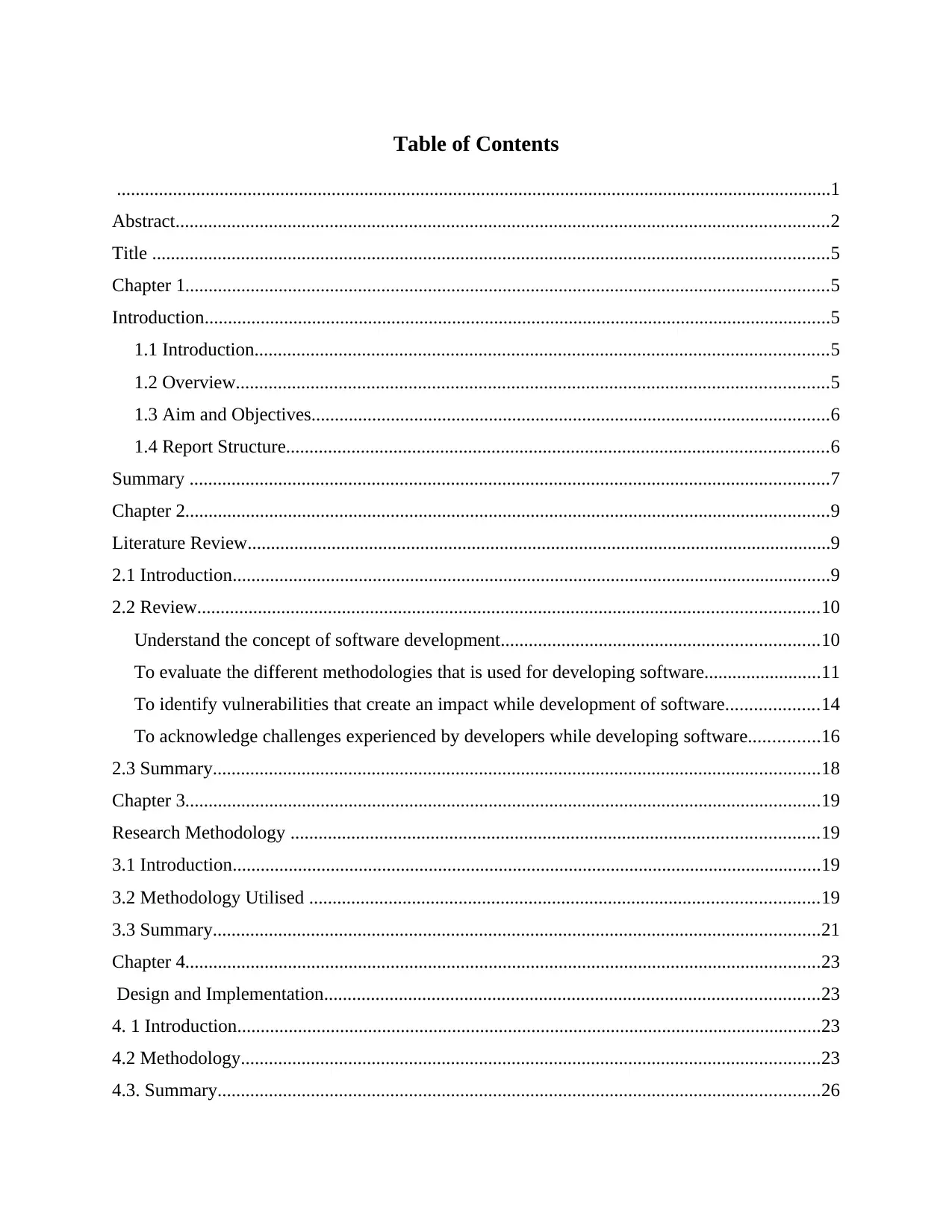
Table of Contents
.........................................................................................................................................................1
Abstract............................................................................................................................................2
Title .................................................................................................................................................5
Chapter 1..........................................................................................................................................5
Introduction......................................................................................................................................5
1.1 Introduction...........................................................................................................................5
1.2 Overview...............................................................................................................................5
1.3 Aim and Objectives...............................................................................................................6
1.4 Report Structure....................................................................................................................6
Summary .........................................................................................................................................7
Chapter 2..........................................................................................................................................9
Literature Review.............................................................................................................................9
2.1 Introduction................................................................................................................................9
2.2 Review.....................................................................................................................................10
Understand the concept of software development....................................................................10
To evaluate the different methodologies that is used for developing software.........................11
To identify vulnerabilities that create an impact while development of software....................14
To acknowledge challenges experienced by developers while developing software...............16
2.3 Summary..................................................................................................................................18
Chapter 3........................................................................................................................................19
Research Methodology .................................................................................................................19
3.1 Introduction..............................................................................................................................19
3.2 Methodology Utilised .............................................................................................................19
3.3 Summary..................................................................................................................................21
Chapter 4........................................................................................................................................23
Design and Implementation..........................................................................................................23
4. 1 Introduction.............................................................................................................................23
4.2 Methodology............................................................................................................................23
4.3. Summary.................................................................................................................................26
.........................................................................................................................................................1
Abstract............................................................................................................................................2
Title .................................................................................................................................................5
Chapter 1..........................................................................................................................................5
Introduction......................................................................................................................................5
1.1 Introduction...........................................................................................................................5
1.2 Overview...............................................................................................................................5
1.3 Aim and Objectives...............................................................................................................6
1.4 Report Structure....................................................................................................................6
Summary .........................................................................................................................................7
Chapter 2..........................................................................................................................................9
Literature Review.............................................................................................................................9
2.1 Introduction................................................................................................................................9
2.2 Review.....................................................................................................................................10
Understand the concept of software development....................................................................10
To evaluate the different methodologies that is used for developing software.........................11
To identify vulnerabilities that create an impact while development of software....................14
To acknowledge challenges experienced by developers while developing software...............16
2.3 Summary..................................................................................................................................18
Chapter 3........................................................................................................................................19
Research Methodology .................................................................................................................19
3.1 Introduction..............................................................................................................................19
3.2 Methodology Utilised .............................................................................................................19
3.3 Summary..................................................................................................................................21
Chapter 4........................................................................................................................................23
Design and Implementation..........................................................................................................23
4. 1 Introduction.............................................................................................................................23
4.2 Methodology............................................................................................................................23
4.3. Summary.................................................................................................................................26
⊘ This is a preview!⊘
Do you want full access?
Subscribe today to unlock all pages.

Trusted by 1+ million students worldwide
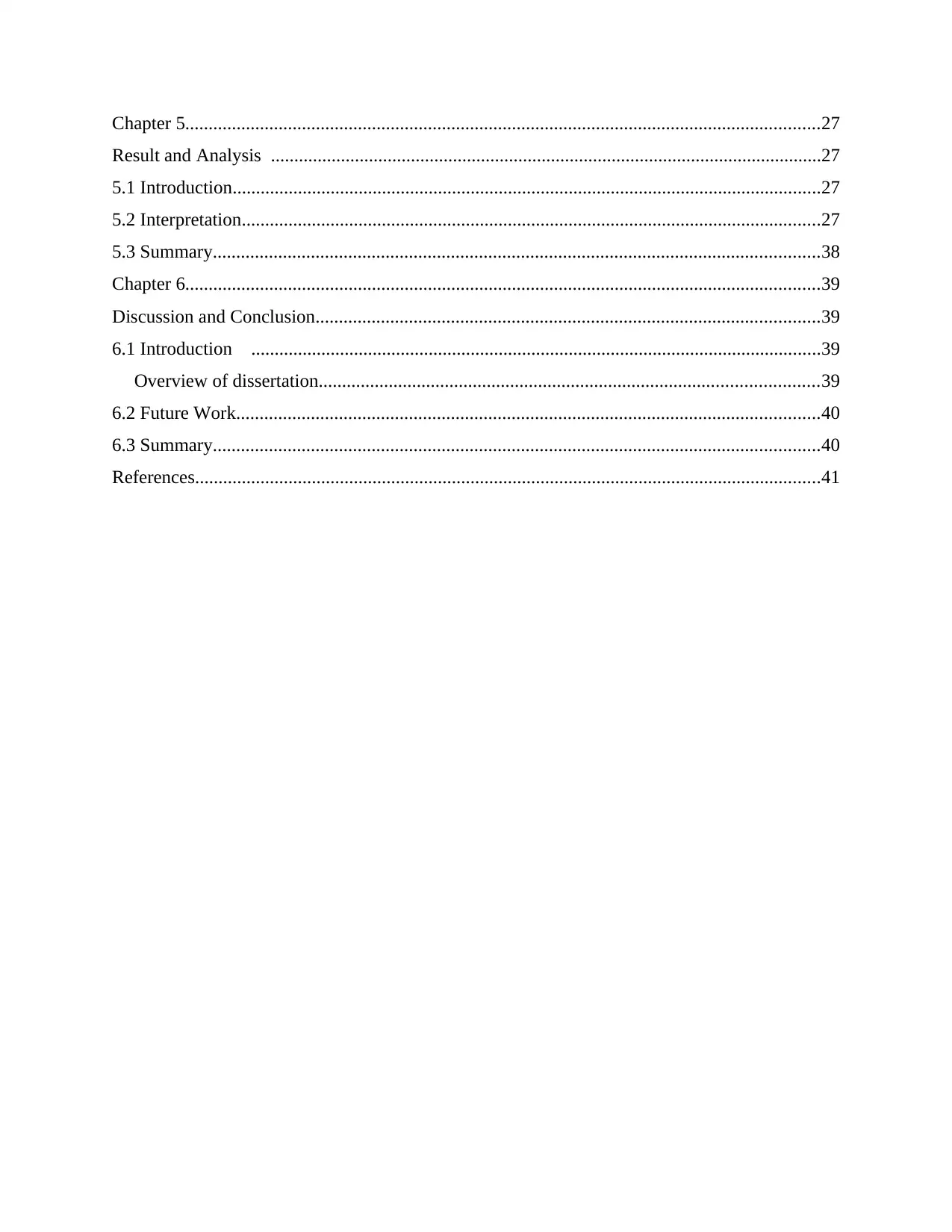
Chapter 5........................................................................................................................................27
Result and Analysis ......................................................................................................................27
5.1 Introduction..............................................................................................................................27
5.2 Interpretation............................................................................................................................27
5.3 Summary..................................................................................................................................38
Chapter 6........................................................................................................................................39
Discussion and Conclusion............................................................................................................39
6.1 Introduction ..........................................................................................................................39
Overview of dissertation...........................................................................................................39
6.2 Future Work.............................................................................................................................40
6.3 Summary..................................................................................................................................40
References......................................................................................................................................41
Result and Analysis ......................................................................................................................27
5.1 Introduction..............................................................................................................................27
5.2 Interpretation............................................................................................................................27
5.3 Summary..................................................................................................................................38
Chapter 6........................................................................................................................................39
Discussion and Conclusion............................................................................................................39
6.1 Introduction ..........................................................................................................................39
Overview of dissertation...........................................................................................................39
6.2 Future Work.............................................................................................................................40
6.3 Summary..................................................................................................................................40
References......................................................................................................................................41
Paraphrase This Document
Need a fresh take? Get an instant paraphrase of this document with our AI Paraphraser
Title
To examine the challenges that is being faced by software developer while developing
software.
Chapter 1
Introduction
1.1 Introduction
Technology is rapidly evolving and to meet the requirements of market organisations are
also altering the ways of their operations. For this they make use of different software but it is
crucial to understand various aspects that are associated with software development. Basically,
insight will be gained challenges that are being faced by developers while working on any
software development (Poniszewska-Marańda, Zieliski and Marańda, 2020). Software denotes
aggregation of computer instruction or data which gives instruction to system in which they have
to work. There are different kinds of software and each has different purpose, they are:
application, system and malicious software. Software development comprises of all the activities
that are liable for bringing in project from conception within the production delivery. It is a set of
computer science activities that are dedicated for process associated with creation, formulation of
designs, deployment and support software. To develop a software, developers makes use of
different methodologies to ensure that adequate results are attained.
1.2 Overview
Software development is a broad concept as at present scenario firms make use of
different software’s through which they are able to deliver their services in precise manner. But
there are different aspects that are involved within the software development. The dissertations
aims at identification challenges that are being faced by developer either its coordination among
team, gathering of requirements, identification of bugs, cost involved, security concerns and
identification of bugs by making use of testing (Ríos and Souto, 2020). It is necessary to
acknowledge these aspects so that precise understanding can be developed with reference to the
software development. The probable significance of this study is to acknowledge various
challenges that are involved within development of software. Evan after having precise
information, it is difficult to analyse which model or methodology will be adequate through
To examine the challenges that is being faced by software developer while developing
software.
Chapter 1
Introduction
1.1 Introduction
Technology is rapidly evolving and to meet the requirements of market organisations are
also altering the ways of their operations. For this they make use of different software but it is
crucial to understand various aspects that are associated with software development. Basically,
insight will be gained challenges that are being faced by developers while working on any
software development (Poniszewska-Marańda, Zieliski and Marańda, 2020). Software denotes
aggregation of computer instruction or data which gives instruction to system in which they have
to work. There are different kinds of software and each has different purpose, they are:
application, system and malicious software. Software development comprises of all the activities
that are liable for bringing in project from conception within the production delivery. It is a set of
computer science activities that are dedicated for process associated with creation, formulation of
designs, deployment and support software. To develop a software, developers makes use of
different methodologies to ensure that adequate results are attained.
1.2 Overview
Software development is a broad concept as at present scenario firms make use of
different software’s through which they are able to deliver their services in precise manner. But
there are different aspects that are involved within the software development. The dissertations
aims at identification challenges that are being faced by developer either its coordination among
team, gathering of requirements, identification of bugs, cost involved, security concerns and
identification of bugs by making use of testing (Ríos and Souto, 2020). It is necessary to
acknowledge these aspects so that precise understanding can be developed with reference to the
software development. The probable significance of this study is to acknowledge various
challenges that are involved within development of software. Evan after having precise
information, it is difficult to analyse which model or methodology will be adequate through
which precise results can be attained, the cost given is adequate to complete the project, which
kind of testing can be used, whether bugs found can be resolved or nor, vulnerabilities within the
software, security issues and many more are there which are associated with every software
development project. It is necessary to acknowledge these aspects to ensure that project is
success (Riaz, 2020). For having an in-depth knowledge related with this concept, the
dissertation is conducted.
1.3 Aim and Objectives
Research Aim
To examine the challenges that is being faced by software developer while developing
software.
Research Objectives:
To understand the concept of software development
To evaluate the different methodologies that is used for developing software.
To identify vulnerabilities that create an impact while development of software
To acknowledge challenges experienced by developers while developing software.
1.4 Report Structure
It denotes critical aspect associated with the research that provides assistance to readers to
have precise information of each chapter in context of what is considered is referred to as route
map. With reference to this section of research, distinct chapters are presented as per the needs
data will be specified.
Chapter 1: Introduction: This denotes introductory sections which will provide all the
essential details related with what is presented within research and will furnish in-depth view of
the topic on which research is being conducted. This chapter will provide readers with
information related with aims and objectives for carrying out this study.
Chapter 2: Literature Review: This implies second chapter that comprises of study that
is conducted by various authors. For doing this, enhanced range of books, publications, articles
and various other sources will be utilised for having precise information. It is responsible for
furnishing support to their readers along with opportunity through which they can have relevant
information associated with work that is conducted by other authors. It will assist them to
acknowledge opinions and have view point in context of challenges faced by software
developers while working on any specific software. This will aid researcher within grabbing
kind of testing can be used, whether bugs found can be resolved or nor, vulnerabilities within the
software, security issues and many more are there which are associated with every software
development project. It is necessary to acknowledge these aspects to ensure that project is
success (Riaz, 2020). For having an in-depth knowledge related with this concept, the
dissertation is conducted.
1.3 Aim and Objectives
Research Aim
To examine the challenges that is being faced by software developer while developing
software.
Research Objectives:
To understand the concept of software development
To evaluate the different methodologies that is used for developing software.
To identify vulnerabilities that create an impact while development of software
To acknowledge challenges experienced by developers while developing software.
1.4 Report Structure
It denotes critical aspect associated with the research that provides assistance to readers to
have precise information of each chapter in context of what is considered is referred to as route
map. With reference to this section of research, distinct chapters are presented as per the needs
data will be specified.
Chapter 1: Introduction: This denotes introductory sections which will provide all the
essential details related with what is presented within research and will furnish in-depth view of
the topic on which research is being conducted. This chapter will provide readers with
information related with aims and objectives for carrying out this study.
Chapter 2: Literature Review: This implies second chapter that comprises of study that
is conducted by various authors. For doing this, enhanced range of books, publications, articles
and various other sources will be utilised for having precise information. It is responsible for
furnishing support to their readers along with opportunity through which they can have relevant
information associated with work that is conducted by other authors. It will assist them to
acknowledge opinions and have view point in context of challenges faced by software
developers while working on any specific software. This will aid researcher within grabbing
⊘ This is a preview!⊘
Do you want full access?
Subscribe today to unlock all pages.
Trusted by 1+ million students worldwide
information related with what has been done to deal with issues and how enhanced results can eb
attained by identification of gap that prevails within.
Chapter 3: Research Methodology: It specifies the next activity that has to be conducted
and research is dependent on thus in context f methods that are being used for working on it. In
this section, methods such as primary and secondary methodologies that are used for collecting
information will be included. Philosophies, quantitative or qualitative, instruments and many
other aspects related with dissertation will be illustrated (Ríos and Souto, 2020). This is critical
chapter as it furnish relevant support to researcher through which relevant data related with
issues faced by developers in context of software development.
Chapter 4: Design & Implementation: It is next chapter that will provide the in-depth
solution to deal with different challenges faced by developers and adequate strategies will be
formulated that will assist within solving these problems. Basically, the strategies will be
designed to provide readers or software developers with way through which problems they go
through can be eliminated or restricted up to certain aspects. This will enable them to ensure that
they are able to deliver their responsibilities in precise manner. Here, questionnaire will be used
to acknowledge the challenges that are being faced and respondents will be developers.
Chapter 5: Results and Analysis: This chapter will assist researcher within rendering
adequate recognition in context of primary data. For this, literature review along with design and
implementation can be utilised for examining secondary data associated with challenges for
software developer (Shameem and et. al, 2020). In addition to this, questionnaire will be used to
acknowledge methods or lifecycle models that are used by developers.
Chapter 6: Discussion and Conclusion: It implies last chapter associated with the
dissertation that will provide adequate data in context of objectives are achieved or not. In
addition to this, it is completely based on results along with its analysis up to larger extent.
Furthermore, some suggestions will also be to firm on the basis of topic.
Summary
This chapter provides insight into introduction to software development which is a part of
software engineering. The branch related with developing software products by utilisation of
well-specified scientific methods, procedures and principles. It is critical aspect within
development of software. The executable code that is liable for serving computational purpose is
defined as software. The collective process that is involved within creation of software programs
attained by identification of gap that prevails within.
Chapter 3: Research Methodology: It specifies the next activity that has to be conducted
and research is dependent on thus in context f methods that are being used for working on it. In
this section, methods such as primary and secondary methodologies that are used for collecting
information will be included. Philosophies, quantitative or qualitative, instruments and many
other aspects related with dissertation will be illustrated (Ríos and Souto, 2020). This is critical
chapter as it furnish relevant support to researcher through which relevant data related with
issues faced by developers in context of software development.
Chapter 4: Design & Implementation: It is next chapter that will provide the in-depth
solution to deal with different challenges faced by developers and adequate strategies will be
formulated that will assist within solving these problems. Basically, the strategies will be
designed to provide readers or software developers with way through which problems they go
through can be eliminated or restricted up to certain aspects. This will enable them to ensure that
they are able to deliver their responsibilities in precise manner. Here, questionnaire will be used
to acknowledge the challenges that are being faced and respondents will be developers.
Chapter 5: Results and Analysis: This chapter will assist researcher within rendering
adequate recognition in context of primary data. For this, literature review along with design and
implementation can be utilised for examining secondary data associated with challenges for
software developer (Shameem and et. al, 2020). In addition to this, questionnaire will be used to
acknowledge methods or lifecycle models that are used by developers.
Chapter 6: Discussion and Conclusion: It implies last chapter associated with the
dissertation that will provide adequate data in context of objectives are achieved or not. In
addition to this, it is completely based on results along with its analysis up to larger extent.
Furthermore, some suggestions will also be to firm on the basis of topic.
Summary
This chapter provides insight into introduction to software development which is a part of
software engineering. The branch related with developing software products by utilisation of
well-specified scientific methods, procedures and principles. It is critical aspect within
development of software. The executable code that is liable for serving computational purpose is
defined as software. The collective process that is involved within creation of software programs
Paraphrase This Document
Need a fresh take? Get an instant paraphrase of this document with our AI Paraphraser
that embody all the stages related with SDLC is referred to as software development life cycle.
This chapter furnish overview of the research topic along with aim and objectives that will be
used for attaining desired results. Furthermore, the outline of other chapters that will be
discussed within the entire dissertation are also specified. The next chapter will provide literature
review which means that work done by different researchers will be studied in order to identify
the gap so that researcher can carry out their operations accordingly. The researcher will have
adequate knowledge with reference to has been done and what else can be done to identify
critical challenges that are faced by software developer while developing a software.
This chapter furnish overview of the research topic along with aim and objectives that will be
used for attaining desired results. Furthermore, the outline of other chapters that will be
discussed within the entire dissertation are also specified. The next chapter will provide literature
review which means that work done by different researchers will be studied in order to identify
the gap so that researcher can carry out their operations accordingly. The researcher will have
adequate knowledge with reference to has been done and what else can be done to identify
critical challenges that are faced by software developer while developing a software.
Chapter 2
Literature Review
2.1 Introduction
The comprehensive study as well as interpretation of literature that are liable for
addressing peculiar topic is referred to as literature review. Basically, it is provides researcher
with both summary along with synthesis of information. The review must enumerate, illustrate,
sum up, carry out objective evaluation as well as have clarification with reference to previous
work (Akbar and et. al, 2019). This will furnish outline activities which are conducted in context
of peculiar area i.e. software development. This is responsible for developing landscape to
readers through which understanding can be developed in the topic of research. It will enable
reader to have in-depth insight related with what has been already and what needs to be still
done. This can be done by collecting data through previous work that has been given by distinct
researchers. The rationale behind usage of literature review to provide adequate information to
learner in accordance to distinct perspectives. Within this section, data is accumulated through
utilisation of secondary sources of information like books, articles, internet, magazines and many
others. This will aid researcher within having significant information through which optimistic
results can be attained (Amouzegar, Hajipour and Jalali, 2020).
Literature is defined as systematic and effective process that is used by researchers to
gain an insight into what has been done and still problems exist that need to be addressed.
Generally a gap will be specified that will be used by researcher fro having precise as well as
concise results. Along with this, it will help within eradication of duplication of aspect for an
instance if COCOMO model is utilised for cost estimation then other method must be used in
case if desired outcome is not attained or it can be merged with some other model for having
adequate results. The reason behind this is that there will be no use of duplication of same
aspects as the solution that is being faced by software developers will not be resolved. The gap
must be determined in distinct studies which is being made by researchers (Aniche, Yoder and
Kon, 2019). It will allow investigator to acknowledge as well as fill up these gaps. For doing so,
each objective must be sequentially addressed. This chapter will provide outline of research
objectives that have been formulated in previous chapter or section.
Literature Review
2.1 Introduction
The comprehensive study as well as interpretation of literature that are liable for
addressing peculiar topic is referred to as literature review. Basically, it is provides researcher
with both summary along with synthesis of information. The review must enumerate, illustrate,
sum up, carry out objective evaluation as well as have clarification with reference to previous
work (Akbar and et. al, 2019). This will furnish outline activities which are conducted in context
of peculiar area i.e. software development. This is responsible for developing landscape to
readers through which understanding can be developed in the topic of research. It will enable
reader to have in-depth insight related with what has been already and what needs to be still
done. This can be done by collecting data through previous work that has been given by distinct
researchers. The rationale behind usage of literature review to provide adequate information to
learner in accordance to distinct perspectives. Within this section, data is accumulated through
utilisation of secondary sources of information like books, articles, internet, magazines and many
others. This will aid researcher within having significant information through which optimistic
results can be attained (Amouzegar, Hajipour and Jalali, 2020).
Literature is defined as systematic and effective process that is used by researchers to
gain an insight into what has been done and still problems exist that need to be addressed.
Generally a gap will be specified that will be used by researcher fro having precise as well as
concise results. Along with this, it will help within eradication of duplication of aspect for an
instance if COCOMO model is utilised for cost estimation then other method must be used in
case if desired outcome is not attained or it can be merged with some other model for having
adequate results. The reason behind this is that there will be no use of duplication of same
aspects as the solution that is being faced by software developers will not be resolved. The gap
must be determined in distinct studies which is being made by researchers (Aniche, Yoder and
Kon, 2019). It will allow investigator to acknowledge as well as fill up these gaps. For doing so,
each objective must be sequentially addressed. This chapter will provide outline of research
objectives that have been formulated in previous chapter or section.
⊘ This is a preview!⊘
Do you want full access?
Subscribe today to unlock all pages.
Trusted by 1+ million students worldwide
2.2 Review
Understand the concept of software development
According to Anwer and et. al (2019), the set of activities that are dedicated for process
associated with creation, design, deployment as well as support software is referred to as
software development. The set of instructions or programs that assists computer with reference to
what they can do and what not is known as software. The process of software development
comprises of set of associated programming code that furnish functionalities for the developed
software. This is also referred to as software design or application development. It implies
iterative logical process which aims at creating programmed or computer coded software that
involves personal goal, process or objectives (Anwer and et. al, 2019). This is a planned
initiative that involves different stages within creating operational software. For doing so
developers make use of software development life cycle model which provides them with
predefined steps that will assist them within having precise steps that they have to use while
formulating any software.
Software development can be attained by usage of computer programming that is being
conducted via software programmers which comprises of processes like data flow design, flow
charts, initial research, documentation, testing and many other architecture techniques. This is
defined as SDLC (Software Development Life Cycle) (Batra, 2020). The various stages involved
within this are specified below:
Planning: This is the initial planning stage related with the project basically a conceptual
stage when all the aspects related with software are pinned down (Software Development Life
Cycle (SDLC), 2020). In this case the entire team related with software development will
acknowledge primary questions that involves what is required, cost and various other aspects.
Designing: Here, abstract is being started which can be transformed within discrete
planning through making use of design specification models. This comprises of cost logistics
loom and buy-in applies.
Build: In this stage, developers will generate source code. During execution or build
phase, the actualised primary code work occurs. This acts as a fulcrum related with what came
before, its designing along with planning and each aspect which takes place after this
(Beldarrain, 2019). It involves testing, evaluation and maintenance of production environment.
Understand the concept of software development
According to Anwer and et. al (2019), the set of activities that are dedicated for process
associated with creation, design, deployment as well as support software is referred to as
software development. The set of instructions or programs that assists computer with reference to
what they can do and what not is known as software. The process of software development
comprises of set of associated programming code that furnish functionalities for the developed
software. This is also referred to as software design or application development. It implies
iterative logical process which aims at creating programmed or computer coded software that
involves personal goal, process or objectives (Anwer and et. al, 2019). This is a planned
initiative that involves different stages within creating operational software. For doing so
developers make use of software development life cycle model which provides them with
predefined steps that will assist them within having precise steps that they have to use while
formulating any software.
Software development can be attained by usage of computer programming that is being
conducted via software programmers which comprises of processes like data flow design, flow
charts, initial research, documentation, testing and many other architecture techniques. This is
defined as SDLC (Software Development Life Cycle) (Batra, 2020). The various stages involved
within this are specified below:
Planning: This is the initial planning stage related with the project basically a conceptual
stage when all the aspects related with software are pinned down (Software Development Life
Cycle (SDLC), 2020). In this case the entire team related with software development will
acknowledge primary questions that involves what is required, cost and various other aspects.
Designing: Here, abstract is being started which can be transformed within discrete
planning through making use of design specification models. This comprises of cost logistics
loom and buy-in applies.
Build: In this stage, developers will generate source code. During execution or build
phase, the actualised primary code work occurs. This acts as a fulcrum related with what came
before, its designing along with planning and each aspect which takes place after this
(Beldarrain, 2019). It involves testing, evaluation and maintenance of production environment.
Paraphrase This Document
Need a fresh take? Get an instant paraphrase of this document with our AI Paraphraser
Testing: This phase will be executed via distinct kind of testing in order to ensure the
software can address the specifications of the system.
Maintenance & release: In this context, teams can contemplate patches along with
updates and work on product is started as it has became external facing. The reason behind
providing patches is that there might be some threat to the software or some additional features
might be added up by developers as per need of the customers, thus patches are released
(Conboy and Carroll, 2019). Generally, they are liable to protect software against any kind of
vulnerabilities.
The SDLC life cycle has been illustrated above and testing is critical aspect that is related
with this. It denotes the process associated with evaluation of software application with intent to
identify whether the software that is being developed will address the required needs or not.
Along with this, it also determine bugs associated with the product.
There are different approaches that are being used by developers for testing their system.
The distinct approaches are mentioned beneath:
White box testing: This is also referred to as clear, glass or structural testing. This testing
is dependent on the internal code structure of the application. In this testing, test cases are being
designed and is carried out at unit levels.
Black box testing: This is also denoted by Input-Output/Specification-Based/Behavioural
testing. This is the software testing method that is being utilised by testers for evaluation of
functionalities of software that is being tested without having an insight into the internal code
(Edet, 2019).
Grey box testing: This specifies integration of both of the approaches. Here, tester can
access design documents that assists within the formulation of enhances test cases in better
manner.
To evaluate the different methodologies that is used for developing software.
As per Erlenhov, Neto and Leitner (2020), software development methodology refers to
process associated with formulation of plans, creation, testing along with deployment of the
project. It has crucial role within development of the software and different methodologies are
being utilised as per requirements of the firm or an individual. The rationale behind usage of
software development methodologies is to furnish smooth development of project according to
needs of the project (Erlenhov, Neto and Leitner, 2020). Basically, it implies framework that is
software can address the specifications of the system.
Maintenance & release: In this context, teams can contemplate patches along with
updates and work on product is started as it has became external facing. The reason behind
providing patches is that there might be some threat to the software or some additional features
might be added up by developers as per need of the customers, thus patches are released
(Conboy and Carroll, 2019). Generally, they are liable to protect software against any kind of
vulnerabilities.
The SDLC life cycle has been illustrated above and testing is critical aspect that is related
with this. It denotes the process associated with evaluation of software application with intent to
identify whether the software that is being developed will address the required needs or not.
Along with this, it also determine bugs associated with the product.
There are different approaches that are being used by developers for testing their system.
The distinct approaches are mentioned beneath:
White box testing: This is also referred to as clear, glass or structural testing. This testing
is dependent on the internal code structure of the application. In this testing, test cases are being
designed and is carried out at unit levels.
Black box testing: This is also denoted by Input-Output/Specification-Based/Behavioural
testing. This is the software testing method that is being utilised by testers for evaluation of
functionalities of software that is being tested without having an insight into the internal code
(Edet, 2019).
Grey box testing: This specifies integration of both of the approaches. Here, tester can
access design documents that assists within the formulation of enhances test cases in better
manner.
To evaluate the different methodologies that is used for developing software.
As per Erlenhov, Neto and Leitner (2020), software development methodology refers to
process associated with formulation of plans, creation, testing along with deployment of the
project. It has crucial role within development of the software and different methodologies are
being utilised as per requirements of the firm or an individual. The rationale behind usage of
software development methodologies is to furnish smooth development of project according to
needs of the project (Erlenhov, Neto and Leitner, 2020). Basically, it implies framework that is
utilised for structuring, planning as well as controlling processes that are involved within
development of information system. It is not involved within any kind of technical aspects but
emphasis is laid on significant planning associated with this. There are different methodologies
that are being utilised by developers, these are specified below:
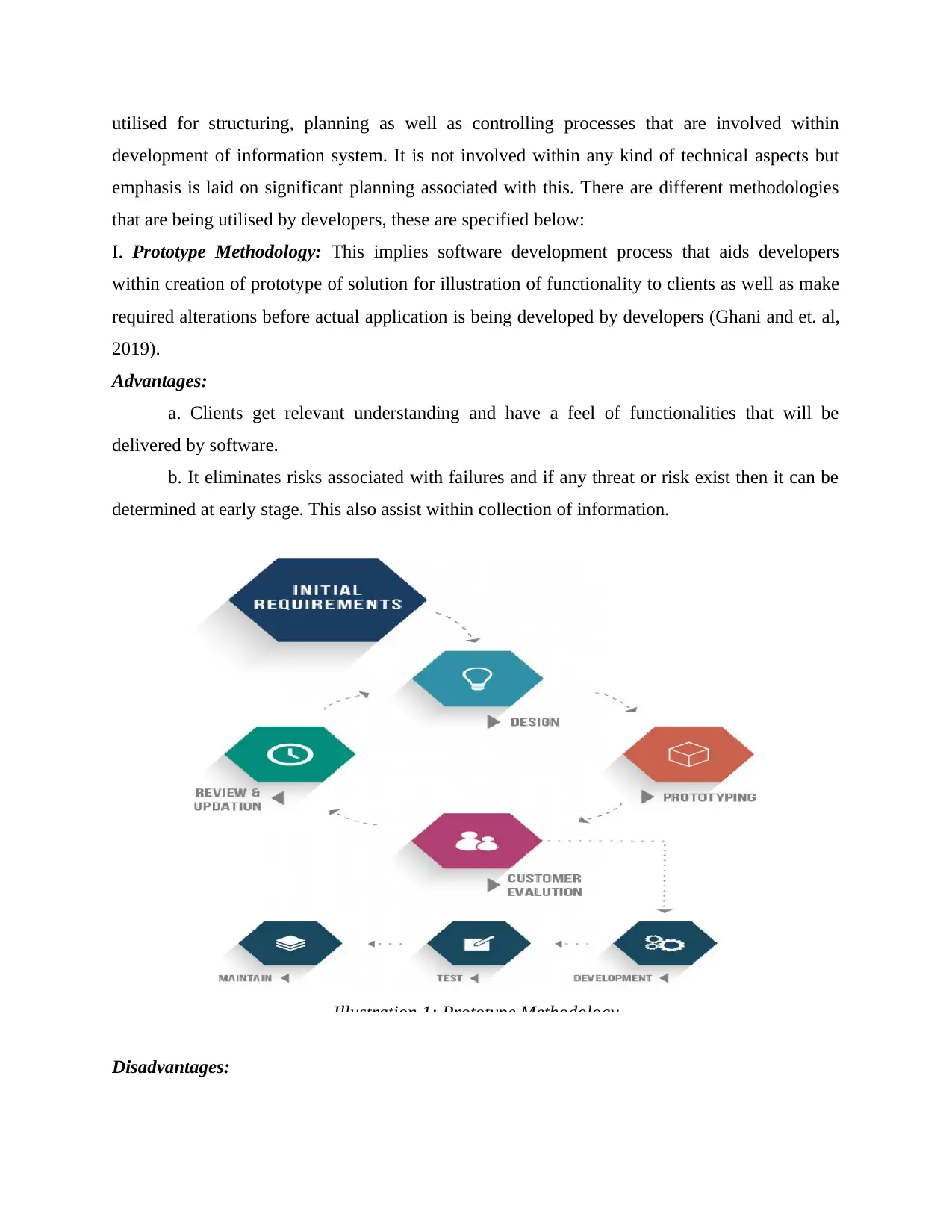
I. Prototype Methodology: This implies software development process that aids developers
within creation of prototype of solution for illustration of functionality to clients as well as make
required alterations before actual application is being developed by developers (Ghani and et. al,
2019).
Advantages:
a. Clients get relevant understanding and have a feel of functionalities that will be
delivered by software.
b. It eliminates risks associated with failures and if any threat or risk exist then it can be
determined at early stage. This also assist within collection of information.
Disadvantages:
Illustration 1: Prototype Methodology
development of information system. It is not involved within any kind of technical aspects but
emphasis is laid on significant planning associated with this. There are different methodologies
that are being utilised by developers, these are specified below:
I. Prototype Methodology: This implies software development process that aids developers
within creation of prototype of solution for illustration of functionality to clients as well as make
required alterations before actual application is being developed by developers (Ghani and et. al,
2019).
Advantages:
a. Clients get relevant understanding and have a feel of functionalities that will be
delivered by software.
b. It eliminates risks associated with failures and if any threat or risk exist then it can be
determined at early stage. This also assist within collection of information.
Disadvantages:
Illustration 1: Prototype Methodology
⊘ This is a preview!⊘
Do you want full access?
Subscribe today to unlock all pages.
Trusted by 1+ million students worldwide

1 out of 44


Related Documents


Your All-in-One AI-Powered Toolkit for Academic Success.
+13062052269
info@desklib.com
Available 24*7 on WhatsApp / Email
![[object Object]](/_next/static/media/star-bottom.7253800d.svg)
Unlock your academic potential
Copyright © 2020–2026 A2Z Services. All Rights Reserved. Developed and managed by ZUCOL.