Software Engineering Adaptor Report: Adaptor Types and Composition

Verified

Added on  2020/04/07

|4
|665
|174
Report
AI Summary
This software engineering report provides an overview of software adaptors, which are crucial for data conversion between different forms, including network packets and application messages. It explores the role of adaptors in modern computer systems, particularly within peripheral devices. The report details different types of adaptors, such as display, network, host, and serial adaptors, and their uses. It further delves into the three types of compositions: sequential, hierarchical, and additive, used in software engineering. The report explains the importance of controlling sequences in imperative programming and outlines the five characteristics of standardized components. The report also describes how adaptors enable incompatible interfaces to work together, ensuring the inner functionality meets the requirements of software engineering components.
Document Page
Running head: SOFTWARE ENGINEERING ADAPTOR SUPPORT
Software Engineering Adaptor Support
Name of the Student
Name of the University
tabler-icon-diamond-filled.svg

Paraphrase This Document

Need a fresh take? Get an instant paraphrase of this document with our AI Paraphraser
Document Page
1SOFTWARE ENGINEERING ADAPTOR SUPPORT
In the field of software engineering, adaptors are different kinds of software components
that are used to convert data that is being transmitted from one form to another form of
presentation. The form of data can be in anything starting with network packets to messages sent
between two or more objects of an application. In the modern world, most of the computer
peripheral devices makes used of the adaptors for the purpose of communication between them.
On the other hand, a system is made up of the different process assembling components
(Bourque and Fairley 2014). The composition is used to build an infrastructure that integrates
components with each other in the system. The adaptors have different use than that of the
expansion cards where some of the expansion cards implements different types of adaptors.
Various peripheral devices which includes Display adaptors, Network adaptors, Host adaptors
and Serial adaptors are some of the examples of the most used adaptors in the field of software
engineering. Most of the modern graphics cards in the market makes use of chips sourced from
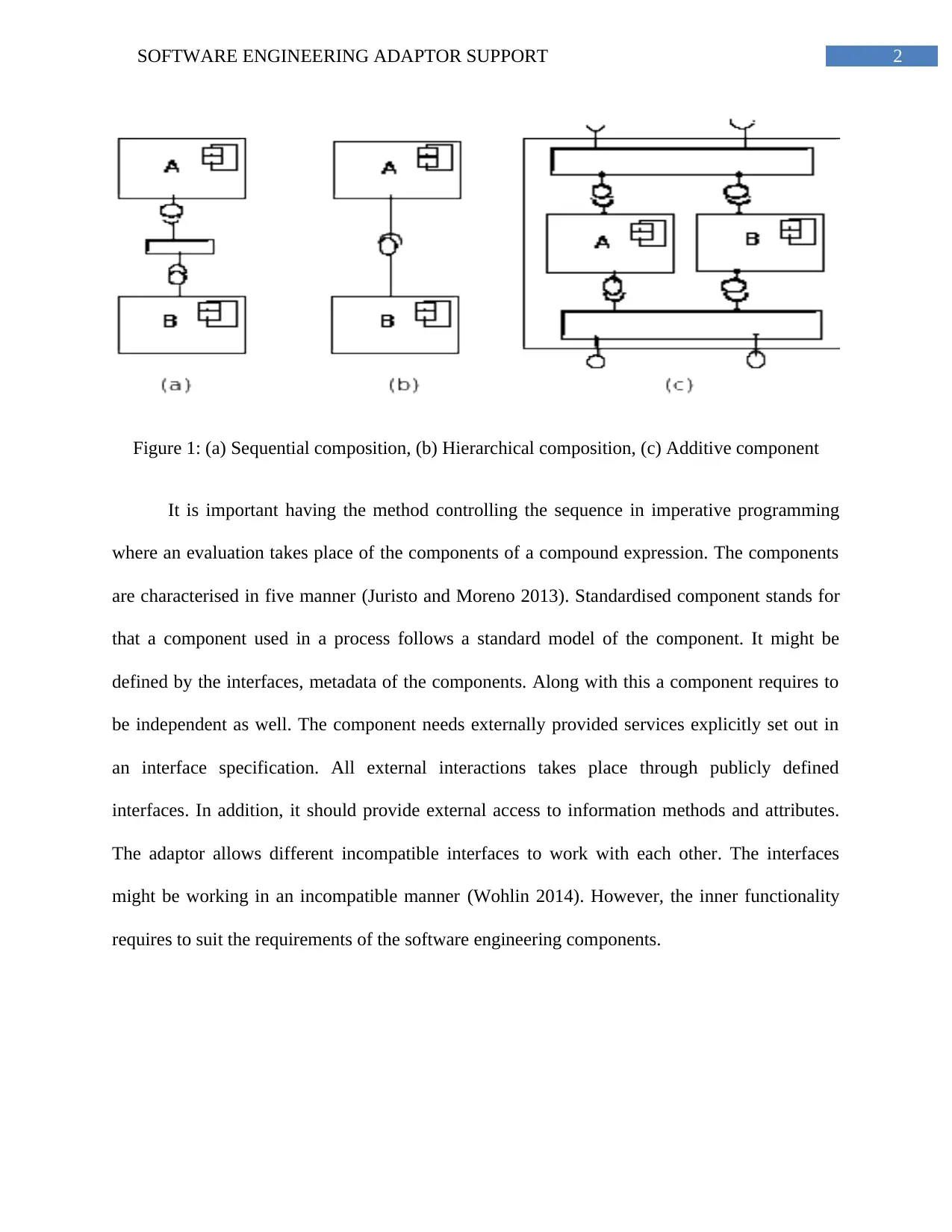
either Nvidia or AMD (De Lemos et al. 2013). There are three types of compositions used for the
several channels in the software engineering. In sequential composition all the components are to
be executed in a sequential manner. In Hierarchical composition of software adapter engineering
one component calls on the service of another component. Therefore, the composition makes use
of the interface of another component. In addictive composition procedure two components are
put together for the creation of another new component.
Document Page
2SOFTWARE ENGINEERING ADAPTOR SUPPORT
Figure 1: (a) Sequential composition, (b) Hierarchical composition, (c) Additive component
It is important having the method controlling the sequence in imperative programming
where an evaluation takes place of the components of a compound expression. The components
are characterised in five manner (Juristo and Moreno 2013). Standardised component stands for
that a component used in a process follows a standard model of the component. It might be
defined by the interfaces, metadata of the components. Along with this a component requires to
be independent as well. The component needs externally provided services explicitly set out in
an interface specification. All external interactions takes place through publicly defined
interfaces. In addition, it should provide external access to information methods and attributes.
The adaptor allows different incompatible interfaces to work with each other. The interfaces
might be working in an incompatible manner (Wohlin 2014). However, the inner functionality
requires to suit the requirements of the software engineering components.
Document Page
3SOFTWARE ENGINEERING ADAPTOR SUPPORT
References
Bourque, P. and Fairley, R.E., 2014. Guide to the software engineering body of knowledge
(SWEBOK (R)): Version 3.0. IEEE Computer Society Press.
De Lemos, R., Giese, H., Müller, H.A., Shaw, M., Andersson, J., Litoiu, M., Schmerl, B.,
Tamura, G., Villegas, N.M., Vogel, T. and Weyns, D., 2013. Software engineering for self-
adaptive systems: A second research roadmap. In Software Engineering for Self-Adaptive
Systems II (pp. 1-32). Springer Berlin Heidelberg.
Juristo, N. and Moreno, A.M., 2013. Basics of software engineering experimentation. Springer
Science & Business Media.
Wohlin, C., 2014, May. Guidelines for snowballing in systematic literature studies and a
replication in software engineering. In Proceedings of the 18th international conference on
evaluation and assessment in software engineering (p. 38). ACM.
chevron_up_icon
1 out of 4
circle_padding
hide_on_mobile
zoom_out_icon
[object Object]