Statistics Homework: Hypothesis Testing, Regression, and Probability

Verified

Added on  2023/03/20

|2
|436
|43
Homework Assignment
AI Summary
This statistics homework assignment provides solutions to various problems in statistical analysis. The solutions cover topics such as hypothesis testing using t-tests and p-values, regression analysis, and the concept of omitted variable bias. It also includes solutions to problems related to conditional probability, causal inference, and maximum likelihood estimation. The assignment addresses the central limit theorem and web scraping techniques, with the final question related to binomial probability. References to key statistical texts are also provided to support the solutions. This assignment is designed to enhance understanding of statistical concepts and their practical applications.
Document Page
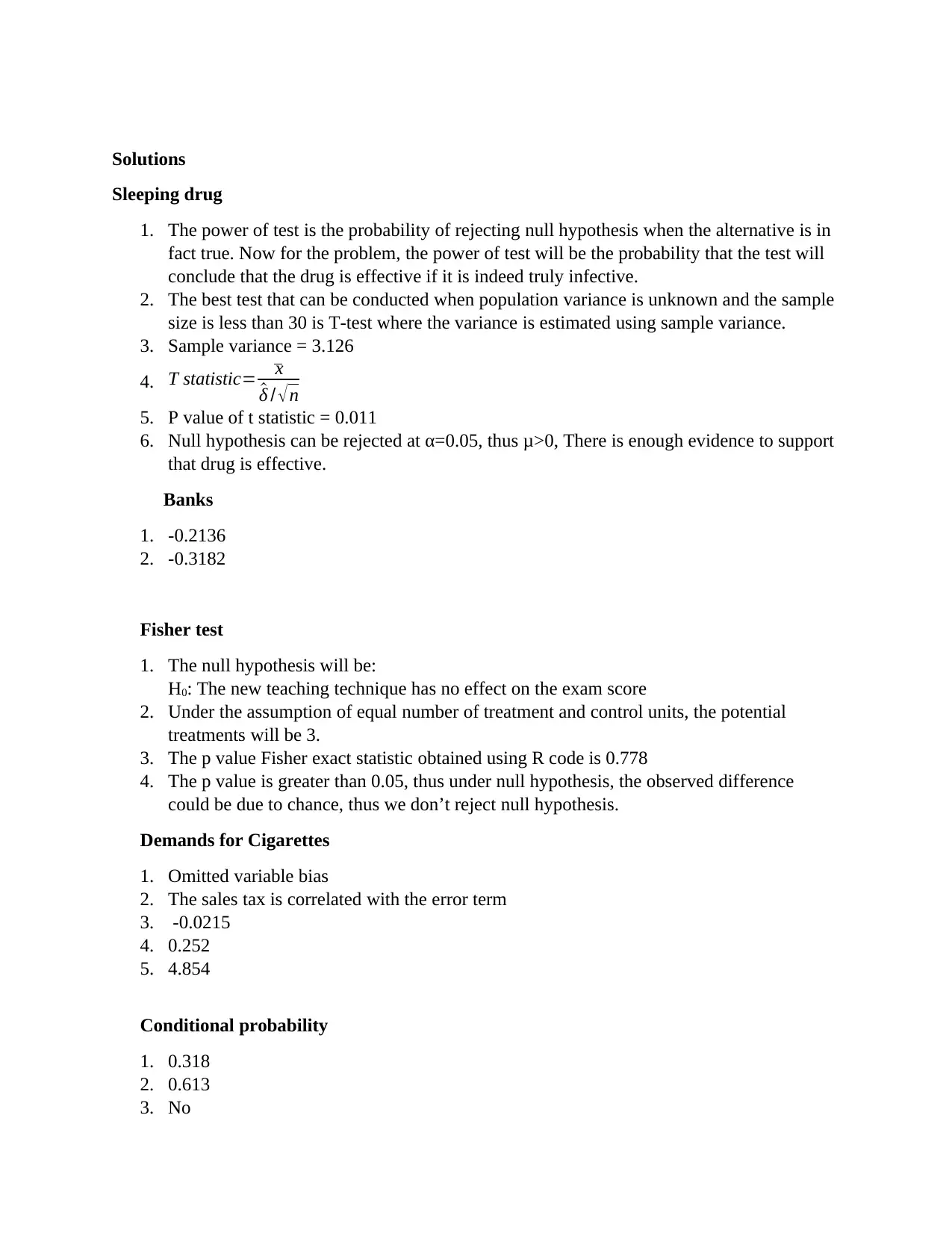
Solutions
Sleeping drug
1. The power of test is the probability of rejecting null hypothesis when the alternative is in
fact true. Now for the problem, the power of test will be the probability that the test will
conclude that the drug is effective if it is indeed truly infective.
2. The best test that can be conducted when population variance is unknown and the sample
size is less than 30 is T-test where the variance is estimated using sample variance.
3. Sample variance = 3.126
4. T statistic= x
^δ / n
5. P value of t statistic = 0.011
6. Null hypothesis can be rejected at α=0.05, thus μ>0, There is enough evidence to support
that drug is effective.
Banks
1. -0.2136
2. -0.3182
Fisher test
1. The null hypothesis will be:
H0: The new teaching technique has no effect on the exam score
2. Under the assumption of equal number of treatment and control units, the potential
treatments will be 3.
3. The p value Fisher exact statistic obtained using R code is 0.778
4. The p value is greater than 0.05, thus under null hypothesis, the observed difference
could be due to chance, thus we don’t reject null hypothesis.
Demands for Cigarettes
1. Omitted variable bias
2. The sales tax is correlated with the error term
3. -0.0215
4. 0.252
5. 4.854
Conditional probability
1. 0.318
2. 0.613
3. No
tabler-icon-diamond-filled.svg

Paraphrase This Document

Need a fresh take? Get an instant paraphrase of this document with our AI Paraphraser
Document Page
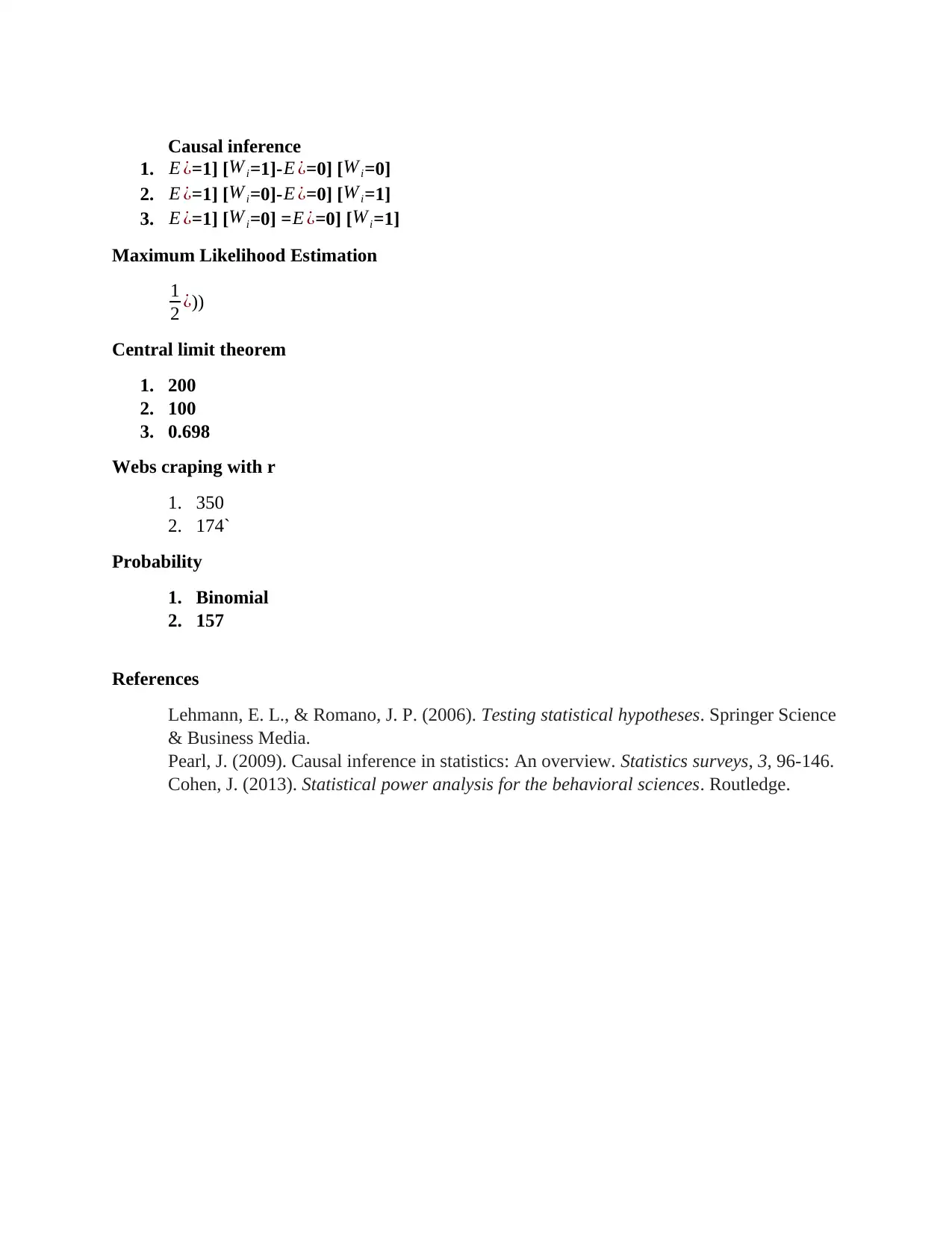
Causal inference
1. E ¿=1] [Wi=1]-E ¿=0] [W i=0]
2. E ¿=1] [Wi=0]- E ¿=0] [W i=1]
3. E ¿=1] [Wi=0] =E ¿=0] [W i=1]
Maximum Likelihood Estimation
1
2 ¿))
Central limit theorem
1. 200
2. 100
3. 0.698
Webs craping with r
1. 350
2. 174`
Probability
1. Binomial
2. 157
References
Lehmann, E. L., & Romano, J. P. (2006). Testing statistical hypotheses. Springer Science
& Business Media.
Pearl, J. (2009). Causal inference in statistics: An overview. Statistics surveys, 3, 96-146.
Cohen, J. (2013). Statistical power analysis for the behavioral sciences. Routledge.
chevron_up_icon
1 out of 2
circle_padding
hide_on_mobile
zoom_out_icon
[object Object]