Psychology Report: Analyzing Spatial Orientation & Cueing Task Data
VerifiedAdded on 2023/06/09
|9
|2218
|394
Report
AI Summary
This report delves into the analysis of cueing task data to explore spatial orientation and attention, employing a descriptive research design with a sample of 87 participants. The study investigates whether there is a significant difference between valid and invalid cues, examining the impact of gender on cue perception using statistical tools like the T-test and SPSS software. Ethical considerations were maintained by obtaining informed consent and using recent, reliable data. The findings suggest that gender does not significantly influence cue validity, and valid cues are present approximately 75% of the time, supporting existing research. The discussion highlights the importance of spatial orientation for attentiveness and effective interaction with the environment, emphasizing that spatial orientation depends on cognitive capability rather than gender. The research concludes by affirming the prevalence of valid cues in spatial orientation tasks.
Cueing Task Data

Paraphrase This Document
Need a fresh take? Get an instant paraphrase of this document with our AI Paraphraser
TABLE OF CONTENTS
INTRODUCTION...........................................................................................................................3
METHODS......................................................................................................................................3
Design.........................................................................................................................................3
Participant...................................................................................................................................4
Materials......................................................................................................................................4
Procedure....................................................................................................................................4
Ethical consideration...................................................................................................................5
RESULTS........................................................................................................................................5
DISCUSSION..................................................................................................................................7
REFERENCES................................................................................................................................9
INTRODUCTION...........................................................................................................................3
METHODS......................................................................................................................................3
Design.........................................................................................................................................3
Participant...................................................................................................................................4
Materials......................................................................................................................................4
Procedure....................................................................................................................................4
Ethical consideration...................................................................................................................5
RESULTS........................................................................................................................................5
DISCUSSION..................................................................................................................................7
REFERENCES................................................................................................................................9
INTRODUCTION
The spatial orientation is being defined as the ability of the person to maintain the
orientation of the body or the posture with respect to the environment wherein the person reacts
and rest during the motion. This spatial orientation is occurring at the time when the attention
need to be drawn for a specific location. This attention can be drawn to a specific location
because of the appearance of stimuli and this is called cueing. For this the Posner cueing task is
being implemented within the study and this relates to the measure which assist the person in
measuring the movement of attention across the visual field without moving the eyes aside.
This is very necessary because these visuals come very fast and it is very necessary that
the person conducting the test must be very attentive such that the working is being done in
better manner. This proper task need to be created and undertaken in correct manner and this
need to be evaluated and examined in proper and effective manner. Along with this the Posner
cueing task measures the different types of the attention (Zhu, Sari and Lee, 2018). This task is
basically performed in order to analyse the fact that how much attentive the person is when they
are provided with different types of the test. The result will be providing the fact that when the
person will be having good attention then this will be motivating the person to be attentive and
will be working in better and effective manner.
The aim of the study is to analyse the fact that whether there is any difference being
present in the valid and invalid cues being outlined within the experiment. This is very necessary
for the reason that in many studies it was stated that 75 % of the times the cues are valid and only
25 % times it is invalid. So that whole study is being directed towards the proving of this fact
correct. Hence, for this it is very crucial that appropriate tests are being conducted and it is very
necessary for the person that they conduct it in proper manner so that appropriate test result can
be outlined.
METHODS
Design
The design of the research is being defined as the methods through which the study can
be completed in proper and effective manner this is very necessary for the researcher that they
select the appropriate design of the completion of the research. In case of the present study, the
research design selected for the completion is the descriptive research design. This is being
The spatial orientation is being defined as the ability of the person to maintain the
orientation of the body or the posture with respect to the environment wherein the person reacts
and rest during the motion. This spatial orientation is occurring at the time when the attention
need to be drawn for a specific location. This attention can be drawn to a specific location
because of the appearance of stimuli and this is called cueing. For this the Posner cueing task is
being implemented within the study and this relates to the measure which assist the person in
measuring the movement of attention across the visual field without moving the eyes aside.
This is very necessary because these visuals come very fast and it is very necessary that
the person conducting the test must be very attentive such that the working is being done in
better manner. This proper task need to be created and undertaken in correct manner and this
need to be evaluated and examined in proper and effective manner. Along with this the Posner
cueing task measures the different types of the attention (Zhu, Sari and Lee, 2018). This task is
basically performed in order to analyse the fact that how much attentive the person is when they
are provided with different types of the test. The result will be providing the fact that when the
person will be having good attention then this will be motivating the person to be attentive and
will be working in better and effective manner.
The aim of the study is to analyse the fact that whether there is any difference being
present in the valid and invalid cues being outlined within the experiment. This is very necessary
for the reason that in many studies it was stated that 75 % of the times the cues are valid and only
25 % times it is invalid. So that whole study is being directed towards the proving of this fact
correct. Hence, for this it is very crucial that appropriate tests are being conducted and it is very
necessary for the person that they conduct it in proper manner so that appropriate test result can
be outlined.
METHODS
Design
The design of the research is being defined as the methods through which the study can
be completed in proper and effective manner this is very necessary for the researcher that they
select the appropriate design of the completion of the research. In case of the present study, the
research design selected for the completion is the descriptive research design. This is being
⊘ This is a preview!⊘
Do you want full access?
Subscribe today to unlock all pages.

Trusted by 1+ million students worldwide
selected for the reason that this type of design of research includes the analysis of the whole
description of the research problem (Harris and et.al., 2019). This will be assisting the researcher
in improving the efficiency of the research and appropriate data can be used by the researcher in
analysing the research problem and to work in better manner.
Participant
The participant includes the people or the respondent through which the data is being
gathered. For the research to be completed in proper and effective manner it is very necessary
that the appropriate participant is being selected so that the accurate data can be gathered. For the
completion of the current study, the use of sample of 87 people was selected and this assisted the
research to gather the data. This participant included the combination of males and females and
belonged to the different age category.
Materials
The material includes the data which is being used by the researcher in order to analyse
and evaluate the data being analysed. The quantitative data is being collected and analysed in
order to prove the research problem correct. But this need to be supported by other qualitative
data as well. This material is being gathered from the different secondary sources which includes
the combination of the different books, articles, journal and other published sources relating to
the research topic.
Procedure
The procedure involves the steps which are being used in order to complete the study in
better and effective manner. This is very necessary for the reason that when the process will not
be appropriate then this will be affecting the efficiency of the completion of the study. hence, the
process used by the researcher involves the collection of the data and then the different statistical
tools and techniques are being applied (Liamputtong, 2020). These statistical tools and
techniques are important to be used by the researcher in order to evaluate and analyse the data
and attain the research objectives. In the present case, the similar process is being followed and
this makes the working of the study much better and accurate. With the help of the SPSS
software it was much easier for the researcher to analyse the data in proper and effective manner
and this assisted them to conduct the research in better way.
description of the research problem (Harris and et.al., 2019). This will be assisting the researcher
in improving the efficiency of the research and appropriate data can be used by the researcher in
analysing the research problem and to work in better manner.
Participant
The participant includes the people or the respondent through which the data is being
gathered. For the research to be completed in proper and effective manner it is very necessary
that the appropriate participant is being selected so that the accurate data can be gathered. For the
completion of the current study, the use of sample of 87 people was selected and this assisted the
research to gather the data. This participant included the combination of males and females and
belonged to the different age category.
Materials
The material includes the data which is being used by the researcher in order to analyse
and evaluate the data being analysed. The quantitative data is being collected and analysed in
order to prove the research problem correct. But this need to be supported by other qualitative
data as well. This material is being gathered from the different secondary sources which includes
the combination of the different books, articles, journal and other published sources relating to
the research topic.
Procedure
The procedure involves the steps which are being used in order to complete the study in
better and effective manner. This is very necessary for the reason that when the process will not
be appropriate then this will be affecting the efficiency of the completion of the study. hence, the
process used by the researcher involves the collection of the data and then the different statistical
tools and techniques are being applied (Liamputtong, 2020). These statistical tools and
techniques are important to be used by the researcher in order to evaluate and analyse the data
and attain the research objectives. In the present case, the similar process is being followed and
this makes the working of the study much better and accurate. With the help of the SPSS
software it was much easier for the researcher to analyse the data in proper and effective manner
and this assisted them to conduct the research in better way.
Paraphrase This Document
Need a fresh take? Get an instant paraphrase of this document with our AI Paraphraser
Ethical consideration
This aspect is also very necessary for the company as without this the research cannot be
completed in proper and effective manner. Thus, the current study included the fact that any of
the personal information or the data of the participant used has the informed consent first and
then it is included in the study. This is necessary for the reason that it will ensure that the proper
approval is taken before using their personal data (Busetto, Wick and Gumbinger, 2020). Along
with this the data involved is not too old and the data beyond 2017 has not been used in the
present study. Along with this the data is being gathered from the authentic and reliable sources
and not from any other sources. All these ethical aspects need to be maintained and followed by
the researcher in order to improve the study and the attainment of the objectives of study.
RESULTS
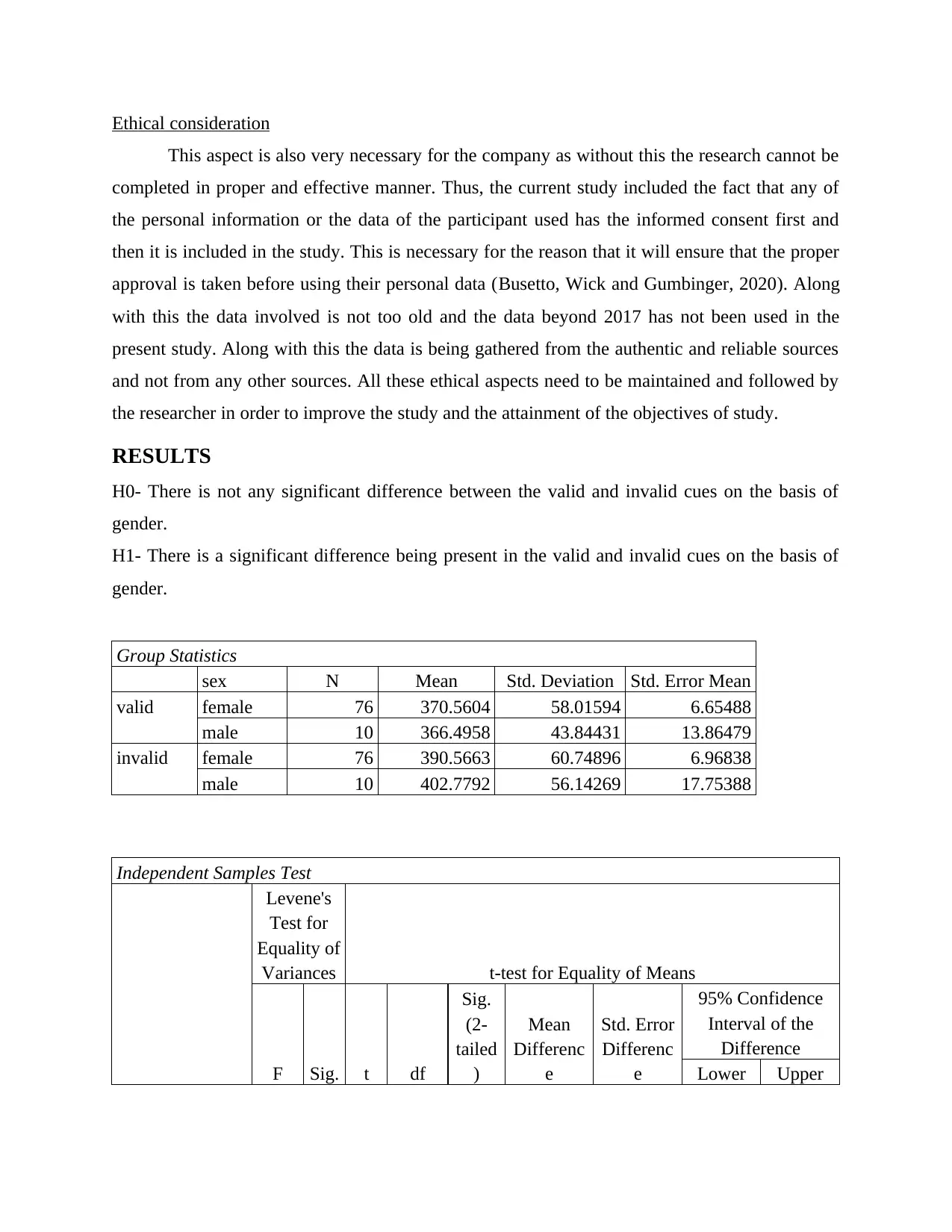
H0- There is not any significant difference between the valid and invalid cues on the basis of
gender.
H1- There is a significant difference being present in the valid and invalid cues on the basis of
gender.
Group Statistics
sex N Mean Std. Deviation Std. Error Mean
valid female 76 370.5604 58.01594 6.65488
male 10 366.4958 43.84431 13.86479
invalid female 76 390.5663 60.74896 6.96838
male 10 402.7792 56.14269 17.75388
Independent Samples Test
Levene's
Test for
Equality of
Variances t-test for Equality of Means
F Sig. t df
Sig.
(2-
tailed
)
Mean
Differenc
e
Std. Error
Differenc
e
95% Confidence
Interval of the
Difference
Lower Upper
This aspect is also very necessary for the company as without this the research cannot be
completed in proper and effective manner. Thus, the current study included the fact that any of
the personal information or the data of the participant used has the informed consent first and
then it is included in the study. This is necessary for the reason that it will ensure that the proper
approval is taken before using their personal data (Busetto, Wick and Gumbinger, 2020). Along
with this the data involved is not too old and the data beyond 2017 has not been used in the
present study. Along with this the data is being gathered from the authentic and reliable sources
and not from any other sources. All these ethical aspects need to be maintained and followed by
the researcher in order to improve the study and the attainment of the objectives of study.
RESULTS
H0- There is not any significant difference between the valid and invalid cues on the basis of
gender.
H1- There is a significant difference being present in the valid and invalid cues on the basis of
gender.
Group Statistics
sex N Mean Std. Deviation Std. Error Mean
valid female 76 370.5604 58.01594 6.65488
male 10 366.4958 43.84431 13.86479
invalid female 76 390.5663 60.74896 6.96838
male 10 402.7792 56.14269 17.75388
Independent Samples Test
Levene's
Test for
Equality of
Variances t-test for Equality of Means
F Sig. t df
Sig.
(2-
tailed
)
Mean
Differenc
e
Std. Error
Differenc
e
95% Confidence
Interval of the
Difference
Lower Upper
valid Equal
variance
s
assumed
3.06
9
.083 .213 84 .832 4.06453 19.06229 -
33.8429
3
41.9719
9
Equal
variance
s not
assumed
.264 13.53
8
.796 4.06453 15.37920 -
29.0264
0
37.1554
7
invali
d
Equal
variance
s
assumed
.049 .825 -.60
2
84 .549 -12.21288 20.27496 -
52.5318
6
28.1061
1
Equal
variance
s not
assumed
-.64
0
11.95
3
.534 -12.21288 19.07246 -
53.7864
9
29.3607
3
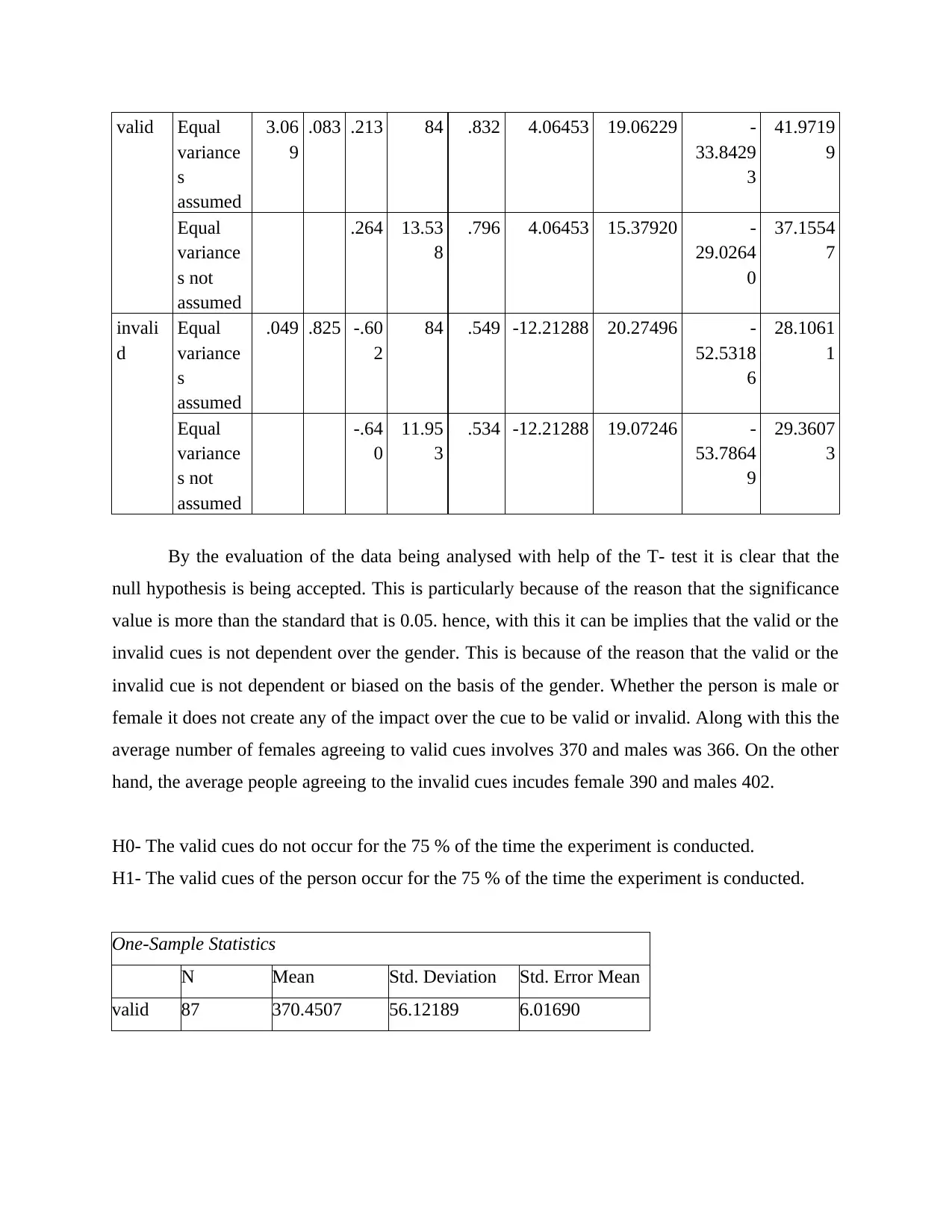
By the evaluation of the data being analysed with help of the T- test it is clear that the
null hypothesis is being accepted. This is particularly because of the reason that the significance
value is more than the standard that is 0.05. hence, with this it can be implies that the valid or the
invalid cues is not dependent over the gender. This is because of the reason that the valid or the
invalid cue is not dependent or biased on the basis of the gender. Whether the person is male or
female it does not create any of the impact over the cue to be valid or invalid. Along with this the
average number of females agreeing to valid cues involves 370 and males was 366. On the other
hand, the average people agreeing to the invalid cues incudes female 390 and males 402.
H0- The valid cues do not occur for the 75 % of the time the experiment is conducted.
H1- The valid cues of the person occur for the 75 % of the time the experiment is conducted.
One-Sample Statistics
N Mean Std. Deviation Std. Error Mean
valid 87 370.4507 56.12189 6.01690
variance
s
assumed
3.06
9
.083 .213 84 .832 4.06453 19.06229 -
33.8429
3
41.9719
9
Equal
variance
s not
assumed
.264 13.53
8
.796 4.06453 15.37920 -
29.0264
0
37.1554
7
invali
d
Equal
variance
s
assumed
.049 .825 -.60
2
84 .549 -12.21288 20.27496 -
52.5318
6
28.1061
1
Equal
variance
s not
assumed
-.64
0
11.95
3
.534 -12.21288 19.07246 -
53.7864
9
29.3607
3
By the evaluation of the data being analysed with help of the T- test it is clear that the
null hypothesis is being accepted. This is particularly because of the reason that the significance
value is more than the standard that is 0.05. hence, with this it can be implies that the valid or the
invalid cues is not dependent over the gender. This is because of the reason that the valid or the
invalid cue is not dependent or biased on the basis of the gender. Whether the person is male or
female it does not create any of the impact over the cue to be valid or invalid. Along with this the
average number of females agreeing to valid cues involves 370 and males was 366. On the other
hand, the average people agreeing to the invalid cues incudes female 390 and males 402.
H0- The valid cues do not occur for the 75 % of the time the experiment is conducted.
H1- The valid cues of the person occur for the 75 % of the time the experiment is conducted.
One-Sample Statistics
N Mean Std. Deviation Std. Error Mean
valid 87 370.4507 56.12189 6.01690
⊘ This is a preview!⊘
Do you want full access?
Subscribe today to unlock all pages.
Trusted by 1+ million students worldwide
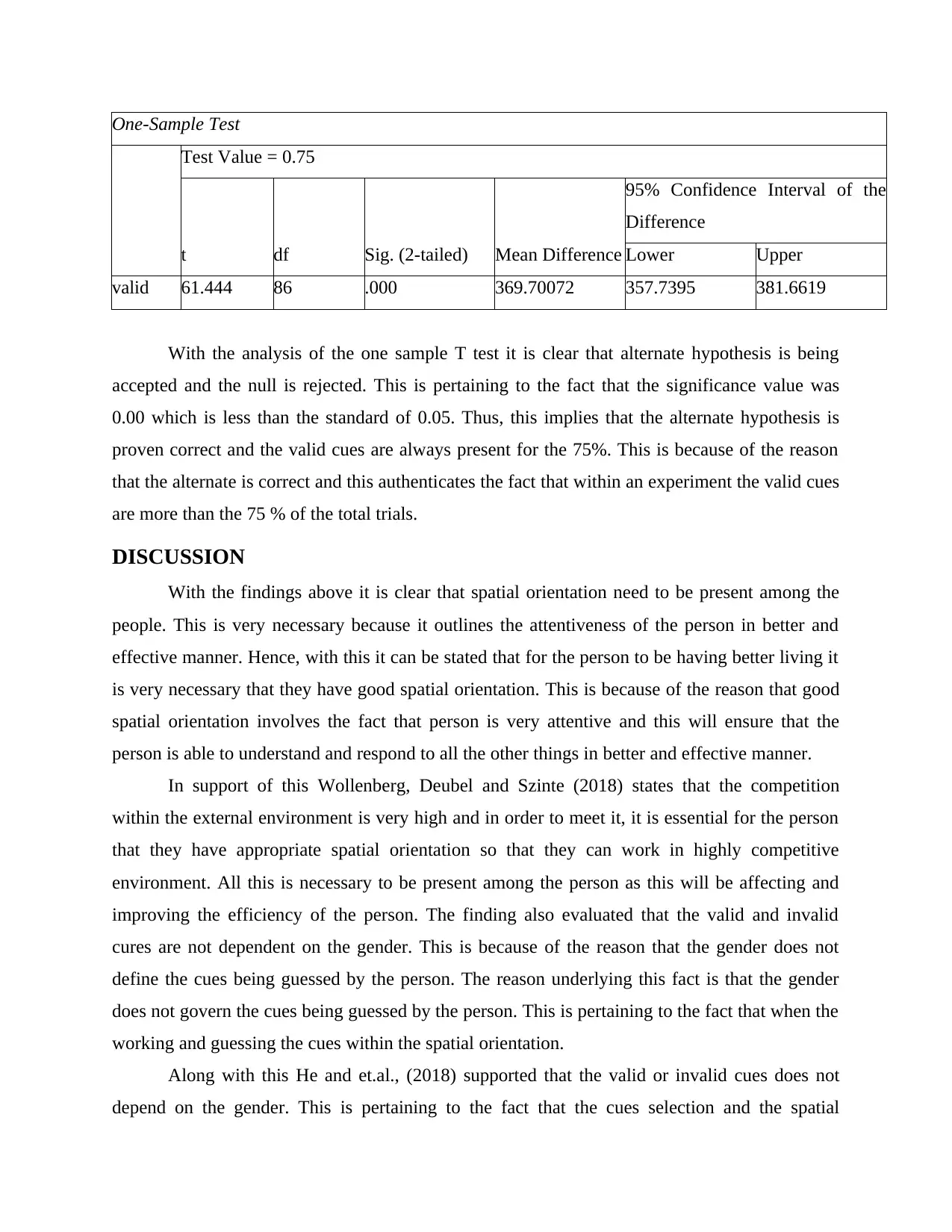
One-Sample Test
Test Value = 0.75
t df Sig. (2-tailed) Mean Difference
95% Confidence Interval of the
Difference
Lower Upper
valid 61.444 86 .000 369.70072 357.7395 381.6619
With the analysis of the one sample T test it is clear that alternate hypothesis is being
accepted and the null is rejected. This is pertaining to the fact that the significance value was
0.00 which is less than the standard of 0.05. Thus, this implies that the alternate hypothesis is
proven correct and the valid cues are always present for the 75%. This is because of the reason
that the alternate is correct and this authenticates the fact that within an experiment the valid cues
are more than the 75 % of the total trials.
DISCUSSION
With the findings above it is clear that spatial orientation need to be present among the
people. This is very necessary because it outlines the attentiveness of the person in better and
effective manner. Hence, with this it can be stated that for the person to be having better living it
is very necessary that they have good spatial orientation. This is because of the reason that good
spatial orientation involves the fact that person is very attentive and this will ensure that the
person is able to understand and respond to all the other things in better and effective manner.
In support of this Wollenberg, Deubel and Szinte (2018) states that the competition
within the external environment is very high and in order to meet it, it is essential for the person
that they have appropriate spatial orientation so that they can work in highly competitive
environment. All this is necessary to be present among the person as this will be affecting and
improving the efficiency of the person. The finding also evaluated that the valid and invalid
cures are not dependent on the gender. This is because of the reason that the gender does not
define the cues being guessed by the person. The reason underlying this fact is that the gender
does not govern the cues being guessed by the person. This is pertaining to the fact that when the
working and guessing the cues within the spatial orientation.
Along with this He and et.al., (2018) supported that the valid or invalid cues does not
depend on the gender. This is pertaining to the fact that the cues selection and the spatial
Test Value = 0.75
t df Sig. (2-tailed) Mean Difference
95% Confidence Interval of the
Difference
Lower Upper
valid 61.444 86 .000 369.70072 357.7395 381.6619
With the analysis of the one sample T test it is clear that alternate hypothesis is being
accepted and the null is rejected. This is pertaining to the fact that the significance value was
0.00 which is less than the standard of 0.05. Thus, this implies that the alternate hypothesis is
proven correct and the valid cues are always present for the 75%. This is because of the reason
that the alternate is correct and this authenticates the fact that within an experiment the valid cues
are more than the 75 % of the total trials.
DISCUSSION
With the findings above it is clear that spatial orientation need to be present among the
people. This is very necessary because it outlines the attentiveness of the person in better and
effective manner. Hence, with this it can be stated that for the person to be having better living it
is very necessary that they have good spatial orientation. This is because of the reason that good
spatial orientation involves the fact that person is very attentive and this will ensure that the
person is able to understand and respond to all the other things in better and effective manner.
In support of this Wollenberg, Deubel and Szinte (2018) states that the competition
within the external environment is very high and in order to meet it, it is essential for the person
that they have appropriate spatial orientation so that they can work in highly competitive
environment. All this is necessary to be present among the person as this will be affecting and
improving the efficiency of the person. The finding also evaluated that the valid and invalid
cures are not dependent on the gender. This is because of the reason that the gender does not
define the cues being guessed by the person. The reason underlying this fact is that the gender
does not govern the cues being guessed by the person. This is pertaining to the fact that when the
working and guessing the cues within the spatial orientation.
Along with this He and et.al., (2018) supported that the valid or invalid cues does not
depend on the gender. This is pertaining to the fact that the cues selection and the spatial
Paraphrase This Document
Need a fresh take? Get an instant paraphrase of this document with our AI Paraphraser
orientation depends on the person and their thinking capability and level of mind. This is because
of the reason that when the working of the mind of person will be in right direction then they will
be in position to analyse and evaluate the cues in valid manner. Hence, for this it is necessary
that the appropriate analysis is being done so that the spatial orientation of the person is good and
they are attentive and able to work in better manner. Moreover, the finding also evaluated that
within the trial or the experiment it is clear that the valid cue is present for 75 % of the times.
With this it can be stated that the most of the research studies are correct and valid cues are
present for 75 % and invalid for 25 %.
of the reason that when the working of the mind of person will be in right direction then they will
be in position to analyse and evaluate the cues in valid manner. Hence, for this it is necessary
that the appropriate analysis is being done so that the spatial orientation of the person is good and
they are attentive and able to work in better manner. Moreover, the finding also evaluated that
within the trial or the experiment it is clear that the valid cue is present for 75 % of the times.
With this it can be stated that the most of the research studies are correct and valid cues are
present for 75 % and invalid for 25 %.
REFERENCES
Books and Journals
Busetto, L., Wick, W. and Gumbinger, C., 2020. How to use and assess qualitative research
methods. Neurological Research and practice. 2(1). pp.1-10.
Harris, D.E., and et.al., 2019. Research methods. In Spiritually and Developmentally Mature
Leadership (pp. 57-65). Springer, Cham.
He, T. and et.al., 2018. An end-to-end textspotter with explicit alignment and attention.
In Proceedings of the IEEE conference on computer vision and pattern recognition (pp.
5020-5029).
Liamputtong, P., 2020. Qualitative research methods.
Wollenberg, L., Deubel, H. and Szinte, M., 2018. Visual attention is not deployed at the endpoint
of averaging saccades. PLoS biology. 16(6). p.e2006548.
Zhu, M., Sari, A. and Lee, M.M., 2018. A systematic review of research methods and topics of
the empirical MOOC literature (2014–2016). The Internet and Higher Education. 37.
pp.31-39.
Books and Journals
Busetto, L., Wick, W. and Gumbinger, C., 2020. How to use and assess qualitative research
methods. Neurological Research and practice. 2(1). pp.1-10.
Harris, D.E., and et.al., 2019. Research methods. In Spiritually and Developmentally Mature
Leadership (pp. 57-65). Springer, Cham.
He, T. and et.al., 2018. An end-to-end textspotter with explicit alignment and attention.
In Proceedings of the IEEE conference on computer vision and pattern recognition (pp.
5020-5029).
Liamputtong, P., 2020. Qualitative research methods.
Wollenberg, L., Deubel, H. and Szinte, M., 2018. Visual attention is not deployed at the endpoint
of averaging saccades. PLoS biology. 16(6). p.e2006548.
Zhu, M., Sari, A. and Lee, M.M., 2018. A systematic review of research methods and topics of
the empirical MOOC literature (2014–2016). The Internet and Higher Education. 37.
pp.31-39.
⊘ This is a preview!⊘
Do you want full access?
Subscribe today to unlock all pages.
Trusted by 1+ million students worldwide

1 out of 9


Related Documents


Your All-in-One AI-Powered Toolkit for Academic Success.
+13062052269
info@desklib.com
Available 24*7 on WhatsApp / Email
![[object Object]](/_next/static/media/star-bottom.7253800d.svg)
Unlock your academic potential
Copyright © 2020–2026 A2Z Services. All Rights Reserved. Developed and managed by ZUCOL.