Special Needs: Assessment for Exceptional Learners - Assignment

Verified

Added on  2022/01/05

|4
|462
|56
Homework Assignment
AI Summary
This assignment delves into the assessment practices for exceptional learners, particularly those with autism spectrum disorder. The student explores the importance of various assessment methods, highlighting the need for specialized support in areas like writing, problem-solving, and social skills. The assignment discusses the limitations of current practices, such as the use of IEPs, and advocates for improved classroom-based assessments. Recommendations include the supervision of an Advisory Board to enhance the quality of assessment processes and track the progress of the child. The assignment references relevant literature and emphasizes the need for tailored educational support to meet the unique needs of these learners. The student argues for the importance of healthcare support and the critical role of the Assessment Board Staffs in improving the quality of healthcare supports for children with special learning needs.
Document Page
Running head: SPECIAL NEEDS CLASS
Reflection on the importance of different assessment practices for exceptional learners
Name of the student:
Name of the university:
Author note:
tabler-icon-diamond-filled.svg

Paraphrase This Document

Need a fresh take? Get an instant paraphrase of this document with our AI Paraphraser
Document Page
1
SPECIAL NEEDS CLASS
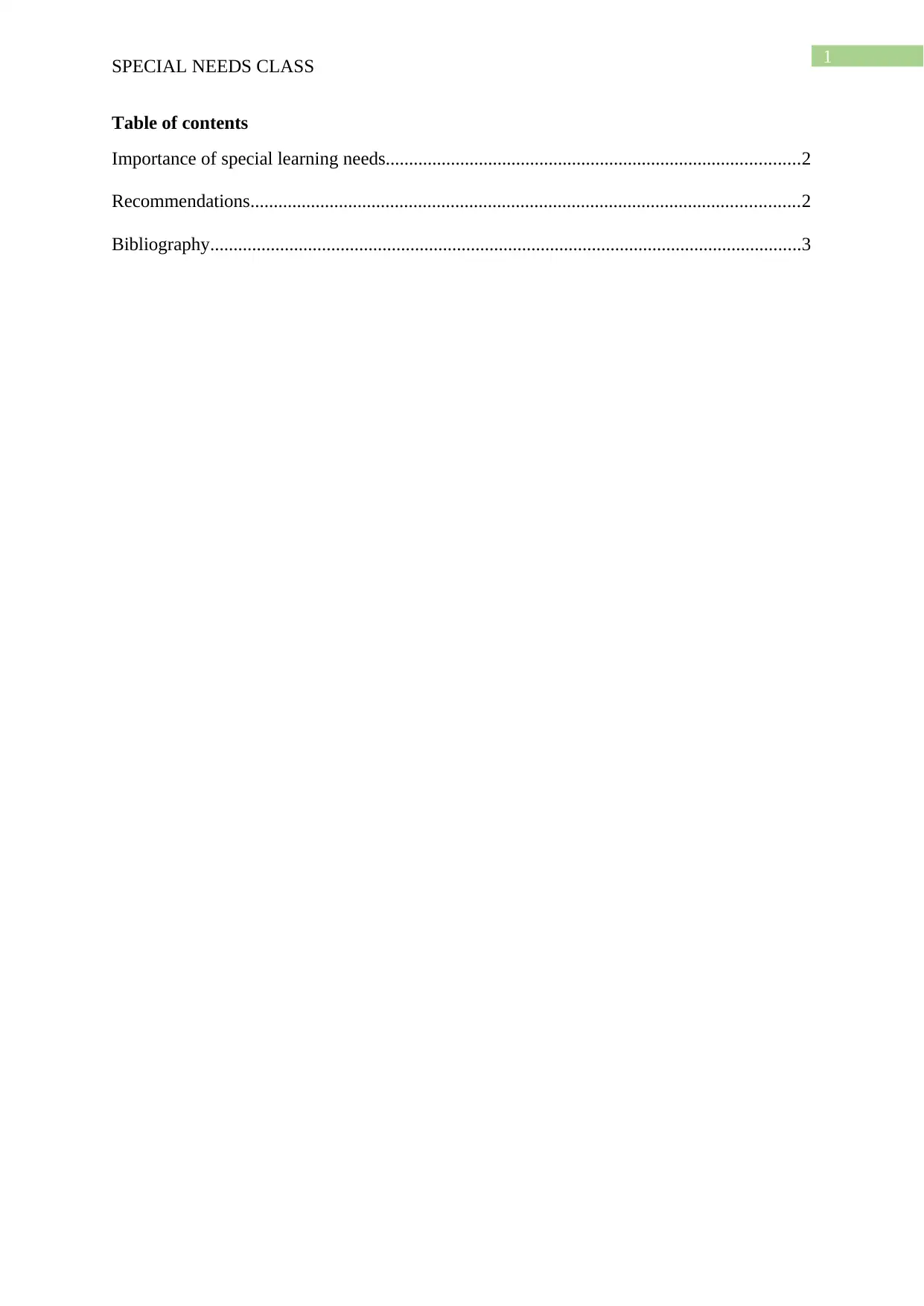
Table of contents
Importance of special learning needs.........................................................................................2
Recommendations......................................................................................................................2
Bibliography...............................................................................................................................3
Document Page
2
SPECIAL NEEDS CLASS
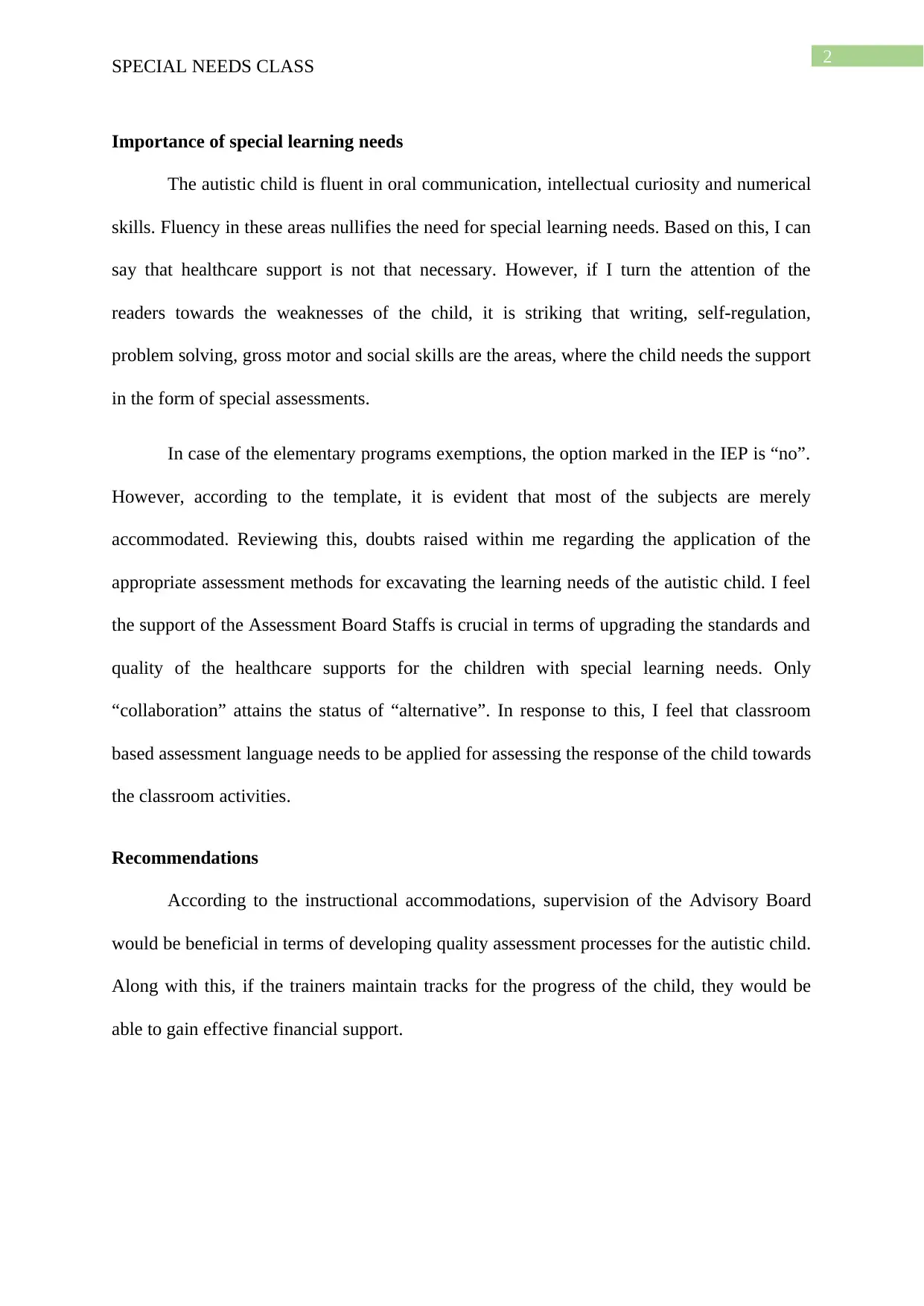
Importance of special learning needs
The autistic child is fluent in oral communication, intellectual curiosity and numerical
skills. Fluency in these areas nullifies the need for special learning needs. Based on this, I can
say that healthcare support is not that necessary. However, if I turn the attention of the
readers towards the weaknesses of the child, it is striking that writing, self-regulation,
problem solving, gross motor and social skills are the areas, where the child needs the support
in the form of special assessments.
In case of the elementary programs exemptions, the option marked in the IEP is “no”.
However, according to the template, it is evident that most of the subjects are merely
accommodated. Reviewing this, doubts raised within me regarding the application of the
appropriate assessment methods for excavating the learning needs of the autistic child. I feel
the support of the Assessment Board Staffs is crucial in terms of upgrading the standards and
quality of the healthcare supports for the children with special learning needs. Only
“collaboration” attains the status of “alternative”. In response to this, I feel that classroom
based assessment language needs to be applied for assessing the response of the child towards
the classroom activities.
Recommendations
According to the instructional accommodations, supervision of the Advisory Board
would be beneficial in terms of developing quality assessment processes for the autistic child.
Along with this, if the trainers maintain tracks for the progress of the child, they would be
able to gain effective financial support.
Document Page
3
SPECIAL NEEDS CLASS
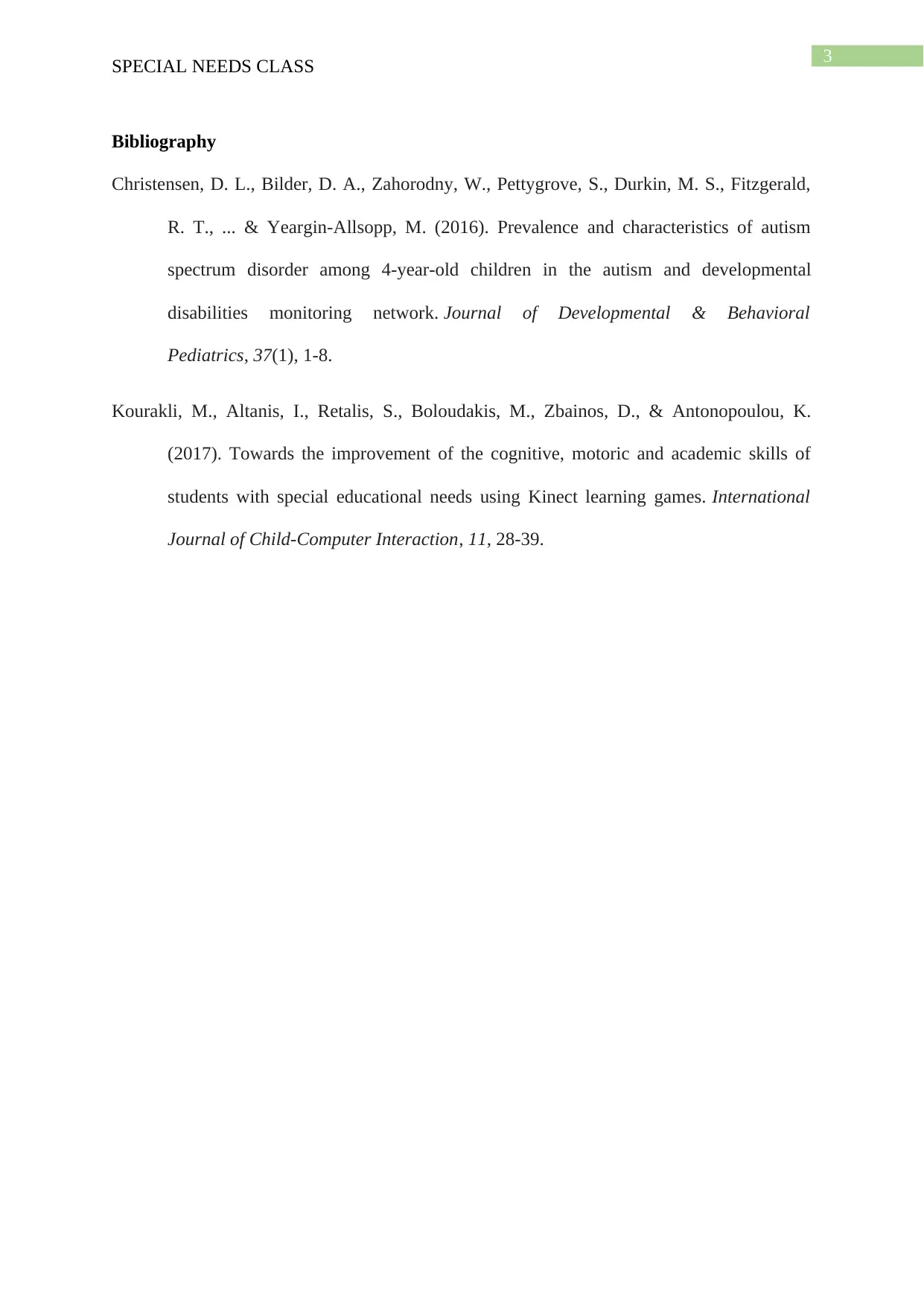
Bibliography
Christensen, D. L., Bilder, D. A., Zahorodny, W., Pettygrove, S., Durkin, M. S., Fitzgerald,
R. T., ... & Yeargin-Allsopp, M. (2016). Prevalence and characteristics of autism
spectrum disorder among 4-year-old children in the autism and developmental
disabilities monitoring network. Journal of Developmental & Behavioral
Pediatrics, 37(1), 1-8.
Kourakli, M., Altanis, I., Retalis, S., Boloudakis, M., Zbainos, D., & Antonopoulou, K.
(2017). Towards the improvement of the cognitive, motoric and academic skills of
students with special educational needs using Kinect learning games. International
Journal of Child-Computer Interaction, 11, 28-39.
chevron_up_icon
1 out of 4
circle_padding
hide_on_mobile
zoom_out_icon
[object Object]