SRM777 - Stakeholder Influence on Quality in Construction Projects
VerifiedAdded on 2023/06/10
|14
|5121
|437
Report
AI Summary
This report examines the crucial role of stakeholder involvement in construction projects and its subsequent impact on project quality. It delves into the various stakeholders involved, including clients, contractors, consultants, and suppliers, highlighting their individual influences and contributions at different project stages. The report emphasizes the importance of effective stakeholder management in achieving desired project outcomes, managing risks, and ensuring adherence to quality standards. Furthermore, it discusses the planning phase and quality planning processes, addressing problem-solving and decision-making strategies within the context of stakeholder engagement. The study also references previous research, underscoring the need for collaborative approaches to enhance project success and mitigate potential negative impacts. This assignment is available on Desklib, where students can find a wealth of similar resources and solved assignments.
Assessment 1 -
SRM777
SRM777

Paraphrase This Document
Need a fresh take? Get an instant paraphrase of this document with our AI Paraphraser
Contents
INTRODUCTION......................................................................................................................3
MAIN BODY.............................................................................................................................4
Stakeholders in the construction industry..............................................................................5
Influences of stakeholder involvement on construction projects and their quality................6
The planning phase................................................................................................................8
Quality Planning Process.......................................................................................................9
Problem solving and decision making.................................................................................10
CONCLUSION........................................................................................................................11
REFERENCES.........................................................................................................................13
INTRODUCTION......................................................................................................................3
MAIN BODY.............................................................................................................................4
Stakeholders in the construction industry..............................................................................5
Influences of stakeholder involvement on construction projects and their quality................6
The planning phase................................................................................................................8
Quality Planning Process.......................................................................................................9
Problem solving and decision making.................................................................................10
CONCLUSION........................................................................................................................11
REFERENCES.........................................................................................................................13
INTRODUCTION
Numerous partners, people and parties are involved in arranging and shipping the
development, each with their own roles, needs and goals. Therefore, since the partners of the
development project are diverse and unique, this understands the concept of partner
contribution within the enterprise to a certain extent. Still, depending on the type of adventure
accepted and its particular necessity, it's just that some parties may have to fully engage in all
phases of a mission (Kissi and et.al., 2020).
To meet the different needs of various partner gatherings and to expand the adequacy
and productivity of choices made during the development project life cycle, project leaders
need to develop far-reaching partner contribution plans. Past inspections have focused on the
development domain characteristics of partner associations that are significant in terms of the
adequacy of work outcomes. The nature of development projects also often relies on the
appropriate presentation of executives from different partners, especially hired workers and
experts. This does mean that if the protocol's important gatherings don't fulfil their
obligations as expected, it could adversely affect the final mission quality level.
Furthermore, the degree of ability to affect the quality of the final risk is most
pronounced at the beginning of the career and diminishes as the task progresses. It is
generally accepted in venture capital committees and foundation project writing that the
tasking and scheduling phases are the phases where partners with different requirements and
goals are most likely to influence the cause and its outcomes. Further developing strong
partner contributions will not only help expand partners to effectively collaborate with each
other, it will also work with the opportunity for regrettable declines in ecological impact and
increase the monetary manageability and nature of the mission. Nonetheless, to date no major
investigation has been undertaken to definitively examine how to work with more viable
partners to increase the final delivery of development construction projects (Ding, Nie and
Wu, 2021). Again, a key stage in working with further development partners is to determine
the level of momentum for partner contributions, and it is critical to assess current
arrangements within key exploration areas prior to laying out the structure. As such, this
inspection focused on investigating and assessing the level of detail key partners currently
have in the scheduling cycle of privately structured projects.
Numerous partners, people and parties are involved in arranging and shipping the
development, each with their own roles, needs and goals. Therefore, since the partners of the
development project are diverse and unique, this understands the concept of partner
contribution within the enterprise to a certain extent. Still, depending on the type of adventure
accepted and its particular necessity, it's just that some parties may have to fully engage in all
phases of a mission (Kissi and et.al., 2020).
To meet the different needs of various partner gatherings and to expand the adequacy
and productivity of choices made during the development project life cycle, project leaders
need to develop far-reaching partner contribution plans. Past inspections have focused on the
development domain characteristics of partner associations that are significant in terms of the
adequacy of work outcomes. The nature of development projects also often relies on the
appropriate presentation of executives from different partners, especially hired workers and
experts. This does mean that if the protocol's important gatherings don't fulfil their
obligations as expected, it could adversely affect the final mission quality level.
Furthermore, the degree of ability to affect the quality of the final risk is most
pronounced at the beginning of the career and diminishes as the task progresses. It is
generally accepted in venture capital committees and foundation project writing that the
tasking and scheduling phases are the phases where partners with different requirements and
goals are most likely to influence the cause and its outcomes. Further developing strong
partner contributions will not only help expand partners to effectively collaborate with each
other, it will also work with the opportunity for regrettable declines in ecological impact and
increase the monetary manageability and nature of the mission. Nonetheless, to date no major
investigation has been undertaken to definitively examine how to work with more viable
partners to increase the final delivery of development construction projects (Ding, Nie and
Wu, 2021). Again, a key stage in working with further development partners is to determine
the level of momentum for partner contributions, and it is critical to assess current
arrangements within key exploration areas prior to laying out the structure. As such, this
inspection focused on investigating and assessing the level of detail key partners currently
have in the scheduling cycle of privately structured projects.
⊘ This is a preview!⊘
Do you want full access?
Subscribe today to unlock all pages.

Trusted by 1+ million students worldwide
MAIN BODY
Achievement is always the decisive reason for every business action, including
development and construction projects. Project outcomes are extensively examined in the
development and assignment of executive writing, but it is difficult for various writers to
fully understand the project outcomes model. Most exams focus on the extent of task
achievement, which means methods for assessing risk outcomes and factors affecting project
achievement. The most well-known method for evaluating project outcomes is the significant
iron triangle of cost, time, and required quality. Some exams expand project outcome criteria
into new perspectives, such as partner investment and fulfilment, client advantage, and
upcoming associations (Aghimien, Oke and Aigbavboa, 2018). Various ideas have been
applied to quantify project achievement, for example, project work, project committees, and
business execution of hired workers. In assessing the micro-criteria, time, cost, quality,
execution, and safety are included, while the full-scale model includes the firm's true
strengths and its micro-rules during the activity phase. Entrepreneurial achievements can also
be divided into two parts: "Project Board Achievements" and "Project Achievements". The
career management task cycle of executive achievement is basically the effective
achievement of risk involving meeting cost, time, and quality objectives, although project
achievement revolves around determining the impact of the project. The core issue is that
both achievement parts should satisfy the partner's achievement, which is the connection
between their strengths and these parts. Additionally, boosting partner contributions can help
deal with their necessities, reduce unexpected gambles and reduce non-constructive activities
or reactions that could affect project outcomes. Despite these debates, the two components of
value and the board of partners are often seen as two important achievement factors and are
therefore the focus of the exam. Recruiting workers is associated with poor development
quality, delivery processes, supplier issues and unfamiliar industry issues. The RII results
showed that experts, hired workers, and clients were not comparable in their beliefs about
project worker execution. In the consultant's view, the three main factors associated with
employment are wrongful convictions; unwise development strategies of employed workers,
and poor quality of materials employed by employed workers alone (Lu and et.al., 2022).
While the client accepted this, the main three variables were: a lack of good coordination,
time constraints, and a conservative approach to old details and principles. Hire workers have
different views than different partners. The positioning of the recruitment, the low quality of
the materials used by the project workers themselves (the customer is the material provider),
Achievement is always the decisive reason for every business action, including
development and construction projects. Project outcomes are extensively examined in the
development and assignment of executive writing, but it is difficult for various writers to
fully understand the project outcomes model. Most exams focus on the extent of task
achievement, which means methods for assessing risk outcomes and factors affecting project
achievement. The most well-known method for evaluating project outcomes is the significant
iron triangle of cost, time, and required quality. Some exams expand project outcome criteria
into new perspectives, such as partner investment and fulfilment, client advantage, and
upcoming associations (Aghimien, Oke and Aigbavboa, 2018). Various ideas have been
applied to quantify project achievement, for example, project work, project committees, and
business execution of hired workers. In assessing the micro-criteria, time, cost, quality,
execution, and safety are included, while the full-scale model includes the firm's true
strengths and its micro-rules during the activity phase. Entrepreneurial achievements can also
be divided into two parts: "Project Board Achievements" and "Project Achievements". The
career management task cycle of executive achievement is basically the effective
achievement of risk involving meeting cost, time, and quality objectives, although project
achievement revolves around determining the impact of the project. The core issue is that
both achievement parts should satisfy the partner's achievement, which is the connection
between their strengths and these parts. Additionally, boosting partner contributions can help
deal with their necessities, reduce unexpected gambles and reduce non-constructive activities
or reactions that could affect project outcomes. Despite these debates, the two components of
value and the board of partners are often seen as two important achievement factors and are
therefore the focus of the exam. Recruiting workers is associated with poor development
quality, delivery processes, supplier issues and unfamiliar industry issues. The RII results
showed that experts, hired workers, and clients were not comparable in their beliefs about
project worker execution. In the consultant's view, the three main factors associated with
employment are wrongful convictions; unwise development strategies of employed workers,
and poor quality of materials employed by employed workers alone (Lu and et.al., 2022).
While the client accepted this, the main three variables were: a lack of good coordination,
time constraints, and a conservative approach to old details and principles. Hire workers have
different views than different partners. The positioning of the recruitment, the low quality of
the materials used by the project workers themselves (the customer is the material provider),
Paraphrase This Document
Need a fresh take? Get an instant paraphrase of this document with our AI Paraphraser
the incoordination between the partners, and the inappropriate development techniques of the
recruitment execution due to the lack of consultants occupy the first three positions.
Stakeholders in the construction industry
The idea of the partner hypothesis originally evolved from an academic exam
accepted in the United States in the 1960s, which described partners as those with high
enough influence in the association to withdraw from existence without the help of the
partner reunion. Later, this definition described a "partner in an association" as "any assembly
or individual capable of influencing or being affected by the achievement of the association's
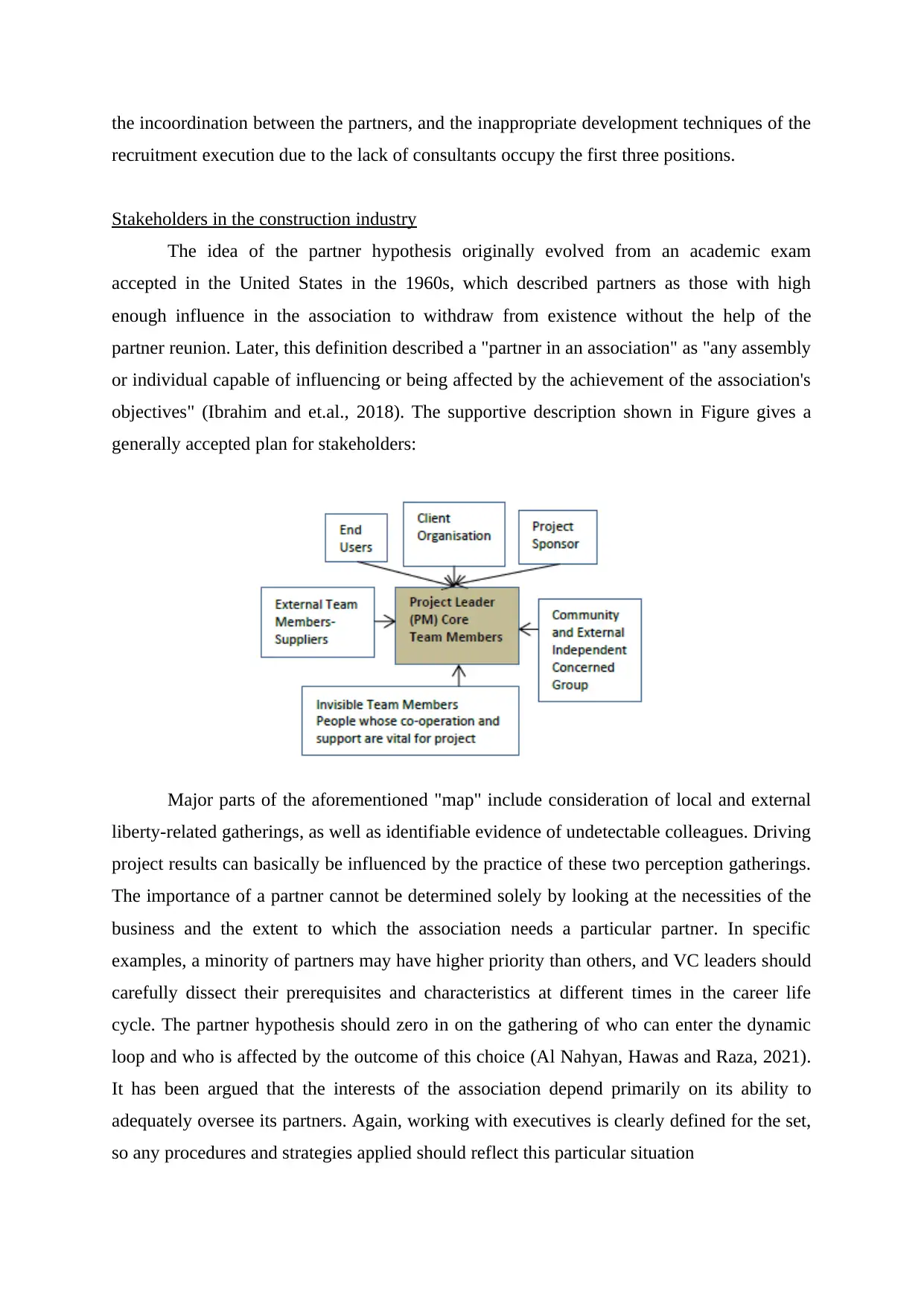
objectives" (Ibrahim and et.al., 2018). The supportive description shown in Figure gives a
generally accepted plan for stakeholders:
Major parts of the aforementioned "map" include consideration of local and external
liberty-related gatherings, as well as identifiable evidence of undetectable colleagues. Driving
project results can basically be influenced by the practice of these two perception gatherings.
The importance of a partner cannot be determined solely by looking at the necessities of the
business and the extent to which the association needs a particular partner. In specific
examples, a minority of partners may have higher priority than others, and VC leaders should
carefully dissect their prerequisites and characteristics at different times in the career life
cycle. The partner hypothesis should zero in on the gathering of who can enter the dynamic
loop and who is affected by the outcome of this choice (Al Nahyan, Hawas and Raza, 2021).
It has been argued that the interests of the association depend primarily on its ability to
adequately oversee its partners. Again, working with executives is clearly defined for the set,
so any procedures and strategies applied should reflect this particular situation
recruitment execution due to the lack of consultants occupy the first three positions.
Stakeholders in the construction industry
The idea of the partner hypothesis originally evolved from an academic exam
accepted in the United States in the 1960s, which described partners as those with high
enough influence in the association to withdraw from existence without the help of the
partner reunion. Later, this definition described a "partner in an association" as "any assembly
or individual capable of influencing or being affected by the achievement of the association's
objectives" (Ibrahim and et.al., 2018). The supportive description shown in Figure gives a
generally accepted plan for stakeholders:
Major parts of the aforementioned "map" include consideration of local and external
liberty-related gatherings, as well as identifiable evidence of undetectable colleagues. Driving
project results can basically be influenced by the practice of these two perception gatherings.
The importance of a partner cannot be determined solely by looking at the necessities of the
business and the extent to which the association needs a particular partner. In specific
examples, a minority of partners may have higher priority than others, and VC leaders should
carefully dissect their prerequisites and characteristics at different times in the career life
cycle. The partner hypothesis should zero in on the gathering of who can enter the dynamic
loop and who is affected by the outcome of this choice (Al Nahyan, Hawas and Raza, 2021).
It has been argued that the interests of the association depend primarily on its ability to
adequately oversee its partners. Again, working with executives is clearly defined for the set,
so any procedures and strategies applied should reflect this particular situation
In the development business, at various stages of tasks from basic preparation to final
activities and maintenance, explicit parties are involved, the assumptions of which may affect
the results, or which may be adversely and decisively affected by commitments. These
gatherings include:
Many researchers say these gatherings are important partners in developing
construction projects. The effective execution and realization of a business depends to a large
extent on the propensity to the needs and assumptions of the participants, and the inability to
accurately address their prerequisites raises many entrepreneurial problems (Ahmed and
Sobuz, 2019). It is not enough to distinguish between partners, directors and owners need to
evaluate the strengths of each partner to express their assumptions about project selection.
The key obligation of the entrepreneur is to answer the prerequisites and necessities raised by
the partner, and to have the option to complete, control and handle the dynamic cycle of
entrepreneurship. Improper management and oversight of partners can create problems in a
business' professional and executive systems. Additionally, conflicting and covert partner
programs, while perhaps not all-encompassing, can lead to many mission disappointments.
These problems are characterized by the need for a precise method of dealing with
differentiating mission-critical partners, looking at their necessity and investigating the
impact and possible dangers they may impose on the mission.
Influences of stakeholder involvement on construction projects and their quality.
The activities and practices attempted at important gatherings will obviously affect
the outcome of the project. As a result, there has recently been growing evidence for the
important work of differentiating key players in the project in this way. To achieve project
results, task leaders are required to work with partners' commitments at different stages of
commitment. A strong system of collaboration with partners to further develop project
outcomes and make progress is not particularly evident in developing business drills.
Different partners can be part of the main team of a large enterprise, and depending on
how they are approached and what their job is, they may have different interests, influences
and desires on a task. Therefore, a key part of the board cycle should be a clear assessment of
the importance and level of impact of these gatherings and their likely direction for the cause
(McNamara and Sepasgozar, 2021).
The partner survey can be divided into four phases: (1) identify key partners (2)
investigate partner tendencies and the possible impact of the cause on those interests (3)
assess partner impact and importance and (4) build support system. It is worth noting that
activities and maintenance, explicit parties are involved, the assumptions of which may affect
the results, or which may be adversely and decisively affected by commitments. These
gatherings include:
Many researchers say these gatherings are important partners in developing
construction projects. The effective execution and realization of a business depends to a large
extent on the propensity to the needs and assumptions of the participants, and the inability to
accurately address their prerequisites raises many entrepreneurial problems (Ahmed and
Sobuz, 2019). It is not enough to distinguish between partners, directors and owners need to
evaluate the strengths of each partner to express their assumptions about project selection.
The key obligation of the entrepreneur is to answer the prerequisites and necessities raised by
the partner, and to have the option to complete, control and handle the dynamic cycle of
entrepreneurship. Improper management and oversight of partners can create problems in a
business' professional and executive systems. Additionally, conflicting and covert partner
programs, while perhaps not all-encompassing, can lead to many mission disappointments.
These problems are characterized by the need for a precise method of dealing with
differentiating mission-critical partners, looking at their necessity and investigating the
impact and possible dangers they may impose on the mission.
Influences of stakeholder involvement on construction projects and their quality.
The activities and practices attempted at important gatherings will obviously affect
the outcome of the project. As a result, there has recently been growing evidence for the
important work of differentiating key players in the project in this way. To achieve project
results, task leaders are required to work with partners' commitments at different stages of
commitment. A strong system of collaboration with partners to further develop project
outcomes and make progress is not particularly evident in developing business drills.
Different partners can be part of the main team of a large enterprise, and depending on
how they are approached and what their job is, they may have different interests, influences
and desires on a task. Therefore, a key part of the board cycle should be a clear assessment of
the importance and level of impact of these gatherings and their likely direction for the cause
(McNamara and Sepasgozar, 2021).
The partner survey can be divided into four phases: (1) identify key partners (2)
investigate partner tendencies and the possible impact of the cause on those interests (3)
assess partner impact and importance and (4) build support system. It is worth noting that
⊘ This is a preview!⊘
Do you want full access?
Subscribe today to unlock all pages.
Trusted by 1+ million students worldwide
partners and joint ventures have reciprocal effects, which means that partners can influence
projects; a development enterprise can influence partners here and there. For example,
providing a better life by expanding the nature of the office of the last business is the benefit
of execution risk. Again, climate elimination is an example of the negative consequences for
some partners (Noor and Yi, 2018). Many factors affect the nature of a business. Incidentally,
the obvious work of key partners is an important part of determining the level of quality. The
nature of a development project often depends on the mindset of the individual partners.
Therefore, if a significant gathering of the protocol does not meet its obligations as expected,
this will adversely affect the final risk quality level. The value level view of customers
(partners) is fundamental, so considering key partners at important stages of the mission life
cycle should be an important part of any system aimed at improving quality.
The corporate oversight team can study its feasibility and the effectiveness of its
control and execution processes, thereby further improving the quality of the project. This
expects them to have important data about the business and be accurate enough to break
down that data and draw a blueprint of mission-critical systems. Hired workers, sub-project
workers and suppliers may not be involved in the beginning stages of the campaign, though,
because they provide materials, hardware, and field work, they can have a significant impact
on the final resource quality anyway. A basic stage of the construction of a comprehensive
quality culture is to cultivate a group of engineering backbones and subcontractors who take
the quality cycle as the core and form a useful quality mentality as soon as possible. In a
serious market, hired workers who are typified by delivering low-quality construction results
will largely not get many future promises. These project staff should be urged in this way to
work according to the nature of their work in order to expand their chances of winning the
bid. Again, a well-qualified hired worker should communicate the project within the
scheduled time and spending plan and achieve the desired level of value.
Furthermore, owners (clients) and designers have an important responsibility for
achieving the desired level of quality of construction results. These parties are not only
responsible for planning a clear and complete decision, but also screening and controlling the
actual field work of both hired workers and subcontractors. In a new examination of value
work using the lens of the "iron triangle of cost, time and quality", there are serious areas of
strength between grade quality and standards, such as board partners, project advocacy and
senior management support (Barraket and Loosemore, 2018). Past inspections were flawed,
and he demonstrated that, in many cases, the execution of value efforts was frustrated by a
lack of consideration for partners' assumptions and perspectives on what the quality of
projects; a development enterprise can influence partners here and there. For example,
providing a better life by expanding the nature of the office of the last business is the benefit
of execution risk. Again, climate elimination is an example of the negative consequences for
some partners (Noor and Yi, 2018). Many factors affect the nature of a business. Incidentally,
the obvious work of key partners is an important part of determining the level of quality. The
nature of a development project often depends on the mindset of the individual partners.
Therefore, if a significant gathering of the protocol does not meet its obligations as expected,
this will adversely affect the final risk quality level. The value level view of customers
(partners) is fundamental, so considering key partners at important stages of the mission life
cycle should be an important part of any system aimed at improving quality.
The corporate oversight team can study its feasibility and the effectiveness of its
control and execution processes, thereby further improving the quality of the project. This
expects them to have important data about the business and be accurate enough to break
down that data and draw a blueprint of mission-critical systems. Hired workers, sub-project
workers and suppliers may not be involved in the beginning stages of the campaign, though,
because they provide materials, hardware, and field work, they can have a significant impact
on the final resource quality anyway. A basic stage of the construction of a comprehensive
quality culture is to cultivate a group of engineering backbones and subcontractors who take
the quality cycle as the core and form a useful quality mentality as soon as possible. In a
serious market, hired workers who are typified by delivering low-quality construction results
will largely not get many future promises. These project staff should be urged in this way to
work according to the nature of their work in order to expand their chances of winning the
bid. Again, a well-qualified hired worker should communicate the project within the
scheduled time and spending plan and achieve the desired level of value.
Furthermore, owners (clients) and designers have an important responsibility for
achieving the desired level of quality of construction results. These parties are not only
responsible for planning a clear and complete decision, but also screening and controlling the
actual field work of both hired workers and subcontractors. In a new examination of value
work using the lens of the "iron triangle of cost, time and quality", there are serious areas of
strength between grade quality and standards, such as board partners, project advocacy and
senior management support (Barraket and Loosemore, 2018). Past inspections were flawed,
and he demonstrated that, in many cases, the execution of value efforts was frustrated by a
lack of consideration for partners' assumptions and perspectives on what the quality of
Paraphrase This Document
Need a fresh take? Get an instant paraphrase of this document with our AI Paraphraser
precise things in the development business meant. It emphasizes that there are some partner
assumptions and influences that should be kept in mind for executive interactions. What’s
more, if a business’s partners are dissatisfied with the nature of executives’ sequential tasks
or risk outcomes, the task force will then be expected to change the degree, time, and cost to
gauge the partners’ assumptions about quality issues.
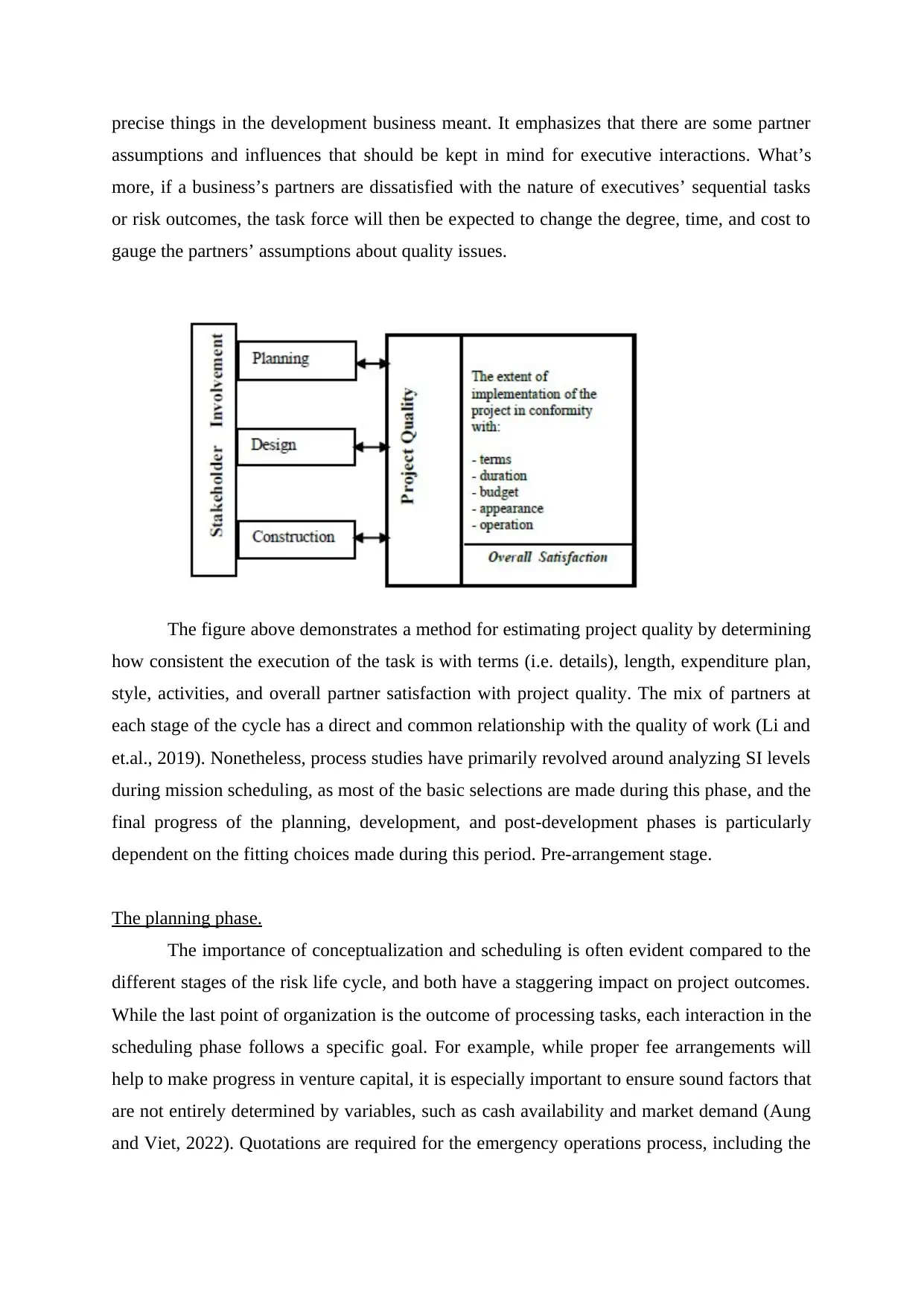
The figure above demonstrates a method for estimating project quality by determining
how consistent the execution of the task is with terms (i.e. details), length, expenditure plan,
style, activities, and overall partner satisfaction with project quality. The mix of partners at
each stage of the cycle has a direct and common relationship with the quality of work (Li and
et.al., 2019). Nonetheless, process studies have primarily revolved around analyzing SI levels
during mission scheduling, as most of the basic selections are made during this phase, and the
final progress of the planning, development, and post-development phases is particularly
dependent on the fitting choices made during this period. Pre-arrangement stage.
The planning phase.
The importance of conceptualization and scheduling is often evident compared to the
different stages of the risk life cycle, and both have a staggering impact on project outcomes.
While the last point of organization is the outcome of processing tasks, each interaction in the
scheduling phase follows a specific goal. For example, while proper fee arrangements will
help to make progress in venture capital, it is especially important to ensure sound factors that
are not entirely determined by variables, such as cash availability and market demand (Aung
and Viet, 2022). Quotations are required for the emergency operations process, including the
assumptions and influences that should be kept in mind for executive interactions. What’s
more, if a business’s partners are dissatisfied with the nature of executives’ sequential tasks
or risk outcomes, the task force will then be expected to change the degree, time, and cost to
gauge the partners’ assumptions about quality issues.
The figure above demonstrates a method for estimating project quality by determining
how consistent the execution of the task is with terms (i.e. details), length, expenditure plan,
style, activities, and overall partner satisfaction with project quality. The mix of partners at
each stage of the cycle has a direct and common relationship with the quality of work (Li and
et.al., 2019). Nonetheless, process studies have primarily revolved around analyzing SI levels
during mission scheduling, as most of the basic selections are made during this phase, and the
final progress of the planning, development, and post-development phases is particularly
dependent on the fitting choices made during this period. Pre-arrangement stage.
The planning phase.
The importance of conceptualization and scheduling is often evident compared to the
different stages of the risk life cycle, and both have a staggering impact on project outcomes.
While the last point of organization is the outcome of processing tasks, each interaction in the
scheduling phase follows a specific goal. For example, while proper fee arrangements will
help to make progress in venture capital, it is especially important to ensure sound factors that
are not entirely determined by variables, such as cash availability and market demand (Aung
and Viet, 2022). Quotations are required for the emergency operations process, including the
integration scheduling system. Essentially, quality arrangements are important to ensure that
quality objectives for key partner prerequisites are met.
Quality Planning Process
Quality management and improvement should start at the scheduling stage, not when
the customer is committed. One of the benefits of starting a quality improvement exercise in
the straightforward start-up phase is that being "scheduled" better immediately in the front-
end of the task will guarantee fewer problems later in the cycle, resulting in a better final
phase. quality delivery. Currently, many associations are focusing their efforts on quality
improvement programs, although the article suggests that these programs do not consistently
create normal quality upgrades (Safa, Baeza and Weeks, 2019). This is the downside of a
robust quality scheduling process prior to implementing quality practices. Therefore, quality
scheduling is the main stage in the business quality management process and requires more
inspection and thinking afterwards. Quality Scheduling is a focused cycle designed to ensure
an organized arrangement of value identification and control exercises. These exercises will
ensure that the Association is able to execute first-class projects on time and in accordance
with the needs and general inclinations of clients and partners. The collection of value
arrangements explicitly used in this exam has been applied to various fields of study
including development. The primary ladder of agglomeration value is divided into five stages
In this scheduling system, the reason for the main phase (EP) is to give the task a clear
goal and correct title. An important part of this process includes: distinguishing tasks that
satisfy the association's technology, explaining the mission of each business, appointing
business colleagues, and developing an overall mission plan. The next stage (IS) gives an
ordered proof of distinction and a complete understanding of all risk partners and their
imperatives, assumptions and prerequisites. By identifying customers and explicitly
evaluating their assumptions, downplaying and identifying vulnerabilities can be avoided
(Sohu and et.al., 2018).
Specific tasks/projects, quality scheduling tools, methodologies and business
innovations are expected to be applied to create successful programs, fully adapted to the
needs of the partner. The outcome of identifying and performing the final task is to
accommodate this necessity and no lack is the main reason for Phase 3 (DP1). Phase 4 (DP2)
ensures that the entire interaction and its components adequately communicate expected and
planned risks. It also filters out that interactions with key project goals are predictable.
Ultimately, functional bugs can be closed in Phase 5 (CO) by creating a plan and effectively
quality objectives for key partner prerequisites are met.
Quality Planning Process
Quality management and improvement should start at the scheduling stage, not when
the customer is committed. One of the benefits of starting a quality improvement exercise in
the straightforward start-up phase is that being "scheduled" better immediately in the front-
end of the task will guarantee fewer problems later in the cycle, resulting in a better final
phase. quality delivery. Currently, many associations are focusing their efforts on quality
improvement programs, although the article suggests that these programs do not consistently
create normal quality upgrades (Safa, Baeza and Weeks, 2019). This is the downside of a
robust quality scheduling process prior to implementing quality practices. Therefore, quality
scheduling is the main stage in the business quality management process and requires more
inspection and thinking afterwards. Quality Scheduling is a focused cycle designed to ensure
an organized arrangement of value identification and control exercises. These exercises will
ensure that the Association is able to execute first-class projects on time and in accordance
with the needs and general inclinations of clients and partners. The collection of value
arrangements explicitly used in this exam has been applied to various fields of study
including development. The primary ladder of agglomeration value is divided into five stages
In this scheduling system, the reason for the main phase (EP) is to give the task a clear
goal and correct title. An important part of this process includes: distinguishing tasks that
satisfy the association's technology, explaining the mission of each business, appointing
business colleagues, and developing an overall mission plan. The next stage (IS) gives an
ordered proof of distinction and a complete understanding of all risk partners and their
imperatives, assumptions and prerequisites. By identifying customers and explicitly
evaluating their assumptions, downplaying and identifying vulnerabilities can be avoided
(Sohu and et.al., 2018).
Specific tasks/projects, quality scheduling tools, methodologies and business
innovations are expected to be applied to create successful programs, fully adapted to the
needs of the partner. The outcome of identifying and performing the final task is to
accommodate this necessity and no lack is the main reason for Phase 3 (DP1). Phase 4 (DP2)
ensures that the entire interaction and its components adequately communicate expected and
planned risks. It also filters out that interactions with key project goals are predictable.
Ultimately, functional bugs can be closed in Phase 5 (CO) by creating a plan and effectively
⊘ This is a preview!⊘
Do you want full access?
Subscribe today to unlock all pages.
Trusted by 1+ million students worldwide
transferring the plan to the functional group. One of the important outputs of the quality
scheduling process is the quality management plan, which describes how the contractor
oversight team should implement the organization's quality approach. It likewise highlights
an important idea as a major priority that risk arrangements and quality arrangements should
not be considered as separate cycles as they contain many comparable exercises that are
interrelated and similar to the different cycles of the arrangement (Ding and et.al., 2018).
Problem solving and decision making.
The work of critical thinking and investigation is illustrated through two cases Larger private
development projects; 1) Increased efficiency cycle Pre-planned substantial design and 2)
turbulent cycles of development loft story on top of structure.
One of the main tasks in development is selecting the right project staff. Picking
legitimate project workers from the variety of candidates available on the market today can
be a confusing issue for clients. When managing the extracted resources, it is important to
select legitimate workers for employment, which can guarantee the nature of the building
structure. The achievement of this is largely dependent on the expressiveness of the chosen
project staff. The importance of the nature of the item and the mode of transportation are
important factors in supplier selection.
All construction processes are dangerous. Authority Game The board of directors
constitutes a part of the legal game of the organization against the executives, so it is crucial
to the overall game of the organization against the executives. The goals of the board's
authority gamble are not limited to the management of legal dangers in contracts. A legally
binding gamble, executives likewise cover the different dangers in business by using
authoritative preparation and boardroom techniques. More issues in development,
administrators are recognized in agricultural countries. It features the most important
developments in board framing issues:
All board development issues should be addressed when endorsed. In the age of data,
associative speculation has resolved critical thinking as the act of data processing. In any
case, at this time, shared critical thinking is increasingly seen as a trigger for information
creation as information-based perspectives recognize associations (Hendiani and Bagherpour,
2019). In a shared critical thinking process, partners bring a variety of information into
problem contexts, which are captured, produced, and shared by colleagues. In development
projects, shared critical thinking often occurs through nearby real-world critical thinking,
especially by overseeing project changes.
scheduling process is the quality management plan, which describes how the contractor
oversight team should implement the organization's quality approach. It likewise highlights
an important idea as a major priority that risk arrangements and quality arrangements should
not be considered as separate cycles as they contain many comparable exercises that are
interrelated and similar to the different cycles of the arrangement (Ding and et.al., 2018).
Problem solving and decision making.
The work of critical thinking and investigation is illustrated through two cases Larger private
development projects; 1) Increased efficiency cycle Pre-planned substantial design and 2)
turbulent cycles of development loft story on top of structure.
One of the main tasks in development is selecting the right project staff. Picking
legitimate project workers from the variety of candidates available on the market today can
be a confusing issue for clients. When managing the extracted resources, it is important to
select legitimate workers for employment, which can guarantee the nature of the building
structure. The achievement of this is largely dependent on the expressiveness of the chosen
project staff. The importance of the nature of the item and the mode of transportation are
important factors in supplier selection.
All construction processes are dangerous. Authority Game The board of directors
constitutes a part of the legal game of the organization against the executives, so it is crucial
to the overall game of the organization against the executives. The goals of the board's
authority gamble are not limited to the management of legal dangers in contracts. A legally
binding gamble, executives likewise cover the different dangers in business by using
authoritative preparation and boardroom techniques. More issues in development,
administrators are recognized in agricultural countries. It features the most important
developments in board framing issues:
All board development issues should be addressed when endorsed. In the age of data,
associative speculation has resolved critical thinking as the act of data processing. In any
case, at this time, shared critical thinking is increasingly seen as a trigger for information
creation as information-based perspectives recognize associations (Hendiani and Bagherpour,
2019). In a shared critical thinking process, partners bring a variety of information into
problem contexts, which are captured, produced, and shared by colleagues. In development
projects, shared critical thinking often occurs through nearby real-world critical thinking,
especially by overseeing project changes.
Paraphrase This Document
Need a fresh take? Get an instant paraphrase of this document with our AI Paraphraser
When choosing a multi-model technique, certain measures should be taken. Create a
multi-rule navigation model.
The placement options should first be characterized. For example, when selecting
employees during the development process, all potential employees should be identified to
complete the task (Sarkar and et.al., 2021).
Furthermore, criteria for these options should be set. This means that a distinction
should be made between factors that have a significant impact on project staff decision-
making.
The third is to do a good job in the rules and assessment arrangements. Each measure
is evaluated in unexpected ways, so the framework should be characterized. For example, a
hired worker's insight can be assessed as significant, excellent, normal, suboptimal, or
unacceptable, while productivity can be described as high, normal, or low, etc.
Fourth, the rule load should be characterized. In this process, a distinction should be
made between important and unimportant measures. The more important a criterion is, the
more weight it should have. Then, by then, every model for every option should be evaluated.
Finally, the count should be counted and the best electives selected with the help of the
program (Zhang and et.al., 2018).
CONCLUSION
This above essay completes a complete assessment of the level of partner contribution
at the current stage of project scheduling. Addressing the lack of deep involvement of
entrepreneurs and employed persons in formulating the enterprise, the key objectives are
often to identify the cause, define degrees, goals and objectives, and develop the tools to
accomplish the objectives, select tasks to group and characterize project assets and their
constraints. This can be attributed to the failure of these gatherings to take into account the
importance of understanding the work of key partners and the significance of their
contributions to dynamic cycles. While project execution relies on establishing group
connections between hired workers, creators and owners at the start of a start-up, it has not
been proven much in the realm of private structures. In addition, the career transfer accepted
by the project owner, in general, determines the stages in which both creators and hired
workers participate in the project arrangement. So they (owners and engineers) need to take
pains to choose the right type of agreement to make a convincing contribution to these
previous partner gatherings. While accurately distinguishing key partners and breaking down
multi-rule navigation model.
The placement options should first be characterized. For example, when selecting
employees during the development process, all potential employees should be identified to
complete the task (Sarkar and et.al., 2021).
Furthermore, criteria for these options should be set. This means that a distinction
should be made between factors that have a significant impact on project staff decision-
making.
The third is to do a good job in the rules and assessment arrangements. Each measure
is evaluated in unexpected ways, so the framework should be characterized. For example, a
hired worker's insight can be assessed as significant, excellent, normal, suboptimal, or
unacceptable, while productivity can be described as high, normal, or low, etc.
Fourth, the rule load should be characterized. In this process, a distinction should be
made between important and unimportant measures. The more important a criterion is, the
more weight it should have. Then, by then, every model for every option should be evaluated.
Finally, the count should be counted and the best electives selected with the help of the
program (Zhang and et.al., 2018).
CONCLUSION
This above essay completes a complete assessment of the level of partner contribution
at the current stage of project scheduling. Addressing the lack of deep involvement of
entrepreneurs and employed persons in formulating the enterprise, the key objectives are
often to identify the cause, define degrees, goals and objectives, and develop the tools to
accomplish the objectives, select tasks to group and characterize project assets and their
constraints. This can be attributed to the failure of these gatherings to take into account the
importance of understanding the work of key partners and the significance of their
contributions to dynamic cycles. While project execution relies on establishing group
connections between hired workers, creators and owners at the start of a start-up, it has not
been proven much in the realm of private structures. In addition, the career transfer accepted
by the project owner, in general, determines the stages in which both creators and hired
workers participate in the project arrangement. So they (owners and engineers) need to take
pains to choose the right type of agreement to make a convincing contribution to these
previous partner gatherings. While accurately distinguishing key partners and breaking down
their necessities and prerequisites is an important part of the scheduling phase, the ability to
accurately identify and monitor partners can mean the difference between progress and
disappointment. The study confirmed that owners and engineers were not deeply involved in
the deliberate identification process. This problem can be the result of specific causes; for
example, a lack of information and data about the mission and its highlights can seriously
hinder strong collaboration between the owner and the business. Unfortunate customer
information can adversely affect businesses and their partners. The quality readiness of most
businesses will be tested by a large number of partner demands, so the task force should
appropriately describe and assess these needs and requirements. The task improvement stage
is the stage in which the task is actually implemented. Gathering the essentials of the relevant
partners, identifying strategies for identifying project highlights, distinguishing quality
assumptions, etc. exercises, are fully completed at this stage. Disregarding the significance of
this stage, it was found that the owner/engineer and sponsor did not contribute significantly to
the effective realization of the stage goals. One reason for this may be that they are not fully
obligated to perform the exercises associated with this stage precisely. This lack of full
accountability can be a consequence of an unfortunate familiarity with the importance and
benefits of applying these exercises to moving the project forward. Proper management and
partner contributions and meeting quality prerequisites (considered important exercises at this
stage) are the two main elements of task completion. Therefore, if mission-critical individuals
can improve their mindfulness and increase the completion of goals in this phase, it may help
the project progress. What's more, choosing the most reliable technique to perform the cycle
requires ideally to downplay the job and its particular highlights. To be sure, executing such a
loop is not fully efficient when the members do not have satisfactory correct data, or do not
have enough grasp.
In the development business, one must often make choices at all stages of the
structural cycle, from arranging another development project, to execution, to using the ready
design stage. In general, dynamic interactions become more chaotic due to the specifics of
structural design. Under such various options, it is specified that different dynamic help
techniques are applied. From a scientific and computational methodology perspective, both
writing and active experience recommend some techniques, some less, some more confusing.
accurately identify and monitor partners can mean the difference between progress and
disappointment. The study confirmed that owners and engineers were not deeply involved in
the deliberate identification process. This problem can be the result of specific causes; for
example, a lack of information and data about the mission and its highlights can seriously
hinder strong collaboration between the owner and the business. Unfortunate customer
information can adversely affect businesses and their partners. The quality readiness of most
businesses will be tested by a large number of partner demands, so the task force should
appropriately describe and assess these needs and requirements. The task improvement stage
is the stage in which the task is actually implemented. Gathering the essentials of the relevant
partners, identifying strategies for identifying project highlights, distinguishing quality
assumptions, etc. exercises, are fully completed at this stage. Disregarding the significance of
this stage, it was found that the owner/engineer and sponsor did not contribute significantly to
the effective realization of the stage goals. One reason for this may be that they are not fully
obligated to perform the exercises associated with this stage precisely. This lack of full
accountability can be a consequence of an unfortunate familiarity with the importance and
benefits of applying these exercises to moving the project forward. Proper management and
partner contributions and meeting quality prerequisites (considered important exercises at this
stage) are the two main elements of task completion. Therefore, if mission-critical individuals
can improve their mindfulness and increase the completion of goals in this phase, it may help
the project progress. What's more, choosing the most reliable technique to perform the cycle
requires ideally to downplay the job and its particular highlights. To be sure, executing such a
loop is not fully efficient when the members do not have satisfactory correct data, or do not
have enough grasp.
In the development business, one must often make choices at all stages of the
structural cycle, from arranging another development project, to execution, to using the ready
design stage. In general, dynamic interactions become more chaotic due to the specifics of
structural design. Under such various options, it is specified that different dynamic help
techniques are applied. From a scientific and computational methodology perspective, both
writing and active experience recommend some techniques, some less, some more confusing.
⊘ This is a preview!⊘
Do you want full access?
Subscribe today to unlock all pages.
Trusted by 1+ million students worldwide

1 out of 14


Your All-in-One AI-Powered Toolkit for Academic Success.
+13062052269
info@desklib.com
Available 24*7 on WhatsApp / Email
![[object Object]](/_next/static/media/star-bottom.7253800d.svg)
Unlock your academic potential
Copyright © 2020–2026 A2Z Services. All Rights Reserved. Developed and managed by ZUCOL.