The State as Deviant: Exploring Government Deviance Using Weber & Marx

Verified

Added on  2023/05/29

|5
|999
|286
Essay
AI Summary
This essay explores the concept of the state and government acting as deviants, challenging the conventional understanding of these institutions as enforcers of conformity. It uses the theories of Max Weber and Karl Marx to analyze situations where the government prioritizes its own interests over the public good. The essay defines deviance as behavior that violates societal norms and examines how the state, despite its power to legislate and enforce laws for the common good, can exhibit deviant behavior when it becomes isolated from its purpose of serving society. The author uses Robert Brym's cancer paradox as an example, highlighting the disproportionate allocation of research funding towards biological causes rather than environmental prevention, suggesting a conflict of interest where powerful entities control resource allocation. The essay concludes by emphasizing that while deviance is often seen negatively, it can also expose conflicts and prompt necessary changes within society, while also drawing attention to the importance of responsible use of legal power by state to avoid conflicts.
Document Page
Running head: STATE AND GOVERNMENT AS A DEVIANT
STATE AND GOVERNMENT AS A DEVIANT
Name of the student:
Name of the university:
Author note:
tabler-icon-diamond-filled.svg

Paraphrase This Document

Need a fresh take? Get an instant paraphrase of this document with our AI Paraphraser
Document Page
1STATE AND GOVERNMENT AS A DEVIANT
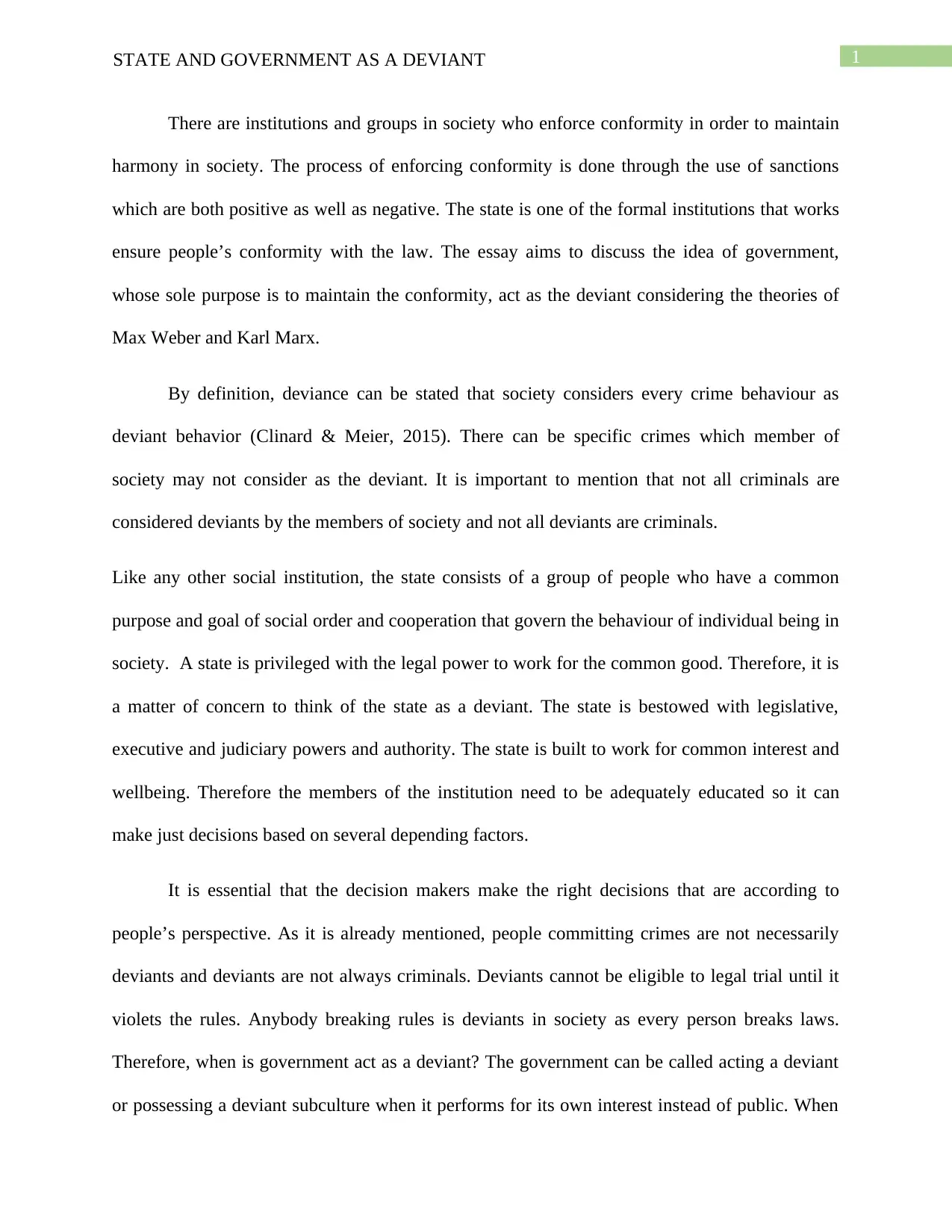
There are institutions and groups in society who enforce conformity in order to maintain
harmony in society. The process of enforcing conformity is done through the use of sanctions
which are both positive as well as negative. The state is one of the formal institutions that works
ensure people’s conformity with the law. The essay aims to discuss the idea of government,
whose sole purpose is to maintain the conformity, act as the deviant considering the theories of
Max Weber and Karl Marx.
By definition, deviance can be stated that society considers every crime behaviour as
deviant behavior (Clinard & Meier, 2015). There can be specific crimes which member of
society may not consider as the deviant. It is important to mention that not all criminals are
considered deviants by the members of society and not all deviants are criminals.
Like any other social institution, the state consists of a group of people who have a common
purpose and goal of social order and cooperation that govern the behaviour of individual being in
society. A state is privileged with the legal power to work for the common good. Therefore, it is
a matter of concern to think of the state as a deviant. The state is bestowed with legislative,
executive and judiciary powers and authority. The state is built to work for common interest and
wellbeing. Therefore the members of the institution need to be adequately educated so it can
make just decisions based on several depending factors.
It is essential that the decision makers make the right decisions that are according to
people’s perspective. As it is already mentioned, people committing crimes are not necessarily
deviants and deviants are not always criminals. Deviants cannot be eligible to legal trial until it
violets the rules. Anybody breaking rules is deviants in society as every person breaks laws.
Therefore, when is government act as a deviant? The government can be called acting a deviant
or possessing a deviant subculture when it performs for its own interest instead of public. When
Document Page
2STATE AND GOVERNMENT AS A DEVIANT
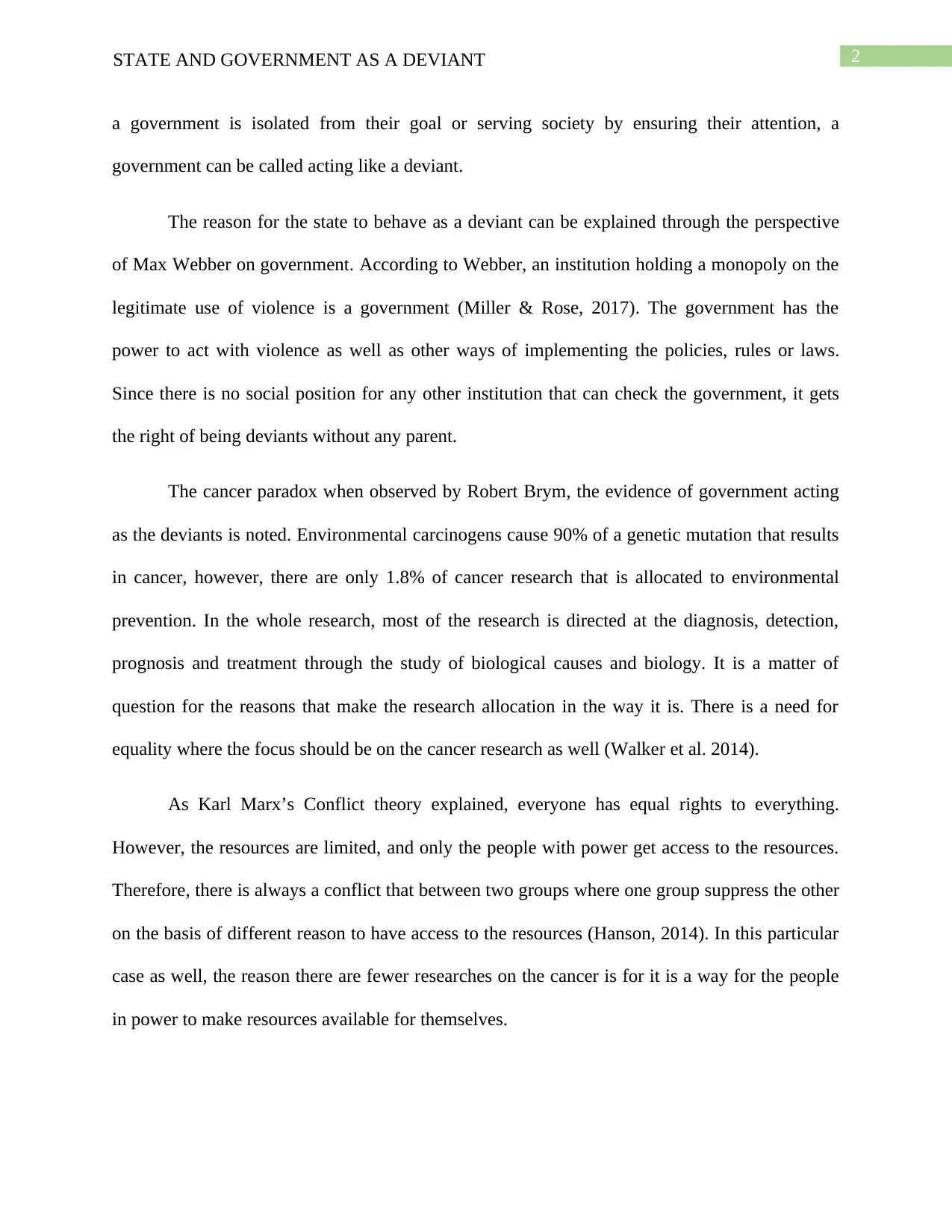
a government is isolated from their goal or serving society by ensuring their attention, a
government can be called acting like a deviant.
The reason for the state to behave as a deviant can be explained through the perspective
of Max Webber on government. According to Webber, an institution holding a monopoly on the
legitimate use of violence is a government (Miller & Rose, 2017). The government has the
power to act with violence as well as other ways of implementing the policies, rules or laws.
Since there is no social position for any other institution that can check the government, it gets
the right of being deviants without any parent.
The cancer paradox when observed by Robert Brym, the evidence of government acting
as the deviants is noted. Environmental carcinogens cause 90% of a genetic mutation that results
in cancer, however, there are only 1.8% of cancer research that is allocated to environmental
prevention. In the whole research, most of the research is directed at the diagnosis, detection,
prognosis and treatment through the study of biological causes and biology. It is a matter of
question for the reasons that make the research allocation in the way it is. There is a need for
equality where the focus should be on the cancer research as well (Walker et al. 2014).
As Karl Marx’s Conflict theory explained, everyone has equal rights to everything.
However, the resources are limited, and only the people with power get access to the resources.
Therefore, there is always a conflict that between two groups where one group suppress the other
on the basis of different reason to have access to the resources (Hanson, 2014). In this particular
case as well, the reason there are fewer researches on the cancer is for it is a way for the people
in power to make resources available for themselves.
Document Page
3STATE AND GOVERNMENT AS A DEVIANT
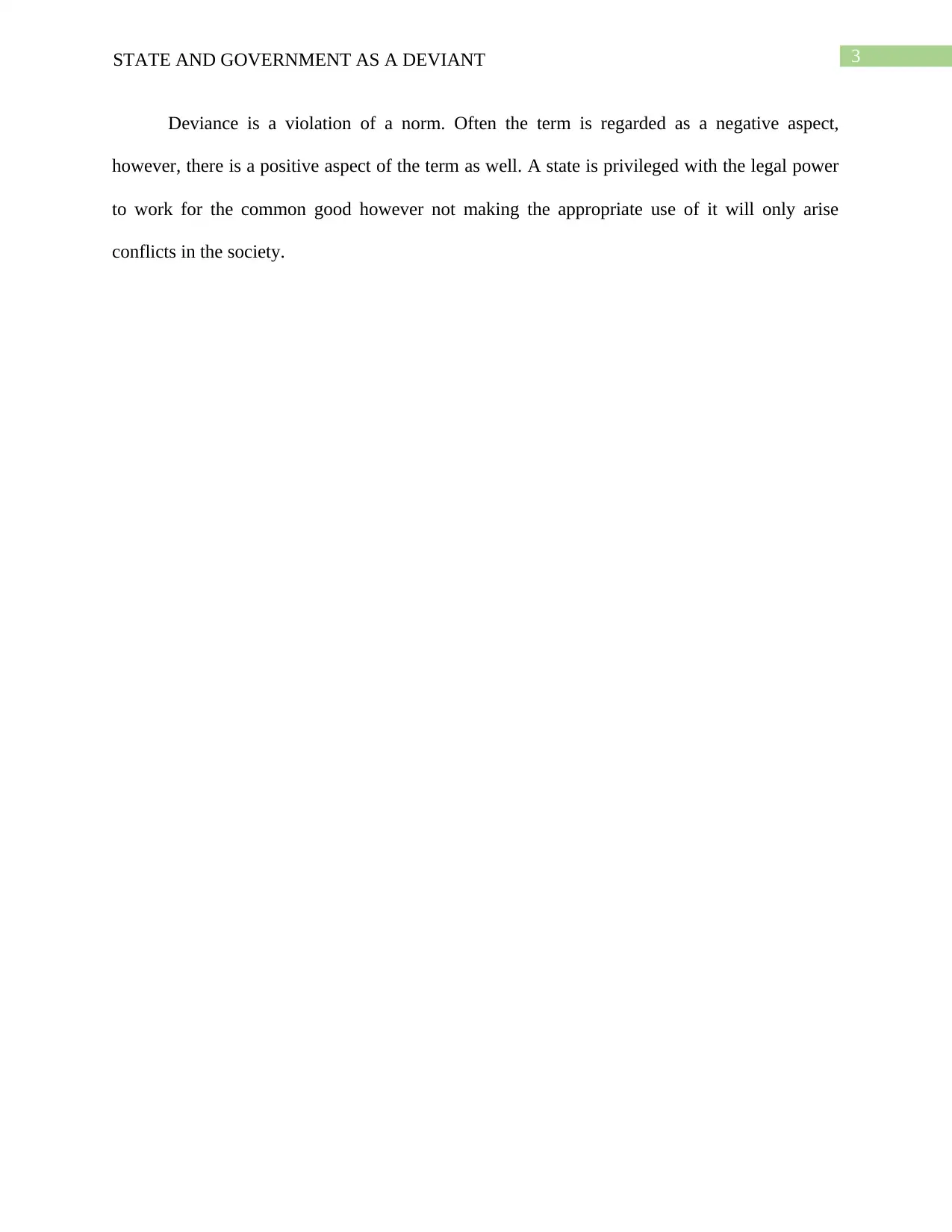
Deviance is a violation of a norm. Often the term is regarded as a negative aspect,
however, there is a positive aspect of the term as well. A state is privileged with the legal power
to work for the common good however not making the appropriate use of it will only arise
conflicts in the society.
tabler-icon-diamond-filled.svg

Paraphrase This Document

Need a fresh take? Get an instant paraphrase of this document with our AI Paraphraser
Document Page
4STATE AND GOVERNMENT AS A DEVIANT
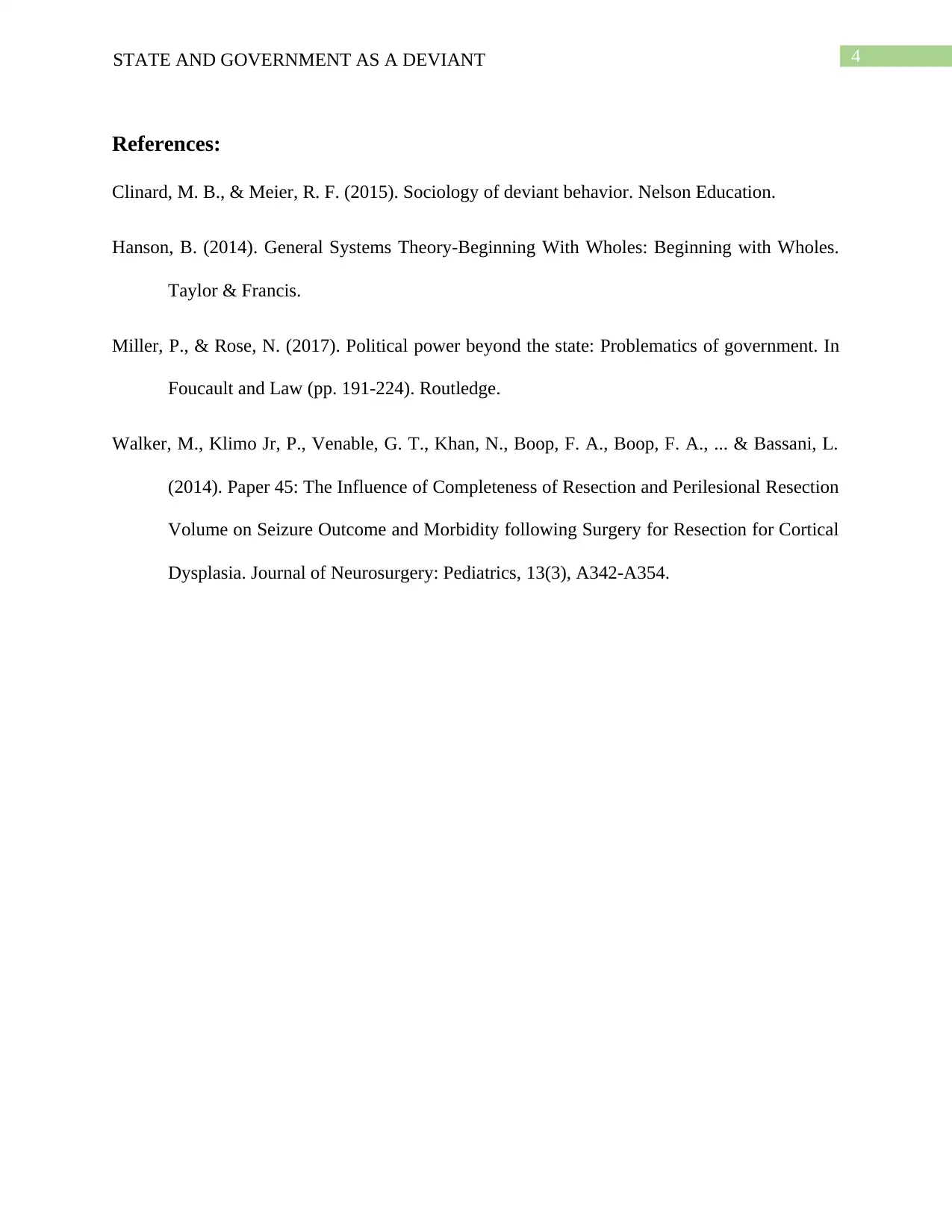
References:
Clinard, M. B., & Meier, R. F. (2015). Sociology of deviant behavior. Nelson Education.
Hanson, B. (2014). General Systems Theory-Beginning With Wholes: Beginning with Wholes.
Taylor & Francis.
Miller, P., & Rose, N. (2017). Political power beyond the state: Problematics of government. In
Foucault and Law (pp. 191-224). Routledge.
Walker, M., Klimo Jr, P., Venable, G. T., Khan, N., Boop, F. A., Boop, F. A., ... & Bassani, L.
(2014). Paper 45: The Influence of Completeness of Resection and Perilesional Resection
Volume on Seizure Outcome and Morbidity following Surgery for Resection for Cortical
Dysplasia. Journal of Neurosurgery: Pediatrics, 13(3), A342-A354.
chevron_up_icon
1 out of 5
circle_padding
hide_on_mobile
zoom_out_icon
[object Object]