IKEA Strategic Management Report: Market Analysis and Responses
VerifiedAdded on 2024/05/17
|14
|3292
|129
Report
AI Summary
This strategic management report provides a comprehensive analysis of IKEA's market position, strategic issues, and responses. The report identifies key strategic issues using PESTLE and Porter's Five Forces analyses, highlighting the impact of political, economic, social, technological, legal, and environmental factors, as well as competitive rivalry, supplier power, buyer power, the threat of substitution, and the threat of new entry. Strategic responses are discussed at industry, corporate, business, and operational levels, focusing on critical success factors (CSFs) and resource management. The results of these strategic responses are evaluated using VRIO analysis to determine sustainable competitive advantages. The report concludes with recommendations for IKEA to maintain and improve its market position. Desklib provides access to this and other solved assignments for students.
Strategic Management
1
1

Paraphrase This Document
Need a fresh take? Get an instant paraphrase of this document with our AI Paraphraser
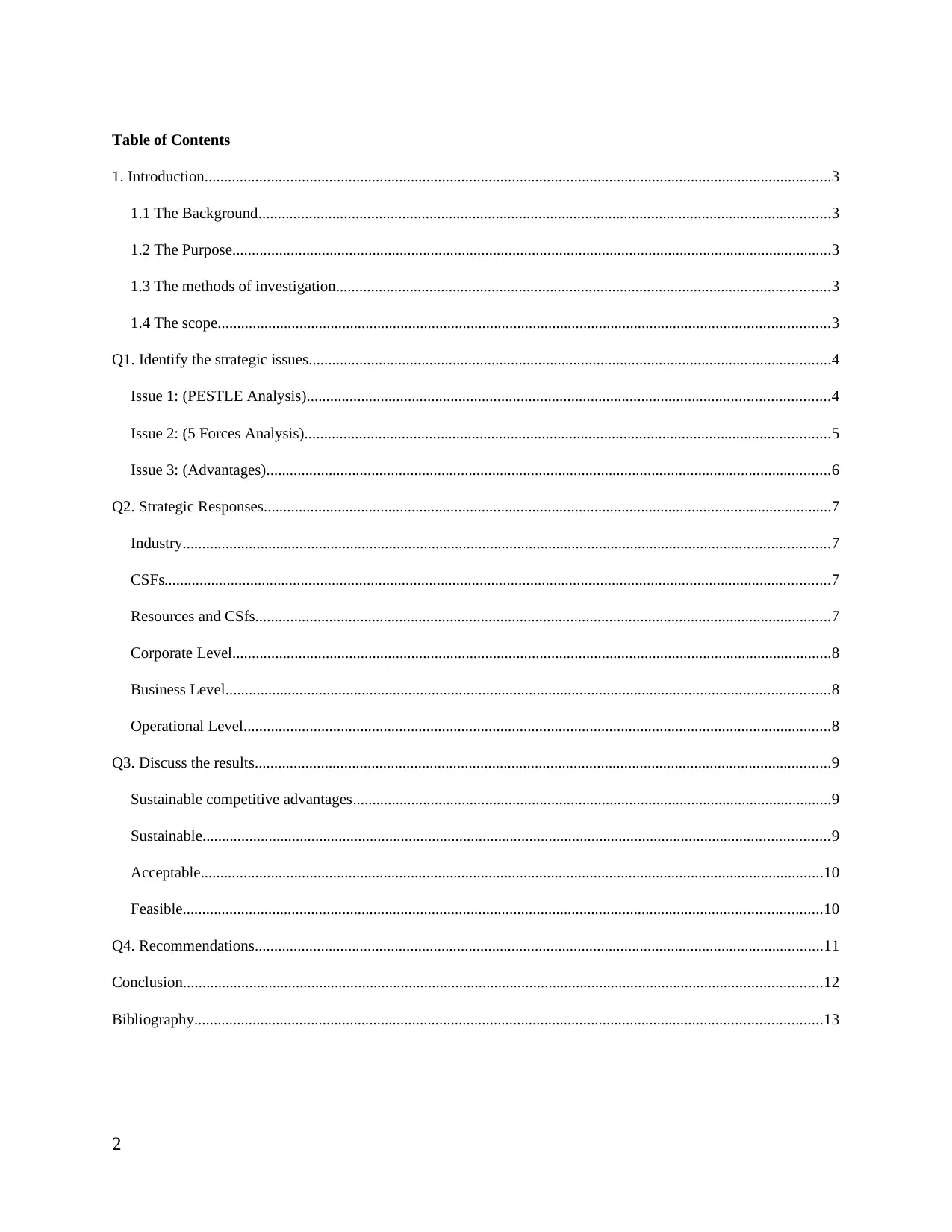
Table of Contents
1. Introduction.................................................................................................................................................................3
1.1 The Background...................................................................................................................................................3
1.2 The Purpose..........................................................................................................................................................3
1.3 The methods of investigation...............................................................................................................................3
1.4 The scope.............................................................................................................................................................3
Q1. Identify the strategic issues......................................................................................................................................4
Issue 1: (PESTLE Analysis)......................................................................................................................................4
Issue 2: (5 Forces Analysis).......................................................................................................................................5
Issue 3: (Advantages).................................................................................................................................................6
Q2. Strategic Responses..................................................................................................................................................7
Industry......................................................................................................................................................................7
CSFs...........................................................................................................................................................................7
Resources and CSfs....................................................................................................................................................7
Corporate Level..........................................................................................................................................................8
Business Level...........................................................................................................................................................8
Operational Level.......................................................................................................................................................8
Q3. Discuss the results....................................................................................................................................................9
Sustainable competitive advantages...........................................................................................................................9
Sustainable.................................................................................................................................................................9
Acceptable................................................................................................................................................................10
Feasible....................................................................................................................................................................10
Q4. Recommendations..................................................................................................................................................11
Conclusion....................................................................................................................................................................12
Bibliography.................................................................................................................................................................13
2
1. Introduction.................................................................................................................................................................3
1.1 The Background...................................................................................................................................................3
1.2 The Purpose..........................................................................................................................................................3
1.3 The methods of investigation...............................................................................................................................3
1.4 The scope.............................................................................................................................................................3
Q1. Identify the strategic issues......................................................................................................................................4
Issue 1: (PESTLE Analysis)......................................................................................................................................4
Issue 2: (5 Forces Analysis).......................................................................................................................................5
Issue 3: (Advantages).................................................................................................................................................6
Q2. Strategic Responses..................................................................................................................................................7
Industry......................................................................................................................................................................7
CSFs...........................................................................................................................................................................7
Resources and CSfs....................................................................................................................................................7
Corporate Level..........................................................................................................................................................8
Business Level...........................................................................................................................................................8
Operational Level.......................................................................................................................................................8
Q3. Discuss the results....................................................................................................................................................9
Sustainable competitive advantages...........................................................................................................................9
Sustainable.................................................................................................................................................................9
Acceptable................................................................................................................................................................10
Feasible....................................................................................................................................................................10
Q4. Recommendations..................................................................................................................................................11
Conclusion....................................................................................................................................................................12
Bibliography.................................................................................................................................................................13
2
1. Introduction
1.1 The Background
IKEA is one the oldest organisation working in the home fixtures and kitchen appliances. The
company has developed a very positive brand image among its target market, which has
influenced to other big business groups to enter in this retail market to make profits. It has
increased the market rivalries for the IKEA and now many of the companies are working in this
sector (Bainbridge, 2012). John Leis, DFS, Habitat, and SCS are some of the market competitors
of the IKEA affecting the business of its.
1.2 The Purpose
The key reason to develop this report is to identify the strategic issues on which is analysed by
the IKEA in its market. This report is also explaining the strategic response on a different level
of organisation which supports to improve on these strategic issues. Results of this strategic
response are also discussed in this report and after it, some recommendation is also given in this
report.
1.3 The methods of investigation
It is prior to defining the methods to investigate the company to gather the key information about
the IKEA and its market. Secondary research is effective for this report to collect information
about the retail furniture market and IKEA’s loopholes in the marketing strategy. Published
articles in online journals, newspaper and website are effective to gather information about the
company and market competition.
1.4 The scope
This report is mainly focused on the information about the IKEA from 2012 to 2018 which
shows that this report is containing the limited scope. The main area of this report is to explain
the market condition, rivalry and strategy to improve on it for the IKEA.
3
1.1 The Background
IKEA is one the oldest organisation working in the home fixtures and kitchen appliances. The
company has developed a very positive brand image among its target market, which has
influenced to other big business groups to enter in this retail market to make profits. It has
increased the market rivalries for the IKEA and now many of the companies are working in this
sector (Bainbridge, 2012). John Leis, DFS, Habitat, and SCS are some of the market competitors
of the IKEA affecting the business of its.
1.2 The Purpose
The key reason to develop this report is to identify the strategic issues on which is analysed by
the IKEA in its market. This report is also explaining the strategic response on a different level
of organisation which supports to improve on these strategic issues. Results of this strategic
response are also discussed in this report and after it, some recommendation is also given in this
report.
1.3 The methods of investigation
It is prior to defining the methods to investigate the company to gather the key information about
the IKEA and its market. Secondary research is effective for this report to collect information
about the retail furniture market and IKEA’s loopholes in the marketing strategy. Published
articles in online journals, newspaper and website are effective to gather information about the
company and market competition.
1.4 The scope
This report is mainly focused on the information about the IKEA from 2012 to 2018 which
shows that this report is containing the limited scope. The main area of this report is to explain
the market condition, rivalry and strategy to improve on it for the IKEA.
3
⊘ This is a preview!⊘
Do you want full access?
Subscribe today to unlock all pages.

Trusted by 1+ million students worldwide
Q1. Identify the strategic issues
Issue 1: (PESTLE Analysis)
It is an efficacious tool to analyse the external environment of the organisation. It contains a
wide range of the significant elements which creates a huge effect on a company in its different
areas and activities (Srdjevic, et. al., 2012). A PESTLE analysis of the IKEA is presented in the
below points:
Political: It contains the policies and rules developed by the government for the specific market.
It identifies those political factors which are creating a huge impact on the furniture market and
industry. The company is working in the EU nations also so Brexit has created a huge i9mopact
on the business of the EU nations.
Economical: This factor contains the relevant subfactors which impact on the furniture industry.
In the year of 2017, the GDP of the UK is $2.565 Trillion which is the sixth largest national
economy in the world. The unemployment rate in the UK is 4.3% and the inflation rate is 3% in
the year of 2017 (Office for National Statistics., 2018).
Social: The sociological factor is having a huge influence on the organisation’s sales, marketing,
demands, and supply so it is essential to consider in the external analysis. The occupation of the
furniture depends on the available space of occupier so it is essential for the IKEA to consider it
to develop their furniture and fixtures.
Technological: Development in technology effects on the production, marketing, sales, and
design. Most of the market rivalries are more focused on the use of technology in designing the
fixtures and customised furniture. 3D and technology in the furniture designing have potential to
develop a better design of furniture to use in the home. This technology is also efficacious to
maximise the utilisation of the available space.
Legal: Legislation and laws create a huge effect on the acts of the company in the different areas.
Employability acts, Company act, Contract act etc. have a huge value for the IKEA which can
help the company to develop a better change.
4
Issue 1: (PESTLE Analysis)
It is an efficacious tool to analyse the external environment of the organisation. It contains a
wide range of the significant elements which creates a huge effect on a company in its different
areas and activities (Srdjevic, et. al., 2012). A PESTLE analysis of the IKEA is presented in the
below points:
Political: It contains the policies and rules developed by the government for the specific market.
It identifies those political factors which are creating a huge impact on the furniture market and
industry. The company is working in the EU nations also so Brexit has created a huge i9mopact
on the business of the EU nations.
Economical: This factor contains the relevant subfactors which impact on the furniture industry.
In the year of 2017, the GDP of the UK is $2.565 Trillion which is the sixth largest national
economy in the world. The unemployment rate in the UK is 4.3% and the inflation rate is 3% in
the year of 2017 (Office for National Statistics., 2018).
Social: The sociological factor is having a huge influence on the organisation’s sales, marketing,
demands, and supply so it is essential to consider in the external analysis. The occupation of the
furniture depends on the available space of occupier so it is essential for the IKEA to consider it
to develop their furniture and fixtures.
Technological: Development in technology effects on the production, marketing, sales, and
design. Most of the market rivalries are more focused on the use of technology in designing the
fixtures and customised furniture. 3D and technology in the furniture designing have potential to
develop a better design of furniture to use in the home. This technology is also efficacious to
maximise the utilisation of the available space.
Legal: Legislation and laws create a huge effect on the acts of the company in the different areas.
Employability acts, Company act, Contract act etc. have a huge value for the IKEA which can
help the company to develop a better change.
4
Paraphrase This Document
Need a fresh take? Get an instant paraphrase of this document with our AI Paraphraser
Environmental: Most of the customers prefer to use wooden furniture and fixtures which are
creating a huge negative impact on the forest and woodland. So considering this factor it is
essential to use some relevant option to secure and protect the forest for the better environment in
the UK.
Issue 2: (5 Forces Analysis)
Porter’s five forces analysis specifically grounded on the market condition of a company which
supports the strategic development of the negative market conditions. The Porter’s five forces
analysis is given in the below points:
Competitive rivalry: IKEA is working as a furniture retailer and many of the companies are
also working in the same sector. John Lewis, DFS, Habitat, SCS, independent furniture stores are
creating a negative effect on the business of the IKEA (Bainbridge. 2012). These organisations
are continuously growing their business and market share which are decreasing the profits and
sales of the IKEA. It is essential for the company to overcome the market rivalries by developing
some changes in their product range and also adopting a change in the market strategy.
Supplier power: The IKEA has several suppliers for the raw materials which helps them to
develop products as per the demands and needs of the customers. Cost of the product is mainly
based on the consumed raw material’s cost so the IKEA is mainly demanding on the suppliers.
The quantity of production is also varying on the supplier’s strength to supply raw materials in
the demands of the IKEA. Most of the suppliers contain enough strength to supply raw material
according to demands of the company cost factor is leading to this kind of situation which affects
the price of the product.
Buyer power: The IKEA is mainly focused on sales their products in the economic market.
IKEA is working in the business to customer’s retail market so the buyers are focused to
purchase cost-effective furniture and fixture to use at home. It creates a compulsion for the
company to take their price of products in the economical price range which can help to their
targeted customers to easily purchase their products.
The threat of substitution: It is related to the risk of substitute products which can be used by
the customers on behalf of the produced products of the company. IKEA is producing a large
5
creating a huge negative impact on the forest and woodland. So considering this factor it is
essential to use some relevant option to secure and protect the forest for the better environment in
the UK.
Issue 2: (5 Forces Analysis)
Porter’s five forces analysis specifically grounded on the market condition of a company which
supports the strategic development of the negative market conditions. The Porter’s five forces
analysis is given in the below points:
Competitive rivalry: IKEA is working as a furniture retailer and many of the companies are
also working in the same sector. John Lewis, DFS, Habitat, SCS, independent furniture stores are
creating a negative effect on the business of the IKEA (Bainbridge. 2012). These organisations
are continuously growing their business and market share which are decreasing the profits and
sales of the IKEA. It is essential for the company to overcome the market rivalries by developing
some changes in their product range and also adopting a change in the market strategy.
Supplier power: The IKEA has several suppliers for the raw materials which helps them to
develop products as per the demands and needs of the customers. Cost of the product is mainly
based on the consumed raw material’s cost so the IKEA is mainly demanding on the suppliers.
The quantity of production is also varying on the supplier’s strength to supply raw materials in
the demands of the IKEA. Most of the suppliers contain enough strength to supply raw material
according to demands of the company cost factor is leading to this kind of situation which affects
the price of the product.
Buyer power: The IKEA is mainly focused on sales their products in the economic market.
IKEA is working in the business to customer’s retail market so the buyers are focused to
purchase cost-effective furniture and fixture to use at home. It creates a compulsion for the
company to take their price of products in the economical price range which can help to their
targeted customers to easily purchase their products.
The threat of substitution: It is related to the risk of substitute products which can be used by
the customers on behalf of the produced products of the company. IKEA is producing a large
5
range of wooden, plastic, aluminium and steel based furniture’s and fixtures to use at home so
the organisation has eliminated the threat of substitution.
The threat of new entry: It is the key risk factor for the company which can impact on the
market position and market share of the company. Many big business groups are targeting to
enter in the retail furniture market which can affect the market share and position of the
company.
Issue 3: (Advantages)
It is founded on the background of the company that the IKEA is one of the oldest market
players in the furniture retail sector. The company has a brand image and recognition in the
market which can be used as a competitive advantage. Another thing is that the IKEA is having a
large product range and less threat of substitutes which is its key competitive advantage to
resolve its market rivalries. List of key competitive advantage is given in below points:
Brand image
A wide range of product
Less threat of substitutes
These all identified key factors have potentials to support the organisation in maximising their
sales and profits. All of the elements can support the IKEA develop a competitive advantage to
maintain its market share and position.
6
the organisation has eliminated the threat of substitution.
The threat of new entry: It is the key risk factor for the company which can impact on the
market position and market share of the company. Many big business groups are targeting to
enter in the retail furniture market which can affect the market share and position of the
company.
Issue 3: (Advantages)
It is founded on the background of the company that the IKEA is one of the oldest market
players in the furniture retail sector. The company has a brand image and recognition in the
market which can be used as a competitive advantage. Another thing is that the IKEA is having a
large product range and less threat of substitutes which is its key competitive advantage to
resolve its market rivalries. List of key competitive advantage is given in below points:
Brand image
A wide range of product
Less threat of substitutes
These all identified key factors have potentials to support the organisation in maximising their
sales and profits. All of the elements can support the IKEA develop a competitive advantage to
maintain its market share and position.
6
⊘ This is a preview!⊘
Do you want full access?
Subscribe today to unlock all pages.
Trusted by 1+ million students worldwide
Q2. Strategic Responses
Industry
The IKEA is working in the retail industry in which the company works in both businesses to
business and business to customer market. In the year of 2016, £358 billion and it is the largest
sector which provides the largest employability to the unemployed people. The retail industry
has a huge influence on the purchasing power and fluctuations in the inflations (Abdou, et. al.,
2012). Retain industry is full of the market competition which creates a huge problem for
existing companies to survive but it is effective for the customers to get better products and
services.
CSFs
Factors which determines the success of the organisation in some specific conditions and market
situations states as critical success factors. In the case of the IKEA, it is essential to determine
the CSF which can help to the organisation to get success in the market competition. Most of the
customers want a customised fixture to maximise the utilisation of available space. Another thing
is that customers want to online purchase and home delivery of the products by which IKEA can
improve their sales and market share. List of critical success factor is given in the below-
mentioned points:
Improved sales by 5% in the current year
Online sales
Home delivery of products
Customised products
Resources and CSfs
The IKEA has experienced employees which are enough skilled and experienced to produce a
better-customised product which has potential to enhance the customer's satisfaction level. IKEA
has enough financial resources to fulfill the needs of the marketing, sales, production and
7
Industry
The IKEA is working in the retail industry in which the company works in both businesses to
business and business to customer market. In the year of 2016, £358 billion and it is the largest
sector which provides the largest employability to the unemployed people. The retail industry
has a huge influence on the purchasing power and fluctuations in the inflations (Abdou, et. al.,
2012). Retain industry is full of the market competition which creates a huge problem for
existing companies to survive but it is effective for the customers to get better products and
services.
CSFs
Factors which determines the success of the organisation in some specific conditions and market
situations states as critical success factors. In the case of the IKEA, it is essential to determine
the CSF which can help to the organisation to get success in the market competition. Most of the
customers want a customised fixture to maximise the utilisation of available space. Another thing
is that customers want to online purchase and home delivery of the products by which IKEA can
improve their sales and market share. List of critical success factor is given in the below-
mentioned points:
Improved sales by 5% in the current year
Online sales
Home delivery of products
Customised products
Resources and CSfs
The IKEA has experienced employees which are enough skilled and experienced to produce a
better-customised product which has potential to enhance the customer's satisfaction level. IKEA
has enough financial resources to fulfill the needs of the marketing, sales, production and
7
Paraphrase This Document
Need a fresh take? Get an instant paraphrase of this document with our AI Paraphraser
research & development team to make changes in their strategies to work. The inbound and
outbound logistics have a huge significance for the organisation and develops capabilities to beat
the market competitions. Experienced employees are enough for the IKEA to provide customised
better quality products which have a long life and attractive design.
Corporate Level
Expansion: The organisation has shown the positive response at the corporate level. The
company has expanded its market in different countries which helps them to maintain the profits
and revenues (Ritala, 2012).
Retrenchment: IKEA has used the retrenchment policy to put down the price of their product to
sustain the competitive advantage. The organisation has used some cost-cutting ideas which
helps them to decline the price of the products.
Concentration: IKEA is mainly focused to sustain its market position by providing effective
product and services as per the needs and demands of the products.
Business Level
IKEA has decreased its cost of products to keep the sales level of their products and maintain the
revenues. Differentiation and cost leadership are the main strategies which are used by the
organisation on the business level as a strategic response to the increased market competition
(Teeratansirikool, et. al., 2012). These strategies support to deliver better products and services
as per the demands of the economical customers.
Operational Level
IKEA has its focus on to maintain the effective price of their products for the economical market
so the company has its key focus to maximise the utilisation of its resources. Human, financial,
raw material etc. significant resources are maintained by the company in the resource
management.
8
outbound logistics have a huge significance for the organisation and develops capabilities to beat
the market competitions. Experienced employees are enough for the IKEA to provide customised
better quality products which have a long life and attractive design.
Corporate Level
Expansion: The organisation has shown the positive response at the corporate level. The
company has expanded its market in different countries which helps them to maintain the profits
and revenues (Ritala, 2012).
Retrenchment: IKEA has used the retrenchment policy to put down the price of their product to
sustain the competitive advantage. The organisation has used some cost-cutting ideas which
helps them to decline the price of the products.
Concentration: IKEA is mainly focused to sustain its market position by providing effective
product and services as per the needs and demands of the products.
Business Level
IKEA has decreased its cost of products to keep the sales level of their products and maintain the
revenues. Differentiation and cost leadership are the main strategies which are used by the
organisation on the business level as a strategic response to the increased market competition
(Teeratansirikool, et. al., 2012). These strategies support to deliver better products and services
as per the demands of the economical customers.
Operational Level
IKEA has its focus on to maintain the effective price of their products for the economical market
so the company has its key focus to maximise the utilisation of its resources. Human, financial,
raw material etc. significant resources are maintained by the company in the resource
management.
8
Q3. Discuss the results
Sustainable competitive advantages
It is effective to use VRIO analysis tool to evaluate the results of the strategic response of the
company. This tool mainly focused on the resource of the company and competitive advantages.
A VRIO analysis is given in the below-mentioned points:
Value: The IKEA has used resource management techniques on the operational level and it is
effectively supported to the organisation to maximise the utilisation of wooden. It helps to the
company to keep decrease the cost of the products and also to utilise the wood in furniture
(Rothaermel, 2015).
Rarity: Many of the organisations are working in the retail furniture market so rarely few firms
are controlling on the resources.
Imitability: It is essential for the IKEA to have all the raw material to keep an effective cost of
the products to maintain the price.
Organisation: IKEA has effectively applied the policies and strategies to maximise the
utilisation of resources in the production.
Sustainable
Resource management is effective for the IKEA to manage all of the natural resources to sustain
them for a longer time (Bratton and Gold, 2017). IKEA has focused to maximise the use of
wooden and steel avoid the exploitation of the natural resources. It is essential for the
organisation which is working in the retail furniture market to avoid the wastage of natural and
human resources which can help them to make a better change in the product development.
Differentiation and cost leadership strategies are effective to maintain the economic and social
factors of the environment of the IKEA. Differentiation strategy is effective for the organisation
to provide a better product to the customer.
9
Sustainable competitive advantages
It is effective to use VRIO analysis tool to evaluate the results of the strategic response of the
company. This tool mainly focused on the resource of the company and competitive advantages.
A VRIO analysis is given in the below-mentioned points:
Value: The IKEA has used resource management techniques on the operational level and it is
effectively supported to the organisation to maximise the utilisation of wooden. It helps to the
company to keep decrease the cost of the products and also to utilise the wood in furniture
(Rothaermel, 2015).
Rarity: Many of the organisations are working in the retail furniture market so rarely few firms
are controlling on the resources.
Imitability: It is essential for the IKEA to have all the raw material to keep an effective cost of
the products to maintain the price.
Organisation: IKEA has effectively applied the policies and strategies to maximise the
utilisation of resources in the production.
Sustainable
Resource management is effective for the IKEA to manage all of the natural resources to sustain
them for a longer time (Bratton and Gold, 2017). IKEA has focused to maximise the use of
wooden and steel avoid the exploitation of the natural resources. It is essential for the
organisation which is working in the retail furniture market to avoid the wastage of natural and
human resources which can help them to make a better change in the product development.
Differentiation and cost leadership strategies are effective to maintain the economic and social
factors of the environment of the IKEA. Differentiation strategy is effective for the organisation
to provide a better product to the customer.
9
⊘ This is a preview!⊘
Do you want full access?
Subscribe today to unlock all pages.
Trusted by 1+ million students worldwide
Acceptable
It is essential for the company to apply a better strategy develop a positive impact on the
stakeholders. Suppliers, investors, customers, government, employees are the key stakeholders
which is essential to keep in focus while developing a strategy for the IKEA. Cost leadership
and differentiation strategy are effective for the customers to get better designed and quality
furniture (D. Banker, et. al., 2014). Resource management which is used at the operational level
is effective for the employees to develop better operation activities to maximise their output from
lesser efforts. Market expansion, retrenchment, and concentration are effective for the suppliers
and investors to maximise business of these key stakeholders.
Feasible
The differentiation and cost leadership strategies are effective on the operational level to enhance
the strategic capabilities of the organisation. IKEA has a huge need of maximisation of the sales
which can help them to keep the sales level and market share. It is effective for the organisation
to sustain their sales which develop a capability to stay in the market rivalry.
10
It is essential for the company to apply a better strategy develop a positive impact on the
stakeholders. Suppliers, investors, customers, government, employees are the key stakeholders
which is essential to keep in focus while developing a strategy for the IKEA. Cost leadership
and differentiation strategy are effective for the customers to get better designed and quality
furniture (D. Banker, et. al., 2014). Resource management which is used at the operational level
is effective for the employees to develop better operation activities to maximise their output from
lesser efforts. Market expansion, retrenchment, and concentration are effective for the suppliers
and investors to maximise business of these key stakeholders.
Feasible
The differentiation and cost leadership strategies are effective on the operational level to enhance
the strategic capabilities of the organisation. IKEA has a huge need of maximisation of the sales
which can help them to keep the sales level and market share. It is effective for the organisation
to sustain their sales which develop a capability to stay in the market rivalry.
10
Paraphrase This Document
Need a fresh take? Get an instant paraphrase of this document with our AI Paraphraser
Q4. Recommendations
IKEA has implemented better strategies to eliminate the market competition and maximise the
sales of the organisation. But some of the additional factors are given here in the below-
mentioned points which can be added to the strategy to develop some improvements in it:
Concentration on the strategic element of resources: IKEA has to use its experienced
employees which can help them to resolve internal organisational issues and maximise the
production. It also supports them to make a better production line to maximise the utilisation of
the human resources (Daley, 2012). IKEA has to increase the use of steel furniture rather than
wooden to secure the natural resources and it will be also cost effective for them.
Capability: Internal management has to divide the better teams in the organisation which can
help them to enhance the capabilities of less or nonperforming employees. It is essential for the
organisation to generate maximum output from the employees to enhance their capabilities to
produce better quality and quantity in the products.
Advantage: It is also essential to develop some advantage in the acts of the organisation to
improve the sales. They have to develop a wide range of sizes in the fixtures which can help
them to make better sales of products.
11
IKEA has implemented better strategies to eliminate the market competition and maximise the
sales of the organisation. But some of the additional factors are given here in the below-
mentioned points which can be added to the strategy to develop some improvements in it:
Concentration on the strategic element of resources: IKEA has to use its experienced
employees which can help them to resolve internal organisational issues and maximise the
production. It also supports them to make a better production line to maximise the utilisation of
the human resources (Daley, 2012). IKEA has to increase the use of steel furniture rather than
wooden to secure the natural resources and it will be also cost effective for them.
Capability: Internal management has to divide the better teams in the organisation which can
help them to enhance the capabilities of less or nonperforming employees. It is essential for the
organisation to generate maximum output from the employees to enhance their capabilities to
produce better quality and quantity in the products.
Advantage: It is also essential to develop some advantage in the acts of the organisation to
improve the sales. They have to develop a wide range of sizes in the fixtures which can help
them to make better sales of products.
11
Conclusion
On the basis of the above-presented report, it can be concluded that market competition has a
huge influence on an organisation to create a compulsion to make4 changes in the strategies.
Pestle analysis is effective to analyse the external environment of an organisation on the basis of
which some specific changes can be effectively implemented. Porter five forces are also effective
to analyse the strength of the market rivalry, supplier and buyer’s power in creating changes in
the organisation. Cost leadership and differentiation strategies are effective to use in lower
downing the market competition. It creates competitive advantages in the product line and
company to develop better products and services as per the needs of the customers. The further
report can be made on the sustainable competitive advantage of the same or another company.
12
On the basis of the above-presented report, it can be concluded that market competition has a
huge influence on an organisation to create a compulsion to make4 changes in the strategies.
Pestle analysis is effective to analyse the external environment of an organisation on the basis of
which some specific changes can be effectively implemented. Porter five forces are also effective
to analyse the strength of the market rivalry, supplier and buyer’s power in creating changes in
the organisation. Cost leadership and differentiation strategies are effective to use in lower
downing the market competition. It creates competitive advantages in the product line and
company to develop better products and services as per the needs of the customers. The further
report can be made on the sustainable competitive advantage of the same or another company.
12
⊘ This is a preview!⊘
Do you want full access?
Subscribe today to unlock all pages.
Trusted by 1+ million students worldwide

1 out of 14


Related Documents


Your All-in-One AI-Powered Toolkit for Academic Success.
+13062052269
info@desklib.com
Available 24*7 on WhatsApp / Email
![[object Object]](/_next/static/media/star-bottom.7253800d.svg)
Unlock your academic potential
Copyright © 2020–2026 A2Z Services. All Rights Reserved. Developed and managed by ZUCOL.