Tesco's Strategic Analysis: Problems, Solutions, and Recommendations
VerifiedAdded on 2019/12/28
|13
|4016
|198
Report
AI Summary
This report provides a strategic analysis of Tesco, examining its company profile, strategic planning processes, and the application of models such as Porter's Five Forces and the Ansoff Matrix to assess its competitive environment and growth strategies. The analysis identifies management problems, including declining sales and accounting scandals, and proposes solutions focused on market penetration, development, and product diversification. The report also includes a recovery plan and risk management strategies, offering recommendations to improve Tesco's performance. The study highlights the challenges faced by Tesco and suggests strategic changes to enhance its market position, addressing the need for improved financial performance and customer trust.
Strategic Analysis
(3000 words)
(3000 words)

Paraphrase This Document
Need a fresh take? Get an instant paraphrase of this document with our AI Paraphraser
Table of Contents
INTRODUCTION...........................................................................................................................1
Company Profile..............................................................................................................................1
Strategical Analysis.........................................................................................................................3
Management Problems and solutions..............................................................................................6
Recovery plan and risk management strategy for Tesco................................................................8
Recommendations............................................................................................................................9
CONCLUSION................................................................................................................................9
REFERENCES..............................................................................................................................10
INTRODUCTION...........................................................................................................................1
Company Profile..............................................................................................................................1
Strategical Analysis.........................................................................................................................3
Management Problems and solutions..............................................................................................6
Recovery plan and risk management strategy for Tesco................................................................8
Recommendations............................................................................................................................9
CONCLUSION................................................................................................................................9
REFERENCES..............................................................................................................................10
INTRODUCTION
Strategic analysis is a technique which is used by organisations to collect and analyse
information from a given situation. This data analysis assists management in understanding
variables and other factors in internal and external environment. Strategic synthesis supports
strategic formulation and implementation process as this aids in controlling factors which might
impact the organisation in future. In this report, situational analysis of Tesco is done. The
company is currently going through financial slow down due to some factors which will be
analysed in this report (Abraham, 2013). A proper analysis of Tesco and other related factors
will assist management in undertaking process of strategic changes, to improve organisation
performance and productivity. There are certain theories and models which will be used in this
report as to increase the effectiveness. This project will also provide a recovery plan and
recommendations to solve existing problems.
Company Profile
Tesco plc is a multinational grocery and general merchandise retailer based in Welwyn
Garden City, Hertfordshire, England, United Kingdom. It was founded in 1919 by Jack Cohen in
the form of group stalls. In 1931, it came out with his first store and by 1939 Tesco gained
success in opening 100 stores in different parts of UK. Today, A company is the third largest
retailer in the world in terms of profits and ninth largest revenue maker. Tesco has registered
their presence in over 12 countries and currently it is on expansion mode (Aslani, Naaranoja and
Wong, 2013). The company has to maintain its image of being a seller of high quality products
and services for low cost.
Today, the company has strong brand name and image in the global market. But it has
also witnessed a fall in sales and an accounting scandal (overstating its profits and other financial
data) which forced the company in reporting a loss of £6.4billon in 2014-15. There have been
some major changes in the strategic formulation and decision making process of company. Also,
it has to develop a monitoring system which is able to record every transaction and transition in a
company.
Tesco has a well established process for strategic planning and practices. The strategic
plan used by company aids its management in formulating and updating its policies and
procedures. There are certain steps taken by company for speeding up its decision making
1
Strategic analysis is a technique which is used by organisations to collect and analyse
information from a given situation. This data analysis assists management in understanding
variables and other factors in internal and external environment. Strategic synthesis supports
strategic formulation and implementation process as this aids in controlling factors which might
impact the organisation in future. In this report, situational analysis of Tesco is done. The
company is currently going through financial slow down due to some factors which will be
analysed in this report (Abraham, 2013). A proper analysis of Tesco and other related factors
will assist management in undertaking process of strategic changes, to improve organisation
performance and productivity. There are certain theories and models which will be used in this
report as to increase the effectiveness. This project will also provide a recovery plan and
recommendations to solve existing problems.
Company Profile
Tesco plc is a multinational grocery and general merchandise retailer based in Welwyn
Garden City, Hertfordshire, England, United Kingdom. It was founded in 1919 by Jack Cohen in
the form of group stalls. In 1931, it came out with his first store and by 1939 Tesco gained
success in opening 100 stores in different parts of UK. Today, A company is the third largest
retailer in the world in terms of profits and ninth largest revenue maker. Tesco has registered
their presence in over 12 countries and currently it is on expansion mode (Aslani, Naaranoja and
Wong, 2013). The company has to maintain its image of being a seller of high quality products
and services for low cost.
Today, the company has strong brand name and image in the global market. But it has
also witnessed a fall in sales and an accounting scandal (overstating its profits and other financial
data) which forced the company in reporting a loss of £6.4billon in 2014-15. There have been
some major changes in the strategic formulation and decision making process of company. Also,
it has to develop a monitoring system which is able to record every transaction and transition in a
company.
Tesco has a well established process for strategic planning and practices. The strategic
plan used by company aids its management in formulating and updating its policies and
procedures. There are certain steps taken by company for speeding up its decision making
1
⊘ This is a preview!⊘
Do you want full access?
Subscribe today to unlock all pages.

Trusted by 1+ million students worldwide
process. These changes are also aimed at reducing confusion regarding it strategic changes in
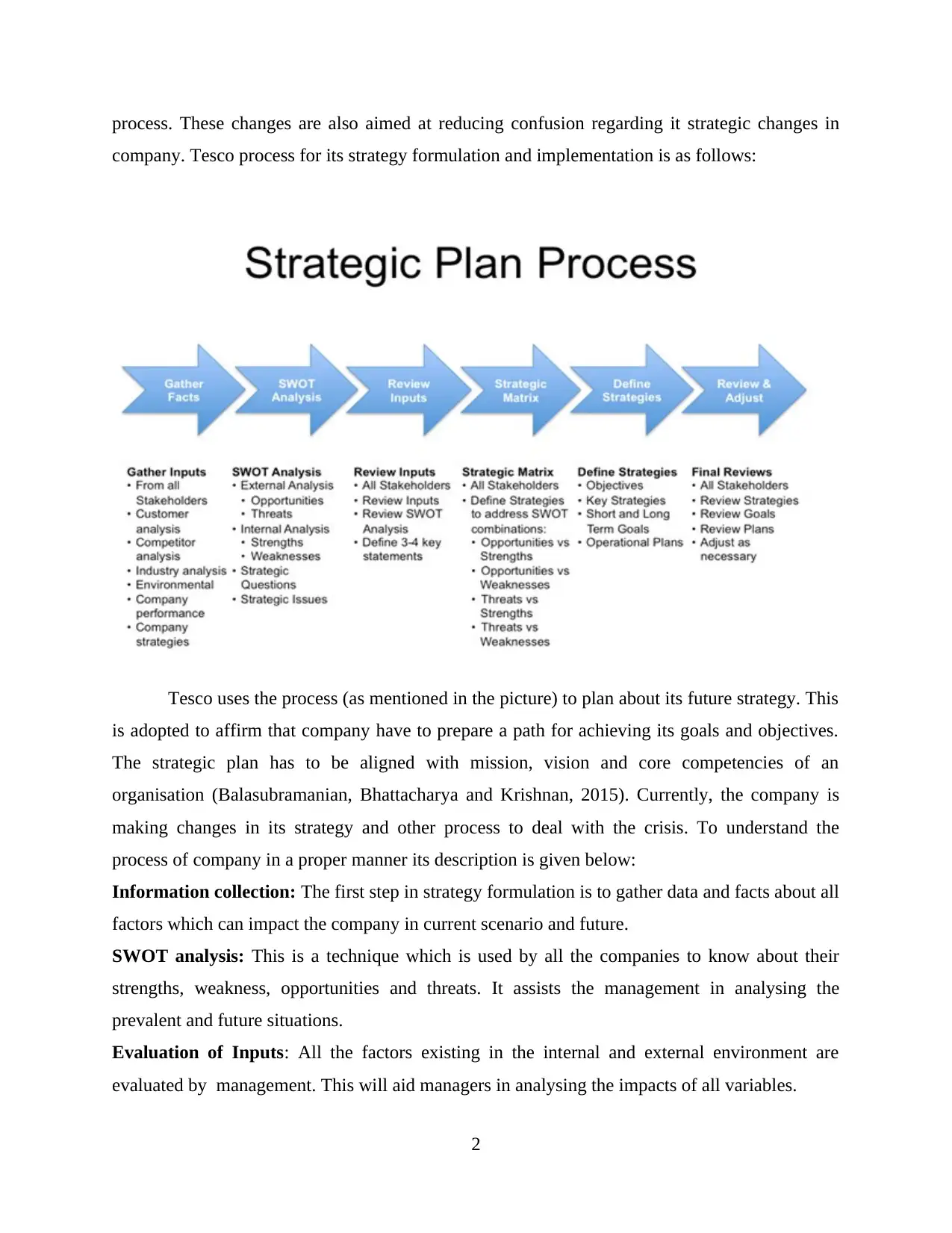
company. Tesco process for its strategy formulation and implementation is as follows:
Tesco uses the process (as mentioned in the picture) to plan about its future strategy. This
is adopted to affirm that company have to prepare a path for achieving its goals and objectives.
The strategic plan has to be aligned with mission, vision and core competencies of an
organisation (Balasubramanian, Bhattacharya and Krishnan, 2015). Currently, the company is
making changes in its strategy and other process to deal with the crisis. To understand the
process of company in a proper manner its description is given below:
Information collection: The first step in strategy formulation is to gather data and facts about all
factors which can impact the company in current scenario and future.
SWOT analysis: This is a technique which is used by all the companies to know about their
strengths, weakness, opportunities and threats. It assists the management in analysing the
prevalent and future situations.
Evaluation of Inputs: All the factors existing in the internal and external environment are
evaluated by management. This will aid managers in analysing the impacts of all variables.
2
company. Tesco process for its strategy formulation and implementation is as follows:
Tesco uses the process (as mentioned in the picture) to plan about its future strategy. This
is adopted to affirm that company have to prepare a path for achieving its goals and objectives.
The strategic plan has to be aligned with mission, vision and core competencies of an
organisation (Balasubramanian, Bhattacharya and Krishnan, 2015). Currently, the company is
making changes in its strategy and other process to deal with the crisis. To understand the
process of company in a proper manner its description is given below:
Information collection: The first step in strategy formulation is to gather data and facts about all
factors which can impact the company in current scenario and future.
SWOT analysis: This is a technique which is used by all the companies to know about their
strengths, weakness, opportunities and threats. It assists the management in analysing the
prevalent and future situations.
Evaluation of Inputs: All the factors existing in the internal and external environment are
evaluated by management. This will aid managers in analysing the impacts of all variables.
2
Paraphrase This Document
Need a fresh take? Get an instant paraphrase of this document with our AI Paraphraser
Strategy formulation: It is a process where managers start making strategy for the company. It
is based on various resources which are available for utilisation. The plan of action developed by
them will be based on substantive growth strategies and interactive approach as to boost sales
and customer approach.
Strategy evaluation: After formulating strategy for an organisation, management will analyse
the strategy. This is necessary to check whether the formulated plan of action is effective or not.
This step is very important for ensuring about the impact of strategy on companies functioning.
Implementation and control: In this stage, strategy has been selected or made, then manger
have implement it in business. The company has to monitor and control situation so that, if any
problem occur it can be solved at that particular point of time (Cárceles-Poveda and Tauman,
2011). An enterprise compare standard performance to actual performance for knowing the
results and position of an organisation.
By this process effective strategy is formulated and implemented. An enterprise needs to
follow these steps properly because this is a base by which a company make its plan of action.
Whatever plan thy have made totally depend on a impressive strategy.
Strategical Analysis
To bring growth in company they can adopt porter's five force model. This model can
help an enterprise to analyse level of competition within a industry which is of same sector. This
model can support an organisation to know competitor in the market, bargaining power of buyers
and suppliers (Greco, Cricelli and Grimaldi, 2013). By this owner make strategies by which they
can create competitive advantage and gain market share for growth of firm. Following is porter's
five force model of Tesco.
Threats of new entrants: There are less companies in relating sector. There are many strong
player which are already in UK market like Tesco, Asda, sainsbury. These companies are
holding around 80% of retail market in UK. So, if any new players wants to come in market they
need to perform over expectationally. The new competitor need to high quantity of service and
cost to make entry in market.
Threats of substitute products and services: There is high risk of substitute products, there are
so many companies in UK market which delivers same products. Then customer can go for other
substitute in market. An enterprise needs to focus on this thing and make the product more
attractive. so that they don’t lose customers.
3
is based on various resources which are available for utilisation. The plan of action developed by
them will be based on substantive growth strategies and interactive approach as to boost sales
and customer approach.
Strategy evaluation: After formulating strategy for an organisation, management will analyse
the strategy. This is necessary to check whether the formulated plan of action is effective or not.
This step is very important for ensuring about the impact of strategy on companies functioning.
Implementation and control: In this stage, strategy has been selected or made, then manger
have implement it in business. The company has to monitor and control situation so that, if any
problem occur it can be solved at that particular point of time (Cárceles-Poveda and Tauman,
2011). An enterprise compare standard performance to actual performance for knowing the
results and position of an organisation.
By this process effective strategy is formulated and implemented. An enterprise needs to
follow these steps properly because this is a base by which a company make its plan of action.
Whatever plan thy have made totally depend on a impressive strategy.
Strategical Analysis
To bring growth in company they can adopt porter's five force model. This model can
help an enterprise to analyse level of competition within a industry which is of same sector. This
model can support an organisation to know competitor in the market, bargaining power of buyers
and suppliers (Greco, Cricelli and Grimaldi, 2013). By this owner make strategies by which they
can create competitive advantage and gain market share for growth of firm. Following is porter's
five force model of Tesco.
Threats of new entrants: There are less companies in relating sector. There are many strong
player which are already in UK market like Tesco, Asda, sainsbury. These companies are
holding around 80% of retail market in UK. So, if any new players wants to come in market they
need to perform over expectationally. The new competitor need to high quantity of service and
cost to make entry in market.
Threats of substitute products and services: There is high risk of substitute products, there are
so many companies in UK market which delivers same products. Then customer can go for other
substitute in market. An enterprise needs to focus on this thing and make the product more
attractive. so that they don’t lose customers.
3
Intensity of competitive rivalry: In retail sector the competition is very high. Tesco is facing
intense competition from other retail companies like asda and sainsbury. Companies have the
competition in terms of prices, product range, promotions and others. Company needs to analyse
market regularly to know competitors strategy and take action accordingly (Hua, Cheng and
Wang, 2011). These can be threat for an enterprise to sustain its leadership position. An
enterprise needs to make unique promotion strategies so that they can attract more customers and
convince them to buy that particular product.
Bargaining power of buyers: The bargaining power of buyers is quite high in such kind of
industry. In this segment there are many competitors which sells the same product, so this gives
independence to the buyer to consume from any retailer. Products are of good standard and
substitutes are easily available in the market. Prices of these are almost same which increases the
bargaining power of buyers. Purchaser can change his way from one retailer to another if he gets
something. Customer gets attracted to place wherever they get lower price, large range of
product, good services and others. Buyers can easily differentiate with the products by making a
comparison between them and can go with the best product.
Bargaining power of suppliers: The bargaining power of suppliers are low because the
company in which they are supplying the raw materials has a strong brand name. Bargaining
with these companies can loose their commercial contracts. In the negotiation part both the
parties agree on same rate on which they can exchange the raw material.
As sales of company is decreasing and customers of Tesco losing their trust, in this an
enterprise use Ansoff model which enhance growth of products and make some good image in
market (Jain, 2012). Ansoff is the model which gives guidelines to manger, executives and
marketing head to make the future strategies. This model can help company to overcome from
the issues and develop market so that an enterprise can earn the profits and serve more
customers. Ansoff matrix of Tesco is given below.
4
intense competition from other retail companies like asda and sainsbury. Companies have the
competition in terms of prices, product range, promotions and others. Company needs to analyse
market regularly to know competitors strategy and take action accordingly (Hua, Cheng and
Wang, 2011). These can be threat for an enterprise to sustain its leadership position. An
enterprise needs to make unique promotion strategies so that they can attract more customers and
convince them to buy that particular product.
Bargaining power of buyers: The bargaining power of buyers is quite high in such kind of
industry. In this segment there are many competitors which sells the same product, so this gives
independence to the buyer to consume from any retailer. Products are of good standard and
substitutes are easily available in the market. Prices of these are almost same which increases the
bargaining power of buyers. Purchaser can change his way from one retailer to another if he gets
something. Customer gets attracted to place wherever they get lower price, large range of
product, good services and others. Buyers can easily differentiate with the products by making a
comparison between them and can go with the best product.
Bargaining power of suppliers: The bargaining power of suppliers are low because the
company in which they are supplying the raw materials has a strong brand name. Bargaining
with these companies can loose their commercial contracts. In the negotiation part both the
parties agree on same rate on which they can exchange the raw material.
As sales of company is decreasing and customers of Tesco losing their trust, in this an
enterprise use Ansoff model which enhance growth of products and make some good image in
market (Jain, 2012). Ansoff is the model which gives guidelines to manger, executives and
marketing head to make the future strategies. This model can help company to overcome from
the issues and develop market so that an enterprise can earn the profits and serve more
customers. Ansoff matrix of Tesco is given below.
4
⊘ This is a preview!⊘
Do you want full access?
Subscribe today to unlock all pages.
Trusted by 1+ million students worldwide
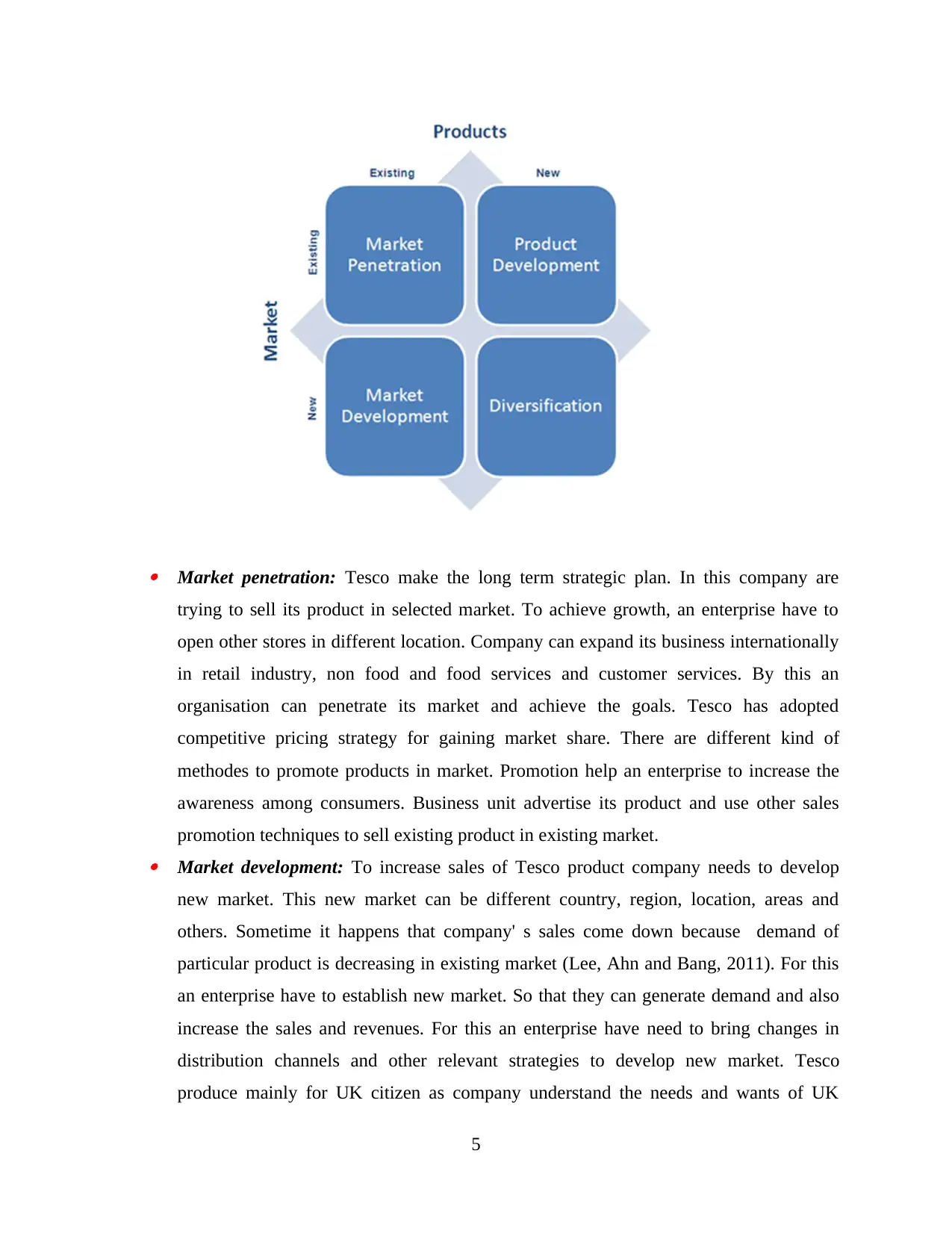
Market penetration: Tesco make the long term strategic plan. In this company are
trying to sell its product in selected market. To achieve growth, an enterprise have to
open other stores in different location. Company can expand its business internationally
in retail industry, non food and food services and customer services. By this an
organisation can penetrate its market and achieve the goals. Tesco has adopted
competitive pricing strategy for gaining market share. There are different kind of
methodes to promote products in market. Promotion help an enterprise to increase the
awareness among consumers. Business unit advertise its product and use other sales
promotion techniques to sell existing product in existing market. Market development: To increase sales of Tesco product company needs to develop
new market. This new market can be different country, region, location, areas and
others. Sometime it happens that company' s sales come down because demand of
particular product is decreasing in existing market (Lee, Ahn and Bang, 2011). For this
an enterprise have to establish new market. So that they can generate demand and also
increase the sales and revenues. For this an enterprise have need to bring changes in
distribution channels and other relevant strategies to develop new market. Tesco
produce mainly for UK citizen as company understand the needs and wants of UK
5
trying to sell its product in selected market. To achieve growth, an enterprise have to
open other stores in different location. Company can expand its business internationally
in retail industry, non food and food services and customer services. By this an
organisation can penetrate its market and achieve the goals. Tesco has adopted
competitive pricing strategy for gaining market share. There are different kind of
methodes to promote products in market. Promotion help an enterprise to increase the
awareness among consumers. Business unit advertise its product and use other sales
promotion techniques to sell existing product in existing market. Market development: To increase sales of Tesco product company needs to develop
new market. This new market can be different country, region, location, areas and
others. Sometime it happens that company' s sales come down because demand of
particular product is decreasing in existing market (Lee, Ahn and Bang, 2011). For this
an enterprise have to establish new market. So that they can generate demand and also
increase the sales and revenues. For this an enterprise have need to bring changes in
distribution channels and other relevant strategies to develop new market. Tesco
produce mainly for UK citizen as company understand the needs and wants of UK
5
Paraphrase This Document
Need a fresh take? Get an instant paraphrase of this document with our AI Paraphraser
market. This unique strategy can help company to extend new market. And offer
existing products and services to them. To solve the current situation in Tesco. This
strategy is more suitable, company sales is going down so that they can expand market
to recover the situation. Product development: In Ansoff model the new technique is product development. In
this an enterprise provide new product in existing market. There is lot of uncertain risk
face by a company to launch new product. Tesco is making new strategy for non-food
items and expanding its product line in the existing market. For this an enterprise need
to understand needs and wants of consumers and research is done by which an
organisation gets information to launch new product (Moe, 2014). When any good
launch in market business unit need to promote that good to generate the awareness
among customers. Tesco use the different pricing strategy so that more customer get
attracted to it. The product should be promoted in the market so demand can increase.
Diversification: Diversification refers to creating the new product in new market. The
risk which is involved in this process is very high. every enterprise need to do deep
research because they need to find new market and also understand needs of new
people. As Tesco is well aware about the UK market. It take lots of time and cost to
identify the needs of the new customers.
Management Problems and solutions
Management function is to plan, organise, staff, direct and control whole business's
operations. Effectiveness of the management is very essential in every organisation. A proper
control over everything leads to achievement of goals and objectives of a company. This is
enabled by managing team in any business organisation. So as in TESCO the managing team is
working to form appropriate strategies that can be implied in company to cope up with various
problems arising (Müller, 2010). The manager of TESCO is working to increase sale of company
to earn appropriate amount of profit leading to cover cost of expenses in company.
TESCO is facing a lot of problems out of which some are listed below: Sales have
declined: Sales of TESCO have declined due to which company is facing problems in earning
revenues. This has a major impact on company's operations as the profit depends on sale. It is a
result of decreasing demand that also impacts the variable cost. TESCO is wholly dependent on
6
existing products and services to them. To solve the current situation in Tesco. This
strategy is more suitable, company sales is going down so that they can expand market
to recover the situation. Product development: In Ansoff model the new technique is product development. In
this an enterprise provide new product in existing market. There is lot of uncertain risk
face by a company to launch new product. Tesco is making new strategy for non-food
items and expanding its product line in the existing market. For this an enterprise need
to understand needs and wants of consumers and research is done by which an
organisation gets information to launch new product (Moe, 2014). When any good
launch in market business unit need to promote that good to generate the awareness
among customers. Tesco use the different pricing strategy so that more customer get
attracted to it. The product should be promoted in the market so demand can increase.
Diversification: Diversification refers to creating the new product in new market. The
risk which is involved in this process is very high. every enterprise need to do deep
research because they need to find new market and also understand needs of new
people. As Tesco is well aware about the UK market. It take lots of time and cost to
identify the needs of the new customers.
Management Problems and solutions
Management function is to plan, organise, staff, direct and control whole business's
operations. Effectiveness of the management is very essential in every organisation. A proper
control over everything leads to achievement of goals and objectives of a company. This is
enabled by managing team in any business organisation. So as in TESCO the managing team is
working to form appropriate strategies that can be implied in company to cope up with various
problems arising (Müller, 2010). The manager of TESCO is working to increase sale of company
to earn appropriate amount of profit leading to cover cost of expenses in company.
TESCO is facing a lot of problems out of which some are listed below: Sales have
declined: Sales of TESCO have declined due to which company is facing problems in earning
revenues. This has a major impact on company's operations as the profit depends on sale. It is a
result of decreasing demand that also impacts the variable cost. TESCO is wholly dependent on
6
sales of its products, if this will not happen than company would not be able to cover cost of
production.
Loss in profit: Decline in sales will lead to loss for TESCO so it is facing loss. It
is not earning revenue to cover its cost due to low sales, which is resulting in loss to a
company (Reid, 2010). TESCO is not earning appropriate profit, which is essential
problem to rectify in company. Hence, this a major issue faced by TESCO. Growth of
entity is being affected due to this. It has also resulted in bankruptcy and operations of
TESCO which has greatly been affected.
Customer loss: The customers are very important for every business as for
TESCO but due to loss in profit sales have been reduced. Hence, customers are no more
interested in buying products of company. Outcome of which is that the company is
facing problem to earn profit.
Solution to the various problems faced by TESCO:Innovation: TESCO can use new innovation
in its product, which could help it to attract more and more customer in the firm. Enabling
reduction of impact that loss will cause to entity.
Adoption of technologies: TESCO can adopt new technologies in its production
and can make strategies according to these new technologies. This will help company to
work according to trends, which are present in the market.
Reducing cost of production: Efficient use of resources can be regulated in
policies of TESCO this will result in reduction in expenses of operations leading to
minimization of cost. This aids TESCO to conquer the impact of loss on company's
activities.
All of above problems, can be solved by providing solution which can assist TESCO to
overcome problems faced by it (Rothaermel, 2015). There are various suggestions, which can be
adopted by a company to get over different consequences occurring. There is always a solution
to every problem if it is analysed properly likewise TESCO can get better off the current
situation of company.
7
production.
Loss in profit: Decline in sales will lead to loss for TESCO so it is facing loss. It
is not earning revenue to cover its cost due to low sales, which is resulting in loss to a
company (Reid, 2010). TESCO is not earning appropriate profit, which is essential
problem to rectify in company. Hence, this a major issue faced by TESCO. Growth of
entity is being affected due to this. It has also resulted in bankruptcy and operations of
TESCO which has greatly been affected.
Customer loss: The customers are very important for every business as for
TESCO but due to loss in profit sales have been reduced. Hence, customers are no more
interested in buying products of company. Outcome of which is that the company is
facing problem to earn profit.
Solution to the various problems faced by TESCO:Innovation: TESCO can use new innovation
in its product, which could help it to attract more and more customer in the firm. Enabling
reduction of impact that loss will cause to entity.
Adoption of technologies: TESCO can adopt new technologies in its production
and can make strategies according to these new technologies. This will help company to
work according to trends, which are present in the market.
Reducing cost of production: Efficient use of resources can be regulated in
policies of TESCO this will result in reduction in expenses of operations leading to
minimization of cost. This aids TESCO to conquer the impact of loss on company's
activities.
All of above problems, can be solved by providing solution which can assist TESCO to
overcome problems faced by it (Rothaermel, 2015). There are various suggestions, which can be
adopted by a company to get over different consequences occurring. There is always a solution
to every problem if it is analysed properly likewise TESCO can get better off the current
situation of company.
7
⊘ This is a preview!⊘
Do you want full access?
Subscribe today to unlock all pages.
Trusted by 1+ million students worldwide
Recovery plan and risk management strategy for Tesco
Recovery plans are used by the companies to prepare themselves for potential treats or
to bring company out of a difficult situation. There are many companies in the market, which are
offering better products and services in the market just like Tesco. This is one of the reason
behind the downfall in sales of Tesco. Various competitors like ASDA, Sainsbury and Morrisons
which are also providing products and services based on the concept of high quality and low
prices. Also, the price war is going on in the market which minimises the margin of profit for
Tesco as they have to increase the number of discounts and others promotional offers to improve
their sales (Stokke, 2013). The company can introduce various measures to boost efficiency and
increase productivity of the organisation.
New innovative strategical approach will help the organisation in reducing the expenses
and improve customer satisfaction level. Tesco can cut down expenditure on activities, which are
not necessary to be conducted, this will save more money for the company. The company needs
to focus more on providing customer value oriented products and services. Tesco also has to
improve its supply chain management to reduce the current cost; which is occurring while
moving its products from distribution centres to its stores across the country.
Tesco have to push for certain changes to ensure that it makes the required recovery.
There are five changes, which are essentially required by the company:
Improve supply chain management;
Provide training and development to the employee's;
Build a monitoring department to keep tracking all transactions and transitions;
Enhance services and products quality;
Boost sales in other markets and reduce dependency on UK market.These changes
will help the company in improving the customer satisfaction, while it will be able to maintain a
good margin for profits. Also, the company will be able to boost its market image and reputation.
Above mentioned, steps will help in recovering from its current situation.
Risk management strategy refers to the method by which company is able to reduce the
risk, carried by an opportunity (Suri, 2011). This strategy aids in managing the potential
8
Recovery plans are used by the companies to prepare themselves for potential treats or
to bring company out of a difficult situation. There are many companies in the market, which are
offering better products and services in the market just like Tesco. This is one of the reason
behind the downfall in sales of Tesco. Various competitors like ASDA, Sainsbury and Morrisons
which are also providing products and services based on the concept of high quality and low
prices. Also, the price war is going on in the market which minimises the margin of profit for
Tesco as they have to increase the number of discounts and others promotional offers to improve
their sales (Stokke, 2013). The company can introduce various measures to boost efficiency and
increase productivity of the organisation.
New innovative strategical approach will help the organisation in reducing the expenses
and improve customer satisfaction level. Tesco can cut down expenditure on activities, which are
not necessary to be conducted, this will save more money for the company. The company needs
to focus more on providing customer value oriented products and services. Tesco also has to
improve its supply chain management to reduce the current cost; which is occurring while
moving its products from distribution centres to its stores across the country.
Tesco have to push for certain changes to ensure that it makes the required recovery.
There are five changes, which are essentially required by the company:
Improve supply chain management;
Provide training and development to the employee's;
Build a monitoring department to keep tracking all transactions and transitions;
Enhance services and products quality;
Boost sales in other markets and reduce dependency on UK market.These changes
will help the company in improving the customer satisfaction, while it will be able to maintain a
good margin for profits. Also, the company will be able to boost its market image and reputation.
Above mentioned, steps will help in recovering from its current situation.
Risk management strategy refers to the method by which company is able to reduce the
risk, carried by an opportunity (Suri, 2011). This strategy aids in managing the potential
8
Paraphrase This Document
Need a fresh take? Get an instant paraphrase of this document with our AI Paraphraser
challenges, which will come up in future. Tesco needs a proper risk management structure to
reduce risk and increase chances of achieving good growth. There are different strategies, which
are available and can be used by Tesco to reduce risk. The strategies are given below:
Avoidance of risk: This strategy states that the management just simply ignores the risk.
This is the most used strategy by corporates all around the world.
Risk Mitigation: This strategy is used when risk cannot be avoided by the
company. It helps in mitigating the risk by managing all activities and distributes it
evenly.
Transfer of Risk: This is a strategy, which states that the company sometimes
transfer the risk to the insurance or other parties as to manage the activities properly.
Risk Acceptance: The Company by this strategy accepts the risk and starts
finding its possible solution.
Recommendations
Tesco has one of the best management structure in the corporate world, but there are
issues which it is facing and they have to be managed properly (Thonnard and Dacier, 2011).
Currently, it is facing a financial slowdown, which needs to control as to stop loss making. There
are certain steps described in recovery plan such as improving quality of products and services
delivery, enhance efficiency of supply chain management, reduce managerial weakness, also
build monitoring machinery as to record each and every transaction and transition.
CONCLUSION
Tesco needs to focus on its strategic management capabilities to improve its condition
without going further down in the market. Even though, it has record growth in market share in
previous quarter but still its sales are not at par with the set standards. There are changes, which
will be required, to be made by Tesco to ensure that the company is not overstating any financial
data and all information shared and used is actual..
9
reduce risk and increase chances of achieving good growth. There are different strategies, which
are available and can be used by Tesco to reduce risk. The strategies are given below:
Avoidance of risk: This strategy states that the management just simply ignores the risk.
This is the most used strategy by corporates all around the world.
Risk Mitigation: This strategy is used when risk cannot be avoided by the
company. It helps in mitigating the risk by managing all activities and distributes it
evenly.
Transfer of Risk: This is a strategy, which states that the company sometimes
transfer the risk to the insurance or other parties as to manage the activities properly.
Risk Acceptance: The Company by this strategy accepts the risk and starts
finding its possible solution.
Recommendations
Tesco has one of the best management structure in the corporate world, but there are
issues which it is facing and they have to be managed properly (Thonnard and Dacier, 2011).
Currently, it is facing a financial slowdown, which needs to control as to stop loss making. There
are certain steps described in recovery plan such as improving quality of products and services
delivery, enhance efficiency of supply chain management, reduce managerial weakness, also
build monitoring machinery as to record each and every transaction and transition.
CONCLUSION
Tesco needs to focus on its strategic management capabilities to improve its condition
without going further down in the market. Even though, it has record growth in market share in
previous quarter but still its sales are not at par with the set standards. There are changes, which
will be required, to be made by Tesco to ensure that the company is not overstating any financial
data and all information shared and used is actual..
9
REFERENCES
Book and Journals
Abraham, S., 2013. Will business model innovation replace strategic analysis?. Strategy &
Leadership. 41(2). pp.31-38.
Aslani, A., Naaranoja, M. and Wong, K.F.V., 2013. Strategic analysis of diffusion of renewable
energy in the Nordic countries. Renewable and sustainable energy reviews. 22. pp.497-
505.
Balasubramanian, S., Bhattacharya, S. and Krishnan, V.V., 2015. Pricing information goods: A
strategic analysis of the selling and pay-per-use mechanisms. Marketing Science. 34(2).
pp.218-234.
Cárceles-Poveda, E. and Tauman, Y., 2011. A strategic analysis of the war against transnational
terrorism. Games and Economic Behavior. 71(1). pp.49-65.
Greco, M., Cricelli, L. and Grimaldi, M., 2013. A strategic management framework of tangible
and intangible assets. European Management Journal. 31(1). pp.55-66.
Hua, G., Cheng, T.C.E. and Wang, S., 2011. Electronic books: To “E” or not to “E”? A strategic
analysis of distribution channel choices of publishers. International Journal of
Production Economics. 129(2). pp.338-346.
Jain, S., 2012. Marketing of vice goods: A strategic analysis of the package size decision.
Marketing Science. 31(1). pp.36-51.
Lee, D.J., Ahn, J.H. and Bang, Y., 2011. Managing consumer privacy concerns in
personalization: a strategic analysis of privacy protection. Mis Quarterly. pp.423-444.
Moe, A., 2014. The Northern Sea Route: Smooth Sailing Ahead?. Strategic Analysis. 38(6).
pp.784-802.
Müller, H., 2010. Between power and justice: Current problems and perspectives of the NPT
regime. Strategic Analysis, 34(2), pp.189-201.
Reid, K., 2010. Management of School Attendance in the UK A Strategic Analysis. Educational
Management Administration & Leadership. 38(1). pp.88-106.
Rothaermel, F.T., 2015. Strategic management. New York, NY: McGraw-Hill.
Stokke, O.S., 2013. The promise of involvement: Asia in the Arctic. Strategic Analysis. 37(4).
pp.474-479.
Suri, N., 2011. Public diplomacy in india's foreign policy. Strategic Analysis. 35(2). pp.297-303.
Thonnard, O. and Dacier, M., 2011, September. A strategic analysis of spam botnets operations.
In Proceedings of the 8th Annual Collaboration, Electronic messaging, Anti-Abuse and
Spam Conference (pp. 162-171). ACM.
Tijssen, R.J., 2012. Co-authored research publications and strategic analysis of public–private
collaboration. Research Evaluation. p.rvs013.
Book and Journals
Abraham, S., 2013. Will business model innovation replace strategic analysis?. Strategy &
Leadership. 41(2). pp.31-38.
Aslani, A., Naaranoja, M. and Wong, K.F.V., 2013. Strategic analysis of diffusion of renewable
energy in the Nordic countries. Renewable and sustainable energy reviews. 22. pp.497-
505.
Balasubramanian, S., Bhattacharya, S. and Krishnan, V.V., 2015. Pricing information goods: A
strategic analysis of the selling and pay-per-use mechanisms. Marketing Science. 34(2).
pp.218-234.
Cárceles-Poveda, E. and Tauman, Y., 2011. A strategic analysis of the war against transnational
terrorism. Games and Economic Behavior. 71(1). pp.49-65.
Greco, M., Cricelli, L. and Grimaldi, M., 2013. A strategic management framework of tangible
and intangible assets. European Management Journal. 31(1). pp.55-66.
Hua, G., Cheng, T.C.E. and Wang, S., 2011. Electronic books: To “E” or not to “E”? A strategic
analysis of distribution channel choices of publishers. International Journal of
Production Economics. 129(2). pp.338-346.
Jain, S., 2012. Marketing of vice goods: A strategic analysis of the package size decision.
Marketing Science. 31(1). pp.36-51.
Lee, D.J., Ahn, J.H. and Bang, Y., 2011. Managing consumer privacy concerns in
personalization: a strategic analysis of privacy protection. Mis Quarterly. pp.423-444.
Moe, A., 2014. The Northern Sea Route: Smooth Sailing Ahead?. Strategic Analysis. 38(6).
pp.784-802.
Müller, H., 2010. Between power and justice: Current problems and perspectives of the NPT
regime. Strategic Analysis, 34(2), pp.189-201.
Reid, K., 2010. Management of School Attendance in the UK A Strategic Analysis. Educational
Management Administration & Leadership. 38(1). pp.88-106.
Rothaermel, F.T., 2015. Strategic management. New York, NY: McGraw-Hill.
Stokke, O.S., 2013. The promise of involvement: Asia in the Arctic. Strategic Analysis. 37(4).
pp.474-479.
Suri, N., 2011. Public diplomacy in india's foreign policy. Strategic Analysis. 35(2). pp.297-303.
Thonnard, O. and Dacier, M., 2011, September. A strategic analysis of spam botnets operations.
In Proceedings of the 8th Annual Collaboration, Electronic messaging, Anti-Abuse and
Spam Conference (pp. 162-171). ACM.
Tijssen, R.J., 2012. Co-authored research publications and strategic analysis of public–private
collaboration. Research Evaluation. p.rvs013.
⊘ This is a preview!⊘
Do you want full access?
Subscribe today to unlock all pages.
Trusted by 1+ million students worldwide

1 out of 13


Related Documents


Your All-in-One AI-Powered Toolkit for Academic Success.
+13062052269
info@desklib.com
Available 24*7 on WhatsApp / Email
![[object Object]](/_next/static/media/star-bottom.7253800d.svg)
Unlock your academic potential
Copyright © 2020–2026 A2Z Services. All Rights Reserved. Developed and managed by ZUCOL.