Strategic Applications of Management Accounting - Finance Report
VerifiedAdded on 2020/07/22
|22
|5695
|31
Report
AI Summary
This report analyzes the strategic applications of management accounting through three case studies. The first case study explores pricing strategies, target costing, and life cycle budgeting for HWL, including NPV analysis. The second case study evaluates a trial cost-saving rewards system at ATL, assessing its effectiveness and identifying areas for improvement in team-based performance evaluation. The third case study focuses on QPT Ltd, determining electricity and lighting costs, and providing recommendations for cost savings. The report covers various management accounting techniques such as competitive and cost plus pricing, value engineering, activity-based budgeting, and performance measurement. The analysis includes financial calculations, interpretations, and recommendations to improve business performance and decision-making.

Strategic Applications of Management
Accounting
Accounting

Paraphrase This Document
Need a fresh take? Get an instant paraphrase of this document with our AI Paraphraser
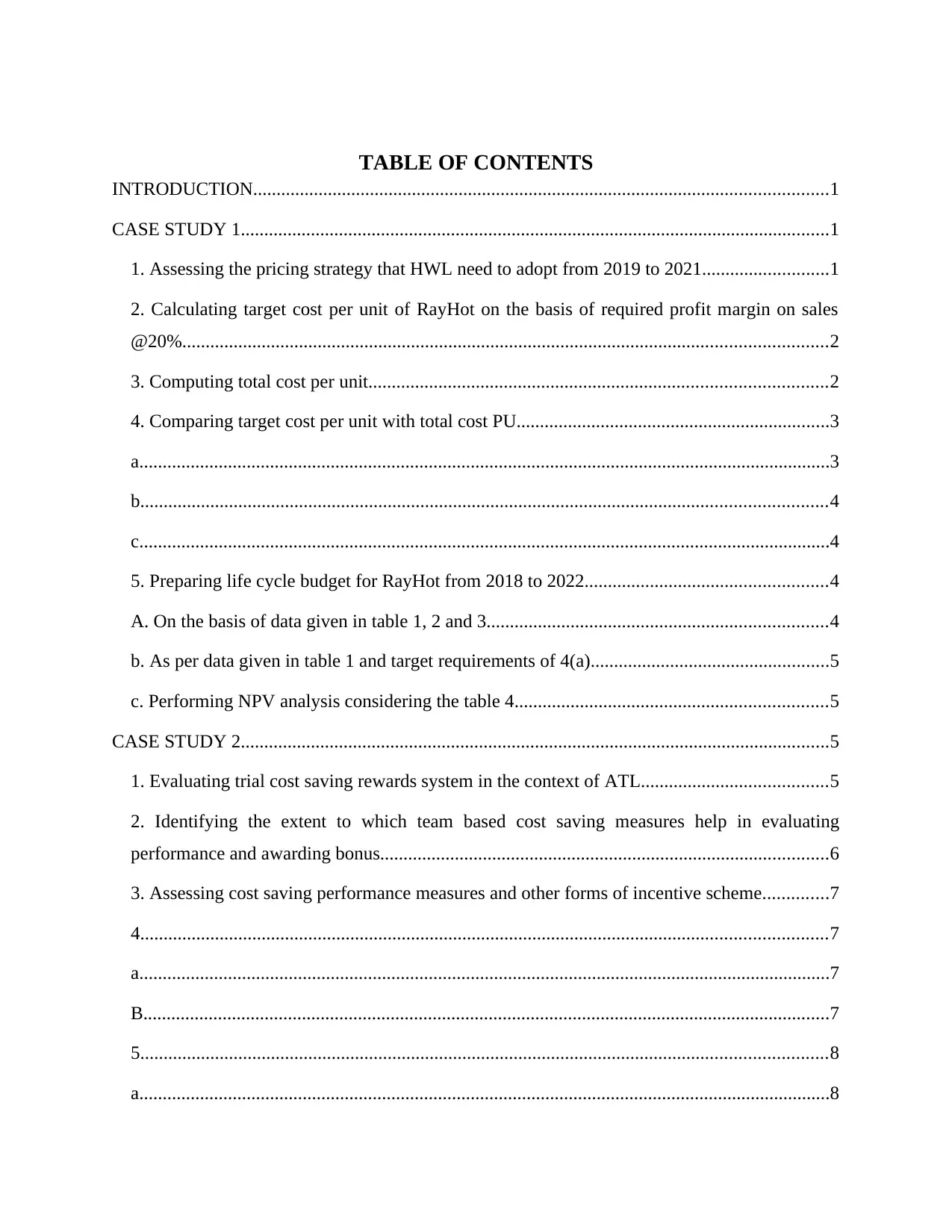
TABLE OF CONTENTS
INTRODUCTION...........................................................................................................................1
CASE STUDY 1..............................................................................................................................1
1. Assessing the pricing strategy that HWL need to adopt from 2019 to 2021...........................1
2. Calculating target cost per unit of RayHot on the basis of required profit margin on sales
@20%..........................................................................................................................................2
3. Computing total cost per unit..................................................................................................2
4. Comparing target cost per unit with total cost PU...................................................................3
a....................................................................................................................................................3
b...................................................................................................................................................4
c....................................................................................................................................................4
5. Preparing life cycle budget for RayHot from 2018 to 2022....................................................4
A. On the basis of data given in table 1, 2 and 3.........................................................................4
b. As per data given in table 1 and target requirements of 4(a)...................................................5
c. Performing NPV analysis considering the table 4...................................................................5
CASE STUDY 2..............................................................................................................................5
1. Evaluating trial cost saving rewards system in the context of ATL........................................5
2. Identifying the extent to which team based cost saving measures help in evaluating
performance and awarding bonus................................................................................................6
3. Assessing cost saving performance measures and other forms of incentive scheme..............7
4...................................................................................................................................................7
a....................................................................................................................................................7
B...................................................................................................................................................7
5...................................................................................................................................................8
a....................................................................................................................................................8
INTRODUCTION...........................................................................................................................1
CASE STUDY 1..............................................................................................................................1
1. Assessing the pricing strategy that HWL need to adopt from 2019 to 2021...........................1
2. Calculating target cost per unit of RayHot on the basis of required profit margin on sales
@20%..........................................................................................................................................2
3. Computing total cost per unit..................................................................................................2
4. Comparing target cost per unit with total cost PU...................................................................3
a....................................................................................................................................................3
b...................................................................................................................................................4
c....................................................................................................................................................4
5. Preparing life cycle budget for RayHot from 2018 to 2022....................................................4
A. On the basis of data given in table 1, 2 and 3.........................................................................4
b. As per data given in table 1 and target requirements of 4(a)...................................................5
c. Performing NPV analysis considering the table 4...................................................................5
CASE STUDY 2..............................................................................................................................5
1. Evaluating trial cost saving rewards system in the context of ATL........................................5
2. Identifying the extent to which team based cost saving measures help in evaluating
performance and awarding bonus................................................................................................6
3. Assessing cost saving performance measures and other forms of incentive scheme..............7
4...................................................................................................................................................7
a....................................................................................................................................................7
B...................................................................................................................................................7
5...................................................................................................................................................8
a....................................................................................................................................................8
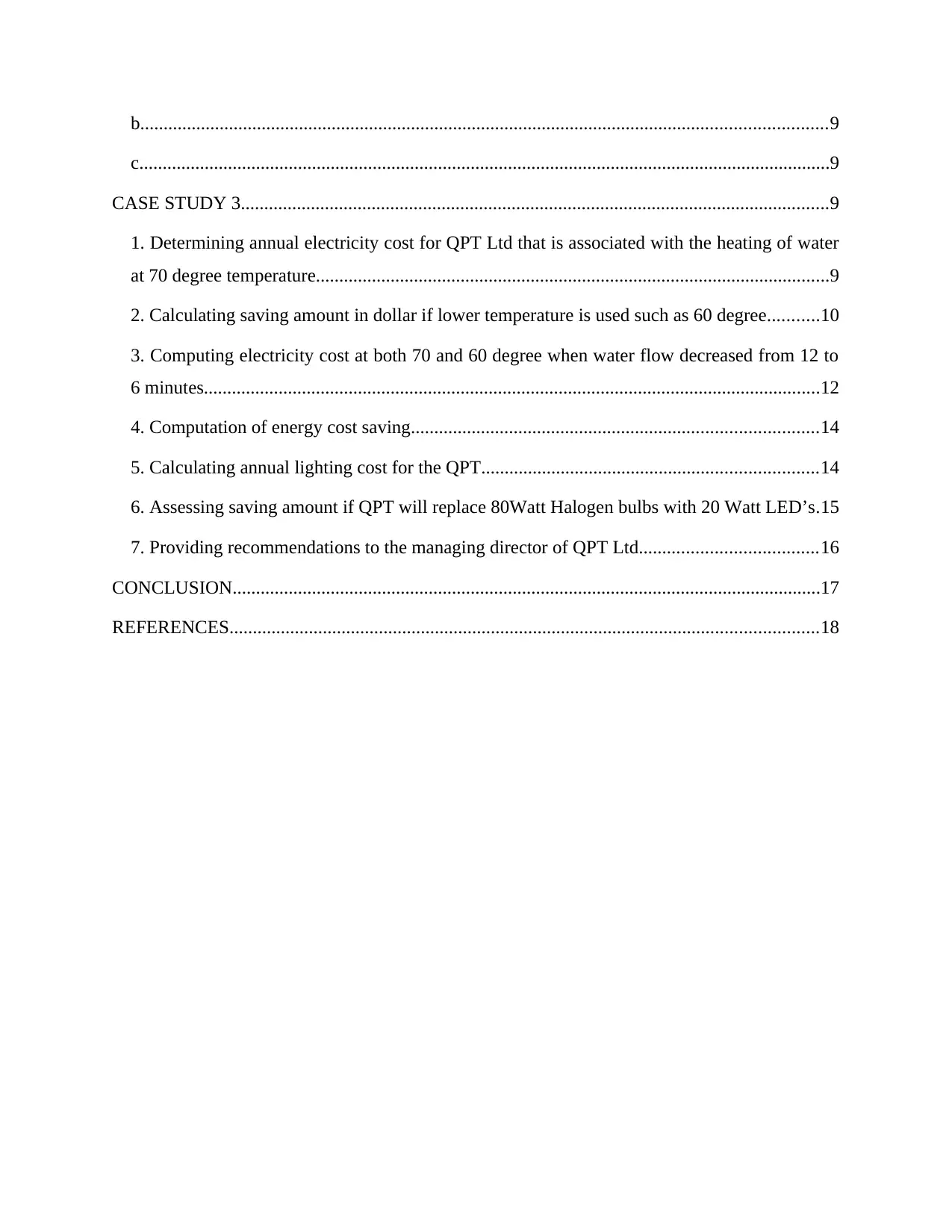
b...................................................................................................................................................9
c....................................................................................................................................................9
CASE STUDY 3..............................................................................................................................9
1. Determining annual electricity cost for QPT Ltd that is associated with the heating of water
at 70 degree temperature..............................................................................................................9
2. Calculating saving amount in dollar if lower temperature is used such as 60 degree...........10
3. Computing electricity cost at both 70 and 60 degree when water flow decreased from 12 to
6 minutes....................................................................................................................................12
4. Computation of energy cost saving.......................................................................................14
5. Calculating annual lighting cost for the QPT........................................................................14
6. Assessing saving amount if QPT will replace 80Watt Halogen bulbs with 20 Watt LED’s.15
7. Providing recommendations to the managing director of QPT Ltd......................................16
CONCLUSION..............................................................................................................................17
REFERENCES..............................................................................................................................18
c....................................................................................................................................................9
CASE STUDY 3..............................................................................................................................9
1. Determining annual electricity cost for QPT Ltd that is associated with the heating of water
at 70 degree temperature..............................................................................................................9
2. Calculating saving amount in dollar if lower temperature is used such as 60 degree...........10
3. Computing electricity cost at both 70 and 60 degree when water flow decreased from 12 to
6 minutes....................................................................................................................................12
4. Computation of energy cost saving.......................................................................................14
5. Calculating annual lighting cost for the QPT........................................................................14
6. Assessing saving amount if QPT will replace 80Watt Halogen bulbs with 20 Watt LED’s.15
7. Providing recommendations to the managing director of QPT Ltd......................................16
CONCLUSION..............................................................................................................................17
REFERENCES..............................................................................................................................18
⊘ This is a preview!⊘
Do you want full access?
Subscribe today to unlock all pages.

Trusted by 1+ million students worldwide
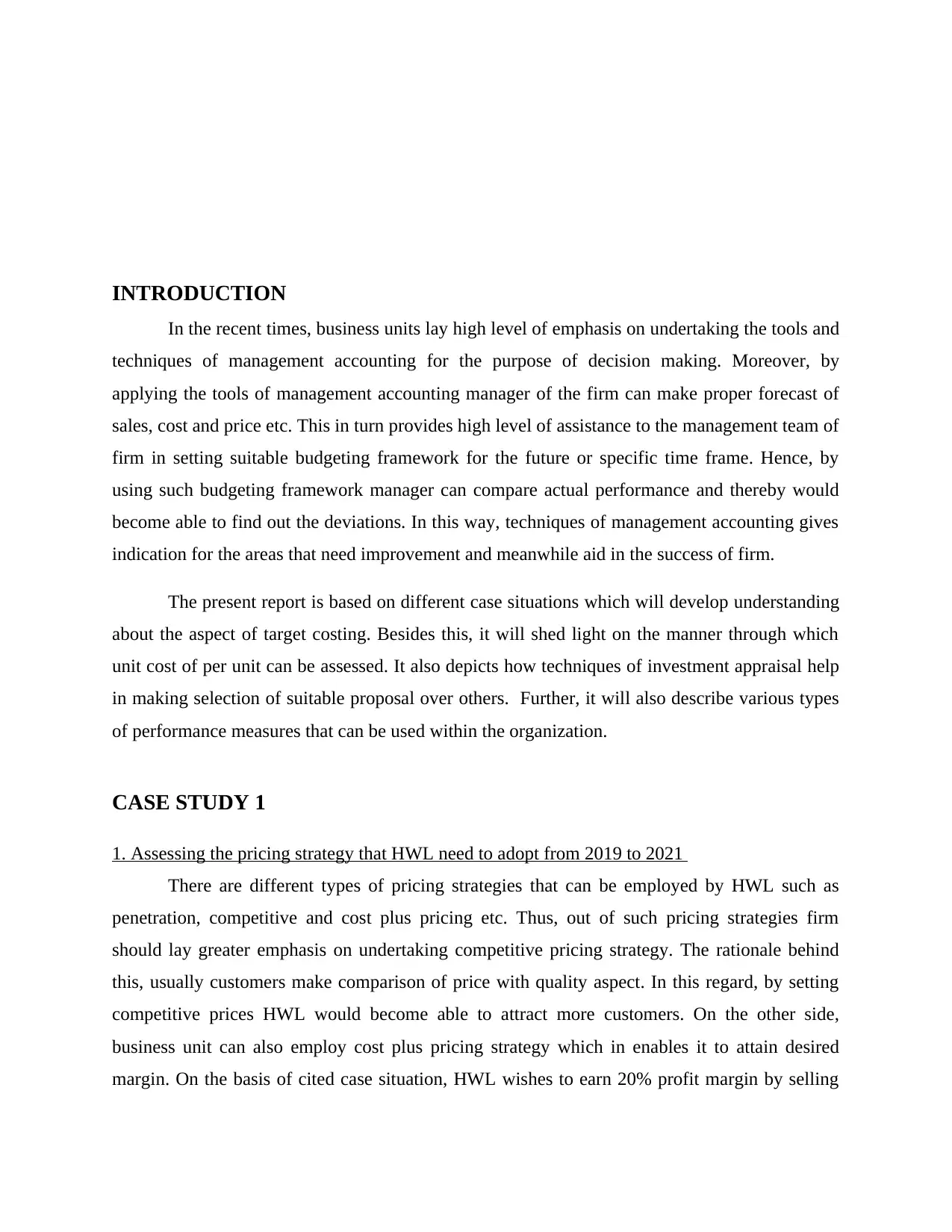
INTRODUCTION
In the recent times, business units lay high level of emphasis on undertaking the tools and
techniques of management accounting for the purpose of decision making. Moreover, by
applying the tools of management accounting manager of the firm can make proper forecast of
sales, cost and price etc. This in turn provides high level of assistance to the management team of
firm in setting suitable budgeting framework for the future or specific time frame. Hence, by
using such budgeting framework manager can compare actual performance and thereby would
become able to find out the deviations. In this way, techniques of management accounting gives
indication for the areas that need improvement and meanwhile aid in the success of firm.
The present report is based on different case situations which will develop understanding
about the aspect of target costing. Besides this, it will shed light on the manner through which
unit cost of per unit can be assessed. It also depicts how techniques of investment appraisal help
in making selection of suitable proposal over others. Further, it will also describe various types
of performance measures that can be used within the organization.
CASE STUDY 1
1. Assessing the pricing strategy that HWL need to adopt from 2019 to 2021
There are different types of pricing strategies that can be employed by HWL such as
penetration, competitive and cost plus pricing etc. Thus, out of such pricing strategies firm
should lay greater emphasis on undertaking competitive pricing strategy. The rationale behind
this, usually customers make comparison of price with quality aspect. In this regard, by setting
competitive prices HWL would become able to attract more customers. On the other side,
business unit can also employ cost plus pricing strategy which in enables it to attain desired
margin. On the basis of cited case situation, HWL wishes to earn 20% profit margin by selling
In the recent times, business units lay high level of emphasis on undertaking the tools and
techniques of management accounting for the purpose of decision making. Moreover, by
applying the tools of management accounting manager of the firm can make proper forecast of
sales, cost and price etc. This in turn provides high level of assistance to the management team of
firm in setting suitable budgeting framework for the future or specific time frame. Hence, by
using such budgeting framework manager can compare actual performance and thereby would
become able to find out the deviations. In this way, techniques of management accounting gives
indication for the areas that need improvement and meanwhile aid in the success of firm.
The present report is based on different case situations which will develop understanding
about the aspect of target costing. Besides this, it will shed light on the manner through which
unit cost of per unit can be assessed. It also depicts how techniques of investment appraisal help
in making selection of suitable proposal over others. Further, it will also describe various types
of performance measures that can be used within the organization.
CASE STUDY 1
1. Assessing the pricing strategy that HWL need to adopt from 2019 to 2021
There are different types of pricing strategies that can be employed by HWL such as
penetration, competitive and cost plus pricing etc. Thus, out of such pricing strategies firm
should lay greater emphasis on undertaking competitive pricing strategy. The rationale behind
this, usually customers make comparison of price with quality aspect. In this regard, by setting
competitive prices HWL would become able to attract more customers. On the other side,
business unit can also employ cost plus pricing strategy which in enables it to attain desired
margin. On the basis of cited case situation, HWL wishes to earn 20% profit margin by selling
Paraphrase This Document
Need a fresh take? Get an instant paraphrase of this document with our AI Paraphraser
per unit of RayHot. Thus, by determining unit cost and adding 20% margin into it HWL can
determine suitable price which in turn helps in getting the desired margin. Hence, firm should go
with competitive or cost plus pricing strategy (Fayard & et.al., 2014, p.1).
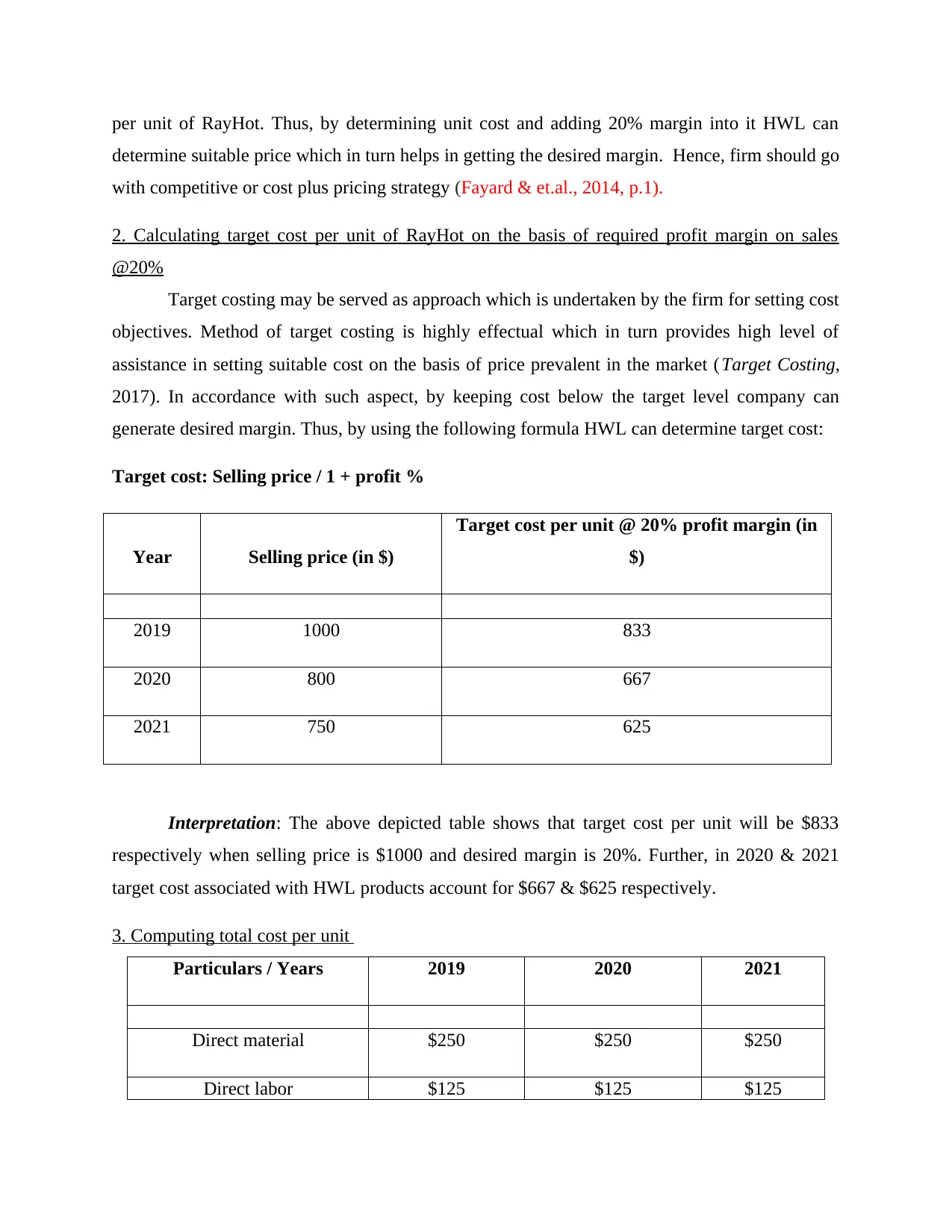
2. Calculating target cost per unit of RayHot on the basis of required profit margin on sales
@20%
Target costing may be served as approach which is undertaken by the firm for setting cost
objectives. Method of target costing is highly effectual which in turn provides high level of
assistance in setting suitable cost on the basis of price prevalent in the market (Target Costing,
2017). In accordance with such aspect, by keeping cost below the target level company can
generate desired margin. Thus, by using the following formula HWL can determine target cost:
Target cost: Selling price / 1 + profit %
Year Selling price (in $)
Target cost per unit @ 20% profit margin (in
$)
2019 1000 833
2020 800 667
2021 750 625
Interpretation: The above depicted table shows that target cost per unit will be $833
respectively when selling price is $1000 and desired margin is 20%. Further, in 2020 & 2021
target cost associated with HWL products account for $667 & $625 respectively.
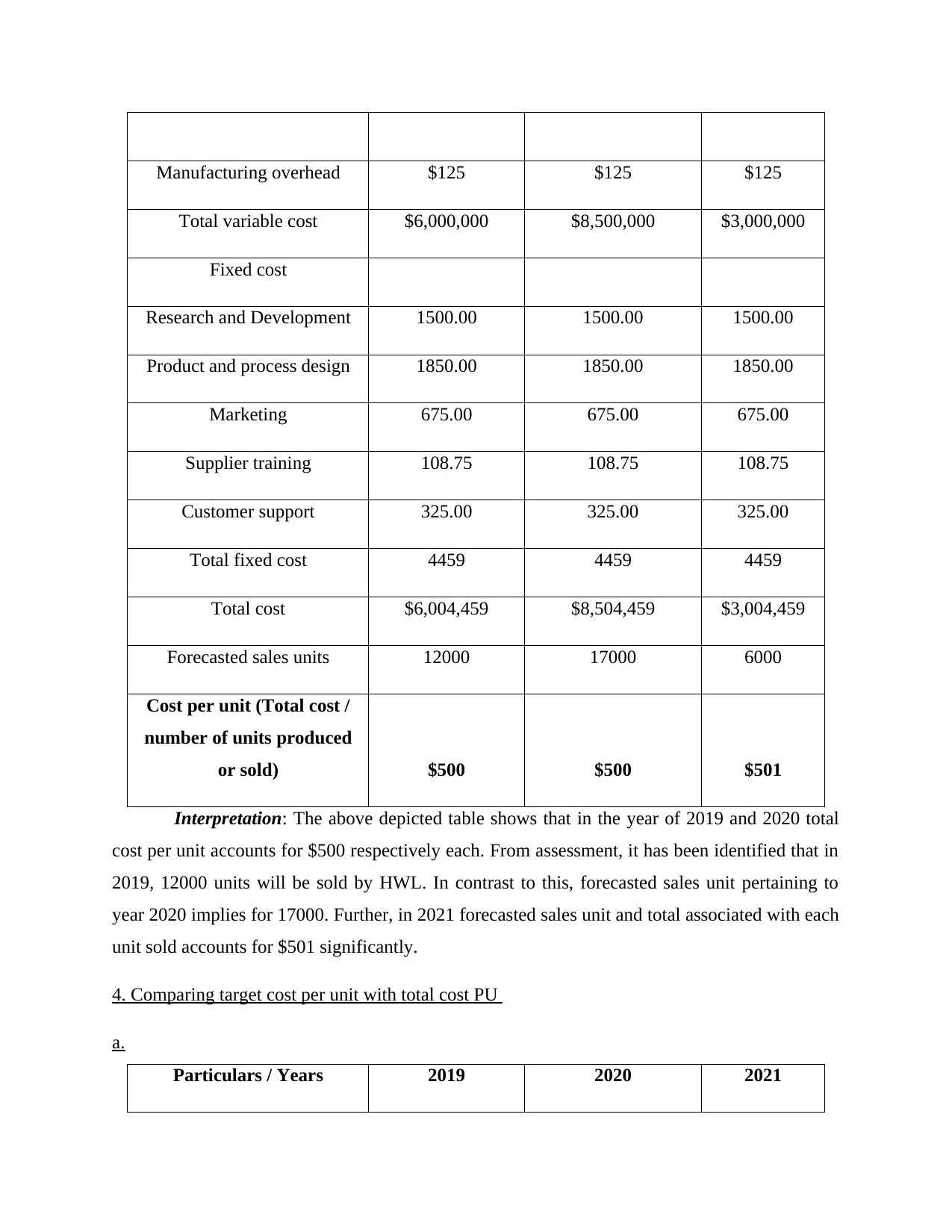
3. Computing total cost per unit
Particulars / Years 2019 2020 2021
Direct material $250 $250 $250
Direct labor $125 $125 $125
determine suitable price which in turn helps in getting the desired margin. Hence, firm should go
with competitive or cost plus pricing strategy (Fayard & et.al., 2014, p.1).
2. Calculating target cost per unit of RayHot on the basis of required profit margin on sales
@20%
Target costing may be served as approach which is undertaken by the firm for setting cost
objectives. Method of target costing is highly effectual which in turn provides high level of
assistance in setting suitable cost on the basis of price prevalent in the market (Target Costing,
2017). In accordance with such aspect, by keeping cost below the target level company can
generate desired margin. Thus, by using the following formula HWL can determine target cost:
Target cost: Selling price / 1 + profit %
Year Selling price (in $)
Target cost per unit @ 20% profit margin (in
$)
2019 1000 833
2020 800 667
2021 750 625
Interpretation: The above depicted table shows that target cost per unit will be $833
respectively when selling price is $1000 and desired margin is 20%. Further, in 2020 & 2021
target cost associated with HWL products account for $667 & $625 respectively.
3. Computing total cost per unit
Particulars / Years 2019 2020 2021
Direct material $250 $250 $250
Direct labor $125 $125 $125
Manufacturing overhead $125 $125 $125
Total variable cost $6,000,000 $8,500,000 $3,000,000
Fixed cost
Research and Development 1500.00 1500.00 1500.00
Product and process design 1850.00 1850.00 1850.00
Marketing 675.00 675.00 675.00
Supplier training 108.75 108.75 108.75
Customer support 325.00 325.00 325.00
Total fixed cost 4459 4459 4459
Total cost $6,004,459 $8,504,459 $3,004,459
Forecasted sales units 12000 17000 6000
Cost per unit (Total cost /
number of units produced
or sold) $500 $500 $501
Interpretation: The above depicted table shows that in the year of 2019 and 2020 total
cost per unit accounts for $500 respectively each. From assessment, it has been identified that in
2019, 12000 units will be sold by HWL. In contrast to this, forecasted sales unit pertaining to
year 2020 implies for 17000. Further, in 2021 forecasted sales unit and total associated with each
unit sold accounts for $501 significantly.
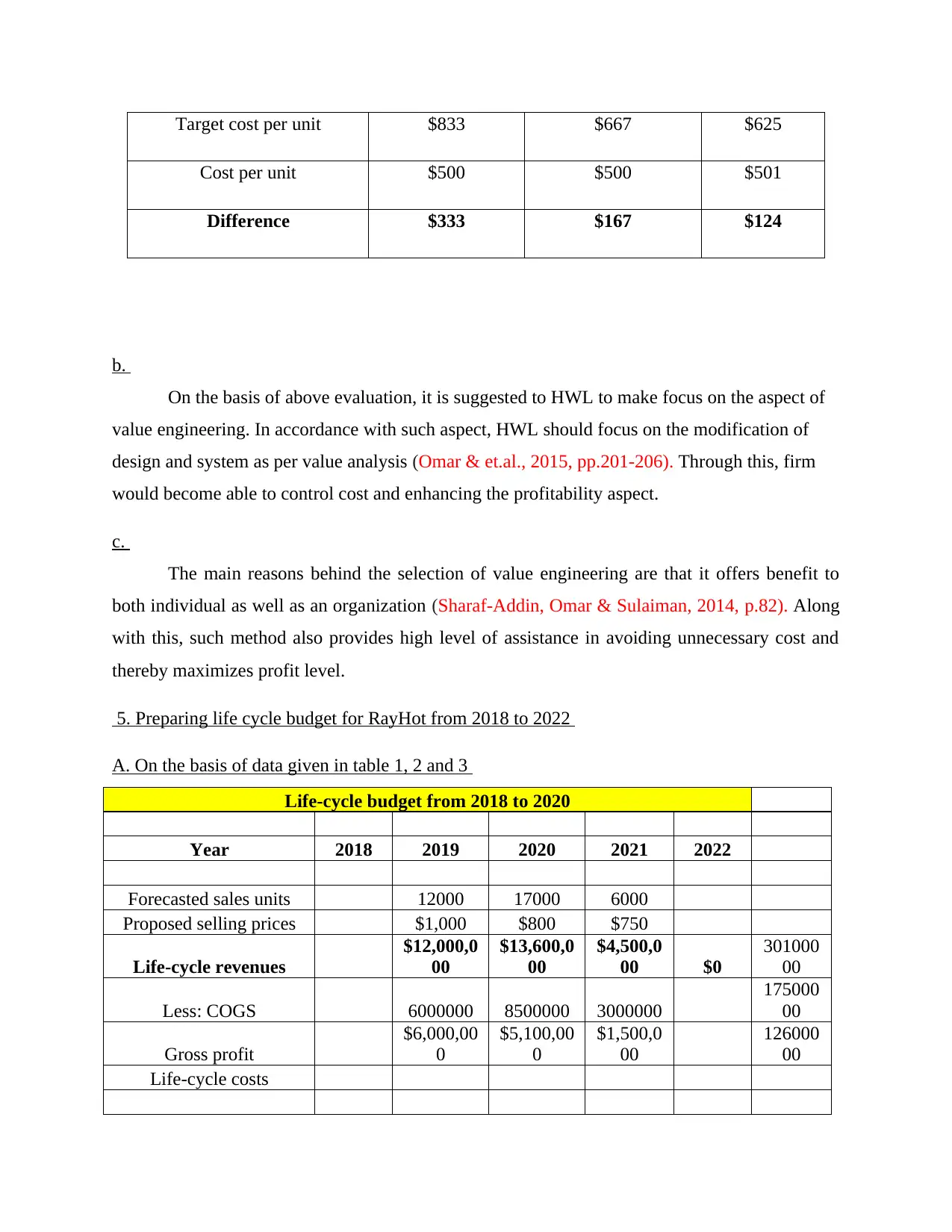
4. Comparing target cost per unit with total cost PU
a.
Particulars / Years 2019 2020 2021
Total variable cost $6,000,000 $8,500,000 $3,000,000
Fixed cost
Research and Development 1500.00 1500.00 1500.00
Product and process design 1850.00 1850.00 1850.00
Marketing 675.00 675.00 675.00
Supplier training 108.75 108.75 108.75
Customer support 325.00 325.00 325.00
Total fixed cost 4459 4459 4459
Total cost $6,004,459 $8,504,459 $3,004,459
Forecasted sales units 12000 17000 6000
Cost per unit (Total cost /
number of units produced
or sold) $500 $500 $501
Interpretation: The above depicted table shows that in the year of 2019 and 2020 total
cost per unit accounts for $500 respectively each. From assessment, it has been identified that in
2019, 12000 units will be sold by HWL. In contrast to this, forecasted sales unit pertaining to
year 2020 implies for 17000. Further, in 2021 forecasted sales unit and total associated with each
unit sold accounts for $501 significantly.
4. Comparing target cost per unit with total cost PU
a.
Particulars / Years 2019 2020 2021
⊘ This is a preview!⊘
Do you want full access?
Subscribe today to unlock all pages.
Trusted by 1+ million students worldwide
Target cost per unit $833 $667 $625
Cost per unit $500 $500 $501
Difference $333 $167 $124
b.
On the basis of above evaluation, it is suggested to HWL to make focus on the aspect of
value engineering. In accordance with such aspect, HWL should focus on the modification of
design and system as per value analysis (Omar & et.al., 2015, pp.201-206). Through this, firm
would become able to control cost and enhancing the profitability aspect.
c.
The main reasons behind the selection of value engineering are that it offers benefit to
both individual as well as an organization (Sharaf-Addin, Omar & Sulaiman, 2014, p.82). Along
with this, such method also provides high level of assistance in avoiding unnecessary cost and
thereby maximizes profit level.
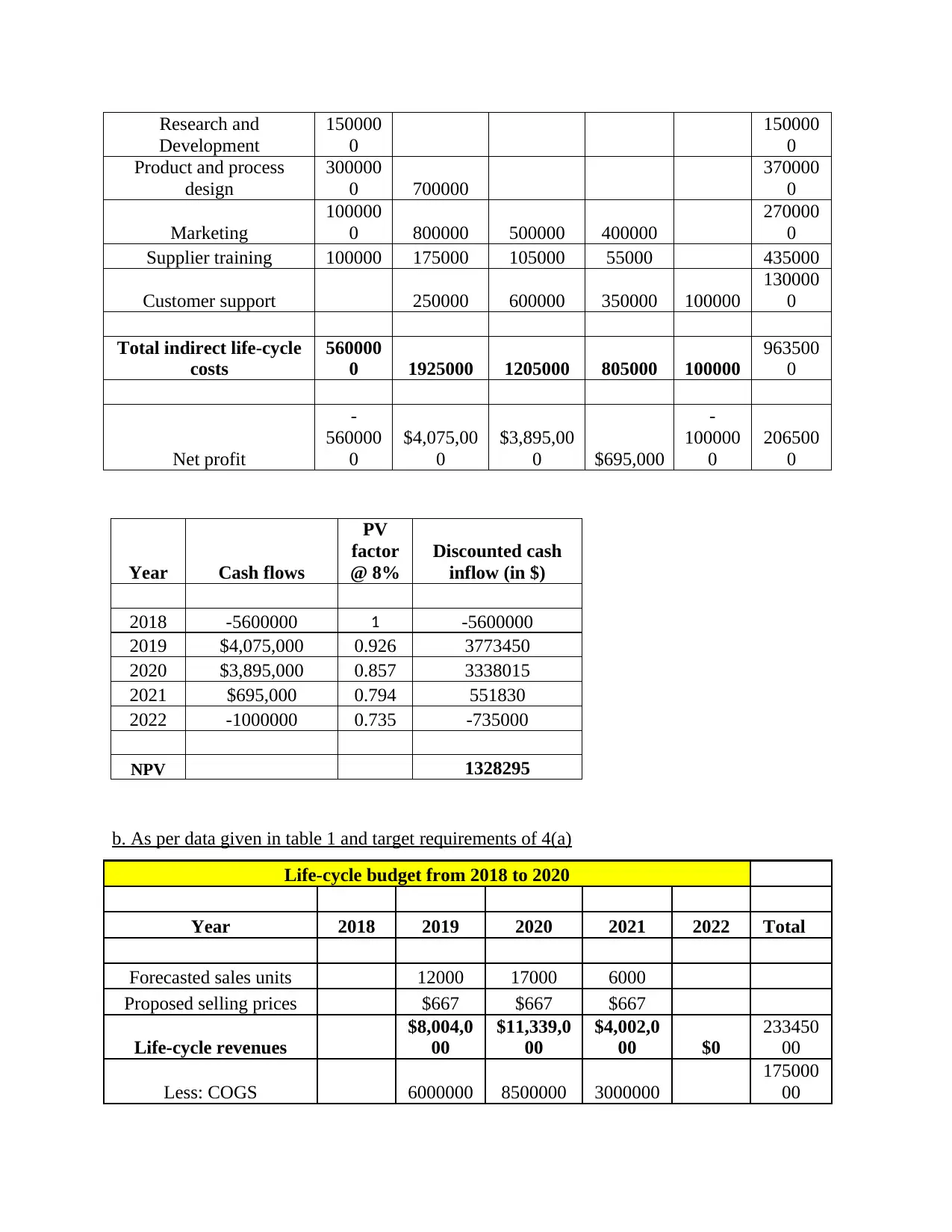
5. Preparing life cycle budget for RayHot from 2018 to 2022
A. On the basis of data given in table 1, 2 and 3
Life-cycle budget from 2018 to 2020
Year 2018 2019 2020 2021 2022
Forecasted sales units 12000 17000 6000
Proposed selling prices $1,000 $800 $750
Life-cycle revenues
$12,000,0
00
$13,600,0
00
$4,500,0
00 $0
301000
00
Less: COGS 6000000 8500000 3000000
175000
00
Gross profit
$6,000,00
0
$5,100,00
0
$1,500,0
00
126000
00
Life-cycle costs
Cost per unit $500 $500 $501
Difference $333 $167 $124
b.
On the basis of above evaluation, it is suggested to HWL to make focus on the aspect of
value engineering. In accordance with such aspect, HWL should focus on the modification of
design and system as per value analysis (Omar & et.al., 2015, pp.201-206). Through this, firm
would become able to control cost and enhancing the profitability aspect.
c.
The main reasons behind the selection of value engineering are that it offers benefit to
both individual as well as an organization (Sharaf-Addin, Omar & Sulaiman, 2014, p.82). Along
with this, such method also provides high level of assistance in avoiding unnecessary cost and
thereby maximizes profit level.
5. Preparing life cycle budget for RayHot from 2018 to 2022
A. On the basis of data given in table 1, 2 and 3
Life-cycle budget from 2018 to 2020
Year 2018 2019 2020 2021 2022
Forecasted sales units 12000 17000 6000
Proposed selling prices $1,000 $800 $750
Life-cycle revenues
$12,000,0
00
$13,600,0
00
$4,500,0
00 $0
301000
00
Less: COGS 6000000 8500000 3000000
175000
00
Gross profit
$6,000,00
0
$5,100,00
0
$1,500,0
00
126000
00
Life-cycle costs
Paraphrase This Document
Need a fresh take? Get an instant paraphrase of this document with our AI Paraphraser
Research and
Development
150000
0
150000
0
Product and process
design
300000
0 700000
370000
0
Marketing
100000
0 800000 500000 400000
270000
0
Supplier training 100000 175000 105000 55000 435000
Customer support 250000 600000 350000 100000
130000
0
Total indirect life-cycle
costs
560000
0 1925000 1205000 805000 100000
963500
0
Net profit
-
560000
0
$4,075,00
0
$3,895,00
0 $695,000
-
100000
0
206500
0
Year Cash flows
PV
factor
@ 8%
Discounted cash
inflow (in $)
2018 -5600000 1 -5600000
2019 $4,075,000 0.926 3773450
2020 $3,895,000 0.857 3338015
2021 $695,000 0.794 551830
2022 -1000000 0.735 -735000
NPV 1328295
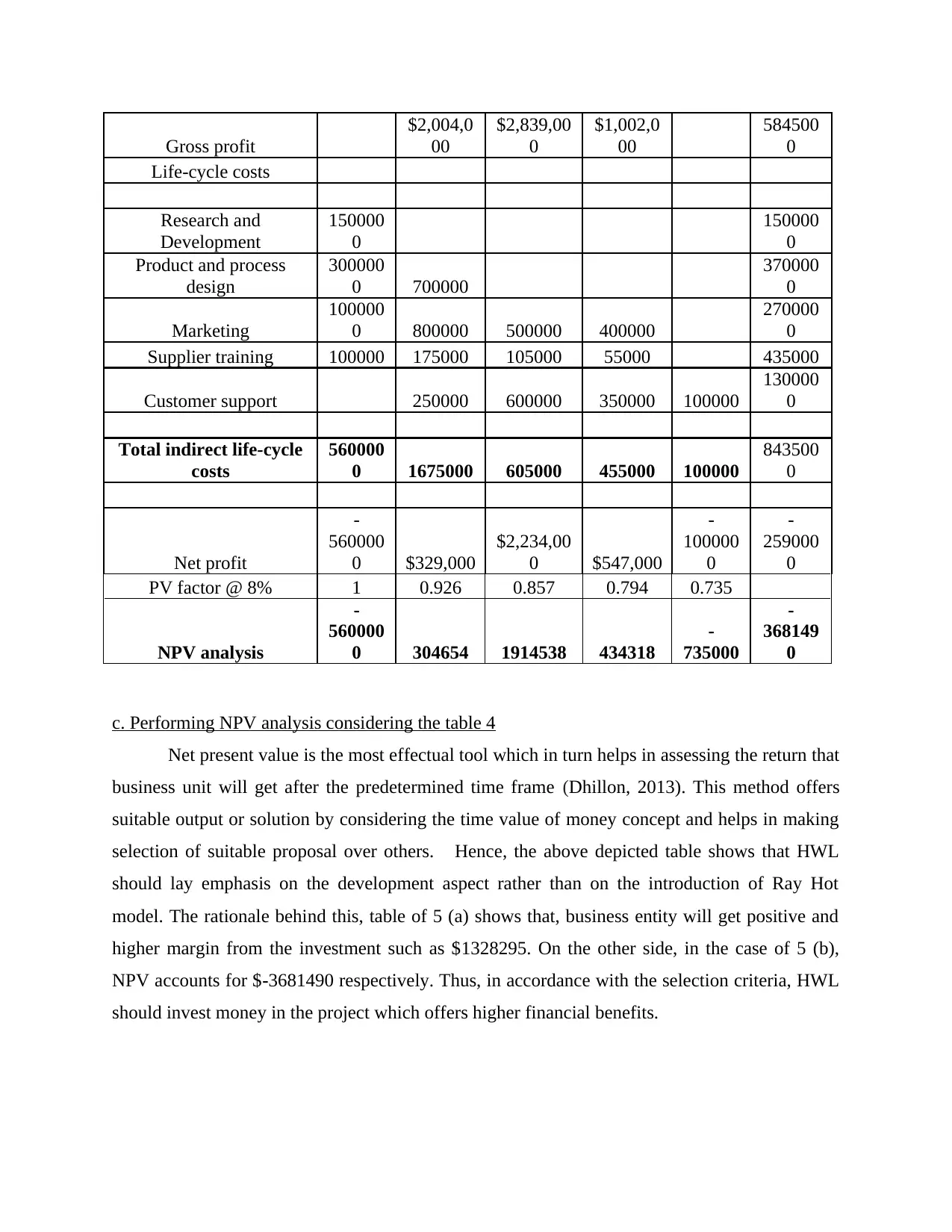
b. As per data given in table 1 and target requirements of 4(a)
Life-cycle budget from 2018 to 2020
Year 2018 2019 2020 2021 2022 Total
Forecasted sales units 12000 17000 6000
Proposed selling prices $667 $667 $667
Life-cycle revenues
$8,004,0
00
$11,339,0
00
$4,002,0
00 $0
233450
00
Less: COGS 6000000 8500000 3000000
175000
00
Development
150000
0
150000
0
Product and process
design
300000
0 700000
370000
0
Marketing
100000
0 800000 500000 400000
270000
0
Supplier training 100000 175000 105000 55000 435000
Customer support 250000 600000 350000 100000
130000
0
Total indirect life-cycle
costs
560000
0 1925000 1205000 805000 100000
963500
0
Net profit
-
560000
0
$4,075,00
0
$3,895,00
0 $695,000
-
100000
0
206500
0
Year Cash flows
PV
factor
@ 8%
Discounted cash
inflow (in $)
2018 -5600000 1 -5600000
2019 $4,075,000 0.926 3773450
2020 $3,895,000 0.857 3338015
2021 $695,000 0.794 551830
2022 -1000000 0.735 -735000
NPV 1328295
b. As per data given in table 1 and target requirements of 4(a)
Life-cycle budget from 2018 to 2020
Year 2018 2019 2020 2021 2022 Total
Forecasted sales units 12000 17000 6000
Proposed selling prices $667 $667 $667
Life-cycle revenues
$8,004,0
00
$11,339,0
00
$4,002,0
00 $0
233450
00
Less: COGS 6000000 8500000 3000000
175000
00
Gross profit
$2,004,0
00
$2,839,00
0
$1,002,0
00
584500
0
Life-cycle costs
Research and
Development
150000
0
150000
0
Product and process
design
300000
0 700000
370000
0
Marketing
100000
0 800000 500000 400000
270000
0
Supplier training 100000 175000 105000 55000 435000
Customer support 250000 600000 350000 100000
130000
0
Total indirect life-cycle
costs
560000
0 1675000 605000 455000 100000
843500
0
Net profit
-
560000
0 $329,000
$2,234,00
0 $547,000
-
100000
0
-
259000
0
PV factor @ 8% 1 0.926 0.857 0.794 0.735
NPV analysis
-
560000
0 304654 1914538 434318
-
735000
-
368149
0
c. Performing NPV analysis considering the table 4
Net present value is the most effectual tool which in turn helps in assessing the return that
business unit will get after the predetermined time frame (Dhillon, 2013). This method offers
suitable output or solution by considering the time value of money concept and helps in making
selection of suitable proposal over others. Hence, the above depicted table shows that HWL
should lay emphasis on the development aspect rather than on the introduction of Ray Hot
model. The rationale behind this, table of 5 (a) shows that, business entity will get positive and
higher margin from the investment such as $1328295. On the other side, in the case of 5 (b),
NPV accounts for $-3681490 respectively. Thus, in accordance with the selection criteria, HWL
should invest money in the project which offers higher financial benefits.
$2,004,0
00
$2,839,00
0
$1,002,0
00
584500
0
Life-cycle costs
Research and
Development
150000
0
150000
0
Product and process
design
300000
0 700000
370000
0
Marketing
100000
0 800000 500000 400000
270000
0
Supplier training 100000 175000 105000 55000 435000
Customer support 250000 600000 350000 100000
130000
0
Total indirect life-cycle
costs
560000
0 1675000 605000 455000 100000
843500
0
Net profit
-
560000
0 $329,000
$2,234,00
0 $547,000
-
100000
0
-
259000
0
PV factor @ 8% 1 0.926 0.857 0.794 0.735
NPV analysis
-
560000
0 304654 1914538 434318
-
735000
-
368149
0
c. Performing NPV analysis considering the table 4
Net present value is the most effectual tool which in turn helps in assessing the return that
business unit will get after the predetermined time frame (Dhillon, 2013). This method offers
suitable output or solution by considering the time value of money concept and helps in making
selection of suitable proposal over others. Hence, the above depicted table shows that HWL
should lay emphasis on the development aspect rather than on the introduction of Ray Hot
model. The rationale behind this, table of 5 (a) shows that, business entity will get positive and
higher margin from the investment such as $1328295. On the other side, in the case of 5 (b),
NPV accounts for $-3681490 respectively. Thus, in accordance with the selection criteria, HWL
should invest money in the project which offers higher financial benefits.
⊘ This is a preview!⊘
Do you want full access?
Subscribe today to unlock all pages.
Trusted by 1+ million students worldwide
CASE STUDY 2
1. Evaluating trial cost saving rewards system in the context of ATL
Cited case situation presents that Alum Tubes Ltd (ATL) has introduced cost saving
performance related pay system for the period of 2017. Hence, company has announced that
from January to December 2017 team who will meet or exceed the performance target entitled to
get a bonus pool of $30000. With the aim to motivate all the personnel and to get the desired
level of outcome targets for the quarter are shared equally among the members. On the initial
level, such scheme has placed positive impact on employee motivation because it will assist
them in attaining financial gain.
However, at the time and during the implementation of such system several issues were
faced by the team who participated in such process such as Scuba finishing. Moreover, at the
time of evaluation related to trial cost saving program member of team Scuba finishing entails
that due to some issues they were failed to meet the target. During discussion, member of Scuba
finishing said that team Scuba assembly supplied faulty product to them for further processing.
Due to this, team Scuba finishing has taken long time for the completion of manufacturing
process. Besides this, team Scuba finishing claimed that purchasing department placed order for
the material too late. Thus, all such are the main issues due to which ATL failed to get desired
level of success from trial cost saving rewards system.
Along with this, team fire finishing stated that they were not the part of bonus scheme.
Hence, for ATL there is a requirement to make some modifications in the existing framework
which in turn contribute in the attainment of organizational goals. In accordance with the
outcome of evaluation ATL tends to make focus on undertaking activity based budgeting
technique. This in turn facilitates optimum allocation of cost on the basis of concerned driver and
thereby helps in making effectual use of financial resources (Martinez-Sanchez, Kromann &
Astrup, 2015, pp.343-355).
2. Identifying the extent to which team based cost saving measures help in evaluating
performance and awarding bonus
From assessment, it has been identified that team based cost saving measures are
appropriate when one is not based on another. In the current situation, team members of Scuba
1. Evaluating trial cost saving rewards system in the context of ATL
Cited case situation presents that Alum Tubes Ltd (ATL) has introduced cost saving
performance related pay system for the period of 2017. Hence, company has announced that
from January to December 2017 team who will meet or exceed the performance target entitled to
get a bonus pool of $30000. With the aim to motivate all the personnel and to get the desired
level of outcome targets for the quarter are shared equally among the members. On the initial
level, such scheme has placed positive impact on employee motivation because it will assist
them in attaining financial gain.
However, at the time and during the implementation of such system several issues were
faced by the team who participated in such process such as Scuba finishing. Moreover, at the
time of evaluation related to trial cost saving program member of team Scuba finishing entails
that due to some issues they were failed to meet the target. During discussion, member of Scuba
finishing said that team Scuba assembly supplied faulty product to them for further processing.
Due to this, team Scuba finishing has taken long time for the completion of manufacturing
process. Besides this, team Scuba finishing claimed that purchasing department placed order for
the material too late. Thus, all such are the main issues due to which ATL failed to get desired
level of success from trial cost saving rewards system.
Along with this, team fire finishing stated that they were not the part of bonus scheme.
Hence, for ATL there is a requirement to make some modifications in the existing framework
which in turn contribute in the attainment of organizational goals. In accordance with the
outcome of evaluation ATL tends to make focus on undertaking activity based budgeting
technique. This in turn facilitates optimum allocation of cost on the basis of concerned driver and
thereby helps in making effectual use of financial resources (Martinez-Sanchez, Kromann &
Astrup, 2015, pp.343-355).
2. Identifying the extent to which team based cost saving measures help in evaluating
performance and awarding bonus
From assessment, it has been identified that team based cost saving measures are
appropriate when one is not based on another. In the current situation, team members of Scuba
Paraphrase This Document
Need a fresh take? Get an instant paraphrase of this document with our AI Paraphraser
finishing are highly dependent on assembly. On the basis of such aspect, if one team fails to
perform in right direction then it closely impacts another. In this situation, it is not possible for
ATL to determine the efficiency level of team in an appropriate manner and award them with
bonuses. As per the given case situation, Team Scuba finishing performance is based on
assembly, whereas others are considered as independent. In this, irrespective of having high
efficiency level Scuba finishing failed to perform activities in a prominent way.
3. Assessing cost saving performance measures and other forms of incentive scheme
By doing assessment of the current strategic framework it has found that ATL’s trial cost
saving performance related pay system is not highly effectual. Thus, for the achievement of goals
and objectives it is highly required for the business unit to make focus on undertaking effective
measures (Tsai & et.al., 2014, pp.607-619). Thus, prominent or competent measures on which
firm should focus on includes contribution to total spend ratio, purchase price variance, contract
pricing, supplier management and performance. Hence, by employing all such measure ATL
would become able to assess the extent to which specific team has made contribution in cost
control.
Along with this, ALT should focus on developing budget by employing ABB techniques.
Moreover, such technique lays high level of emphasis on the cost of overhead which is large
proportion of operating cost. Further, in this, budgeting is highly based on activity framework as
well as cost driver and variance feedback processes. Thus, it can be stated that budget which is
based on ABB presents clear view of financials and thereby helps in setting suitable standards
for incentive schemes. On the basis of such aspect by making comparison of actual performance
in against to set standards ATL can assess deviations and thereby would become able to evaluate
the efficiency of team.
4.
a.
Strategies at various levels
Strategies at various levels
perform in right direction then it closely impacts another. In this situation, it is not possible for
ATL to determine the efficiency level of team in an appropriate manner and award them with
bonuses. As per the given case situation, Team Scuba finishing performance is based on
assembly, whereas others are considered as independent. In this, irrespective of having high
efficiency level Scuba finishing failed to perform activities in a prominent way.
3. Assessing cost saving performance measures and other forms of incentive scheme
By doing assessment of the current strategic framework it has found that ATL’s trial cost
saving performance related pay system is not highly effectual. Thus, for the achievement of goals
and objectives it is highly required for the business unit to make focus on undertaking effective
measures (Tsai & et.al., 2014, pp.607-619). Thus, prominent or competent measures on which
firm should focus on includes contribution to total spend ratio, purchase price variance, contract
pricing, supplier management and performance. Hence, by employing all such measure ATL
would become able to assess the extent to which specific team has made contribution in cost
control.
Along with this, ALT should focus on developing budget by employing ABB techniques.
Moreover, such technique lays high level of emphasis on the cost of overhead which is large
proportion of operating cost. Further, in this, budgeting is highly based on activity framework as
well as cost driver and variance feedback processes. Thus, it can be stated that budget which is
based on ABB presents clear view of financials and thereby helps in setting suitable standards
for incentive schemes. On the basis of such aspect by making comparison of actual performance
in against to set standards ATL can assess deviations and thereby would become able to evaluate
the efficiency of team.
4.
a.
Strategies at various levels
Strategies at various levels
Corporate: In the corporate context, firm needs to evaluate the sustainability practices
which are undertaken by competitors.
Business or enterprise: In this, business unit should employ competent strategic
framework and technology which in turn contributes in the sustainability aspects.
Functional: On functional level business unit requires to conduct training and
development session for personnel.
B.
In the business organization, it is highly required for ATL to create effectual culture by sharing
vision with personnel. Hence, manager of the firm should communicate to the personnel about
the significance of sustainability practices. Thus, firm should organize workshops, meetings and
send mail to the individuals or personnel regarding the role of sustainability practices in cost
reduction and enhancement of operational efficiency. Thus, by communicating both short and
long term benefits to personnel which are associated with sustainability practices firm can gain
competitive edge over others. Along with this, by making investment in training and
development activity ATL would become able to persuade personnel specifically Team fire
finishing about how to deal with the technological aspect firm can attain sustainability related
objectives (Mohamad & et.al., 2014, pp.78-89). Hence, by organizing training activity firm can
enhance the proficiency level of personnel and would become able to indulge the culture of
teamwork as well as innovation within ATL.
5.
Societal values account for the ways through which scare resources can be allocated and
used more efficiently. Hence, it focuses on looking beyond the price and considers all the factors
that a public authority or body chooses to award a contract. Thus, the main motives of the firm
behind all such aspects are to contribute in the collective benefit of community.
a.
From evaluation, it has been identified that some modifications are required in the new
performance evaluation system. It is cited in the case situation that CEO of ATL has taken
decision in relation to not involving the team Fire Finishing trial cost efficiency performance-
which are undertaken by competitors.
Business or enterprise: In this, business unit should employ competent strategic
framework and technology which in turn contributes in the sustainability aspects.
Functional: On functional level business unit requires to conduct training and
development session for personnel.
B.
In the business organization, it is highly required for ATL to create effectual culture by sharing
vision with personnel. Hence, manager of the firm should communicate to the personnel about
the significance of sustainability practices. Thus, firm should organize workshops, meetings and
send mail to the individuals or personnel regarding the role of sustainability practices in cost
reduction and enhancement of operational efficiency. Thus, by communicating both short and
long term benefits to personnel which are associated with sustainability practices firm can gain
competitive edge over others. Along with this, by making investment in training and
development activity ATL would become able to persuade personnel specifically Team fire
finishing about how to deal with the technological aspect firm can attain sustainability related
objectives (Mohamad & et.al., 2014, pp.78-89). Hence, by organizing training activity firm can
enhance the proficiency level of personnel and would become able to indulge the culture of
teamwork as well as innovation within ATL.
5.
Societal values account for the ways through which scare resources can be allocated and
used more efficiently. Hence, it focuses on looking beyond the price and considers all the factors
that a public authority or body chooses to award a contract. Thus, the main motives of the firm
behind all such aspects are to contribute in the collective benefit of community.
a.
From evaluation, it has been identified that some modifications are required in the new
performance evaluation system. It is cited in the case situation that CEO of ATL has taken
decision in relation to not involving the team Fire Finishing trial cost efficiency performance-
⊘ This is a preview!⊘
Do you want full access?
Subscribe today to unlock all pages.
Trusted by 1+ million students worldwide

1 out of 22


Related Documents


Your All-in-One AI-Powered Toolkit for Academic Success.
+13062052269
info@desklib.com
Available 24*7 on WhatsApp / Email
![[object Object]](/_next/static/media/star-bottom.7253800d.svg)
Unlock your academic potential
Copyright © 2020–2025 A2Z Services. All Rights Reserved. Developed and managed by ZUCOL.