Analysis of External Environment in Australian IT Industry
VerifiedAdded on 2021/01/02
|12
|4485
|414
Report
AI Summary
This report provides an in-depth analysis of the external environment of the Information Technology (IT) industry in Australia. The report begins with an overview of the IT industry in Australia, highlighting its growth, key drivers, and its significance in the Australian economy. The main body of the report focuses on an external analysis of the IT industry using the PESTLE framework, which examines political, economic, social, technological, legal, and environmental factors. Each factor is discussed in detail, outlining its impact on the industry, including opportunities and threats. The political factors include government policies and stability, while economic factors encompass economic growth and market trends. Social factors involve customer behavior and technological adoption. Technological factors cover innovation and cybercrime. Environmental factors address sustainability, and legal factors consider intellectual property and crime. The report concludes with a summary of the key findings and the overall impact of the external environment on the Australian IT industry.
INDUSTRY AND EXTERNAL
ENVIRONMENT ANALYSIS
ENVIRONMENT ANALYSIS

Paraphrase This Document
Need a fresh take? Get an instant paraphrase of this document with our AI Paraphraser
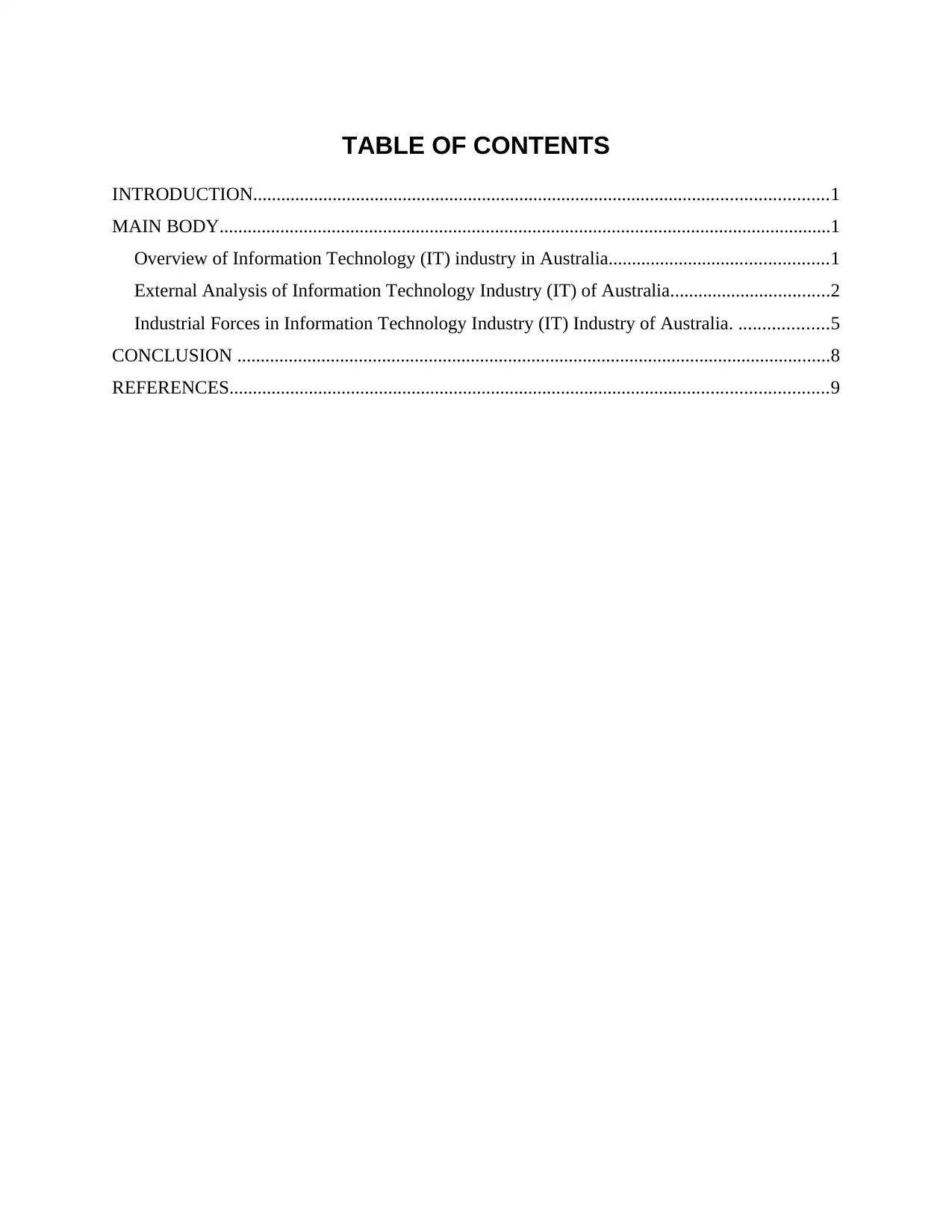
TABLE OF CONTENTS
INTRODUCTION...........................................................................................................................1
MAIN BODY...................................................................................................................................1
Overview of Information Technology (IT) industry in Australia...............................................1
External Analysis of Information Technology Industry (IT) of Australia..................................2
Industrial Forces in Information Technology Industry (IT) Industry of Australia. ...................5
CONCLUSION ...............................................................................................................................8
REFERENCES................................................................................................................................9
INTRODUCTION...........................................................................................................................1
MAIN BODY...................................................................................................................................1
Overview of Information Technology (IT) industry in Australia...............................................1
External Analysis of Information Technology Industry (IT) of Australia..................................2
Industrial Forces in Information Technology Industry (IT) Industry of Australia. ...................5
CONCLUSION ...............................................................................................................................8
REFERENCES................................................................................................................................9
INTRODUCTION
The information technology (IT) industry has become one of the most robust industries in
the world. IT is more than any other industry or economic facet has increases productivity
particularly in developed world and thus a key driver of global economic growth and
development (Lu and et.al., 2015). There are mainly two environment in which an industry
operated such as internal and external. External factors are not in control with the company as
these are uncertain factors. The external analysis takes a look at the opportunities and threats
which are existing in the environment of the company. There are various factors that needs to be
evaluate as it affect the operations and function of the company in industry are customers,
competitive, market and environmental factor. In this present report, the external analysis of
Information technology industry of Australia will be done.
MAIN BODY
Overview of Information Technology (IT) industry in Australia.
Information Technology (IT) is the use of computers to store, transmit, manipulates and
retrieve information or data often in the context of a business or other enterprises. This
information and technology industry has been considered as the subset of information and
communication technology (ICT). Australia's digital healthy industry has a long history of using
innovative communication technology across the world (Grant, 2016). The spending of Australia
in the growth in Information technology will be driven by companies investments in the solution
of software's and services over 2019 to 2022. Internet Of Things (IOT), Artificial Intelligence
(AI) technologies, cloud and edge computing are the main impetus which are being demanded
for the solutions. Australia is recognised for adopting new and advance technologies at a high
growth rate as compare to other nations across the world. For example, IT entered the new
millenniums with one of the fastest rates of internet access in the world.
Researchers and Scientist from Australia have been accountable for many leading
discovery as well as development in technology across the world. It is true that Australia swash
eight Nobel Prizes recipient and it is not bad for nation with 19 million population. In Australia,
the growth in IT industry has had various essential results like it has raised the opportunities for
design and innovation, it also aids other sectors to make improvements in their already existing
set-ups or establishments as well as it also assist existing set ups or establishment to improve
thee quality of goods and services. Further, the growth in Information Technology (IT) industry
1
The information technology (IT) industry has become one of the most robust industries in
the world. IT is more than any other industry or economic facet has increases productivity
particularly in developed world and thus a key driver of global economic growth and
development (Lu and et.al., 2015). There are mainly two environment in which an industry
operated such as internal and external. External factors are not in control with the company as
these are uncertain factors. The external analysis takes a look at the opportunities and threats
which are existing in the environment of the company. There are various factors that needs to be
evaluate as it affect the operations and function of the company in industry are customers,
competitive, market and environmental factor. In this present report, the external analysis of
Information technology industry of Australia will be done.
MAIN BODY
Overview of Information Technology (IT) industry in Australia.
Information Technology (IT) is the use of computers to store, transmit, manipulates and
retrieve information or data often in the context of a business or other enterprises. This
information and technology industry has been considered as the subset of information and
communication technology (ICT). Australia's digital healthy industry has a long history of using
innovative communication technology across the world (Grant, 2016). The spending of Australia
in the growth in Information technology will be driven by companies investments in the solution
of software's and services over 2019 to 2022. Internet Of Things (IOT), Artificial Intelligence
(AI) technologies, cloud and edge computing are the main impetus which are being demanded
for the solutions. Australia is recognised for adopting new and advance technologies at a high
growth rate as compare to other nations across the world. For example, IT entered the new
millenniums with one of the fastest rates of internet access in the world.
Researchers and Scientist from Australia have been accountable for many leading
discovery as well as development in technology across the world. It is true that Australia swash
eight Nobel Prizes recipient and it is not bad for nation with 19 million population. In Australia,
the growth in IT industry has had various essential results like it has raised the opportunities for
design and innovation, it also aids other sectors to make improvements in their already existing
set-ups or establishments as well as it also assist existing set ups or establishment to improve
thee quality of goods and services. Further, the growth in Information Technology (IT) industry
1
⊘ This is a preview!⊘
Do you want full access?
Subscribe today to unlock all pages.

Trusted by 1+ million students worldwide
has helps to improve and develop Australian economy and now it has becomes one of the leading
country in exporting and importing of exporting and importing of goods and services across the
world (Takata, 2016).
In the Australian department of employment anticipating that IT industry has raised the
job opportunities and in 2018 the demands of professionals in IT has raised to 12.8 percent. The
capital cities of Australia like Sydney, Brisbane and Melbourne are seen the largest growth in the
technology as these are called as the hub of technology as well as home to more than half of the
nations tops 20 technical firms whereas the Victoria state has over and about 8000 companies
operating in IT industry for example, Microsoft, Intel and IBM. The salary of IT professionals
working in Sydney are one of the highest among the nation as well as with about 65 percent of
technological start-ups are based in New South Wales (Overview of Information technology (IT)
Industry, 2018). In addition to this, in the global digitalised economy, Brisbane has become one
of the leading competitive player because of having booming technological starts ups.
External Analysis of Information Technology Industry (IT) of Australia.
External environment is everything that is outside the company which may influence the
operations and functions of the company. External environment represent some forces that
influence the firms across all sectors. With the advancement in time, it has been seen a great
progress and development in IT industry. All most population in Australia is using internet in
order to have connection with the people as well as across the world. It is true that, the credit of
raising the standard of people is goes to IT industry (Siqueira, Webb and Bruton, 2016). Apart
from this, there are several factors that influence the operations, functions and entire profitability
in both positive and negative manner. Thus, to understand the external factors and there impact,
Pestle Analysis one of the best tool to evaluate the impact.
PESTLE ANALYSIS
Political Factors: This is the factors that influence the business in IT industry in both
positive and negative manner. For IT industry, government has formed various rules, policies
and laws in order to introduce IT sector in various departments. Private sectors is growing by
taking help with IT industry. It is very essential for government authorities to ensure the right
policies and laws for using the software and social media so that the operations will be on right
track. With the policies and rules, the chances of crimes are reduced which is a very important
for growth of IT industry. The political stability in the nations could assist to grow and develop
2
country in exporting and importing of exporting and importing of goods and services across the
world (Takata, 2016).
In the Australian department of employment anticipating that IT industry has raised the
job opportunities and in 2018 the demands of professionals in IT has raised to 12.8 percent. The
capital cities of Australia like Sydney, Brisbane and Melbourne are seen the largest growth in the
technology as these are called as the hub of technology as well as home to more than half of the
nations tops 20 technical firms whereas the Victoria state has over and about 8000 companies
operating in IT industry for example, Microsoft, Intel and IBM. The salary of IT professionals
working in Sydney are one of the highest among the nation as well as with about 65 percent of
technological start-ups are based in New South Wales (Overview of Information technology (IT)
Industry, 2018). In addition to this, in the global digitalised economy, Brisbane has become one
of the leading competitive player because of having booming technological starts ups.
External Analysis of Information Technology Industry (IT) of Australia.
External environment is everything that is outside the company which may influence the
operations and functions of the company. External environment represent some forces that
influence the firms across all sectors. With the advancement in time, it has been seen a great
progress and development in IT industry. All most population in Australia is using internet in
order to have connection with the people as well as across the world. It is true that, the credit of
raising the standard of people is goes to IT industry (Siqueira, Webb and Bruton, 2016). Apart
from this, there are several factors that influence the operations, functions and entire profitability
in both positive and negative manner. Thus, to understand the external factors and there impact,
Pestle Analysis one of the best tool to evaluate the impact.
PESTLE ANALYSIS
Political Factors: This is the factors that influence the business in IT industry in both
positive and negative manner. For IT industry, government has formed various rules, policies
and laws in order to introduce IT sector in various departments. Private sectors is growing by
taking help with IT industry. It is very essential for government authorities to ensure the right
policies and laws for using the software and social media so that the operations will be on right
track. With the policies and rules, the chances of crimes are reduced which is a very important
for growth of IT industry. The political stability in the nations could assist to grow and develop
2
Paraphrase This Document
Need a fresh take? Get an instant paraphrase of this document with our AI Paraphraser
this industry and used in various departments so that work becomes easy, fast and effective. IT
industry has brought all the firms in Australia to come closer and do work in coordination with
each other. Thus, the stability in the political situation of the nations allows investors to invest
with the firms because thy feel confident during investment.
Further, the government of Australia is supporting and moving the economy towards
digitalisation which is a good opportunity for the firms operating as well as another opportunity
is political support for e-technologies (De Wolf, Pomponi and Moncaster, 2017). On the
contrary, if the political conditions are not stable and if government changes the policies and
laws on continuous basis it will influence the entire operations and functions in negative way
which is not at all good for the Austrian economy because Australia has become hub of the
technology in the digital economy.
Economic Factor: This is also one of the factor that leads to influenced the operations
and functioning of IT industry in both positive and negative way. The effect that IT industry
leads is incredible impact on the Information Industry. Australia holds the 13th spot for the
biggest economy worldwide. There growth of the economy has grown by 2 percent. Because of
IT industry, it has becomes easy to detect and observe the economic recession, competition,
availability of contract as well as deposit of fee (Bakker and Shepherd, 2017). IT industry is
growing with the highest pace because Australia is featured as the stable economy with the rise
of inflows in Foreign Direct Investment that has rendered the economy a cushion to the economy
even in the period of crisis. In addition to this, increasing need for online goods is another
opportunity that helps company to flourish and grow more. On the contrary, decline in the
economic growth influence the market of IT industry because in today's era each and everything
is depended on internet and if economic conditions are bot good, the purchasing power of people
is reduced which in turn decreases the production and automatically IT industry also suffers.
Social Factor: This is another factors that leads both opportunities and threats for the
organisation. This factors included the culture, belief, attitudes, living styles and many other
elements which are associated with the social factors. Today the world is of digitalisation as
almost all the operations and functions of companies are relied on the advance technology
because customers are now become highly advance. The macro-environmental factors of
increasing purchase capacities associated with the firms in Information technology industry is the
opportunities for market penetration and leads to positive impact on the growth and development
3
industry has brought all the firms in Australia to come closer and do work in coordination with
each other. Thus, the stability in the political situation of the nations allows investors to invest
with the firms because thy feel confident during investment.
Further, the government of Australia is supporting and moving the economy towards
digitalisation which is a good opportunity for the firms operating as well as another opportunity
is political support for e-technologies (De Wolf, Pomponi and Moncaster, 2017). On the
contrary, if the political conditions are not stable and if government changes the policies and
laws on continuous basis it will influence the entire operations and functions in negative way
which is not at all good for the Austrian economy because Australia has become hub of the
technology in the digital economy.
Economic Factor: This is also one of the factor that leads to influenced the operations
and functioning of IT industry in both positive and negative way. The effect that IT industry
leads is incredible impact on the Information Industry. Australia holds the 13th spot for the
biggest economy worldwide. There growth of the economy has grown by 2 percent. Because of
IT industry, it has becomes easy to detect and observe the economic recession, competition,
availability of contract as well as deposit of fee (Bakker and Shepherd, 2017). IT industry is
growing with the highest pace because Australia is featured as the stable economy with the rise
of inflows in Foreign Direct Investment that has rendered the economy a cushion to the economy
even in the period of crisis. In addition to this, increasing need for online goods is another
opportunity that helps company to flourish and grow more. On the contrary, decline in the
economic growth influence the market of IT industry because in today's era each and everything
is depended on internet and if economic conditions are bot good, the purchasing power of people
is reduced which in turn decreases the production and automatically IT industry also suffers.
Social Factor: This is another factors that leads both opportunities and threats for the
organisation. This factors included the culture, belief, attitudes, living styles and many other
elements which are associated with the social factors. Today the world is of digitalisation as
almost all the operations and functions of companies are relied on the advance technology
because customers are now become highly advance. The macro-environmental factors of
increasing purchase capacities associated with the firms in Information technology industry is the
opportunities for market penetration and leads to positive impact on the growth and development
3
of IT industry. For example, high sales revenue are expected as target customers are competent
of buying product related to information technology from IT companies. Apart from this, another
opportunity from social factor present that the use of customer services is increasing for the
evaluation of quality and product as well as business. For example, IBM company provides the
foundation for applying standard of effective quality customer services in order to attract huge
market share (Hakansson, 2015). Furthermore, increasing use of online service is another
remarkable opportunities for IT industry in Australia. For example, offering product that is based
on clout platforms could raise the revenue of the firm. On the contrary, the changes in
technology very frequently leads to negative impact on the operations and functions of the
company because it raises the cost of operations.
Technological Factor: This is one of the core factor that leads to great opportunities
along with threat to the economy. IT industry has changes the life of people as well as the
economy of the nation. Everyone has mobile phones, social media networks to contact with the
people. Further, it is the great opportunity for the Information technology industry is the
expansion of international accessibility to internet like the revenue of the company is rising
because IT industry is providing services of cloud platform. On the contrary, firms in IT industry
faces macro environmental factors of integration of technology in several sector along with
market and it is threat for companies in IT sector because it raises the attention of new entrants
from other sectors.
New entrants impose terror against the firm and have interest in radiating the businesses.
For instances, there are some robotic enterprises which are attracted towards the market segment
of IT in order to create there won goods that will compete with the products of IT firms like
IBM, Intel, etc. On the other hand, cybercrime is another threat or danger for the firms operating
in IT industry (Bohari, Hin and Fuad, 2017). This threat is likely to be in the form of cyber attack
on infrastructure based on online. But on the contrary it is also an opportunity for IT firms as
they are developing software's for overcoming or reducing these cyber attack.
Environmental Factors: This is another external factor that has influenced IT industry
in both positive and negative manner. It is fact that the rising use of the tools, machines and
equipments of IT has threatened the balance and sustainability of environment. In Australia, the
government is highly concern on the environment sustainability and it is mandatory for all the
firms to abide all these factors for ethical practices. IT firms are taking this as opportunity as they
4
of buying product related to information technology from IT companies. Apart from this, another
opportunity from social factor present that the use of customer services is increasing for the
evaluation of quality and product as well as business. For example, IBM company provides the
foundation for applying standard of effective quality customer services in order to attract huge
market share (Hakansson, 2015). Furthermore, increasing use of online service is another
remarkable opportunities for IT industry in Australia. For example, offering product that is based
on clout platforms could raise the revenue of the firm. On the contrary, the changes in
technology very frequently leads to negative impact on the operations and functions of the
company because it raises the cost of operations.
Technological Factor: This is one of the core factor that leads to great opportunities
along with threat to the economy. IT industry has changes the life of people as well as the
economy of the nation. Everyone has mobile phones, social media networks to contact with the
people. Further, it is the great opportunity for the Information technology industry is the
expansion of international accessibility to internet like the revenue of the company is rising
because IT industry is providing services of cloud platform. On the contrary, firms in IT industry
faces macro environmental factors of integration of technology in several sector along with
market and it is threat for companies in IT sector because it raises the attention of new entrants
from other sectors.
New entrants impose terror against the firm and have interest in radiating the businesses.
For instances, there are some robotic enterprises which are attracted towards the market segment
of IT in order to create there won goods that will compete with the products of IT firms like
IBM, Intel, etc. On the other hand, cybercrime is another threat or danger for the firms operating
in IT industry (Bohari, Hin and Fuad, 2017). This threat is likely to be in the form of cyber attack
on infrastructure based on online. But on the contrary it is also an opportunity for IT firms as
they are developing software's for overcoming or reducing these cyber attack.
Environmental Factors: This is another external factor that has influenced IT industry
in both positive and negative manner. It is fact that the rising use of the tools, machines and
equipments of IT has threatened the balance and sustainability of environment. In Australia, the
government is highly concern on the environment sustainability and it is mandatory for all the
firms to abide all these factors for ethical practices. IT firms are taking this as opportunity as they
4
⊘ This is a preview!⊘
Do you want full access?
Subscribe today to unlock all pages.
Trusted by 1+ million students worldwide
are trying to amend or improve its sustainability by utilizing recycling of by-products, renewable
energy and reduce the waste in the production. IT companies also organise programmes for
gaining the interest and attention of stakeholder towards the environmental sustainability. On the
other hand, the products of IT industry has become threat for the health of people because of
excessive use of mobile phones and installation of signal towers has made the life of people in
danger. Thus, in order to mitigate these impact, IT industries are working and providing organic
products in the market (De Grosbois, 2016).
Legal Factors: This is another macro-environmental factor which influenced the
company in both optimistic and negative way. Australian government has improved the
intellectual property act which created opportunities for IT firms to expand the business by
reducing violation of intellectual property in the industry of IT but still companies are facing
issues in emerging market just because of weak implementation as well as loopholes in
protection of intellectual property. So, such type of conditions becomes very challenging for IT
firms to generate higher revenues. Further, the increasing crimes like terrorist attacks is also
causing pressure on IT industry from government. But, IT industries are taking and converting
all these threat in opportunities by making cooperation with the government in reducing all these
concern of intellectual property as well as other illegal issues.
Thus, from the above analysis, it has been clearly understood that there are so many
factors which are influencing the functions and operations of IT industry. But still, IT industry of
Australia is capable enough to overcome the impact of micro-environment factors and covert
those threats into opportunities (Yuan, Ren and Chen, 2017). The biggest example is, Cyber
attack vs Anti- Cyber Crime Software's.
Industrial Forces in Information Technology Industry (IT) Industry of Australia.
IT industry is growing popularity due ton various technological advancement which has
help the economy of the Australia in their growth and success. The external forces affect IT
industry as there are various factors which have their negative impact on the industry
functioning. It is important to analyse the industry to get the in - depth information about the
industry feasibility and the growth and success of the firm which are involved in this industry.
There has been development in IT industry which assist in contributing to the growth of
Australian economy as there are various technological advancement taking place in this industry.
5
energy and reduce the waste in the production. IT companies also organise programmes for
gaining the interest and attention of stakeholder towards the environmental sustainability. On the
other hand, the products of IT industry has become threat for the health of people because of
excessive use of mobile phones and installation of signal towers has made the life of people in
danger. Thus, in order to mitigate these impact, IT industries are working and providing organic
products in the market (De Grosbois, 2016).
Legal Factors: This is another macro-environmental factor which influenced the
company in both optimistic and negative way. Australian government has improved the
intellectual property act which created opportunities for IT firms to expand the business by
reducing violation of intellectual property in the industry of IT but still companies are facing
issues in emerging market just because of weak implementation as well as loopholes in
protection of intellectual property. So, such type of conditions becomes very challenging for IT
firms to generate higher revenues. Further, the increasing crimes like terrorist attacks is also
causing pressure on IT industry from government. But, IT industries are taking and converting
all these threat in opportunities by making cooperation with the government in reducing all these
concern of intellectual property as well as other illegal issues.
Thus, from the above analysis, it has been clearly understood that there are so many
factors which are influencing the functions and operations of IT industry. But still, IT industry of
Australia is capable enough to overcome the impact of micro-environment factors and covert
those threats into opportunities (Yuan, Ren and Chen, 2017). The biggest example is, Cyber
attack vs Anti- Cyber Crime Software's.
Industrial Forces in Information Technology Industry (IT) Industry of Australia.
IT industry is growing popularity due ton various technological advancement which has
help the economy of the Australia in their growth and success. The external forces affect IT
industry as there are various factors which have their negative impact on the industry
functioning. It is important to analyse the industry to get the in - depth information about the
industry feasibility and the growth and success of the firm which are involved in this industry.
There has been development in IT industry which assist in contributing to the growth of
Australian economy as there are various technological advancement taking place in this industry.
5
Paraphrase This Document
Need a fresh take? Get an instant paraphrase of this document with our AI Paraphraser
This industry have provided various solution for the businesses which help therm in attracting
more customers towards their brand (Yuan, Ren and Chen, 2017).
The Industry analysis is important to identify the factor which have their potential impact
on the business involved in industry. The growth of IT industry of Australia is enhancing due to
the various innovation which are being taking place in this industry due to various firms. The
porter five forces analysis is conducted to identify the feasibility of the industry and the
competitiveness existing in IT industry. Thus, in order to track the impact of external forces and
competitive advantages, the best tool is Porter-s-five-forces-model.
PORTER FIVE FORCES ANALYSIS
Threat of new entrants : It is related to the threat for IT firms due to the entry of the
new firm in this industry. Threat of entreats is low in IT industry. This Industry is attractive due
to various changes and growth taking place in this industry which have in creased the demand for
this industry. The Australian IT industry is unattractive because of high cost involved in entering
this industry. The newcomers in this industry have to face various difficulties due to high
competition exiting in this industry and also the capital investment required for the entering in
this industry is high (Posch and et.al., 2015).
Also, due to lack of distribution channel available for the new comers the new firms are
not entering this industry. Moreover, it requires implementation of the innovative ideas for being
successful in industry which is not attainable by many new entrants. However, it is true that, IT
industry is attracted new comers to invest in IT sectors but at the same time, it is very
challenging for the company because of cost advantage large scale incumbents posses, and the
establishment of existing brands.
Threat of Competition: This is also one of force that exert pressure on the companies.
The threat of competition in Australia is very high because of small starts ups are continuously
increasing with rapid growth. IT industry is known for the competition. However, the new
entrants are not gaining such success because of intense competition between existing players.
Another reason, why the competition in IT industry is very high because all the businesses are
selling products and services equally in the market. Furthermore, moderate degree of uniqueness
and differentiation is the force that raises the competition in the market as they have to reduced
the prices of the products. In addition to this, another force which is influencing the companies in
IT industry is high imitation of products and services are possible and it is one the string force
6
more customers towards their brand (Yuan, Ren and Chen, 2017).
The Industry analysis is important to identify the factor which have their potential impact
on the business involved in industry. The growth of IT industry of Australia is enhancing due to
the various innovation which are being taking place in this industry due to various firms. The
porter five forces analysis is conducted to identify the feasibility of the industry and the
competitiveness existing in IT industry. Thus, in order to track the impact of external forces and
competitive advantages, the best tool is Porter-s-five-forces-model.
PORTER FIVE FORCES ANALYSIS
Threat of new entrants : It is related to the threat for IT firms due to the entry of the
new firm in this industry. Threat of entreats is low in IT industry. This Industry is attractive due
to various changes and growth taking place in this industry which have in creased the demand for
this industry. The Australian IT industry is unattractive because of high cost involved in entering
this industry. The newcomers in this industry have to face various difficulties due to high
competition exiting in this industry and also the capital investment required for the entering in
this industry is high (Posch and et.al., 2015).
Also, due to lack of distribution channel available for the new comers the new firms are
not entering this industry. Moreover, it requires implementation of the innovative ideas for being
successful in industry which is not attainable by many new entrants. However, it is true that, IT
industry is attracted new comers to invest in IT sectors but at the same time, it is very
challenging for the company because of cost advantage large scale incumbents posses, and the
establishment of existing brands.
Threat of Competition: This is also one of force that exert pressure on the companies.
The threat of competition in Australia is very high because of small starts ups are continuously
increasing with rapid growth. IT industry is known for the competition. However, the new
entrants are not gaining such success because of intense competition between existing players.
Another reason, why the competition in IT industry is very high because all the businesses are
selling products and services equally in the market. Furthermore, moderate degree of uniqueness
and differentiation is the force that raises the competition in the market as they have to reduced
the prices of the products. In addition to this, another force which is influencing the companies in
IT industry is high imitation of products and services are possible and it is one the string force
6
that directly impact on the profitability of the company (Hawn and Ioannou, 2016). Thus, in
order to mitigate the impact of these forces, organisations in IT industry of Australia are adopting
growth strategies in which cost leadership strategies are selected to lead the market.
Threat of Substitutes: This is another force that is exerted pressure on the industry. The
threat of switching in IT industry is relatively moderate. The cost of moderate creates a
considerable barrier against the use of substitutes by customers to the technology of company.
For example, customers is using the innovation of a company like Paytm which is software to
send money, Another IT company made software like Phone-pay which substitute of Paytm but
still customers will majorly use Paytm because it is first innovation and there were no complains.
In addition to this, the availability of substitute is also moderate because all the firms are selling
equally in the market. On the other hand, another example is use of computers by people is
cannot be replace because nothing can do so what computers are doing for community. In
addition to this, an individual could exert pressure sometimes like a retail company who
purchase large number of machines, tools and equipments if that company switches to others, it
will affect the profitability of IT firm (Prajogo and Oke, 2016). Thus, the forces are mainly
depends on the size and nature.
Bargaining Power of Customers: This is force which is exerted pressure on the industry
by the buyers in the market. It determines the power of customers as well as there effect on
pricing along with quality. The power of customers are increases when there are large number of
sellers as they find easy to move on other organisation. On the contrary, when the sellers are less
than the power of customers are less. In It industry, the power of buyers is low because of large
number of customers it is because when the customers are in large number the contribution is
weak. If any customers switch to other, it will not affect the profitability of the company. But on
the other hand, one individual customers can influence pressure on the company, for example, a
food company who used to buy large number of equipments, machines from IT company. Such
size of purchase considerably intensified the bargaining power of customers. Thus, the customers
bargaining power is moderate and sometimes low as this foe is also depends on the nature and
size of customers.
Bargaining Power of Suppliers: This is the type of external force that exert pressure on
IT industry. The power of suppliers are moderate in IT industry. The power of suppliers are low
when there are large number of suppliers in the market but when the suppliers are limited the
7
order to mitigate the impact of these forces, organisations in IT industry of Australia are adopting
growth strategies in which cost leadership strategies are selected to lead the market.
Threat of Substitutes: This is another force that is exerted pressure on the industry. The
threat of switching in IT industry is relatively moderate. The cost of moderate creates a
considerable barrier against the use of substitutes by customers to the technology of company.
For example, customers is using the innovation of a company like Paytm which is software to
send money, Another IT company made software like Phone-pay which substitute of Paytm but
still customers will majorly use Paytm because it is first innovation and there were no complains.
In addition to this, the availability of substitute is also moderate because all the firms are selling
equally in the market. On the other hand, another example is use of computers by people is
cannot be replace because nothing can do so what computers are doing for community. In
addition to this, an individual could exert pressure sometimes like a retail company who
purchase large number of machines, tools and equipments if that company switches to others, it
will affect the profitability of IT firm (Prajogo and Oke, 2016). Thus, the forces are mainly
depends on the size and nature.
Bargaining Power of Customers: This is force which is exerted pressure on the industry
by the buyers in the market. It determines the power of customers as well as there effect on
pricing along with quality. The power of customers are increases when there are large number of
sellers as they find easy to move on other organisation. On the contrary, when the sellers are less
than the power of customers are less. In It industry, the power of buyers is low because of large
number of customers it is because when the customers are in large number the contribution is
weak. If any customers switch to other, it will not affect the profitability of the company. But on
the other hand, one individual customers can influence pressure on the company, for example, a
food company who used to buy large number of equipments, machines from IT company. Such
size of purchase considerably intensified the bargaining power of customers. Thus, the customers
bargaining power is moderate and sometimes low as this foe is also depends on the nature and
size of customers.
Bargaining Power of Suppliers: This is the type of external force that exert pressure on
IT industry. The power of suppliers are moderate in IT industry. The power of suppliers are low
when there are large number of suppliers in the market but when the suppliers are limited the
7
⊘ This is a preview!⊘
Do you want full access?
Subscribe today to unlock all pages.
Trusted by 1+ million students worldwide
power of suppliers is high. Furthermore, the power of suppliers are also depends on the quality of
raw material they are selling to the company as if the quality is un-beatable than the power of
suppliers may be high. The reason why the power of suppliers is moderate in It industry is that
because the raw materials used are basically for fabrication of microprocessor. In addition to this,
the limited power of suppliers are also because of low degree of their progressive integration that
is corresponds to the high degree of IT firms reversed integration (Phan, and Baird, 2015). Like,
organisations maintains critical control on there supply chain on the other hand, suppliers have
restricted control in the supply chain of IT firms that results in weak strength of the bargaining
power of suppliers.
Thus, from the above analysis, it has been clearly understood that IT industry needs to
develop and create suitable competitive benefits in order to address the most significant forces
which are influencing the business as well as industry environment. It is true that improvement in
entire competitive benefits enable IT industry to become the leader in the contribution to
economic growth and development of the country i.e. Australia. The best way to gain
competitive advantage as well as economic growth of the nations is to ficus on innovation
strategy as this is best for gaining profit (Posch and et.al., 2015).
CONCLUSION
From the above case study it has concluded about External environment and the industry
analysis which assist in identifying the factors which may affect the business environment. The
External environment analysis is made through which the various external factors can be
identified with their impact on the business operations. Moreover, it has provided information
about political factors, economic factors, social factors, environmental factors and legal factors.
With the help of PESTLE analysis this factors can be easily analysed on the basis of which the
firms involved in this industry are able to make changes as per the changes happening in the
external environment. Furthermore, it has contained information about IT industry of Australia
and the various factors which may have their impact on the industry operation. It has provided
with factors such as threat of new entrants, bargaining power of customers, bargaining power of
suppliers, threat of existing rivalry, threat of substitute products and services. This information is
required for the industry analysis and the effectiveness of the industry and the competitiveness.
8
raw material they are selling to the company as if the quality is un-beatable than the power of
suppliers may be high. The reason why the power of suppliers is moderate in It industry is that
because the raw materials used are basically for fabrication of microprocessor. In addition to this,
the limited power of suppliers are also because of low degree of their progressive integration that
is corresponds to the high degree of IT firms reversed integration (Phan, and Baird, 2015). Like,
organisations maintains critical control on there supply chain on the other hand, suppliers have
restricted control in the supply chain of IT firms that results in weak strength of the bargaining
power of suppliers.
Thus, from the above analysis, it has been clearly understood that IT industry needs to
develop and create suitable competitive benefits in order to address the most significant forces
which are influencing the business as well as industry environment. It is true that improvement in
entire competitive benefits enable IT industry to become the leader in the contribution to
economic growth and development of the country i.e. Australia. The best way to gain
competitive advantage as well as economic growth of the nations is to ficus on innovation
strategy as this is best for gaining profit (Posch and et.al., 2015).
CONCLUSION
From the above case study it has concluded about External environment and the industry
analysis which assist in identifying the factors which may affect the business environment. The
External environment analysis is made through which the various external factors can be
identified with their impact on the business operations. Moreover, it has provided information
about political factors, economic factors, social factors, environmental factors and legal factors.
With the help of PESTLE analysis this factors can be easily analysed on the basis of which the
firms involved in this industry are able to make changes as per the changes happening in the
external environment. Furthermore, it has contained information about IT industry of Australia
and the various factors which may have their impact on the industry operation. It has provided
with factors such as threat of new entrants, bargaining power of customers, bargaining power of
suppliers, threat of existing rivalry, threat of substitute products and services. This information is
required for the industry analysis and the effectiveness of the industry and the competitiveness.
8
Paraphrase This Document
Need a fresh take? Get an instant paraphrase of this document with our AI Paraphraser
REFERENCES
Books and Journals
Axelsson, B. and Easton, G., 2016. Industrial Networks (Routledge Revivals): A New View of
Reality. Routledge.
Bakker, R. M. and Shepherd, D. A., 2017. Pull the plug or take the plunge: Multiple
opportunities and the speed of venturing decisions in the Australian mining
industry. Academy of Management Journal. 60(1). pp.130-155.
Bohari, A. M., Hin, C. W. and Fuad, N., 2017. The competitiveness of halal food industry in
Malaysia: A SWOT-ICT analysis. Geografia-Malaysian Journal of Society and
Space. 9(1).
De Grosbois, D., 2016. Corporate social responsibility reporting in the cruise tourism industry: a
performance evaluation using a new institutional theory based model. Journal of
Sustainable Tourism. 24(2). pp.245-269.
De Wolf, C., Pomponi, F. and Moncaster, A., 2017. Measuring embodied carbon dioxide
equivalent of buildings: A review and critique of current industry practice. Energy and
Buildings. 140. pp.68-80.
Grant, R.M., 2016. Contemporary strategy analysis: Text and cases edition. John Wiley & Sons.
Hakansson, H., 2015. Industrial Technological Development (Routledge Revivals): A Network
Approach. Routledge.
Hawn, O. and Ioannou, I., 2016. Mind the gap: The interplay between external and internal
actions in the case of corporate social responsibility. Strategic Management
Journal. 37(13). pp.2569-2588.
Lu, Y., Chen, B., Feng, K. and Hubacek, K., 2015. Ecological network analysis for carbon
metabolism of eco-industrial parks: a case study of a typical eco-industrial park in
Beijing. Environmental science & technology. 49(12). pp.7254-7264.
Phan, T. N. and Baird, K., 2015. The comprehensiveness of environmental management
systems: The influence of institutional pressures and the impact on environmental
performance. Journal of environmental management. 160.pp.45-56.
Posch, A. and et.al., 2015. Strategic energy management in energy-intensive enterprises: a
quantitative analysis of relevant factors in the Austrian paper and pulp industry. Journal of
Cleaner Production. 90. pp.291-299.
9
Books and Journals
Axelsson, B. and Easton, G., 2016. Industrial Networks (Routledge Revivals): A New View of
Reality. Routledge.
Bakker, R. M. and Shepherd, D. A., 2017. Pull the plug or take the plunge: Multiple
opportunities and the speed of venturing decisions in the Australian mining
industry. Academy of Management Journal. 60(1). pp.130-155.
Bohari, A. M., Hin, C. W. and Fuad, N., 2017. The competitiveness of halal food industry in
Malaysia: A SWOT-ICT analysis. Geografia-Malaysian Journal of Society and
Space. 9(1).
De Grosbois, D., 2016. Corporate social responsibility reporting in the cruise tourism industry: a
performance evaluation using a new institutional theory based model. Journal of
Sustainable Tourism. 24(2). pp.245-269.
De Wolf, C., Pomponi, F. and Moncaster, A., 2017. Measuring embodied carbon dioxide
equivalent of buildings: A review and critique of current industry practice. Energy and
Buildings. 140. pp.68-80.
Grant, R.M., 2016. Contemporary strategy analysis: Text and cases edition. John Wiley & Sons.
Hakansson, H., 2015. Industrial Technological Development (Routledge Revivals): A Network
Approach. Routledge.
Hawn, O. and Ioannou, I., 2016. Mind the gap: The interplay between external and internal
actions in the case of corporate social responsibility. Strategic Management
Journal. 37(13). pp.2569-2588.
Lu, Y., Chen, B., Feng, K. and Hubacek, K., 2015. Ecological network analysis for carbon
metabolism of eco-industrial parks: a case study of a typical eco-industrial park in
Beijing. Environmental science & technology. 49(12). pp.7254-7264.
Phan, T. N. and Baird, K., 2015. The comprehensiveness of environmental management
systems: The influence of institutional pressures and the impact on environmental
performance. Journal of environmental management. 160.pp.45-56.
Posch, A. and et.al., 2015. Strategic energy management in energy-intensive enterprises: a
quantitative analysis of relevant factors in the Austrian paper and pulp industry. Journal of
Cleaner Production. 90. pp.291-299.
9
Prajogo, D. I. and Oke, A., 2016. Human capital, service innovation advantage, and business
performance: The moderating roles of dynamic and competitive
environments. International Journal of Operations & Production Management. 36(9).
pp.974-994.
Siqueira, A. C. O., Webb, J. W. and Bruton, G. D., 2016. Informal entrepreneurship and industry
conditions. Entrepreneurship Theory and Practice. 40(1). pp.177-200.
Takata, H., 2016. Effects of industry forces, market orientation, and marketing capabilities on
business performance: An empirical analysis of Japanese manufacturers from 2009 to
2011. Journal of Business Research. 69(12). pp.5611-5619.
Yuan, B., Ren, S. and Chen, X., 2017. Can environmental regulation promote the coordinated
development of economy and environment in China’s manufacturing industry?–A panel
data analysis of 28 sub-sectors. Journal of cleaner production. 149. pp.11-24.
Online:
Overview of Information Technology (IT) Industry of Australia. 2018. [Online]. Accessed
trough: <http://www.csustudycentres.edu.au/blog/why-study-information-technology-in-
australia>.
10
performance: The moderating roles of dynamic and competitive
environments. International Journal of Operations & Production Management. 36(9).
pp.974-994.
Siqueira, A. C. O., Webb, J. W. and Bruton, G. D., 2016. Informal entrepreneurship and industry
conditions. Entrepreneurship Theory and Practice. 40(1). pp.177-200.
Takata, H., 2016. Effects of industry forces, market orientation, and marketing capabilities on
business performance: An empirical analysis of Japanese manufacturers from 2009 to
2011. Journal of Business Research. 69(12). pp.5611-5619.
Yuan, B., Ren, S. and Chen, X., 2017. Can environmental regulation promote the coordinated
development of economy and environment in China’s manufacturing industry?–A panel
data analysis of 28 sub-sectors. Journal of cleaner production. 149. pp.11-24.
Online:
Overview of Information Technology (IT) Industry of Australia. 2018. [Online]. Accessed
trough: <http://www.csustudycentres.edu.au/blog/why-study-information-technology-in-
australia>.
10
⊘ This is a preview!⊘
Do you want full access?
Subscribe today to unlock all pages.
Trusted by 1+ million students worldwide

1 out of 12


Related Documents


Your All-in-One AI-Powered Toolkit for Academic Success.
+13062052269
info@desklib.com
Available 24*7 on WhatsApp / Email
![[object Object]](/_next/static/media/star-bottom.7253800d.svg)
Unlock your academic potential
Copyright © 2020–2026 A2Z Services. All Rights Reserved. Developed and managed by ZUCOL.