Strategic Human Resource Development and Career Growth at Unilever
VerifiedAdded on 2023/06/10
|13
|3239
|233
Report
AI Summary
This report provides a critical analysis of strategic human resource development at Unilever Plc, a UK-based multinational consumer goods company. It examines the importance of career development for attracting and retaining talent, improving employee satisfaction, and boosting overall productivity. The report identifies issues arising from a lack of career development opportunities within Unilever, such as the absence of formal training systems, poor communication, and inadequate management support, leading to negative work environments. It proposes a career development strategy centered on training and development initiatives, including needs assessment, objective setting, action planning, implementation, and continuous evaluation. The report emphasizes the necessity of effective training implementation to align employee skills with organizational goals, recommending specific steps for Unilever's management to enhance employee engagement and improve business performance. This analysis underscores the critical role of strategic human resource management in fostering a positive and productive work environment at Unilever Plc.
Strategic Human
Resource Development
Resource Development

Paraphrase This Document
Need a fresh take? Get an instant paraphrase of this document with our AI Paraphraser
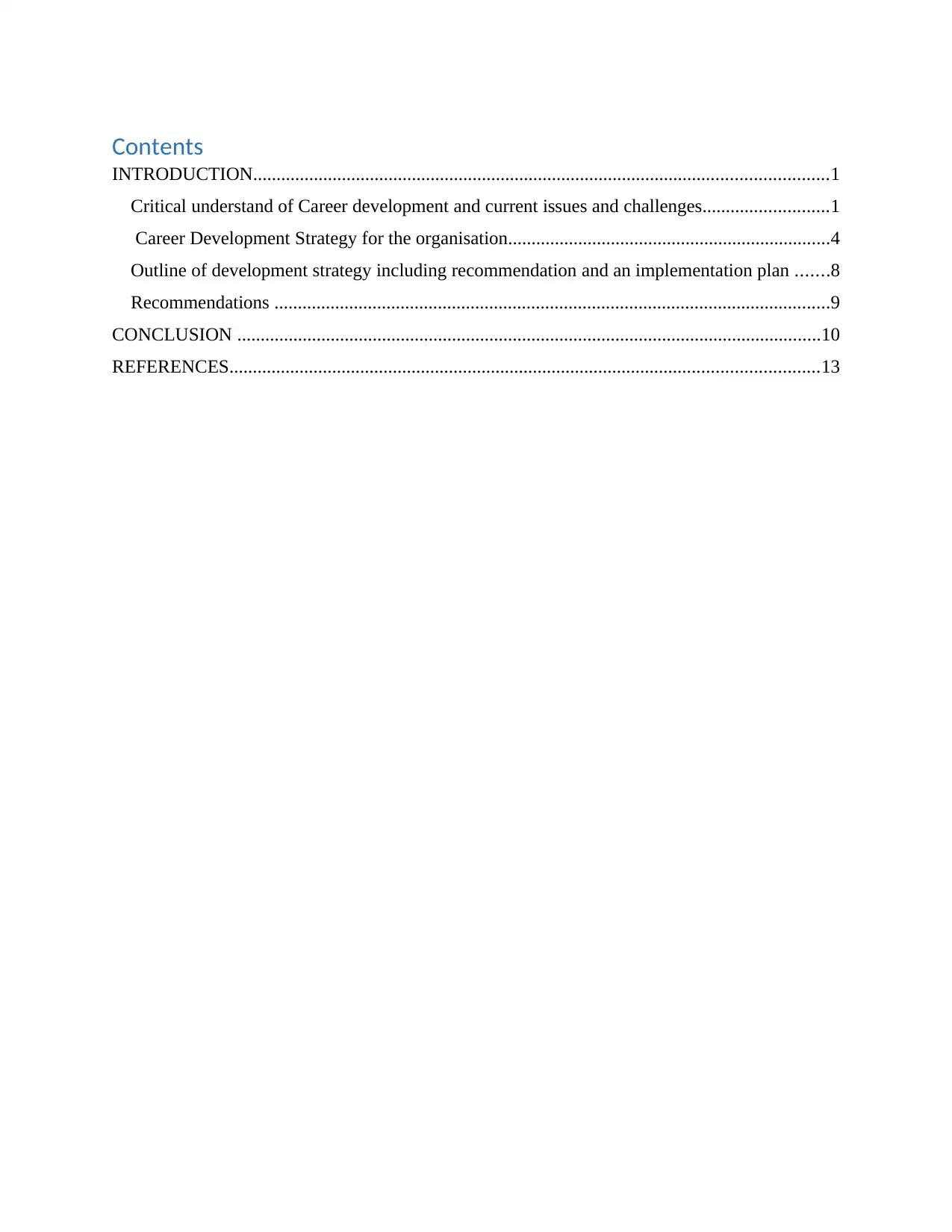
Contents
INTRODUCTION...........................................................................................................................1
Critical understand of Career development and current issues and challenges...........................1
Career Development Strategy for the organisation.....................................................................4
Outline of development strategy including recommendation and an implementation plan .......8
Recommendations .......................................................................................................................9
CONCLUSION .............................................................................................................................10
REFERENCES..............................................................................................................................13
INTRODUCTION...........................................................................................................................1
Critical understand of Career development and current issues and challenges...........................1
Career Development Strategy for the organisation.....................................................................4
Outline of development strategy including recommendation and an implementation plan .......8
Recommendations .......................................................................................................................9
CONCLUSION .............................................................................................................................10
REFERENCES..............................................................................................................................13
INTRODUCTION
Strategic human resource management can be descried as connection among human resource
management of company and its objectives, strategies, goals. Aim of this term is on offering
flexibility in organisation, adoption of innovation that provide them opportunity to get
competitive advantage in market (Cheng, 2020). It also allow them to develop purpose for
organisational culture. It will helps managers of company to ensure improvement in
performance of business. In order to improve strategic human resource management of
company, human resource management play important role in order to develop and create
new policies in company and also implement it in effective manner. This project report includes
study of Unilever Plc which is UK based organisation and considered as largest retailer. It was
established in the year 1929 in UK by William Lever. It offer different types of consumer good,
home care products, beauty care products, health care products to its customers. This project
report includes Critical understanding of career development and current issues faced by
company. It also includes carer development strategies suite for situation of company.
Moreover, it consist development strategy for company and its implementation plan.
Critical understand of Career development and current issues and challenges
Career development can be described a process which can be adopted by individual for
purpose of evolution of occupational status. It is a process which consist decision for long term
learning for alignment of personal needs with carer advancement opportunities. It also refers to
total encompass of individual work related experience and also leads to occupational role
which can be hold in organisation. It is a process of self knowledge, decision making and
exploration that provide shape to career. It navigate occupational options to choose and also
1
Strategic human resource management can be descried as connection among human resource
management of company and its objectives, strategies, goals. Aim of this term is on offering
flexibility in organisation, adoption of innovation that provide them opportunity to get
competitive advantage in market (Cheng, 2020). It also allow them to develop purpose for
organisational culture. It will helps managers of company to ensure improvement in
performance of business. In order to improve strategic human resource management of
company, human resource management play important role in order to develop and create
new policies in company and also implement it in effective manner. This project report includes
study of Unilever Plc which is UK based organisation and considered as largest retailer. It was
established in the year 1929 in UK by William Lever. It offer different types of consumer good,
home care products, beauty care products, health care products to its customers. This project
report includes Critical understanding of career development and current issues faced by
company. It also includes carer development strategies suite for situation of company.
Moreover, it consist development strategy for company and its implementation plan.
Critical understand of Career development and current issues and challenges
Career development can be described a process which can be adopted by individual for
purpose of evolution of occupational status. It is a process which consist decision for long term
learning for alignment of personal needs with carer advancement opportunities. It also refers to
total encompass of individual work related experience and also leads to occupational role
which can be hold in organisation. It is a process of self knowledge, decision making and
exploration that provide shape to career. It navigate occupational options to choose and also
1
⊘ This is a preview!⊘
Do you want full access?
Subscribe today to unlock all pages.

Trusted by 1+ million students worldwide
provide training for job that suits to personality, interest and skills. Focus on a person in career
development assist them to identify strength and blind spot which allow them to improve their
skills (Das and Kodwani, 2018). It is important for Unilever Plc to provide career development
opportunities to their employees as it helps them to attract skilled and talented people in
business. It will also allow managers to explain right ways of doing work to employees and also
allow them to improve productivity of company. It improve work satisfaction of employees as it
helps employees to fulfil their personal goals. It is also important for employees to get growth
opportunities. There are different issues arise in Unilever Plc due to lack of lack of career
development opportunities in business. It create dissatisfaction among employees and also
leads to negative working environment. It also leads to conflict among management and
employees. Some of these issues arise in Unilever Plc due to ignorance of Career development
opportunities as it impact over staff career development and these are mentioned below:
Absence of formal system for training: There is no formal system of training and development
in organisation of Unilever Plc. It does not provide proper training and development to
employees as focus of management is on reducing cost of employees and due to this, they are
ignoring career development in organisation (Hamid, Muzamil and Shah, 2022). A formal
system guide management for offering training to employees that allow them to contribute for
growth and success of company. But due to absence of management does not give proper
attention to this program in organisation as it leads to increase in cost. But career development
helps to improve productivity of employees that allow employees to work in efficient manner in
limited resources and in less time.
2
development assist them to identify strength and blind spot which allow them to improve their
skills (Das and Kodwani, 2018). It is important for Unilever Plc to provide career development
opportunities to their employees as it helps them to attract skilled and talented people in
business. It will also allow managers to explain right ways of doing work to employees and also
allow them to improve productivity of company. It improve work satisfaction of employees as it
helps employees to fulfil their personal goals. It is also important for employees to get growth
opportunities. There are different issues arise in Unilever Plc due to lack of lack of career
development opportunities in business. It create dissatisfaction among employees and also
leads to negative working environment. It also leads to conflict among management and
employees. Some of these issues arise in Unilever Plc due to ignorance of Career development
opportunities as it impact over staff career development and these are mentioned below:
Absence of formal system for training: There is no formal system of training and development
in organisation of Unilever Plc. It does not provide proper training and development to
employees as focus of management is on reducing cost of employees and due to this, they are
ignoring career development in organisation (Hamid, Muzamil and Shah, 2022). A formal
system guide management for offering training to employees that allow them to contribute for
growth and success of company. But due to absence of management does not give proper
attention to this program in organisation as it leads to increase in cost. But career development
helps to improve productivity of employees that allow employees to work in efficient manner in
limited resources and in less time.
2
Paraphrase This Document
Need a fresh take? Get an instant paraphrase of this document with our AI Paraphraser
Lack of communication: Communication is an important things which allow a person to share
their views, feeling and other thing to another person. It is important for manager of Unilever
Plc to ensure proper communication with members of company. In process of career
development, management does not ensure proper communication with employees that does
not allow them to give feedback to employees. Management of company also does not listen to
views of employees regarding training and development. All these things does not allow
managers to ensure proper training and development in company that leads to dissatisfaction
among employees and also it fails for organisation to retain employees for long term.
Lack of support from management: There is also lack of support from management of Unilever
Plc to employees. Management of company is focusing on reducing cost of company and does
not emphasis on career development opportunities. It does not allow them to offer career
development to employees that leads to dissatisfaction among staff and also does not allow
them to retain staff members (Jin and Wang, 2020). It leads to conflict among management and
staff and create negative environment in company. Employees of company wants to get proper
training but HR department of company has tighten their budget and training opportunities for
employees has decreased.
Create negative environment: Lack of career development opportunities in Unilever Plc does
not provide opportunity to employees to improve their learning, knowledge and skills. It leads
to dissatisfaction among employees and also diverse their focus from work. It also create
negative impact over productivity of company and also does not allow them to cooperate with
company. It is also create situation of conflict among management and employees that create
negative environment in company due to which employees leave organisation.
3
their views, feeling and other thing to another person. It is important for manager of Unilever
Plc to ensure proper communication with members of company. In process of career
development, management does not ensure proper communication with employees that does
not allow them to give feedback to employees. Management of company also does not listen to
views of employees regarding training and development. All these things does not allow
managers to ensure proper training and development in company that leads to dissatisfaction
among employees and also it fails for organisation to retain employees for long term.
Lack of support from management: There is also lack of support from management of Unilever
Plc to employees. Management of company is focusing on reducing cost of company and does
not emphasis on career development opportunities. It does not allow them to offer career
development to employees that leads to dissatisfaction among staff and also does not allow
them to retain staff members (Jin and Wang, 2020). It leads to conflict among management and
staff and create negative environment in company. Employees of company wants to get proper
training but HR department of company has tighten their budget and training opportunities for
employees has decreased.
Create negative environment: Lack of career development opportunities in Unilever Plc does
not provide opportunity to employees to improve their learning, knowledge and skills. It leads
to dissatisfaction among employees and also diverse their focus from work. It also create
negative impact over productivity of company and also does not allow them to cooperate with
company. It is also create situation of conflict among management and employees that create
negative environment in company due to which employees leave organisation.
3
Career Development Strategy for the organisation
Career development strategy includes various career development activities as well as actions
that helps an individual to attain all determined goals and objectives in efficient manner. It
includes developing knowledge and skills of an individual that helps them to take uniformed
and specific decisions regarding their career, training and education (Knezović, Bušatlić and
Riđić, 2020). There are various aspects are included in career development strategy such as it
provides proper career exploration, career information, career advice and guidance that lead all
efforts and actions in right direction. Unilever creates various career development strategies for
its employees that enhances their skills, capabilities and competencies as well as enhance their
contribution to accomplish determined objectives and enhances their contribution to attain
overall organisational desired goals. Some career development strategies or programmes are
explained below:
Training: Training is defined as teaching and learning activities that are carried by the
organisation to improve employee’s skills, abilities, competencies and attitude that are required
to perform defined job role in organisation. Training as well as development programmes
provides benefits to both employee’s ad organisations such as it enhances employee’s
performance, boost their productivity, reduce their turnover rate and improve organisational
overall profitability. It helps human resource of organisation to attain the objective of career
growth and development as well as enhance their contribution level in attaining business goals
and objectives on efficient manner (Kundu, Mor and Gahlawat, 2020). There are various
training and development methods that are used by the organisations such as on-the-job
training method, simulation method, knowledge bases methods and experimental method that
4
Career development strategy includes various career development activities as well as actions
that helps an individual to attain all determined goals and objectives in efficient manner. It
includes developing knowledge and skills of an individual that helps them to take uniformed
and specific decisions regarding their career, training and education (Knezović, Bušatlić and
Riđić, 2020). There are various aspects are included in career development strategy such as it
provides proper career exploration, career information, career advice and guidance that lead all
efforts and actions in right direction. Unilever creates various career development strategies for
its employees that enhances their skills, capabilities and competencies as well as enhance their
contribution to accomplish determined objectives and enhances their contribution to attain
overall organisational desired goals. Some career development strategies or programmes are
explained below:
Training: Training is defined as teaching and learning activities that are carried by the
organisation to improve employee’s skills, abilities, competencies and attitude that are required
to perform defined job role in organisation. Training as well as development programmes
provides benefits to both employee’s ad organisations such as it enhances employee’s
performance, boost their productivity, reduce their turnover rate and improve organisational
overall profitability. It helps human resource of organisation to attain the objective of career
growth and development as well as enhance their contribution level in attaining business goals
and objectives on efficient manner (Kundu, Mor and Gahlawat, 2020). There are various
training and development methods that are used by the organisations such as on-the-job
training method, simulation method, knowledge bases methods and experimental method that
4
⊘ This is a preview!⊘
Do you want full access?
Subscribe today to unlock all pages.
Trusted by 1+ million students worldwide
plays important role in improving employee’s skills and capabilities that lead their actions and
efforts in right direction. It is important for the organisations to provide regular training to
employees that improve employee work quality and skills that enable to lead them towards
attaining determined career objectives.
Coaching: Coaching is defined as the efficient form of development in which an
experienced person or coach supports learner or clients to achieve determined personal as well
as professional goals through providing training and development programmes. The main
objective of providing coaching to maximise the performance level of employees and help them
to reach their potential. It creates various skills and competencies in an individual such as
leadership qualities, develop self-belief system, self-discipline and enhances motivation level of
employees to perform their determined operations in best possible manner (Lee, 2021).
Through provide coaching, an individual can improve its performance level, enhances
strengthen areas and attain various development opportunities that helps them to accomplish
career objectives on time. There are various coaching types such as adaptive coaching, system
coaching, cognitive coaching, goal-oriented coaching and other that enhances overall efficiency
and effectiveness of employees so, they contributed towards attaining business objectives on
time.
Mentoring: Mentoring is defined as the relationship between two or more people with
the objective of attain the personal and professional development objectives (Manuti, 2020). I
mentoring, mentor is the experienced individual who share knowledge, advices and experience
to less experienced members to put their efforts to attain determined objectives on time with
greater efficiency. There are various types of mentoring such as traditions one to one
5
efforts in right direction. It is important for the organisations to provide regular training to
employees that improve employee work quality and skills that enable to lead them towards
attaining determined career objectives.
Coaching: Coaching is defined as the efficient form of development in which an
experienced person or coach supports learner or clients to achieve determined personal as well
as professional goals through providing training and development programmes. The main
objective of providing coaching to maximise the performance level of employees and help them
to reach their potential. It creates various skills and competencies in an individual such as
leadership qualities, develop self-belief system, self-discipline and enhances motivation level of
employees to perform their determined operations in best possible manner (Lee, 2021).
Through provide coaching, an individual can improve its performance level, enhances
strengthen areas and attain various development opportunities that helps them to accomplish
career objectives on time. There are various coaching types such as adaptive coaching, system
coaching, cognitive coaching, goal-oriented coaching and other that enhances overall efficiency
and effectiveness of employees so, they contributed towards attaining business objectives on
time.
Mentoring: Mentoring is defined as the relationship between two or more people with
the objective of attain the personal and professional development objectives (Manuti, 2020). I
mentoring, mentor is the experienced individual who share knowledge, advices and experience
to less experienced members to put their efforts to attain determined objectives on time with
greater efficiency. There are various types of mentoring such as traditions one to one
5
Paraphrase This Document
Need a fresh take? Get an instant paraphrase of this document with our AI Paraphraser
mentoring,distance mentoring and group mentoring that enhances various quality in
employee’s such as enhance their self-confidence, self-awareness, communication and
leadership skills that facilitates them to attain determined goals and objectives in best possible
manner.
Organisation faces the issues regarding the absence of a formal system for transferring
and transmitting critical knowledge and experience. Unilever Plc adopted various monitoring
programme but staff member of organisation complained that they are not receiving adequate
training for career development. So, it is important for the HRM department of Unilever to
adopt training and development programmes that enhances various work related skills,
capabilities and competences in employees as well as enable them to attain their career
objectives on time (McClean and Collins, 2019). Training and development programme is
feasible for the business because it enhances overall performance and productivity of
employees, reduce wastage, boost their morale, improve their knowledge and understanding
regarding organisational policies and goals as well as reduce the requirement of supervising
employees. Effective and educate training programme enhances employee satisfaction and
retain them with organisation for longer period of time. Unilever implements on the job the
job, off the job and other training that helps employees in career development.
Outline of development strategy including recommendation and an implementation plan
According to situation of Unilever Plc, training and development is best suited strategy for
company. Training initiatives alone is not sufficient for an organisation to meet its expectation
and effective implementation of training program is important for company in order to get
6
employee’s such as enhance their self-confidence, self-awareness, communication and
leadership skills that facilitates them to attain determined goals and objectives in best possible
manner.
Organisation faces the issues regarding the absence of a formal system for transferring
and transmitting critical knowledge and experience. Unilever Plc adopted various monitoring
programme but staff member of organisation complained that they are not receiving adequate
training for career development. So, it is important for the HRM department of Unilever to
adopt training and development programmes that enhances various work related skills,
capabilities and competences in employees as well as enable them to attain their career
objectives on time (McClean and Collins, 2019). Training and development programme is
feasible for the business because it enhances overall performance and productivity of
employees, reduce wastage, boost their morale, improve their knowledge and understanding
regarding organisational policies and goals as well as reduce the requirement of supervising
employees. Effective and educate training programme enhances employee satisfaction and
retain them with organisation for longer period of time. Unilever implements on the job the
job, off the job and other training that helps employees in career development.
Outline of development strategy including recommendation and an implementation plan
According to situation of Unilever Plc, training and development is best suited strategy for
company. Training initiatives alone is not sufficient for an organisation to meet its expectation
and effective implementation of training program is important for company in order to get
6
success (Yim, 2021). In order to implement this strategy in organisation, managers of Unilever
needs to take different steps which are mentioned below:
Assessment of training needs: It is first step in training and development program which helps
to identify various training needs in business. It is also identified by a business managers of
Unilever in their strategies, individual as well as human resource development plans.
Setting of Organisational training objectives: Assessment of training needs in Unilever helps
organisation for purpose of identifying gaps in business for training initiatives and skills of
employees (Park, Jeong and Ju, 2021). These gaps taken by company can be prioritised in order
to develop training objectives in Unilever Plc. Goals of this program is to reducing bridge in
company between its current as well as desired performance.
Creating training action plan: In next step, action plan is development which consist different
types of theories of learning, content, material, instructional design for training. In this step,
methods and resources of training are detailed by managers of Unilever Plc that provide clarity
to all members.
Implementation of training initiatives: In this step, actual implementation of program can be
done in organisation of Unilever Plc. Needs of organisation helps to analyse whether training of
employees will be in-house or externally conducted. Implementation of this program is also
based on employees engagement as well as learning of KPI goals.
Evaluation and revision of training: It is last step in implementation of training program in
company in which this program is continuously monitored. In this, success of program is
determine by basis of capability of company to meet its training objectives (Sthapit, 2018). If
7
needs to take different steps which are mentioned below:
Assessment of training needs: It is first step in training and development program which helps
to identify various training needs in business. It is also identified by a business managers of
Unilever in their strategies, individual as well as human resource development plans.
Setting of Organisational training objectives: Assessment of training needs in Unilever helps
organisation for purpose of identifying gaps in business for training initiatives and skills of
employees (Park, Jeong and Ju, 2021). These gaps taken by company can be prioritised in order
to develop training objectives in Unilever Plc. Goals of this program is to reducing bridge in
company between its current as well as desired performance.
Creating training action plan: In next step, action plan is development which consist different
types of theories of learning, content, material, instructional design for training. In this step,
methods and resources of training are detailed by managers of Unilever Plc that provide clarity
to all members.
Implementation of training initiatives: In this step, actual implementation of program can be
done in organisation of Unilever Plc. Needs of organisation helps to analyse whether training of
employees will be in-house or externally conducted. Implementation of this program is also
based on employees engagement as well as learning of KPI goals.
Evaluation and revision of training: It is last step in implementation of training program in
company in which this program is continuously monitored. In this, success of program is
determine by basis of capability of company to meet its training objectives (Sthapit, 2018). If
7
⊘ This is a preview!⊘
Do you want full access?
Subscribe today to unlock all pages.
Trusted by 1+ million students worldwide
any problem arise in this, feedback is given to management and on that basis improvement is
made in training program of company.
Recommendations
As Unilever adopts training and development strategy for transmitting and transforming critical
knowledge and experience to employees. Respective organisation faces the problem due
absence of formal system that enhances employee’s skills and competencies that directly
impacts on employee’s morale, satisfaction and performance level. Some recommendations to
improve organisational training and development strategy are explained below:
It is recommended to Unilever to identify the gap in employee’s knowledge and specific
areas that needs improvement for running business operations and process properly.
After analysing these gap in this areas, organisation should develop training and
development strategy that improves overall performance and productivity of
employees.
It is advised to the Unilever Plc to make the learning or training process more flexible
and accessible through implementing Learning Management System. It makes the
process more viable and easy to use for employees that helps employees to learn
different work related concepts on appropriate manner and implement them in
business operations.
Unilever is suggested to uses various tools and technologies for providing training to
remote workers as well as in-office teams. Organisation should adopt quality LMS for
ongoing training for employees that enhances the efficiency of overall training
programme.
8
made in training program of company.
Recommendations
As Unilever adopts training and development strategy for transmitting and transforming critical
knowledge and experience to employees. Respective organisation faces the problem due
absence of formal system that enhances employee’s skills and competencies that directly
impacts on employee’s morale, satisfaction and performance level. Some recommendations to
improve organisational training and development strategy are explained below:
It is recommended to Unilever to identify the gap in employee’s knowledge and specific
areas that needs improvement for running business operations and process properly.
After analysing these gap in this areas, organisation should develop training and
development strategy that improves overall performance and productivity of
employees.
It is advised to the Unilever Plc to make the learning or training process more flexible
and accessible through implementing Learning Management System. It makes the
process more viable and easy to use for employees that helps employees to learn
different work related concepts on appropriate manner and implement them in
business operations.
Unilever is suggested to uses various tools and technologies for providing training to
remote workers as well as in-office teams. Organisation should adopt quality LMS for
ongoing training for employees that enhances the efficiency of overall training
programme.
8
Paraphrase This Document
Need a fresh take? Get an instant paraphrase of this document with our AI Paraphraser
Unilever is recommended to provide incentives and rewards to employees for their
achievements that creates learning and development environment in business. It makes
employees proactive to achieve determined outcome with efficiency. Organisation is
suggested to redefine their training methods over specific period of time to improve the
efficiency and effectiveness of training in organisation.
CONCLUSION
As per the above report, it can be concluded that strategic human resource management is the
framework that create link between people management as well as development practices to
attain long term goals and objectives of organisation. It ensures that business work together to
reach its determined goals with greater efficiency and effectiveness. It is important for the
business to develop various employees career development programme with the objective of
improving employee’s skills, and competencies that lead enhances their overall performance
level. It is concluded that, it is important for the organisation to access various issues and
challenges that are raised in career development than develop effective planning to overcome
these issues in efficient manner. It is very important for the organisation to invest in the
activities of human resource development practices because it enhances employee’s
commitment and engagement level of employees through provide them training and
development opportunities. Along with that, it HRD enhances employee’s performance and
learning capacities, improve overall effectiveness of organisation as well as enhances
communication and involvement of employees that creates effective business culture and
enhances teamwork. If organisational employees are skilled and productive than it enables
business to gain competitive advantages than other competitors. Human resource development
9
achievements that creates learning and development environment in business. It makes
employees proactive to achieve determined outcome with efficiency. Organisation is
suggested to redefine their training methods over specific period of time to improve the
efficiency and effectiveness of training in organisation.
CONCLUSION
As per the above report, it can be concluded that strategic human resource management is the
framework that create link between people management as well as development practices to
attain long term goals and objectives of organisation. It ensures that business work together to
reach its determined goals with greater efficiency and effectiveness. It is important for the
business to develop various employees career development programme with the objective of
improving employee’s skills, and competencies that lead enhances their overall performance
level. It is concluded that, it is important for the organisation to access various issues and
challenges that are raised in career development than develop effective planning to overcome
these issues in efficient manner. It is very important for the organisation to invest in the
activities of human resource development practices because it enhances employee’s
commitment and engagement level of employees through provide them training and
development opportunities. Along with that, it HRD enhances employee’s performance and
learning capacities, improve overall effectiveness of organisation as well as enhances
communication and involvement of employees that creates effective business culture and
enhances teamwork. If organisational employees are skilled and productive than it enables
business to gain competitive advantages than other competitors. Human resource development
9
practices improves employee’s satisfaction from business and retain them with organisation
that lead business towards growth and development. Furthermore, It provides various
opportunities for employees regarding training and development, creates opportunities for
career development and improves employees performance level that helps organisation to
attain determined goals and objective on time. HRD is important for the both employee and
organisation because it enhances employee’s skills and helps them in attaining career goals and
improve their performance level that also helps organisation through improving overall
business performance and efficiency.
10
that lead business towards growth and development. Furthermore, It provides various
opportunities for employees regarding training and development, creates opportunities for
career development and improves employees performance level that helps organisation to
attain determined goals and objective on time. HRD is important for the both employee and
organisation because it enhances employee’s skills and helps them in attaining career goals and
improve their performance level that also helps organisation through improving overall
business performance and efficiency.
10
⊘ This is a preview!⊘
Do you want full access?
Subscribe today to unlock all pages.
Trusted by 1+ million students worldwide

1 out of 13


Related Documents


Your All-in-One AI-Powered Toolkit for Academic Success.
+13062052269
info@desklib.com
Available 24*7 on WhatsApp / Email
![[object Object]](/_next/static/media/star-bottom.7253800d.svg)
Unlock your academic potential
Copyright © 2020–2025 A2Z Services. All Rights Reserved. Developed and managed by ZUCOL.