HI5019: Strategic Information Systems and Business Enterprise Report
VerifiedAdded on 2022/09/18
|12
|3599
|21
Report
AI Summary
This report examines the strategic information systems of Rainbow Illusion, a retail clothing company. It details the strengths of their centralized sales transaction system, including increased efficiency, accuracy, and inventory management. The report identifies potential fraud risks within the system, particularly manual errors and vulnerabilities in the centralized structure. It then explores the advantages of distributed computer systems over centralized ones, such as improved speed, scalability, and reliability. The report concludes with recommendations for Rainbow Illusion to improve its information systems and mitigate risks, referencing various academic sources. The analysis covers transaction cycles, financial reporting, management reporting, and e-commerce aspects, aligning with the assignment brief's objectives. The report highlights the importance of understanding fraud opportunities and implementing appropriate security measures within the context of electronic commerce and ERP systems.
Running Head: Strategic Information Systems for Business and Enterprise 0
Strategic Information Systems for
Business and Enterprise
Report
Student name
Strategic Information Systems for
Business and Enterprise
Report
Student name

Paraphrase This Document
Need a fresh take? Get an instant paraphrase of this document with our AI Paraphraser
Strategic Information Systems for Business and Enterprise 1
Table of Contents
Executive summary...........................................................................................................2
Introduction........................................................................................................................3
Strengths in the company’s system for controlling sales transactions..............................3
1. Increased Efficiency.................................................................................................3
2. Greater Accuracy.....................................................................................................3
3. Reporting.................................................................................................................3
4. Detailed Receipts.....................................................................................................4
5. Simplified Accounting..............................................................................................4
6. Inventory Management............................................................................................4
Problems that the company has avoided..........................................................................4
Situational pressures that would increase the likelihood of fraud.....................................5
Reasons for companies to install a distributed computer system rather than a
centralized one..................................................................................................................5
Speed of Distributed system:.........................................................................................5
Scaling and Parallelism..................................................................................................5
Reliability of the system:.................................................................................................6
Distributed Computing Challenges.................................................................................6
Recommendations.............................................................................................................7
Conclusion.........................................................................................................................7
References.........................................................................................................................8
Table of Contents
Executive summary...........................................................................................................2
Introduction........................................................................................................................3
Strengths in the company’s system for controlling sales transactions..............................3
1. Increased Efficiency.................................................................................................3
2. Greater Accuracy.....................................................................................................3
3. Reporting.................................................................................................................3
4. Detailed Receipts.....................................................................................................4
5. Simplified Accounting..............................................................................................4
6. Inventory Management............................................................................................4
Problems that the company has avoided..........................................................................4
Situational pressures that would increase the likelihood of fraud.....................................5
Reasons for companies to install a distributed computer system rather than a
centralized one..................................................................................................................5
Speed of Distributed system:.........................................................................................5
Scaling and Parallelism..................................................................................................5
Reliability of the system:.................................................................................................6
Distributed Computing Challenges.................................................................................6
Recommendations.............................................................................................................7
Conclusion.........................................................................................................................7
References.........................................................................................................................8
Strategic Information Systems for Business and Enterprise 2
Executive summary
Rainbow Illusion is a well-known company in New South Wales and Victoria for ready-
to-wear clothes. It has established 30 stores for the retail chain. In addition, the
company has appointed various persons for managing the sales and finance
department, such as manager, cashier, and many others. In addition, the company
makes all the processes centralized and provides all the data to the central department
for inventory and other works.
This report will explain the six strengths of the company and it will describe the issues of
centralized system faced by the company. It will explain two situational pressures in a
company, which are the reason of fraud. In the later section of this report, it will explain
why companies choose distributed system in sales and other works rather than a
centralized one.
Executive summary
Rainbow Illusion is a well-known company in New South Wales and Victoria for ready-
to-wear clothes. It has established 30 stores for the retail chain. In addition, the
company has appointed various persons for managing the sales and finance
department, such as manager, cashier, and many others. In addition, the company
makes all the processes centralized and provides all the data to the central department
for inventory and other works.
This report will explain the six strengths of the company and it will describe the issues of
centralized system faced by the company. It will explain two situational pressures in a
company, which are the reason of fraud. In the later section of this report, it will explain
why companies choose distributed system in sales and other works rather than a
centralized one.
⊘ This is a preview!⊘
Do you want full access?
Subscribe today to unlock all pages.

Trusted by 1+ million students worldwide
Strategic Information Systems for Business and Enterprise 3
Introduction
Rainbow Illusion is a good company in the retail business, as the company has
established 30-stores for clothes for their customers. It manages all the processes using
centralized systems. There are both types of processes are working, which are online
and offline. There are some good strengths of the company, which makes all things
good for the company. In addition, the company can use various types of advantages of
technologies in its sales system.
The sales department should be better for more benefits, as customers have directly
affected form the sales department of the company. The sales team can attract more
customers using various types of systems and facilities, such as fast servicing in
payment, easy return, and many others.
This report will explain the six strengths of the company, which makes it different from
others in the field of retail business. In addition, there are some advantages to their
systems for the company as well as their customers. This report will describe two
situations in the sales department that create pressure for fraud. In this report, the
benefits and features of distributed system will provide in the later section.
Strengths in the company’s system for controlling sales transactions
Rainbow Illusion makes proper arrangements for the various things for the sales
department, as salespersons, cahier, and manger. All the respective persons work
properly for managing the sales department of the company. Besides, it makes the
sales department stronger for various works. There are many advantages of the
centralized system that all the things have checked in a proper manner (Al-Mashari &
Al-Mudimigh, 2003). In addition, many things can be disturbed because of changes in
the whole system. In addition, centralizing system is easy to implement and more
focused on the particular work, as sales department is sensible department because of
data and transaction of products and customers. This system is also having large
amount of information about products and services.
There are mainly six strengths of the company’s system for controlling sales
transactions, which areas:
1. Increased Efficiency
It is a big strength of the company to manage all the sales transactions properly,
as young people manage their work easily, as most of the works is handled with
patience and at the proper time. There is another advantage of these things that
young employees work for extra hours that are good for the profit of the
company. In addition, ERP implementation process can provide better efficiency
and performance to the sales department ( Arguin, 2017).
2. Greater Accuracy
A salesperson can manage various things on the sales floor that are related to
the company’s system. The salesperson makes entries manually including all the
Introduction
Rainbow Illusion is a good company in the retail business, as the company has
established 30-stores for clothes for their customers. It manages all the processes using
centralized systems. There are both types of processes are working, which are online
and offline. There are some good strengths of the company, which makes all things
good for the company. In addition, the company can use various types of advantages of
technologies in its sales system.
The sales department should be better for more benefits, as customers have directly
affected form the sales department of the company. The sales team can attract more
customers using various types of systems and facilities, such as fast servicing in
payment, easy return, and many others.
This report will explain the six strengths of the company, which makes it different from
others in the field of retail business. In addition, there are some advantages to their
systems for the company as well as their customers. This report will describe two
situations in the sales department that create pressure for fraud. In this report, the
benefits and features of distributed system will provide in the later section.
Strengths in the company’s system for controlling sales transactions
Rainbow Illusion makes proper arrangements for the various things for the sales
department, as salespersons, cahier, and manger. All the respective persons work
properly for managing the sales department of the company. Besides, it makes the
sales department stronger for various works. There are many advantages of the
centralized system that all the things have checked in a proper manner (Al-Mashari &
Al-Mudimigh, 2003). In addition, many things can be disturbed because of changes in
the whole system. In addition, centralizing system is easy to implement and more
focused on the particular work, as sales department is sensible department because of
data and transaction of products and customers. This system is also having large
amount of information about products and services.
There are mainly six strengths of the company’s system for controlling sales
transactions, which areas:
1. Increased Efficiency
It is a big strength of the company to manage all the sales transactions properly,
as young people manage their work easily, as most of the works is handled with
patience and at the proper time. There is another advantage of these things that
young employees work for extra hours that are good for the profit of the
company. In addition, ERP implementation process can provide better efficiency
and performance to the sales department ( Arguin, 2017).
2. Greater Accuracy
A salesperson can manage various things on the sales floor that are related to
the company’s system. The salesperson makes entries manually including all the
Paraphrase This Document
Need a fresh take? Get an instant paraphrase of this document with our AI Paraphraser
Strategic Information Systems for Business and Enterprise 4
taxes, and transactions of clothes, such as unit price, quantity, description, and
class. He or she makes proper entries in the sales invoice. For the backup
process, the salesperson makes a copy of that invoice and retains a copy in the
sales book for further process in the future. Moreover, ERP is a new trend in the
market for managing various functions of an organization ( Bach, 2018).
3. Reporting
The cashier is an important part of the system and it is necessary to identify
various changes in invoice and input of the sales. The cashier has used the cash
register for managing all the processes. The cashier of the system makes proper
arrangements of the cash register. The cashier is responsible for the various
things in the company, such as reviews of the invoice, credit approval, approving
sales, return slip, and many more. In addition, an enterprise must have
architecture to provide better reporting to all the departments (Bernus, et al.,
2012).
4. Detailed Receipts
There are many advantages to the transaction system for the company. Manager
reviews all the statements properly for release daily bank deposit, such as credit
card sales invoices, and many others. The manager makes proper deposits and
creates files for validated deposit slips. In addition, an information system is
helpful in managing receipts of various products and services (Braglia &
Frosolini, 2014).
5. Simplified Accounting
The cash register has used for the mechanically validates the invoice and it
provides an automatic number for each invoice to manage properly of all the
transactions. It is helpful for the cashier as well as customers of the company, as
they have a copy of all the transactions from their credit cards. In addition,
various cloud ERP services are available in the market for making accounting ore
simplified (Cheng, 2018).
6. Inventory Management
Central data processing department: the central data processing system has
situated at the headquarter of the company for the processing of all the things. In
addition, the inventory system can be managed using ERP with high efficiency,
which will provide more benefits to the company ( Davies, 2016).
Problems that the company has avoided
Rainbow Illusion has avoided various problems that can make a huge impact on sales
transactions. In addition, there are many things, which can make a bad impact on the
processing of the system for controlling sales transactions ( Denecken , 2017).
In addition, the sales department is the backbone of the whole business of the
company, as it provides all the products and services to the consumers and other
stakeholders. The sales department has provided many things for the company, which
taxes, and transactions of clothes, such as unit price, quantity, description, and
class. He or she makes proper entries in the sales invoice. For the backup
process, the salesperson makes a copy of that invoice and retains a copy in the
sales book for further process in the future. Moreover, ERP is a new trend in the
market for managing various functions of an organization ( Bach, 2018).
3. Reporting
The cashier is an important part of the system and it is necessary to identify
various changes in invoice and input of the sales. The cashier has used the cash
register for managing all the processes. The cashier of the system makes proper
arrangements of the cash register. The cashier is responsible for the various
things in the company, such as reviews of the invoice, credit approval, approving
sales, return slip, and many more. In addition, an enterprise must have
architecture to provide better reporting to all the departments (Bernus, et al.,
2012).
4. Detailed Receipts
There are many advantages to the transaction system for the company. Manager
reviews all the statements properly for release daily bank deposit, such as credit
card sales invoices, and many others. The manager makes proper deposits and
creates files for validated deposit slips. In addition, an information system is
helpful in managing receipts of various products and services (Braglia &
Frosolini, 2014).
5. Simplified Accounting
The cash register has used for the mechanically validates the invoice and it
provides an automatic number for each invoice to manage properly of all the
transactions. It is helpful for the cashier as well as customers of the company, as
they have a copy of all the transactions from their credit cards. In addition,
various cloud ERP services are available in the market for making accounting ore
simplified (Cheng, 2018).
6. Inventory Management
Central data processing department: the central data processing system has
situated at the headquarter of the company for the processing of all the things. In
addition, the inventory system can be managed using ERP with high efficiency,
which will provide more benefits to the company ( Davies, 2016).
Problems that the company has avoided
Rainbow Illusion has avoided various problems that can make a huge impact on sales
transactions. In addition, there are many things, which can make a bad impact on the
processing of the system for controlling sales transactions ( Denecken , 2017).
In addition, the sales department is the backbone of the whole business of the
company, as it provides all the products and services to the consumers and other
stakeholders. The sales department has provided many things for the company, which
Strategic Information Systems for Business and Enterprise 5
can be used for the growth and success of the company, such as revenue, profit, and
many other things.
There is always a salesperson for making entries of all the things, which has required
completing the transaction process. The salesperson has marked his or her transaction
and employee number to identify issues with the transaction. It is the best way to
manage all the things. Otherwise, it can be a problem in front of the sales department to
identify a particular person, who is responsible for the mistakes.
There are some problems with the company with their centralized system. Therefore,
the company can face various types of risks, such as credit card data, data breach,
manual mistakes, and many others.
In addition, the cashier makes a proper checklist of the invoices and issues a copy of
the transaction to the customers to verify the amount and other things in a proper
manner. It is a good way to manage all the things properly ( Florentine, 2017).
The transaction cycle is a process that begins with capturing data about a transaction.
In addition, there is some data and information exchange between nodes. It ends with
an information output, such as a set of financial statements.
• The basic exchanges can be grouped into five major transaction cycles.
– Financing cycle: it is a process in which cash flow from one side to another side.
Customers give cash to the company and the company gives cash to suppliers.
– Revenue cycle: Company provides products to their customers and gets money
from them in a process.
– Human resources/payroll cycle: in this cycle, a department gives money to its
employees and makes money from other sources.
– Production cycle: it is a cycle in which companies provide labor for particular work
and get products for their customers.
– Expenditure cycle: it is cycling in which the company provides cash to the suppliers
and get material for the goods and products.
Situational pressures that would increase the likelihood of fraud
In a company, there are various situations in the company in which numbers of chances
are increased for fraud because of the weak point of the system (Giachetti, 2016).
There are some weak points in the company’s sales system, which are as follows:
1. The salesperson can make mistakes in the invoices, as it is a manual process.
Therefore, the number of chances has increased for the fraud. He or she makes
fake entries in the invoices and make mistakes in the calculations as well.
2. The centralized system is good for the processing but there is some critical
situation in the system that can create pressure for fraud.
can be used for the growth and success of the company, such as revenue, profit, and
many other things.
There is always a salesperson for making entries of all the things, which has required
completing the transaction process. The salesperson has marked his or her transaction
and employee number to identify issues with the transaction. It is the best way to
manage all the things. Otherwise, it can be a problem in front of the sales department to
identify a particular person, who is responsible for the mistakes.
There are some problems with the company with their centralized system. Therefore,
the company can face various types of risks, such as credit card data, data breach,
manual mistakes, and many others.
In addition, the cashier makes a proper checklist of the invoices and issues a copy of
the transaction to the customers to verify the amount and other things in a proper
manner. It is a good way to manage all the things properly ( Florentine, 2017).
The transaction cycle is a process that begins with capturing data about a transaction.
In addition, there is some data and information exchange between nodes. It ends with
an information output, such as a set of financial statements.
• The basic exchanges can be grouped into five major transaction cycles.
– Financing cycle: it is a process in which cash flow from one side to another side.
Customers give cash to the company and the company gives cash to suppliers.
– Revenue cycle: Company provides products to their customers and gets money
from them in a process.
– Human resources/payroll cycle: in this cycle, a department gives money to its
employees and makes money from other sources.
– Production cycle: it is a cycle in which companies provide labor for particular work
and get products for their customers.
– Expenditure cycle: it is cycling in which the company provides cash to the suppliers
and get material for the goods and products.
Situational pressures that would increase the likelihood of fraud
In a company, there are various situations in the company in which numbers of chances
are increased for fraud because of the weak point of the system (Giachetti, 2016).
There are some weak points in the company’s sales system, which are as follows:
1. The salesperson can make mistakes in the invoices, as it is a manual process.
Therefore, the number of chances has increased for the fraud. He or she makes
fake entries in the invoices and make mistakes in the calculations as well.
2. The centralized system is good for the processing but there is some critical
situation in the system that can create pressure for fraud.
⊘ This is a preview!⊘
Do you want full access?
Subscribe today to unlock all pages.
Trusted by 1+ million students worldwide
Strategic Information Systems for Business and Enterprise 6
Reasons for companies to install a distributed computer system rather
than a centralized one
Distributed structures are computer systems in which a couple of computer structures
are running together successfully as a single unit (Kiadehi & Mohammadi, 2012).
Examples of distributed structures encompass content distribution networks used to
serve web sites and online motion pictures, supercomputers built out of multiple
effective mathematical processors and allotted databases used in many online systems.
Disbursed structures can be more resilient, more powerful, and swifter than unmarried-
laptop structures, but they also can require more upkeep and cautious notion about
corporations and troubles that may pass wrong ( LaBarre , 2019).
In addition, some ethical reasons have situated because of various things associated
with personal computer systems. All the systems are interconnecting with each other
and it is a huge reason behind various issues.
There are a number of capacity advantages to the usage of a distributed machine. One
of the simplest to apprehend is redundancy and resiliency (Zeng, et al., 2012). If an
agency is serving its internet site from a distributed set of servers, instead of a single
server, it can be capable of living up despite the fact that one server bodily fails (Mather,
et al., 2009). If information is sent between a couple of servers or disks, a not unusual
occurrence in modern-day disbursed structures, there might not be any statistics loss
even supposing a storage device ceases to work (McDermid, 2015).
Speed of Distributed system:
When used to implement parallel processing wherein the best aim is to attain
most velocity on a single hassle, allotted systems can gain very excessive speed as
compared to the centralized ones (Mezghani, 2019).
Scaling and Parallelism
As soon as dispensed systems are installation to distribute information the various
servers worried, they also can be without difficulty scalable. If they are nicely designed,
it could be as easy as including a few new hardware and telling the community to
feature it to the disbursed gadget (Nord, et al., 2007).
Distributed systems can also be designed for parallelism (Melendez, 2018). That is not
unusual in mathematical operations for such things as climate modeling and medical
computing, wherein a couple of effective processors can divide impartial parts of
complicated simulations and get the solution quicker than they would stroll them in the
collection.
Reliability of the system:
Any other capability gain of a dispensed system over a centralized
one is of higher reliability. By way of dispensing the workload over many machines, a
single chip failure will carry down at maximum one gadget, leaving the relaxation intact (
O'Shaughnessy, 2019).
Reasons for companies to install a distributed computer system rather
than a centralized one
Distributed structures are computer systems in which a couple of computer structures
are running together successfully as a single unit (Kiadehi & Mohammadi, 2012).
Examples of distributed structures encompass content distribution networks used to
serve web sites and online motion pictures, supercomputers built out of multiple
effective mathematical processors and allotted databases used in many online systems.
Disbursed structures can be more resilient, more powerful, and swifter than unmarried-
laptop structures, but they also can require more upkeep and cautious notion about
corporations and troubles that may pass wrong ( LaBarre , 2019).
In addition, some ethical reasons have situated because of various things associated
with personal computer systems. All the systems are interconnecting with each other
and it is a huge reason behind various issues.
There are a number of capacity advantages to the usage of a distributed machine. One
of the simplest to apprehend is redundancy and resiliency (Zeng, et al., 2012). If an
agency is serving its internet site from a distributed set of servers, instead of a single
server, it can be capable of living up despite the fact that one server bodily fails (Mather,
et al., 2009). If information is sent between a couple of servers or disks, a not unusual
occurrence in modern-day disbursed structures, there might not be any statistics loss
even supposing a storage device ceases to work (McDermid, 2015).
Speed of Distributed system:
When used to implement parallel processing wherein the best aim is to attain
most velocity on a single hassle, allotted systems can gain very excessive speed as
compared to the centralized ones (Mezghani, 2019).
Scaling and Parallelism
As soon as dispensed systems are installation to distribute information the various
servers worried, they also can be without difficulty scalable. If they are nicely designed,
it could be as easy as including a few new hardware and telling the community to
feature it to the disbursed gadget (Nord, et al., 2007).
Distributed systems can also be designed for parallelism (Melendez, 2018). That is not
unusual in mathematical operations for such things as climate modeling and medical
computing, wherein a couple of effective processors can divide impartial parts of
complicated simulations and get the solution quicker than they would stroll them in the
collection.
Reliability of the system:
Any other capability gain of a dispensed system over a centralized
one is of higher reliability. By way of dispensing the workload over many machines, a
single chip failure will carry down at maximum one gadget, leaving the relaxation intact (
O'Shaughnessy, 2019).
Paraphrase This Document
Need a fresh take? Get an instant paraphrase of this document with our AI Paraphraser
Strategic Information Systems for Business and Enterprise 7
Distributed Computing Challenges
One big undertaking with distributed computing is that it may be tough for programmers
to the purpose. There can be demanding situations in the way to distribute information
to ensure that resiliency necessities are met under diverse sudden conditions (Peng &
Gala, 2014).
If devices need to synchronize, there may be difficult-to-spot insects that motivate them
to attend on each other to transmit information or accidentally try to examine or write an
equal piece of information on the identical time, inflicting mistakes (Pennison, 2016).
Protection and privacy can also turn out to be a problem with allotted structures, when
you consider that people's information is stored across multiple computers, from time to
time in a couple of physical locations (Tondon, 2016). Distributed structures can also be
overkill for some tasks, the usage of extra physical sources and engineering time than is
important (Zhong & Rohde, 2014).
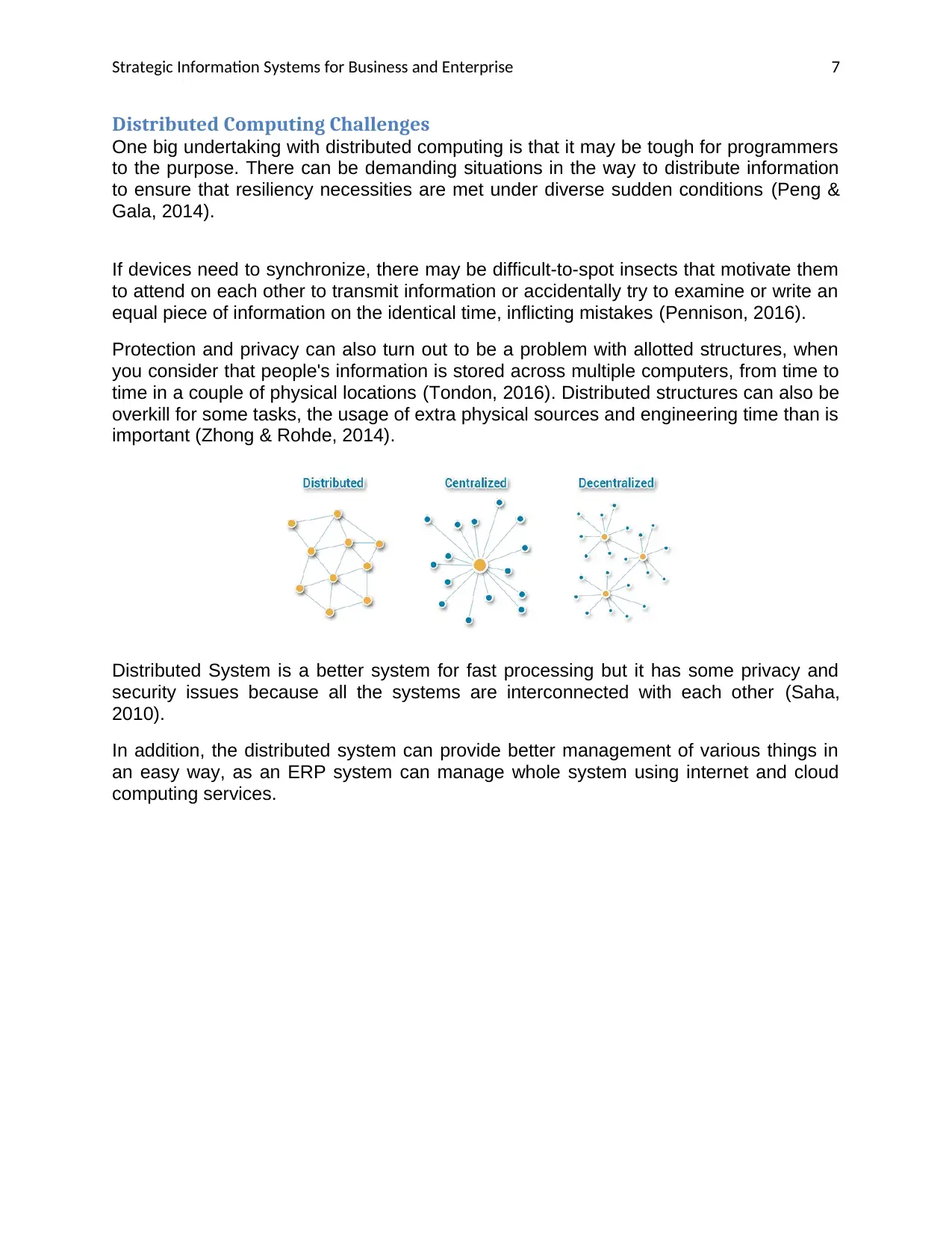
Distributed System is a better system for fast processing but it has some privacy and
security issues because all the systems are interconnected with each other (Saha,
2010).
In addition, the distributed system can provide better management of various things in
an easy way, as an ERP system can manage whole system using internet and cloud
computing services.
Distributed Computing Challenges
One big undertaking with distributed computing is that it may be tough for programmers
to the purpose. There can be demanding situations in the way to distribute information
to ensure that resiliency necessities are met under diverse sudden conditions (Peng &
Gala, 2014).
If devices need to synchronize, there may be difficult-to-spot insects that motivate them
to attend on each other to transmit information or accidentally try to examine or write an
equal piece of information on the identical time, inflicting mistakes (Pennison, 2016).
Protection and privacy can also turn out to be a problem with allotted structures, when
you consider that people's information is stored across multiple computers, from time to
time in a couple of physical locations (Tondon, 2016). Distributed structures can also be
overkill for some tasks, the usage of extra physical sources and engineering time than is
important (Zhong & Rohde, 2014).
Distributed System is a better system for fast processing but it has some privacy and
security issues because all the systems are interconnected with each other (Saha,
2010).
In addition, the distributed system can provide better management of various things in
an easy way, as an ERP system can manage whole system using internet and cloud
computing services.
Strategic Information Systems for Business and Enterprise 8
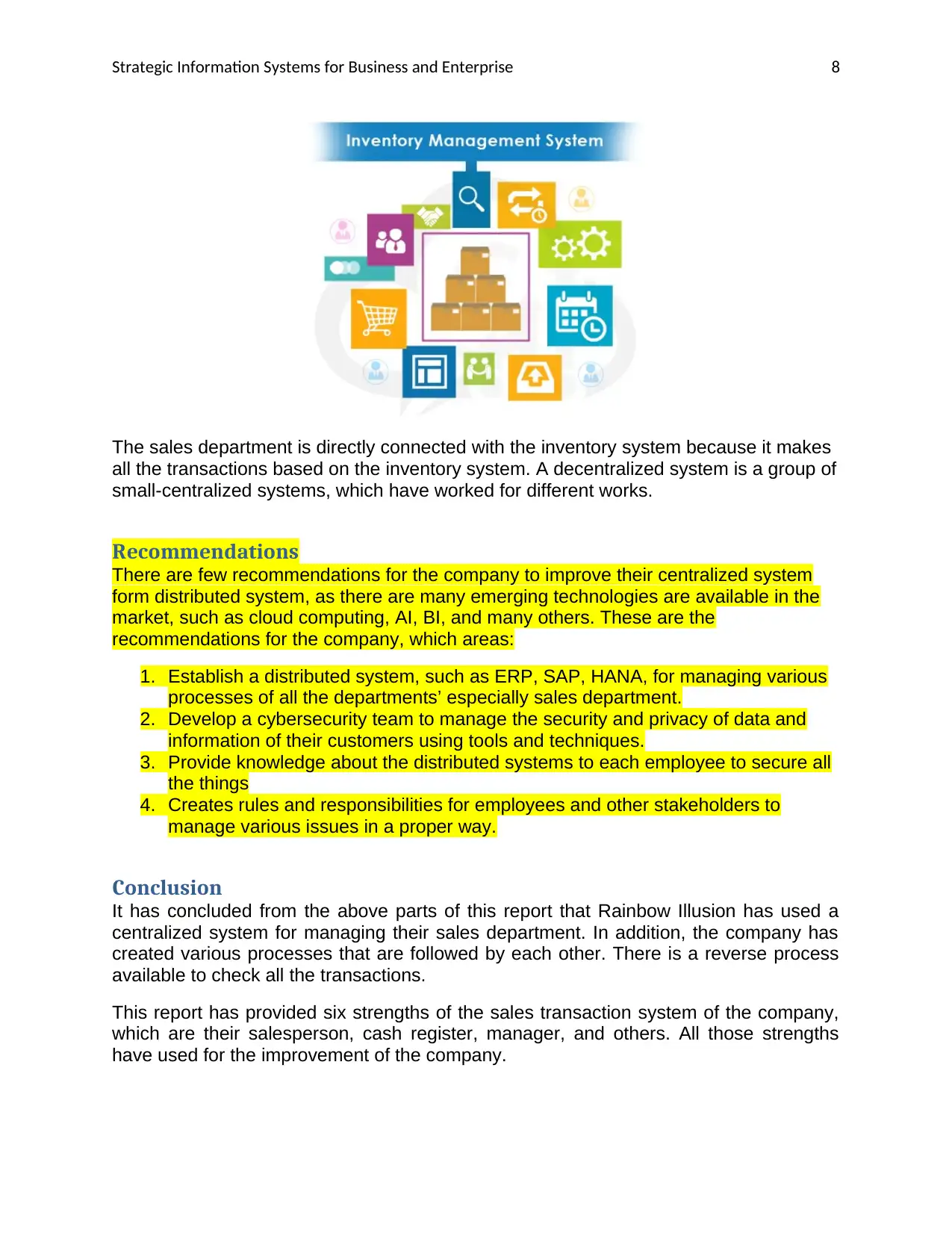
The sales department is directly connected with the inventory system because it makes
all the transactions based on the inventory system. A decentralized system is a group of
small-centralized systems, which have worked for different works.
Recommendations
There are few recommendations for the company to improve their centralized system
form distributed system, as there are many emerging technologies are available in the
market, such as cloud computing, AI, BI, and many others. These are the
recommendations for the company, which areas:
1. Establish a distributed system, such as ERP, SAP, HANA, for managing various
processes of all the departments’ especially sales department.
2. Develop a cybersecurity team to manage the security and privacy of data and
information of their customers using tools and techniques.
3. Provide knowledge about the distributed systems to each employee to secure all
the things
4. Creates rules and responsibilities for employees and other stakeholders to
manage various issues in a proper way.
Conclusion
It has concluded from the above parts of this report that Rainbow Illusion has used a
centralized system for managing their sales department. In addition, the company has
created various processes that are followed by each other. There is a reverse process
available to check all the transactions.
This report has provided six strengths of the sales transaction system of the company,
which are their salesperson, cash register, manager, and others. All those strengths
have used for the improvement of the company.
The sales department is directly connected with the inventory system because it makes
all the transactions based on the inventory system. A decentralized system is a group of
small-centralized systems, which have worked for different works.
Recommendations
There are few recommendations for the company to improve their centralized system
form distributed system, as there are many emerging technologies are available in the
market, such as cloud computing, AI, BI, and many others. These are the
recommendations for the company, which areas:
1. Establish a distributed system, such as ERP, SAP, HANA, for managing various
processes of all the departments’ especially sales department.
2. Develop a cybersecurity team to manage the security and privacy of data and
information of their customers using tools and techniques.
3. Provide knowledge about the distributed systems to each employee to secure all
the things
4. Creates rules and responsibilities for employees and other stakeholders to
manage various issues in a proper way.
Conclusion
It has concluded from the above parts of this report that Rainbow Illusion has used a
centralized system for managing their sales department. In addition, the company has
created various processes that are followed by each other. There is a reverse process
available to check all the transactions.
This report has provided six strengths of the sales transaction system of the company,
which are their salesperson, cash register, manager, and others. All those strengths
have used for the improvement of the company.
⊘ This is a preview!⊘
Do you want full access?
Subscribe today to unlock all pages.
Trusted by 1+ million students worldwide
Strategic Information Systems for Business and Enterprise 9
This report has provided two situations for the company’s system of sales transactions
that create a situation of fraud. In addition, this report has explained the problem in the
system because of their weak points, but the company manages them using their
strengths.
Finally, the company can change its transaction system from a centralized system to a
distributed system. It will improve the performance and efficiency of the company in
terms of growth and success.
This report has provided two situations for the company’s system of sales transactions
that create a situation of fraud. In addition, this report has explained the problem in the
system because of their weak points, but the company manages them using their
strengths.
Finally, the company can change its transaction system from a centralized system to a
distributed system. It will improve the performance and efficiency of the company in
terms of growth and success.
Paraphrase This Document
Need a fresh take? Get an instant paraphrase of this document with our AI Paraphraser
Strategic Information Systems for Business and Enterprise 10
References
Arguin, V., 2017. What is the ERP Implementation Process?. [Online]
Available at: https://www.acumatica.com/blog/what-is-the-erp-implementation-process/
[Accessed 9 May 2019].
Bach, B., 2018. ERP Trends in 2018 – Oracle Report. [Online]
Available at: https://terillium.com/erp-trends-report-2018/
[Accessed 9 May 2019].
Davies, J., 2016. common-erp-project-management-challenges-and-how-to-overcome-
them. [Online]
Available at: http://www.winman.com/blog/common-erp-project-management-
challenges-and-how-to-overcome-them
Denecken , S., 2017. SAP S/4HANA Cloud: Revolutionizing the Next Generation of
Cloud ERP. [Online]
Available at: https://blogs.saphana.com/2017/02/13/sap-s4hana-cloud-revolutionizing-
the-next-generation-of-cloud-erp/
[Accessed 9 May 2019].
Florentine, . S., 2017. Why you need an enterprise architect. [Online]
Available at: https://www.cio.com/article/3197390/enterprise-architecture/why-you-need-
an-enterprise-architect.html
[Accessed 21 December 2018].
LaBarre , . O., 2019. Enterprise Resource Planning (ERP). [Online]
Available at: https://www.investopedia.com/terms/e/erp.asp
[Accessed 10 May 2019].
O'Shaughnessy, K., 2019. Compare Best Cloud ERP: Which Systems Win in 2019.
[Online]
Available at: https://selecthub.com/enterprise-resource-planning/comparing-cloud-erp/
[Accessed 9 May 2019].
Al-Mashari, M. & Al-Mudimigh, A., 2003. ERP implementation: lessons from a case
study. Information Technology & People, 16(1), pp. 21-33.
Bernus, P., Nemes, L., Schmidt, G. & eds, 2012. Handbook on enterprise architecture.
s.l.:Springer Science & Business Media.
Braglia, M. & Frosolini, M., 2014. An integrated approach to implement project
management information systems within the extended enterprise. International Journal
of Project Management, 32(1), pp. 18-29.
Cheng, . Y.-M., 2018. What drives cloud ERP continuance? An integrated view. Journal
of Enterprise Information Management, 31(5), pp. 724-750.
References
Arguin, V., 2017. What is the ERP Implementation Process?. [Online]
Available at: https://www.acumatica.com/blog/what-is-the-erp-implementation-process/
[Accessed 9 May 2019].
Bach, B., 2018. ERP Trends in 2018 – Oracle Report. [Online]
Available at: https://terillium.com/erp-trends-report-2018/
[Accessed 9 May 2019].
Davies, J., 2016. common-erp-project-management-challenges-and-how-to-overcome-
them. [Online]
Available at: http://www.winman.com/blog/common-erp-project-management-
challenges-and-how-to-overcome-them
Denecken , S., 2017. SAP S/4HANA Cloud: Revolutionizing the Next Generation of
Cloud ERP. [Online]
Available at: https://blogs.saphana.com/2017/02/13/sap-s4hana-cloud-revolutionizing-
the-next-generation-of-cloud-erp/
[Accessed 9 May 2019].
Florentine, . S., 2017. Why you need an enterprise architect. [Online]
Available at: https://www.cio.com/article/3197390/enterprise-architecture/why-you-need-
an-enterprise-architect.html
[Accessed 21 December 2018].
LaBarre , . O., 2019. Enterprise Resource Planning (ERP). [Online]
Available at: https://www.investopedia.com/terms/e/erp.asp
[Accessed 10 May 2019].
O'Shaughnessy, K., 2019. Compare Best Cloud ERP: Which Systems Win in 2019.
[Online]
Available at: https://selecthub.com/enterprise-resource-planning/comparing-cloud-erp/
[Accessed 9 May 2019].
Al-Mashari, M. & Al-Mudimigh, A., 2003. ERP implementation: lessons from a case
study. Information Technology & People, 16(1), pp. 21-33.
Bernus, P., Nemes, L., Schmidt, G. & eds, 2012. Handbook on enterprise architecture.
s.l.:Springer Science & Business Media.
Braglia, M. & Frosolini, M., 2014. An integrated approach to implement project
management information systems within the extended enterprise. International Journal
of Project Management, 32(1), pp. 18-29.
Cheng, . Y.-M., 2018. What drives cloud ERP continuance? An integrated view. Journal
of Enterprise Information Management, 31(5), pp. 724-750.
Strategic Information Systems for Business and Enterprise 11
Giachetti, . R. E., 2016. Design of enterprise systems: Theory, architecture, and
methods. s.l.:CRC Press.
Kiadehi, E. F. & Mohammadi, S., 2012. Cloud ERP: Implementation of enterprise
resource planning using cloud computing technology. Journal of Basic and Applied
Scientific Research, 2(11), pp. 11422-11427.
Mather, T., Kumaraswamy, S. & Latif, S., 2009. Cloud security and privacy: an
enterprise perspective on risks and compliance.. Sebastopol: O'Reilly Media, Inc..
McDermid, D., 2015. Ethics in ICT: an Australian perspective. 2nd ed. Australia :
Pearson Higher Education AU..
Melendez, S., 2018. Advantages & Disadvantages of Distributed Systems. [Online]
Available at: https://www.techwalla.com/articles/advantages-disadvantages-of-
distributed-systems
[Accessed 26 August 2019].
Mezghani, K., 2019. From On-Premise ERP to Cloud ERP. s.l., IGI Global, pp. 816-826.
Nord, J. H., Nord, G. D., Cormack, S. & Cater-Steel, A., 2007. An investigation of the
effect of Information Technology (IT) culture on the relationship between IT and
business professionals. International Journal of Management and Enterprise
Development, 4(3), pp. 265-292.
Peng, G. C. A. & Gala, C., 2014. Cloud ERP: a new dilemma to modern organisations?.
Journal of Computer Information Systems, 54(4), pp. 22-30.
Pennison, A., 2016. Alignment of Enterprise Governance and IT Governance. [Online]
Available at: https://slideplayer.com/slide/3356759/
Saha, P., 2010. ENTERPRISE ARCHITECTURE AS PLATFORM. [Online]
Available at: unpan1.un.org/intradoc/groups/public/documents/unpan/unpan041801.pdf
[Accessed 23 March 2019].
Tondon, V., 2016. Top 10 challenges Faced by an Organisation in ERP Implementation.
[Online]
Available at: https://www.invoicera.com/blog/10-common-challenges-in-erp-
implementation/
Zeng, L., Li, L. & Duan, L., 2012. Business intelligence in enterprise computing
environment. Information Technology and Management, 13(4), pp. 297-310.
Zhong, F. & Rohde, M. E., 2014. Cloud computing and ERP: a framework of promises
and challenges. New Zealand, ACIS.
Giachetti, . R. E., 2016. Design of enterprise systems: Theory, architecture, and
methods. s.l.:CRC Press.
Kiadehi, E. F. & Mohammadi, S., 2012. Cloud ERP: Implementation of enterprise
resource planning using cloud computing technology. Journal of Basic and Applied
Scientific Research, 2(11), pp. 11422-11427.
Mather, T., Kumaraswamy, S. & Latif, S., 2009. Cloud security and privacy: an
enterprise perspective on risks and compliance.. Sebastopol: O'Reilly Media, Inc..
McDermid, D., 2015. Ethics in ICT: an Australian perspective. 2nd ed. Australia :
Pearson Higher Education AU..
Melendez, S., 2018. Advantages & Disadvantages of Distributed Systems. [Online]
Available at: https://www.techwalla.com/articles/advantages-disadvantages-of-
distributed-systems
[Accessed 26 August 2019].
Mezghani, K., 2019. From On-Premise ERP to Cloud ERP. s.l., IGI Global, pp. 816-826.
Nord, J. H., Nord, G. D., Cormack, S. & Cater-Steel, A., 2007. An investigation of the
effect of Information Technology (IT) culture on the relationship between IT and
business professionals. International Journal of Management and Enterprise
Development, 4(3), pp. 265-292.
Peng, G. C. A. & Gala, C., 2014. Cloud ERP: a new dilemma to modern organisations?.
Journal of Computer Information Systems, 54(4), pp. 22-30.
Pennison, A., 2016. Alignment of Enterprise Governance and IT Governance. [Online]
Available at: https://slideplayer.com/slide/3356759/
Saha, P., 2010. ENTERPRISE ARCHITECTURE AS PLATFORM. [Online]
Available at: unpan1.un.org/intradoc/groups/public/documents/unpan/unpan041801.pdf
[Accessed 23 March 2019].
Tondon, V., 2016. Top 10 challenges Faced by an Organisation in ERP Implementation.
[Online]
Available at: https://www.invoicera.com/blog/10-common-challenges-in-erp-
implementation/
Zeng, L., Li, L. & Duan, L., 2012. Business intelligence in enterprise computing
environment. Information Technology and Management, 13(4), pp. 297-310.
Zhong, F. & Rohde, M. E., 2014. Cloud computing and ERP: a framework of promises
and challenges. New Zealand, ACIS.
⊘ This is a preview!⊘
Do you want full access?
Subscribe today to unlock all pages.
Trusted by 1+ million students worldwide

1 out of 12


Related Documents


Your All-in-One AI-Powered Toolkit for Academic Success.
+13062052269
info@desklib.com
Available 24*7 on WhatsApp / Email
![[object Object]](/_next/static/media/star-bottom.7253800d.svg)
Unlock your academic potential
Copyright © 2020–2026 A2Z Services. All Rights Reserved. Developed and managed by ZUCOL.