Strategy, Competition, and Financial Analysis: Nebraska Container Co.
VerifiedAdded on 2023/06/15
|15
|4145
|63
Report
AI Summary
This report evaluates the performance and position of The Nebraska Container Company based on financial and marketing factors. It presents strategic plans and recommendations for the next 5 years, focusing on asset reduction, new investments, return on equity improvements, operating expense management, and balance sheet adjustments. The report includes quantitative analysis of these areas, detailing the potential financial impacts of each recommendation. It also touches upon cash flow analysis and net present value techniques across the company's financial services, energy, packaging, and forecast products divisions, aiming to enhance the company's financial performance and market position.
Running Head: Strategy and Competition
1
Project Report: Strategy and Competition
1
Project Report: Strategy and Competition

Paraphrase This Document
Need a fresh take? Get an instant paraphrase of this document with our AI Paraphraser
Strategy and Competition
2
Contents
Introduction.......................................................................................................................3
List of recommendation....................................................................................................3
Quantitative analysis.........................................................................................................4
Financial impact of the recommendation.........................................................................6
Cash flow analysis and Net present value techniques......................................................8
Recommendation and conclusion.....................................................................................9
References.......................................................................................................................10
Appendix.........................................................................................................................12
2
Contents
Introduction.......................................................................................................................3
List of recommendation....................................................................................................3
Quantitative analysis.........................................................................................................4
Financial impact of the recommendation.........................................................................6
Cash flow analysis and Net present value techniques......................................................8
Recommendation and conclusion.....................................................................................9
References.......................................................................................................................10
Appendix.........................................................................................................................12
Strategy and Competition
3
Introduction:
This report has been prepared to evaluate the performance and the position of the
company, The Nebraska Container Company, on the basis of financial and marketing factor
of the company. The given case explains that the company has an uneven history and various
changes are required to be done by the company to manage the financial performance and the
stock performance in the market. In this report, strategic plans of the company have been
presented and the recommendation has been given to the company for next 5 years for
betterment of the company. Further, it also explains that the how the changes would impact
on the financial performance and the position of the company.
For preparing this report, the entire case and the last 5 years performance of the
company has been evaluated and the recommendation has been provided to the management
of the company accordingly. The company has faced few changes in last 5 years and explains
that the performance and the position of the company would also change in near future.
Further, it explains that the recommendation would assist the company to manage the
performance.
List of recommendation:
Following is the list of recommendation which must be done by the company to
manage and evaluate the performance of the company. These recommendations make it
easier for the company to achieve the goal and enhance the performance and the profitability
position of the company. It explains that the performance and the operations of the company
should be changed to manage the financial position of the company. Recommendations are as
follows:
1. Reduce the level of the assets so that the profitability position of the company on the
basis of assets has been enhanced and the maximum utilization of minimum resources
could be done (Schaltegger & Burritt, 2017).
2. Investment must be done in new projects to enhance the return level of the company.
3. Return on equity level of the company should be improved through making the
changes into the capital structure of the company and the operations of the company.
3
Introduction:
This report has been prepared to evaluate the performance and the position of the
company, The Nebraska Container Company, on the basis of financial and marketing factor
of the company. The given case explains that the company has an uneven history and various
changes are required to be done by the company to manage the financial performance and the
stock performance in the market. In this report, strategic plans of the company have been
presented and the recommendation has been given to the company for next 5 years for
betterment of the company. Further, it also explains that the how the changes would impact
on the financial performance and the position of the company.
For preparing this report, the entire case and the last 5 years performance of the
company has been evaluated and the recommendation has been provided to the management
of the company accordingly. The company has faced few changes in last 5 years and explains
that the performance and the position of the company would also change in near future.
Further, it explains that the recommendation would assist the company to manage the
performance.
List of recommendation:
Following is the list of recommendation which must be done by the company to
manage and evaluate the performance of the company. These recommendations make it
easier for the company to achieve the goal and enhance the performance and the profitability
position of the company. It explains that the performance and the operations of the company
should be changed to manage the financial position of the company. Recommendations are as
follows:
1. Reduce the level of the assets so that the profitability position of the company on the
basis of assets has been enhanced and the maximum utilization of minimum resources
could be done (Schaltegger & Burritt, 2017).
2. Investment must be done in new projects to enhance the return level of the company.
3. Return on equity level of the company should be improved through making the
changes into the capital structure of the company and the operations of the company.
⊘ This is a preview!⊘
Do you want full access?
Subscribe today to unlock all pages.

Trusted by 1+ million students worldwide
Strategy and Competition
4
4. Operating expenses of the company should be evaluated and the relevant changes are
required to be done to enhance the net profit margin of the company (Zimmerman &
Yahya-Zadeh, 2011).
5. Balance sheet items and the level of those items of the company should also be
changed.
Quantitative analysis:
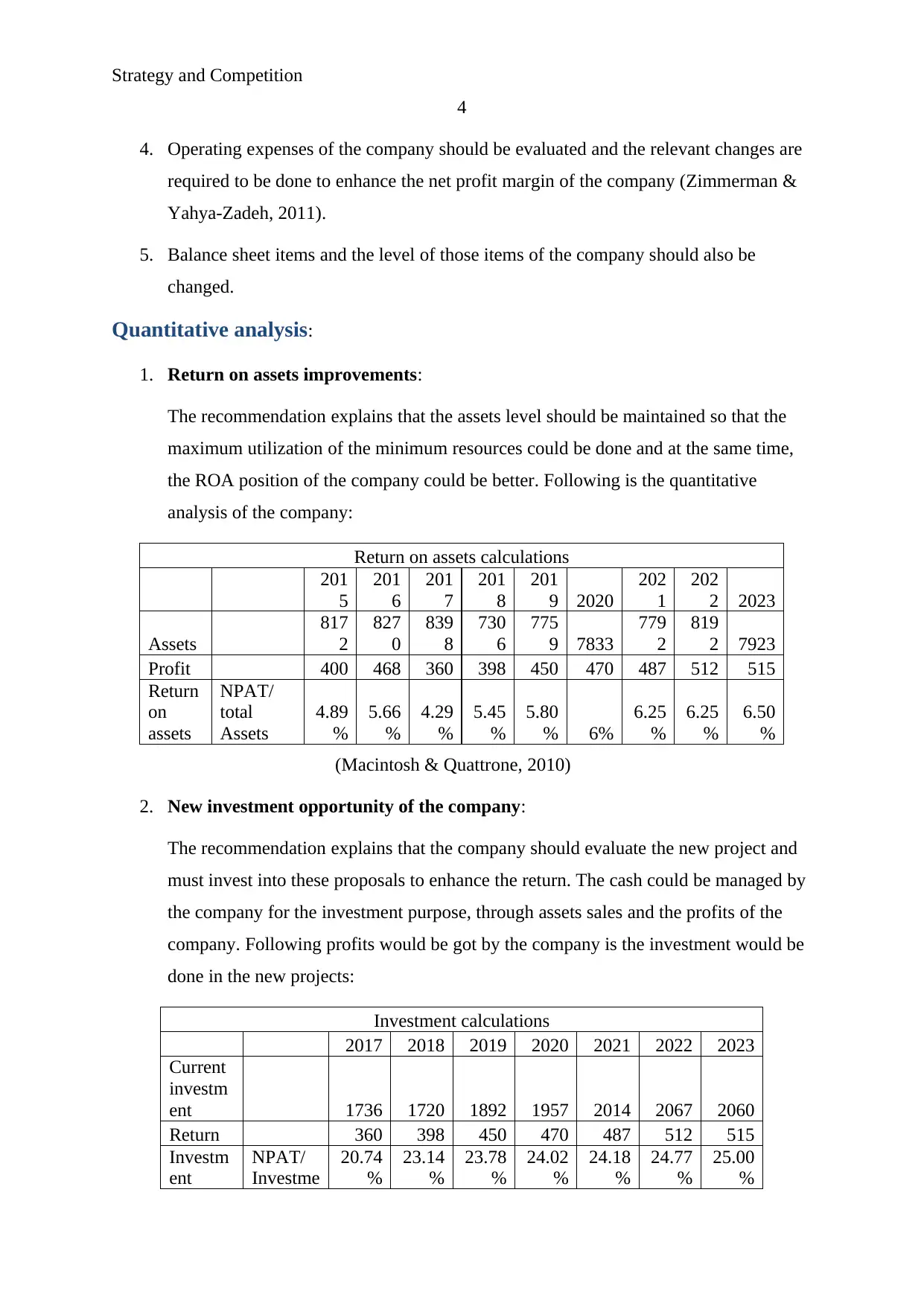
1. Return on assets improvements:
The recommendation explains that the assets level should be maintained so that the
maximum utilization of the minimum resources could be done and at the same time,
the ROA position of the company could be better. Following is the quantitative
analysis of the company:
Return on assets calculations
201
5
201
6
201
7
201
8
201
9 2020
202
1
202
2 2023
Assets
817
2
827
0
839
8
730
6
775
9 7833
779
2
819
2 7923
Profit 400 468 360 398 450 470 487 512 515
Return
on
assets
NPAT/
total
Assets
4.89
%
5.66
%
4.29
%
5.45
%
5.80
% 6%
6.25
%
6.25
%
6.50
%
(Macintosh & Quattrone, 2010)
2. New investment opportunity of the company:
The recommendation explains that the company should evaluate the new project and
must invest into these proposals to enhance the return. The cash could be managed by
the company for the investment purpose, through assets sales and the profits of the
company. Following profits would be got by the company is the investment would be
done in the new projects:
Investment calculations
2017 2018 2019 2020 2021 2022 2023
Current
investm
ent 1736 1720 1892 1957 2014 2067 2060
Return 360 398 450 470 487 512 515
Investm
ent
NPAT/
Investme
20.74
%
23.14
%
23.78
%
24.02
%
24.18
%
24.77
%
25.00
%
4
4. Operating expenses of the company should be evaluated and the relevant changes are
required to be done to enhance the net profit margin of the company (Zimmerman &
Yahya-Zadeh, 2011).
5. Balance sheet items and the level of those items of the company should also be
changed.
Quantitative analysis:
1. Return on assets improvements:
The recommendation explains that the assets level should be maintained so that the
maximum utilization of the minimum resources could be done and at the same time,
the ROA position of the company could be better. Following is the quantitative
analysis of the company:
Return on assets calculations
201
5
201
6
201
7
201
8
201
9 2020
202
1
202
2 2023
Assets
817
2
827
0
839
8
730
6
775
9 7833
779
2
819
2 7923
Profit 400 468 360 398 450 470 487 512 515
Return
on
assets
NPAT/
total
Assets
4.89
%
5.66
%
4.29
%
5.45
%
5.80
% 6%
6.25
%
6.25
%
6.50
%
(Macintosh & Quattrone, 2010)
2. New investment opportunity of the company:
The recommendation explains that the company should evaluate the new project and
must invest into these proposals to enhance the return. The cash could be managed by
the company for the investment purpose, through assets sales and the profits of the
company. Following profits would be got by the company is the investment would be
done in the new projects:
Investment calculations
2017 2018 2019 2020 2021 2022 2023
Current
investm
ent 1736 1720 1892 1957 2014 2067 2060
Return 360 398 450 470 487 512 515
Investm
ent
NPAT/
Investme
20.74
%
23.14
%
23.78
%
24.02
%
24.18
%
24.77
%
25.00
%
Paraphrase This Document
Need a fresh take? Get an instant paraphrase of this document with our AI Paraphraser
Strategy and Competition
5
return nt
(Higgins, 2012)
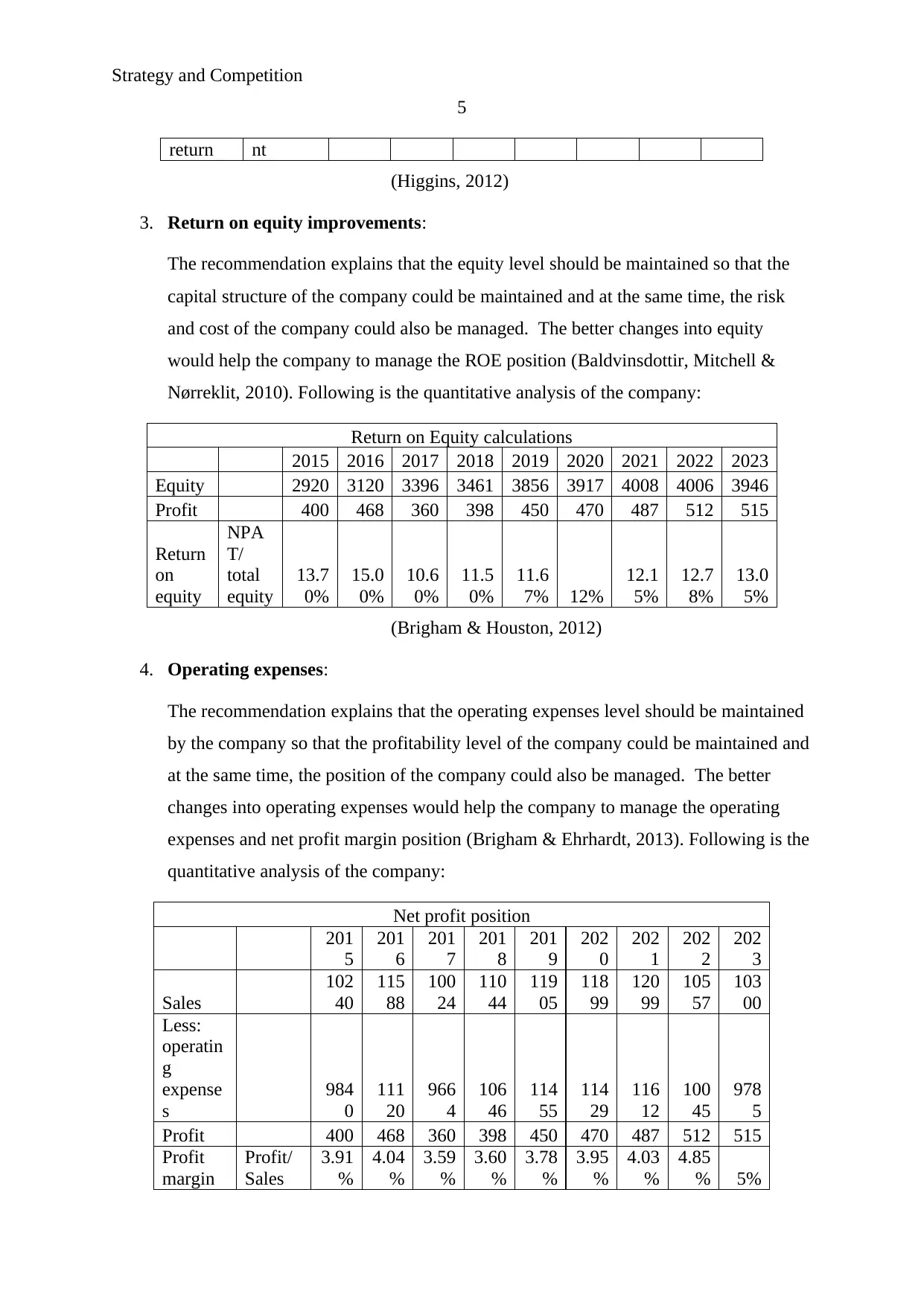
3. Return on equity improvements:
The recommendation explains that the equity level should be maintained so that the
capital structure of the company could be maintained and at the same time, the risk
and cost of the company could also be managed. The better changes into equity
would help the company to manage the ROE position (Baldvinsdottir, Mitchell &
Nørreklit, 2010). Following is the quantitative analysis of the company:
Return on Equity calculations
2015 2016 2017 2018 2019 2020 2021 2022 2023
Equity 2920 3120 3396 3461 3856 3917 4008 4006 3946
Profit 400 468 360 398 450 470 487 512 515
Return
on
equity
NPA
T/
total
equity
13.7
0%
15.0
0%
10.6
0%
11.5
0%
11.6
7% 12%
12.1
5%
12.7
8%
13.0
5%
(Brigham & Houston, 2012)
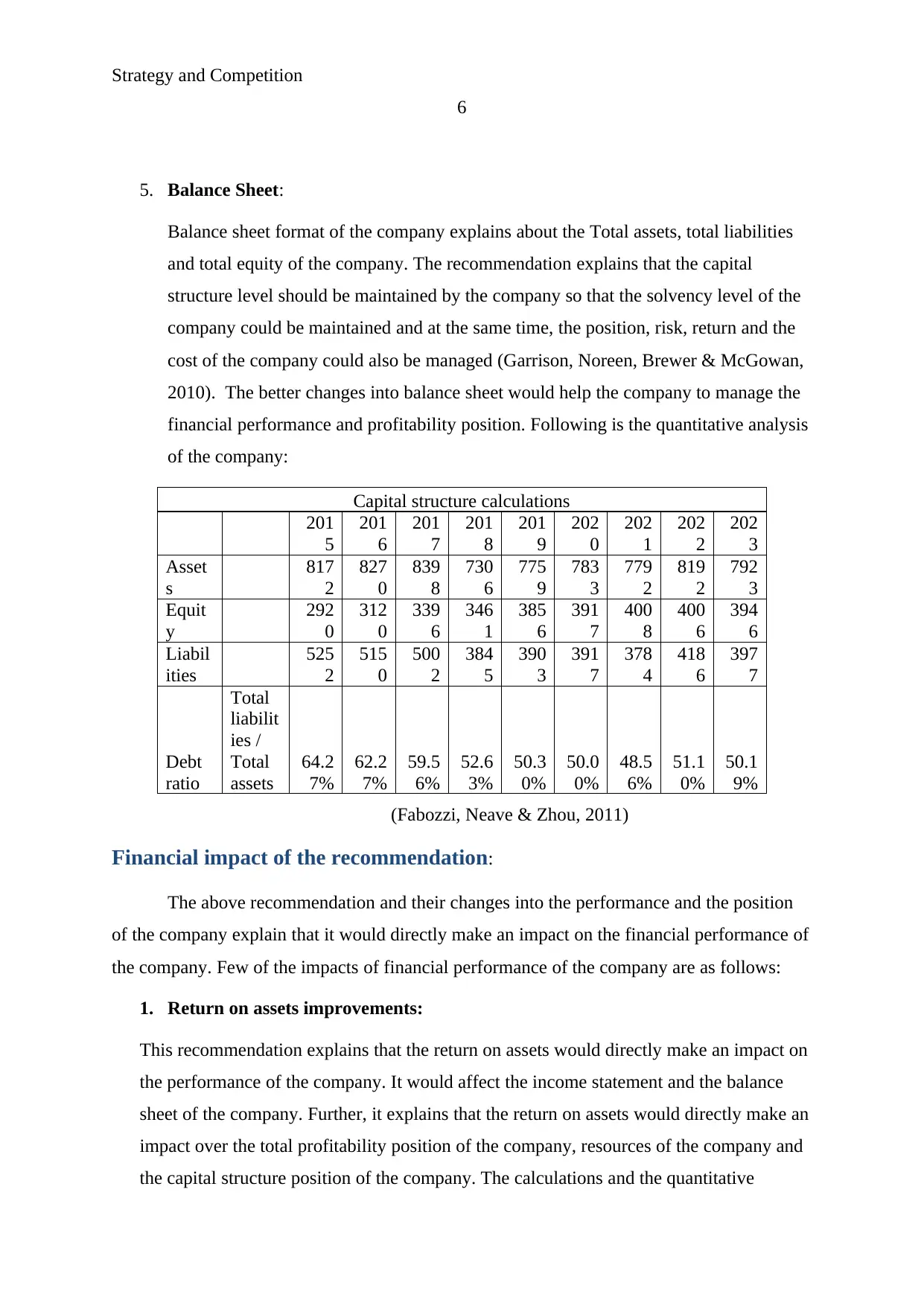
4. Operating expenses:
The recommendation explains that the operating expenses level should be maintained
by the company so that the profitability level of the company could be maintained and
at the same time, the position of the company could also be managed. The better
changes into operating expenses would help the company to manage the operating
expenses and net profit margin position (Brigham & Ehrhardt, 2013). Following is the
quantitative analysis of the company:
Net profit position
201
5
201
6
201
7
201
8
201
9
202
0
202
1
202
2
202
3
Sales
102
40
115
88
100
24
110
44
119
05
118
99
120
99
105
57
103
00
Less:
operatin
g
expense
s
984
0
111
20
966
4
106
46
114
55
114
29
116
12
100
45
978
5
Profit 400 468 360 398 450 470 487 512 515
Profit
margin
Profit/
Sales
3.91
%
4.04
%
3.59
%
3.60
%
3.78
%
3.95
%
4.03
%
4.85
% 5%
5
return nt
(Higgins, 2012)
3. Return on equity improvements:
The recommendation explains that the equity level should be maintained so that the
capital structure of the company could be maintained and at the same time, the risk
and cost of the company could also be managed. The better changes into equity
would help the company to manage the ROE position (Baldvinsdottir, Mitchell &
Nørreklit, 2010). Following is the quantitative analysis of the company:
Return on Equity calculations
2015 2016 2017 2018 2019 2020 2021 2022 2023
Equity 2920 3120 3396 3461 3856 3917 4008 4006 3946
Profit 400 468 360 398 450 470 487 512 515
Return
on
equity
NPA
T/
total
equity
13.7
0%
15.0
0%
10.6
0%
11.5
0%
11.6
7% 12%
12.1
5%
12.7
8%
13.0
5%
(Brigham & Houston, 2012)
4. Operating expenses:
The recommendation explains that the operating expenses level should be maintained
by the company so that the profitability level of the company could be maintained and
at the same time, the position of the company could also be managed. The better
changes into operating expenses would help the company to manage the operating
expenses and net profit margin position (Brigham & Ehrhardt, 2013). Following is the
quantitative analysis of the company:
Net profit position
201
5
201
6
201
7
201
8
201
9
202
0
202
1
202
2
202
3
Sales
102
40
115
88
100
24
110
44
119
05
118
99
120
99
105
57
103
00
Less:
operatin
g
expense
s
984
0
111
20
966
4
106
46
114
55
114
29
116
12
100
45
978
5
Profit 400 468 360 398 450 470 487 512 515
Profit
margin
Profit/
Sales
3.91
%
4.04
%
3.59
%
3.60
%
3.78
%
3.95
%
4.03
%
4.85
% 5%
Strategy and Competition
6
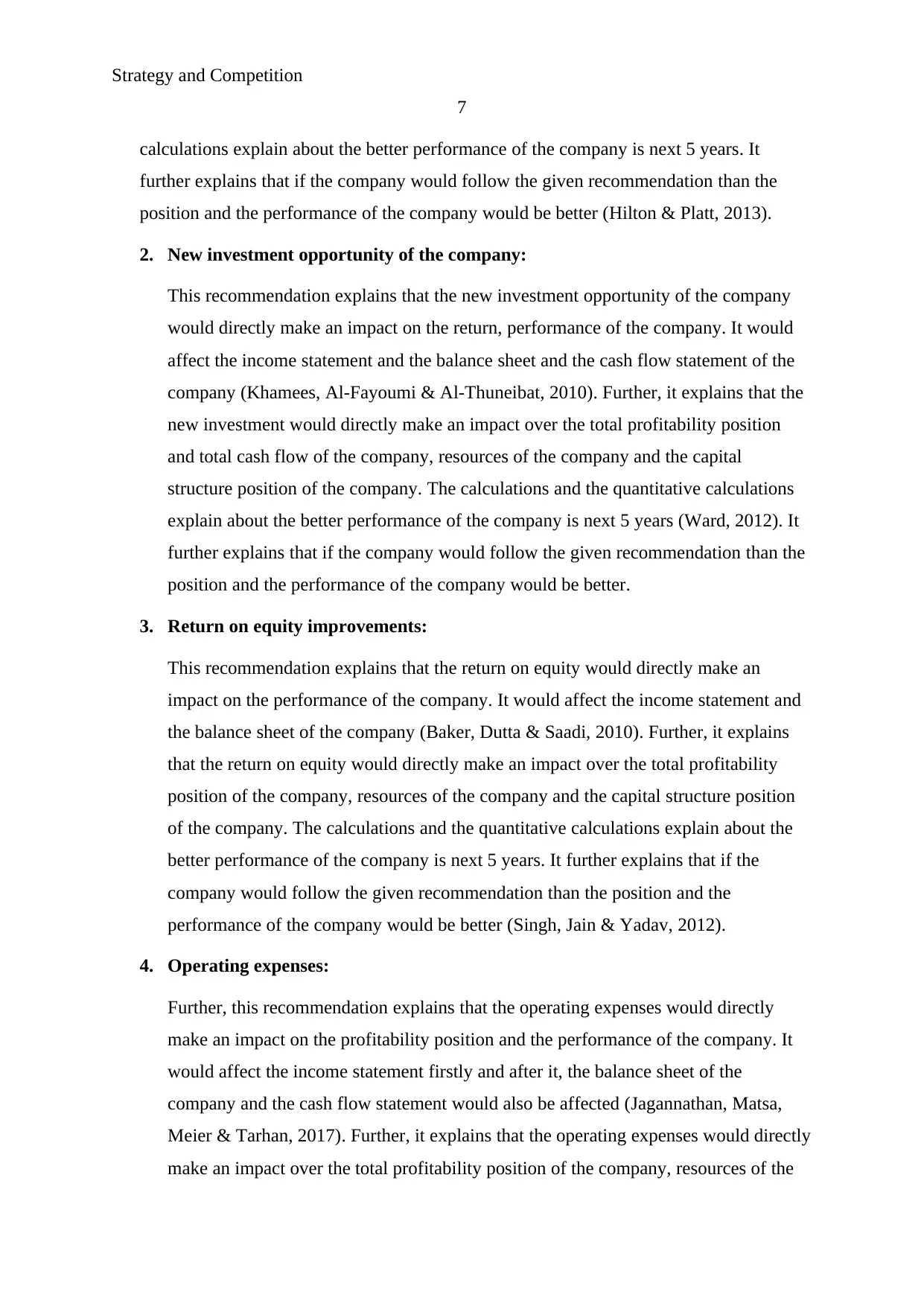
5. Balance Sheet:
Balance sheet format of the company explains about the Total assets, total liabilities
and total equity of the company. The recommendation explains that the capital
structure level should be maintained by the company so that the solvency level of the
company could be maintained and at the same time, the position, risk, return and the
cost of the company could also be managed (Garrison, Noreen, Brewer & McGowan,
2010). The better changes into balance sheet would help the company to manage the
financial performance and profitability position. Following is the quantitative analysis
of the company:
Capital structure calculations
201
5
201
6
201
7
201
8
201
9
202
0
202
1
202
2
202
3
Asset
s
817
2
827
0
839
8
730
6
775
9
783
3
779
2
819
2
792
3
Equit
y
292
0
312
0
339
6
346
1
385
6
391
7
400
8
400
6
394
6
Liabil
ities
525
2
515
0
500
2
384
5
390
3
391
7
378
4
418
6
397
7
Debt
ratio
Total
liabilit
ies /
Total
assets
64.2
7%
62.2
7%
59.5
6%
52.6
3%
50.3
0%
50.0
0%
48.5
6%
51.1
0%
50.1
9%
(Fabozzi, Neave & Zhou, 2011)
Financial impact of the recommendation:
The above recommendation and their changes into the performance and the position
of the company explain that it would directly make an impact on the financial performance of
the company. Few of the impacts of financial performance of the company are as follows:
1. Return on assets improvements:
This recommendation explains that the return on assets would directly make an impact on
the performance of the company. It would affect the income statement and the balance
sheet of the company. Further, it explains that the return on assets would directly make an
impact over the total profitability position of the company, resources of the company and
the capital structure position of the company. The calculations and the quantitative
6
5. Balance Sheet:
Balance sheet format of the company explains about the Total assets, total liabilities
and total equity of the company. The recommendation explains that the capital
structure level should be maintained by the company so that the solvency level of the
company could be maintained and at the same time, the position, risk, return and the
cost of the company could also be managed (Garrison, Noreen, Brewer & McGowan,
2010). The better changes into balance sheet would help the company to manage the
financial performance and profitability position. Following is the quantitative analysis
of the company:
Capital structure calculations
201
5
201
6
201
7
201
8
201
9
202
0
202
1
202
2
202
3
Asset
s
817
2
827
0
839
8
730
6
775
9
783
3
779
2
819
2
792
3
Equit
y
292
0
312
0
339
6
346
1
385
6
391
7
400
8
400
6
394
6
Liabil
ities
525
2
515
0
500
2
384
5
390
3
391
7
378
4
418
6
397
7
Debt
ratio
Total
liabilit
ies /
Total
assets
64.2
7%
62.2
7%
59.5
6%
52.6
3%
50.3
0%
50.0
0%
48.5
6%
51.1
0%
50.1
9%
(Fabozzi, Neave & Zhou, 2011)
Financial impact of the recommendation:
The above recommendation and their changes into the performance and the position
of the company explain that it would directly make an impact on the financial performance of
the company. Few of the impacts of financial performance of the company are as follows:
1. Return on assets improvements:
This recommendation explains that the return on assets would directly make an impact on
the performance of the company. It would affect the income statement and the balance
sheet of the company. Further, it explains that the return on assets would directly make an
impact over the total profitability position of the company, resources of the company and
the capital structure position of the company. The calculations and the quantitative
⊘ This is a preview!⊘
Do you want full access?
Subscribe today to unlock all pages.
Trusted by 1+ million students worldwide
Strategy and Competition
7
calculations explain about the better performance of the company is next 5 years. It
further explains that if the company would follow the given recommendation than the
position and the performance of the company would be better (Hilton & Platt, 2013).
2. New investment opportunity of the company:
This recommendation explains that the new investment opportunity of the company
would directly make an impact on the return, performance of the company. It would
affect the income statement and the balance sheet and the cash flow statement of the
company (Khamees, Al-Fayoumi & Al-Thuneibat, 2010). Further, it explains that the
new investment would directly make an impact over the total profitability position
and total cash flow of the company, resources of the company and the capital
structure position of the company. The calculations and the quantitative calculations
explain about the better performance of the company is next 5 years (Ward, 2012). It
further explains that if the company would follow the given recommendation than the
position and the performance of the company would be better.
3. Return on equity improvements:
This recommendation explains that the return on equity would directly make an
impact on the performance of the company. It would affect the income statement and
the balance sheet of the company (Baker, Dutta & Saadi, 2010). Further, it explains
that the return on equity would directly make an impact over the total profitability
position of the company, resources of the company and the capital structure position
of the company. The calculations and the quantitative calculations explain about the
better performance of the company is next 5 years. It further explains that if the
company would follow the given recommendation than the position and the
performance of the company would be better (Singh, Jain & Yadav, 2012).
4. Operating expenses:
Further, this recommendation explains that the operating expenses would directly
make an impact on the profitability position and the performance of the company. It
would affect the income statement firstly and after it, the balance sheet of the
company and the cash flow statement would also be affected (Jagannathan, Matsa,
Meier & Tarhan, 2017). Further, it explains that the operating expenses would directly
make an impact over the total profitability position of the company, resources of the
7
calculations explain about the better performance of the company is next 5 years. It
further explains that if the company would follow the given recommendation than the
position and the performance of the company would be better (Hilton & Platt, 2013).
2. New investment opportunity of the company:
This recommendation explains that the new investment opportunity of the company
would directly make an impact on the return, performance of the company. It would
affect the income statement and the balance sheet and the cash flow statement of the
company (Khamees, Al-Fayoumi & Al-Thuneibat, 2010). Further, it explains that the
new investment would directly make an impact over the total profitability position
and total cash flow of the company, resources of the company and the capital
structure position of the company. The calculations and the quantitative calculations
explain about the better performance of the company is next 5 years (Ward, 2012). It
further explains that if the company would follow the given recommendation than the
position and the performance of the company would be better.
3. Return on equity improvements:
This recommendation explains that the return on equity would directly make an
impact on the performance of the company. It would affect the income statement and
the balance sheet of the company (Baker, Dutta & Saadi, 2010). Further, it explains
that the return on equity would directly make an impact over the total profitability
position of the company, resources of the company and the capital structure position
of the company. The calculations and the quantitative calculations explain about the
better performance of the company is next 5 years. It further explains that if the
company would follow the given recommendation than the position and the
performance of the company would be better (Singh, Jain & Yadav, 2012).
4. Operating expenses:
Further, this recommendation explains that the operating expenses would directly
make an impact on the profitability position and the performance of the company. It
would affect the income statement firstly and after it, the balance sheet of the
company and the cash flow statement would also be affected (Jagannathan, Matsa,
Meier & Tarhan, 2017). Further, it explains that the operating expenses would directly
make an impact over the total profitability position of the company, resources of the
Paraphrase This Document
Need a fresh take? Get an instant paraphrase of this document with our AI Paraphraser
Strategy and Competition
8
company and the profitability position of the company (Lukka & Modell, 2010). The
calculations and the quantitative calculations explain about the better performance of
the company is next 5 years. It further explains that if the company would follow the
given recommendation than the position and the performance of the company would
be better.
5. Balance Sheet
Lastly, the recommendation about the balance sheet of the company explains that the
total assets, total liabilities and total equity would directly make an impact on the
performance and the financial position of the company (Hornstein & Zhao, 2011). It
would affect the balance sheet of the company and due to it; the income statement and
cash flow statement of the company would also be affected. Further, it explains that
the balance sheet would directly make an impact over the total debt position, capital
structure position of the company, resources of the company etc of the company. The
calculations and the quantitative calculations explain about the better performance of
the company is next 5 years (Parker, 2012). It further explains that if the company
would follow the given recommendation than the position and the performance of the
company would be better.
Cash flow analysis and Net present value techniques:
Further, the study has been done on the four divisions of the company which are
financial services outlook, energy and packaging and forecast products. The study has been
conducted on all the four segments to evaluate the cash flow analysis of all the projects and it
has been evaluated that the cash flow of all the four projects is different to each other. The
evaluation on the financial service outlook has been done firstly and it has been found that the
cash outflow and the cash inflow of the project would be different in each year and it would
explains the company about the total profit of the company which could be earn by the
company in current financial year (Renz & Herman, 2016). Further, it explains about the total
performance and the total position of the company. The net profit valuation of the company
explains about the total profit of $ 62,40,87,014.85 in 8 years.
Further, the calculations of energy sector has been evaluated and it has been found
that the cash outflow and the cash inflow of the project would be different in each year and
the returns of the project also varies in each year. Further, it would explain the company
8
company and the profitability position of the company (Lukka & Modell, 2010). The
calculations and the quantitative calculations explain about the better performance of
the company is next 5 years. It further explains that if the company would follow the
given recommendation than the position and the performance of the company would
be better.
5. Balance Sheet
Lastly, the recommendation about the balance sheet of the company explains that the
total assets, total liabilities and total equity would directly make an impact on the
performance and the financial position of the company (Hornstein & Zhao, 2011). It
would affect the balance sheet of the company and due to it; the income statement and
cash flow statement of the company would also be affected. Further, it explains that
the balance sheet would directly make an impact over the total debt position, capital
structure position of the company, resources of the company etc of the company. The
calculations and the quantitative calculations explain about the better performance of
the company is next 5 years (Parker, 2012). It further explains that if the company
would follow the given recommendation than the position and the performance of the
company would be better.
Cash flow analysis and Net present value techniques:
Further, the study has been done on the four divisions of the company which are
financial services outlook, energy and packaging and forecast products. The study has been
conducted on all the four segments to evaluate the cash flow analysis of all the projects and it
has been evaluated that the cash flow of all the four projects is different to each other. The
evaluation on the financial service outlook has been done firstly and it has been found that the
cash outflow and the cash inflow of the project would be different in each year and it would
explains the company about the total profit of the company which could be earn by the
company in current financial year (Renz & Herman, 2016). Further, it explains about the total
performance and the total position of the company. The net profit valuation of the company
explains about the total profit of $ 62,40,87,014.85 in 8 years.
Further, the calculations of energy sector has been evaluated and it has been found
that the cash outflow and the cash inflow of the project would be different in each year and
the returns of the project also varies in each year. Further, it would explain the company
Strategy and Competition
9
about the total profit of the company which could be earn by the company after 12 years.
Further, it explains that this project is not more profitable for the company. The net profit
valuation of the company explains about the loss would be faced by the company in this case
(Bierman & Smidt, 2012).
In addition, the calculations of packaging sector has been evaluated and it has been
found that the cash outflow and the cash inflow of the project would totally be dependable on
the total sales and the operations of the company. Further, it would explain the company
about the total profit of the company which could be earn by the company after 10 years.
Further, it explains that this project average profitable for the company. The net profit
valuation of the company explains about the moderate position of the investment and
explains about the average performance of the company (Bennouna, Meredith & Marchant,
2010).
In addition, the calculations of forest product outlook sector has been evaluated and it
has been found that the cash outflow and the cash inflow of the project would totally be
dependable on the total products and their position in the market. Further, it would explain
the company about the total profit of the company which could be earn by the company after
10 years (Gervais, Heaton & Odean, 2011). Further, it explains that this project is quite
profitable for the company. The net profit valuation of the company explains about the good
position of the investment and explains about the better performance of the company in the
market. More, it depicts that the company would offer huge return to the company.
Recommendation and conclusion:
The above study explains about the financial position and the performance of the
company. This report has explained about the performance and the position of the company,
The Nebraska Container Company, on the basis of financial and marketing factor of the
company. The study explains that the company has an uneven history and thus few
recommendations have been given to the company to manage the financial performance and
the stock performance in the market. According to this report, strategic plans of the company
for next 5 years explain that the company would enjoy the betterment. Further, it also
explains that the recommendation would impact on the financial performance and the
position of the company.
9
about the total profit of the company which could be earn by the company after 12 years.
Further, it explains that this project is not more profitable for the company. The net profit
valuation of the company explains about the loss would be faced by the company in this case
(Bierman & Smidt, 2012).
In addition, the calculations of packaging sector has been evaluated and it has been
found that the cash outflow and the cash inflow of the project would totally be dependable on
the total sales and the operations of the company. Further, it would explain the company
about the total profit of the company which could be earn by the company after 10 years.
Further, it explains that this project average profitable for the company. The net profit
valuation of the company explains about the moderate position of the investment and
explains about the average performance of the company (Bennouna, Meredith & Marchant,
2010).
In addition, the calculations of forest product outlook sector has been evaluated and it
has been found that the cash outflow and the cash inflow of the project would totally be
dependable on the total products and their position in the market. Further, it would explain
the company about the total profit of the company which could be earn by the company after
10 years (Gervais, Heaton & Odean, 2011). Further, it explains that this project is quite
profitable for the company. The net profit valuation of the company explains about the good
position of the investment and explains about the better performance of the company in the
market. More, it depicts that the company would offer huge return to the company.
Recommendation and conclusion:
The above study explains about the financial position and the performance of the
company. This report has explained about the performance and the position of the company,
The Nebraska Container Company, on the basis of financial and marketing factor of the
company. The study explains that the company has an uneven history and thus few
recommendations have been given to the company to manage the financial performance and
the stock performance in the market. According to this report, strategic plans of the company
for next 5 years explain that the company would enjoy the betterment. Further, it also
explains that the recommendation would impact on the financial performance and the
position of the company.
⊘ This is a preview!⊘
Do you want full access?
Subscribe today to unlock all pages.
Trusted by 1+ million students worldwide
Strategy and Competition
10
The case explains that the financial performance and the position of the company
would be better if all the given recommendations would be followed by the company. Further
it explains that if the company would follow the given recommendation than the position and
the performance of the company would be better.
10
The case explains that the financial performance and the position of the company
would be better if all the given recommendations would be followed by the company. Further
it explains that if the company would follow the given recommendation than the position and
the performance of the company would be better.
Paraphrase This Document
Need a fresh take? Get an instant paraphrase of this document with our AI Paraphraser
Strategy and Competition
11
References:
Baker, H. K., Dutta, S., & Saadi, S. (2010). Management views on real options in capital
budgeting.
Baldvinsdottir, G., Mitchell, F., & Nørreklit, H. (2010). Issues in the relationship between
theory and practice in management accounting. Management Accounting
Research, 21(2), 79-82.
Bennouna, K., Meredith, G. G., & Marchant, T. (2010). Improved capital budgeting decision
making: evidence from Canada. Management decision, 48(2), 225-247.
Bierman Jr, H., & Smidt, S. (2012). The capital budgeting decision: economic analysis of
investment projects. Routledge.
Brigham, E. F., & Ehrhardt, M. C. (2013). Financial management: Theory & practice.
Cengage Learning.
Brigham, E. F., & Houston, J. F. (2012). Fundamentals of financial management. Cengage
Learning.
Fabozzi, F. J., Neave, E. H., & Zhou, G. (2011). Financial economics. Wiley Global
Education.
Garrison, R. H., Noreen, E. W., Brewer, P. C., & McGowan, A. (2010). Managerial
accounting. Issues in Accounting Education, 25(4), 792-793.
Gervais, S., Heaton, J. B., & Odean, T. (2011). Overconfidence, compensation contracts, and
capital budgeting. The Journal of Finance, 66(5), 1735-1777.
Higgins, R. C. (2012). Analysis for financial management. McGraw-Hill/Irwin.
Hilton, R. W., & Platt, D. E. (2013). Managerial accounting: creating value in a dynamic
business environment. McGraw-Hill Education.
Hornstein, A. S., & Zhao, M. (2011). Corporate capital budgeting decisions and information
sharing. Journal of Economics & Management Strategy, 20(4), 1135-1170.
Jagannathan, R., Matsa, D. A., Meier, I., & Tarhan, V. (2017). Search in. CFA Digest, 47(4).
11
References:
Baker, H. K., Dutta, S., & Saadi, S. (2010). Management views on real options in capital
budgeting.
Baldvinsdottir, G., Mitchell, F., & Nørreklit, H. (2010). Issues in the relationship between
theory and practice in management accounting. Management Accounting
Research, 21(2), 79-82.
Bennouna, K., Meredith, G. G., & Marchant, T. (2010). Improved capital budgeting decision
making: evidence from Canada. Management decision, 48(2), 225-247.
Bierman Jr, H., & Smidt, S. (2012). The capital budgeting decision: economic analysis of
investment projects. Routledge.
Brigham, E. F., & Ehrhardt, M. C. (2013). Financial management: Theory & practice.
Cengage Learning.
Brigham, E. F., & Houston, J. F. (2012). Fundamentals of financial management. Cengage
Learning.
Fabozzi, F. J., Neave, E. H., & Zhou, G. (2011). Financial economics. Wiley Global
Education.
Garrison, R. H., Noreen, E. W., Brewer, P. C., & McGowan, A. (2010). Managerial
accounting. Issues in Accounting Education, 25(4), 792-793.
Gervais, S., Heaton, J. B., & Odean, T. (2011). Overconfidence, compensation contracts, and
capital budgeting. The Journal of Finance, 66(5), 1735-1777.
Higgins, R. C. (2012). Analysis for financial management. McGraw-Hill/Irwin.
Hilton, R. W., & Platt, D. E. (2013). Managerial accounting: creating value in a dynamic
business environment. McGraw-Hill Education.
Hornstein, A. S., & Zhao, M. (2011). Corporate capital budgeting decisions and information
sharing. Journal of Economics & Management Strategy, 20(4), 1135-1170.
Jagannathan, R., Matsa, D. A., Meier, I., & Tarhan, V. (2017). Search in. CFA Digest, 47(4).
Strategy and Competition
12
Khamees, B. A., Al-Fayoumi, N., & Al-Thuneibat, A. A. (2010). Capital budgeting practices
in the Jordanian industrial corporations. International journal of commerce and
management, 20(1), 49-63.
Lukka, K., & Modell, S. (2010). Validation in interpretive management accounting
research. Accounting, organizations and society, 35(4), 462-477.
Macintosh, N. B., & Quattrone, P. (2010). Management accounting and control systems: An
organizational and sociological approach. John Wiley & Sons.
Parker, L. D. (2012). Qualitative management accounting research: Assessing deliverables
and relevance. Critical perspectives on accounting, 23(1), 54-70.
Renz, D. O., & Herman, R. D. (Eds.). (2016). The Jossey-Bass handbook of nonprofit
leadership and management. John Wiley & Sons.
Schaltegger, S., & Burritt, R. (2017). Contemporary environmental accounting: issues,
concepts and practice. Routledge.
Singh, S., Jain, P. K., & Yadav, S. S. (2012). Capital budgeting decisions: evidence from
India. Journal of Advances in Management Research, 9(1), 96-112.
Ward, K. (2012). Strategic management accounting. Routledge.
Zimmerman, J. L., & Yahya-Zadeh, M. (2011). Accounting for decision making and
control. Issues in Accounting Education, 26(1), 258-259.
12
Khamees, B. A., Al-Fayoumi, N., & Al-Thuneibat, A. A. (2010). Capital budgeting practices
in the Jordanian industrial corporations. International journal of commerce and
management, 20(1), 49-63.
Lukka, K., & Modell, S. (2010). Validation in interpretive management accounting
research. Accounting, organizations and society, 35(4), 462-477.
Macintosh, N. B., & Quattrone, P. (2010). Management accounting and control systems: An
organizational and sociological approach. John Wiley & Sons.
Parker, L. D. (2012). Qualitative management accounting research: Assessing deliverables
and relevance. Critical perspectives on accounting, 23(1), 54-70.
Renz, D. O., & Herman, R. D. (Eds.). (2016). The Jossey-Bass handbook of nonprofit
leadership and management. John Wiley & Sons.
Schaltegger, S., & Burritt, R. (2017). Contemporary environmental accounting: issues,
concepts and practice. Routledge.
Singh, S., Jain, P. K., & Yadav, S. S. (2012). Capital budgeting decisions: evidence from
India. Journal of Advances in Management Research, 9(1), 96-112.
Ward, K. (2012). Strategic management accounting. Routledge.
Zimmerman, J. L., & Yahya-Zadeh, M. (2011). Accounting for decision making and
control. Issues in Accounting Education, 26(1), 258-259.
⊘ This is a preview!⊘
Do you want full access?
Subscribe today to unlock all pages.
Trusted by 1+ million students worldwide

1 out of 15


Related Documents


Your All-in-One AI-Powered Toolkit for Academic Success.
+13062052269
info@desklib.com
Available 24*7 on WhatsApp / Email
![[object Object]](/_next/static/media/star-bottom.7253800d.svg)
Unlock your academic potential
Copyright © 2020–2026 A2Z Services. All Rights Reserved. Developed and managed by ZUCOL.